REVIEW 4 major objections 4 minor 86 references
A stacked analysis of IceCube neutrinos from four active galactic nuclei places the strongest limits to date on dark-matter–neutrino scattering, down to about 10⁻³⁹ cm².
Reviewed by Pith at T0; open to challenge. T0 means a machine referee read the full paper against a public rubric. the ladder, T0–T4 →
T0 review · deepseek-v4-flash
2026-08-03 04:00 UTC pith:LIBYDC6G
load-bearing objection A solid, clearly-written stacking analysis that delivers genuinely new limits on DM-neutrino scattering, but the headline numbers depend on an optimistic spike profile and the paper should be asked to fold the systematic uncertainty into the quoted bounds. the 4 major comments →
Searching for dark matter signals with high energy astrophysical neutrinos in IceCube
The pith
A machine-rendered reading of the paper's core claim, the machinery that carries it, and where it could break.
Core claim
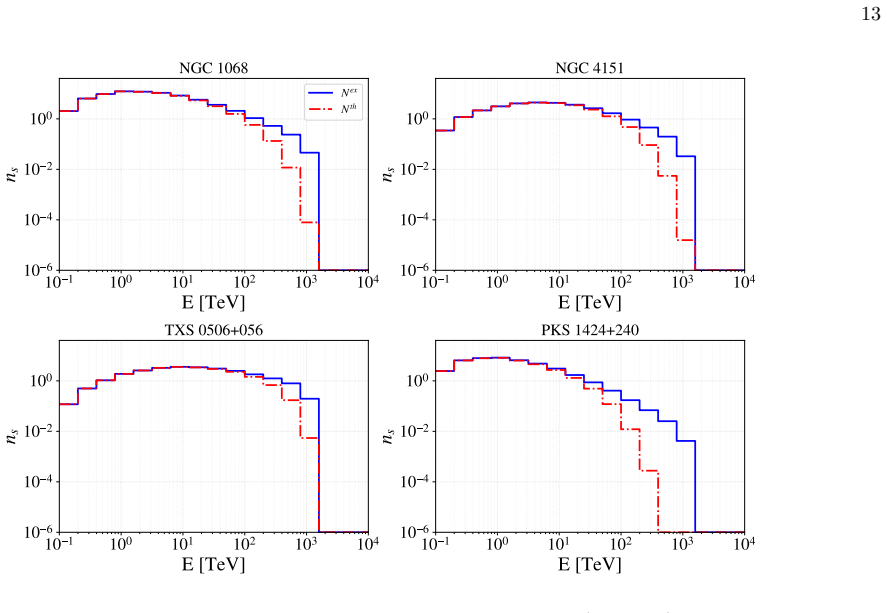
The central claim is that high-energy astrophysical neutrinos passing through dark-matter spikes around supermassive black holes can be measurably attenuated by dark-matter–neutrino scattering, and that IceCube's observed AGN neutrino fluxes already set the most stringent direct bounds on that scattering cross-section. Using a full Poisson likelihood treatment rather than simple event-count lower limits, the authors stack four sources and find σ₀ ≲ 8×10⁻³⁹ cm² for energy-independent scattering and σ₀ ≲ 10⁻³⁹ cm² for linearly energy-dependent scattering, both at 90% CL and for a spike profile with slope α = 7/3 and no dark-matter annihilation (their BM1 benchmark). The bounds are dominated by
What carries the argument
The DM column density Σχ(r) = ∫ρ_χ dr′ along the neutrino line of sight, with ρ_χ given by the Gondolo–Silk adiabatic spike profile (including gravitational-scattering and annihilation variants), is the quantity that sets the attenuation probability. The neutrino flux evolution is governed by a cascade equation that includes both attenuation and energy redistribution; for energy-dependent scattering the equation is discretized and solved numerically. A Poisson likelihood χ² per source, combined by simple addition across the four sources, turns the observed event numbers and spectral indices into a 90% CL upper limit on σ₀. The benchmark profiles BM1–BM3 and BM1′–BM3′ scan the uncertainty in
Load-bearing premise
The limits assume that neutrinos from each AGN pass through an intact, steep dark-matter spike (slope α = 7/3) that extends down to a neutrino emission radius R_em chosen by hand from a few to a few thousand Schwarzschild radii, with no gravitational scattering or annihilation flattening the spike.
What would settle it
Measure the actual neutrino emission radius in NGC 1068 or the blazars (e.g., by correlating IceCube events with high-resolution radio or gamma-ray maps) or obtain independent evidence that the dark-matter spike is suppressed through gravitational scattering or annihilation; if R_em is larger than about 0.1 pc for the blazars, or the spike density is reduced, the column density drops and the claimed σ₀ bounds loosen by up to about three orders of magnitude.
If this is right
- If the limits are correct, any dark-matter model that gives a constant dark-matter–neutrino scattering cross-section above about 10⁻³⁸ cm² (for ~keV masses) is ruled out by high-energy astrophysical neutrinos, complementing cosmological bounds from the cosmic microwave background and Lyman-α forest.
- The linearly energy-dependent bound of ~10⁻³⁹ cm² directly constrains models where a light Z′ mediator couples dark matter to mu/tau neutrinos, such as U(1)Lμ−Lτ, and in the complex-scalar case nearly the entire thermal-relic region shown is excluded.
- Stacking multiple sources substantially improves sensitivity over single-source analyses; the method can be extended to additional IceCube point sources as they are discovered, tightening the limits further.
- The energy-dependent analysis shows that sources with harder spectra and higher-energy events (like TXS 0506+056) become the strongest probes once the cross-section grows with energy, which will matter for future neutrino telescopes.
- The constraints are strongest for adiabatic spikes without annihilation or gravitational scattering; for spikes flattened by those processes, the bounds weaken, so the paper effectively identifies which astrophysical conditions would be needed to discover or exclude such interactions.
Where Pith is reading between the lines
- A direct measurement of the neutrino emission radius in any of the four AGN—for example through multi-wavelength correlations or future high-resolution imaging—would either confirm or dissolve the headline limits, since the column density and hence the σ₀ bound scale inversely with emission radius.
- The same stacked analysis could be applied to sub-threshold source candidates in IceCube archival data, or to future sources with better-known geometry, potentially extending these bounds to lower cross-sections without new detector hardware.
- If dark-matter annihilation is active, the spike is self-regulated and the neutrino attenuation signal saturates; this suggests that the absence of a signal in BM2/BM3 profiles may be more robust than the BM1 limit, which rides on an unverified steep spike.
- The strong dependence on the spike profile means that these constraints are also a test of black-hole–dark-matter interactions: an independent probe of the dark-matter distribution near AGN (e.g., gravitational lensing or gamma-ray signals) could disambiguate whether the limit is a statement about particle physics or about astrophysics.
Editorial analysis
A structured set of objections, weighed in public.
Referee Report
Summary. This paper combines IceCube event-count information for four AGN neutrino sources (TXS 0506+056, NGC 1068, PKS 1424+240, NGC 4151) with model DM density spikes around SMBHs to constrain the DM-neutrino scattering cross-section. For each source the authors compute the DM column density from spike profiles (adiabatic BM1/BM2/BM3 and relaxed BM1'/BM2'/BM3'), solve an attenuation cascade equation for a constant and a linearly energy-dependent cross-section, and derive 90% CL limits by a Poisson likelihood. A stacked analysis gives σ0 ≲ 8×10^-39 cm² (constant) and σ0 ≲ 10^-39 cm² (linear), quoted for 1 keV DM under the BM1 profile. The limits are then interpreted in a U(1)_{Lμ-Lτ} model with pseudo-Dirac or complex scalar DM.
Significance. The statistical framework is standard, the benchmark models are clearly tabulated, and the comparison with previous single-source analyses (Cline et al.) provides a useful check. If the BM1 spike and adopted emission radii are accepted, the stacked limits are plausibly the strongest high-energy neutrino constraints in this scenario and the model-interpretation plots are of interest. The paper is therefore potentially significant. The main caveat is that the headline bounds are conditional on astrophysical assumptions—particularly R_em—that the paper itself shows can change Σχ by up to ~3 orders of magnitude, and this dependence is not propagated into the reported 90% bands.
major comments (4)
- [Sec. III B and Fig. 1] The systematics from R_em are not propagated. Fig. 1 shows that within the shaded allowed ranges for R_em, the BM1 column density varies by about an order of magnitude for NGC 1068/NGC 4151 and by up to three orders for TXS/PKS, and the text states that the σ0 bound relaxes by the same factor. Yet the 90% limits in Figs. 2–3 and the abstract include only the Poisson statistical uncertainty. Since the chosen R_em values lie at the lower end of the allowed blazar range, the headline constraints are optimized rather than representative. Please marginalize over R_em (or show limits as a function of R_em) and adjust the 'most stringent' claim accordingly.
- [Eq. (14), Sec. IV] The statement that for a constant cross-section 'the second term is zero' is not generally correct for elastic ν–χ scattering; the differential cross-section redistributes neutrinos to lower energies, and the incoming-energy integral is nonzero. The same discretized treatment used for the energy-dependent case should be applied, or a no-energy-loss/full-absorption approximation should be explicitly justified. This affects the exponential survival factor and Eq. (19), and hence the constant-cross-section limits.
- [Eq. (31), Sec. VI B] The limiting conditions 'Eν ≫ mZ'/mχ' and 'Eν ≪ mZ'/mχ' are dimensionally inconsistent; the threshold should involve mZ'^2/mχ (an energy). For the mχ = 1 keV benchmark with mZ' = 3 mχ, the threshold is O(keV), far below the IceCube energy range, so the actual model cross-section is in the constant regime, not the linearly energy-dependent regime used in the model-interpretation section. Please verify which limiting form applies to each mass range and re-map the constraints in Figs. 4–5 accordingly.
- [Sec. III A, Eqs. (9)–(11)] The normalization derivation is unclear as written. Eq. (10) equates 'M' to M_BH/(4π)[fα(rh)-fα(ri)], which does not by itself determine ρ_N; the relations M ≈ ρ_N r_h^{3/2} and M ≈ ρ_N R_sp^{7/3} are then introduced without resolving the definitions. In the same paragraph, the claim that 'for all sources examined here, the value of R_em exceeds this limit' (20 pc) is contradicted by Table II: R_em = 30 R_s for NGC 1068 is ~3×10^-5 pc. Please rewrite the normalization and correct this statement, since the column densities—and all limits—depend on ρ_N.
minor comments (4)
- [Sec. III A / Table II] The text says the same R_em is used for both blazars, while Table II lists 2.2×10^3 R_s and 6.7×10^2 R_s. These correspond to the same physical radius (~0.065 pc) for the different black-hole masses; please state this explicitly to avoid the apparent contradiction.
- [Eq. (15)] The discretized redistribution kernel (the sum over j≥i with equal weight per log-bin) should be defined; as written it is not derived from the differential cross-section in Eq. (14). A sentence explaining the binning and the assumed final-energy distribution would help.
- [Fig. 1] The shaded regions are not labeled in the panels; a legend or caption note identifying BM1/BM1′ and the R_em ranges would improve readability.
- [Abstract / Table II] The abstract and conclusion quote the 1 keV limits, while Table II lists Σχ for mχ = 1 GeV; clarify the mass scaling so readers can reproduce the 1 keV numbers.
Circularity Check
No circular derivation: quoted limits are set by IceCube event counts via a standard likelihood, with the DM density profile as an explicit conditional input; only minor non-load-bearing self-citations are present.
full rationale
The central constraints are not circular. Table I gives ns and Γ as observed inputs from IceCube public data (following [23]); these are not outputs of the DM model. The χ² in Eq. (17) compares theoretical counts N_th, which depend on σ0 through the attenuation equations (14)-(16), against these fixed observed counts. The 90% limits follow from a likelihood minimization, and no parameter determining the prediction is fitted from the target quantity. The inverse dependence on the column density Σχ is explicitly stated (Eq. (19) and Sec. III B: 'a decrease in Σχ will relax the bound on σ0 by the same order of magnitude'), so the headline limits are conditional on the assumed BM1 spike profile and the chosen R_em; this is a robustness/uncertainty concern, not circularity. The paper also anchors itself externally by comparing with the independent Cline et al. results [6,7] and finding agreement. The self-citations to [23] (event-count inputs) and [69] (freeze-out formalism in the model-interpretation section) are prior published inputs or standard reference methodology; they are not invoked to forbid alternatives or to define the predicted quantity in terms of itself. Therefore no specific circular reduction can be exhibited, and the score is 1 due only to minor, non-load-bearing author-overlapping citations.
Axiom & Free-Parameter Ledger
free parameters (7)
- R_em (neutrino emission radius, per source) =
NGC 1068: 30 R_s; NGC 4151: 30 R_s; TXS 0506+056: 2.2e3 R_s; PKS 1424+240: 6.7e2 R_s
- alpha (DM spike spectral index) =
7/3 (BM1-BM3) or 3/2 (BM1'-BM3')
- <sigma_av> (DM annihilation cross-section) =
0, 1e-28, 3e-26 cm^3/s
- t_BH (SMBH age) =
1e9 yr
- r_h (influence radius) for TXS/PKS =
1e5 R_s
- E0 (reference energy) =
10 TeV
- Model benchmarks: m_Z'/m_chi = 3, g_chi = 1 =
m_Z' = 3 m_chi; g_chi = 1
axioms (7)
- domain assumption NFW dark matter halo profile and concentration-mass relation (Eqs. 2-3)
- domain assumption Adiabatic DM spike formation around SMBHs (Eqs. 4 and 8)
- domain assumption M_BH - M_DM relation (Eq. 12)
- domain assumption Unbroken power-law neutrino flux with best-fit n_s and Gamma from [23] (Eq. 1)
- standard math Cascade equation for neutrino attenuation and redistribution (Eqs. 14-15)
- standard math Poisson likelihood chi-square statistic (Eq. 17)
- domain assumption U(1)_{Lmu-Ltau} model and thermal freeze-out relic density formulas (Eqs. 20-28)
invented entities (2)
-
Z' gauge boson of U(1)_{Lmu-Ltau}
independent evidence
-
Dark matter candidate chi (pseudo-Dirac fermion or complex scalar) charged under U(1)_{Lmu-Ltau}
independent evidence
read the original abstract
High-energy neutrinos provide a potentially powerful and distinctive probe for dark matter (DM) - neutrino interactions, particularly in environments with enhanced DM densities, such as the DM spikes predicted to form around supermassive black holes (SMBHs) at the center of active galactic nuclei (AGN). Recent results by the IceCube Neutrino Observatory, which reported four significant AGNs, namely TXS 0506+056, NGC 1068, PKS 1424+240, and NGC 4151 as candidate neutrino sources, provide a valuable opportunity to search for signatures of these interactions. In this study, we use IceCube data to derive the most stringent constraints to date on both the energy-dependent and energy-independent DM-neutrino scattering cross-sections. We perform a statistical analysis using data from individual sources as well as a combined (stacked) analysis of all four sources. Our strongest limits arise from the stacking analysis, yielding an upper bound of $\sigma_{0} \lesssim 8\times 10^{-39}$ cm$^2$ for an energy-independent cross-section and $\sigma_{0} \lesssim 10^{-39}$ cm$^2$ for a linearly energy-dependent cross-section, both at 90$\%$ confidence level, particularly in scenarios involving the adiabatic growth of black holes.
Figures


Reference graph
Works this paper leans on
-
[1]
History of dark matter.Rev
Gianfranco Bertone and Dan Hooper. History of dark matter.Rev. Mod. Phys., 90(4):045002, 2018
2018
-
[2]
Dark matter.arXiv preprint arXiv:2406.01705, 2024
Marco Cirelli, Alessandro Strumia, and Jure Zupan. Dark matter.arXiv preprint arXiv:2406.01705, 2024
Pith/arXiv arXiv 2024
-
[3]
Arg¨ uelles, Ali Kheirandish, and Aaron C
Carlos A. Arg¨ uelles, Ali Kheirandish, and Aaron C. Vin- cent. Imaging Galactic Dark Matter with High-Energy Cosmic Neutrinos.Phys. Rev. Lett., 119(20):201801, 2017
2017
-
[4]
Constraining dark matter-neutrino interactions with IceCube-170922A.Phys
Ki-Young Choi, Jongkuk Kim, and Carsten Rott. Constraining dark matter-neutrino interactions with IceCube-170922A.Phys. Rev. D, 99(8):083018, 2019
2019
-
[5]
Hooper and Matteo Lucca
Deanna C. Hooper and Matteo Lucca. Hints of dark matter-neutrino interactions in Lyman-αdata.Phys. Rev. D, 105(10):103504, 2022
2022
-
[6]
Cline, Shan Gao, Fangyi Guo, Zhongan Lin, Shiyan Liu, Matteo Puel, Phillip Todd, and Tianzhuo Xiao
James M. Cline, Shan Gao, Fangyi Guo, Zhongan Lin, Shiyan Liu, Matteo Puel, Phillip Todd, and Tianzhuo Xiao. Blazar constraints on neutrino-dark matter scat- tering.Phys. Rev. Lett., 130:091402, Feb 2023
2023
-
[7]
Cline and Matteo Puel
James M. Cline and Matteo Puel. Ngc 1068 constraints on neutrino-dark matter scattering.Journal of Cosmol- ogy and Astroparticle Physics, 2023(06):004, jun 2023
2023
-
[8]
New constraints on the dark matter-neutrino and dark matter-photon scattering cross sections from txs 0506+ 056.Journal of Cosmology and Astroparticle Physics, 2023(05):057, 2023
Francesc Ferrer, Gonzalo Herrera, and Alejandro Ibarra. New constraints on the dark matter-neutrino and dark matter-photon scattering cross sections from txs 0506+ 056.Journal of Cosmology and Astroparticle Physics, 2023(05):057, 2023
2023
-
[9]
A Keivani, K Murase, M Petropoulou, DB Fox, SB Cenko, S Chaty, A Coleiro, JJ DeLaunay, S Dimitrak- oudis, PA Evans, et al. A multimessenger picture of the 13 10 1 100 101 102 103 104 E [TeV] 10 6 10 4 10 2 100 ns NGC 1068 Nex Nth 10 1 100 101 102 103 104 E [TeV] 10 6 10 4 10 2 100 ns NGC 4151 10 1 100 101 102 103 104 E [TeV] 10 6 10 4 10 2 100 ns TXS 0506...
2018
-
[10]
Cas- cading Constraints from Neutrino-emitting Blazars: The Case of TXS 0506+056.Astrophys
Anita Reimer, Markus Boettcher, and Sara Buson. Cas- cading Constraints from Neutrino-emitting Blazars: The Case of TXS 0506+056.Astrophys. J., 881(1):46, 2019. [Erratum: Astrophys.J. 899, 168 (2020)]
2019
-
[11]
Leptohadronic Blazar Models Applied to the 2014–2015 Flare of TXS 0506+056.Astrophys
Xavier Rodrigues, Shan Gao, Anatoli Fedynitch, An- drea Palladino, and Walter Winter. Leptohadronic Blazar Models Applied to the 2014–2015 Flare of TXS 0506+056.Astrophys. J. Lett., 874(2):L29, 2019
2014
-
[12]
Cerruti, A
M. Cerruti, A. Zech, C. Boisson, G. Emery, S. Inoue, and J. P. Lenain. Leptohadronic single-zone models for the electromagnetic and neutrino emission of TXS 0506+056. Mon. Not. Roy. Astron. Soc., 483(1):L12–L16, 2019. [Er- ratum: Mon.Not.Roy.Astron.Soc. 502, L21–L22 (2021)]
2019
-
[13]
Yoshiyuki Inoue, Dmitry Khangulyan, Susumu Inoue, and Akihiro Doi. On high-energy particles in accretion disk coronae of supermassive black holes: Implications for mev gamma-rays and high-energy neutrinos from agn cores.The Astrophysical Journal, 880(1):40, jul 2019
2019
-
[14]
Cosmogenic gamma-ray and neutrino fluxes from blazars associated with IceCube events.Astron
Saikat Das, Soebur Razzaque, and Nayantara Gupta. Cosmogenic gamma-ray and neutrino fluxes from blazars associated with IceCube events.Astron. Astrophys., 658:L6, 2022
2022
-
[15]
Im- plications of multiwavelength spectrum on cosmic-ray ac- celeration in blazar TXS 0506+056.Astron
Saikat Das, Nayantara Gupta, and Soebur Razzaque. Im- plications of multiwavelength spectrum on cosmic-ray ac- celeration in blazar TXS 0506+056.Astron. Astrophys., 668:A146, 2022
2022
-
[16]
M. G. Aartsen et al. Multimessenger observations of a flaring blazar coincident with high-energy neutrino IceCube-170922A.Science, 361(6398):eaat1378, 2018
2018
-
[17]
M. G. Aartsen et al. Neutrino emission from the direc- tion of the blazar TXS 0506+056 prior to the IceCube- 170922A alert.Science, 361(6398):147–151, 2018
2018
-
[18]
Evidence for neu- trino emission from the nearby active galaxy ngc 1068
IceCube Collaboration*†, R Abbasi, M Ackermann, J Adams, JA Aguilar, M Ahlers, M Ahrens, JM Alamed- dine, C Alispach, AA Alves Jr, et al. Evidence for neu- trino emission from the nearby active galaxy ngc 1068. Science, 378(6619):538–543, 2022
2022
-
[19]
Search for neutrino emission from hard x-ray agn with icecube.The Astrophysical Journal, 981(2):131, 2025
R Abbasi, M Ackermann, J Adams, SK Agarwalla, JA Aguilar, M Ahlers, JM Alameddine, NM Amin, K An- deen, C Arg¨ uelles, et al. Search for neutrino emission from hard x-ray agn with icecube.The Astrophysical Journal, 981(2):131, 2025
2025
-
[20]
using 10 years of data from 2008-2018 with its 86- string configuration (IC86). Subsequently, IceCube re- ported a global significance of 4.2σfor NGC 1068 in- dividually and an overall (catalog-wide) significance of ∼3.7σlocal (3.4σglobal) from the binomial test, com- bining the three sources NGC 1068, PKS 1424+240, and TXS 0506+056 [21]. IceCube further ...
2008
-
[21]
Abbasi et al
R. Abbasi et al. Evidence for neutrino emission from the nearby active galaxy NGC 1068.Science, 378(6619):538– 543, 2022
2022
-
[22]
Abbasi et al
R. Abbasi et al. Search for Multi-flare Neutrino Emis- sions in 10 yr of IceCube Data from a Catalog of Sources. Astrophys. J. Lett., 920(2):L45, 2021
2021
- [23]
-
[24]
Abbasi et al
R. Abbasi et al. Search for Neutrino Emission from Hard X-Ray AGN with IceCube.Astrophys. J., 981(2):131, 2025
2025
-
[25]
Kravtsov, Anatoly A
Andrey V. Kravtsov, Anatoly A. Klypin, and Alexei M. Khokhlov. Adaptive refinement tree: A New high reso- lution N body code for cosmological simulations.Astro- phys. J. Suppl., 111:73, 1997. 14
1997
-
[26]
Navarro, Carlos S
Julio F. Navarro, Carlos S. Frenk, and Simon D. M. White. The Structure of cold dark matter halos.As- trophys. J., 462:563–575, 1996
1996
-
[27]
D. N. Spergel et al. Wilkinson Microwave Anisotropy Probe (WMAP) three year results: implications for cos- mology.Astrophys. J. Suppl., 170:377, 2007
2007
-
[28]
G. L. Bryan and M. L. Norman. Statistical properties of x-ray clusters: Analytic and numerical comparisons. Astrophys. J., 495:80, 1998
1998
-
[29]
Analytical models for galactic nuclei
HongSheng Zhao. Analytical models for galactic nuclei. Mon. Not. Roy. Astron. Soc., 278:488–496, 1996
1996
-
[30]
Dark matter annihilation at the galactic center.Phys
Paolo Gondolo and Joseph Silk. Dark matter annihilation at the galactic center.Phys. Rev. Lett., 83:1719–1722, 1999
1999
-
[31]
Evolution of the dark matter distribution at the galactic center.Phys
David Merritt. Evolution of the dark matter distribution at the galactic center.Phys. Rev. Lett., 92:201304, May 2004
2004
-
[32]
From inflation to dark matter halo profiles: the impact of primordial non-Gaussianities on the central density cusp.JCAP, 05:021, 2024
Cl´ ement Stahl, Nicolas Mai, Benoit Famaey, Yohan Dubois, and Rodrigo Ibata. From inflation to dark matter halo profiles: the impact of primordial non-Gaussianities on the central density cusp.JCAP, 05:021, 2024
2024
-
[33]
Collisionally regenerated dark matter structures in galac- tic nuclei.Phys
David Merritt, Stefan Harfst, and Gianfranco Bertone. Collisionally regenerated dark matter structures in galac- tic nuclei.Phys. Rev. D, 75:043517, Feb 2007
2007
-
[34]
Gnedin and Joel R
Oleg Y. Gnedin and Joel R. Primack. Dark matter profile in the galactic center.Phys. Rev. Lett., 93:061302, Aug 2004
2004
-
[35]
Dark matter dy- namics in Galactic center.Phys
Eugene Vasiliev and Maxim Zelnikov. Dark matter dy- namics in Galactic center.Phys. Rev. D, 78:083506, 2008
2008
-
[36]
Shapiro and Douglas C
Stuart L. Shapiro and Douglas C. Heggie. Effect of stars on the dark matter spike around a black hole: A tale of two treatments.Phys. Rev. D, 106:043018, Aug 2022
2022
-
[37]
Bentz, Peter R
Misty C. Bentz, Peter R. Williams, and Tommaso Treu. The broad line region and black hole mass of ngc 4151. The Astrophysical Journal, 934(2):168, aug 2022
2022
-
[38]
L. J. Greenhill, C. R. Gwinn, R. Antonucci, and R. Bar- vainis. Vlbi imaging of water maser emission from the nuclear torus of ngc 1068.Astrophys. J. Lett., 472:L21, 1996
1996
-
[39]
Cerruti, W
M. Cerruti, W. Benbow, X. Chen, J. P. Dumm, L. F. Fortson, and K. Shahinyan. Luminous and high- frequency peaked blazars: the origin of theγ-ray emission from PKS 1424+240.Astron. Astrophys., 606:A68, 2017
2017
-
[40]
Padovani, F
P. Padovani, F. Oikonomou, M. Petropoulou, P. Giommi, and E. Resconi. TXS 0506+056, the first cosmic neutrino source, is not a BL Lac.Mon. Not. Roy. Astron. Soc., 484(1):L104–L108, 2019
2019
-
[41]
Kimura, and Peter Meszaros
Kohta Murase, Shigeo S. Kimura, and Peter Meszaros. Hidden Cores of Active Galactic Nuclei as the Ori- gin of Medium-Energy Neutrinos: Critical Tests with the MeV Gamma-Ray Connection.Phys. Rev. Lett., 125(1):011101, 2020
2020
-
[42]
Blazar-boosted dark matter at super-kamiokande
Alessandro Granelli, Piero Ullio, and Jin-Wei Wang. Blazar-boosted dark matter at super-kamiokande. Journal of Cosmology and Astroparticle Physics, 2022(07):013, 2022
2022
-
[43]
Detection of Coronal Magnetic Activity in Nearby Active Supermassive Black Holes.Astrophys
Yoshiyuki Inoue and Akihiro Doi. Detection of Coronal Magnetic Activity in Nearby Active Supermassive Black Holes.Astrophys. J., 869(2):114, 2018
2018
-
[44]
On the Origin of High-energy Neutrinos from NGC 1068: The Role of Nonthermal Coronal Activity.Astrophys
Yoshiyuki Inoue, Dmitry Khangulyan, and Akihiro Doi. On the Origin of High-energy Neutrinos from NGC 1068: The Role of Nonthermal Coronal Activity.Astrophys. J. Lett., 891(2):L33, 2020
2020
-
[45]
Hidden Hearts of Neutrino Active Galax- ies.Astrophys
Kohta Murase. Hidden Hearts of Neutrino Active Galax- ies.Astrophys. J. Lett., 941(1):L17, 2022
2022
-
[46]
Gallimore, Stefi A
Jack F. Gallimore, Stefi A. Baum, and Christopher P. O’Dea. The parsec-scale radio structure of ngc 1068 and the nature of the nuclear radio source.Astrophys. J., 613:794–810, 2004
2004
-
[47]
Origin of non-keplerian motions of masers in ngc 1068.Astron
Jean-Marc Hure. Origin of non-keplerian motions of masers in ngc 1068.Astron. Astrophys., 395:L21–L24, 2002
2002
-
[48]
The mass assembly of high- redshift black holes.Monthly Notices of the Royal Astro- nomical Society, 500(2):2146–2158, 10 2020
Olmo Piana, Pratika Dayal, Marta Volonteri, and Tirthankar Roy Choudhury. The mass assembly of high- redshift black holes.Monthly Notices of the Royal Astro- nomical Society, 500(2):2146–2158, 10 2020
2020
-
[49]
Megan Urry
Jong-Hak Woo and C. Megan Urry. AGN black hole masses and bolometric luminosities.Astrophys. J., 579:530–544, 2002
2002
-
[50]
Giuseppe Lodato and G. Bertin. Non-Keplerian rotation in the nucleus of NGC 1068: Evidence for a massive ac- cretion disk?Astron. Astrophys., 398:517–524, 2003
2003
-
[51]
Onken, Monica Valluri, Jonathan S
Christopher A. Onken, Monica Valluri, Jonathan S. Brown, Peter J. McGregor, Bradley M. Peterson, Misty C. Bentz, Laura Ferrarese, Richard W. Pogge, Marianne Vestergaard, Thaisa Storchi-Bergmann, and Rogemar A. Riffel. The Black Hole Mass of NGC 4151. II. Stellar Dynamical Measurement from Near-infrared Inte- gral Field Spectroscopy.Astrophys. J., 791(1):3...
2014
-
[52]
Bassani, M
Francesca Panessa, L. Bassani, M. Cappi, M. Dadina, X. Barcons, F. J. Carrera, L. C. Ho, and K. Iwasawa. On the X-ray, optical emission line and black hole mass properties of local Seyfert galaxies.Astron. Astrophys., 455:173, 2006
2006
-
[53]
Laleh Sadeghian, Francesc Ferrer, and Clifford M. Will. Dark matter distributions around massive black holes: A general relativistic analysis.Phys. Rev. D, 88(6):063522, 2013
2013
-
[54]
Probing dark matter with active galactic nuclei jets.Phys
Mikhail Gorchtein, Stefano Profumo, and Lorenzo Ubaldi. Probing dark matter with active galactic nuclei jets.Phys. Rev. D, 82:083514, Oct 2010
2010
-
[55]
Beyond the bulge: a fundamental rela- tion between supermassive black holes and dark matter halos.Astrophys
Laura Ferrarese. Beyond the bulge: a fundamental rela- tion between supermassive black holes and dark matter halos.Astrophys. J., 578:90–97, 2002
2002
-
[56]
Tiziana Di Matteo, Rupert A. C. Croft, Volker Springel, and Lars Hernquist. Black hole growth and activity in a lambda CDM universe.Astrophys. J., 593:56–68, 2003
2003
-
[57]
Vincent, Carlos A
Aaron C. Vincent, Carlos A. Arg¨ uelles, and Ali Kheiran- dish. High-energy neutrino attenuation in the Earth and its associated uncertainties.JCAP, 11:012, 2017
2017
-
[58]
Maarten Baes, Pieter Buyle, George K. T. Hau, and Herwig Dejonghe. Observational evidence for a connec- tion between supermassive black holes and dark matter haloes.Mon. Not. Roy. Astron. Soc., 341:L44, 2003
2003
-
[59]
Cosmic-Neutrino-Boosted Dark Matter (νBDM)
Yongsoo Jho, Jong-Chul Park, Seong Chan Park, and Po-Yan Tseng. Cosmic-Neutrino-Boosted Dark Matter (νBDM). 1 2021
2021
-
[60]
Searching for Afterglow: Light Dark Matter Boosted by Supernova Neutrinos.Phys
Yen-Hsun Lin, Wen-Hua Wu, Meng-Ru Wu, and Henry Tsz-King Wong. Searching for Afterglow: Light Dark Matter Boosted by Supernova Neutrinos.Phys. Rev. Lett., 130(11):111002, 2023
2023
-
[61]
(green dotted), Lyman-α[5] (orange dotted). B. Results for constant cross-section The results of this analysis for constantσ νχ are shown in Fig. 2. •We find that for benchmark models BM1 and BM1′, for which⟨σ av⟩= 0 and consequently the column density Σ χ(mχ) is nearly independent of the DM massm χ, the strongest constraint arises from the NGC 1068 sourc...
-
[62]
Ex- clusion limits on dark matter-neutrino scattering cross section.Phys
Diptimoy Ghosh, Atanu Guha, and Divya Sachdeva. Ex- clusion limits on dark matter-neutrino scattering cross section.Phys. Rev. D, 105(10):103029, 2022
2022
-
[63]
Mosbech, Celine Boehm, Steen Hannestad, Olga Mena, Julia Stadler, and Yvonne Y
Markus R. Mosbech, Celine Boehm, Steen Hannestad, Olga Mena, Julia Stadler, and Yvonne Y. Y. Wong. The full Boltzmann hierarchy for dark matter-massive neu- trino interactions.JCAP, 03:066, 2021
2021
-
[64]
Clarification of the use of chi-square and likelihood functions in fits to his- 15 tograms.Nuclear Instruments and Methods in Physics Research, 221(2):437–442, 1984
Steve Baker and Robert D Cousins. Clarification of the use of chi-square and likelihood functions in fits to his- 15 tograms.Nuclear Instruments and Methods in Physics Research, 221(2):437–442, 1984
1984
-
[65]
Time-dependent lepto-hadronic modelling of the emis- sion from blazar jets with SOPRANO: the case of TXS 0506 + 056, 3HSP J095507.9 + 355101, and 3C 279.Mon
Sargis Gasparyan, Damien B´ egu´ e, and Narek Sahakyan. Time-dependent lepto-hadronic modelling of the emis- sion from blazar jets with SOPRANO: the case of TXS 0506 + 056, 3HSP J095507.9 + 355101, and 3C 279.Mon. Not. Roy. Astron. Soc., 509(2):2102–2121, 2021
2021
-
[66]
X. G. He, Girish C. Joshi, H. Lew, and R. R. Volkas. NEW Z-prime PHENOMENOLOGY.Phys. Rev. D, 43:22–24, 1991
1991
-
[67]
Joshi, H
Xiao-Gang He, Girish C. Joshi, H. Lew, and R. R. Volkas. Simplest Z-prime model.Phys. Rev. D, 44:2118–2132, 1991
1991
-
[68]
Detecting theL µ −L τ gauge boson at Belle II.Phys
Takeshi Araki, Shihori Hoshino, Toshihiko Ota, Joe Sato, and Takashi Shimomura. Detecting theL µ −L τ gauge boson at Belle II.Phys. Rev. D, 95(5):055006, 2017
2017
-
[69]
Neto, Javier Silva-Malpartida, and Farinaldo S
Nicol´ as Bernal, Jacinto P. Neto, Javier Silva-Malpartida, and Farinaldo S. Queiroz. Enabling thermal dark mat- ter within the vanilla Lµ-Lτmodel.Phys. Rev. D, 112(7):075042, 2025
2025
-
[70]
M 3: a new muon missing momentum exper- iment to probe (g−2) µ and dark matter at Fermilab
Yonatan Kahn, Gordan Krnjaic, Nhan Tran, and Andrew Whitbeck. M 3: a new muon missing momentum exper- iment to probe (g−2) µ and dark matter at Fermilab. JHEP, 09:153, 2018
2018
-
[71]
Buckley, Andrew Mastbaum, and Gopolang Mohlabeng
Matthew R. Buckley, Andrew Mastbaum, and Gopolang Mohlabeng. Directional neutrino searches for Galac- tic Center dark matter at large underground LArTPCs. Phys. Rev. D, 107(9):092006, 2023
2023
-
[72]
Aghanim et al
N. Aghanim et al. Planck 2018 results. VI. Cosmological parameters.Astron. Astrophys., 641:A6, 2020. [Erratum: Astron.Astrophys. 652, C4 (2021)]
2018
-
[73]
James D. Wells. Annihilation cross-sections for relic den- sities in the low velocity limit. 3 1994
1994
-
[74]
Bea- com
Gary Steigman, Basudeb Dasgupta, and John F. Bea- com. Precise Relic WIMP Abundance and its Impact on Searches for Dark Matter Annihilation.Phys. Rev. D, 86:023506, 2012
2012
-
[75]
Shoemaker
Kohta Murase and Ian M. Shoemaker. Neutrino Echoes from Multimessenger Transient Sources.Phys. Rev. Lett., 123(24):241102, 2019
2019
-
[76]
Neutrino – Dark Matter Scattering and Co- incident Detections of UHE Neutrinos with EM Sources
Seth Koren. Neutrino – Dark Matter Scattering and Co- incident Detections of UHE Neutrinos with EM Sources. JCAP, 09:013, 2019
2019
-
[77]
Dark matter neutrino scattering in the galactic centre with IceCube.JINST, 16(08):C08001, 2021
Adam McMullen, Aaron Vincent, Carlos Arguelles, and Austin Schneider. Dark matter neutrino scattering in the galactic centre with IceCube.JINST, 16(08):C08001, 2021
2021
-
[78]
Constraints on light dark matter from core-collapse supernovae.Phys
Pierre Fayet, Dan Hooper, and Gunter Sigl. Constraints on light dark matter from core-collapse supernovae.Phys. Rev. Lett., 96:211302, 2006
2006
-
[79]
Cosmological bounds on dark-matter-neutrino interactions.Physical Review D—Particles, Fields, Gravitation, and Cosmol- ogy, 74(4):043517, 2006
Gianpiero Mangano, Alessandro Melchiorri, Paolo Serra, Asantha Cooray, and Marc Kamionkowski. Cosmological bounds on dark-matter-neutrino interactions.Physical Review D—Particles, Fields, Gravitation, and Cosmol- ogy, 74(4):043517, 2006
2006
-
[80]
A lower bound on the mass of cold thermal dark matter from planck.Journal of Cosmology and Astropar- ticle Physics, 2013(08):041, 2013
C´ eline Boehm, Matthew J Dolan, and Christopher Mc- Cabe. A lower bound on the mass of cold thermal dark matter from planck.Journal of Cosmology and Astropar- ticle Physics, 2013(08):041, 2013
2013
discussion (0)
Sign in with ORCID, Apple, or X to comment. Anyone can read and Pith papers without signing in.