REVIEW 2 major objections 6 minor 7 cited by
MadSpace claims a compute-graph phase-space engine can match baseline leading-order distributions while running the whole pipeline on GPUs, reaching about 250x higher throughput for Drell–Yan plus one jet.
Reviewed by Pith at T0; open to challenge. T0 means a machine referee read the full paper against a public rubric. the ladder, T0–T4 →
T0 review · deepseek-v4-flash
2026-08-03 03:45 UTC pith:K4WUI4VX
load-bearing objection Genuine infrastructure advance with a genuinely new FastRambo mapping; the main soft spots are unquantified inverse-map accuracy in the global/ML path, a missing code artifact, and a placeholder reference. the 2 major comments →
MadSpace -- Event Generation for the Era of GPUs and ML
The pith
A machine-rendered reading of the paper's core claim, the machinery that carries it, and where it could break.
Core claim
The paper's central claim is that a phase-space library built as a directed acyclic compute graph of fully invertible maps can run end-to-end on GPUs and still reproduce standard leading-order physics. The load-bearing pieces are recursive diagram-based channel maps with analytic inverses, a new FastRambo map that replaces numerical root-finding with a closed-form rational-quadratic transform, and a device-resident event workflow with binary intermediate files. Validation shows phase-space volumes matching the analytic result, distributions agreeing with the baseline within Monte Carlo uncertainty, and a GPU throughput of roughly 30 million weighted events per second for one Drell–Yan-plus-j
What carries the argument
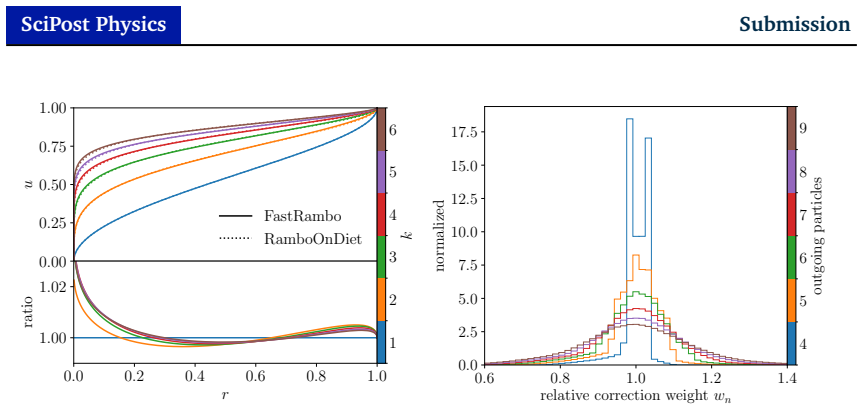
The load-bearing object is the set of fully invertible phase-space maps in the compute-graph framework. Each building block — two-body decay, (φ,t) scattering, double-invariant (˜s,t), three-body decay, PDF convolution — supplies a forward map from unit hypercube to physical momenta and a closed-form inverse with Jacobian density. Invertibility is what allows global multi-channel weighting, where every channel density must be evaluated at a shared phase-space point, and what enables future neural importance sampling and differentiability. FastRambo is the paper's new map: a one-parameter rational-quadratic spline whose endpoint slope is fit once per multiplicity to approximate the original d
Load-bearing premise
The whole edifice rests on the premise that the two validated benchmark processes and the described-but-unshown automated test suite are representative, and that the inverse maps and the adopted massive-reweighting formula stay accurate in exactly the soft and collinear regions (s,t near zero) where the paper's own round-trip test shows the largest deviations.
What would settle it
Run the same sliced high-statistics comparison for a process with a t-channel pole and a light jet, binning events by the gluon-pair Mandelstam invariants s and t near zero; if the MadSpace-to-baseline ratio departs from unity by more than the quoted Monte Carlo uncertainty in those bins, the round-trip tail is not harmless and the global-multi-channel weights carry a bias.
If this is right
- If the claims hold, the phase-space and event-generation overhead in leading-order simulation can move off the CPU critical path, with the whole pipeline resident on a GPU.
- The invertibility of all channel maps means one code base can support both global multi-channel and single-diagram-enhanced strategies, and can insert learned samplers as interchangeable graph components.
- For processes with cheap matrix elements, speed-ups of one to two orders of magnitude are achievable; for amplitude-dominated processes, the advantage shrinks, pointing to amplitude evaluation as the next bottleneck.
- The near-flat FastRambo weights make it a practical drop-in for workflows that need a fast analytic invertible sampler without exact flatness, especially when adaptive or learned samplers refine the density afterwards.
- Binary intermediate files and in-memory channel combination reduce final event-output time by more than two orders of magnitude in the benchmarked case, easing high-statistics runs.
Where Pith is reading between the lines
- The same compute-graph invertibility implies a natural path to differentiability: gradients of weighted observables with respect to masses, couplings, or PDF parameters could be computed by backpropagation through the maps, something the paper lists as future work but does not demonstrate.
- The round-trip test's power-law tail near s,t → 0 suggests a testable stress point: the global multi-channel weight, which evaluates every channel density through inverse maps, is most likely to be biased precisely in those corners; a targeted high-statistics comparison there would either confirm or refute that the tail is harmless.
- Because FastRambo's fitted coefficients cover only up to seven outgoing particles and the massive-case reweighting formula is adopted without rederivation, an extension of this work would be to scan higher multiplicities and heavy final states to see whether the near-flat weight distribution and mass treatment remain accurate.
- The speed-up pattern implies that the next gains for high-multiplicity QCD will come from cheap amplitude surrogates rather than phase-space optimization, since matrix-element cost dominates once the pipeline itself is fast.
Editorial analysis
A structured set of objections, weighed in public.
Referee Report
Summary. MadSpace is a modular C++/CUDA/HIP phase-space and event-generation library for LO computations, organized as a compute-graph interpreter over batches of events. It implements recursive diagram-based mappings, a new analytic FastRambo variant, Chili-style mappings, VEGAS and neural importance sampling components, PDF interpolation, cuts, unweighting, and a UMAMI matrix-element interface. The paper validates phase-space volumes against Eq. (81), inverse round-trip mappings, differential distributions for gg->ttgg and uu->e+e-gg against high-statistics sliced MG5aMC runs, and CPU/GPU throughput. The central claims are that MadSpace reproduces LO physics and provides large speed-ups, up to ~30M weighted events/s and ~250x for DY+1j on an A100.
Significance. The potential contribution is substantial: it is a rare full GPU-resident LO event-generation pipeline, explicitly designed for the MadGraph ecosystem, with open-source availability, a clean modular architecture, and an interface (UMAMI) that decouples matrix elements from sampling. The validation strategy has real strengths: phase-space volumes are checked against an independent analytic expression, the MG5aMC comparisons use 10M sliced reference events and the same CUDACPP matrix elements on both sides, and the forward/inverse round-trip test is a useful sanity check. FastRambo's closed-form inverse is a concrete algorithmic improvement over RamboOnDiet's polynomial root finding. However, the correctness evidence is incomplete exactly where the claimed ML/global multi-channel functionality depends on inverse maps, and the massive FastRambo reweighting is unvalidated. These gaps are fixable and do not undermine the core local-mode results, so the paper is a strong major-revision candidate.
major comments (2)
- [§2.1.1, Eqs. (8)–(10); §4.1, Fig. 8 (right); §4.2] The global multi-channel form (Eq. 8) and ML reweighting require evaluating every g_j(x) via inverse maps, while the local/SDE form (Eq. 10) does not. §4.2 never states which variant produced the gg->ttgg and uu->e+e-gg distributions; if it was the local mode, those plots do not validate the inverse-map path. The round-trip test in Fig. 8 (right) shows the largest deviations exactly for Mandelstam s,t near zero, the t-channel-pole region with strongest Jacobian variation, but no magnitude, frequency, or effect on w(x)=f(x)/g(x) is quantified. Please specify the §4.2 multi-channel variant and add a global-mode validation (weighted and unweighted distributions vs MG5aMC, plus a quantitative round-trip/Jacobian error study near small |t| or s).
- [§2.3.1, Eq. (68); §4.1] The massive extension of FastRambo is imported from Refs. [64,66] without derivation, and the paper nowhere validates it independently. The volume check in §4.1 is massless only; the inverse round-trip test for gg->ttgg exercises massive FastRambo, but round-trip consistency does not establish the correctness of the density/Jacobian. If the §4.2 distributions use diagram-based channels rather than FastRambo (as appears to be the case for the multi-channel setup), then Eq. (68) is effectively unvalidated for physical predictions. Please provide a derivation or a dedicated check, e.g., a massive phase-space volume comparison against an independent implementation (RamboOnDiet or analytic formula) and state explicitly which tests exercise massive FastRambo.
minor comments (6)
- [§4.3, Fig. 11] The caption says 'number of weighted events per second' although the figure and text describe unweighted throughput; change 'weighted' to 'unweighted' in the caption text.
- [§4.2, Fig. 9] 'Agree well within statistical uncertainty' is supported visually. Add a quantitative measure (e.g., bin-wise chi-squared or KS statistic) to make the claim reproducible.
- [§4.1, final paragraph] The automated CI validation suite is asserted but not shown; include a representative summary or a link to a public CI status page so the 'broader class' claim can be checked.
- [§3.2.2, §4.3, Conclusion] The paper explicitly defers MadNIS performance and a systematic ML study to future work. Consider softening the abstract or adding a minimal demonstration, since the title advertises ML as part of the present contribution.
- [§4.3, Fig. 10] State whether the benchmark used the global or local multi-channel variant, since this affects the inverse-map workload. For full context, consider also showing the 24-core MG5aMC result on the GPU plot.
- [§2.2.3, Eq. (24)] Check the sign convention in the two-body energy formula: the two energies should be (m0^2 + m1^2 - m2^2)/(2m0) and (m0^2 - m1^2 + m2^2)/(2m0), respectively, as written the notation '±' is ambiguous.
Circularity Check
No significant circularity; validation is anchored to external analytic volumes and MG5aMC baselines.
full rationale
MadSpace's central physics claims are checked against two independent external anchors: the analytic phase-space volume Eq. (81) and high-statistics MG5aMC reference distributions (Sec. 4.2). The throughput comparison (Sec. 4.3) is explicitly controlled by using the same CUDACPP matrix elements and identical multi-channel/VEGAS settings on both sides, so the speed comparison does not reduce to the phase-space generator's own output. The only numerical fit in the paper, the FastRambo parameters c*_k from Eq. (66), is disclosed as a one-time fit to the reference RamboOnDiet mapping, and the paper does not present FastRambo's closeness to that mapping as a physics prediction; the physical validation of FastRambo is instead the analytic volume test in Sec. 4.1. The massive-reweighting formula Eq. (68) is adopted from external Refs. [64,66] and is not derived from the claims being made; it is independently falsifiable. The cited author-overlapping MadNIS work [34-36] is deferred, not load-bearing. The acknowledged round-trip inverse-map deviations for s,t near zero are a potential correctness risk for the global multi-channel/ML-reweighting path, but the paper identifies them explicitly rather than hiding a fitted quantity; a correctness concern is not a circularity. No step in the claimed derivation chain reduces by construction to its own inputs.
Axiom & Free-Parameter Ledger
free parameters (4)
- FastRambo spline parameters c*_k (k=1..7) =
2, 2.712001, 3.084521, 3.313073, 3.467512, 3.578833, 3.662872 (Table 1)
- Power-law mapping exponent ν =
0.8 default (Sec 2.2.1); 0.3 used in the Sec 4.1 validation
- Auxiliary regulator mass a (m²=−a) in power-law/log mappings =
unspecified ("0<a≪1")
- Chili small-pT regulator λ_C =
λ_C = m for massive particles; m = 1 for massless
axioms (7)
- standard math Recursive phase-space factorization into 1→2 / 2→2 / 1→3 building blocks (Eq. 13)
- domain assumption RamboOnDiet mass-reweighting formula Eq. (68) is correct for massive final states
- domain assumption Chili mapping (Eqs. 70–77) as implemented is a valid phase-space parametrization
- domain assumption Double-invariant (˜s,t) two-particle phase-space formulas (Eqs. 31–37) from Byckling–Kajantie [78] and Frederix–Vitos [79]
- standard math Rational-quadratic transform (Eqs. 64–65) has the stated closed-form inverse and monotonicity
- domain assumption MG5aMC+CUDACPP provides the correct reference LO physics for validation
- standard math Analytic phase-space volume formula Eq. (81)
invented entities (3)
-
FastRambo rational–quadratic mapping
independent evidence
-
UMAMI matrix-element interface
independent evidence
-
Compute-graph byte-code execution model
independent evidence
read the original abstract
MadSpace is a new modular phase-space and event-generation library written in C++ with native GPU support via CUDA and HIP. It provides a unified compute-graph-based framework for phase-space construction, adaptive and neural importance sampling, and event unweighting. It includes a wide range of mappings, from the standard MadGraph multi-channel phase space to optimized normalizing flows with analytic inverse transformations. All components operate on batches of events and support end-to-end on-device workflows. A high-level Python interface enables seamless integration with machine-learning libraries such as PyTorch.
Figures




Forward citations
Cited by 7 Pith papers
-
Local Conformal Predictions for Calibrated Surrogates
FALCON is a novel conformal prediction technique that learns locally calibrated confidence intervals for neural network surrogates modeling LHC scattering amplitudes.
-
Nested-GPT for variable-multiplicity parton showers: A case study in the resummation of non-global logarithms
Nested-GPT is an autoregressive Transformer that dynamically generates variable-multiplicity parton showers matching Monte Carlo references for non-global logarithm resummation in the large-Nc limit.
-
Nested-GPT for variable-multiplicity parton showers: A case study in the resummation of non-global logarithms
Nested-GPT is an autoregressive Transformer surrogate that generates variable-multiplicity parton showers while enforcing ordered Markovian branching and matches reference Monte Carlo results for leading-log non-globa...
-
Monte Carlo Event Generators for Future Lepton Colliders
Reviews selected challenges in Monte Carlo event generators for future lepton colliders including electroweak corrections, initial-state radiation, beam dynamics, perturbative QCD and non-perturbative modelling.
-
Open LHC Monte Carlo Event Generation
A review of initiatives to make LHC Monte Carlo event generations available as open data to minimize redundant simulations and resource use.
-
The Monte Carlo Ecosystem in High-Energy Physics: A Primer
A primer by six leading developers maps the full Monte Carlo chain (matrix elements, parton showers, hadronisation, detector simulation, tuning, analysis) and the computing and reproducibility issues that come with it.
-
The Monte Carlo Ecosystem in High-Energy Physics: A Primer
A primer that surveys the architecture, methodologies, computational challenges, and future trajectory of the Monte Carlo event generator ecosystem in collider physics.
Reference graph
Works this paper leans on
-
[1]
[1]J. M. Campbellet al.,Event generators for high-energy physics experiments, SciPost Phys. 16(2024) 5, 130, arXiv:2203.11110[hep-ph]. [2]C. Bierlichet al.,A comprehensive guide to the physics and usage of PYTHIA 8.3, SciPost Phys. Codeb.2022(2022) 8, arXiv:2203.11601[hep-ph]. [3]Sherpa, E. Bothmannet al.,Event generation with Sherpa 3, JHEP12(2024) 156, ...
Pith/arXiv arXiv 2024
-
[192]
[68]G. P . Lepage,VEGAS: AN ADAPTIVE MULTIDIMENSIONAL INTEGRATION PROGRAM, . [69]L. Heinrich and M. Kagan,Differentiable Matrix Elements with MadJax, J. Phys. Conf. Ser.2438(2023) 1, 012137, arXiv:2203.00057[hep-ph]. [70]B. Nachman and S. Prestel,Morphing parton showers with event derivatives, arXiv:2208.02274[hep-ph]. [71]MODE, T . Dorigoet al.,Toward th...
Pith/arXiv arXiv 2023
-
[359]
van Hameren,Adaptive channels for data analysis and importance sampling, arXiv:hep-ph/0301036
38 SciPost Physics Submission [65]A. van Hameren,Adaptive channels for data analysis and importance sampling, arXiv:hep-ph/0301036. [66]S. Plätzer,RAMBO on diet, arXiv:1308.2922[hep-ph]. [67]G. P . Lepage,A New Algorithm for Adaptive Multidimensional Integration, J. Comput. Phys.27(1978)
Pith/arXiv arXiv 1978
-
[2001]
arXiv:hep-ph/0109068. [91]R. D. Ballet al.,Parton distributions with LHC data, Nucl. Phys. B867(2013) 244, arXiv:1207.1303[hep-ph]. [92]P . Artoisenet, V . Lemaitre, F . Maltoni, and O. Mattelaer,Automation of the matrix element reweighting method, JHEP12(2010) 068, arXiv:1007.3300[hep-ph]. [93]S. Brochet, C. Delaere, B. François, V . Lemaître, A. Mertens...
Pith/arXiv arXiv 2013
-
[2008]
[79]R. Frederix and T . Vitos,Leading-colour-based unweighted event generation for multi-parton tree-level processes, JHEP12(2024) 201, arXiv:2409.12128[hep-ph]. [80]G. Knippen,Next-to-leading-order QCD and electroweak corrections to WWW production at proton–proton colliders. PhD thesis, Freiburg U., Freiburg U.,
Pith/arXiv arXiv 2024
-
[2019]
7511, arXiv:1906.04032 [stat.ML]. [82]M. L. Mangano, M. Moretti, F . Piccinini, R. Pittau, and A. D. Polosa,ALPGEN, a generator for hard multiparton processes in hadronic collisions, JHEP07(2003) 001, arXiv:hep-ph/0206293. 39 SciPost Physics Submission [83]T . Gleisberg and S. Hoeche,Comix, a new matrix element generator, JHEP12(2008) 039, arXiv:0808.3674...
Pith/arXiv arXiv 1906
-
[2021]
A Living Review of Machine Learning for Particle Physics
066, arXiv:2106.09474[hep-ph]. [12]D. Maître and H. Truong,A factorisation-aware Matrix element emulator, JHEP11 (2021) 066, arXiv:2107.06625[hep-ph]. [13]K. Danziger, T . Janßen, S. Schumann, and F . Siegert,Accelerating Monte Carlo event generation – rejection sampling using neural network event-weight estimates, SciPost Phys.12(2022) 164, arXiv:2109.11...
Pith/arXiv arXiv 2021
-
[2025]
arXiv:2503.21935[physics.comp-ph]. [62]S. Hageböck, D. Massaro, O. Mattelaer, S. Roiser, A. Valassi, and Z. Wettersten, Data-parallel leading-order event generation in MadGraph5_aMC@NLO, arXiv:2507.21039[hep-ph]. [63]S. Roiser, R. Schöfbeck, and Z. Wettersten,Rapid event extraction and tensorial event adaption, Eur. Phys. J. C85(2025) 12, 1448, arXiv:2510...
arXiv 2025
discussion (0)
Sign in with ORCID, Apple, or X to comment. Anyone can read and Pith papers without signing in.