REVIEW 4 major objections 5 minor 55 references
With just 15 AR-teleoperated demonstrations, dexterous-grasping RL trains about four times faster and reaches higher success rates than standard actor-critic methods.
Reviewed by Pith at T0; open to challenge. T0 means a machine referee read the full paper against a public rubric. the ladder, T0–T4 →
T0 review · deepseek-v4-flash
2026-08-03 03:37 UTC pith:NUMTPH6R
load-bearing objection A plausible two-phase BC+contrastive-SAC pipeline for dexterous grasping with an AR teleop system, but the 4x speedup and collapse-prevention claims rest on a single unseeded comparison and 15 unanalyzed demonstrations. the 4 major comments →
Scalable Dexterous Robot Learning with AR-based Remote Human-Robot Interactions
The pith
A machine-rendered reading of the paper's core claim, the machinery that carries it, and where it could break.
Core claim
Starting from 15 expert trajectories collected by an AR teleoperation setup, the authors first train the actor by regression (behavior cloning), then fine-tune a SAC agent while a projection head projects (state, action) pairs of both the expert and the current actor into a shared latent space; a contrastive loss maximizes agreement between the expert's pair and the actor's pair for the same state. This contrastive constraint is what distinguishes the method from BC+SAC, and the ablation indicates it prevents the policy from collapsing during RL fine-tuning. The paper reports roughly 4x faster convergence than vanilla SAC (55-75 minutes vs 270-300 minutes), higher mean rewards and success ra
What carries the argument
The load-bearing mechanism is the projection head: a two-layer MLP that maps concatenated expert and actor (state, action) pairs into a 128-dimensional latent space. A temperature-scaled InfoNCE-style contrastive loss (Eq. 12) treats the expert's and the actor's representation for the same expert state as a positive pair, pulling the two together. This operates as a regularizer on the SAC policy objective (Eq. 11), added with weight 0.5, and is what the ablation isolates when comparing BC+SAC against the full method. The first phase, BC pretraining, provides the initialization; the contrastive term is the mechanism that prevents collapse and accelerates convergence.
Load-bearing premise
The 15 expert demonstrations are good enough — representative, correct, and sufficiently diverse — to serve both as the BC pretraining target and as the contrastive anchors; if they are noisy or biased, the policy is actively pulled toward suboptimal behavior.
What would settle it
Ablate demonstration quality: take the same 15 trajectories, corrupt a random 30% of the actions with noise (or replace them with random actions), and retrain. If the proposed method still reaches ~90% success and 4x speedup, then the contrastive mechanism must be doing the work regardless of demo fidelity; if performance collapses, the claim's dependence on high-quality demos is confirmed. Also, train BC+SAC without contrastive learning on 15 demos and then with 100 demos: if the contrastive gain disappears when demos are plentiful, the mechanism's value is specifically in the low-data regime
If this is right
- Behavior cloning pretraining accounts for most of the training-time reduction; contrastive learning adds a smaller but consistent performance gain.
- With a tiny demonstration set (15 trajectories), the method outperforms both PPO and SAC in success rate on two grasping tasks, suggesting demo-efficient policy learning is feasible.
- The projection head can be discarded after RL training, so inference time is not increased by the auxiliary network.
- The event-driven reward (success/collision/contact) that accompanies the contrastive loss is part of why the learned policy behaves safely in the real world.
- The method is presented as task-agnostic within arm-hand manipulation, so the same pipeline could transfer to other dexterous skills beyond ball and bottle grasping.
Where Pith is reading between the lines
- If the contrastive regularizer is the real collapse-preventer, a stripped-down version that uses only BC pretraining plus a simple L2 penalty on actor-expert action distance might achieve similar gains; the paper does not test this, so the projection head's specific design is not proven necessary.
- The scalability claim rests on the AR teleoperation pipeline; a testable extension would be to vary demonstration count (e.g., 5, 15, 50) and see whether the contrastive gain shrinks as demos increase, which would clarify whether the method is demo-efficient or just under-powered at 15 demos.
- The same two-phase recipe could apply to other off-policy RL algorithms than SAC, since neither the contrastive loss nor BC pretraining is SAC-specific; a direct test would be BC+contrastive with TD3 or DDPG.
Editorial analysis
A structured set of objections, weighed in public.
Referee Report
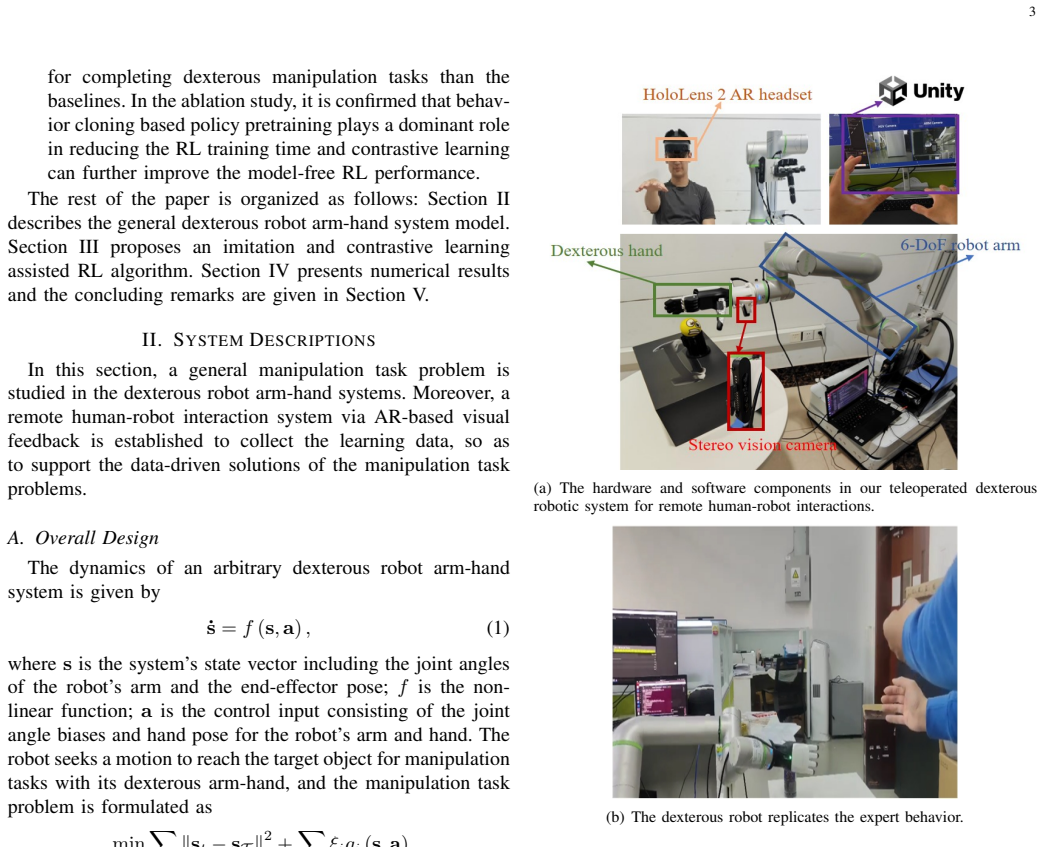
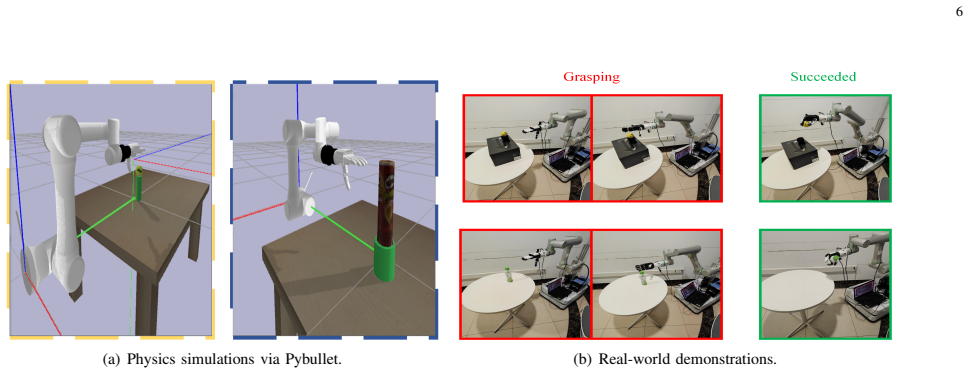
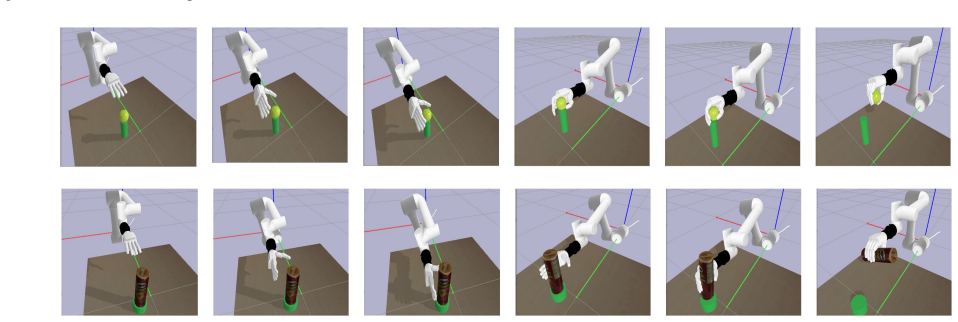
Summary. The paper proposes a two-phase learning framework for dexterous arm-hand grasping: Phase 1 performs behavior cloning (BC) pretraining on 15 expert trajectories collected through a HoloLens 2 based AR teleoperation system; Phase 2 trains a Soft Actor-Critic (SAC) policy with an auxiliary contrastive loss defined through a projection head over expert state-action pairs. The method is evaluated in PyBullet on ball and bottle grasping against PPO, SAC, and a BC+SAC ablation, plus 50-trial real-world experiments. The central claims are that the proposed method trains about four times faster than SAC, achieves the highest success rates, and that the contrastive component prevents 'policy collapse.'
Significance. If substantiated, the combination of a low-cost AR teleoperation interface, BC pretraining, and a contrastive auxiliary loss would be a practically useful recipe for reducing RL training time in high-DoF dexterous manipulation. The paper also provides a genuine ablation (BC+SAC without contrastive learning) and reports both simulated and physical experiments. However, the central quantitative claims are not currently established: the empirical comparison rests on single training runs without variance or statistical tests, the notion of convergence is left undefined, and the sensitivity of the method to the single 15-trajectory demonstration set is not examined. The contribution is therefore promising but needs substantially stronger empirical support before the advertised speed and robustness claims can be accepted.
major comments (4)
- [Section IV-A, Table III] The success-rate and time comparisons are reported from a single training run per algorithm. Table III reports means over 10^4 evaluation trials, but no standard deviations, confidence intervals, or number of seeds. The gap between BC+SAC and Ours on ball grasping (85.49% vs 91.80%) and the identical convergence time (75 min) cannot be distinguished from seed noise without multi-seed experiments. Please report mean ± std over at least 5 seeds and include statistical significance tests (e.g., paired bootstrap) for the success-rate and time differences.
- [Section IV-A, Table III / Fig. 6] The terms 'convergence' and 'Number of iterations until convergence' are never defined. Fig. 6 shows reward curves but no convergence criterion, no error bands, and no definition of when training is deemed converged. Moreover, the time-consumption column does not state whether the Phase 1 BC pretraining time is included. Since the 'approximately four times faster than SAC' claim is a headline result, please define the convergence rule explicitly and report wall-clock time excluding and including Phase 1 pretraining.
- [Section III, Eqs. (11)-(12) and Algorithm 1] The claim that contrastive learning 'overcomes policy collapse' is asserted repeatedly but never defined or demonstrated. No metric for policy collapse (e.g., action entropy, effective parameter norm, Q-value dispersion) is provided, and Fig. 6 does not compare collapse behavior. In addition, the contrastive loss draws positive pairs exclusively from the 15 expert trajectories. The paper does not analyze demonstration quality, diversity, or sensitivity to the number of demonstrations; if the demonstrations are noisy or biased, L_CL would actively attract the policy toward suboptimal behavior. Please add a formal or operational definition of policy collapse, quantitative evidence, and a demonstration-count/quality sensitivity study.
- [Section IV-A, Fig. 8] The real-world results are based on 50 trials per method with no confidence intervals or error bars. The discussion of 'marginal sim-to-real gap' for bottle grasping is not supported by any numerical comparison or statistical test. Please report exact success counts, binomial confidence intervals, and, if applicable, a test comparing the proposed method with BC+SAC, which is the closest ablation.
minor comments (5)
- [Eq. (6) and surrounding text] Typo: 'hand pose adjustment award' should be 'reward'. Also, Eq. (6) has a piecewise structure with Z4/Z5 but the text does not explain the intuition for the two regimes or how Λ_th was chosen.
- [Algorithm 1, lines 6-7] The update order is: projection head updated with L_CL, then the actor updated with L_πθ that includes ξ4 L_CL. Please clarify whether the projection head's parameters are treated as fixed or updated during the actor update, since L_CL depends on φ through h_A.
- [References] Reference [29] contains garbled characters ('Bj?rkman') and should be corrected. Also, the arXiv date (Feb 2026) and the use of very recent references (e.g., [53]-[55]) should be double-checked for correctness.
- [Section II-B] The statement that the system can 'capture diverse expert demonstrations' is not supported by any quantitative description of the 15 trajectories (e.g., length, variance across trajectories, number of successes/failures). A brief descriptive summary of the dataset would strengthen the paper.
- [Table I] The table lists α=1, but SAC's temperature is usually learned. If α is fixed, state so; if learned, explain how the value 1 was obtained. Similarly, the large number of hand-chosen reward weights (Z1-Z5, ξ1-ξ4, Λ_th) should be justified or at least motivated.
Circularity Check
No significant circularity: the central claim is an empirical comparison, and the only self-citation is a non-load-bearing background reference.
full rationale
The paper's central claim is an empirical result: in Table III and Section IV-A, the proposed BC-pretrained, contrastive-augmented SAC is reported to converge in about 75/55 minutes versus 300/270 minutes for SAC, with higher success rates on ball and bottle grasping. No step of the derivation reduces to its own inputs by construction. Phase 1 fits a behavior-cloning regression L_BC to expert demonstrations; Phase 2 adds a contrastive loss L_CL over the same demonstrations, but the reported success rates are evaluated on 10^4 simulated trials and 50 real-world trials, not on the training demonstrations themselves. The reward function in Eqs. (4)-(6) is hand-shaped with constants from Table I, but the reward is the optimization objective rather than a fitted predictor of the reported success-rate gaps, and the same task metrics are used for all algorithms. The only identifiable self-citation is reference [23], a co-author's 360-degree video delivery paper, used as background for the statement that 'in 6G, extended reality (XR) ... is one of the most transformative services'; it is not load-bearing for the proposed method or the evaluation. No uniqueness theorem, ansatz-by-citation, or renaming pattern appears. The absence of seed variance, error bars, and demonstration-quality analysis is a statistical robustness limitation, not circularity.
Axiom & Free-Parameter Ledger
free parameters (12)
- α (entropy temperature) =
1
- ξ1 (smooth/progress reward weight) =
1000
- ξ2 (event reward weight) =
1
- ξ3 (pose reward weight) =
1
- ξ4 (contrastive loss weight) =
0.5
- Z1 (success reward) =
1000
- Z2 (collision penalty) =
100
- Z3 (hand-object contact penalty) =
60
- Z4 (pose reward coefficient, lower regime) =
7
- Z5 (pose reward coefficient, upper regime) =
80
- Λ_th (geometric reasoning threshold) =
0.75
- τ_CL (contrastive temperature) =
0.1
axioms (4)
- domain assumption The 15 expert demonstrations collected via AR are high-quality, representative, and sufficient for behavior cloning and contrastive anchoring.
- ad hoc to paper The hand-crafted reward function (Eqs. 4-6) with its weights correctly encodes task success, safety, and desirable hand-object alignment.
- ad hoc to paper The contrastive loss with the projection head (Eqs. 11-12) prevents policy collapse and improves sample efficiency.
- domain assumption A policy trained in PyBullet transfers to the real robot with acceptable sim-to-real gap for the considered tasks.
read the original abstract
This paper focuses on the scalable robot learning for manipulation in the dexterous robot arm-hand systems, where the remote human-robot interactions via augmented reality (AR) are established to collect the expert demonstration data for improving efficiency. In such a system, we present a novel method to address the general manipulation task problem. Specifically, the proposed method consists of two phases: i) In the first phase for pretraining, the policy is created in a behavior cloning (BC) manner, through leveraging the learning data from our AR-based remote human-robot interaction system; ii) In the second phase, a contrastive learning empowered reinforcement learning (RL) method is developed to obtain more efficient and robust policy than the BC, and thus a projection head is designed to accelerate the learning progress. An event-driven augmented reward is adopted for enhancing the safety. To validate the proposed method, both the physics simulations via PyBullet and real-world experiments are carried out. The results demonstrate that compared to the baselines, our method not only significantly speeds up the training process, but also achieves much better performance in terms of the success rate for fulfilling the manipulation tasks. By conducting the ablation study, it is confirmed that the proposed RL with contrastive learning overcomes policy collapse. Supplementary demonstrations are available at https://cyberyyc.github.io/.
Figures




Reference graph
Works this paper leans on
-
[1]
A roadmap for AI in robotics,
A. Billard, A. Albu-Schaeffer, M. Beetzet al., “A roadmap for AI in robotics,”Nat. Mach. Intell., vol. 7, pp. 818–824, 2025
2025
-
[2]
A survey of embodied AI: From simulators to research tasks,
J. Duan, S. Yu, H. L. Tan, H. Zhu, and C. Tan, “A survey of embodied AI: From simulators to research tasks,”IEEE Trans. Emerg. Top. Comput. Intell., vol. 6, no. 2, pp. 230–244, Apr. 2022
2022
-
[3]
DexPilot: Vision-based teleoper- ation of dexterous robotic hand-arm system,
A. Handa, K. Van Wyk, W. Yang, J. Liang, Y .-W. Chao, Q. Wan, S. Birchfield, N. Ratliff, and D. Fox, “DexPilot: Vision-based teleoper- ation of dexterous robotic hand-arm system,” inIEEE Int. Conf.. Robot. Autom. (ICRA), 2020, pp. 9164–9170
2020
-
[4]
A review of robot learning for manipulation: Challenges, representations, and algorithms,
O. Kroemer, S. Niekum, and G. Konidaris, “A review of robot learning for manipulation: Challenges, representations, and algorithms,”J. Mach. Learn. Res., vol. 22, no. 1, Jan. 2021
2021
-
[5]
Learning thin deformable object manipulation with a multisensory integrated soft hand,
C. Zhao, C. Jiang, L. Luo, S. Yuan, Q. Chen, and H. Yu, “Learning thin deformable object manipulation with a multisensory integrated soft hand,”IEEE Trans. Robot., vol. 41, pp. 4606–4621, 2025
2025
-
[6]
Enhancing dexterity in confined spaces: Real-time motion planning for multifingered in-hand manipulation,
X. Gao, K. Yao, F. Khadivar, and A. Billard, “Enhancing dexterity in confined spaces: Real-time motion planning for multifingered in-hand manipulation,”IEEE Robot. Autom. Mag., vol. 31, no. 4, pp. 100–112, Sept. 2024
2024
-
[7]
Deep imitation learning for complex manipulation tasks from virtual reality teleoperation,
T. Zhang, Z. McCarthy, O. Jow, D. Lee, X. Chen, K. Goldberg, and P. Abbeel, “Deep imitation learning for complex manipulation tasks from virtual reality teleoperation,” inIEEE Int. Conf. Robot. Autom. (ICRA), 2018, pp. 5628–5635
2018
-
[8]
Coarse-to-fine imitation learning: Robot manipulation from a single demonstration,
E. Johns, “Coarse-to-fine imitation learning: Robot manipulation from a single demonstration,” inIEEE Int. Conf. Robot. Autom. (ICRA), 2021, pp. 4613–4619
2021
-
[9]
HG-DAgger: Interactive imitation learning with human experts,
M. Kelly, C. Sidrane, K. Driggs-Campbell, and M. J. Kochenderfer, “HG-DAgger: Interactive imitation learning with human experts,” inInt. Conf. Robot. Autom. (ICRA), 2019, pp. 8077–8083
2019
-
[10]
Multistage cable routing through hierarchical imitation learning,
J. Luo, C. Xu, X. Geng, G. Feng, K. Fang, L. Tan, S. Schaal, and S. Levine, “Multistage cable routing through hierarchical imitation learning,”IEEE Trans. Robot., vol. 40, pp. 1476–1491, Jan. 2024
2024
-
[11]
Goal-conditioned dual-action imitation learning for dexterous dual-arm robot manipulation,
H. Kim, Y . Ohmura, and Y . Kuniyoshi, “Goal-conditioned dual-action imitation learning for dexterous dual-arm robot manipulation,”IEEE Trans. Robot., vol. 40, pp. 2287–2305, Mar. 2024
2024
-
[12]
Learning fine-grained bimanual manipulation with low-cost hardware,
T. Z. Zhao, V . Kumar, S. Levine, and C. Finn, “Learning fine-grained bimanual manipulation with low-cost hardware,” inProc. Robot.: Sci. Syst., 2023
2023
-
[13]
Behavior cloning-based active scene recognition via generated expert data with revision and prediction for domestic robots,
S. Liu, C. Huang, and H. Huang, “Behavior cloning-based active scene recognition via generated expert data with revision and prediction for domestic robots,”IEEE Trans. Robot., vol. 41, pp. 4180–4194, 2025
2025
-
[14]
Learning complex dexterous manipulation with deep reinforcement learning and demonstrations,
A. Rajeswaran, V . Kumar, A. Gupta, G. Vezzani, J. Schulman, E. Todorov, and S. Levine, “Learning complex dexterous manipulation with deep reinforcement learning and demonstrations,” InRobot.: Sci. Syst. (RSS), 2018
2018
-
[15]
DexRepNet: Learning dexterous robotic grasping network with geometric and spatial hand-object representations,
Q. Liuet al., “DexRepNet: Learning dexterous robotic grasping network with geometric and spatial hand-object representations,” inIEEE Int. Conf. Intell. Rob. Syst., 2023, pp. 3153–3160
2023
-
[16]
Teleoperation of humanoid robots: A survey,
K. Darvish, L. Penco, J. Ramos, R. Cisneros, J. Pratt, E. Yoshida, S. Ivaldi, and D. Pucci, “Teleoperation of humanoid robots: A survey,” IEEE Trans. Robot., vol. 39, no. 3, pp. 1706–1727, June 2023
2023
-
[17]
De- terministic networking empowered robotic teleoperation,
C. Yang, H. Yu, Q. Guo, T. Taleb, J. C. Requena, and K. Tammi, “De- terministic networking empowered robotic teleoperation,”IEEE Netw., vol. 39, no. 4, pp. 280–289, 2025
2025
-
[18]
Incremental learning of robotic manipulation tasks through virtual reality demonstrations,
G. Rauso, R. Caccavale, and A. Finzi, “Incremental learning of robotic manipulation tasks through virtual reality demonstrations,” inIEEE/RSJ Int. Conf. Intell. Robot. Syst. (IROS), 2024, pp. 5176–5181. 9
2024
-
[19]
Robot teleoperation with augmented reality virtual surrogates,
M. E. Walker, H. Hedayati, and D. Szafir, “Robot teleoperation with augmented reality virtual surrogates,” inACM/IEEE Int. Conf. Human- Robot Interaction (HRI), 2019, pp. 202–210
2019
-
[20]
Bunny-VisionPro: Real-time bimanual dexterous teleoperation for im- itation learning,
R. Ding, Y . Qin, J. Zhu, C. Jia, S. Yang, R. Yang, X. Qi, and X. Wang, “Bunny-VisionPro: Real-time bimanual dexterous teleoperation for im- itation learning,”arXiv preprint arXiv:2407.03162, 2024
Pith/arXiv arXiv 2024
-
[21]
Augmented reality and humancrobot collaboration framework for percutaneous nephrolithotomy: System de- sign, implementation, and performance metrics,
J. Fu, M. Pecorella, E. Iovene, M. C. Palumbo, A. Rota, A. Redaelli, G. Ferrigno, and E. De Momi, “Augmented reality and humancrobot collaboration framework for percutaneous nephrolithotomy: System de- sign, implementation, and performance metrics,”IEEE Robot. Autom. Mag., vol. 31, no. 3, pp. 25–37, 2024
2024
-
[22]
E-BTS: Event-based tactile sensor for haptic teleoperation in aug- mented reality,
D. Mukashev, S. Seitzhan, J. Chumakov, S. Khajikhanov, M. Yergibay, N. Zhaniyar, R. Chibar, A. Mazhitov, M. Rubagotti, and Z. Kappassov, “E-BTS: Event-based tactile sensor for haptic teleoperation in aug- mented reality,”IEEE Trans. Robot., vol. 41, pp. 450–463, 2025
2025
-
[23]
Two-tier 360-degree video delivery control in multiuser immersive communications systems,
M. Hu, L. Wang, B. Tan, and S. Jin, “Two-tier 360-degree video delivery control in multiuser immersive communications systems,”IEEE Trans. V eh. Technol., vol. 72, no. 3, pp. 4119–4123, 2023
2023
-
[24]
A survey of imitation learning: Algorithms, recent developments, and challenges,
M. Zare, P. M. Kebria, A. Khosravi, and S. Nahavandi, “A survey of imitation learning: Algorithms, recent developments, and challenges,” IEEE Trans. Cybern., vol. 54, no. 12, pp. 7173–7186, Dec. 2024
2024
-
[25]
Dexterous manipulation with deep reinforcement learning: Efficient, general, and low-cost,
H. Zhu, A. Gupta, A. Rajeswaran, S. Levine, and V . Kumar, “Dexterous manipulation with deep reinforcement learning: Efficient, general, and low-cost,” inInt. Conf. Robot. Autom. (ICRA), 2019, pp. 3651–3657
2019
-
[26]
Deep reinforcement learning for vision-based robotic grasping: A simulated comparative evaluation of off-policy methods,
D. Quillen, E. Jang, O. Nachum, C. Finn, J. Ibarz, and S. Levine, “Deep reinforcement learning for vision-based robotic grasping: A simulated comparative evaluation of off-policy methods,” inIEEE Int. Conf. Robot. Autom. (ICRA), 2018, pp. 6284–6291
2018
-
[27]
Scal- able deep reinforcement learning for vision based robotic manipulation,
D. Kalashnikov, A. Irpan, P. Pastor, J. Ibarz, A. Herzog, E. Jang, D. Quillen, E. Holly, M. Kalakrishnan, V . Vanhoucke, and S. Levine, “Scal- able deep reinforcement learning for vision based robotic manipulation,” inProc. PMLR, 2018, pp. 651–673
2018
-
[28]
Towards safe human-robot collaboration using deep reinforcement learning,
M. El-Shamouty, X. Wu, S. Yang, M. Albus, and M. F. Huber, “Towards safe human-robot collaboration using deep reinforcement learning,” in IEEE Int. Conf. Robot. Autom. (ICRA), 2020, pp. 4899–4905
2020
-
[29]
Human-centered collaborative robots with deep reinforcement learn- ing,
A. Ghadirzadeh, X. Chen, W. Yin, Z. Yi, M. Bj?rkman, and D. Kragic, “Human-centered collaborative robots with deep reinforcement learn- ing,”IEEE Robot. Autom. Lett., vol. 6, no. 2, pp. 566–571, 2021
2021
-
[30]
Task-oriented deep reinforcement learning for robotic skill acquisition and control,
G. Xiang and J. Su, “Task-oriented deep reinforcement learning for robotic skill acquisition and control,”IEEE Trans. Cybern., vol. 51, no. 2, pp. 1056–1069, 2021
2021
-
[31]
Dexterous pre-grasp manipulation for human-like functional categorical grasping: Deep reinforcement learning and grasp representations,
D. Pavlichenko and S. Behnke, “Dexterous pre-grasp manipulation for human-like functional categorical grasping: Deep reinforcement learning and grasp representations,”IEEE Trans. Autom. Sci. Eng., early access, pp. 1–14, 2025
2025
-
[32]
Reinforce- ment learning methods for assistive and rehabilitation robotic systems: A survey,
M. Sharifi, S. Tripathi, Y . Chen, Q. Zhang, and M. Tavakoli, “Reinforce- ment learning methods for assistive and rehabilitation robotic systems: A survey,”IEEE Trans. Syst. Man. Cybern.: Syst., vol. 55, no. 7, pp. 4534–4551, 2025
2025
-
[33]
Learning visual robotic control efficiently with contrastive pre-training and data augmentation,
A. Zhan, R. Zhao, L. Pinto, P. Abbeel, and M. Laskin, “Learning visual robotic control efficiently with contrastive pre-training and data augmentation,” inIEEE/RSJ Int. Conf. Intell. Robot. Syst. (IROS), 2022, pp. 4040–4047
2022
-
[34]
Masked world models for visual control,
Y . Seo, D. Hafner, H. Liu, F. Liu, S. James, K. Lee, and P. Abbeel, “Masked world models for visual control,” inConf. Robot Learn. (CoRL), 2022
2022
-
[35]
MoDem: Accelerating visual model-based reinforcement learning with demonstrations,
N. Hansen, Y . Lin, H. Su, X. Wang, V . Kumar, and A. Rajeswaran, “MoDem: Accelerating visual model-based reinforcement learning with demonstrations,”Int. Conf. Learn. Rep. (ICLR), 2023
2023
-
[36]
Imitation bootstrapped rein- forcement learning ,
H. Hu, S. Mirchandani, and D. Sadigh, “Imitation bootstrapped rein- forcement learning ,” InRobot.: Sci. Syst. (RSS), 2024
2024
-
[37]
Bootstrapping reinforcement learning with imitation for vision-based agile flight,
J. Xing, A. Romero, L. Bauersfeld, and D. Scaramuzza, “Bootstrapping reinforcement learning with imitation for vision-based agile flight,”Conf. Robot Learn. (CoRL), 2024
2024
-
[38]
Contrastive learning as goal-conditioned reinforcement learning,
B. Eysenbach, T. Zhang, S. Levine, and R. Salakhutdinov, “Contrastive learning as goal-conditioned reinforcement learning,” inNeural Inf. Process. Syst. (NeurIPS), A. H. Oh, A. Agarwal, D. Belgrave, and K. Cho, Eds., 2022
2022
-
[39]
Representation learning with contrastive predictive coding,
A. van den Oord, Y . Li, and O. Vinyals, “Representation learning with contrastive predictive coding,” 2019
2019
-
[40]
A simple framework for contrastive learning of visual representations,
T. Chen, S. Kornblith, M. Norouzi, and G. Hinton, “A simple framework for contrastive learning of visual representations,” inInt. Conf. Mach. Learn. (ICML), 2020
2020
-
[41]
CURL: Contrastive unsupervised representations for reinforcement learning,
M. Laskin, A. Srinivas, and P. Abbeel, “CURL: Contrastive unsupervised representations for reinforcement learning,” inInt. Conf. Mach. Learn. (ICML), 2020, pp. 5639–5650
2020
-
[42]
Masked contrastive representation learning for reinforcement learning,
J. Zhu, Y . Xia, L. Wu, J. Deng, W. Zhou, T. Qin, T.-Y . Liu, and H. Li, “Masked contrastive representation learning for reinforcement learning,” IEEE Trans. Pattern Anal. Mach. Intell., vol. 45, no. 3, pp. 3421–3433, 2023
2023
-
[43]
Return-based contrastive representation learning for reinforcement learning,
G. Liu, C. Zhang, L. Zhao, T. Qin, J. Zhu, L. Jian, N. Yu, and T.-Y . Liu, “Return-based contrastive representation learning for reinforcement learning,” inInt. Conf. Learn. Rep. (ICLR), 2021
2021
-
[44]
Contrastive learning methods for deep reinforce- ment learning,
D. Wang and M. Hu, “Contrastive learning methods for deep reinforce- ment learning,”IEEE Access, vol. 11, pp. 97 107–97 117, 2023
2023
-
[45]
Contrastive UCB: Prov- ably efficient contrastive self-supervised learning in online reinforcement learning,
S. Qiu, L. Wang, C. Bai, Z. Yang, and Z. Wang, “Contrastive UCB: Prov- ably efficient contrastive self-supervised learning in online reinforcement learning,”Int. Conf. Mach. Learn. (ICML), 2022
2022
-
[46]
Contrastive energy prediction for exact energy-guided diffusion sampling in offline reinforcement learning,
C. Lu, H. Chen, J. Chen, H. Su, C. Li, and J. Zhu, “Contrastive energy prediction for exact energy-guided diffusion sampling in offline reinforcement learning,”Int. Conf. Mach. Learn. (ICML), 2023
2023
-
[47]
ContraDiff: Planning towards high return states via contrastive learn- ing,
Y . Shan, Z. Zhu, T. Long, L. Qifan, Y . Chang, W. Zhang, and L. Yin, “ContraDiff: Planning towards high return states via contrastive learn- ing,” inInt. Conf. Learn. Rep. (ICLR), 2025
2025
-
[48]
Stabilizing Contrastive RL: Techniques for robotic goal reaching from offline data,
C. Zheng, B. Eysenbach, H. Walke, P. Yin, K. Fang, R. Salakhutdinov, and S. Levine, “Stabilizing Contrastive RL: Techniques for robotic goal reaching from offline data,” inInt. Conf. Learn. Rep. (ICLR), 2024
2024
-
[49]
On-robot reinforcement learning with goal-contrastive rewards,
O. Biza, T. Weng, L. Sun, K. Schmeckpeper, T. Kelestemur, Y . J. Ma, R. Platt, J. van de Meent, and L. L. S. Wong, “On-robot reinforcement learning with goal-contrastive rewards,” inIEEE Int. Conf. Robot. Autom. (ICRA), 2025
2025
-
[50]
Prox- imal policy optimization algorithms,
J. Schulman, F. Wolski, P. Dhariwal, A. Radford, and O. Klimov, “Prox- imal policy optimization algorithms,”arXiv preprint arXiv:1707.06347, 2017
Pith/arXiv arXiv 2017
-
[51]
Soft Actor-Critic: Off- policy maximum entropy deep reinforcement learning with a stochastic actor,
T. Haarnoja, A. Zhou, P. Abbeel, and S. Levine, “Soft Actor-Critic: Off- policy maximum entropy deep reinforcement learning with a stochastic actor,” inInt. Conf. Mach. Learn. (ICML), 2018, pp. 1861–1870
2018
-
[52]
Real-time safe and smooth visual servoing for robot manipulators via reinforcement learning,
J. Mao, J. Hu, X. Zhou, C. Zhang, J. Yang, and H. Wang, “Real-time safe and smooth visual servoing for robot manipulators via reinforcement learning,”IEEE Trans. Ind. Electron., pp. 1–12, 2025
2025
-
[53]
Embedding high-resolution touch across robotic hands enables adaptive human-like grasping,
Z. Zhao, W. Li, Y . Liet al., “Embedding high-resolution touch across robotic hands enables adaptive human-like grasping,”Nat. Mach. Intell., vol. 7, pp. 889–900, 2025
2025
-
[54]
Z. Lei, Z. Zhou, S. Yin, Y . Chen, Q. Xu, W. Li, Y . Wang, B. Tang, W. Jing, and S. Chen, “Polysim: Bridging the sim-to-real gap for humanoid control via multi-simulator dynamics randomization,”arXiv preprint arXiv:2510.01708, 2025
arXiv 2025
-
[55]
Y . Tang, H. Geng, S. Zang, P. Abbeel, and J. Malik, “Visual-geometry diffusion policy: Robust generalization via complementarity-aware mul- timodal fusion,”arXiv preprint arXiv:2511.22445, 2025
Pith/arXiv arXiv 2025
discussion (0)
Sign in with ORCID, Apple, or X to comment. Anyone can read and Pith papers without signing in.