REVIEW 4 major objections 5 minor 1 cited by
A language model's own complexity, familiarity, and knowledge-density scores can route each medical question to the cheapest reasoning strategy that still answers it correctly.
Reviewed by Pith at T0; open to challenge. T0 means a machine referee read the full paper against a public rubric. the ladder, T0–T4 →
T0 review · deepseek-v4-flash
2026-08-03 03:26 UTC pith:B7UNA7AI
load-bearing objection A useful idea with honest experiments, but the 5.5× headline is built on a fitted curve that doesn't support it; the accuracy improvements are real but small and underpowered. the 4 major comments →
MedCoG: Maximizing LLM Inference Density in Medical Reasoning via Meta-Cognitive Regulation
The pith
A machine-rendered reading of the paper's core claim, the machinery that carries it, and where it could break.
Core claim
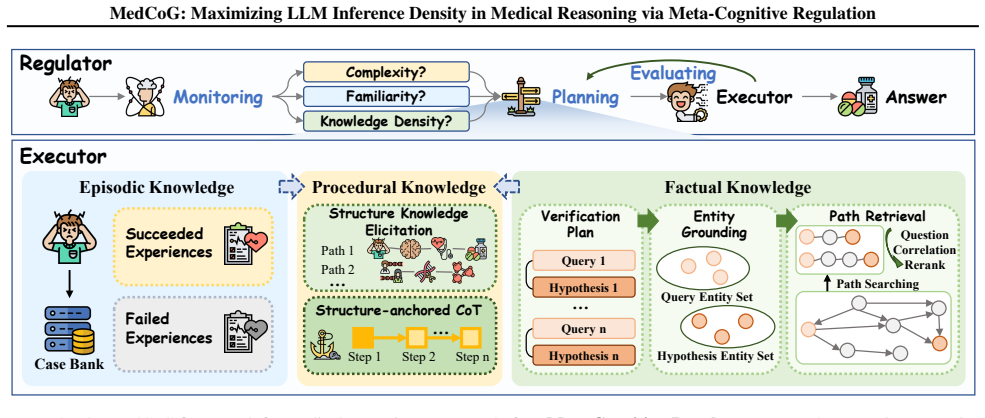
MedCoG treats the LLM as both the reasoner and the dispatcher of its own reasoning. Before answering, a regulator produces three scores for the question—complexity, familiarity, and knowledge density—and a thresholded gate (Eq. 1) chooses among five strategies: zero-shot; structural chain-of-thought alone; chain-of-thought plus a retrieved past case; chain-of-thought plus knowledge-graph verification; or all three. The three knowledge sources are procedural (step-by-step structured reasoning), episodic (similar solved cases), and factual (paths from a medical knowledge graph). Evaluated on hard subsets of five medical benchmarks, the gated version improves average accuracy by 8.7 percent rel
What carries the argument
The load-bearing object is the meta-cognitive state vector s=(s_c,s_f,s_k) and the non-parametric gate in Eq. 1: if none of the three scores clears its fitted threshold, answer directly; otherwise reason with structural CoT, adding episodic memory when familiarity is high and KG verification when knowledge density is high. The thresholds are calibrated on 50 held-out samples. Inference efficiency is quantified by ρ=f^{-1}(Acc_M)/C_M, where f is the log-linear accuracy-cost curve (Eq. 4) fitted to the baseline Pareto frontier; this is the quantity that produces the 5.5× number.
Load-bearing premise
The efficiency claim stands or falls on the fitted log-linear accuracy-cost curve (Eq. 4) being a valid representation of what reference methods cost at each accuracy; if that fit is unstable or not a true Pareto frontier, the 5.5× density is an artifact of the fitting procedure rather than a measured property of MedCoG.
What would settle it
Run all five strategies on the 100-sample MedQA hard set, measure per-sample accuracy and dollar cost, and ask whether the gate's per-sample choices beat always running the most expensive static strategy. If fixed SCoT+KG+Memory at the same or lower average cost matches or exceeds MedCoG-Meta's 52 percent accuracy, the routing claim fails. Separately, refit Eq. 4 leaving out one baseline at a time; if the 5.5× projection moves below 1×, the density metric is an artifact.
If this is right
- If the gate works, every fixed pipeline that spends the same compute and knowledge budget on every question is leaving both accuracy and cost on the table; per-question routing becomes the efficiency baseline.
- The gate needs no fine-tuning: it is a set of three thresholds, so it can be retargeted to new backbones or domains by recalibrating thresholds on a small validation set.
- The oracle gap (67 vs 52 on MedQA-hard) means further gains should come from better calibration of the three scores rather than from adding more knowledge sources.
- Medical QA systems that currently rely on multi-agent or retrieval-heavy workflows can use the density metric to compare alternatives at equal accuracy instead of comparing raw accuracy alone.
- Episodic memory and knowledge-graph facts are complements, not substitutes: the threshold study shows memory helps the model interpret KG paths, so removing either component loses accuracy on hard questions.
Where Pith is reading between the lines
- The 5.5× figure is not a direct cost measurement. It is the inverse of a log-linear curve fitted through a handful of baseline points (R²=0.91), so the number inherits whatever brittleness that fit has; the abstract's 6.2× makes the inconsistency explicit.
- The three meta-cognitive scores are self-reports from the same model that then reasons. Nothing in the paper shows they are measuring distinct latent states rather than one general confidence signal, so a cheap proxy could be tested against them.
- A testable extension: use the same gate on non-medical reasoning benchmarks. The regulator is domain-agnostic, and the paper's own theory predicts the same win-win—less cost, less distraction—wherever scaling gains diminish.
Editorial analysis
A structured set of objections, weighed in public.
Referee Report
Summary. The paper proposes MedCoG, a GPT-4o-based medical reasoning agent with a meta-cognitive regulator that scores each question on complexity, familiarity, and knowledge density and routes it to zero-shot, structural chain-of-thought, KG verification, episodic memory, or combinations. The authors introduce two efficiency metrics: inference density (Eq. 5), defined as the ratio of the cost predicted by a fitted log-linear scaling curve to the method's actual cost, and Inference Incremental Efficiency (IIE, Eq. 6). Experiments on five hard medical subsets report average accuracy 37.5 vs 34.5 for AFlow, an IIE of 0.443, and 5.5× inference density on MedQA; an Oracle that selects the best strategy per sample reaches 98.98 on MedQA-Full. The paper concludes that meta-cognitive regulation mitigates inference scaling laws.
Significance. If the accuracy gain is real and the efficiency metric is robust, the core idea—instance-wise, training-free routing based on LLM self-assessment—is valuable and could reduce inference cost in medical agents. The paper contains useful analyses: strategy distributions across backbones, threshold studies, a detailed error taxonomy, and a memory-evolution experiment. It also provides full prompts (Appendix K) and uses a transparent, non-parametric gate. However, the headline efficiency claim is defined through the paper's own fitted scaling curve and is not yet supported; the accuracy claims lack uncertainty quantification. The IIE metric is a more direct, commendable step, and the revision should reframe the central claims around it.
major comments (4)
- [§3.4, Eq. (5), Fig. 1] The inference density ρ is defined as f^{-1}(Acc_M)/C_M, where f (Eq. 4) is a log-linear fit to baseline Pareto points. MedCoG-META's average accuracy (37.5) lies above the best baseline (AFlow, 34.5), so the effective cost is obtained by extrapolating the fitted curve beyond the data. The paper reports R²=0.91 but no confidence intervals for α and β, no leave-one-out sensitivity, and no list of which baselines define the frontier. Since ρ is exponential in the fitted parameters, small changes in α produce multiplicative changes in ρ. The claim is further weakened by the abstract reporting 6.2× while the main text/Fig. 1 report 5.5×, and by the fact that density is computed on MedQA only (Fig. 1) but is generalized to 'five hard sets' in the abstract. Please report bootstrap CIs, alternative reference sets, and either keep the density claim for MedQA or provide per-dataset densities.
- [§4.1, Table 2, §4.4] The hard subsets contain 73–100 questions. MedCoG-META's average is 37.5 vs AFlow's 34.5, a 3-point difference; on MedQA-H the gap is 52 vs 48, i.e., 4 correct answers out of 100. No error bars, bootstrap CIs, or paired significance tests (e.g., McNemar) are reported. The statement 'outperforms ... by 8.7%' appears to compare average accuracy, but with these sample sizes the difference is within sampling noise. Please provide per-dataset CIs and a paired test across the five datasets.
- [§2, Table 1] The Oracle is constructed by selecting, for each test sample, the strategy that yields the correct answer; reaching 98.98 on MedQA-Full is therefore an upper bound by construction. This does not establish that 'the knowledge capacity and reasoning ability of LLMs are sufficient' or that the bottleneck is solely regulation, because the Oracle also requires ground-truth labels. I recommend rephrasing this as an upper-bound analysis and avoiding the causal claim.
- [§3.2 / §4.3] The policy gate (Eq. 1) has three thresholds calibrated on 50 random training samples. That is a small calibration set for a three-dimensional threshold, and the paper does not report the variance of the final results across different calibration draws or across threshold choices. The threshold studies (Fig. 4) show performance varies with τ, so the reader cannot tell how much of the reported gain depends on the specific calibration. Please include a sensitivity analysis or a bootstrap over calibration sets.
minor comments (5)
- [Abstract vs §3.4] The abstract states 6.2× inference density while the main text and Fig. 1 state 5.5×. Please reconcile.
- [Fig. 1] The fitted scaling curve has no confidence band; the two Pareto frontiers are difficult to distinguish. Please list explicitly which methods are on 'Pareto w/o ours'.
- [Eq. (1) and notation] The symbol M is used both for the strategy and for the meta-cognitive state mapping; this is confusing. Also, 'SCoT' and 'SCOT' are used inconsistently.
- [Appendix G] The in-distribution vs out-of-distribution memory comparison on PubMedQA rests on 10 vs 20 correct answers out of 100; this is not sufficient to support the OOD-transferability claim without error bars.
- [§4.3] The cost of MedCoG should be itemized (monitoring, KG grounding, retrieval, reasoning) to ensure the cost comparison with MedAgentsBench baselines is fair and reproducible.
Circularity Check
No significant circularity: the 5.5× density figure is a defined evaluation metric anchored to an external baseline fit, and the accuracy/IIE claims are benchmarked on held-out sets.
full rationale
MedCoG's central derivations are self-contained. The meta-cognitive gate (Eq. 1) is a defined policy whose thresholds are calibrated on a held-out validation set (50 samples) and then applied to held-out test sets; no fitted parameter is renamed as a prediction. The Oracle row is explicitly labeled an upper bound and selects the optimal strategy per sample by construction, so its high accuracy is not a claim about MedCoG itself. The 5.5× inference density (Eq. 5) is a defined metric: effective cost is the inverse of the baseline-fitted scaling curve (Eq. 4). The paper itself acknowledges that density 'inherently relies on the distribution of reference models.' This makes the density number sensitive to the fit and to the choice of reference methods, which is a measurement-validity/robustness concern, not a circular derivation: f is fitted to baseline points from MedAgentsBench, not to MedCoG, and MedCoG's accuracy is measured externally. Moreover, the paper's efficiency claim is independently supported by IIE (Eq. 6), which is not defined through the scaling-curve fit and compares MedCoG-META directly against the CoT reference on measured accuracy and cost. Self-citations to MedAgents and MedAgentsBench supply benchmark results that are externally falsifiable baseline data, and they do not encode the target result. The stated limitation in Appendix J (distribution shift between validation and test data) and the abstract/main-text discrepancy (6.2× vs 5.5×) are consistency/robustness issues, not circularity. No load-bearing step reduces to its own inputs.
Axiom & Free-Parameter Ledger
free parameters (3)
- Scaling-curve coefficients α, β =
not reported numerically; R²=0.91
- Meta-cognition thresholds τ_c, τ_f, τ_k =
calibrated on 50 held-out training samples; exact values not stated in main text
- Retrieval sizes K =
K=5 for KG paths and K=5 for case bank
axioms (5)
- domain assumption Logarithmic scaling law Acc = α ln(C) + β describes the baseline cost-accuracy frontier.
- domain assumption The LLM's self-reported complexity, familiarity, and knowledge-density scores are informative for strategy selection.
- domain assumption PrimeKG and the MedReason SCoT case bank provide sufficient, unbiased factual and episodic knowledge.
- domain assumption Cost figures and accuracy numbers for baselines from MedAgentsBench are accurate and directly comparable to MedCoG's measured costs.
- domain assumption CoT is the correct reference point for IIE.
read the original abstract
Large Language Models (LLMs) have shown strong potential in complex medical reasoning yet face diminishing gains under inference scaling laws. While existing studies augment LLMs with various knowledge types, it remains unclear how effectively the additional costs translate into accuracy. In this paper, we explore how meta-cognition of LLMs, i.e., their self-assessment of their own cognitive states, can regulate the reasoning process. Specifically, we propose MedCoG, a Medical Meta-Cognition Agent with Knowledge Graph, where the meta-cognitive assessments of task complexity, familiarity, and knowledge density dynamically regulate utilization of procedural, episodic, and factual knowledge. The LLM-centric on-demand reasoning aims to mitigate the diminishing returns under scaling law by (1) reducing costs via avoiding indiscriminate scaling, (2) improving accuracy via filtering out distractive knowledge. To validate this, we empirically characterize the scaling curve and introduce inference density to quantify inference efficiency. Experiments demonstrate the effectiveness and efficiency of MedCoG on five hard sets of medical benchmarks, yielding 6.2x inference density. Furthermore, the Oracle study highlights the significant potential of meta-cognitive regulation.
Figures



Forward citations
Cited by 1 Pith paper
-
MIRROR: A Hierarchical Benchmark for Metacognitive Calibration in Large Language Models
MIRROR benchmark shows LLMs universally fail at compositional self-prediction and cannot translate partial self-knowledge into better agentic actions, with external metacognitive control reducing confident failures by...
Reference graph
Works this paper leans on
-
[1]
Feeling of Knowing: DA and SCoT wrong, SCoT+KG or SCoT+Mem or SCoT+KG+Mem correct / More knowledge strategy correct 13 4
-
[2]
All strategies in strategy pool are correct / selected right strategy 18 52
-
[3]
Synergy Missed: SCoT+KG+Mem correct, SCoT+KG or SCoT+Mem wrong 29 4
-
[4]
Over Reasoning: DA or SCoT correct, SCoT+Mem or SCoT+KG or SCoT+KG+Mem wrong / Less knowledge strategy correct 33 14
-
[5]
KG Noise: SCoT correct, SCoT+KG wrong; SCoT+Mem correct, SCoT+KG+Mem wrong 23 10
-
[6]
Memory Noise: SCoT correct, SCoT+Mem wrong; SCoT+KG correct, SCoT+KG+Mem wrong 20 3
-
[7]
Over-Reasoning
Unsolvable: All strategies are wrong. 33 33 Insights:There are also critical insights that emerge from the data: (1) Only 13 cases in the pool genuinely required external knowledge (Feeling of Knowing), suggesting that knowledge deficits are not the primary cause of difficulty for most hard samples; (2) “Over-Reasoning” still accounted for 14 errors, high...
-
[8]
Information Conflict: SCoT+KG correct and SCoT+Mem correct, SCoT+KG+Mem wrong 5 2
-
[20]
Flank pain → Recent surgical history → Possible complication → Ureteral obstruction → Right flank pain
-
[21]
Flank pain → Costovertebral angle tenderness → Hydronephrosis → Ureteral obstruction → Right flank pain
-
[22]
Intravenous pyelogram findings → Dilated renal pelvis and ureter → Obstruction at ureterovesical junction→Possible surgical or anatomical cause
-
[23]
Reasoning Process:
Ureteral anatomy → Proximity to pelvic structures → Surgical procedure (e.g., hysterectomy) → Ureteral injury→Right flank pain. Reasoning Process:
-
[24]
These symptoms suggest a problem involving the kidney or ureter, such as obstruction or infection
**Symptoms and Physical Exam Findings**: - The patient presents with right flank pain and costovertebral angle tenderness, which are classic signs of renal or ureteral pathology. These symptoms suggest a problem involving the kidney or ureter, such as obstruction or infection
-
[25]
The lack of contrast proximal to the ureterovesical junction indicates a blockage at this location
**Imaging Findings**: - The intravenous pyelogram shows a dilated renal pelvis and ureter on the right side, which is consistent with hydronephrosis. The lack of contrast proximal to the ureterovesical junction indicates a blockage at this location
-
[26]
Given the recent onset of symptoms following a procedure, a surgical complication is a strong possibility
**Possible Causes of Ureteral Obstruction**: - Ureteral obstruction can result from intrinsic causes (e.g., stones, strictures, tumors) or extrinsic causes (e.g., compression or injury from nearby structures). Given the recent onset of symptoms following a procedure, a surgical complication is a strong possibility
-
[27]
Ureteral injury during a hysterectomy is a known complication, often due to accidental ligation, kinking, or cutting of the ureter
**Surgical History and Anatomical Considerations**: - The ureter runs close to the uterus and can be injured during pelvic surgeries, such as a hysterectomy. Ureteral injury during a hysterectomy is a known complication, often due to accidental ligation, kinking, or cutting of the ureter. This could explain the obstruction at the ureterovesical junction a...
-
[28]
The right-sided findings suggest that the procedure likely involved manipulation or injury to the right ureter
**Correlation with the Patient’s Presentation**: - The timing of the symptoms (3 days after a procedure) aligns with the development of hydronephrosis due to ureteral obstruction. The right-sided findings suggest that the procedure likely involved manipulation or injury to the right ureter. 24 MedCoG: Maximizing LLM Inference Density in Medical Reasoning ...
-
[29]
Right flank pain and tenderness → Ultrasound shows right ureter and renal pelvis dilation → Possible obstruction→Common iliac artery aneurysm causing compression
-
[30]
Reasoning Process:
Peripheral artery disease → Vascular alterations → Potential for iliac artery aneurysm → Compression of the ureter leading to obstruction and hydronephrosis. Reasoning Process:
-
[31]
These symptoms suggest a possible obstruction or compressive cause in the urinary tract
**Symptom Analysis**: The patient, a 68-year-old male with diabetes and peripheral artery disease, presents with right flank pain, abdominal tenderness, and right flank tenderness. These symptoms suggest a possible obstruction or compressive cause in the urinary tract
-
[32]
This aligns with the findings of abdominal and flank tenderness, indicating possible urinary tract blockage
**Imaging and Physical Examination**: The ultrasound showing dilation of the right ureter and renal pelvis suggests hydronephrosis due to a possible obstruction at or below the level of the ureter. This aligns with the findings of abdominal and flank tenderness, indicating possible urinary tract blockage
-
[33]
This is significant because an aneurysm in the common iliac artery can exert pressure on nearby structures, such as the ureter, causing obstruction
**Underlying Causes**: - **Peripheral Artery Disease Influence**: The patient’s history of peripheral artery disease can predispose him to vascular complications such as aneurysms. This is significant because an aneurysm in the common iliac artery can exert pressure on nearby structures, such as the ureter, causing obstruction. - **Path Verification**: Th...
-
[34]
- Benign prostatic hyperplasia would primarily cause lower urinary tract symptoms rather than isolated ureteral dilation
**Exclusion of Other Options**: - Renal artery stenosis typically presents with hypertension and not flank pain. - Benign prostatic hyperplasia would primarily cause lower urinary tract symptoms rather than isolated ureteral dilation. - Urethral stricture is more likely to cause bladder-level or bilateral kidney problems rather than unilateral
-
[35]
**Connecting Evidence**: The plausible connection of peripheral artery disease leading to complications in iliac artery integrity supports the hypothesis that a common iliac artery aneurysm is the most likely cause of the observed hydronephrosis. FINAL ANSWER: C Post-hoc Evaluation (GPT-5.2) KG Evaluation Score(Assign a score between 0 and 1 reflecting th...
-
[61]
[Key concept from Question] -> [Relation] -> [Intermediate concept] -> [Key entity from ,→Option]
-
[72]
[Key observation from Question] -> [Intermediate concept] -> [Key conclusion from ,→Option]) 8 9### Reasoning Process: 10(Generate a step-by-step reasoning process to solve the problem. Ensure the steps are ,→logical and concise.) 21 MedCoG: Maximizing LLM Inference Density in Medical Reasoning via Meta-Cognitive Regulation 11 12### FINAL ANSWER: [Option ...
-
[91]
**Complexity (0-1): ** Does it require multi-hop reasoning or logic? (1=High complexity)
-
[101]
Assess if the retrieved paths provide a COMPLETE and LOGICAL answer to the query
-
[102]
**Familiarity (0-1): ** Is it a standard clinical case of common knowledge or a rare ,→clinical case of a hard reasoning pattern? (1=High familiarity)
-
[112]
Identify specific gaps (e.g., missing drug side effects, broken relationship between A ,→and B)
-
[113]
complexity\
**Knowledge-Density (0-1): ** Does it rely on specific, obscure medical knowledge, ,→including medical concepts or entities (genes, rare drugs)? (1=High density) 12 13 **STRATEGY SELECTION: ** 14- **DIRECT:** If Complexity < 0.5. (Simple/General knowledge) 15- **MEMORY_RECALL:** If Familiarity > 0.5. (Standard but complex cases, use similar past ,→cases/C...
-
[123]
sufficient
If information is missing, provide a SPECIFIC instruction for the next planning ,→question and hypothesis step. 13 14Output format strictly as JSON: 15{{ 16"sufficient": boolean, 17"reasoning": "short explanation", 18"feedback_for_planner": "Direct instruction on what to question and hypothesis for ,→next plan. E.g., ’The path mentions X but not its dosag...
-
[232]
Ensure the steps are ,→logical and concise.) 27 28### FINAL ANSWER: [Option Letter] 29 30 **CONSTRAINTS:** 31- Your final answer should be the Option Letter only, e.g., A, B,
[Key observation from Question] -> [Intermediate concept] -> [Key conclusion from ,→Option]) 24 25### Reasoning Process: 26(Generate a step-by-step reasoning process to solve the problem. Ensure the steps are ,→logical and concise.) 27 28### FINAL ANSWER: [Option Letter] 29 30 **CONSTRAINTS:** 31- Your final answer should be the Option Letter only, e.g., ...
-
[2025]
monitor-evaluate-correction
enables agentic knowledge graph RAG and achieves autonomous medical KG construction and continuous updating. Moreover, interactive medical RAG frameworks like AgentClinic (Schmidgall et al., 2024), AgentHospital (Li et al., 2024a), and Mediq (Li et al., 2024b) simulate the entire clinical decision-making process in virtual hospital environments. While 12 ...
2024
discussion (0)
Sign in with ORCID, Apple, or X to comment. Anyone can read and Pith papers without signing in.