Recognition: 2 theorem links
· Lean TheoremCancellation of one-parameter graviton gauge dependence in the effective scalar field equation in de Sitter
Pith reviewed 2026-05-16 06:31 UTC · model grok-4.3
The pith
Gauge dependence cancels in one-graviton-loop corrections to the effective scalar field equation in de Sitter when all diagram classes are collected.
A machine-rendered reading of the paper's core claim, the machinery that carries it, and where it could break.
Core claim
We show that the gauge-dependent contributions to the effective self-mass of the scalar cancel when the contributions from all diagram classes are collected, including one-loop corrections to external mode functions, which play a qualitatively new role relative to flat space. This supports the construction of graviton gauge-independent cosmological quantum-gravitational observables from quantum-corrected effective equations.
What carries the argument
The Δα variation of the de Sitter-breaking graviton propagator in a one-parameter family of gauges, which isolates the gauge-dependent parts that must cancel across diagram classes.
If this is right
- Effective equations for scalars in de Sitter become gauge-independent at one-graviton-loop order.
- One-loop corrections to external mode functions are essential for cancellation, unlike in flat space.
- Quantum-corrected effective equations can yield reliable cosmological observables independent of graviton gauge choice.
Where Pith is reading between the lines
- The result suggests that similar cancellations may hold for other fields or higher loops in de Sitter.
- Future work could test this by computing in a two-parameter gauge family to confirm full independence.
- This approach might extend to deriving gauge-invariant quantities in inflationary cosmology models.
Load-bearing premise
The one-parameter family of gauges and the Δα variation of the de Sitter-breaking graviton propagator capture all gauge dependence without introducing artifacts from other gauge-fixing methods.
What would settle it
A calculation of the effective scalar equation in a gauge outside the one-parameter family that shows remaining gauge dependence after including all diagrams would falsify the cancellation claim.
Figures


read the original abstract
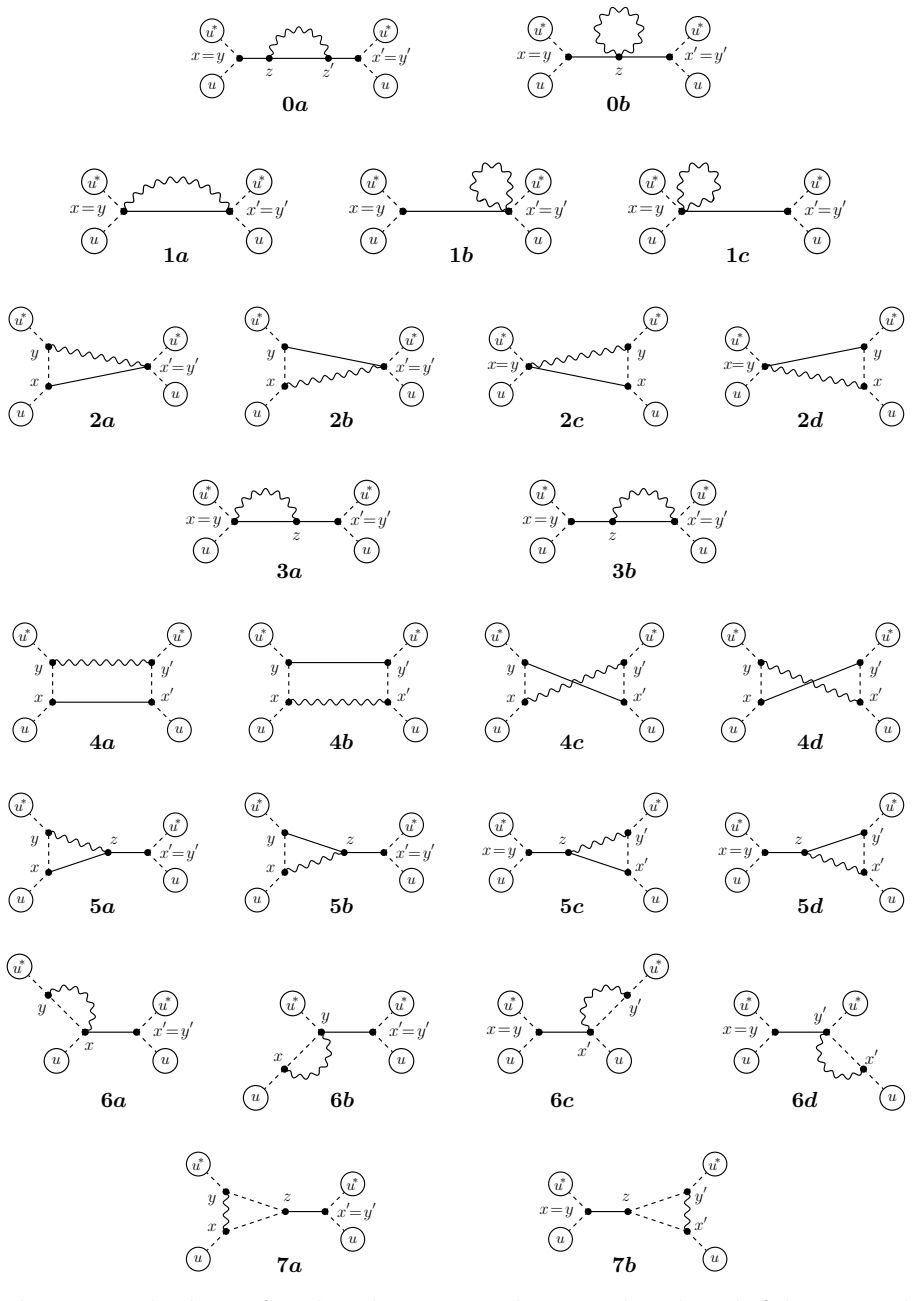
We investigate gauge dependence of one-graviton-loop corrections to the effective field equation of the massless, minimally coupled scalar in de Sitter, obtained by including source and observer corrections to the effective self-mass correcting the equation. Using the $\Delta\alpha$ variation of the de Sitter-breaking graviton propagator in a one-parameter family of gauges, we compute the gauge-dependent contributions to the effective self-mass of a massless minimally coupled scalar mediating interactions between heavy scalars. We show that gauge dependence cancels provided the contributions from all diagram classes are collected, including one-loop corrections to external mode functions, which play a qualitatively new role relative to flat space. The resulting cancellation supports the construction of graviton gauge-independent cosmological quantum-gravitational observables from quantum-corrected effective equations.
Editorial analysis
A structured set of objections, weighed in public.
Referee Report
Summary. The manuscript claims that one-parameter graviton gauge dependence cancels in the one-loop effective self-mass for a massless minimally coupled scalar in de Sitter when all diagram classes are summed, including one-loop corrections to external mode functions. This is shown by computing the Δα variation of the de Sitter-breaking graviton propagator within a one-parameter gauge family and demonstrating explicit cancellation of gauge-dependent terms.
Significance. If the cancellation holds, the result is significant because it supports the construction of gauge-independent cosmological observables from quantum-corrected effective equations. The qualitative new role played by external mode function corrections (absent in flat-space analogs) strengthens the case for using effective field equations in de Sitter quantum gravity.
major comments (2)
- [Abstract and §3 (gauge variation procedure)] The central cancellation result is obtained solely via Δα variation inside a one-parameter gauge family. This does not automatically exhaust all possible gauge artifacts, since de Sitter graviton propagators admit additional gauge-fixing structures (non-linear or non-covariant) whose variations are not generated by Δα; any residual dependence would survive the diagram summation and undermine the gauge-independent observable claim. A concrete cross-check against at least one alternative gauge-fixing term is required.
- [Abstract] The abstract asserts that gauge dependence cancels 'provided the contributions from all diagram classes are collected' but supplies no explicit intermediate expressions, summed diagrams, or error estimates. Without these, the claim that external-leg corrections play a qualitatively new role cannot be verified at the level needed for a load-bearing result.
minor comments (1)
- [§2] Clarify the precise definition of the one-parameter family and the explicit form of the de Sitter-breaking propagator used for the Δα derivative.
Simulated Author's Rebuttal
We thank the referee for the thorough review and insightful comments on our manuscript. We address the major comments in detail below and have revised the manuscript to incorporate the feedback where possible.
read point-by-point responses
-
Referee: [Abstract and §3 (gauge variation procedure)] The central cancellation result is obtained solely via Δα variation inside a one-parameter gauge family. This does not automatically exhaust all possible gauge artifacts, since de Sitter graviton propagators admit additional gauge-fixing structures (non-linear or non-covariant) whose variations are not generated by Δα; any residual dependence would survive the diagram summation and undermine the gauge-independent observable claim. A concrete cross-check against at least one alternative gauge-fixing term is required.
Authors: We agree that our use of the Δα variation within the one-parameter gauge family does not address all possible gauge-fixing structures, such as non-linear or non-covariant terms. Our focus is on the standard one-parameter family of gauges, which is widely used for the de Sitter graviton propagator and captures the gauge dependence relevant to the de Sitter-breaking terms. We have revised the manuscript to clarify this scope and to emphasize that the cancellation holds within this family, supporting gauge-independent observables in this context. A comprehensive check against alternative gauge fixings would require a separate investigation. revision: partial
-
Referee: [Abstract] The abstract asserts that gauge dependence cancels 'provided the contributions from all diagram classes are collected' but supplies no explicit intermediate expressions, summed diagrams, or error estimates. Without these, the claim that external-leg corrections play a qualitatively new role cannot be verified at the level needed for a load-bearing result.
Authors: The abstract summarizes the main result, while the explicit calculations of the gauge variation, diagram contributions, and their summation—including the external mode function corrections—are provided in detail in Section 3 and the appendices. To improve verifiability, we have revised the manuscript to include additional intermediate expressions and a clearer presentation of how the external corrections contribute to the cancellation, highlighting their new role compared to flat space. As the result is an exact cancellation, error estimates are not required. revision: yes
- A concrete cross-check against at least one alternative gauge-fixing term.
Circularity Check
No significant circularity; direct variation and summation
full rationale
The derivation proceeds by explicit computation: the Δα variation is applied to the de Sitter-breaking graviton propagator within the stated one-parameter family, contributions from all diagram classes (including external mode-function corrections) are evaluated term-by-term, and their sum is shown to cancel the gauge dependence. This cancellation is obtained from the algebra of the variation and the diagram summation rather than by fitting parameters, redefining inputs, or reducing to a prior self-citation as a uniqueness theorem. The central claim therefore retains independent computational content and does not collapse to its inputs by construction.
Axiom & Free-Parameter Ledger
free parameters (1)
- gauge parameter α
axioms (1)
- domain assumption Existence and form of the de Sitter-breaking graviton propagator in the chosen gauge family
Lean theorems connected to this paper
-
IndisputableMonolith/Foundation/RealityFromDistinction.leanreality_from_one_distinction unclear?
unclearRelation between the paper passage and the cited Recognition theorem.
Using the Δα variation of the de Sitter-breaking graviton propagator in a one-parameter family of gauges, we compute the gauge-dependent contributions to the effective self-mass... We show that gauge dependence cancels provided the contributions from all diagram classes are collected, including one-loop corrections to external mode functions
-
IndisputableMonolith/Cost/FunctionalEquation.leanwashburn_uniqueness_aczel unclear?
unclearRelation between the paper passage and the cited Recognition theorem.
the resulting cancellation supports the construction of graviton gauge-independent cosmological quantum-gravitational observables from quantum-corrected effective equations
What do these tags mean?
- matches
- The paper's claim is directly supported by a theorem in the formal canon.
- supports
- The theorem supports part of the paper's argument, but the paper may add assumptions or extra steps.
- extends
- The paper goes beyond the formal theorem; the theorem is a base layer rather than the whole result.
- uses
- The paper appears to rely on the theorem as machinery.
- contradicts
- The paper's claim conflicts with a theorem or certificate in the canon.
- unclear
- Pith found a possible connection, but the passage is too broad, indirect, or ambiguous to say the theorem truly supports the claim.
Forward citations
Cited by 1 Pith paper
-
Genericness of quantum damping of cosmological shear in modified loop quantum cosmology
For genuine 3D collapsing Bianchi I initial conditions in mLQC-I, quantum effects damp shear exponentially after the bounce, yielding an isotropic attractor independent of matter content under the weak energy condition.
Reference graph
Works this paper leans on
-
[1]
Particle creation in expanding universes,
L. Parker, “Particle creation in expanding universes,” Phys. Rev. Lett. 21 (1968), 562-564
work page 1968
-
[2]
Quantum Fluctuations and a Nonsingular Universe,
V. F. Mukhanov and G. V. Chibisov, “Quantum Fluctuations and a Nonsingular Universe,” JETP Lett. 33 (1981), 532-535
work page 1981
-
[3]
Spectrum of relict gravitational ra diation and the early state of the universe,
A. A. Starobinsky, “Spectrum of relict gravitational ra diation and the early state of the universe,” JETP Lett. 30 (1979), 682-685
work page 1979
-
[4]
Planck 2018 results. X. Constraints on inflation
Y. Akrami et al. [Planck], “Planck 2018 results. X. Constraints on inflation ,” Astron. As- trophys. 641 (2020), A10 [arXiv:1807.06211 [astro-ph.CO]]
work page internal anchor Pith review Pith/arXiv arXiv 2018
-
[5]
General relativity as an effective field theory: The leading quantum corrections
J. F. Donoghue, “General relativity as an effective field th eory: The leading quantum corrections,” Phys. Rev. D 50 (1994), 3874-3888 [arXiv:gr-qc/9405057 [gr-qc]]
work page internal anchor Pith review Pith/arXiv arXiv 1994
-
[6]
Introduction to the effective field theory description of gravity,
J. F. Donoghue, “Introduction to the effective field theory description of gravity,” [arXiv:gr- qc/9512024 [gr-qc]]
-
[7]
Quantum Gravity in Everyday Life: General Relativity as an Effective Field Theory
C. P. Burgess, “Quantum gravity in everyday life: Genera l relativity as an effective field theory,” Living Rev. Rel. 7 (2004), 5-56 [arXiv:gr-qc/0311082 [gr-qc]]
work page internal anchor Pith review Pith/arXiv arXiv 2004
-
[8]
The effective field theory treatment of quantum gravity
J. F. Donoghue, “The effective field theory treatment of qua ntum gravity,” AIP Conf. Proc. 1483 (2012) no.1, 73-94 [arXiv:1209.3511 [gr-qc]]
work page internal anchor Pith review Pith/arXiv arXiv 2012
-
[9]
Quantum gravity as a low energy effective fiel d theory,
J. Donoghue, “Quantum gravity as a low energy effective fiel d theory,” Scholarpedia 12 (2017) no.4, 32997 36
work page 2017
-
[10]
Quantum General Relativity and Effectiv e Field Theory,
J. F. Donoghue, “Quantum General Relativity and Effectiv e Field Theory,” in Handbook of Quantum Gravity, C. Bambi, L. Modesto and I. Shapiro, Spri nger, Singapore (2023) [arXiv:2211.09902 [hep-th]]
-
[11]
One loop corrected conformally coupled scalar mode equations during inflation
S. Boran, E. O. Kahya and S. Park, “One loop corrected con formally coupled scalar mode equations during inflation,” Phys. Rev. D 96 (2017) no.10, 105003 [erratum: Phys. Rev. D 98 (2018) no.2, 029903] [arXiv:1708.01831 [gr-qc]]
work page internal anchor Pith review Pith/arXiv arXiv 2017
-
[12]
One -loop Graviton Corrections to Conformal Scalars on a de Sitter Background,
D. Glavan, S. P. Miao, T. Prokopec and R. P. Woodard, “One -loop Graviton Corrections to Conformal Scalars on a de Sitter Background,” Phys. Rev. D 103 (2021) no.10, 105022 [arXiv:2007.10395 [gr-qc]]
-
[13]
Gravitons Enhance Fermions during Inflation
S. P. Miao and R. P. Woodard, “Gravitons Enhance Fermion s during Inflation,” Phys. Rev. D 74 (2006), 024021 [arXiv:gr-qc/0603135 [gr-qc]]
work page internal anchor Pith review Pith/arXiv arXiv 2006
-
[14]
Electrodynamic Effects of Inflationary Gravitons
D. Glavan, S. P. Miao, T. Prokopec and R. P. Woodard, “Ele ctrodynamic Effects of Infla- tionary Gravitons,” Class. Quant. Grav. 31 (2014), 175002 [arXiv:1308.3453 [gr-qc]]
work page internal anchor Pith review Pith/arXiv arXiv 2014
-
[15]
Excitation of Photons by Inflationary Gravitons
C. L. Wang and R. P. Woodard, “Excitation of Photons by In flationary Gravitons,” Phys. Rev. D 91 (2015) no.12, 124054 [arXiv:1408.1448 [gr-qc]]
work page internal anchor Pith review Pith/arXiv arXiv 2015
-
[16]
How inflationary g ravitons affect gravitational radiation,
L. Tan, N. C. Tsamis and R. P. Woodard, “How inflationary g ravitons affect gravitational radiation,” Phil. Trans. Roy. Soc. Lond. A 380 (2021), 0187 [arXiv:2107.13905 [gr-qc]]
-
[17]
D. Glavan, S. P. Miao, T. Prokopec and R. P. Woodard, “Lar ge logarithms from quantum gravitational corrections to a massless, minimally couple d scalar on de Sitter,” JHEP 03 (2022), 088 [arXiv:2112.00959 [gr-qc]]
-
[18]
How Inflationary G ravitons Affect the Force of Gravity,
L. Tan, N. C. Tsamis and R. P. Woodard, “How Inflationary G ravitons Affect the Force of Gravity,” Universe 8 (2022) no.7, 376 [arXiv:2206.11467 [gr-qc]]
-
[19]
Summing inflat ionary logarithms in nonlinear sigma models,
S. P. Miao, N. C. Tsamis and R. P. Woodard, “Summing inflat ionary logarithms in nonlinear sigma models,” JHEP 03 (2022), 069 [arXiv:2110.08715 [gr-qc]]
-
[20]
Exp laining large electromagnetic logarithms from loops of inflationary gravitons,
D. Glavan, S. P. Miao, T. Prokopec and R. P. Woodard, “Exp laining large electromagnetic logarithms from loops of inflationary gravitons,” JHEP 08 (2023), 195 [arXiv:2307.09386 [gr-qc]]
-
[21]
The Structure of perturb ative quantum gravity on a De Sitter background,
N. C. Tsamis and R. P. Woodard, “The Structure of perturb ative quantum gravity on a De Sitter background,” Commun. Math. Phys. 162 (1994), 217-248
work page 1994
-
[22]
de Sitter breaking in field theory,
R. P. Woodard, “de Sitter breaking in field theory,” publ ished in “Deserfest: A Celebra- tion of the Life and Works of Stanley Deser” (Eds. J. T. Liu, M. J. Duff, K. S. Stelle, R. P. Woodard), World Scientific (2006), [arXiv:gr-qc/0408 002 [gr-qc]]
work page 2006
-
[23]
One Loop Graviton Self-Energy In A Locally De Sitter Background
N. C. Tsamis and R. P. Woodard, “One loop graviton selfen ergy in a locally de Sitter background,” Phys. Rev. D 54 (1996), 2621-2639 [arXiv:hep-ph/9602317 [hep-ph]]
work page internal anchor Pith review Pith/arXiv arXiv 1996
-
[24]
The Fermion Self-Energy during Inflation
S. P. Miao and R. P. Woodard, “The Fermion self-energy du ring inflation,” Class. Quant. Grav. 23 (2006), 1721-1762 [arXiv:gr-qc/0511140 [gr-qc]]
work page internal anchor Pith review Pith/arXiv arXiv 2006
-
[25]
Quantum Gravity Corrections to the One Loop Scalar Self-Mass during Inflation
E. O. Kahya and R. P. Woodard, “Quantum Gravity Correcti ons to the One Loop Scalar Self-Mass during Inflation,” Phys. Rev. D 76 (2007), 124005 [arXiv:0709.0536 [gr-qc]]
work page internal anchor Pith review Pith/arXiv arXiv 2007
-
[26]
Quantum Gravitational Effects on Massive Fermions during Inflation I
S. P. Miao, “Quantum Gravitational Effects on Massive Fer mions during Inflation I,” Phys. Rev. D 86 (2012), 104051 [arXiv:1207.5241 [gr-qc]]. 37
work page internal anchor Pith review Pith/arXiv arXiv 2012
-
[27]
Graviton Corrections to Vacuum Polarization during Inflation
K. E. Leonard and R. P. Woodard, “Graviton Corrections t o Vacuum Polarization during Inflation,” Class. Quant. Grav. 31 (2014), 015010 [arXiv:1304.7265 [gr-qc]]
work page internal anchor Pith review Pith/arXiv arXiv 2014
-
[28]
D. Glavan, S. P. Miao, T. Prokopec and R. P. Woodard, “Sin gle graviton loop contribution to the self-mass of a massless, conformally coupled scalar o n a de Sitter background,” Phys. Rev. D 101 (2020) no.10, 106016 [arXiv:2003.02549 [gr-qc]]
-
[29]
de Sitter invariance of the dS graviton vacuum
A. Higuchi, D. Marolf and I. A. Morrison, “de Sitter inva riance of the dS graviton vacuum,” Class. Quant. Grav. 28 (2011), 245012 [arXiv:1107.2712 [hep-th]]
work page internal anchor Pith review Pith/arXiv arXiv 2011
-
[30]
S. P. Miao, N. C. Tsamis and R. P. Woodard, “Gauging away P hysics,” Class. Quant. Grav. 28 (2011), 245013 [arXiv:1107.4733 [gr-qc]]
work page internal anchor Pith review Pith/arXiv arXiv 2011
-
[31]
On cosmic hair and "de Sitter breaking" in linearized quantum gravity
I. A. Morrison, “On cosmic hair and ”de Sitter breaking” in linearized quantum gravity,” [arXiv:1302.1860 [gr-qc]]
work page internal anchor Pith review Pith/arXiv arXiv
-
[32]
The Perils of Analytic Continuation
S. P. Miao, P. J. Mora, N. C. Tsamis and R. P. Woodard, “Per ils of analytic continuation,” Phys. Rev. D 89 (2014) no.10, 104004 [arXiv:1306.5410 [gr-qc]]
work page internal anchor Pith review Pith/arXiv arXiv 2014
-
[33]
Graviton Propagator in a General Invariant Gauge on de Sitter
P. J. Mora, N. C. Tsamis and R. P. Woodard, “Graviton Prop agator in a General Invariant Gauge on de Sitter,” J. Math. Phys. 53 (2012), 122502 [arXiv:1205.4468 [gr-qc]]
work page internal anchor Pith review Pith/arXiv arXiv 2012
-
[34]
Graviton Loop Corrections to Vacuum Polarization in de Sitter in a General Covariant Gauge
D. Glavan, S. P. Miao, T. Prokopec and R. P. Woodard, “Gra viton Loop Corrections to Vacuum Polarization in de Sitter in a General Covariant Gaug e,” Class. Quant. Grav. 32 (2015) no.19, 195014 [arXiv:1504.00894 [gr-qc]]
work page internal anchor Pith review Pith/arXiv arXiv 2015
-
[35]
One loop graviton corrections to dynamical photons in de Sitter
D. Glavan, S. P. Miao, T. Prokopec and R. P. Woodard, “One loop graviton correc- tions to dynamical photons in de Sitter,” Class. Quant. Grav . 34 (2017) no.8, 085002 [arXiv:1609.00386 [gr-qc]]
work page internal anchor Pith review Pith/arXiv arXiv 2017
-
[36]
Deducing Cosmological Observables from the S-matrix
S. P. Miao, T. Prokopec and R. P. Woodard, “Deducing Cosm ological Observables from the S-matrix,” Phys. Rev. D 96 (2017) no.10, 104029 [arXiv:1708.06239 [gr-qc]]
work page internal anchor Pith review Pith/arXiv arXiv 2017
-
[37]
Graviton Corrections to Maxwell's Equations
K. E. Leonard and R. P. Woodard, “Graviton Corrections t o Maxwell’s Equations,” Phys. Rev. D 85 (2012), 104048 [arXiv:1202.5800 [gr-qc]]
work page internal anchor Pith review Pith/arXiv arXiv 2012
-
[38]
Leading Quantum Correction to the Newtonian Potential
J. F. Donoghue, “Leading quantum correction to the Newt onian potential,” Phys. Rev. Lett. 72 (1994), 2996-2999 [arXiv:gr-qc/9310024 [gr-qc]]
work page internal anchor Pith review Pith/arXiv arXiv 1994
-
[39]
Leading quantum gravitational corrections to scalar QED
N. E. J. Bjerrum-Bohr, “Leading quantum gravitational corrections to scalar QED,” Phys. Rev. D 66 (2002), 084023 [arXiv:hep-th/0206236 [hep-th]]
work page internal anchor Pith review Pith/arXiv arXiv 2002
-
[40]
Quantum Gravitational Corrections to the Nonrelativistic Scattering Potential of Two Masses
N. E. J. Bjerrum-Bohr, J. F. Donoghue and B. R. Holstein, “Quantum gravitational cor- rections to the nonrelativistic scattering potential of tw o masses,” Phys. Rev. D 67 (2003), 084033 [erratum: Phys. Rev. D 71 (2005), 069903] [arXiv:hep-th/0211072 [hep-th]]
work page internal anchor Pith review Pith/arXiv arXiv 2003
-
[41]
On the formu lation of quantized field theories,
H. Lehmann, K. Symanzik and W. Zimmermann, “On the formu lation of quantized field theories,” Nuovo Cim. 1 (1955), 205-225
work page 1955
-
[42]
Perturbative S-matrix for massive scalar fields in global de Sitter space
D. Marolf, I. A. Morrison and M. Srednicki, “Perturbati ve S-matrix for massive scalar fields in global de Sitter space,” Class. Quant. Grav. 30, 155023 (2013) [arXiv:1209.6039 [hep-th]]
work page internal anchor Pith review Pith/arXiv arXiv 2013
-
[43]
S. Melville and G. L. Pimentel, “de Sitter S matrix for th e masses,” Phys. Rev. D 110 (2024) no.10, 103530 [arXiv:2309.07092 [hep-th]]
-
[44]
S. Melville and G. L. Pimentel, “A de Sitter S-matrix fro m amputated cosmological corre- lators,” JHEP 08 (2024), 211 [arXiv:2404.05712 [hep-th]]. 38
-
[45]
On the power counting of loop diagrams in general relativity
J. F. Donoghue and T. Torma, “On the power counting of loo p diagrams in general rela- tivity,” Phys. Rev. D 54 (1996), 4963-4972 [arXiv:hep-th/9602121 [hep-th]]
work page internal anchor Pith review Pith/arXiv arXiv 1996
-
[46]
Gauge independent quantu m gravitational corrections to Maxwell’s equation,
S. Katuwal and R. P. Woodard, “Gauge independent quantu m gravitational corrections to Maxwell’s equation,” JHEP 10 (2021), 029 [arXiv:2107.13341 [gr-qc]]
-
[47]
Gra viton Propagator in a 2- Parameter Family of de Sitter Breaking Gauges,
D. Glavan, S. P. Miao, T. Prokopec and R. P. Woodard, “Gra viton Propagator in a 2- Parameter Family of de Sitter Breaking Gauges,” JHEP 10 (2019), 096 [arXiv:1908.06064 [gr-qc]]
-
[48]
Graviton propagator in de Sitter space in a s imple one-parameter gauge,
D. Glavan, “Graviton propagator in de Sitter space in a s imple one-parameter gauge,” [arXiv:2511.13660 [gr-qc]]
-
[49]
Gau ge independent logarithms from inflationary gravitons,
D. Glavan, S. P. Miao, T. Prokopec and R. P. Woodard, “Gau ge independent logarithms from inflationary gravitons,” JHEP 03 (2024), 129 [arXiv:2402.05452 [hep-th]]
-
[50]
Gauge Invariant Cosmological Perturba tions,
J. M. Bardeen, “Gauge Invariant Cosmological Perturba tions,” Phys. Rev. D 22, 1882-1905 (1980)
work page 1905
-
[51]
Physical Green’s Functi ons in Quantum Gravity,
N. C. Tsamis and R. P. Woodard, “Physical Green’s Functi ons in Quantum Gravity,” Annals Phys. 215, 96-155 (1992)
work page 1992
-
[52]
Quantum Gravity: a Progress Report
S. Carlip, “Quantum gravity: A Progress report,” Rept. Prog. Phys. 64, 885 (2001) [arXiv:gr-qc/0108040 [gr-qc]]
work page internal anchor Pith review Pith/arXiv arXiv 2001
-
[53]
A Scalar Measure Of The Local Expansion Rate
L. R. Abramo and R. P. Woodard, “A Scalar measure of the lo cal expansion rate,” Phys. Rev. D 65, 043507 (2002) [arXiv:astro-ph/0109271 [astro-ph]]
work page internal anchor Pith review Pith/arXiv arXiv 2002
-
[54]
Back Reaction And Local Cosmological Expansion Rate
G. Geshnizjani and R. Brandenberger, “Back reaction an d local cosmological expansion rate,” Phys. Rev. D 66, 123507 (2002) [arXiv:gr-qc/0204074 [gr-qc]]
work page internal anchor Pith review Pith/arXiv arXiv 2002
-
[55]
Observables in effective gravity
S. B. Giddings, D. Marolf and J. B. Hartle, “Observables in effective gravity,” Phys. Rev. D 74, 064018 (2006) [arXiv:hep-th/0512200 [hep-th]]
work page internal anchor Pith review Pith/arXiv arXiv 2006
-
[56]
Loops in inflationary correlation functions
T. Tanaka and Y. Urakawa, “Loops in inflationary correla tion functions,” Class. Quant. Grav. 30, 233001 (2013) [arXiv:1306.4461 [hep-th]]
work page internal anchor Pith review Pith/arXiv arXiv 2013
-
[57]
Diffeomorphism-invariant observables and their nonlocal algebra
W. Donnelly and S. B. Giddings, “Diffeomorphism-invaria nt observables and their nonlocal algebra,” Phys. Rev. D 93, no.2, 024030 (2016) [erratum: Phys. Rev. D 94, no.2, 029903 (2016)] [arXiv:1507.07921 [hep-th]]
work page internal anchor Pith review Pith/arXiv arXiv 2016
-
[58]
Local and gauge invariant observables in gravity
I. Khavkine, “Local and gauge invariant observables in gravity,” Class. Quant. Grav. 32, no.18, 185019 (2015) [arXiv:1503.03754 [gr-qc]]
work page internal anchor Pith review Pith/arXiv arXiv 2015
-
[59]
Comments on Microcausality, Chaos, and Gravitational Observables
D. Marolf, “Comments on Microcausality, Chaos, and Gra vitational Observables,” Class. Quant. Grav. 32, no.24, 245003 (2015) [arXiv:1508.00939 [gr-qc]]
work page internal anchor Pith review Pith/arXiv arXiv 2015
-
[60]
Gauge-invariant quantum gravitational corrections to correlation functions
M. B. Fr¨ ob, “Gauge-invariant quantum gravitational c orrections to correlation functions,” Class. Quant. Grav. 35, no.5, 055006 (2018) [arXiv:1710.00839 [gr-qc]]
work page internal anchor Pith review Pith/arXiv arXiv 2018
-
[61]
Propagators for gauge-invariant observables in cosmology
M. B. Fr¨ ob and W. C. C. Lima, “Propagators for gauge-invariant observables in cosmology,” Class. Quant. Grav. 35, no.9, 095010 (2018) [arXiv:1711.08470 [gr-qc]]
work page internal anchor Pith review Pith/arXiv arXiv 2018
-
[62]
Gravitational Observables and Local Symmetries
C. G. Torre, “Gravitational observables and local symm etries,” Phys. Rev. D 48, R2373- R2376 (1993) [arXiv:gr-qc/9306030 [gr-qc]]
work page internal anchor Pith review Pith/arXiv arXiv 1993
-
[63]
Issues Concerning Loop Corrections to the Primordial Power Spectra
S. P. Miao and R. P. Woodard, “Issues Concerning Loop Cor rections to the Primordial Power Spectra,” JCAP 07, 008 (2012) [arXiv:1204.1784 [astro-ph.CO]]. 39
work page internal anchor Pith review Pith/arXiv arXiv 2012
-
[64]
Invariant Measure of the One Loop Quantum Gravitational Back-Reaction on Inflation
S. P. Miao, N. C. Tsamis and R. P. Woodard, “Invariant mea sure of the one-loop quan- tum gravitational backreaction on inflation,” Phys. Rev. D 95, no.12, 125008 (2017) [arXiv:1702.05694 [gr-qc]]
work page internal anchor Pith review Pith/arXiv arXiv 2017
-
[65]
M. B. Fr¨ ob, “One-loop quantum gravitational correcti ons to the scalar two-point function at fixed geodesic distance,” Class. Quant. Grav. 35, no.3, 035005 (2018) [arXiv:1706.01891 [hep-th]]
work page internal anchor Pith review Pith/arXiv arXiv 2018
-
[66]
On the Multiplicat ion of the causal function in the quantum theory of fields,
N. N. Bogoliubov and O. S. Parasiuk, “On the Multiplicat ion of the causal function in the quantum theory of fields,” Acta Math. 97, 227-266 (1957)
work page 1957
-
[67]
Proof of the Bogolyubov-Parasiuk theorem on r enormalization,
K. Hepp, “Proof of the Bogolyubov-Parasiuk theorem on r enormalization,” Commun. Math. Phys. 2, 301-326 (1966)
work page 1966
-
[68]
The power counting theorem for minkows ki metric,
W. Zimmermann, “The power counting theorem for minkows ki metric,” Commun. Math. Phys. 11, 1-8 (1968)
work page 1968
-
[69]
Convergence of Bogolyubov’s method of renormalization in momentum space,
W. Zimmermann, “Convergence of Bogolyubov’s method of renormalization in momentum space,” Commun. Math. Phys. 15, 208-234 (1969)
work page 1969
-
[70]
C. Itzykson and J. B. Zuber, “Quantum Field Theory,” McG raw-Hill, 1980, ISBN 978-0- 486-44568-7
work page 1980
-
[71]
The quantum theory of fields. Vol. 2: Moder n applications,
S. Weinberg, “The quantum theory of fields. Vol. 2: Moder n applications,” Cambridge University Press, 2013, ISBN 978-1-139-63247-8, 978-0-52 1-67054-8, 978-0-521-55002-4
work page 2013
-
[72]
Renormalizatio n of the Wilson Loops Beyond the Leading Order,
G. P. Korchemsky and A. V. Radyushkin, “Renormalizatio n of the Wilson Loops Beyond the Leading Order,” Nucl. Phys. B 283, 342-364 (1987)
work page 1987
-
[73]
Classical radiation by free-falling charges in de Sitter spacetime
E. T. Akhmedov, A. Roura and A. Sadofyev, “Classical rad iation by free-falling charges in de Sitter spacetime,” Phys. Rev. D 82 (2010), 044035 [arXiv:1006.3274 [gr-qc]]
work page internal anchor Pith review Pith/arXiv arXiv 2010
-
[74]
Bre aking of scaling symmetry by massless scalar on de Sitter,
D. Glavan, S. P. Miao, T. Prokopec and R. P. Woodard, “Bre aking of scaling symmetry by massless scalar on de Sitter,” Phys. Lett. B 798 (2019), 134944 [arXiv:1908.11113 [gr-qc]]
-
[75]
Brownian motion of a quantum oscillat or,
J. S. Schwinger, “Brownian motion of a quantum oscillat or,” J. Math. Phys. 2 (1961), 407-432
work page 1961
-
[76]
Multiple production of photons in q uantum electrodynamics,
K. T. Mahanthappa, “Multiple production of photons in q uantum electrodynamics,” Phys. Rev. 126 (1962), 329-340
work page 1962
-
[77]
Expectation value f ormalism in quantum field theory. 1.,
P. M. Bakshi and K. T. Mahanthappa, “Expectation value f ormalism in quantum field theory. 1.,” J. Math. Phys. 4 (1963), 1-11
work page 1963
-
[78]
Expectation value f ormalism in quantum field theory. 2.,
P. M. Bakshi and K. T. Mahanthappa, “Expectation value f ormalism in quantum field theory. 2.,” J. Math. Phys. 4 (1963), 12-16
work page 1963
-
[79]
Diagram Technique for Nonequilibrium P rocesses,
L. V. Keldysh, “Diagram Technique for Nonequilibrium P rocesses,” Sov. Phys. JETP 20 (1965), 1018-1026
work page 1965
-
[80]
Equilibrium and N onequilibrium Formalisms Made Unified,
K. c. Chou, Z. b. Su, B. l. Hao and L. Yu, “Equilibrium and N onequilibrium Formalisms Made Unified,” Phys. Rept. 118 (1985), 1-131
work page 1985
discussion (0)
Sign in with ORCID, Apple, or X to comment. Anyone can read and Pith papers without signing in.