REVIEW 4 major objections 5 minor 38 references
Instruction-following in LLMs is driven by localized instruction vectors that are linearly separable by task yet causally superadditive, and that gate later-layer information pathways.
Reviewed by Pith at T0; open to challenge. T0 means a machine referee read the full paper against a public rubric. the ladder, T0–T4 →
T0 review · deepseek-v4-flash
2026-08-03 03:25 UTC pith:FM6NUQAA
load-bearing objection Solid localization evidence for instruction vectors, but the superadditivity claim rests on a statistically fragile test and the path-tracing method is unvalidated. the 4 major comments →
Patches of Nonlinearity: Instruction Vectors in Large Language Models
The pith
A machine-rendered reading of the paper's core claim, the machinery that carries it, and where it could break.
Core claim
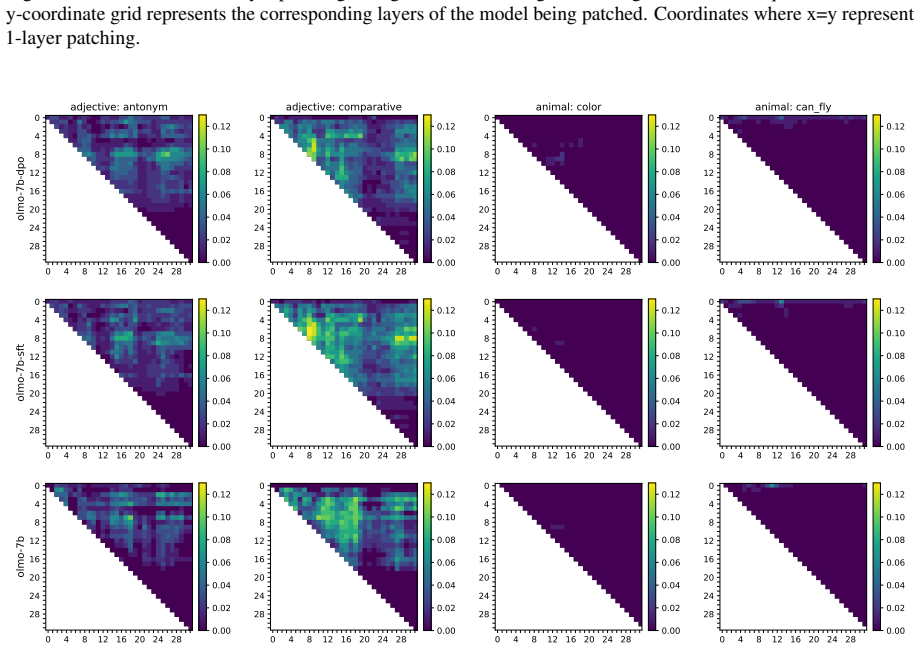
The central object is the Instruction Vector (IV), the model's residual-stream state at the final token of the instruction segment. The paper finds that IVs are formed eagerly before the query is processed, they are localized to a small set of layers, and their task identity is linearly recoverable. The key causal discovery is superadditivity: for high-contributing layer pairs, the causal effect of patching both together satisfies f(x_i ∪ x_j) ≥ f(x_i) + f(x_j), where f measures improvement in reciprocal rank or logit of the target token. Because the inequality holds with very small p-values, the authors conclude that IVs at different layers interact nonlinearly rather than additively. Using
What carries the argument
The central object is the Instruction Vector (IV), defined as the residual-stream state at the final instructional token. The identity doing the causal work is Eq. (2), the superadditivity inequality f(x_i ∪ x_j) ≥ f(x_i) + f(x_j) for the causal effect of patched layers; the paper uses this inequality to argue that IVs interact nonlinearly. To avoid additive assumptions, the machinery is a locally linear decomposition of the Transformer into token-to-token maps: normalization and MLP nonlinearities are replaced by input-dependent affine surrogates, which rewrites the forward pass as a sum of linear paths from each input token to the output logits. Tracing only maximal-attention paths that ra
Load-bearing premise
The load-bearing premise is that the reciprocal-rank (or logit) patching score faithfully measures causal effect, and that testing the inequality on the top-10 layer pairs chosen from the same heatmaps does not inflate apparent superadditivity; if reciprocal-rank saturation or selection-on-maximum artifacts produce f(x_i ∪ x_j) ≥ f(x_i) + f(x_j) even without true nonlinear interaction, the central claim fails even though localization is real.
What would settle it
Run 1- and 2-layer patching on all layer pairs rather than only the top-10, using a non-saturating metric such as the log-probability of the target token, and check whether the superadditivity inequality holds on held-out pairs; if the excess of pair effect over the sum of singles vanishes or becomes negative once saturation and selection bias are removed, the superadditivity claim is refuted.
If this is right
- Activation-patching and circuit-discovery methods that assume additive component contributions will systematically misattribute instruction-following, because a layer can have low effect alone and high effect in combination.
- Instruction representations are formed eagerly, before the query arrives, so an instruction-following model contains a localized bottleneck at the final instructional token that could be monitored or defended.
- The linear representation hypothesis can hold while causal interactions are nonlinear, so linear probing and causal attribution measure different properties and should not be conflated.
- Pretrained models can already form task digests, but instruction tuning contributes the ability to use those digests to select task-specific circuits, giving a measurable mechanistic signature of what SFT and DPO change.
- The locally linear path-tracing method offers an intervention-free way to localize information processing for behaviors where patching is unreliable, such as synergistic interactions.
Where Pith is reading between the lines
- If IVs are circuit selectors, steering instruction-following could be more effective by modulating the early-layer digest rather than patching individual downstream heads; a direct test would compare interventions at the final instructional token with interventions on selected later-layer heads.
- One would predict that instruction vectors transfer across queries and across paraphrases of the same instruction; this is testable by patching the representation at the final instructional token from one paraphrase into a new query and checking whether task performance is restored.
- If the instruction bottleneck is real, adversarial perturbations at the final instructional token should be disproportionately disruptive compared with perturbations elsewhere in the prompt; token-level adversarial attacks could test this.
- Similar superadditivity may appear for other task digests, such as in-context learning and prompt-level demos, which would make nonlinear interaction a general property of task digests rather than a quirk of instructions.
Editorial analysis
A structured set of objections, weighed in public.
Referee Report
Summary. The paper asks how instruction-tuned language models construct and use task instructions. Using activation patching on OLMo-2 base, SFT, and DPO models (1B and 7B), the authors identify localized 'instruction vectors' at the final instructional token, report that these vectors are linearly separable by task (linear-probe accuracy >98%), and claim that they are causally superadditive: two-layer patching yields a larger reciprocal-rank recovery than the sum of the individual layers (Eq. 2, §5.1). To explain this nonlinear interaction, the paper proposes an intervention-free path-tracing method built from locally linear token-to-token maps, and concludes that instruction vectors act as 'circuit selectors': early-layer task representations condition later-layer information pathways. The paper also compares base and post-trained models, arguing that instruction tuning is necessary for the circuit-selection ability.
Significance. If the superadditivity and circuit-selector claims hold, the paper makes a substantive contribution by challenging additive, component-wise circuit discovery and the linear representation hypothesis in the instruction-following setting. The study is transparent: code is released, models have clean base/SFT/DPO separation, and the appendix contains extensive heatmaps and numerical tables. The localization result and the linear-separability result are credible and useful on their own. However, the load-bearing superadditivity claim rests on a statistical test with clear selection bias and a bounded, nonlinear metric, and the path-tracing method relies on strong pruning assumptions that are not validated. These issues are fixable with additional experiments, so the paper is promising but not yet definitive.
major comments (4)
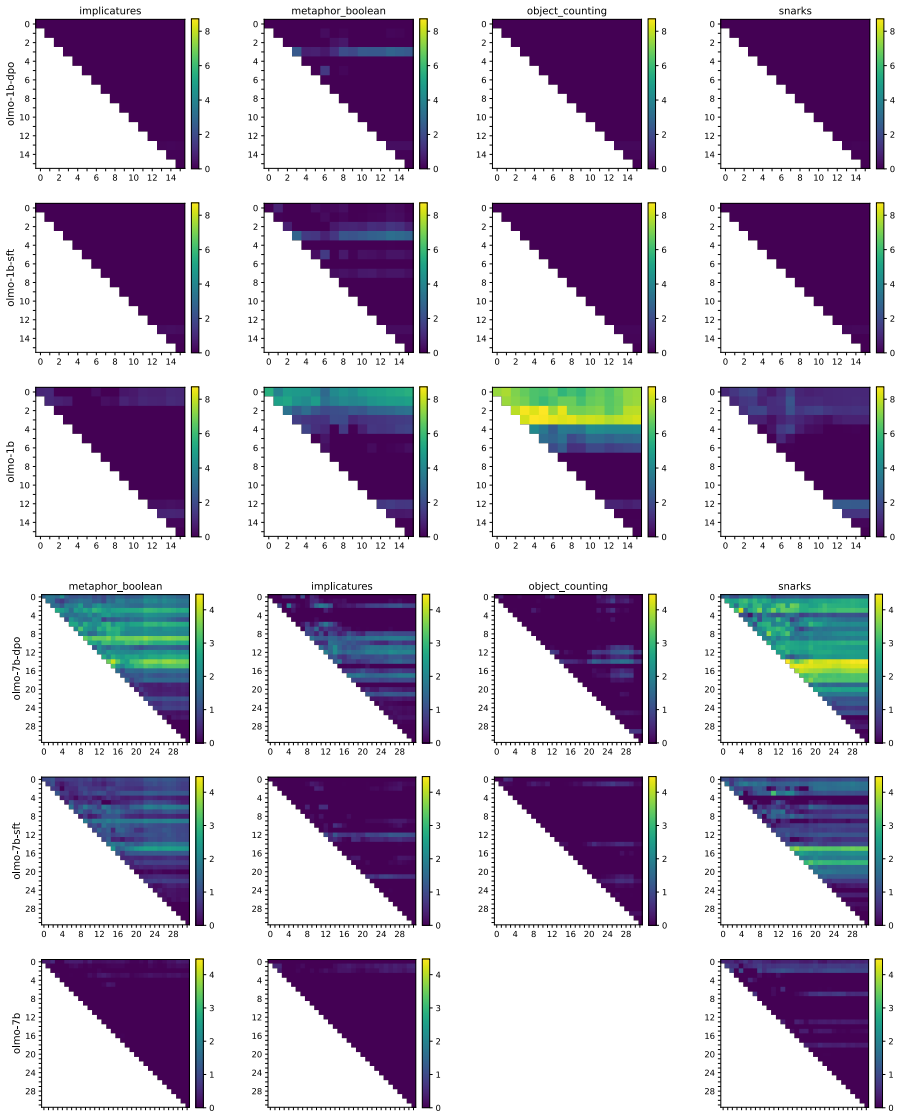
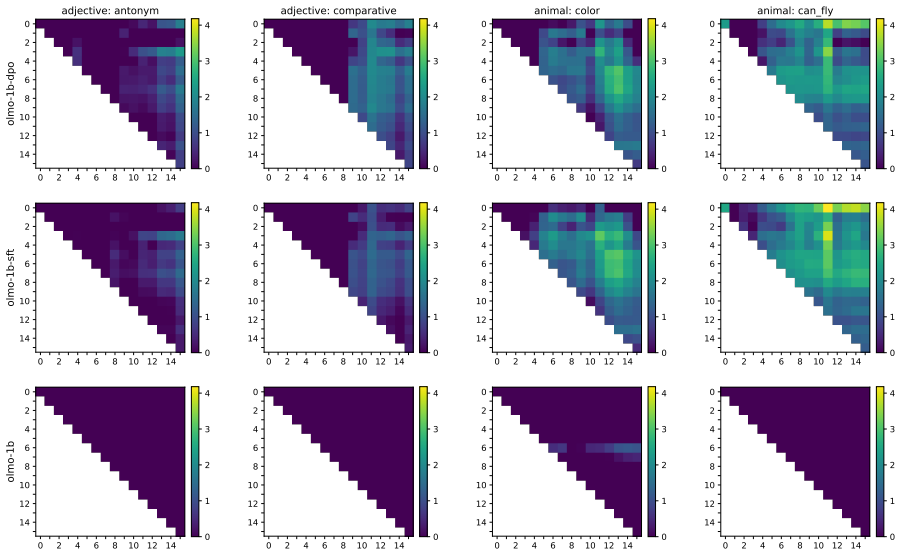
- [§5.1, Eq. (2), Appendix B (Tables 3–6)] The superadditivity test is subject to selection bias. The top-10 layer combinations are selected from the same heatmaps/score tables that define the joint effect f(xi ∪ xj). With roughly 120 pairs for 1B models and ~500 for 7B models, the maximum joint effect is inflated by sampling noise even if the true causal effects are additive. The near-zero p-values on these selected pairs do not establish a model-level nonlinear interaction. Please test Eq. 2 on all pairs (or a pre-specified holdout subset) with an appropriate multiple-comparison or permutation null.
- [§5.1, Eq. (2), Tables 3–6] The metric f is improvement in reciprocal rank, a bounded [0,1] nonlinear function of logits. Saturation or threshold effects can produce f(xi ∪ xj) ≥ f(xi) + f(xj) even when logit effects are additive. The T-test is described on rank-contribution scores, while logit heatmaps are shown only visually. Please re-run Eq. 2 on logit differences for the full set of pairs, or justify that reciprocal-rank superadditivity is the intended causal quantity. Additionally, the reported t-statistics are uniformly negative, e.g., Table 3, (3,3): t = -1.003e+03, which appears inconsistent with a positive mean difference f(i,j) - f(i) - f(j); please clarify the sign convention and the exact null hypothesis.
- [§6.1, Eq. (3), 'Determining the Mechanism'] The path-tracing method prunes to argmax attention edges and retains only paths with answer-token rank <100. This is a strong assumption: non-argmax attention heads/edges and individually low-ranked paths may collectively carry a substantial part of the mechanism. Without sensitivity analyses (e.g., top-k attention for k>1, varying the rank threshold, or comparison with the full linearized forward pass), the circuit-selector conclusion is not robust. The forward pass is still decomposed as a sum of linear maps, so the claim that the method is 'free from additive assumptions' is not validated at the level of the pruned path set.
- [§6.1, 'Attention Head Activity' and 'Circuit Selectors'] The conclusion that IVs act as circuit selectors is derived from paths already defined by leading to the answer token with rank <100. Finding that Tinst emits the most high-ranking paths and that later-layer head activity differs by task is partly by construction, since the path set excludes alternatives. Please provide baseline comparisons—random paths, paths emitted from other tokens, or ablation/perturbation along selected paths—to demonstrate that the identified pathways are specifically and causally relevant. Without such a control, the distinction between 'paths that happen to lead to the answer token' and 'instruction-conditioned circuit selection' is not established.
minor comments (5)
- [§5.1, last paragraph] The sentence 'we take their unnormalized patching scores and evaluate Eq. 2 (as a boolean truth value 1 or 0)' is confusing. A T-test on boolean indicators is not a standard procedure; please report the continuous differences and the exact test statistic.
- [Figure 2, Figures 10–11] The Figure 2 caption says 'logit improvement' but the heatmaps display reciprocal rank. Figures 10 and 11 have similar inconsistencies between captions and plotted quantities. Please align captions with the plotted metric.
- [Appendix A, Table 2] Table 2 lists an 'OLMo-3 7B' column, but OLMo-3 results do not appear in the paper. Clarify whether this model was used or remove the column.
- [Appendix B, Tables 3–6] Many entries have t = -inf or p = 0.000e+00 due to floating-point underflow. Please state how infinite values were handled and report finite precision or sufficient statistics.
- [§6.1, path tracing] The threshold 'answer rank <100' appears arbitrary. Please justify the choice and include a sensitivity analysis or explain why it does not affect the conclusions.
Circularity Check
No circular derivation: localization, linear-separability, and path-tracing claims are measured against independent baselines; the superadditivity test's selection-on-maximum is a statistical robustness concern, not a circular reduction.
full rationale
The paper's derivation chain is self-contained. Localization of instruction vectors is established by activation patching against a no-instruction baseline (filler token), producing full-grid heatmaps over all layer pairs; the location of the instruction vector is not definitionally tied to the conclusion. Linear separability is tested by training a linear probe on 200 instruction rephrasings and evaluating on held-out samples, a standard supervised separability test. The superadditivity claim (Eq. 2) is an empirical inequality on patching scores. The main concern is that the T-test is applied only to the top-10 layer combinations selected from the same heatmaps, and the reciprocal-rank metric is bounded/nonlinear, so selection-on-maximum and metric saturation could produce superadditivity-like numbers without true synergistic causal effects. However, this is a statistical-validity and multiple-comparisons issue, not a circular reduction: the inequality is not guaranteed by the selection criterion, and no fitted parameter is repackaged as a prediction. The path-tracing method in Section 6 is a locally-linear decomposition of the forward pass; defining high-ranking paths as those contributing to the answer token is an operational target, and the observation that Tinst emits many such paths and that attention-head activity differs across tasks is empirical rather than forced by the path definition. No load-bearing self-citation or imported uniqueness theorem appears; references to prior work (Meng et al., Todd et al., Davidson et al., Elhage et al.) are external. The Limitations section acknowledges that mechanism experiments are limited to 1B models and that human-defined contrastive tasks may not match the model's own task similarity; these are generalizability limitations, not evidence of circularity.
Axiom & Free-Parameter Ledger
free parameters (3)
- High-ranking path threshold =
rank < 100
- Top-10 layer-combination selection =
10 per task
- Attention pruning rule =
argmax edge only
axioms (4)
- domain assumption Activation patching on residual-stream layer states is a valid causal mediation tool.
- domain assumption LayerNorm and MLP nonlinearities can be replaced by local affine/diagonal surrogates valid in an ε-neighborhood of the input.
- ad hoc to paper The forward pass decomposes into a sum of token-to-token locally-linear maps whose effects are additive.
- ad hoc to paper Tracing only argmax-attention edges and answer-rank<100 paths preserves the mechanism.
invented entities (2)
-
Instruction Vectors (IVs)
no independent evidence
-
Circuit selector role
no independent evidence
read the original abstract
Despite the recent success of instruction-tuned language models and their ubiquitous usage, very little is known of how models process instructions internally. In this work, we address this gap from a mechanistic point of view by investigating how instruction-specific representations are constructed and utilized in different stages of post-training: Supervised Fine-Tuning (SFT) and Direct Preference Optimization (DPO). Via causal mediation, we identify that instruction representation is fairly localized in models. These representations, which we call Instruction Vectors (IVs), demonstrate a curious juxtaposition of linear separability along with non-linear causal interaction, broadly questioning the scope of the linear representation hypothesis commonplace in mechanistic interpretability. To disentangle the non-linear causal interaction, we propose a novel method to localize information processing in language models that is free from the implicit linear assumptions of patching-based techniques. We find that, conditioned on the task representations formed in the early layers, different information pathways are selected in the later layers to solve that task, i.e., IVs act as circuit selectors.
Figures





Reference graph
Works this paper leans on
-
[1]
Emmanuel Ameisen, Jack Lindsey, Adam Pearce, Wes Gurnee, Nicholas L Turner, et al. 2025. https://transformer-circuits.pub/2025/attribution-graphs/methods.html Circuit tracing: Revealing computational graphs in language models . Transformer Circuits Thread
2025
-
[2]
Nooshin Bahador. 2025. https://doi.org/10.48550/ARXIV.2504.02976 Localized definitions and distributed reasoning: A proof-of-concept mechanistic interpretability study via activation patching . CoRR, abs/2504.02976
work page internal anchor Pith review Pith/arXiv arXiv doi:10.48550/arxiv.2504.02976 2025
-
[3]
Xiao Bi, Deli Chen, Guanting Chen, Shanhuang Chen, Damai Dai, et al. 2024. https://doi.org/10.48550/ARXIV.2401.02954 Deepseek LLM: scaling open-source language models with longtermism . CoRR, abs/2401.02954
-
[4]
Sid Black, Lee Sharkey, Leo Grinsztajn, Eric Winsor, Dan Braun, et al. 2022. https://arxiv.org/abs/2211.12312 Interpreting neural networks through the polytope lens . Preprint, arXiv:2211.12312
Pith/arXiv arXiv 2022
-
[5]
Anwoy Chatterjee, H. S. V. N. S. Kowndinya Renduchintala, Sumit Bhatia, and Tanmoy Chakraborty. 2025. https://doi.org/10.1162/TACL.A.42 On the effect of instruction tuning loss on generalization . Trans. Assoc. Comput. Linguistics, 13:1360--1380
-
[6]
Mavor - Parker, Aengus Lynch, Stefan Heimersheim, and Adri \` a Garriga - Alonso
Arthur Conmy, Augustine N. Mavor - Parker, Aengus Lynch, Stefan Heimersheim, and Adri \` a Garriga - Alonso. 2023. http://papers.nips.cc/paper\_files/paper/2023/hash/34e1dbe95d34d7ebaf99b9bcaeb5b2be-Abstract-Conference.html Towards automated circuit discovery for mechanistic interpretability . In Advances in Neural Information Processing Systems 36: Annua...
2023
-
[7]
Guy Davidson, Todd M. Gureckis, Brenden M. Lake, and Adina Williams. 2025. https://doi.org/10.48550/ARXIV.2505.12075 Do different prompting methods yield a common task representation in language models? CoRR, abs/2505.12075
-
[8]
Nelson Elhage, Neel Nanda, Catherine Olsson, Tom Henighan, Nicholas Joseph, et al. 2021. https://transformer-circuits.pub/2021/framework/index.html A mathematical framework for transformer circuits . Transformer Circuits Thread
2021
-
[9]
Jaden Fried Fiotto - Kaufman, Alexander Russell Loftus, Eric Todd, Jannik Brinkmann, Koyena Pal, et al. 2025. https://openreview.net/forum?id=MxbEiFRf39 Nnsight and NDIF: democratizing access to open-weight foundation model internals . In The Thirteenth International Conference on Learning Representations, ICLR 2025, Singapore, April 24-28, 2025 . OpenReview.net
2025
-
[10]
Sreyan Ghosh, Chandra Kiran Reddy Evuru, Sonal Kumar, Ramaneswaran S., Deepali Aneja, et al. 2024. https://openreview.net/forum?id=XkHJo8iXGQ A closer look at the limitations of instruction tuning . In Forty-first International Conference on Machine Learning, ICML 2024, Vienna, Austria, July 21-27, 2024 . OpenReview.net
2024
-
[11]
Wes Gurnee and Max Tegmark. 2024. https://openreview.net/forum?id=jE8xbmvFin Language models represent space and time . In The Twelfth International Conference on Learning Representations, ICLR 2024, Vienna, Austria, May 7-11, 2024 . OpenReview.net
2024
-
[12]
Boris Hanin and David Rolnick. 2019. https://proceedings.neurips.cc/paper/2019/hash/9766527f2b5d3e95d4a733fcfb77bd7e-Abstract.html Deep relu networks have surprisingly few activation patterns . In Advances in Neural Information Processing Systems 32: Annual Conference on Neural Information Processing Systems 2019, NeurIPS 2019, December 8-14, 2019, Vancou...
arXiv 2019
-
[13]
Zirui He, Haiyan Zhao, Yiran Qiao, Fan Yang, Ali Payani, et al. 2025. https://doi.org/10.48550/ARXIV.2502.11356 SAIF: A sparse autoencoder framework for interpreting and steering instruction following of language models . CoRR, abs/2502.11356
-
[14]
Roee Hendel, Mor Geva, and Amir Globerson. 2023. https://doi.org/10.18653/V1/2023.FINDINGS-EMNLP.624 In-context learning creates task vectors . In Findings of the Association for Computational Linguistics: EMNLP 2023, Singapore, December 6-10, 2023 . Association for Computational Linguistics
-
[15]
Shih - Cheng Huang, Pin - Zu Li, Yu - Chi Hsu, Kuang - Ming Chen, Yu - Tung Lin, et al. 2024. https://doi.org/10.18653/V1/2024.ACL-LONG.590 Chat vector: A simple approach to equip llms with instruction following and model alignment in new languages . In Proceedings of the 62nd Annual Meeting of the Association for Computational Linguistics, ACL 2024, Bang...
-
[16]
Dick, Hidenori Tanaka, et al
Samyak Jain, Robert Kirk, Ekdeep Singh Lubana, Robert P. Dick, Hidenori Tanaka, et al. 2024. https://openreview.net/forum?id=A0HKeKl4Nl Mechanistically analyzing the effects of fine-tuning on procedurally defined tasks . In The Twelfth International Conference on Learning Representations, ICLR 2024, Vienna, Austria, May 7-11, 2024 . OpenReview.net
2024
-
[17]
Yuxuan Li, Declan Campbell, Stephanie C. Y. Chan, and Andrew Kyle Lampinen. 2025. https://doi.org/10.48550/ARXIV.2509.04466 Just-in-time and distributed task representations in language models . CoRR, abs/2509.04466
-
[18]
Huanxuan Liao, Shizhu He, Yao Xu, Yuanzhe Zhang, Yanchao Hao, et al. 2024. http://papers.nips.cc/paper\_files/paper/2024/hash/50ea4dbd1cff6bd3daef939eff10c092-Abstract-Conference.html From instance training to instruction learning: Task adapters generation from instructions . In Advances in Neural Information Processing Systems 38: Annual Conference on Ne...
2024
-
[19]
Jack Lindsey, Adly Templeton, Jonathan Marcus, Thomas Conerly, Joshua Batson, et al. 2024. Sparse crosscoders for cross-layer features and model diffing. https://transformer-circuits.pub/2024/crosscoders/index.html. Anthropic interpretability research note
2024
-
[20]
Kevin Meng, David Bau, Alex Andonian, and Yonatan Belinkov. 2022. http://papers.nips.cc/paper\_files/paper/2022/hash/6f1d43d5a82a37e89b0665b33bf3a182-Abstract-Conference.html Locating and editing factual associations in GPT . In Advances in Neural Information Processing Systems 35: Annual Conference on Neural Information Processing Systems 2022, NeurIPS 2...
2022
-
[21]
Trung Nguyen and Yan Leng. 2025. https://doi.org/10.48550/ARXIV.2502.16385 Toward a flexible framework for linear representation hypothesis using maximum likelihood estimation . CoRR, abs/2502.16385
-
[22]
Team OLMo, Pete Walsh, Luca Soldaini, Dirk Groeneveld, Kyle Lo, et al. 2025. https://doi.org/10.48550/ARXIV.2501.00656 2 olmo 2 furious . CoRR, abs/2501.00656
-
[23]
OpenAI. 2025. https://platform.openai.com/docs/models/gpt-5-nano gpt-5-nano-2025-08-07
2025
-
[24]
Wainwright, et al
Long Ouyang, Jeffrey Wu, Xu Jiang, Diogo Almeida, Carroll L. Wainwright, et al. 2022. http://papers.nips.cc/paper\_files/paper/2022/hash/b1efde53be364a73914f58805a001731-Abstract-Conference.html Training language models to follow instructions with human feedback . In Advances in Neural Information Processing Systems 35: Annual Conference on Neural Informa...
2022
-
[25]
Kiho Park, Yo Joong Choe, and Victor Veitch. 2024. https://openreview.net/forum?id=UGpGkLzwpP The linear representation hypothesis and the geometry of large language models . In Forty-first International Conference on Machine Learning, ICML 2024, Vienna, Austria, July 21-27, 2024 . OpenReview.net
2024
-
[26]
Lee Sharkey, Bilal Chughtai, Joshua Batson, Jack Lindsey, Jeffrey Wu, et al. 2025. https://openreview.net/forum?id=91H76m9Z94 Open problems in mechanistic interpretability . Trans. Mach. Learn. Res., 2025
2025
-
[27]
Yang, Bin Wu, Laurence Aitchison, Emine Yilmaz, et al
Zhengxiang Shi, Adam X. Yang, Bin Wu, Laurence Aitchison, Emine Yilmaz, et al. 2024. http://papers.nips.cc/paper\_files/paper/2024/hash/7ffb43adf37b3eeaba559098bc084cc6-Abstract-Conference.html Instruction tuning with loss over instructions . In Advances in Neural Information Processing Systems 38: Annual Conference on Neural Information Processing System...
2024
-
[28]
Aarohi Srivastava, Abhinav Rastogi, Abhishek Rao, Abu Awal Md Shoeb, Abubakar Abid, et al. 2023. https://openreview.net/forum?id=uyTL5Bvosj Beyond the imitation game: Quantifying and extrapolating the capabilities of language models . Trans. Mach. Learn. Res., 2023
2023
-
[29]
Alessandro Stolfo, Vidhisha Balachandran, Safoora Yousefi, Eric Horvitz, and Besmira Nushi. 2025. https://openreview.net/forum?id=wozhdnRCtw Improving instruction-following in language models through activation steering . In The Thirteenth International Conference on Learning Representations, ICLR 2025, Singapore, April 24-28, 2025 . OpenReview.net
2025
-
[30]
Denis Sutter, Julian Minder, Thomas Hofmann, and Tiago Pimentel. 2025. https://doi.org/10.48550/ARXIV.2507.08802 The non-linear representation dilemma: Is causal abstraction enough for mechanistic interpretability? CoRR, abs/2507.08802
-
[31]
Naftali Tishby, Fernando C. N. Pereira, and William Bialek. 2000. http://arxiv.org/abs/physics/0004057 The information bottleneck method . CoRR, physics/0004057
Pith/arXiv arXiv 2000
-
[32]
Li, Arnab Sen Sharma, Aaron Mueller, Byron C
Eric Todd, Millicent L. Li, Arnab Sen Sharma, Aaron Mueller, Byron C. Wallace, et al. 2024. https://openreview.net/forum?id=AwyxtyMwaG Function vectors in large language models . In The Twelfth International Conference on Learning Representations, ICLR 2024, Vienna, Austria, May 7-11, 2024 . OpenReview.net
2024
-
[33]
Kevin Ro Wang, Alexandre Variengien, Arthur Conmy, Buck Shlegeris, and Jacob Steinhardt. 2023. https://openreview.net/forum?id=NpsVSN6o4ul Interpretability in the wild: a circuit for indirect object identification in GPT-2 small . In The Eleventh International Conference on Learning Representations, ICLR 2023, Kigali, Rwanda, May 1-5, 2023 . OpenReview.net
2023
-
[34]
Zhao, Kelvin Guu, Adams Wei Yu, et al
Jason Wei, Maarten Bosma, Vincent Y. Zhao, Kelvin Guu, Adams Wei Yu, et al. 2022. https://openreview.net/forum?id=gEZrGCozdqR Finetuned language models are zero-shot learners . In The Tenth International Conference on Learning Representations, ICLR 2022, Virtual Event, April 25-29, 2022 . OpenReview.net
2022
-
[35]
Fred Zhang and Neel Nanda. 2024. https://openreview.net/forum?id=Hf17y6u9BC Towards best practices of activation patching in language models: Metrics and methods . In The Twelfth International Conference on Learning Representations, ICLR 2024, Vienna, Austria, May 7-11, 2024 . OpenReview.net
2024
-
[36]
Chunting Zhou, Pengfei Liu, Puxin Xu, Srinivasan Iyer, Jiao Sun, et al. 2023. http://papers.nips.cc/paper\_files/paper/2023/hash/ac662d74829e4407ce1d126477f4a03a-Abstract-Conference.html LIMA: less is more for alignment . In Advances in Neural Information Processing Systems 36: Annual Conference on Neural Information Processing Systems 2023, NeurIPS 2023,...
2023
-
[37]
online" 'onlinestring :=
ENTRY address archivePrefix author booktitle chapter edition editor eid eprint eprinttype howpublished institution journal key month note number organization pages publisher school series title type volume year doi pubmed url lastchecked label extra.label sort.label short.list INTEGERS output.state before.all mid.sentence after.sentence after.block STRING...
-
[38]
write newline
" write newline "" before.all 'output.state := FUNCTION n.dashify 't := "" t empty not t #1 #1 substring "-" = t #1 #2 substring "--" = not "--" * t #2 global.max substring 't := t #1 #1 substring "-" = "-" * t #2 global.max substring 't := while if t #1 #1 substring * t #2 global.max substring 't := if while FUNCTION word.in bbl.in capitalize " " * FUNCT...
discussion (0)
Sign in with ORCID, Apple, or X to comment. Anyone can read and Pith papers without signing in.