Recognition: 2 theorem links
· Lean TheoremSelf-resonance preheating in deformed attractor models: oscillon formation and evolution
Pith reviewed 2026-05-16 06:19 UTC · model grok-4.3
The pith
A Gaussian feature in deformed α-attractor potentials produces more numerous but smaller and shorter-lived oscillons during self-resonance preheating.
A machine-rendered reading of the paper's core claim, the machinery that carries it, and where it could break.
Core claim
In deformed α-attractor T-models that include a Gaussian feature near the potential minimum, the inflaton fragments into a larger population of smaller oscillons that store less energy and persist for shorter times than in the undeformed case; the gravitational-wave emission remains dominated by the resonance phase and is strongly suppressed once oscillons form, with the high-frequency part of the spectrum modified while the low-frequency part stays similar.
What carries the argument
The Gaussian deformation parameter h added to the α-attractor T-model potential, which shifts the shape near the minimum and thereby changes the resonance structure and subsequent oscillon dynamics.
If this is right
- Gradient energy transfer during the resonance stage remains independent of h, but the subsequent decay of gradient energy depends strongly on h.
- Models with nonzero h form a larger number of smaller oscillons that contain progressively less energy as |h| increases.
- Oscillons become systematically shorter-lived once h is nonzero, with the reduction in lifetime strengthening for larger |h|.
- Gravitational-wave emission is dominated by the resonance stage and drops sharply after oscillons form, leaving the low-frequency spectrum unchanged while suppressing the high-frequency tail.
- Clear qualitative differences in the cosmic expansion history appear within the simulated time window even without a full reheating calculation.
Where Pith is reading between the lines
- If oscillons in these models couple to other fields, the increased number and reduced lifetime could shift the spectrum of produced particles relative to standard attractor preheating.
- The modified high-frequency gravitational-wave tail might become observable with future detectors tuned to higher frequencies, offering a potential signature of potential features during reheating.
- Predictions for the final reheating temperature and the total number of post-inflationary e-folds in these models would change once the shorter oscillon lifetimes are taken into account.
Load-bearing premise
The Gaussian feature stays far from the end of inflation and the lattice simulations without external couplings or higher resolution still capture the main qualitative changes in oscillon number, size, lifetime, and expansion history.
What would settle it
Running the same lattice simulations at substantially higher resolution or with added external couplings and finding no systematic increase in oscillon number or decrease in their lifetime as the magnitude of h grows would falsify the central claim.
Figures






read the original abstract
It is well known that, in potentials that are quadratic near the minimum but shallower away, such as small $\alpha$ ($\ll M_P^2$) attractors, the inflaton condensate fragments into localized compact objects known as oscillons during self-resonance preheating. In this work we investigate the self-resonance in deformed $\alpha$-attractor T-model with a Gaussian feature near the minimum, distant from inflation's end. Linear analysis reveals altered resonance bands and deformed Floquet charts dependent on feature parameters. In fully nonlinear lattice simulations, we find that the gradient energy transfer is largely independent of the potential feature parameter $h$. In contrast, after resonance terminates, the subsequent evolution of gradient energy becomes strongly dependent on $h$. Statistical analysis reveals that models with the potential feature produce larger number of smaller oscillons, with a reduced energy stored in these objects, increasingly suppressed as the magnitude of $h$ grows. By tracking the total energy and the gradient energy contained in oscillons, we find that in models with nonzero $h$ oscillons are systematically shorter-lived, with this effect strengthening for larger $h$. The gravitational wave emission is dominated by the resonance stage and is strongly suppressed once oscillons form. Potential features leave the low-frequency spectrum largely unchanged but significantly modify the high-frequency tail. Although a complete reheating description requires external couplings and higher-resolution simulations, clear qualitative differences of cosmic expansion history already emerge within our simulated time window. These results highlight the important role of potential features in shaping reheating dynamics and their cosmological implications, and provide a deeper understanding of preheating dynamics and the properties of oscillons.
Editorial analysis
A structured set of objections, weighed in public.
Referee Report
Summary. The paper investigates self-resonance preheating in deformed α-attractor T-models with a Gaussian potential feature near the minimum, parameterized by h. Linear Floquet analysis reveals modified resonance bands. Fully nonlinear lattice simulations show gradient energy transfer during resonance is largely independent of h, but post-resonance evolution depends on h: models with the feature yield more numerous smaller oscillons storing less energy (suppressed with growing |h|), and these oscillons have shorter lifetimes that decrease further with larger |h|. Gravitational wave emission is resonance-dominated, with the feature modifying the high-frequency tail. The authors conclude that qualitative differences in cosmic expansion history appear within the simulated window despite omitted external couplings.
Significance. If the reported h-dependent trends in oscillon statistics, energy partitioning, and lifetimes are robust, the work would meaningfully advance understanding of how small potential deformations affect preheating, oscillon formation, and gravitational wave production in inflationary models. The combination of Floquet analysis with lattice simulations is appropriate and highlights the role of features distant from the inflationary plateau in shaping reheating dynamics.
major comments (2)
- [Lattice simulations] Lattice simulations section: No convergence tests, resolution studies, or box-size checks are reported for the lattice parameters used to extract oscillon number, size, energy fraction, and lifetimes. Since these quantities are extracted via post-processing and are sensitive to numerical dissipation and grid artifacts, the quantitative h-dependence claims in the abstract and results rest on an unverified assumption and require explicit verification.
- [Abstract and Conclusions] Abstract and conclusions: The assertion that 'clear qualitative differences of cosmic expansion history already emerge within our simulated time window' is not supported by any quantitative metrics (e.g., evolution of the scale factor, Hubble parameter, or energy density components) comparing different h values. Without such evidence, the claim that the simulated interval suffices to demonstrate cosmological implications remains unsubstantiated.
minor comments (2)
- [Figures] Figure captions should explicitly list the h values corresponding to each curve or panel to improve readability of the oscillon and GW spectra results.
- [Introduction] The introduction should provide a quantitative estimate (e.g., field value or number of e-folds) confirming that the Gaussian feature remains sufficiently distant from the end of inflation so as not to affect the inflationary dynamics itself.
Simulated Author's Rebuttal
We thank the referee for the careful reading and constructive comments. We address each major comment below and describe the revisions that will be incorporated.
read point-by-point responses
-
Referee: Lattice simulations section: No convergence tests, resolution studies, or box-size checks are reported for the lattice parameters used to extract oscillon number, size, energy fraction, and lifetimes. Since these quantities are extracted via post-processing and are sensitive to numerical dissipation and grid artifacts, the quantitative h-dependence claims in the abstract and results rest on an unverified assumption and require explicit verification.
Authors: We agree that convergence tests are essential to substantiate the robustness of the extracted oscillon statistics. In the revised manuscript we will add explicit resolution studies (including runs at doubled grid resolution) and box-size checks, together with a brief discussion of how these confirm that the reported h-dependent trends in oscillon number, size, energy fraction and lifetimes are insensitive to numerical artifacts. These tests will appear in the Lattice simulations section or a new appendix. revision: yes
-
Referee: Abstract and conclusions: The assertion that 'clear qualitative differences of cosmic expansion history already emerge within our simulated time window' is not supported by any quantitative metrics (e.g., evolution of the scale factor, Hubble parameter, or energy density components) comparing different h values. Without such evidence, the claim that the simulated interval suffices to demonstrate cosmological implications remains unsubstantiated.
Authors: We acknowledge that the statement would be strengthened by direct quantitative support. While the energy-partitioning figures already indicate h-dependent differences that affect the expansion rate, we will add explicit comparisons of the scale-factor evolution a(t) and Hubble parameter H(t) for representative h values in the revised manuscript. These plots will be placed in the results section to substantiate the qualitative differences observed within the simulated window. revision: yes
Circularity Check
No significant circularity; claims rest on direct lattice integration and linear Floquet analysis
full rationale
The paper derives its results on resonance bands, oscillon statistics, energy partitioning, lifetimes, and gravitational-wave spectra from linear stability analysis (Floquet charts) followed by fully nonlinear lattice simulations of the Klein-Gordon equation. No analytical step reduces a prediction to a fitted parameter by construction, no self-citation chain carries the central claim, and no ansatz is smuggled in. The authors explicitly note that external couplings and higher resolution are needed for a complete reheating picture, yet the reported h-dependent qualitative trends are extracted from the simulated window without self-referential closure. This yields a minor (score-1) finding consistent with direct numerical work.
Axiom & Free-Parameter Ledger
free parameters (1)
- h
axioms (1)
- domain assumption Standard assumptions of single-field slow-roll inflation and subsequent self-resonance preheating in a flat FLRW background
Lean theorems connected to this paper
-
IndisputableMonolith/Foundation/RealityFromDistinction.leanreality_from_one_distinction unclear?
unclearRelation between the paper passage and the cited Recognition theorem.
In fully nonlinear lattice simulations, we find that the gradient energy transfer is largely independent of the potential feature parameter h. ... models with the potential feature produce larger number of smaller oscillons, with a reduced energy stored in these objects
-
IndisputableMonolith/Cost/FunctionalEquation.leanwashburn_uniqueness_aczel unclear?
unclearRelation between the paper passage and the cited Recognition theorem.
By tracking the total energy and the gradient energy contained in oscillons, we find that in models with nonzero h oscillons are systematically shorter-lived
What do these tags mean?
- matches
- The paper's claim is directly supported by a theorem in the formal canon.
- supports
- The theorem supports part of the paper's argument, but the paper may add assumptions or extra steps.
- extends
- The paper goes beyond the formal theorem; the theorem is a base layer rather than the whole result.
- uses
- The paper appears to rely on the theorem as machinery.
- contradicts
- The paper's claim conflicts with a theorem or certificate in the canon.
- unclear
- Pith found a possible connection, but the passage is too broad, indirect, or ambiguous to say the theorem truly supports the claim.
Reference graph
Works this paper leans on
-
[1]
gradient energy Now let us analyze the energy transfer in preheating. During the period of self-resonance, the inflaton transfers energy to its own fluctuations, leading to their amplifica- tion and the formation of a spatially anisotropic energy distribution. As an example, we show the fraction of the volume averaged gradient energy in figure 6. We see t...
-
[2]
Properties of oscillons It is well known that the gradient energy plays a crucial role in oscillon formation. During resonance, a significant fraction of the inflaton field energy is transferred into the fluctuations, leading to highly anisotropic spatial distri- bution of energy. After the resonance ends, provided that the potential has an appropriate sh...
-
[3]
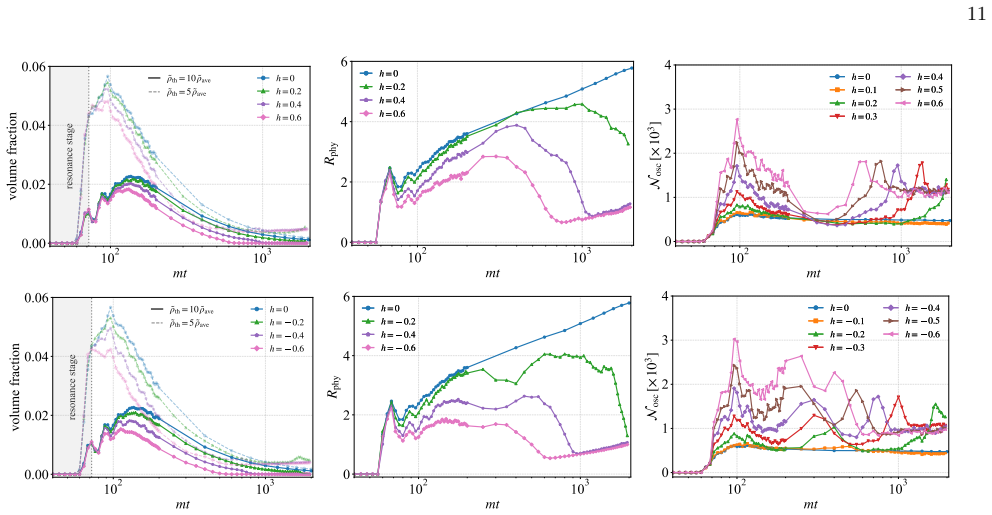
Morphology and number We show the volume fraction, the averaged physical size, and the number of the overdense objects in fig- ure 8. During the resonance stage, the energy of the homogeneous mode of the inflaton is continuously trans- ferred into gradient energy, leading to a steady growth of the volume fraction of overdense regions. At the end of resona...
-
[4]
Energy and lifetime Perhaps the most important properties of oscillons are their energy and lifetime. The total energy fraction of the overdense objects and the averaged energy contained per object are shown in figure 9. Only part of the os- cillon energy is inherited from the resonance stage. At the end of resonance, dense objects contain 16% of the tota...
work page 2018
-
[5]
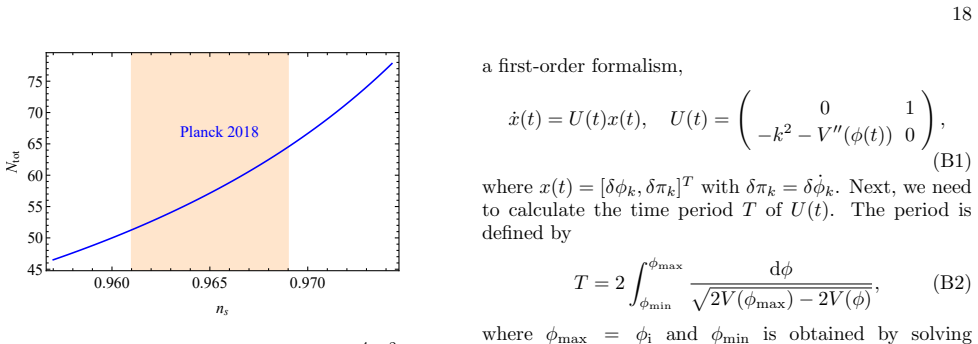
and V0 = 1.14×10 −14M4 P , yieldingn s = 0.965 andN tot ≃57. Appendix B: Derivation of the Floquet exponent We compute the Floquet exponent following the pro- cedure outlined in [25]. We first recast equation (14) into a first-order formalism, ˙x(t) =U(t)x(t), U(t) = 0 1 −k2 −V ′′(ϕ(t)) 0 ! , (B1) wherex(t) = [δϕ k, δπk]T withδπ k =δ ˙ϕk. Next, we need to...
-
[6]
A. A. Starobinsky, Phys. Lett. B91, 99 (1980)
work page 1980
-
[7]
A. H. Guth, Phys. Rev. D23, 347 (1981)
work page 1981
-
[8]
A. D. Linde, Phys. Lett. B108, 389 (1982)
work page 1982
- [9]
-
[10]
A. D. Linde, Phys. Lett. B129, 177 (1983)
work page 1983
-
[11]
Planck 2018 results. VI. Cosmological parameters
N. Aghanimet al.(Planck), Astron. Astrophys.641, A6 (2020), [Erratum: Astron.Astrophys. 652, C4 (2021)], arXiv:1807.06209 [astro-ph.CO]
work page internal anchor Pith review Pith/arXiv arXiv 2020
-
[12]
Planck 2018 results. X. Constraints on inflation
Y. Akramiet al.(Planck), Astron. Astrophys.641, A10 (2020), arXiv:1807.06211 [astro-ph.CO]
work page internal anchor Pith review Pith/arXiv arXiv 2020
-
[13]
The Atacama Cosmology Telescope: DR6 Power Spectra, Likelihoods and $\Lambda$CDM Parameters
T. Louiset al.(Atacama Cosmology Telescope), JCAP 11, 062, arXiv:2503.14452 [astro-ph.CO]
work page internal anchor Pith review Pith/arXiv arXiv
-
[14]
The Atacama Cosmology Telescope: DR6 Constraints on Extended Cosmological Models
E. Calabreseet al.(Atacama Cosmology Telescope), JCAP11, 063, arXiv:2503.14454 [astro-ph.CO]
work page internal anchor Pith review Pith/arXiv arXiv
-
[15]
L. F. Abbott, E. Farhi, and M. B. Wise, Phys. Lett. B 117, 29 (1982)
work page 1982
-
[16]
A. D. Dolgov and D. P. Kirilova, Sov. J. Nucl. Phys.51, 172 (1990)
work page 1990
-
[17]
J. H. Traschen and R. H. Brandenberger, Phys. Rev. D 42, 2491 (1990)
work page 1990
-
[18]
Non-Equilibrium Evolution of Scalar Fields in FRW Cosmologies I
D. Boyanovsky, H. J. de Vega, and R. Holman, Phys. Rev. D49, 2769 (1994), arXiv:hep-ph/9310319
work page internal anchor Pith review Pith/arXiv arXiv 1994
-
[19]
D. Boyanovsky, H. J. de Vega, R. Holman, D. S. Lee, and A. Singh, Phys. Rev. D51, 4419 (1995), arXiv:hep- ph/9408214
-
[20]
L. Kofman, A. D. Linde, and A. A. Starobinsky, Phys. Rev. Lett.73, 3195 (1994), arXiv:hep-th/9405187 [hep- th]
work page internal anchor Pith review Pith/arXiv arXiv 1994
-
[21]
Universe Reheating after Inflation
Y. Shtanov, J. H. Traschen, and R. H. Brandenberger, Phys. Rev.D51, 5438 (1995), arXiv:hep-ph/9407247 [hep-ph]
work page internal anchor Pith review Pith/arXiv arXiv 1995
-
[22]
Towards the Theory of Reheating After Inflation
L. Kofman, A. D. Linde, and A. A. Starobinsky, Phys. Rev. D56, 3258 (1997), arXiv:hep-ph/9704452
work page internal anchor Pith review Pith/arXiv arXiv 1997
- [23]
-
[24]
M. A. Amin, (2010), arXiv:1006.3075 [astro-ph.CO]
work page internal anchor Pith review Pith/arXiv arXiv 2010
-
[25]
M. A. Amin, R. Easther, and H. Finkel, JCAP12, 001, arXiv:1009.2505 [astro-ph.CO]
work page internal anchor Pith review Pith/arXiv arXiv
-
[26]
M. A. Amin, R. Easther, H. Finkel, R. Flauger, and M. P. Hertzberg, Phys. Rev. Lett.108, 241302 (2012), arXiv:1106.3335 [astro-ph.CO]
work page internal anchor Pith review Pith/arXiv arXiv 2012
-
[27]
B. A. Bassett, S. Tsujikawa, and D. Wands, Rev. Mod. Phys.78, 537 (2006), arXiv:astro-ph/0507632 [astro- ph]
work page internal anchor Pith review Pith/arXiv arXiv 2006
-
[28]
Reheating in Inflationary Cosmology: Theory and Applications
R. Allahverdi, R. Brandenberger, F.-Y. Cyr-Racine, and A. Mazumdar, Ann. Rev. Nucl. Part. Sci.60, 27 (2010), arXiv:1001.2600 [hep-th]
work page internal anchor Pith review Pith/arXiv arXiv 2010
-
[29]
K. D. Lozanov, (2019), arXiv:1907.04402 [astro- ph.CO]
work page internal anchor Pith review Pith/arXiv arXiv 2019
-
[30]
M. A. Amin, M. P. Hertzberg, D. I. Kaiser, and J. Karouby, Int. J. Mod. Phys. D24, 1530003 (2014), arXiv:1410.3808 [hep-ph]
work page internal anchor Pith review Pith/arXiv arXiv 2014
- [31]
- [32]
-
[33]
S.-Y. Zhou, E. J. Copeland, R. Easther, H. Finkel, Z.-G. Mou, and P. M. Saffin, JHEP10, 026, arXiv:1304.6094 [astro-ph.CO]
work page internal anchor Pith review Pith/arXiv arXiv
- [34]
- [35]
-
[36]
Gravitational Waves from Oscillons with Cuspy Potentials
J. Liu, Z.-K. Guo, R.-G. Cai, and G. Shiu, Phys. Rev. Lett.120, 031301 (2018), arXiv:1707.09841 [astro- ph.CO]
work page internal anchor Pith review Pith/arXiv arXiv 2018
-
[37]
S. Antusch, F. Cefala, S. Krippendorf, F. Muia, S. Orani, and F. Quevedo, JHEP01, 083, arXiv:1708.08922 [hep-th]
work page internal anchor Pith review Pith/arXiv arXiv
- [38]
-
[39]
K. D. Lozanov and M. A. Amin, Phys. Rev. D97, 023533 (2018), arXiv:1710.06851 [astro-ph.CO]
work page internal anchor Pith review Pith/arXiv arXiv 2018
-
[40]
Zhang, JCAP03, 102, arXiv:2011.11720 [hep-th]
H.-Y. Zhang, JCAP03, 102, arXiv:2011.11720 [hep-th]
-
[41]
R. Mahbub and S. S. Mishra, Phys. Rev. D108, 063524 (2023), arXiv:2303.07503 [astro-ph.CO]
- [42]
-
[43]
Impact of other scalar fields on oscillons after hilltop inflation
S. Antusch and S. Orani, JCAP03, 026, arXiv:1511.02336 [hep-ph]
work page internal anchor Pith review Pith/arXiv arXiv
-
[44]
S. Antusch, F. Cefal` a, and F. Torrent´ ı, JCAP10, 002, arXiv:1907.00611 [hep-ph]
-
[45]
M. A. Amin, Phys. Rev. D87, 123505 (2013), arXiv:1303.1102 [astro-ph.CO]
work page internal anchor Pith review Pith/arXiv arXiv 2013
-
[46]
Y. Sang and Q.-G. Huang, Phys. Lett. B823, 136781 (2021), arXiv:2012.14697 [hep-th]
-
[47]
K. D. Lozanov and M. A. Amin, Phys. Rev. Lett.119, 061301 (2017), arXiv:1608.01213 [astro-ph.CO]. 22
work page internal anchor Pith review Pith/arXiv arXiv 2017
-
[48]
S. Antusch, D. G. Figueroa, K. Marschall, and F. Torrenti, Phys. Lett. B811, 135888 (2020), arXiv:2005.07563 [astro-ph.CO]
- [49]
-
[50]
Equation of state during (p)reheating with trilinear interactions
S. Antusch, K. Marschall, and F. Torrenti, JCAP11, 002, arXiv:2507.13465 [astro-ph.CO]
work page internal anchor Pith review Pith/arXiv arXiv
-
[51]
What can we learn from the stochastic gravitational wave background produced by oscillons?
S. Antusch, F. Cefala, and S. Orani, JCAP03, 032, arXiv:1712.03231 [astro-ph.CO]
work page internal anchor Pith review Pith/arXiv arXiv
-
[52]
D. G. Figueroa and F. Torrenti, JCAP10, 057, arXiv:1707.04533 [astro-ph.CO]
work page internal anchor Pith review Pith/arXiv arXiv
-
[53]
Gravitational wave production after inflation with cuspy potentials
J. Liu, Z.-K. Guo, R.-G. Cai, and G. Shiu, Phys. Rev. D99, 103506 (2019), arXiv:1812.09235 [astro-ph.CO]
work page internal anchor Pith review Pith/arXiv arXiv 2019
- [54]
-
[55]
K. D. Lozanov and M. A. Amin, Phys. Rev. D99, 123504 (2019), arXiv:1902.06736 [astro-ph.CO]
work page internal anchor Pith review Pith/arXiv arXiv 2019
-
[56]
Y. Sang and Q.-G. Huang, Phys. Rev. D100, 063516 (2019), arXiv:1905.00371 [astro-ph.CO]
-
[57]
J. Li, H. Yu, and P. Wu, Phys. Rev. D102, 083522 (2020)
work page 2020
-
[58]
T. Hiramatsu, E. I. Sfakianakis, and M. Yamaguchi, JHEP03, 021, arXiv:2011.12201 [hep-ph]
- [59]
-
[60]
T. Krajewski and K. Turzy´ nski, JCAP10, 005, arXiv:2204.12909 [astro-ph.CO]
- [61]
- [62]
-
[63]
Primordial Black Holes from Inflaton Fragmentation into Oscillons
E. Cotner, A. Kusenko, and V. Takhistov, Phys. Rev. D98, 083513 (2018), arXiv:1801.03321 [astro-ph.CO]
work page internal anchor Pith review Pith/arXiv arXiv 2018
- [64]
- [65]
- [66]
- [67]
- [68]
- [69]
-
[70]
F. van Dissel, O. Pujolas, and E. I. Sfakianakis, JHEP07, 194, [Erratum: JHEP 04, 191 (2025)], arXiv:2303.16072 [hep-th]
-
[71]
Oscillons in Scalar Field Theories: Applications in Higher Dimensions and Inflation
M. Gleiser, Int. J. Mod. Phys. D16, 219 (2007), arXiv:hep-th/0602187
work page internal anchor Pith review Pith/arXiv arXiv 2007
-
[72]
Fodor,A review on radiation of oscillons and os- cillatons, Ph.D
G. Fodor,A review on radiation of oscillons and os- cillatons, Ph.D. thesis, Wigner RCP, Budapest (2019), arXiv:1911.03340 [hep-th]
-
[73]
Oll´ e Aguilera,On the Longevity, Quantum Decay and the role of Oscillons in Dark Matter, Ph.D
J. Oll´ e Aguilera,On the Longevity, Quantum Decay and the role of Oscillons in Dark Matter, Ph.D. thesis, Barcelona, Autonoma U. (2022)
work page 2022
-
[74]
S.-Y. Zhou, Rept. Prog. Phys.88, 046901 (2025), arXiv:2411.16604 [hep-th]
-
[75]
Analytical Characterization of Oscillon Energy and Lifetime
M. Gleiser and D. Sicilia, Phys. Rev. Lett.101, 011602 (2008), arXiv:0804.0791 [hep-th]
work page internal anchor Pith review Pith/arXiv arXiv 2008
-
[76]
Computation of the radiation amplitude of oscillons
G. Fodor, P. Forgacs, Z. Horvath, and M. Mezei, Phys. Rev. D79, 065002 (2009), arXiv:0812.1919 [hep-th]
work page internal anchor Pith review Pith/arXiv arXiv 2009
-
[77]
A General Theory of Oscillon Dynamics
M. Gleiser and D. Sicilia, Phys. Rev.D80, 125037 (2009), arXiv:0910.5922 [hep-th]
work page internal anchor Pith review Pith/arXiv arXiv 2009
-
[78]
M. P. Hertzberg, Phys. Rev. D82, 045022 (2010), arXiv:1003.3459 [hep-th]
work page internal anchor Pith review Pith/arXiv arXiv 2010
-
[79]
On Longevity of I-ball/Oscillon
K. Mukaida, M. Takimoto, and M. Yamada, JHEP03, 122, arXiv:1612.07750 [hep-ph]
work page internal anchor Pith review Pith/arXiv arXiv
-
[80]
M. Ibe, M. Kawasaki, W. Nakano, and E. Sonomoto, JHEP04, 030, arXiv:1901.06130 [hep-ph]
work page internal anchor Pith review Pith/arXiv arXiv 1901
discussion (0)
Sign in with ORCID, Apple, or X to comment. Anyone can read and Pith papers without signing in.