REVIEW 4 major objections 5 minor 2 cited by
An overconfident language model can keep improving past its training plateau by learning against a weaker, earlier version of itself.
Reviewed by Pith at T0; open to challenge. T0 means a machine referee read the full paper against a public rubric. the ladder, T0–T4 →
T0 review · deepseek-v4-flash
2026-08-03 03:20 UTC pith:XDVNIDWI
load-bearing objection A useful post-training recipe that gets over-sold as a paradigm: without the missing entropy/smoothing control, the 'weak agent' mechanism is unproven. the 4 major comments →
Weak-Driven Learning: How Weak Agents make Strong Agents Stronger
The pith
A machine-rendered reading of the paper's core claim, the machinery that carries it, and where it could break.
Core claim
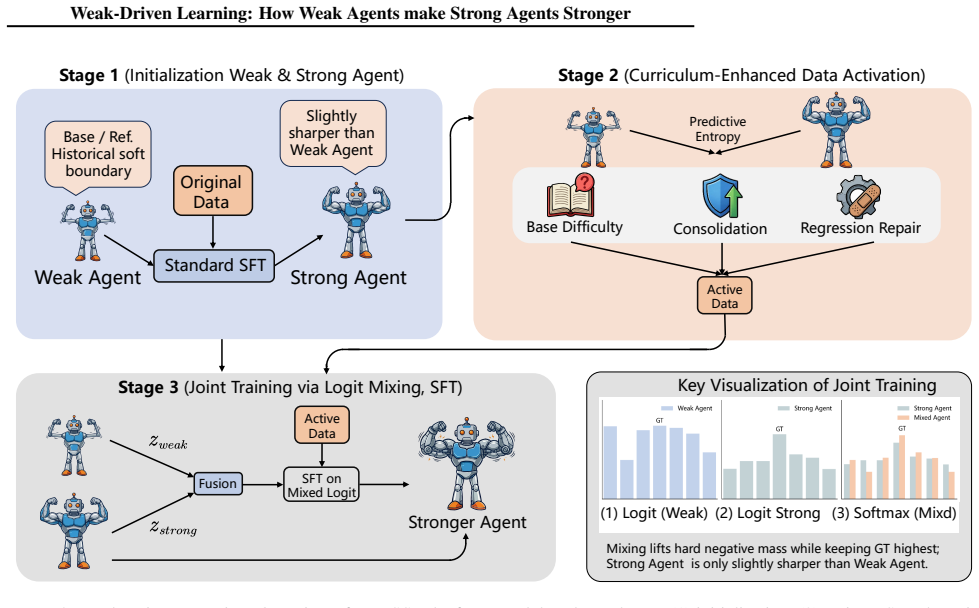
Central claim: post-training saturation is not a hard ceiling but gradient starvation, and the missing signal lies in the model's own history. WMSS mixes the current strong model's logits with a historical weak checkpoint's logits and trains on the target under the mixed softmax. The weak checkpoint's probability mass on plausible-but-wrong tokens raises total negative mass when the weak model is less separated from the target, reviving the vanishing gradients of SFT (Theorem 5.1). An entropy-dynamics curriculum selects hard, brittle, or regressed samples. On math and code benchmarks the method improves accuracy beyond SFT (e.g., Qwen3-8B math 66.7→72.9, code 71.2→77.6) with zero extra infer
What carries the argument
Joint logit mixing (Eq. 11): linearly interpolating the strong and weak models' per-token logits before the softmax and training the strong model on the target token's cross-entropy under that mixture. Backed by a margin analysis: hard negatives are tokens where the weak model's margin (target minus distractor logit) is smaller than the strong model's; Theorem 5.1 shows mixing shrinks those margins and increases the probability of negative classes, amplifying gradients that SFT would let vanish. A three-stage mechanism—amplification, gradient shielding as the strong model's Hessian contracts, and null-space drift along the shift-invariant mean direction—explains the observed logit dynamics.
Load-bearing premise
The load-bearing premise is that a historical weak checkpoint's high-entropy logits encode informative 'plausible distractors'—probability mass on wrong tokens that are worth suppressing—rather than noise that merely distorts the target distribution; if that mass is not informative, the mixed-logit objective is just a noisier version of SFT and the claimed breakthrough evaporates.
What would settle it
Train WMSS on the same data and hyperparameters but replace the weak model's logits with the strong model's own logits plus independent Gaussian noise scaled to match the weak model's entropy (a fake weak model with no task-specific content). If this fake-weak WMSS matches the real WMSS's gains on MATH500 and HumanEval, then weak checkpoints contribute only generic entropy, not structured distractors, and the paper's mechanism is not needed to explain the results.
If this is right
- Standard post-training pipelines can treat every intermediate checkpoint as a reusable teacher instead of discarding it as an inferior intermediate.
- The gains are delivered by training dynamics alone: the deployed model is unchanged, so the method adds zero inference cost in production.
- Saturation, on this account, is a signal that the model's errors are no longer being seen; restoring probability mass to suppressed alternatives is a general lever, not a task-specific trick.
- The entropy-dynamics selection rule gives a practical way to spot catastrophic forgetting in fine-tuning: samples where the current model is less certain than its predecessor are automatically up-weighted.
Where Pith is reading between the lines
- If the mechanism is right, the benefit should scale with the density of plausible wrong answers: reasoning and coding tasks should gain most, while generation tasks with near-unique completions should gain little—testable by comparing WMSS across task families with different distractor entropies.
- A cheap falsification probe: replace the weak checkpoint's logits with the strong model's own logits plus isotropic noise matched to the weak model's entropy; if gains persist, specific distractor content is not what matters, and if they vanish, the paper's story is supported.
- The crossover analysis suggests λ should track the relative sharpness of the two models; a practical extension would be to anneal λ as the strong model grows rather than fixing it at 0.5.
- The same logit-mixing principle might apply to non-autoregressive heads (e.g., classifier fine-tuning), where class confusion between similar categories could substitute for the weak checkpoint.
Editorial analysis
A structured set of objections, weighed in public.
Referee Report
Summary. The paper proposes WMSS, a post-training method in which a 'strong' model (an SFT checkpoint) is further trained on a cross-entropy loss defined over logits mixed between the strong model and a 'weak' historical checkpoint (Eq. 11). A curriculum stage weights training samples using entropy dynamics (Eq. 10), and the authors claim that the weak model's probability mass on plausible-but-incorrect tokens reactivates vanishing gradients, allowing training beyond SFT saturation. Experiments on math and code benchmarks with Qwen-family models report consistent gains over SFT, UNDIAL, and NEFTune at zero extra inference cost. The appendix provides gradient-level proofs, sensitivity analyses for α, β, γ and λ, and extended logit statistics.
Significance. If the central mechanism were established, WMSS would be a practically useful post-training recipe: it requires no extra inference cost, uses only checkpoints already produced during training, and reports meaningful accuracy gains on math and code tasks. The paper also ships a public code repository and includes formal gradient-level proofs, an ablation, and hyperparameter sensitivity tables, which are helpful for reproducibility. However, the distinctive claim—that weak models provide 'informative error signals' rather than generic entropy—is not isolated by the experiments. As presented, the theoretical results are local optimization statements about convex mixtures of logits, and the empirical gains could be explained by soft-target regularization. The significance of the contribution therefore rests on control experiments that the manuscript does not provide.
major comments (4)
- [Algorithm 1 vs. §4, §5, Appendix C] The paper repeatedly says the weak agent is 'co-trained' with the strong agent (Eq. 6, §4), and the theory in §5/Appendix C derives simultaneous updates for both agents (Eqs. 27, 57–58, 75–77). But Algorithm 1 freezes the weak checkpoint and updates only Mθ (lines 10–16). Moreover, the weak model is M_{t-1}, which after the first iteration is not the base M0 but the previously trained strong model. The gradient-shielding and crossover analysis in Appendix C therefore does not apply to the implemented method. This is a load-bearing mismatch: either the algorithm must update the weak branch as the theory assumes, or the theory must be rewritten for a frozen, changing previous checkpoint.
- [§4.2, Eq. (11); Theorem B.7, Corollary B.6] The theoretical mechanism does not distinguish weak-specific information from generic entropy injection. Theorem B.7 and Corollary B.6 only show that if the weak logits have smaller margins on negative tokens, then mixing increases negative probability mass and gradient magnitudes. The same conclusion holds for any higher-entropy distribution, e.g., a temperature-raised or shuffled version of the strong logits. No experiment replaces z_weak in Eq. (11) with such a control. Consequently, the gains in Table 1 could be attributed to soft-target regularization rather than to informative distractors, which is the paper's central claim. A control with a temperature-scaled or permuted weak distribution is essential.
- [§6, Tables 1, 4, 5; Appendix A.2] The hyperparameters α, β, γ are selected using results on the evaluation benchmarks: Table 4 explicitly labels a configuration as 'Ours (Selected)' based on AIME/MATH500 numbers, with no held-out validation split. The main results are 3-run averages without standard deviations or significance tests, and several reported deltas are small relative to the benchmark size: AIME2025 has roughly 30 problems, so a 12.2→20.0 improvement is about 2.5 questions. Appendix A.2 itself concedes that 'minor fluctuations on small sets (e.g., AIME25, 30 problems) are still expected.' This makes the headline 'doubling AIME2025' claim fragile.
- [Appendix A.2, Eqs. (21)–(22), Remark C.4] The claimed prediction of the optimal mixing coefficient is circular as stated. Eq. (21) estimates α from the measured centered norms of the same training run whose logits are being analyzed, and Eq. (22) then uses that α to obtain λcross≈0.455, which is said to lie near the empirically strong region. This is a post-hoc consistency check, not an independent prediction, particularly because Remark C.4 states that Eq. (71) does not predict accuracy inversion. The agreement therefore provides little confirmatory evidence for the theory.
minor comments (5)
- [§6.2 vs. Table 1] Table 1 says all models are fine-tuned for a total of 2 epochs, but Figure 3 plots training over 4 epochs and the text discusses over-optimization at Epoch 4. Please clarify which epoch count is used for the main results and why the convergence analysis extends beyond it.
- [Table 2 and Appendix A.3] The logit statistics are computed from only 200 randomly sampled training examples, with no confidence intervals. Statements such as 'dramatic 56.9% reduction' in the non-target logit mean should be accompanied by estimates of variability.
- [Eq. (10)] The curriculum sampling probability is defined as proportional to a sum of three terms, but no details are given on the sampling size per epoch, whether sampling is with replacement, or how the normalization interacts with the subsequent logit-mixing stage. This affects reproducibility.
- [Terminology] The terms 'weak agent' and 'co-training' are used inconsistently: the base checkpoint M0 is called weak in Phase 1, but Algorithm 1 uses M_{t-1} at each iteration, and the weak branch is never updated. Please align the terminology with the actual procedure.
- [Notation] Eq. (11) and Eq. (13) define the same mixing in different orders (λ z_strong + (1−λ) z_weak vs. (1−λ) z_weak + λ z_strong). This is harmless but should be made uniform.
Circularity Check
No significant circularity; the one apparent 'prediction' (λcross) is explicitly a post-hoc consistency check and the main results rest on external benchmark comparisons.
specific steps
-
fitted input called prediction
[Appendix A.2, Eqs. (21)-(22)]
"From the logits evaluation report, ∥˜z2∥2 ≈1240.10 and ∥˜z1∥2 ≈1034.50 , giving α≈1.44 . Plugging into the crossover formula in Eq. (71), λcross ≈ 1 1 + √α ≈0.455, which lies close to the empirically strongest region (λ∈[0.42,0.48]). We stress that this is a heuristic consistency check: α is phase-dependent and the linearization is local, so the theory predicts a broad optimum region rather than a sharp inversion point."
The λcross calculation is not an independent prediction: α is measured from the centered logit norms of the same trained weak/strong models whose λ sweep in Table 5 supplies the empirical optimum to which λcross is compared. Eq. (22) therefore refits the run's own measurements and checks for self-consistency, rather than forecasting a held-out quantity. The paper explicitly concedes this by calling it a heuristic consistency check, and the main benchmark results do not depend on this calculation.
full rationale
The headline empirical claim — WMSS improves over standard SFT, UNDIAL and NEFTune on math and code benchmarks (Table 1) — rests on external, self-contained evaluation, so the central result does not reduce to its own inputs. The theory in Section 5 is largely an algebraic unpacking of the logit-mixing definition (Eq. 13): Theorem 5.1 follows from convex margin combination and Softmax monotonicity and establishes gradient amplification, not the weak-specific 'informativeness' of distractors; that gap is a mechanistic limitation, not a circular derivation. The only place where a derived quantity is compared to the same run's optimum is the λcross calculation in Appendix A.2, and the paper itself labels it a heuristic consistency check. There is no load-bearing self-citation, no imported uniqueness theorem, and no prediction forced by a fitted parameter beyond the explicitly post-hoc crossover check. Overall: minimal circularity.
Axiom & Free-Parameter Ledger
free parameters (5)
- α (base difficulty weight) =
0.1
- β (consolidation weight) =
0.8
- γ (regression repair weight) =
0.1
- λ (logit mixing coefficient) =
0.5 in main results; Table 5 optimum 0.42
- training duration / epoch count =
2 epochs in Table 1; logit stats at Epoch 3; convergence shown to 4 epochs
axioms (5)
- domain assumption Softmax cross-entropy loss and next-token prediction accurately proxy task performance
- ad hoc to paper The weak checkpoint's high-entropy logits encode 'plausible distractors' rather than noise; these expose recoverable failure modes
- ad hoc to paper Assumption C.3: g^T K_strong g ≈ α g^T K_weak g with α>1, i.e., the strong model has larger sensitivity along the residual
- domain assumption Optimization saturation is caused mainly by vanishing gradients on non-target tokens rather than by capacity or overfitting
- ad hoc to paper Stochastic training noise in the null space follows a random walk with no restoring force, producing mean drift
read the original abstract
As post-training optimization becomes central to improving large language models, we observe a persistent saturation bottleneck: once models grow highly confident, further training yields diminishing returns. While existing methods continue to reinforce target predictions, we find that informative supervision signals remain latent in models' own historical weak states. Motivated by this observation, we propose WMSS (Weak Agents Can Make Strong Agents Stronger), a post-training paradigm that leverages weak checkpoints to guide continued optimization. By identifying recoverable learning gaps via entropy dynamics and reinforcing them through compensatory learning, WMSS enables strong agents to improve beyond conventional post-training saturation. Experiments on mathematical reasoning and code generation datasets show that agents trained with our approach achieve effective performance improvements, while incurring zero additional inference cost.
Figures



Forward citations
Cited by 2 Pith papers
-
Policy Improvement Reinforcement Learning
PIRL maximizes cumulative policy improvement across iterations instead of surrogate rewards and is proven aligned with final performance; PIPO implements it via retrospective verification for stable closed-loop optimization.
-
Policy Improvement Reinforcement Learning
PIPO adds closed-loop policy-improvement feedback to RL post-training so updates that raise measured performance are reinforced and those that drop it are suppressed.
Reference graph
Works this paper leans on
-
[1]
Pre” denotes before joint training, and “Stronger (Post)
“Pre” denotes before joint training, and “Stronger (Post)” denotes the jointly trained strong branch after training. ∆ denotes Post−Pre (percent change in parentheses). Centered norm values are taken directly from the logit analysis report. Metric Weak Strong Pre Post∆Pre Stronger (Post)∆ Mean logitz mean 3.65 9.42 5.77 (+158.1%) 2.87 0.97 -1.90 (-66.2%) ...
1978
-
[5]
How abilities in large language models are affected by supervised fine-tuning data composition
Dong, G., Yuan, H., Lu, K., Li, C., Xue, M., Liu, D., Wang, W., Yuan, Z., Zhou, C., and Zhou, J. How abilities in large language models are affected by supervised fine-tuning data composition. InProceedings of the 62nd Annual Meeting of the Association for Computational Linguistics (Volume 1: Long Papers), pp. 177–198, 2024a. Dong, Y . R., Lin, H., Belkin...
-
[6]
doi: 10.1007/s11263-021-01453-z
ISSN 1573-1405. doi: 10.1007/s11263-021-01453-z. URLhttp://dx.doi. org/10.1007/s11263-021-01453-z. 9 Weak-Driven Learning: How Weak Agents make Strong Agents Stronger Gu, Y ., Dong, L., Wei, F., and Huang, M. Minillm: Knowl- edge distillation of large language models.arXiv preprint arXiv:2306.08543,
-
[7]
URLhttps://arxiv.org/ abs/2305.15717. Gulcehre, C., Paine, T. L., Srinivasan, S., Konyushkova, K., Weerts, L., Sharma, A., Siddhant, A., Ahern, A., Wang, M., Gu, C., Macherey, W., Doucet, A., Firat, O., and de Freitas, N. Reinforced self-training (rest) for language modeling,
-
[8]
He, X., Ban, Y ., Zou, J., Wei, T., Cook, C., and He, J
URLhttps://arxiv.org/abs/ 2308.08998. He, X., Ban, Y ., Zou, J., Wei, T., Cook, C., and He, J. Llm- forest: Ensemble learning of llms with graph-augmented prompts for data imputation. InFindings of the Asso- ciation for Computational Linguistics: ACL 2025, pp. 6921–6936,
Pith/arXiv arXiv 2025
-
[9]
Distilling the knowledge in a neural network.arXiv preprint arXiv:1503.02531,
Hinton, G., Vinyals, O., and Dean, J. Distilling the knowledge in a neural network.arXiv preprint arXiv:1503.02531,
-
[12]
Koncel-Kedziorski, R., Roy, S., Amini, A., Kushman, N., and Hajishirzi, H
URLhttps://arxiv.org/abs/ 2310.05914. Koncel-Kedziorski, R., Roy, S., Amini, A., Kushman, N., and Hajishirzi, H. Mawps: A math word problem reposi- tory. InProceedings of the 2016 conference of the north american chapter of the association for computational lin- guistics: human language technologies, pp. 1152–1157,
Pith/arXiv arXiv 2016
-
[15]
URLhttps://arxiv. org/abs/2402.08115. Touvron, H. et al. Llama 2: Open foundation and fine-tuned chat models.arXiv preprint arXiv:2307.09288,
-
[16]
Xu, C., Sun, Q., Zheng, K., Geng, X., Zhao, P., Feng, J., Tao, C., and Jiang, D. Wizardlm: Empowering large language models to follow complex instructions.arXiv preprint arXiv:2304.12244,
-
[17]
URLhttps://arxiv.org/ abs/2505.09388. Yang, F., Chen, Z., Wang, X., Lu, X., Chai, J., Yin, G., Lin, W., Ma, S., Zhuang, F., Wang, D., Yang, Y ., Li, J., and Ban, Y . Your group-relative advantage is biased,
-
[18]
Zhang, L., Song, J., Gao, A., Chen, J., Bao, C., and Ma, K
URLhttps://arxiv.org/abs/2601.08521. Zhang, L., Song, J., Gao, A., Chen, J., Bao, C., and Ma, K. Be your own teacher: Improve the performance of convolutional neural networks via self distillation,
-
[20]
Zhou, C., Liu, P., Xu, P., Iyer, S., Sun, J., Mao, Y ., Ma, X., Efrat, A., Yu, P., Yu, L., et al
URLhttps://arxiv.org/abs/2503.19633. Zhou, C., Liu, P., Xu, P., Iyer, S., Sun, J., Mao, Y ., Ma, X., Efrat, A., Yu, P., Yu, L., et al. Lima: Less is more for alignment.Advances in Neural Information Processing Systems, 36,
-
[21]
Zou, J., Ban, Y ., Li, Z., Qi, Y ., Qiu, R., Yang, L., and He, J. Transformer copilot: Learning from the mistake log in llm fine-tuning.arXiv preprint arXiv:2505.16270,
-
[22]
10 Weak-Driven Learning: How Weak Agents make Strong Agents Stronger Table 4.Hyperparameter Sensitivity Analysis on Qwen3-4B-Base.We evaluate the impact of the mixing coefficients α (base difficulty), β(consolidation), andγ(regression repair) on mathematical reasoning.Bolddenotes the best performance. Setup Coefficients Accuracy (%) α β γAIME 2025 MATH 50...
2025
-
[25]
To answer the user’s question, you first think about the reasoning process and then provide the user with the answer
System Prompt for Reasoning Enforcement You are a helpful assistant. To answer the user’s question, you first think about the reasoning process and then provide the user with the answer. The reasoning process and answer are enclosed within <think> and <answer> tags, respectively, i.e.,<think>reasoning process here</think> <answer>answer here</answer>. Tab...
2025
-
[500]
Configuration C (α= 0.1, β= 0.9, γ= 0), which disables the regression-repair signal, achieves the highest accuracy on MATH 500 (70.2%)
and complex reasoning capability (AIME 2025). Configuration C (α= 0.1, β= 0.9, γ= 0), which disables the regression-repair signal, achieves the highest accuracy on MATH 500 (70.2%). However, its performance on the more challenging AIME benchmark drops significantly to10.3%. This suggests that while strong consolidation of the target distribution (β= 0.9 )...
2025
-
[2009]
H., Baker, B., Gao, L., Aschenbrenner, L., Chen, Y ., Ecoffet, A., Joglekar, M., Leike, J., et al
Burns, C., Izmailov, P., Kirchner, J. H., Baker, B., Gao, L., Aschenbrenner, L., Chen, Y ., Ecoffet, A., Joglekar, M., Leike, J., et al. Weak-to-strong generalization: Eliciting strong capabilities with weak supervision.arXiv preprint arXiv:2312.09390,
-
[2016]
Ling, W., Yogatama, D., Dyer, C., and Blunsom, P. Pro- gram induction by rationale generation: Learning to solve and explain algebraic word problems.arXiv preprint arXiv:1705.04146,
-
[2019]
Zhao, H., Wang, H., Peng, Y ., Zhao, S., Tian, X., Chen, S., Ji, Y ., and Li, X
URLhttps://arxiv.org/abs/1905.08094. Zhao, H., Wang, H., Peng, Y ., Zhao, S., Tian, X., Chen, S., Ji, Y ., and Li, X. 1.4 million open-source distilled reasoning dataset to empower large language model training,
Pith/arXiv arXiv 1905
-
[2021]
Chen, Z., Ai, T., Li, Y ., Li, G., Wei, Y ., Zhou, W., Li, G., Yu, B., Chen, Z., Sun, H., et al
URLhttps://arxiv.org/abs/2107.03374. Chen, Z., Ai, T., Li, Y ., Li, G., Wei, Y ., Zhou, W., Li, G., Yu, B., Chen, Z., Sun, H., et al. Llmboost: Make large language models stronger with boosting.arXiv preprint arXiv:2512.22309,
-
[2022]
Are nlp models really able to solve simple math word problems?arXiv preprint arXiv:2103.07191,
Patel, A., Bhattamishra, S., and Goyal, N. Are nlp models really able to solve simple math word problems?arXiv preprint arXiv:2103.07191,
-
[2023]
Program synthesis with large language models.arXiv preprint arXiv:2108.07732,
Austin, J., Odena, A., Nye, M., Bosma, M., Michalewski, H., Dohan, D., Jiang, E., Cai, C., Terry, M., Le, Q., et al. Program synthesis with large language models.arXiv preprint arXiv:2108.07732,
-
[2024]
URLhttps://arxiv.org/ abs/2310.01798. Huang, Z., Xia, X., Ren, Y ., Zheng, J., Xiao, X., Xie, H., Huaqiu, L., Liang, S., Dai, Z., Zhuang, F., Li, J., Ban, Y ., and Wang, D. Real-time aligned reward model beyond se- mantics,
-
[2025]
Training verifiers to solve math word problems
Cobbe, K., Kosaraju, V ., Bavarian, M., Chen, M., Jun, H., Kaiser, L., Plappert, M., Tworek, J., Hilton, J., Nakano, R., et al. Training verifiers to solve math word problems. arXiv preprint arXiv:2110.14168,
-
[2026]
Jain, N., yeh Chiang, P., Wen, Y ., Kirchenbauer, J., Chu, H.-M., Somepalli, G., Bartoldson, B
URLhttps://arxiv.org/abs/2601.22664. Jain, N., yeh Chiang, P., Wen, Y ., Kirchenbauer, J., Chu, H.-M., Somepalli, G., Bartoldson, B. R., Kailkhura, B., Schwarzschild, A., Saha, A., Goldblum, M., Geiping, J., and Goldstein, T. Neftune: Noisy embeddings improve instruction finetuning,
discussion (0)
Sign in with ORCID, Apple, or X to comment. Anyone can read and Pith papers without signing in.