Recognition: 2 theorem links
· Lean TheoremA theoretical one-dimensional model for variable-density Rayleigh-Taylor turbulence
Pith reviewed 2026-05-16 06:10 UTC · model grok-4.3
The pith
The full similarity equation from a 1965 turbulent diffusivity model reproduces asymmetric spike and bubble growth in variable-density Rayleigh-Taylor mixing.
A machine-rendered reading of the paper's core claim, the machinery that carries it, and where it could break.
Core claim
The full similarity equation derived from the Belen'kii and Fradkin turbulent diffusivity model captures the asymmetric spike and bubble growth and the systematic shift of velocity statistics toward the light-fluid side in non-Boussinesq Rayleigh-Taylor flows. Solutions to this equation agree reasonably with numerical and experimental data on spatial profiles and mixing layer growth trends. To leading order, the mixing is governed by the competing dynamics between diffusion of ln ρ-bar and mass conservation.
What carries the argument
The full similarity ordinary differential equation obtained by integrating the turbulent diffusivity closure across the mixing layer and enforcing mass conservation.
If this is right
- Spike fronts advance faster into the light fluid than bubble fronts advance into the heavy fluid.
- Mean velocity and fluctuation statistics are displaced toward the light-fluid side of the mixing layer.
- Spatial profiles of density and velocity obtained from the model match trends reported in simulations and experiments.
- A global mass correction to the simplified ODE solution closely recovers the full-equation results.
Where Pith is reading between the lines
- One-dimensional similarity models can recover essential non-Boussinesq asymmetries without requiring three-dimensional resolution of all turbulent scales.
- The same balance between logarithmic-density diffusion and mass conservation may appear in other variable-density shear or buoyancy-driven flows.
- The model offers a low-cost way to estimate late-time growth corrections when full simulations remain expensive.
Load-bearing premise
The turbulent diffusivity closure assumes a specific functional form for the mixing that reduces the governing equations to a similarity ODE.
What would settle it
A high-resolution simulation or experiment that measures bubble and spike heights at late times and finds growth rates that deviate strongly from the asymmetric predictions of the full similarity equation would falsify the central claim.
Figures




read the original abstract
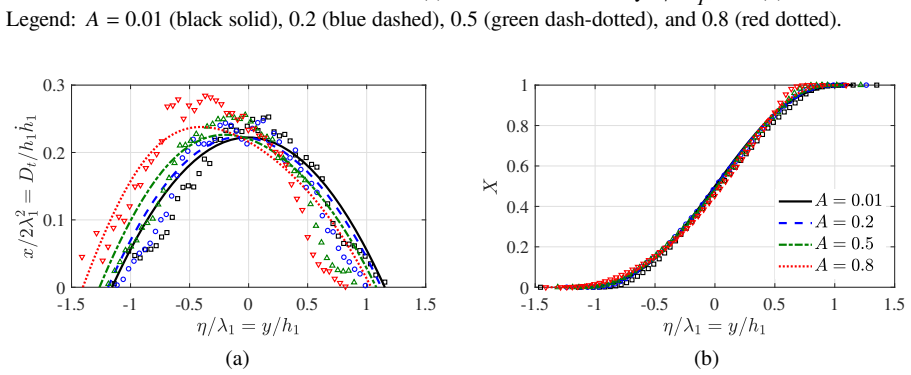
In an early theoretical work published in 1965, Belen'kii & Fradkin proposed a turbulent diffusivity model for Rayleigh--Taylor (RT) mixing. We review its derivation and present alternative arguments leading to the same final similarity equation. The original work then introduced an approximation that led to a simplified ordinary differential equation (ODE), which was used primarily to derive the important scaling result, $h \sim (\ln R)gt^2$. Here, we extend the analysis by examining the solutions to both the full similarity ODE and the simplified ODE in detail. It is shown that the full similarity equation captures many now well-known features of non-Boussinesq RT flows, including asymmetric spike and bubble growth and a systematic shift of velocity statistics toward the light-fluid side. Comparisons of the theoretical model with numerical and experimental studies show reasonable agreement in both spatial profiles and growth trends of mixing layer heights. We further show that a global mass correction applied to the simplified solution closely approximates the full solution, highlighting that, to leading order, RT mixing is governed by the competing dynamics between diffusion of $\ln \bar{\rho}$ and mass conservation.
Editorial analysis
A structured set of objections, weighed in public.
Referee Report
Summary. The manuscript reviews the 1965 Belen'kii-Fradkin turbulent diffusivity model for Rayleigh-Taylor mixing, provides alternative derivations that recover the same similarity equation, solves both the full similarity ODE and its simplified approximation in detail, demonstrates that the full model produces asymmetric spike/bubble growth and a systematic shift of velocity statistics toward the light-fluid side, and reports reasonable agreement with DNS and experimental data on spatial profiles and mixing-layer growth trends. It further shows that a global mass correction applied to the simplified solution closely approximates the full solution, arguing that leading-order RT mixing is governed by the competition between diffusion of ln ρ-bar and mass conservation.
Significance. If the results hold, the work supplies a compact one-dimensional theoretical framework that reproduces several established non-Boussinesq features of variable-density RT turbulence without requiring full three-dimensional resolution. The explicit demonstration that the asymmetry and velocity bias emerge from the interplay of the chosen diffusivity closure and mass conservation offers a useful interpretive lens for both simulations and experiments, while the mass-correction approximation provides a practical simplification for engineering estimates.
major comments (2)
- [Comparisons with numerical and experimental studies] The central claim of reasonable agreement with numerical and experimental studies rests on qualitative statements about spatial profiles and growth trends. No quantitative error metrics (e.g., integrated profile differences or relative errors in h(t) for specific Atwood numbers) are supplied to support this assessment.
- [Derivation of the similarity equation and solution of the full ODE] The asymmetric spike/bubble growth and light-fluid velocity shift are direct consequences of the specific functional form of the turbulent diffusivity closure acting on ln ρ-bar. Although alternative derivations are presented that recover the same closure, no sensitivity tests to plausible alternative closures (e.g., constant-coefficient gradient diffusion or buoyancy-adjusted forms) are reported, leaving open whether the reported non-Boussinesq features are robust or closure-specific.
minor comments (2)
- [Solution of the full similarity ODE] The numerical procedure used to integrate the full similarity ODE (discretization scheme, boundary conditions at the edges of the mixing layer, and convergence checks) should be stated explicitly to allow independent reproduction of the reported profiles.
- [Figures showing spatial profiles] Figure captions for the profile comparisons should list the exact Atwood numbers, dimensionless times, and any normalization constants employed for both the theoretical curves and the reference data.
Simulated Author's Rebuttal
We thank the referee for the positive assessment and recommendation for minor revision. We address the two major comments below.
read point-by-point responses
-
Referee: The central claim of reasonable agreement with numerical and experimental studies rests on qualitative statements about spatial profiles and growth trends. No quantitative error metrics (e.g., integrated profile differences or relative errors in h(t) for specific Atwood numbers) are supplied to support this assessment.
Authors: We agree that quantitative error metrics would strengthen the claims of agreement. In the revised manuscript we will add relative errors in the mixing-layer height h(t) for representative Atwood numbers together with integrated L2 differences between the model profiles and available DNS/experimental data. revision: yes
-
Referee: The asymmetric spike/bubble growth and light-fluid velocity shift are direct consequences of the specific functional form of the turbulent diffusivity closure acting on ln ρ-bar. Although alternative derivations are presented that recover the same closure, no sensitivity tests to plausible alternative closures (e.g., constant-coefficient gradient diffusion or buoyancy-adjusted forms) are reported, leaving open whether the reported non-Boussinesq features are robust or closure-specific.
Authors: The reported non-Boussinesq features are indeed tied to the Belen'kii-Fradkin diffusivity closure. The manuscript's scope is to derive, solve, and interpret this specific model; systematic sensitivity tests to other closures lie outside that scope. We will add an explicit statement in the discussion section noting the closure dependence and identifying alternative closures as a topic for future work. revision: partial
Circularity Check
No significant circularity; derivation relies on external 1965 closure with independent solutions and comparisons
full rationale
The paper reviews the Belen'kii & Fradkin 1965 turbulent diffusivity closure for RT mixing and supplies alternative arguments that recover the same similarity equation. It then solves both the full similarity ODE and the simplified ODE, demonstrating that the full equation produces known non-Boussinesq features such as asymmetric spike/bubble growth and light-fluid velocity shifts. These features are compared against external DNS and experiments for agreement in profiles and growth trends. A global mass correction is shown to approximate the full solution. No step reduces a prediction to a fitted parameter by construction, no self-citation is load-bearing for the central claim, and the closure is treated as an external input rather than derived from the present results. The derivation chain is therefore self-contained against external benchmarks.
Axiom & Free-Parameter Ledger
axioms (1)
- domain assumption Turbulent diffusivity model for Rayleigh-Taylor mixing as proposed by Belen'kii & Fradkin (1965)
Lean theorems connected to this paper
-
IndisputableMonolith/Cost/FunctionalEquation.leanwashburn_uniqueness_aczel unclear?
unclearRelation between the paper passage and the cited Recognition theorem.
the turbulent diffusivity model ... /u1D437 ∗ /u1D461 = /u1D43E (1/¯/u1D70C d¯/u1D70C/dy)^{1/2} g^{1/2} h_t^2 ... leading to the similarity ODE −2η = 3 dξ/dη + ξ³
-
IndisputableMonolith/Foundation/ArithmeticFromLogic.leanembed_injective unclear?
unclearRelation between the paper passage and the cited Recognition theorem.
to leading order, RT mixing is governed by the competing dynamics between diffusion of ln ρ-bar and mass conservation
What do these tags mean?
- matches
- The paper's claim is directly supported by a theorem in the formal canon.
- supports
- The theorem supports part of the paper's argument, but the paper may add assumptions or extra steps.
- extends
- The paper goes beyond the formal theorem; the theorem is a base layer rather than the whole result.
- uses
- The paper appears to rely on the theorem as machinery.
- contradicts
- The paper's claim conflicts with a theorem or certificate in the canon.
- unclear
- Pith found a possible connection, but the passage is too broad, indirect, or ambiguous to say the theorem truly supports the claim.
Reference graph
Works this paper leans on
-
[1]
shows that /u1D465( /u1D702) , though dimensionless, has a density-ratio dependence thr ough the factor /u1D7062 /u1D456. By explicitly separating the similarity variables from th e physical variables, the normalized turbulent diffusivity may therefore be written a s /u1D437 ∗ /u1D461 ℎ/u1D456∝dotaccℎ/u1D456 = /u1D465 2/u1D7062 /u1D456 . (37) C. Analytical...
-
[2]
proposed a range of validity for Eq. ( 42) to be /u1D445≲ 4. IV . RESULTS The main result reported by Belen’kii and Fradkin [ 1] is the analytical ln /u1D445scaling (42) derived from the simplified ODE. Besides limited comparisons of /u1D711( /u1D702) profiles between the full and simplified solution, there was no analysis of the height scal ing from the ful...
-
[3]
2(a) and the corre- sponding mole fraction /u1D44Bin Fig
Full ODE The normalized diffusivity /u1D465/2/u1D7062 /u1D447 from the full ODE ( 27) is shown in Fig. 2(a) and the corre- sponding mole fraction /u1D44Bin Fig. 2(b). As the Atwood number increases, three important trends are 9 -2 -1 0 1 2 0 0.2 0.4 0.6 0.8 1 (a) -2 -1 0 1 2 0 0.2 0.4 0.6 0.8 1 (b) -3 -2 -1 0 1 2 3 0 0.2 0.4 0.6 0.8 1 (c) -2 -1 0 1 2 0 0.2...
-
[4]
( 42) without examining the spatial profiles in detail
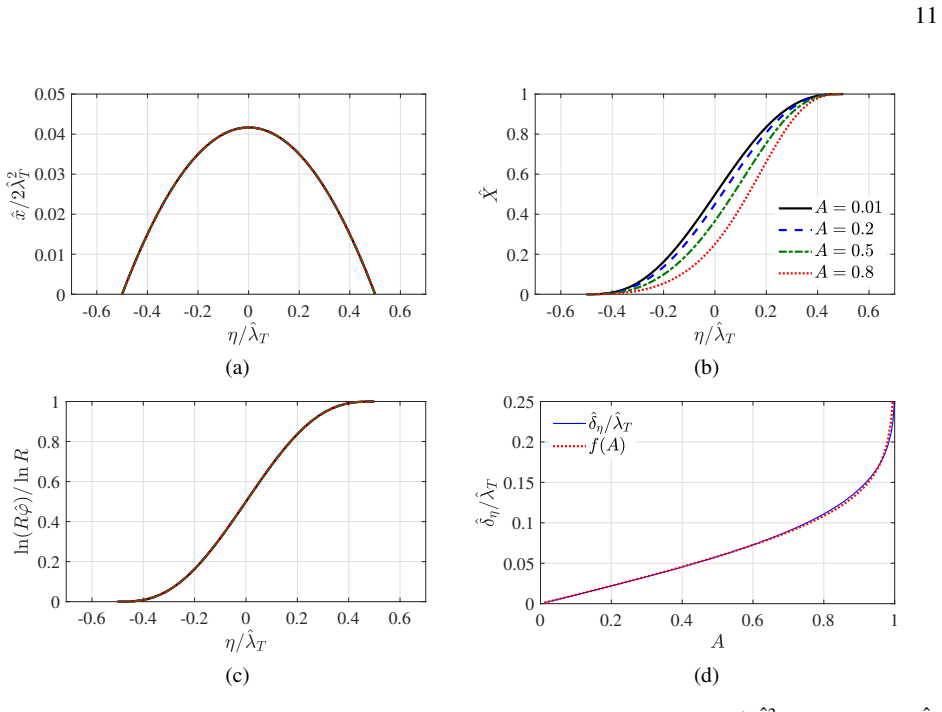
Simplified ODE For the simplified ODE ( 38), Belen’kii and Fradkin [ 1] reported the analytical ln /u1D445growth for ˆℎ/u1D447 in Eq. ( 42) without examining the spatial profiles in detail. This sect ion discusses important physical insights that can be gained by analyzing these profi les directly. The normalized diffusivity ˆ /u1D465/2 ˆ/u1D7062 /u1D447 and m...
-
[5]
(blue solid) and from the analytical expression ( 45) (red dotted) definition of the dimensionless diffusivity, ˆ /u1D4652 = ˆ/u1D711′/ˆ/u1D711= ( ln /u1D711) ′, the even symmetry of ˆ/u1D465implies a centered spreading of ln ˆ/u1D711. This is illustrated by the exact collapse and symmetry of the normalized quantity ln( /u1D445ˆ/u1D711)/ ln /u1D445in Fig. 4...
-
[6]
(11) and global mass conservation is easily proven by integrating Eq
is mathematically equivalent to Eq. (11) and global mass conservation is easily proven by integrating Eq. ( 11) over the domain. We propose a simple correction to enforce global mass conser vation by shifting the profiles leftward by ˆ/u1D6FF/u1D702. All mass-corrected variables are notated with a ∗ superscript, e.g., ˆ/u1D465∗( /u1D702) = ˆ/u1D465( /u1D70...
-
[7]
Total height A key result from Belen’kii and Fradkin [ 1] states that the total mixing layer height scales with ln /u1D445. Because this scaling was derived for the solution to the sim plified ODE, ˆℎ/u1D447 , the authors restricted the validity of this result to /u1D445≤ 4 (i.e. /u1D434 ≤ 0.6). Additionally, it was also assumed in the derivation of Eq. ( ...
-
[8]
Spikes and bubbles It is common in the VD RT literature to track the growth of spik es and bubbles separately. As discussed in the introduction, it has been generally obse rved that bubble heights scale linearly with Atwood number while spike heights do not; this translat es to near-constant values of /u1D6FC/u1D44F ( /u1D434 ) but growing /u1D6FC/u1D460(...
-
[9]
The total mixing layer height scales approximately with l n /u1D445, rather than /u1D434
-
[10]
Spike heights appear to deviate more strongly from /u1D434/u1D454/u1D4612 scaling than bubble heights
-
[11]
The ratio of spike to bubble heights increases with Atwood number
-
[12]
Velocity profiles (represented by /u1D465) are shifted toward the light-fluid side. These behaviors are inherently captured by the model of Bele n’kii and Fradkin [ 1]; however, with the exception of observation (1), they were not discussed in the original paper. The present work brings these results to light and highlights that many now-k nown features of ...
-
[13]
S. Belen’kii and E. Fradkin, Theory of turbulent mixing, Trudi FIAN 29, 207 (1965)
work page 1965
-
[14]
Rayleigh, Investigation of the character of the equilib rium of an incompressible heavy fluid of variable density, Proc. Lond. Math. Soc. s1-14, 170 (1882) . 16
-
[15]
G. I. Taylor, The instability of liquid surfaces when acc elerated in a direction perpendicular to their planes. I, Proc. R. Soc. Lond. A 201, 192 (1950)
work page 1950
-
[16]
Zhou, Rayleigh–Taylor and Richtmyer–Meshkov instab ility induced flow, turbulence, and mixing
Y . Zhou, Rayleigh–Taylor and Richtmyer–Meshkov instab ility induced flow, turbulence, and mixing. I, Phys. Rep. 720, 1 (2017)
work page 2017
-
[17]
D. L. Y oungs, Numerical simulation of turbulent mixing b y Rayleigh–Taylor instability, Physica D. 12, 32 (1984)
work page 1984
-
[18]
J. R. Ristorcelli and T. T. Clark, Rayleigh–Taylor turbu lence: self-similar analysis and direct numerical simulations, J. Fluid Mech. 507, 213 (2004)
work page 2004
-
[19]
G. Dimonte and M. Schneider, Density ratio dependence of Rayleigh—Taylor mixing for sustained and impulsive acceleration histories, Phys. Fluids 12, 304–321 (2000)
work page 2000
-
[20]
A. Banerjee, W . N. Kraft, and M. J. Andrews, Detailed measurements of a statistically steady Rayleigh– Taylor mixing layer from small to high Atwood numbers, J. Fluid. Mech. 659, 127 (2010)
work page 2010
-
[21]
D. L. Y oungs, The density ratio dependence of self-simil ar Rayleigh–Taylor mixing, Phil. Trans. R. Soc. A 371, 20120173 (2013)
work page 2013
-
[22]
Y . Zhou and W . H. Cabot, Time-dependent study of anisotropy in Rayleigh–Taylor instability induced turbulent flows with a variety of density ratios, Phys. Fluids 31, 084106 (2019)
work page 2019
-
[23]
D. Livescu, J. R. Ristorcelli, M. R. Petersen, and R. Gor e, New phenomena in variable-density Rayleigh—Taylor turbulence, Phys. Scr. T142, 014015 (2010)
work page 2010
-
[24]
C. Y . Goh, D. Brito Matehuala, and G. Blanquart, Self-si milar scaling of variable-density Rayleigh– Taylor turbulence, J. Fluid Mech. (2026), In press
work page 2026
-
[25]
S. Abarzhi, Review of theoretical modelling approache s of Rayleigh–Taylor instabilities and turbulent mixing, Phil. Trans. R. Soc. A 368, 1809 (2010)
work page 2010
-
[26]
O. Schilling, Progress on understanding Rayleigh–Tay lor flow and mixing using synergy between simulation, modeling, and experiment, J. Fluids Eng. 142, 120802 (2020)
work page 2020
-
[27]
C. Y . Goh and G. Blanquart, A statistically stationary minimal flow unit for self-similar Rayleigh–Taylor turbulence in the mode-coupling limit, J. Fluid Mech. 1002, A19 (2025)
work page 2025
-
[28]
O. Schilling, Self-similar Reynolds-averaged mechan ical–scalar turbulence models for Rayleigh– Taylor, Richtmyer–Meshkov, and Kelvin–Helmholtz instabi lity-induced mixing in the small Atwood number limit, Phys. Fluids 33, 085129 (2021)
work page 2021
discussion (0)
Sign in with ORCID, Apple, or X to comment. Anyone can read and Pith papers without signing in.