Recognition: 2 theorem links
· Lean TheoremA QFT information protocol for charged black holes
Pith reviewed 2026-05-16 03:06 UTC · model grok-4.3
The pith
The quantum information retrieval protocol generalizes to type III factors for charged black holes and implies quantized emitted charge.
A machine-rendered reading of the paper's core claim, the machinery that carries it, and where it could break.
Core claim
The generalization of the protocol to type III inclusions produces a formula whose value equals the statistical dimension of the superselection sector in the case of charge evaporation. The index-statistics theorem then supplies a thermodynamic interpretation, while the requirement that the index belong to a discrete set of allowed values implies that the charge emitted during evaporation is quantized.
What carries the argument
The index-statistics theorem applied to the generalized retrieval formula on type III inclusions, which equates the index to the statistical dimension of the charge superselection sector.
If this is right
- The information protocol now applies to the type III local algebras that actually arise in quantum field theory.
- Charge-carrying evaporation acquires a thermodynamic interpretation through the statistical dimension.
- The charge lost by the black hole can only take discrete values determined by the allowed indices.
- Entropy and other thermodynamic quantities of the evaporating black hole become directly tied to the index of the inclusion.
Where Pith is reading between the lines
- The discrete charge steps may provide a new handle on how information is preserved during evaporation.
- Analog systems in condensed matter that realize similar type III inclusions could be used to test the predicted quantization.
- Explicit computation of the index for concrete black hole metrics would fix the allowed charge increments.
Load-bearing premise
The index-statistics theorem applies directly to the type III algebra setting of black hole evaporation without further conditions.
What would settle it
An explicit model of charged black hole evaporation in which the emitted charge takes a continuous range of values would falsify the quantization conclusion.
Figures

read the original abstract
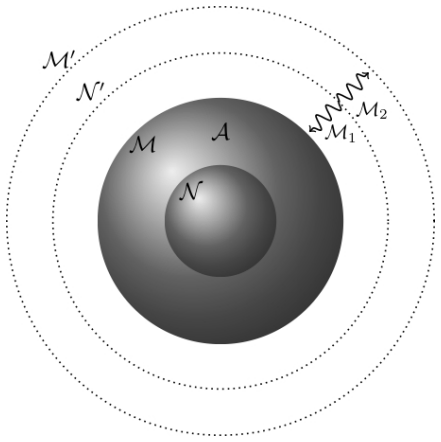
A generalization for the quantum information retrieval protocol recently illustrated by Verlinde and van der Heijden for evaporating black holes is provided to inclusions of type III von Neumann factors. The physical interest of such scenario arises in Quantum Field Theory, where local algebras are type III von Neumann algebras. The formula obtained can be easily interpreted in terms of the statistical dimension of superselection sectors in the case of black holes undergoing charge evaporation, thanks to the index-statistics theorem, leading to a thermodynamic interpretation. A constraint on the values of the index leads to a final remark about the quantization of the charge emitted by the black hole during the evaporation process.
Editorial analysis
A structured set of objections, weighed in public.
Referee Report
Summary. The paper generalizes the Verlinde-van der Heijden quantum information retrieval protocol for evaporating black holes to inclusions of type III von Neumann factors. It interprets the resulting formula via the index-statistics theorem in terms of the statistical dimension of superselection sectors for charged black holes undergoing evaporation, yielding a thermodynamic interpretation, and derives a constraint on the index values implying quantization of the emitted charge.
Significance. If the central generalization and theorem application are rigorously established, the work would connect quantum information protocols with algebraic quantum field theory for black hole processes, potentially clarifying charge quantization constraints during evaporation and extending thermodynamic interpretations to type III settings.
major comments (2)
- [Main derivation section] The generalization to type III von Neumann factor inclusions (main derivation section) lacks an explicit construction of a faithful normal conditional expectation and verification that the inclusion remains finite-index while ensuring the modular automorphism group commutes appropriately with the charge-sector decomposition; without this, the direct invocation of the index-statistics theorem (Longo 1989) for equating the formula to d(ρ)^2 does not follow.
- [Final section on quantization] The thermodynamic interpretation and quantization constraint on emitted charge (final section) rest on the index equaling the square of the statistical dimension, but the paper does not address how the absence of a faithful normal trace in type III factors affects the index definition or the evaporation dynamics.
minor comments (1)
- [Protocol generalization] Notation for the generalized protocol formula should be clarified with explicit reference to the original Verlinde-van der Heijden expressions to highlight the modifications.
Simulated Author's Rebuttal
We thank the referee for their careful reading of the manuscript and for the constructive comments. We address each major comment below and will revise the paper to incorporate the suggested clarifications.
read point-by-point responses
-
Referee: [Main derivation section] The generalization to type III von Neumann factor inclusions (main derivation section) lacks an explicit construction of a faithful normal conditional expectation and verification that the inclusion remains finite-index while ensuring the modular automorphism group commutes appropriately with the charge-sector decomposition; without this, the direct invocation of the index-statistics theorem (Longo 1989) for equating the formula to d(ρ)^2 does not follow.
Authors: We agree that the main derivation would be strengthened by an explicit construction. In the revised manuscript we will add a dedicated subsection providing the faithful normal conditional expectation for the type III inclusion, verify that the inclusion has finite index, and confirm that the modular automorphism group commutes with the charge-sector decomposition using the standard framework of algebraic QFT and modular theory. These additions will make the subsequent application of the index-statistics theorem (Longo 1989) fully rigorous. revision: yes
-
Referee: [Final section on quantization] The thermodynamic interpretation and quantization constraint on emitted charge (final section) rest on the index equaling the square of the statistical dimension, but the paper does not address how the absence of a faithful normal trace in type III factors affects the index definition or the evaporation dynamics.
Authors: We acknowledge that the absence of a trace in type III factors requires explicit discussion. The index is defined through the conditional expectation (rather than a trace) in the general theory of von Neumann algebra inclusions. In the revision we will expand the final section to state this definition clearly, explain its compatibility with the modular operator, and describe how the evaporation dynamics are unaffected at the level of the statistical dimension. The thermodynamic interpretation and the quantization constraint derived from the index-statistics theorem remain valid under this definition. revision: yes
Circularity Check
No circularity: generalization invokes external theorem without self-referential reduction
full rationale
The paper generalizes the Verlinde-van der Heijden protocol to type III von Neumann factors and applies the index-statistics theorem (Longo 1989, external) to obtain a thermodynamic interpretation and charge quantization constraint. No self-citations appear load-bearing, no parameters are fitted then renamed as predictions, and no derivation step reduces by construction to its own inputs. The central formula is presented as obtained from the generalization, with the theorem supplying independent interpretation rather than being smuggled in via author overlap or ansatz. The derivation chain remains self-contained against the cited external results.
Axiom & Free-Parameter Ledger
Lean theorems connected to this paper
-
IndisputableMonolith/Foundation/RealityFromDistinction.leanreality_from_one_distinction unclear?
unclearRelation between the paper passage and the cited Recognition theorem.
The formula obtained can be easily interpreted in terms of the statistical dimension of superselection sectors ... thanks to the index-statistics theorem
-
IndisputableMonolith/Cost/FunctionalEquation.leanwashburn_uniqueness_aczel unclear?
unclearRelation between the paper passage and the cited Recognition theorem.
Jones Index for type III factors ... Kosaki-Longo index
What do these tags mean?
- matches
- The paper's claim is directly supported by a theorem in the formal canon.
- supports
- The theorem supports part of the paper's argument, but the paper may add assumptions or extra steps.
- extends
- The paper goes beyond the formal theorem; the theorem is a base layer rather than the whole result.
- uses
- The paper appears to rely on the theorem as machinery.
- contradicts
- The paper's claim conflicts with a theorem or certificate in the canon.
- unclear
- Pith found a possible connection, but the passage is too broad, indirect, or ambiguous to say the theorem truly supports the claim.
Reference graph
Works this paper leans on
-
[1]
(2012).Local Quantum Physics: fields, particles, algebras
Haag, R. (2012).Local Quantum Physics: fields, particles, algebras. https://doi.org/10.1007/978-3-642-61458-3
-
[2]
Haag, R., & Kastler, D. (1964). An algebraic approach to quantum field theory.Journal of Mathematical Physics, 5(7), 848–861. https://doi.org/10.1063/1.1704187
-
[3]
Werner, R.F. (1999). EPR states for von Neumann algebras.arXiv: Quantum Physics. https://doi.org/10.48550/arXiv.quant-ph/9910077
work page internal anchor Pith review Pith/arXiv arXiv doi:10.48550/arxiv.quant-ph/9910077 1999
-
[4]
Connes, A. (1973). Une classification des facteurs de typeIII.Annales Scientifiques De L’ École Normale Supérieure, 6(2), 133–252. https://doi.org/10.24033/asens.1247
-
[5]
Araki, H. (1964). Type of von Neumann Algebra Associated with Free Field.Progress of Theoretical Physics, 32(6), 956–965. https://doi.org/10.1143/ptp.32.956
-
[6]
Van Der Heijden, J., & Verlinde, E. (2025). An operator algebraic approach to black hole information.Journal of High Energy Physics, 2025(2). https://doi.org/10.1007/jhep02(2025)207
-
[7]
Conlon, A., Crann, J., Kribs, D. W., & Levene, R. H. (2022). Quantum teleportation in the Commuting Operator framework.Annales Henri Poincaré, 24(5), 1779–1821. https://doi.org/10.1007/s00023-022-01255-0
-
[8]
Bédard, C. (2023). Teleportation revealed.Quantum Reports, 5(2), 510–525. https://doi.org/10.3390/quantum5020034
-
[9]
Schrödinger, E. (1935). Discussion of Probability Relations between Separated Systems. Mathematical Proceedings of the Cambridge Philosophical Society, 31(4), 555–563. https://doi.org/10.1017/s0305004100013554
-
[10]
Einstein, A., Podolsky, B., & Rosen, N. (1935). Can Quantum-Mechanical description of physical reality be considered complete?Physical Review, 47(10), 777–780. https://doi.org/10.1103/physrev.47.777
-
[11]
H., Brassard, G., Crépeau, C., Jozsa, R., Peres, A., & Wootters, W
Bennett, C. H., Brassard, G., Crépeau, C., Jozsa, R., Peres, A., & Wootters, W. K. (1993). Teleporting an unknown quantum state via dual classical and Einstein-Podolsky-Rosen channels.Physical Review Letters, 70(13), 1895–1899. https://doi.org/10.1103/physrevlett.70.1895
-
[12]
Hayden, P., & Preskill, J. (2007). Black holes as mirrors: quantum information in random subsystems.Journal of High Energy Physics, 2007(09), 120. https://doi.org/10.1088/1126-6708/2007/09/120
-
[13]
Jones, V. F. R. (1983). Index for subfactors.Inventiones Mathematicae, 72(1), 1–25. https://doi.org/10.1007/bf01389127
-
[14]
Chandrasekaran, V., Longo, R., Penington, G., & Witten, E. (2023). An algebra of observables for de Sitter space.Journal of High Energy Physics, 2023(2). https://doi.org/10.1007/jhep02(2023)082
-
[15]
Hawking, S. W. (1975). Particle creation by black holes.Communications in Mathematical Physics, 43(3), 199–220. https://doi.org/10.1007/bf02345020
-
[16]
Takesaki, M. (1970). Tomita’s Theory of Modular Hilbert Algebras and its Applications. Lecture notes in mathematics. https://doi.org/10.1007/bfb0065832 – 29 –
-
[17]
Takesaki, M. (2003). Theory of Operator Algebras II.Encyclopaedia of mathematical sciences. https://doi.org/10.1007/978-3-662-10451-4
-
[18]
Bisognano, J. J., & Wichmann, E. H. (1975). On the duality condition for a Hermitian scalar field.Journal of Mathematical Physics, 16(4), 985–1007. https://doi.org/10.1063/1.522605
-
[19]
Sewell, G. L. (1982). Quantum fields on manifolds: PCT and gravitationally induced thermal states.Annals of Physics, 141(2), 201–224. https://doi.org/10.1016/0003-4916(82)90285-8
-
[20]
Yoshida, B., & Kitaev, A. (2017). Efficient decoding for the Hayden-Preskill protocol.arXiv (Cornell University). https://doi.org/10.48550/arxiv.1710.03363
work page internal anchor Pith review Pith/arXiv arXiv doi:10.48550/arxiv.1710.03363 2017
-
[21]
Kosaki, H. (1986). Extension of Jones’ theory on index to arbitrary factors.Journal of Functional Analysis, 66(1), 123–140. https://doi.org/10.1016/0022-1236(86)90085-6
-
[22]
Kosaki, H. (1991). Index theory for type III factors.Mappings of Operator Algebras, 227–231. https://doi.org/10.1007/978-1-4612-0453-4_11
-
[23]
Longo, R. (1989). Index of subfactors and statistics of quantum fields. I.Communications in Mathematical Physics, 126(2), 217–247. https://doi.org/10.1007/bf02125124
-
[24]
Longo, R., & Rehren, K.-H. (1995). Nets of subfactors.Reviews in Mathematical Physics, 07(04), 567–597. https://doi.org/10.1142/s0129055x95000232
-
[25]
Connes, A. (1980). On the spatial theory of von Neumann algebras.Journal of Functional Analysis, 35(2), 153–164. https://doi.org/10.1016/0022-1236(80)90002-6
-
[26]
Pimsner, M., & Popa, S. (1986). Entropy and index for subfactors.Annales Scientifiques De L École Normale Supérieure, 19(1), 57–106. https://doi.org/10.24033/asens.1504
-
[27]
Balachandran, A. P., Govindarajan, T. R., De Queiroz, A. R., & Reyes-Lega, A. F. (2013). Algebraic approach to entanglement and entropy.Physical Review A, 88(2). https://doi.org/10.1103/physreva.88.022301
-
[28]
Longo, R. (1993). Minimal Index and Unimodular Sectors.Quantum and Non-Commutative Analysis. Mathematical Physics Studies, vol 16. Springer, Dordrecht. https://doi.org/10.1007/978-94-017-2823-2_27
-
[29]
Wick, G. C., Wightman, A. S., & Wigner, E. P. (1952). The intrinsic parity of elementary particles.Physical Review, 88(1), 101–105. https://doi.org/10.1103/physrev.88.101
-
[30]
Superselection Rules.Compendium of Quantum Physics
Giulini, Domenico (2007). Superselection Rules.Compendium of Quantum Physics. https://doi.org/10.1007/978-3-540-70626-7_219
-
[31]
Zurek, W. H. (2003). Decoherence, einselection, and the quantum origins of the classical. Reviews of Modern Physics, 75(3), 715–775. https://doi.org/10.1103/revmodphys.75.715
-
[32]
(1999).The quantum theory of Fields
Weinberg, S. (1999).The quantum theory of Fields. Cambridge University Press
work page 1999
-
[33]
(1931).Gruppentheorie und ihre Anwendung auf die Quantenmechanik der Atomspektren
Wigner, E. (1931).Gruppentheorie und ihre Anwendung auf die Quantenmechanik der Atomspektren. https://doi.org/10.1007/978-3-663-02555-9
-
[34]
Aharonov, Y., & Susskind, L. (1967). Charge superselection rule.Physical Review, 155(5), 1428–1431. https://doi.org/10.1103/physrev.155.1428
-
[35]
Strocchi, F., & Wightman, A. S. (1974). Proof of the charge superselection rule in local relativistic quantum field theory.Journal of Mathematical Physics, 15(12), 2198–2224. https://doi.org/10.1063/1.1666601 – 30 –
-
[36]
Doplicher, S., Haag, R. & Roberts, J.E. (1971). Local observables and particle statistics I. Communications in Mathematical Physics 23(3), 199–230. https://doi.org/10.1007/bf01877742
-
[37]
Yukawa, H. (1955). On the Interaction of Elementary Particles. I*.Progress of Theoretical Physics Supplement, 1, 1–10. https://doi.org/10.1143/ptps.1.1
-
[38]
Gell-Mann, M., & Lévy, M. (1960). The axial vector current in beta decay.Il Nuovo Cimento, 16(4), 705–726. https://doi.org/10.1007/bf02859738
-
[39]
Myhrer, F., & Wroldsen, J. (1988). The nucleon-nucleon force and the quark degrees of freedom.Reviews of Modern Physics, 60(3), 629–661. https://doi.org/10.1103/revmodphys.60.629
-
[40]
Peskin, M. E., Schroeder, D. V., & Martinec, E. (1996). An introduction to quantum field theory.Physics Today, 49(8), 69–72. https://doi.org/10.1063/1.2807734
-
[41]
Casini, H., Huerta, M., Magán, J. M., & Pontello, D. (2020). Entanglement entropy and superselection sectors. Part I. Global symmetries.Journal of High Energy Physics, 2020(2). https://doi.org/10.1007/jhep02(2020)014
-
[42]
Green, H. S. (1953). A generalized method of field quantization.Physical Review, 90(2), 270–273. https://doi.org/10.1103/physrev.90.270
-
[43]
Longo, R. An Analogue of the Kac—Wakimoto Formula and Black Hole Conditional Entropy .Communications in Mathematical Physics 186, 451–479 (1997). https://doi.org/10.1007/s002200050116
-
[44]
Murray, F. J., & Neumann, J. V. (1936). On rings of operators.Annals of Mathematics, 37(1), 116. https://doi.org/10.2307/1968693
-
[45]
Müller, P. H. (1961). M. A. Naimark, Normed Rings. (Translated from the first russian edition.) XVI + 560 S. Groningen 1959. P. Noordhoff N. V. Preis brosch. $ 12.—.ZAMM - Journal of Applied Mathematics and Mechanics / Zeitschrift Für Angewandte Mathematik Und Mechanik, 41(1–2), 89. https://doi.org/10.1002/zamm.19610410113
-
[46]
Bratteli, O., & Robinson, D. W. (1997). Operator Algebras and Quantum Statistical mechanics. InSpringer eBooks. https://doi.org/10.1007/978-3-662-03444-6
-
[47]
Sorce, J. (2023). Notes on the type classification of von Neumann algebras.Reviews in Mathematical Physics, 36(02). https://doi.org/10.1142/s0129055x24300024
-
[48]
Yngvason, J. (2005). The role of type III factors in quantum field theory.Reports on Mathematical Physics, 55(1), 135–147. https://doi.org/10.1016/s0034-4877(05)80009-6
-
[49]
Witten, E. (2018). APS Medal for Exceptional Achievement in Research: Invited article on entanglement properties of quantum field theory.Reviews of Modern Physics, 90(4). https://doi.org/10.1103/revmodphys.90.045003
-
[50]
Kubo, R. (1957). Statistical-Mechanical Theory of Irreversible Processes. i. General theory and simple applications to magnetic and conduction problems.Journal of the Physical Society of Japan, 12(6), 570–586. https://doi.org/10.1143/jpsj.12.570
-
[51]
Martin, P. C., & Schwinger, J. (1959). Theory of Many-Particle Systems. I.Physical Review, 115(6), 1342–1373. https://doi.org/10.1103/physrev.115.1342
-
[52]
Unruh, W. G. (1976). Notes on black-hole evaporation.Physical Review. D. Particles, Fields, – 31 – Gravitation, and Cosmology/Physical Review. D. Particles and Fields, 14(4), 870–892. https://doi.org/10.1103/physrevd.14.870
-
[53]
Guido, D., & Longo, R. (1992). Relativistic invariance and charge conjugation in quantum field theory.Communications in Mathematical Physics, 148(3), 521–551. https://doi.org/10.1007/bf02096548 – 32 –
discussion (0)
Sign in with ORCID, Apple, or X to comment. Anyone can read and Pith papers without signing in.