Recognition: 2 theorem links
· Lean TheoremUnified Description of Pseudoscalar Meson Structure from Light to Heavy Quarks
Pith reviewed 2026-05-16 05:27 UTC · model grok-4.3
The pith
An algebraic model unifies the structure of all pseudoscalar mesons from light to heavy quarks using consistent Bethe-Salpeter amplitudes.
A machine-rendered reading of the paper's core claim, the machinery that carries it, and where it could break.
Core claim
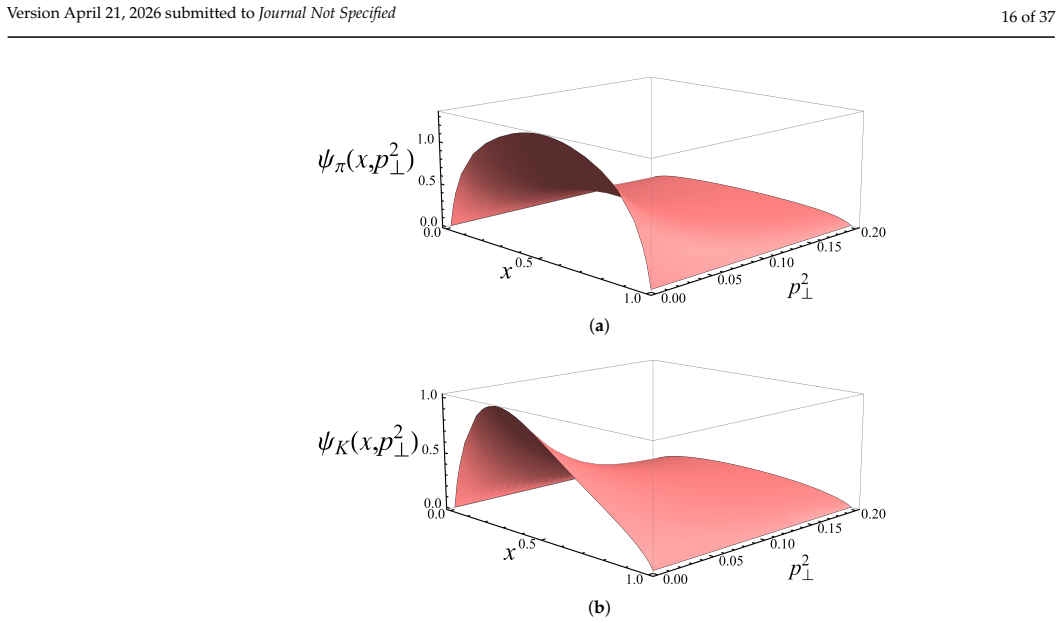
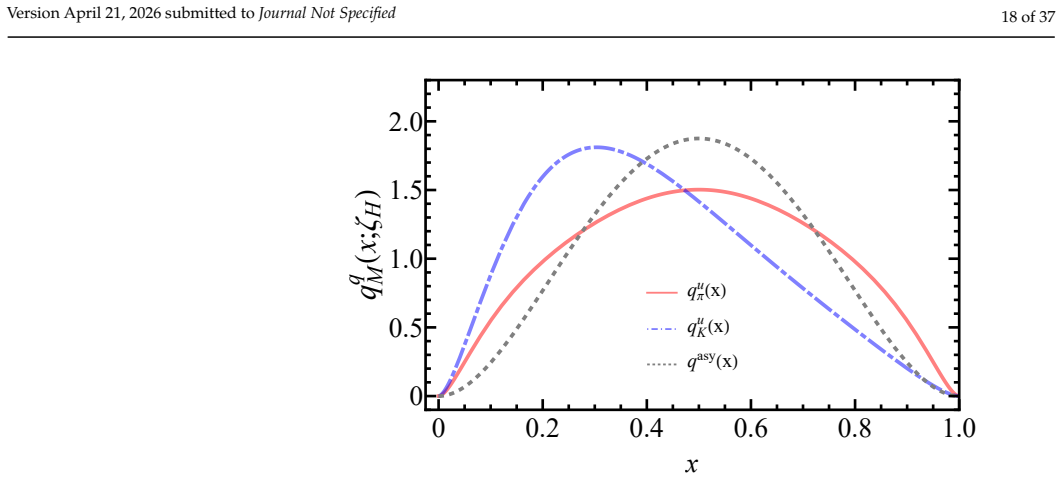
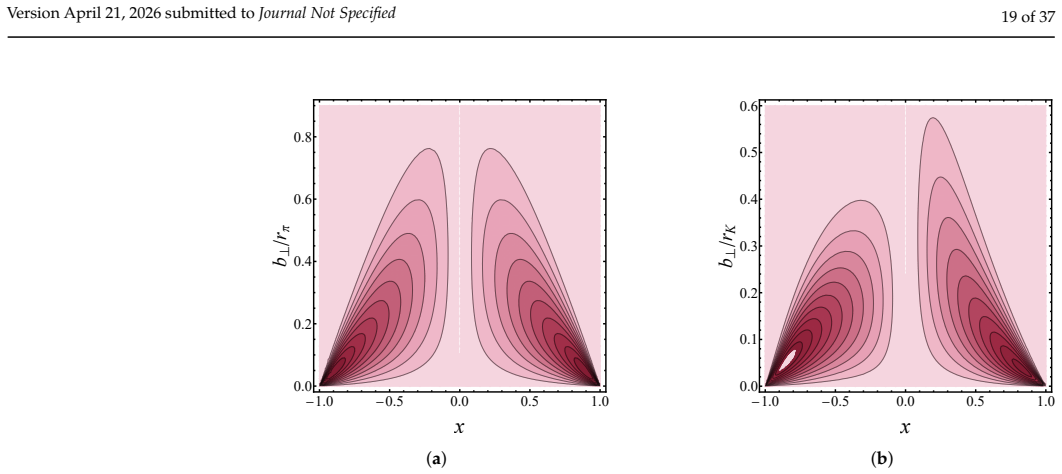
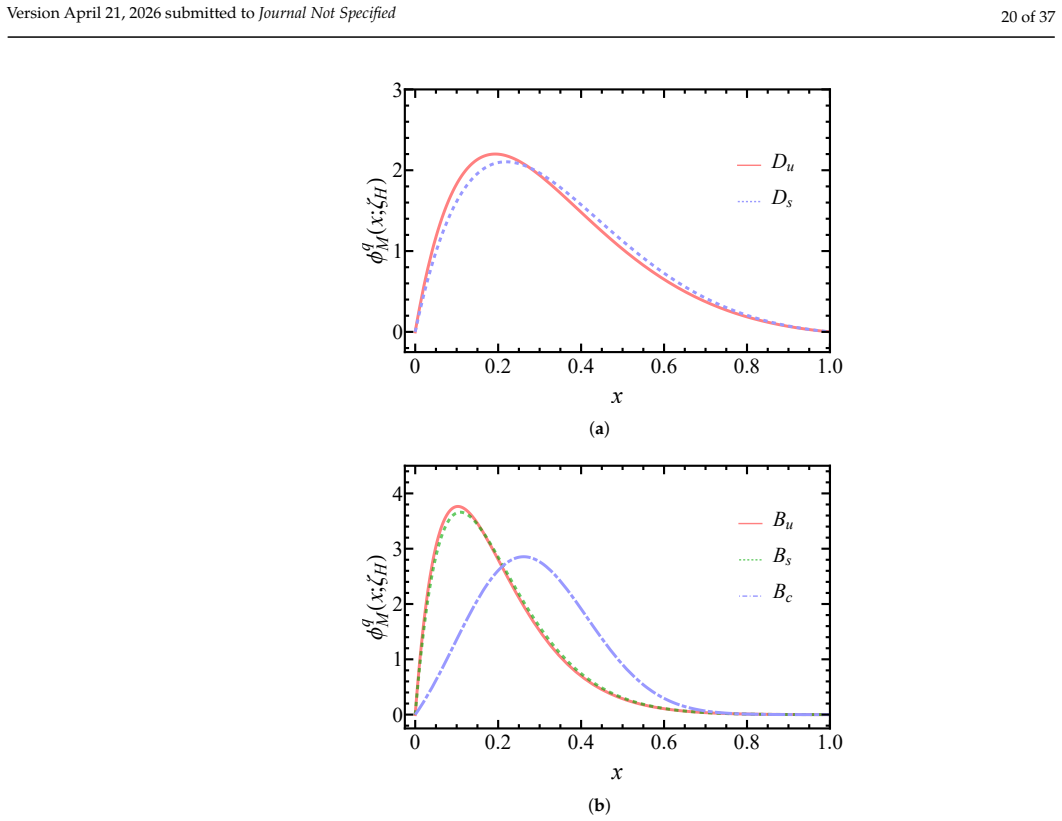
The algebraic model formulated in the light-front framework provides a unified description of leading-twist parton distribution amplitudes, light-front wave functions, generalized parton distributions, parton distribution functions, elastic electromagnetic form factors, charge radii, and impact-parameter distributions for pseudoscalar mesons across light, heavy-light, and heavy-heavy regimes, with every quantity obtained consistently from the same Bethe-Salpeter amplitudes, revealing a systematic transition to symmetric and spatially compact configurations as quark masses increase.
What carries the argument
The algebraic Bethe-Salpeter amplitudes in the light-front framework, which serve as the single common source from which all parton distributions and form factors are derived.
If this is right
- All parton distributions and form factors for mesons from the pion through the eta_b can be computed from one fixed set of amplitudes.
- Quark-mass asymmetry and heavy-quark dynamics produce a clear shift from broad asymmetric momentum distributions to symmetric compact spatial configurations.
- Direct comparisons with lattice QCD, Dyson-Schwinger studies, and contact-interaction results become possible within the same framework across mass ranges.
- Systematic mapping of how increasing quark mass affects three-dimensional meson structure follows from the single algebraic source.
Where Pith is reading between the lines
- The consistent treatment of heavy-quark limits may simplify future modeling of bottomonium decays or production.
- Predictions for impact-parameter distributions in heavy mesons could guide planning of measurements at future electron-ion colliders.
- The observed mass-driven transition suggests that non-relativistic approximations become increasingly reliable for the heaviest systems.
Load-bearing premise
The chosen algebraic form of the Bethe-Salpeter amplitudes remains accurate and sufficient when quark masses vary from light to heavy without additional regime-specific dynamical corrections.
What would settle it
A lattice QCD calculation of the charge radius or a generalized parton distribution for a heavy meson such as the B_c that deviates substantially from the model's prediction of increasing symmetry and compactness.
Figures







read the original abstract
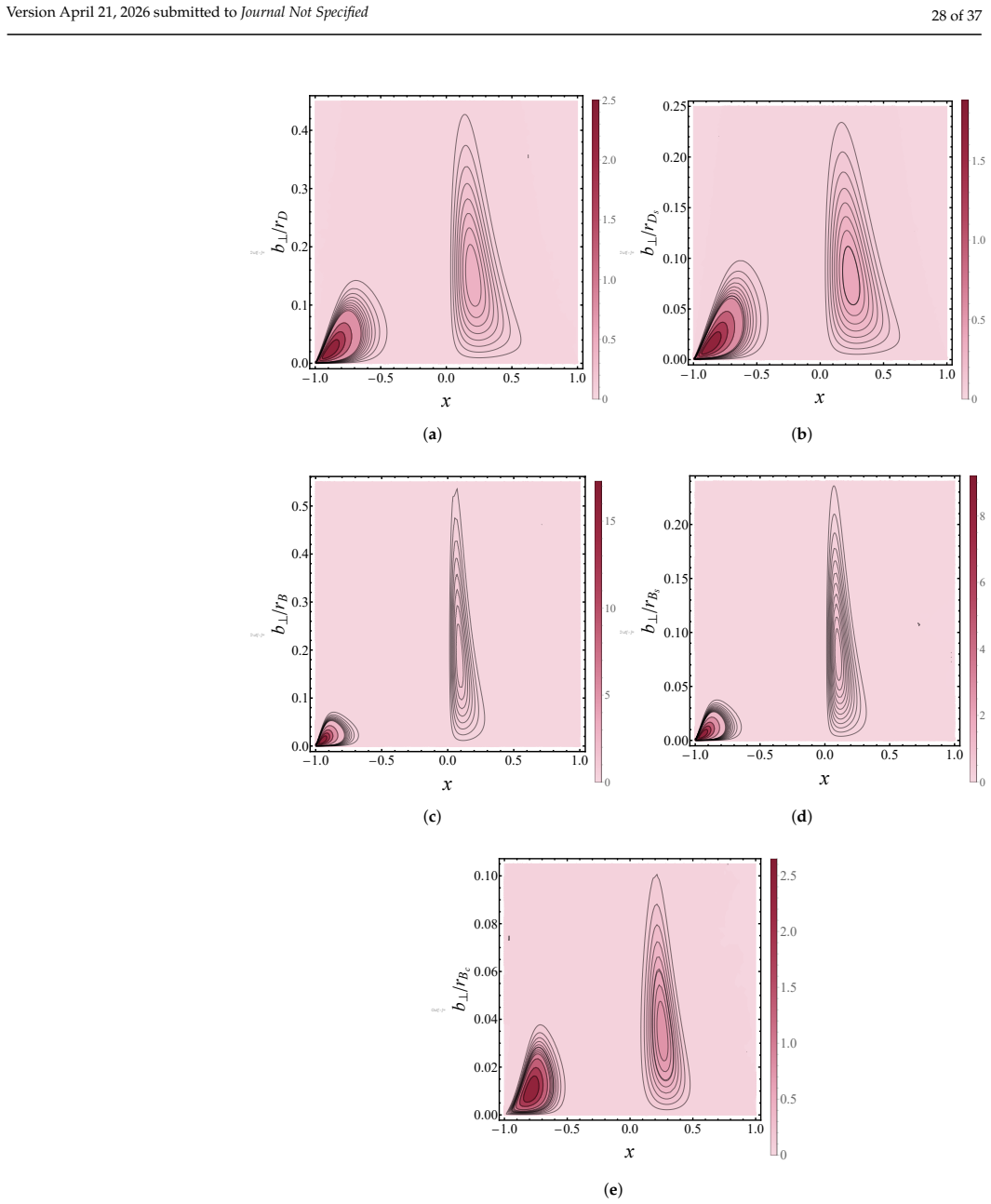
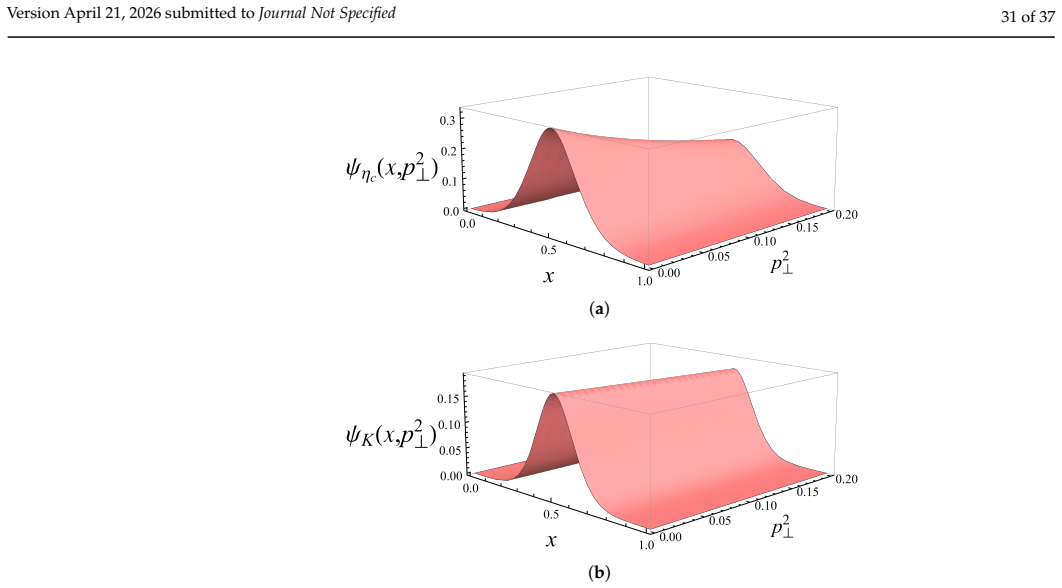
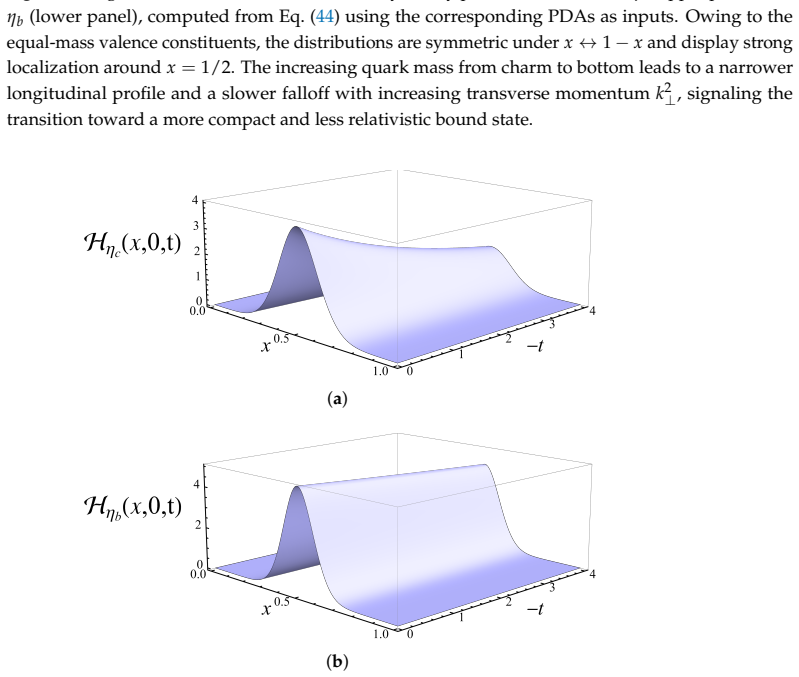
We present a comprehensive review of the structure of pseudoscalar mesons within an algebraic model formulated in the light-front framework. The approach provides a unified description of leading-twist parton distribution amplitudes (PDAs), light-front wave functions (LFWFs), generalized parton distributions (GPDs), parton distribution functions (PDFs), elastic electromagnetic form factors (EFFs), charge radii, and impact-parameter GPDs (IPS-GPDs), all derived consistently from the same underlying Bethe-Salpeter amplitudes. Results are discussed for light ($\pi$, $K$), heavy-light ($D$, $D_s$, $B$, $B_s$, $B_c$), and heavy-heavy ($\eta_c$, $\eta_b$) pseudoscalar mesons, allowing for a systematic analysis of the role played by quark-mass asymmetry and heavy-quark dynamics. The study highlights how increasing quark masses drive a transition from broad, asymmetric momentum distributions to increasingly symmetric and spatially compact configurations. Comparisons with lattice QCD, Dyson-Schwinger equation studies, and contact-interaction models are presented where available. Overall, the algebraic model offers a transparent and symmetry-consistent framework to explore the three-dimensional momentum and spatial structure of pseudoscalar mesons across all quark-mass regimes.
Editorial analysis
A structured set of objections, weighed in public.
Referee Report
Summary. The manuscript presents an algebraic model in the light-front framework that derives leading-twist PDAs, LFWFs, GPDs, PDFs, EFFs, charge radii, and IPS-GPDs for pseudoscalar mesons (π, K, D, Ds, B, Bs, Bc, ηc, ηb) from a single set of Bethe-Salpeter amplitudes, demonstrating a systematic transition from broad asymmetric distributions at light quark masses to symmetric, compact configurations at heavy quark masses, with comparisons to lattice QCD and Dyson-Schwinger studies.
Significance. If the algebraic ansatz is shown to be mass-independent and derived from a fixed kernel, the work would supply a transparent, symmetry-consistent framework for three-dimensional meson structure across all quark-mass regimes, enabling direct comparisons between light and heavy systems and providing a bridge to lattice and DSE results.
major comments (2)
- [Model Definition and Algebraic Ansatz] The central unification claim requires that one fixed algebraic form for the Bethe-Salpeter amplitude generates all observables without mass-dependent re-tuning of parameters or functional shape. The presentation does not explicitly demonstrate that the ansatz parameters remain unchanged when moving from m_q ≈ 0 to m_b ≈ 4.5 GeV, raising the possibility that the reported transition to symmetric configurations is imposed by construction rather than emerging from a single underlying interaction kernel.
- [Results for Heavy Quarks] For heavy-light and heavy-heavy mesons, the reported symmetry and compactness of the LFWFs and GPDs should be traced back to the same Bethe-Salpeter amplitude used for the pion; any implicit mass dependence introduced through the algebraic parametrization must be quantified and shown not to constitute regime-specific adjustments.
minor comments (2)
- [Notation and Definitions] Notation for the light-front momentum fractions and transverse momenta should be standardized across sections to avoid confusion between PDA and GPD variables.
- [Figures] Figure captions for comparisons with lattice data would benefit from explicit statements of the renormalization scale and the precise lattice ensembles used.
Simulated Author's Rebuttal
We thank the referee for the careful reading and constructive comments on our manuscript. We agree that explicit demonstration of the mass-independent algebraic ansatz is essential to support the unification claim and will revise the text accordingly.
read point-by-point responses
-
Referee: [Model Definition and Algebraic Ansatz] The central unification claim requires that one fixed algebraic form for the Bethe-Salpeter amplitude generates all observables without mass-dependent re-tuning of parameters or functional shape. The presentation does not explicitly demonstrate that the ansatz parameters remain unchanged when moving from m_q ≈ 0 to m_b ≈ 4.5 GeV, raising the possibility that the reported transition to symmetric configurations is imposed by construction rather than emerging from a single underlying interaction kernel.
Authors: The algebraic form of the Bethe-Salpeter amplitude is fixed by construction from a single, mass-independent interaction kernel in the light-front framework. Its functional shape and parameters are determined once from the underlying Dyson-Schwinger solution and are not re-tuned when the quark mass is varied; the transition from broad asymmetric to symmetric compact distributions arises dynamically through the kinematic dependence on the physical quark and meson masses. To make this explicit, we will add a new appendix (or subsection) that lists the numerical values of all ansatz parameters for the lightest (pion) and heaviest (η_b) cases, confirming they are identical, together with the explicit kernel used to fix them. revision: yes
-
Referee: [Results for Heavy Quarks] For heavy-light and heavy-heavy mesons, the reported symmetry and compactness of the LFWFs and GPDs should be traced back to the same Bethe-Salpeter amplitude used for the pion; any implicit mass dependence introduced through the algebraic parametrization must be quantified and shown not to constitute regime-specific adjustments.
Authors: All LFWFs, GPDs, PDFs and related quantities for the heavy-light and heavy-heavy systems are obtained by direct substitution of the appropriate quark masses into the identical algebraic Bethe-Salpeter amplitude employed for the pion; no additional functional adjustments or regime-specific parameters are introduced. The observed symmetry and compactness are kinematic consequences of the heavy-quark limit within that fixed amplitude. We will insert a new subsection that writes the explicit LFWF and GPD expressions for a representative heavy-light meson (e.g., B) side-by-side with the pion expressions, highlighting the common amplitude and quantifying the mass dependence through the explicit formulas. revision: yes
Circularity Check
No circularity: unified BSA derivation remains independent of fitted inputs
full rationale
The provided abstract and description present an algebraic model in which PDAs, LFWFs, GPDs, PDFs, EFFs and related quantities are all obtained from the same underlying Bethe-Salpeter amplitudes for light, heavy-light and heavy-heavy pseudoscalar mesons. No equations, parameter-fitting procedures or self-citations are quoted that would reduce any claimed prediction to a re-expression of the input ansatz or to a mass-dependent retuning performed inside the present work. External comparisons with lattice QCD and Dyson-Schwinger studies are referenced as independent benchmarks, confirming that the central unification claim rests on a single consistent algebraic framework rather than on self-referential definitions or fitted-input predictions.
Axiom & Free-Parameter Ledger
Lean theorems connected to this paper
-
IndisputableMonolith/Cost/FunctionalEquation.leanwashburn_uniqueness_aczel unclear?
unclearRelation between the paper passage and the cited Recognition theorem.
the algebraic ansatz employed for the quark (antiquark) propagator and pion BSA reads Sq(k)=(-iγ·k+Mq)Δ(k²,Mq²), nMΓM(k,P)=iγ5∫dzρνM(z)[Δ̂(k²z,Mq²)]ν
-
IndisputableMonolith/Foundation/AlphaCoordinateFixation.leanalpha_pin_under_high_calibration unclear?
unclearRelation between the paper passage and the cited Recognition theorem.
Λ²w = Mq² -¼(1-w²)mM² +½(1-w)(Mh²-Mq²) ... chosen to guarantee Λ²w remains strictly positive
What do these tags mean?
- matches
- The paper's claim is directly supported by a theorem in the formal canon.
- supports
- The theorem supports part of the paper's argument, but the paper may add assumptions or extra steps.
- extends
- The paper goes beyond the formal theorem; the theorem is a base layer rather than the whole result.
- uses
- The paper appears to rely on the theorem as machinery.
- contradicts
- The paper's claim conflicts with a theorem or certificate in the canon.
- unclear
- Pith found a possible connection, but the passage is too broad, indirect, or ambiguous to say the theorem truly supports the claim.
Reference graph
Works this paper leans on
-
[1]
C. N. Yang and R. L. Mills, Phys. Rev.96(1954), 191-195 doi:10.1103/PhysRev.96.191
-
[2]
H. Fritzsch, M. Gell-Mann and H. Leutwyler, Phys. Lett. B47(1973), 365-368 doi:10.1016/0370-2693(73)90625-4
-
[3]
K. G. Wilson, Phys. Rev. D10(1974), 2445-2459 doi:10.1103/PhysRevD.10.2445
-
[4]
J. Greensite, Lect. Notes Phys.821(2011), 1-211 doi:10.1007/978-3-642-14382-3
-
[5]
F. Wilczek, Phys. Today53N1(2000) 13-14 doi:10.1063/1.882927
-
[6]
S. J. Brodsky, Stanley J. and Deur, Alexandre and Roberts, Craig D.", Sci. Am.,3305 (2024) 32-39
work page 2024
-
[7]
D. J. Gross and F. Wilczek, Phys. Rev. Lett.30(1973), 1343-1346 doi:10.1103/PhysRevLett.30.1343
-
[8]
H. D. Politzer, Phys. Rev. Lett.30(1973), 1346-1349 doi:10.1103/PhysRevLett.30.1346
-
[9]
S. Weinberg, Cambridge University Press, 2013, ISBN 978-1-139-63247-8, 978-0-521-67054-8, 978-0-521-55002-4 doi:10.1017/CBO9781139644174
-
[10]
K. G. Wilson, Rev. Mod. Phys.55(1983), 583-600 doi:10.1103/RevModPhys.55.583 Version April 21, 2026 submitted toJournal Not Specified 35 of 37
-
[11]
C. Gattringer and C. B. Lang, Lect. Notes Phys.788(2010), 1-343 Springer, 2010, ISBN 978-3-642-01849-7, 978-3-642-01850-3 doi:10.1007/978-3-642-01850-3
-
[12]
Aokiet al.[Flavour Lattice Averaging Group], Eur
S. Aokiet al.[Flavour Lattice Averaging Group], Eur. Phys. J. C80(2020) no.2, 113 doi:10.1140/epjc/s10052-019-7354-7 [arXiv:1902.08191 [hep-lat]]
-
[13]
I. C. Cloet and C. D. Roberts, Prog. Part. Nucl. Phys.77(2014), 1-69 doi:10.1016/j.ppnp.2014.02.001 [arXiv:1310.2651 [nucl-th]]
work page internal anchor Pith review Pith/arXiv arXiv doi:10.1016/j.ppnp.2014.02.001 2014
-
[14]
R. Alkofer and L. von Smekal, Phys. Rept.353(2001), 281 doi:10.1016/S0370-1573(01)00010-2 [arXiv:hep-ph/0007355 [hep-ph]]
work page internal anchor Pith review Pith/arXiv arXiv doi:10.1016/s0370-1573(01)00010-2 2001
-
[15]
Dyson-Schwinger equations: a tool for hadron physics
P . Maris and C. D. Roberts, Int. J. Mod. Phys. E12(2003), 297-365 doi:10.1142/S0218301303001326 [arXiv:nucl-th/0301049 [nucl-th]]
work page internal anchor Pith review Pith/arXiv arXiv doi:10.1142/s0218301303001326 2003
-
[16]
Sketching the Bethe-Salpeter kernel
L. Chang and C. D. Roberts, Phys. Rev. Lett.103(2009), 081601 doi:10.1103/PhysRevLett.103.081601 [arXiv:0903.5461 [nucl-th]]
work page internal anchor Pith review Pith/arXiv arXiv doi:10.1103/physrevlett.103.081601 2009
-
[17]
Bethe-Salpeter Study of Vector Meson Masses and Decay Constants
P . Maris and P . C. Tandy, Phys. Rev. C60(1999), 055214 doi:10.1103/PhysRevC.60.055214 [arXiv:nucl-th/9905056 [nucl-th]]
work page internal anchor Pith review Pith/arXiv arXiv doi:10.1103/physrevc.60.055214 1999
-
[18]
A. Bender, C. D. Roberts and L. Von Smekal, Phys. Lett. B380(1996), 7-12 doi:10.1016/0370-2693(96)00372-3 [arXiv:nucl- th/9602012 [nucl-th]]
-
[19]
M. S. Bhagwat, A. Holl, A. Krassnigg, C. D. Roberts and P . C. Tandy, Phys. Rev. C70(2004), 035205 doi:10.1103/PhysRevC.70.035205 [arXiv:nucl-th/0403012 [nucl-th]]
work page internal anchor Pith review Pith/arXiv arXiv doi:10.1103/physrevc.70.035205 2004
-
[20]
Y. Nambu and G. Jona-Lasinio, Phys. Rev.122(1961), 345-358 doi:10.1103/PhysRev.122.345
-
[21]
QCD Phenomenology based on a Chiral Effective Lagrangian
T. Hatsuda and T. Kunihiro, Phys. Rept.247(1994), 221-367 doi:10.1016/0370-1573(94)90022-1 [arXiv:hep-ph/9401310 [hep-ph]]
work page internal anchor Pith review Pith/arXiv arXiv doi:10.1016/0370-1573(94)90022-1 1994
-
[22]
L. X. Gutierrez-Guerrero, A. Bashir, I. C. Cloet and C. D. Roberts, Phys. Rev. C81(2010), 065202 doi:10.1103/PhysRevC.81.065202 [arXiv:1002.1968 [nucl-th]]
work page internal anchor Pith review Pith/arXiv arXiv doi:10.1103/physrevc.81.065202 2010
-
[23]
I. C. Cloet, G. Eichmann, B. El-Bennich, T. Klahn and C. D. Roberts, Few Body Syst.46(2009), 1-36 doi:10.1007/s00601-009-0015-x [arXiv:0812.0416 [nucl-th]]
work page internal anchor Pith review Pith/arXiv arXiv doi:10.1007/s00601-009-0015-x 2009
-
[24]
N. Nakanishi, Phys. Rev.130(1963), 1230-1235 doi:10.1103/PhysRev.130.1230
-
[25]
N. Nakanishi, Prog. Theor. Phys. Suppl.43(1969), 1-81 doi:10.1143/PTPS.43.1
-
[26]
Imaging dynamical chiral symmetry breaking: pion wave function on the light front
L. Chang, I. C. Cloet, J. J. Cobos-Martinez, C. D. Roberts, S. M. Schmidt and P . C. Tandy, Phys. Rev. Lett.110(2013) no.13, 132001 doi:10.1103/PhysRevLett.110.132001 [arXiv:1301.0324 [nucl-th]]
work page internal anchor Pith review Pith/arXiv arXiv doi:10.1103/physrevlett.110.132001 2013
-
[27]
Light front distribution of the chiral condensate
L. Chang, C. D. Roberts and S. M. Schmidt, Phys. Lett. B727(2013), 255-259 doi:10.1016/j.physletb.2013.09.040 [arXiv:1308.4708 [nucl-th]]
work page internal anchor Pith review Pith/arXiv arXiv doi:10.1016/j.physletb.2013.09.040 2013
-
[28]
F. Gao, L. Chang, Y. X. Liu, C. D. Roberts and S. M. Schmidt, Phys. Rev. D90(2014) no.1, 014011 doi:10.1103/PhysRevD.90.014011 [arXiv:1405.0289 [nucl-th]]
work page internal anchor Pith review Pith/arXiv arXiv doi:10.1103/physrevd.90.014011 2014
-
[29]
Basic features of the pion valence-quark distribution function
L. Chang, C. Mezrag, H. Moutarde, C. D. Roberts, J. Rodríguez-Quintero and P . C. Tandy, Phys. Lett. B737(2014), 23-29 doi:10.1016/j.physletb.2014.08.009 [arXiv:1406.5450 [nucl-th]]
work page internal anchor Pith review Pith/arXiv arXiv doi:10.1016/j.physletb.2014.08.009 2014
-
[30]
Pion Valence-quark Parton Distribution Function
L. Chang and A. W. Thomas, Phys. Lett. B749(2015), 547-550 doi:10.1016/j.physletb.2015.08.036 [arXiv:1410.8250 [nucl-th]]
work page internal anchor Pith review Pith/arXiv arXiv doi:10.1016/j.physletb.2015.08.036 2015
-
[31]
I. M. Higuera-Angulo, R. J. Hernández-Pinto, K. Raya and A. Bashir, Phys. Rev. D110(2024) no.3, 034013 doi:10.1103/PhysRevD.110.034013 [arXiv:2407.06461 [hep-ph]]
-
[32]
Sketching the pion's valence-quark generalised parton distribution
C. Mezrag, L. Chang, H. Moutarde, C. D. Roberts, J. Rodríguez-Quintero, F. Sabatié and S. M. Schmidt, Phys. Lett. B741(2015), 190-196 doi:10.1016/j.physletb.2014.12.027 [arXiv:1411.6634 [nucl-th]]
work page internal anchor Pith review Pith/arXiv arXiv doi:10.1016/j.physletb.2014.12.027 2015
-
[33]
From Bethe-Salpeter Wave Functions to Generalised Parton Distributions
C. Mezrag, H. Moutarde and J. Rodriguez-Quintero, Few Body Syst.57(2016) no.9, 729-772 doi:10.1007/s00601-016-1119-8 [arXiv:1602.07722 [nucl-th]]
work page internal anchor Pith review Pith/arXiv arXiv doi:10.1007/s00601-016-1119-8 2016
-
[34]
C. Shi, C. Chen, L. Chang, C. D. Roberts, S. M. Schmidt and H. S. Zong, Phys. Rev. D92(2015), 014035 doi:10.1103/PhysRevD.92.014035 [arXiv:1504.00689 [nucl-th]]
work page internal anchor Pith review Pith/arXiv arXiv doi:10.1103/physrevd.92.014035 2015
-
[35]
K. Raya, L. Chang, A. Bashir, J. J. Cobos-Martinez, L. X. Gutiérrez-Guerrero, C. D. Roberts and P . C. Tandy, Phys. Rev. D93(2016) no.7, 074017 doi:10.1103/PhysRevD.93.074017 [arXiv:1510.02799 [nucl-th]]
work page internal anchor Pith review Pith/arXiv arXiv doi:10.1103/physrevd.93.074017 2016
-
[36]
C. Chen, L. Chang, C. D. Roberts, S. Wan and H. S. Zong, Phys. Rev. D93(2016) no.7, 074021 doi:10.1103/PhysRevD.93.074021 [arXiv:1602.01502 [nucl-th]]
work page internal anchor Pith review Pith/arXiv arXiv doi:10.1103/physrevd.93.074021 2016
-
[37]
M. A. Bedolla, K. Raya, J. J. Cobos-Martínez and A. Bashir, Phys. Rev. D93(2016) no.9, 094025 doi:10.1103/PhysRevD.93.094025 [arXiv:1606.03760 [hep-ph]]
work page internal anchor Pith review Pith/arXiv arXiv doi:10.1103/physrevd.93.094025 2016
-
[38]
B. L. Li, L. Chang, M. Ding, C. D. Roberts and H. S. Zong, Phys. Rev. D94(2016) no.9, 094014 doi:10.1103/PhysRevD.94.094014 [arXiv:1608.04749 [nucl-th]]
work page internal anchor Pith review Pith/arXiv arXiv doi:10.1103/physrevd.94.094014 2016
-
[39]
N. Chouika, C. Mezrag, H. Moutarde and J. Rodríguez-Quintero, Phys. Lett. B780(2018), 287-293 doi:10.1016/j.physletb.2018.02.070 [arXiv:1711.11548 [hep-ph]]
work page internal anchor Pith review Pith/arXiv arXiv doi:10.1016/j.physletb.2018.02.070 2018
-
[40]
J. L. Zhang, K. Raya, L. Chang, Z. F. Cui, J. M. Morgado, C. D. Roberts and J. Rodríguez-Quintero, Phys. Lett. B815(2021), 136158 doi:10.1016/j.physletb.2021.136158 [arXiv:2101.12286 [hep-ph]]
-
[41]
K. Raya, Z. F. Cui, L. Chang, J. M. Morgado, C. D. Roberts and J. Rodriguez-Quintero, Chin. Phys. C46(2022) no.1, 013105 doi:10.1088/1674-1137/ac3071 [arXiv:2109.11686 [hep-ph]]
-
[42]
K. Raya and J. Rodríguez-Quintero, Rev. Mex. Fis. Suppl.3(2022) no.3, 0308008 doi:10.31349/SuplRevMexFis.3.0308008 [arXiv:2204.01642 [hep-ph]]. Version April 21, 2026 submitted toJournal Not Specified 36 of 37
-
[43]
L. Albino, I. M. Higuera-Angulo, K. Raya and A. Bashir, Phys. Rev. D106(2022) no.3, 034003 doi:10.1103/PhysRevD.106.034003 [arXiv:2207.06550 [hep-ph]]
-
[44]
B. Almeida-Zamora, J. J. Cobos-Martínez, A. Bashir, K. Raya, J. Rodríguez-Quintero and J. Segovia, Phys. Rev. D109(2024) no.1, 014016 doi:10.1103/PhysRevD.109.014016 [arXiv:2309.17282 [hep-ph]]
-
[45]
B. Almeida-Zamora, J. J. Cobos-Martínez, A. Bashir, K. Raya, J. Rodríguez-Quintero and J. Segovia, PoSQNP2024(2025), 051 doi:10.22323/1.465.0051 [arXiv:2410.13442 [hep-ph]]
-
[46]
L. Albino, K. Raya, R. J. Hernández-Pinto, B. Almeida-Zamora, J. Segovia, A. Huet and A. Bashir, Phys. Rev. D113(2026) no.3, 034019 doi:10.1103/8w28-zvxc [arXiv:2602.10791 [hep-ph]]
-
[47]
B. Almeida-Zamora, J. J. Cobos-Martínez, A. Bashir, K. Raya, J. Rodríguez-Quintero and J. Segovia, Phys. Rev. D107(2023) no.7, 074037 doi:10.1103/PhysRevD.107.074037 [arXiv:2303.09581 [hep-ph]]
-
[48]
Nucleon mass from a covariant three-quark Faddeev equation
G. Eichmann, R. Alkofer, A. Krassnigg and D. Nicmorus, Phys. Rev. Lett.104(2010), 201601 doi:10.1103/PhysRevLett.104.201601 [arXiv:0912.2246 [hep-ph]]
work page internal anchor Pith review Pith/arXiv arXiv doi:10.1103/physrevlett.104.201601 2010
-
[49]
C. D. Roberts and A. G. Williams, Prog. Part. Nucl. Phys.33, 477-575 (1994) doi:10.1016/0146-6410(94)90049-3 [arXiv:hep- ph/9403224 [hep-ph]]
-
[50]
E. E. Salpeter and H. A. Bethe, Phys. Rev.84, 1232-1242 (1951) doi:10.1103/PhysRev.84.1232
-
[51]
H. J. Munczek, Phys. Rev. D52(1995), 4736-4740 doi:10.1103/PhysRevD.52.4736 [arXiv:hep-th/9411239 [hep-th]]
work page internal anchor Pith review Pith/arXiv arXiv doi:10.1103/physrevd.52.4736 1995
-
[52]
Solving Bethe-Salpeter equation for two fermions in Minkowski space
J. Carbonell and V . A. Karmanov, Eur. Phys. J. A46(2010), 387-397 doi:10.1140/epja/i2010-11055-4 [arXiv:1010.4640 [hep-ph]]
work page internal anchor Pith review Pith/arXiv arXiv doi:10.1140/epja/i2010-11055-4 2010
-
[53]
Covariant Extension of the GPD overlap representation at low Fock states
N. Chouika, C. Mezrag, H. Moutarde and J. Rodríguez-Quintero, Eur. Phys. J. C77(2017) no.12, 906 doi:10.1140/epjc/s10052-017- 5465-6 [arXiv:1711.05108 [hep-ph]]
work page internal anchor Pith review Pith/arXiv arXiv doi:10.1140/epjc/s10052-017- 2017
-
[54]
S. J. Brodsky, H. C. Pauli and S. S. Pinsky, Phys. Rept.301(1998), 299-486 doi:10.1016/S0370-1573(97)00089-6 [arXiv:hep- ph/9705477 [hep-ph]]
-
[55]
Generalized Parton Distributions
M. Diehl, Phys. Rept.388(2003), 41-277 doi:10.1016/j.physrep.2003.08.002 [arXiv:hep-ph/0307382 [hep-ph]]
work page internal anchor Pith review Pith/arXiv arXiv doi:10.1016/j.physrep.2003.08.002 2003
-
[56]
J. Carbonell and V . A. Karmanov, Few Body Syst.49(2011), 205-222 doi:10.1007/s00601-010-0133-5 [arXiv:1012.0246 [hep-ph]]
work page internal anchor Pith review Pith/arXiv arXiv doi:10.1007/s00601-010-0133-5 2011
-
[57]
T. Frederico, G. Salme and M. Viviani, Phys. Rev. D85(2012), 036009 doi:10.1103/PhysRevD.85.036009 [arXiv:1112.5568 [hep-ph]]
work page internal anchor Pith review Pith/arXiv arXiv doi:10.1103/physrevd.85.036009 2012
-
[58]
Advances in solving the two-fermion homogeneous Bethe-Salpeter equation in Minkowski space
W. de Paula, T. Frederico, G. Salmè and M. Viviani, Phys. Rev. D94(2016) no.7, 071901 doi:10.1103/PhysRevD.94.071901 [arXiv:1609.00868 [hep-th]]
work page internal anchor Pith review Pith/arXiv arXiv doi:10.1103/physrevd.94.071901 2016
-
[59]
M. V . Polyakov, Phys. Lett. B555(2003), 57-62 doi:10.1016/S0370-2693(03)00036-4 [arXiv:hep-ph/0210165 [hep-ph]]
work page internal anchor Pith review Pith/arXiv arXiv doi:10.1016/s0370-2693(03)00036-4 2003
-
[60]
S. J. Brodsky, M. Diehl and D. S. Hwang, Nucl. Phys. B596(2001), 99-124 doi:10.1016/S0550-3213(00)00695-7 [arXiv:hep- ph/0009254 [hep-ph]]
-
[61]
K. Raya, A. Bashir, D. Binosi, C. D. Roberts and J. Rodríguez-Quintero, Few Body Syst.65(2024) no.2, 60 doi:10.1007/s00601-024- 01924-2 [arXiv:2403.00629 [hep-ph]]
-
[62]
Y. L. Dokshitzer, Sov. Phys. JETP46(1977), 641-653
work page 1977
-
[63]
V . N. Gribov and L. N. Lipatov, Sov. J. Nucl. Phys.15(1972), 438-450 IPTI-381-71
work page 1972
-
[64]
L. N. Lipatov, Yad. Fiz.20(1974), 181-198
work page 1974
-
[65]
G. Altarelli and G. Parisi, Nucl. Phys. B126(1977), 298-318 doi:10.1016/0550-3213(77)90384-4
-
[66]
Z. F. Cui, M. Ding, F. Gao, K. Raya, D. Binosi, L. Chang, C. D. Roberts, J. Rodríguez-Quintero and S. M. Schmidt, Eur. Phys. J. C 80(2020) no.11, 1064 doi:10.1140/epjc/s10052-020-08578-4
-
[67]
M. Ding, F. Gao, L. Chang, Y. X. Liu and C. D. Roberts, Phys. Lett. B753(2016), 330-335 doi:10.1016/j.physletb.2015.11.075 [arXiv:1511.04943 [nucl-th]]
work page internal anchor Pith review Pith/arXiv arXiv doi:10.1016/j.physletb.2015.11.075 2016
-
[68]
P . A. Zylaet al.[Particle Data Group], PTEP2020(2020) no.8, 083C01 doi:10.1093/ptep/ptaa104
-
[69]
Pion electromagnetic form factor at spacelike momenta
L. Chang, I. C. Cloët, C. D. Roberts, S. M. Schmidt and P . C. Tandy, Phys. Rev. Lett.111(2013) no.14, 141802 doi:10.1103/PhysRevLett.111.141802 [arXiv:1307.0026 [nucl-th]]
work page internal anchor Pith review Pith/arXiv arXiv doi:10.1103/physrevlett.111.141802 2013
-
[70]
G. Eichmann, C. S. Fischer and R. Williams, Phys. Rev. D101(2020) no.5, 054015 doi:10.1103/PhysRevD.101.054015 [arXiv:1910.06795 [hep-ph]]
-
[71]
M. S. Bhagwat, A. Krassnigg, P . Maris and C. D. Roberts, Eur. Phys. J. A31(2007), 630-637 doi:10.1140/epja/i2006-10271-9 [arXiv:nucl-th/0612027 [nucl-th]]
work page internal anchor Pith review Pith/arXiv arXiv doi:10.1140/epja/i2006-10271-9 2007
-
[72]
Á. Miramontes, A. Bashir, K. Raya and P . Roig, Phys. Rev. D105(2022) no.7, 074013 doi:10.1103/PhysRevD.105.074013 [arXiv:2112.13916 [hep-ph]]
-
[73]
K. Raya, A. Bashir, A. S. Miramontes and P . Roig Garces, Rev. Mex. Fis. Suppl.3(2022) no.2, 020709 doi:10.31349/SuplRevMexFis.3.020709 [arXiv:2204.01652 [hep-ph]]
-
[74]
J. J. Dudek, R. G. Edwards, N. Mathur and D. G. Richards, J. Phys. Conf. Ser.69(2007), 012006 doi:10.1088/1742-6596/69/1/012006
-
[75]
J. J. Dudek, R. G. Edwards and D. G. Richards, Phys. Rev. D73(2006), 074507 doi:10.1103/PhysRevD.73.074507 [arXiv:hep- ph/0601137 [hep-ph]]
-
[76]
Distribution amplitudes of light-quark mesons from lattice QCD
J. Segovia, L. Chang, I. C. Cloët, C. D. Roberts, S. M. Schmidt and H. s. Zong, Phys. Lett. B731(2014), 13-18 doi:10.1016/j.physletb.2014.02.006 [arXiv:1311.1390 [nucl-th]]. Version April 21, 2026 submitted toJournal Not Specified 37 of 37
work page internal anchor Pith review Pith/arXiv arXiv doi:10.1016/j.physletb.2014.02.006 2014
-
[77]
V . M. Braun, S. Collins, M. Göckeler, P . Pérez-Rubio, A. Schäfer, R. W. Schiel and A. Sternbeck, Phys. Rev. D92(2015) no.1, 014504 doi:10.1103/PhysRevD.92.014504 [arXiv:1503.03656 [hep-lat]]
work page internal anchor Pith review Pith/arXiv arXiv doi:10.1103/physrevd.92.014504 2015
-
[78]
B. L. Li, L. Chang, F. Gao, C. D. Roberts, S. M. Schmidt and H. S. Zong, Phys. Rev. D93(2016) no.11, 114033 doi:10.1103/PhysRevD.93.114033 [arXiv:1604.07415 [nucl-th]]
work page internal anchor Pith review Pith/arXiv arXiv doi:10.1103/physrevd.93.114033 2016
-
[79]
F. Gao, L. Chang and Y. x. Liu, Phys. Lett. B770(2017), 551-555 doi:10.1016/j.physletb.2017.04.077 [arXiv:1611.03560 [nucl-th]]
work page internal anchor Pith review Pith/arXiv arXiv doi:10.1016/j.physletb.2017.04.077 2017
-
[80]
Q. Chang, S. J. Brodsky and X. Q. Li, Phys. Rev. D95(2017) no.9, 094025 doi:10.1103/PhysRevD.95.094025 [arXiv:1612.05298 [hep-ph]]
work page internal anchor Pith review Pith/arXiv arXiv doi:10.1103/physrevd.95.094025 2017
discussion (0)
Sign in with ORCID, Apple, or X to comment. Anyone can read and Pith papers without signing in.