Recognition: no theorem link
Mixed-State Topology in Non-Hermitian Systems
Pith reviewed 2026-05-16 03:04 UTC · model grok-4.3
The pith
Non-Hermitian systems host mixed-state topology distinct from pure states via the Uhlmann connection at finite temperatures.
A machine-rendered reading of the paper's core claim, the machinery that carries it, and where it could break.
Core claim
Non-Hermitian systems exhibit exotic topological features due to exceptional points, but studies have focused on pure states at zero temperature while mixed-state topology remains unexplored. Using the Uhlmann connection at specific temperatures, the thermal Uhlmann-Chern number reveals distinct topological characteristics in two-dimensional NH systems compared to pure states. This framework confirms the existence of higher-order mixed-state topology in three-dimensional Abelian and four-dimensional non-Abelian NH systems.
What carries the argument
The Uhlmann connection applied to mixed states at finite temperature, which defines the Uhlmann phase and the thermal Uhlmann-Chern number for non-Hermitian Hamiltonians.
If this is right
- Mixed-state topological invariants can be calculated at finite temperatures in NH systems.
- These invariants differ from those of pure states at zero temperature.
- Higher-order mixed-state topology is present in three- and four-dimensional non-Hermitian systems.
- This provides a pathway for studying topological phenomena in the mixed-state regime of NH physics.
Where Pith is reading between the lines
- Finite temperature could act as a control parameter for topological features in open quantum systems with gain and loss.
- The framework may extend to driven or time-dependent non-Hermitian models.
- Measurements of Uhlmann phases could be tested in photonic or atomic platforms with engineered dissipation.
Load-bearing premise
The Uhlmann connection remains well-defined and yields a meaningful topological invariant when applied to non-Hermitian Hamiltonians at finite temperature without additional regularization or modification.
What would settle it
If the thermal Uhlmann-Chern number computed for a concrete two-dimensional non-Hermitian lattice model at the relevant temperatures equals the pure-state Chern number, the claim of distinct mixed-state characteristics would be falsified.
Figures



read the original abstract
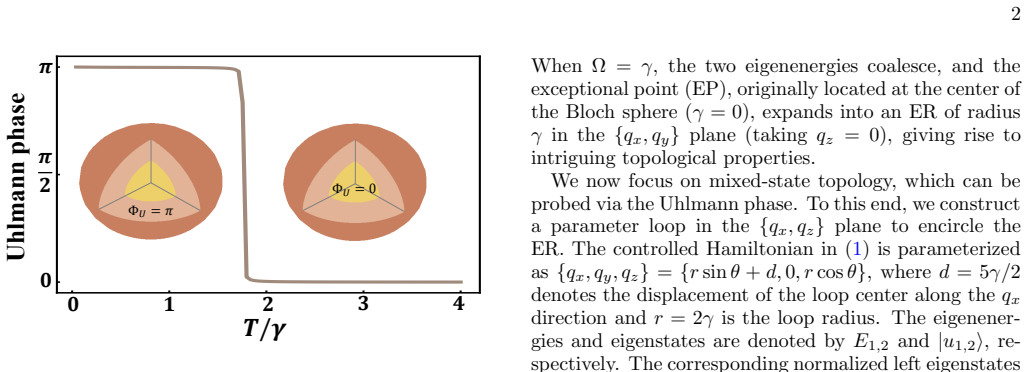
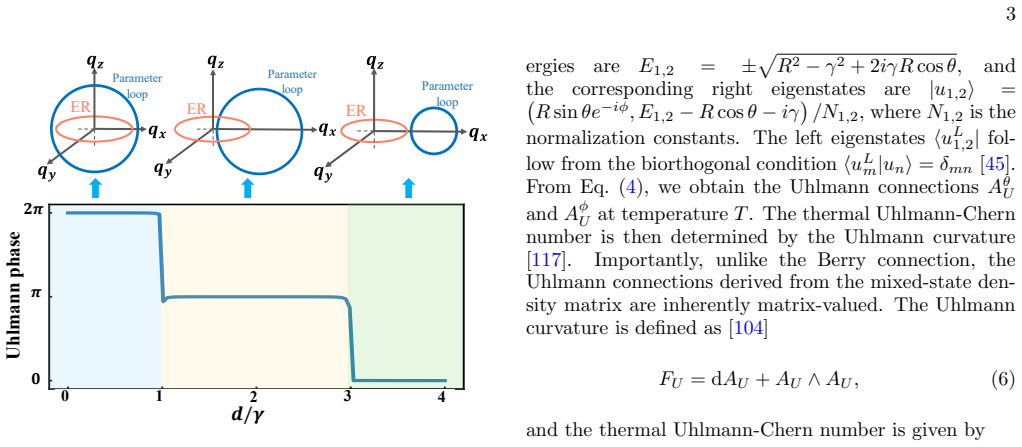
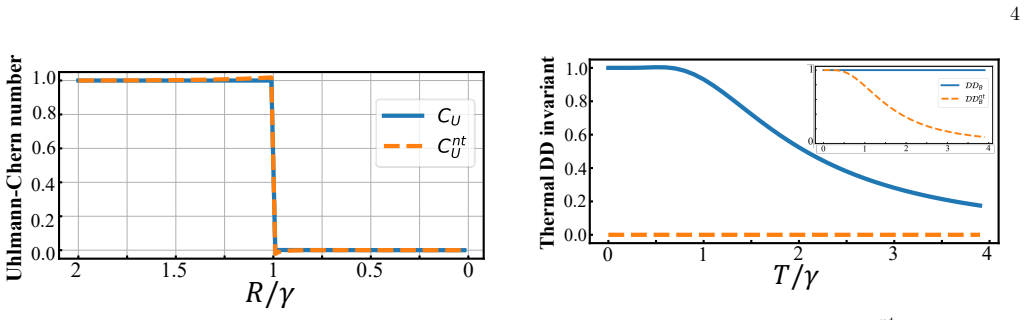
Non-Hermitian (NH) systems, owing to the existence of exceptional point (or ring and surface), exhibit exotic topological features which are inaccessible in Hermitian systems. While current studies on NH topology has primarily focused on pure states at zero temperature, the topological properties of mixed states remain largely unexplored. In this work, we investigate the mixed-state topology in two-dimensional NH systems using the Uhlmann phase and the thermal Uhlmann-Chern number, both structured via the Uhlmann connection at specific temperatures, revealing distinct topological characteristics compared to those of pure states. Furthermore, we extend our analysis to mixed states in three-dimensional Abelian and four-dimensional non-Abelian NH systems, confirming the existence of the higher-order mixed-state topology. Our study establishes a conceptual and practical pathway for exploring topological phenomena in the mixed-state regime of NH physics.
Editorial analysis
A structured set of objections, weighed in public.
Referee Report
Summary. The manuscript investigates mixed-state topology in non-Hermitian (NH) systems using the Uhlmann phase and thermal Uhlmann-Chern number, both constructed via the Uhlmann connection at specific temperatures. It reports distinct topological characteristics in 2D NH systems relative to pure states and extends the analysis to confirm higher-order mixed-state topology in 3D Abelian and 4D non-Abelian NH systems.
Significance. If the central constructions hold, the work opens a route to finite-temperature topological invariants in NH physics, an area where existing literature is restricted to zero-temperature pure states. The explicit extension to higher-dimensional Abelian and non-Abelian cases supplies concrete examples that could guide future experiments or numerical studies.
major comments (3)
- [Section on 2D NH systems] The applicability of the Uhlmann connection to non-Hermitian mixed states at finite temperature is taken as given without additional regularization; this assumption is load-bearing for all reported invariants and must be justified by explicit verification that the connection remains well-defined and yields a gauge-invariant phase (see the derivation of the thermal Uhlmann-Chern number).
- [Section on 2D NH systems] The claim of distinct mixed-state topology versus pure-state topology requires a direct side-by-side comparison of the computed invariants (e.g., the value of the thermal Uhlmann-Chern number versus the conventional Chern number) at the same parameter points; without this, the distinction remains qualitative.
- [Higher-dimensional extensions] For the 3D Abelian and 4D non-Abelian extensions, the manuscript must supply the explicit definition of the higher-order invariants (analogous to Eq. (X) for the 2D case) and demonstrate that they are non-trivial and topologically protected, rather than merely stating their existence.
minor comments (2)
- [Abstract] The abstract refers to 'specific temperatures' without naming them; the main text should state the temperature values or the condition that selects them.
- [Notation and definitions] Notation for the Uhlmann connection and the resulting phase should be introduced once and used consistently; occasional redefinition of symbols hinders readability.
Simulated Author's Rebuttal
We thank the referee for the constructive and detailed comments, which have helped us identify areas where the manuscript can be strengthened. We address each major comment below and will incorporate the suggested revisions in the next version of the manuscript.
read point-by-point responses
-
Referee: [Section on 2D NH systems] The applicability of the Uhlmann connection to non-Hermitian mixed states at finite temperature is taken as given without additional regularization; this assumption is load-bearing for all reported invariants and must be justified by explicit verification that the connection remains well-defined and yields a gauge-invariant phase (see the derivation of the thermal Uhlmann-Chern number).
Authors: We agree that an explicit justification is necessary. In the revised manuscript we will add a dedicated subsection deriving the Uhlmann connection for non-Hermitian density matrices at finite temperature. The derivation will explicitly verify that the connection is well-defined (including handling of the non-Hermitian spectrum) and that the resulting thermal Uhlmann phase is gauge-invariant, following the same steps used for the Hermitian case but with the appropriate non-Hermitian generalizations. revision: yes
-
Referee: [Section on 2D NH systems] The claim of distinct mixed-state topology versus pure-state topology requires a direct side-by-side comparison of the computed invariants (e.g., the value of the thermal Uhlmann-Chern number versus the conventional Chern number) at the same parameter points; without this, the distinction remains qualitative.
Authors: We accept this criticism. The revised manuscript will include a direct quantitative comparison, presented in a new table (or figure) that lists the thermal Uhlmann-Chern number and the conventional Chern number evaluated at identical parameter values across the 2D non-Hermitian phase diagram. This will make the distinction between mixed-state and pure-state topology explicit and quantitative. revision: yes
-
Referee: [Higher-dimensional extensions] For the 3D Abelian and 4D non-Abelian extensions, the manuscript must supply the explicit definition of the higher-order invariants (analogous to Eq. (X) for the 2D case) and demonstrate that they are non-trivial and topologically protected, rather than merely stating their existence.
Authors: We will supply the missing explicit definitions. In the revised manuscript we will write out the full expressions for the 3D Abelian and 4D non-Abelian mixed-state invariants (directly analogous to the 2D thermal Uhlmann-Chern number) and will add concrete model calculations showing that these invariants evaluate to non-trivial integers (or other protected values) in representative parameter regimes, together with a brief discussion of their topological protection. revision: yes
Circularity Check
No significant circularity in derivation chain
full rationale
The provided abstract and context introduce mixed-state topology via the Uhlmann connection and thermal Uhlmann-Chern number for non-Hermitian systems, extending to higher-dimensional cases. No equations, parameter fits, or derivation steps are exhibited that reduce by construction to the paper's own inputs or self-citations. The Uhlmann framework is invoked as a structuring tool without shown self-referential definitions or load-bearing self-citations that would force the central claims. The analysis remains self-contained against external benchmarks for the Uhlmann connection, yielding no detectable circularity.
Axiom & Free-Parameter Ledger
axioms (1)
- domain assumption Uhlmann connection remains well-defined for non-Hermitian Hamiltonians at finite temperature
Forward citations
Cited by 2 Pith papers
-
Anomalous Mixed-State Floquet Topology in One-Dimensional Open Quantum Systems
A driven-dissipative SSH chain has steady-state Z×Z Floquet topology via two ensemble geometric phase invariants, with protected edge modes in both 0 and π quasienergy gaps.
-
Anomalous Mixed-State Floquet Topology in One-Dimensional Open Quantum Systems
A periodically driven dissipative SSH chain exhibits a Z x Z topological classification in its mixed steady state via ensemble geometric phases in the 0 and pi gaps.
Reference graph
Works this paper leans on
-
[1]
M. Z. Hasan and C. L. Kane, Rev. Mod. Phys.82, 3045 (2010)
work page 2010
- [2]
-
[3]
S.-Q. Shen,Topological Insulators: Dirac Equation in Condensed Matters, Springer Series in Solid-State Sci- ences, Vol. 174 (Springer Berlin Heidelberg, Berlin, Hei- delberg, 2012)
work page 2012
-
[4]
B. A. Bernevig,Topological Insulators and Topological Superconductors(Princeton University Press, Prince- ton, 2013)
work page 2013
-
[5]
F. D. M. Haldane, Phys. Rev. Lett.61, 2015 (1988)
work page 2015
-
[6]
C. L. Kane and E. J. Mele, Phys. Rev. Lett.95, 146802 (2005)
work page 2005
-
[7]
B. A. Bernevig, T. L. Hughes, and S.-C. Zhang, Science 314, 1757 (2006)
work page 2006
-
[8]
M. K¨ onig, S. Wiedmann, C. Br¨ une, A. Roth, H. Buh- mann, L. W. Molenkamp, X.-L. Qi, and S.-C. Zhang, Science318, 766 (2007)
work page 2007
-
[9]
L. Fu, C. L. Kane, and E. J. Mele, Phys. Rev. Lett.98, 106803 (2007)
work page 2007
- [10]
- [11]
-
[12]
C.-K. Chiu, J. C. Y. Teo, A. P. Schnyder, and S. Ryu, Rev. Mod. Phys.88, 035005 (2016)
work page 2016
-
[13]
M. V. Berry, Proc. R. Soc. A392, 45 (1984)
work page 1984
- [14]
-
[15]
P. Roushan, C. Neill, Y. Chen, M. Kolodrubetz, C. Quintana, N. Leung, M. Fang, R. Barends, B. Camp- bell, Z. Chen, B. Chiaro, A. Dunsworth, E. Jeffrey, J. Kelly, A. Megrant, J. Mutus, P. J. J. O’Malley, D. Sank, A. Vainsencher, J. Wenner, T. White, A. Polkovnikov, A. N. Cleland, and J. M. Martinis, Nature515, 241 (2014)
work page 2014
-
[16]
M. W. Ray, E. Ruokokoski, S. Kandel, M. M¨ ott¨ onen, and D. S. Hall, Nature505, 657 (2014)
work page 2014
-
[17]
P. A. M. Dirac, Proc. R. Soc. Lond. Ser. A133, 60 (1931)
work page 1931
- [18]
-
[19]
R. W. Jackiw, Int. J. Mod. Phys. A19, 137 (2004)
work page 2004
-
[20]
M. D. Schroer, M. H. Kolodrubetz, W. F. Kindel, M. Sandberg, J. Gao, M. R. Vissers, D. P. Pappas, A. Polkovnikov, and K. W. Lehnert, Phys. Rev. Lett. 113, 050402 (2014)
work page 2014
- [21]
-
[22]
A. R. Kolovsky, Phys. Rev. A98, 013603 (2018)
work page 2018
- [23]
-
[24]
X. S. Wang, A. Brataas, and R. E. Troncoso, Phys. Rev. Lett.125, 217202 (2020)
work page 2020
-
[25]
E. Saei Ghareh Naz, I. C. Fulga, L. Ma, O. G. Schmidt, and J. van den Brink, Phys. Rev. A98, 033830 (2018)
work page 2018
-
[26]
J. Guglielmon, S. Huang, K. P. Chen, and M. C. Rechts- man, Phys. Rev. A97, 031801 (2018)
work page 2018
-
[27]
C. Liu, W. Gao, B. Yang, and S. Zhang, Phys. Rev. Lett.119, 183901 (2017)
work page 2017
-
[28]
C. Dembowski, H.-D. Gr¨ af, H. L. Harney, A. Heine, W. D. Heiss, H. Rehfeld, and A. Richter, Phys. Rev. Lett.86, 787 (2001)
work page 2001
-
[29]
Y. Choi, S. Kang, S. Lim, W. Kim, J.-R. Kim, J.-H. Lee, and K. An, Phys. Rev. Lett.104, 153601 (2010). 8
work page 2010
-
[30]
T. Gao, E. Estrecho, K. Y. Bliokh, T. C. H. Liew, M. D. Fraser, S. Brodbeck, M. Kamp, C. Schneider, S. H¨ ofling, Y. Yamamoto, F. Nori, Y. S. Kivshar, A. G. Truscott, R. G. Dall, and E. A. Ostrovskaya, Nature526, 554 (2015)
work page 2015
-
[31]
D. Zhang, X.-Q. Luo, Y.-P. Wang, T.-F. Li, and J. Q. You, Nat. Commun.8, 1368 (2017)
work page 2017
-
[32]
C. M. Bender and S. Boettcher, Phys. Rev. Lett.80, 5243 (1998)
work page 1998
-
[33]
C. M. Bender, D. C. Brody, and H. F. Jones, Phys. Rev. Lett.89, 270401 (2002)
work page 2002
-
[34]
S. K. ¨Ozdemir, S. Rotter, F. Nori, and L. Yang, Nat. Mater.18, 783 (2019)
work page 2019
-
[35]
A. Guo, G. J. Salamo, D. Duchesne, R. Morandotti, M. Volatier-Ravat, V. Aimez, G. A. Siviloglou, and D. N. Christodoulides, Phys. Rev. Lett.103, 093902 (2009)
work page 2009
-
[36]
L. Feng, Z. J. Wong, R.-M. Ma, Y. Wang, and X. Zhang, Science346, 972 (2014)
work page 2014
-
[37]
H. Hodaei, M.-A. Miri, M. Heinrich, D. N. Christodoulides, and M. Khajavikhan, Science346, 975 (2014)
work page 2014
-
[38]
W. Gou, T. Chen, D. Xie, T. Xiao, T.-S. Deng, B. Gad- way, W. Yi, and B. Yan, Phys. Rev. Lett.124, 070402 (2020)
work page 2020
-
[39]
W. Liu, Y. Wu, C.-K. Duan, X. Rong, and J. Du, Phys. Rev. Lett.126, 170506 (2021)
work page 2021
-
[40]
Z. Ren, D. Liu, E. Zhao, C. He, K. K. Pak, J. Li, and G.-B. Jo, Nat. Phys.18, 385 (2022)
work page 2022
- [41]
-
[42]
J. Doppler, A. A. Mailybaev, J. B¨ ohm, U. Kuhl, A. Girschik, F. Libisch, T. J. Milburn, P. Rabl, N. Moi- seyev, and S. Rotter, Nature537, 76 (2016)
work page 2016
-
[43]
H. Xu, D. Mason, L. Jiang, and J. G. E. Harris, Nature 537, 80 (2016)
work page 2016
-
[44]
J. W. Yoon, Y. Choi, C. Hahn, G. Kim, S. H. Song, K.-Y. Yang, J. Y. Lee, Y. Kim, C. S. Lee, J. K. Shin, H.-S. Lee, and P. Berini, Nature562, 86 (2018)
work page 2018
-
[45]
P.-R. Han, F. Wu, X.-J. Huang, H.-Z. Wu, C.-L. Zou, W. Yi, M. Zhang, H. Li, K. Xu, D. Zheng, H. Fan, J. Wen, Z.-B. Yang, and S.-B. Zheng, Phys. Rev. Lett. 131, 260201 (2023)
work page 2023
-
[46]
W. Chen, S. Kaya ¨Ozdemir, G. Zhao, J. Wiersig, and L. Yang, Nature548, 192 (2017)
work page 2017
- [47]
-
[48]
S.-B. Yang, P.-R. Han, W. Ning, F. Wu, Z.-B. Yang, and S.-B. Zheng, Sci. China Phys. Mech69, 230313 (2026)
work page 2026
-
[49]
A hypersphere-like non-Abelian Yang monopole and its topological characterization
S.-B. Yang, P.-R. Han, W. Ning, F. Wu, Z.-B. Yang, and S.-B. Zheng, “A hypersphere-like non-abelian yang monopole and its topological characterization,” (2025), arXiv:2510.00941 [quant-ph]
work page internal anchor Pith review Pith/arXiv arXiv 2025
-
[50]
E. J. Bergholtz, J. C. Budich, and F. K. Kunst, Rev. Mod. Phys.93, 015005 (2021)
work page 2021
-
[51]
K. Ding, C. Fang, and G. Ma, Nat. Rev. Phys.4, 745 (2022)
work page 2022
- [52]
- [53]
-
[54]
T. Yoshida, R. Peters, N. Kawakami, and Y. Hatsugai, Phys. Rev. B99, 121101 (2019)
work page 2019
-
[55]
T. Liu, J. J. He, Z. Yang, and F. Nori, Phys. Rev. Lett. 127, 196801 (2021)
work page 2021
-
[56]
S. A. A. Ghorashi, T. Li, and M. Sato, Phys. Rev. B 104, L161117 (2021)
work page 2021
-
[57]
R. L. Mc Guinness and P. R. Eastham, Phys. Rev. Res. 2, 043268 (2020)
work page 2020
-
[58]
T. Matsushita, Y. Nagai, and S. Fujimoto, Phys. Rev. B100, 245205 (2019)
work page 2019
- [59]
-
[60]
B. Zhen, C. W. Hsu, Y. Igarashi, L. Lu, I. Kaminer, A. Pick, S.-L. Chua, J. D. Joannopoulos, and M. Soljaˇ ci´ c, Nature525, 354 (2015)
work page 2015
- [61]
-
[62]
W. Tang, K. Ding, and G. Ma, Nat. Commun.14, 6660 (2023)
work page 2023
-
[63]
H. Zhou, J. Y. Lee, S. Liu, and B. Zhen, Optica6, 190 (2019)
work page 2019
- [64]
-
[65]
J. J. Sakurai and J. Napolitano,Modern quantum me- chanics, 2nd ed. (Addison-Wesley, Pearson, Boston, Mass., 2011)
work page 2011
- [66]
-
[67]
L. A. Lessa, M. Cheng, and C. Wang, Phys. Rev. X15, 011069 (2025)
work page 2025
-
[68]
Tensor network for- mulation of symmetry protected topological phases in mixed states,
H. Xue, J. Y. Lee, and Y. Bao, “Tensor network for- mulation of symmetry protected topological phases in mixed states,” (2024), arXiv:2403.17069 [cond-mat.str- el]
- [69]
- [70]
-
[71]
J. Shah, C. Fechisin, Y.-X. Wang, J. T. Iosue, J. D. Wat- son, Y.-Q. Wang, B. Ware, A. V. Gorshkov, and C.-J. Lin, “Instability of steady-state mixed-state symmetry- protected topological order to strong-to-weak sponta- neous symmetry breaking,” (2024), arXiv:2410.12900 [quant-ph]
- [72]
- [73]
- [74]
-
[75]
S. Sang, Y. Zou, and T. H. Hsieh, Phys. Rev. X14, 031044 (2024)
work page 2024
-
[76]
K. Su, Z. Yang, and C.-M. Jian, Phys. Rev. B110, 085158 (2024)
work page 2024
- [77]
- [78]
-
[79]
J. Hauser, Y. Bao, S. Sang, A. Lavasani, U. Agrawal, and M. P. A. Fisher, “Information dynamics in deco- hered quantum memory with repeated syndrome mea- surements: a dual approach,” (2024), arXiv:2407.07882 [quant-ph]
-
[80]
Space- time markov length: a diagnostic for fault tolerance via mixed-state phases,
A.-R. Negari, T. D. Ellison, and T. H. Hsieh, “Space- time markov length: a diagnostic for fault tolerance via mixed-state phases,” (2025), arXiv:2412.00193 [quant- 9 ph]
discussion (0)
Sign in with ORCID, Apple, or X to comment. Anyone can read and Pith papers without signing in.