Cylindrically Symmetric Black Holes Sourced by Dekel-Zhao Dark Matter
Pith reviewed 2026-05-21 12:59 UTC · model grok-4.3
The pith
Dekel-Zhao dark matter density sources exact solutions for cylindrical black strings in 3+1 dimensions and black holes in 2+1 dimensions, with the inner slope parameter a controlling whether an event horizon forms or naked singularities and
A machine-rendered reading of the paper's core claim, the machinery that carries it, and where it could break.
Core claim
Exact analytical solutions exist for a (3+1)-dimensional black string and a (2+1)-dimensional black hole sourced by the Dekel-Zhao dark matter density profile. The event horizon radius depends on the inner slope parameter a; beyond a critical value the horizon vanishes and naked singularities appear. The dark matter induces singularities in the Ricci and Kretschmann scalars, converting the constant-curvature BTZ spacetime into a singular geometry. The effective energy-momentum tensor satisfies the null, weak, and strong energy conditions but violates the dominant energy condition in the (2+1)-dimensional case owing to large tangential pressure gradients. Dark matter alters the Hawking温度 and
What carries the argument
The Dekel-Zhao dark matter density profile with tunable inner slope parameter a, inserted directly into the cylindrically symmetric metric ansatz to determine the metric functions and resulting causal structure.
If this is right
- Beyond the critical inner slope the solutions describe naked singularities instead of black holes or black strings.
- Curvature singularities appear in both the Ricci and Kretschmann scalars wherever the dark matter density is present.
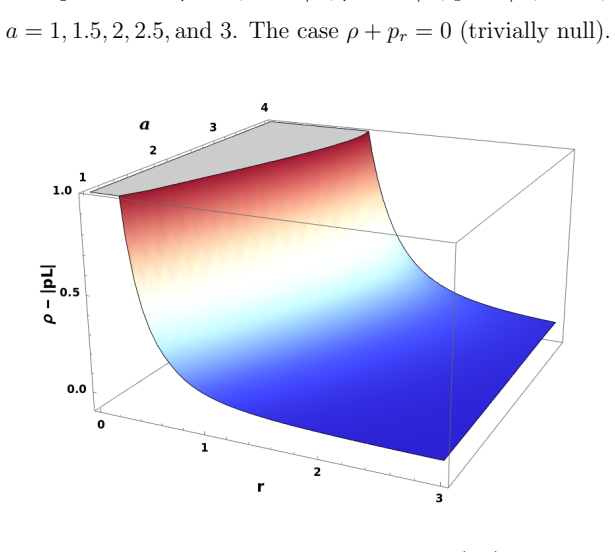
- The null, weak, and strong energy conditions remain satisfied while the dominant energy condition is violated in 2+1 dimensions.
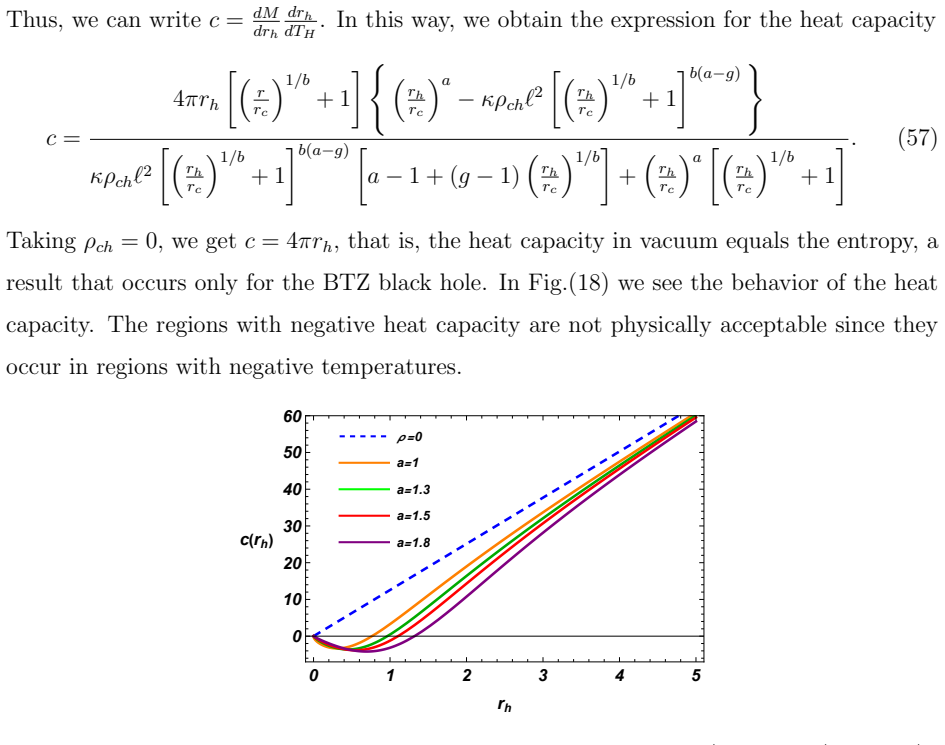
- Hawking temperature and free energy shift with the dark matter parameters while local and global thermodynamic stability are preserved.
Where Pith is reading between the lines
- Galactic dark matter halos with measured inner slopes could be checked against the critical value to see whether cylindrical black-hole-like objects would possess horizons or naked singularities.
- The same density profile might be inserted into other symmetry ansatze to test whether similar horizon disappearance occurs in spherical or planar geometries.
- Numerical simulations of collapse with this density profile could reveal whether the naked singularities form dynamically or remain artifacts of the static ansatz.
Load-bearing premise
The Dekel-Zhao density profile functions as a valid matter source for the chosen cylindrically symmetric metric without extra consistency conditions imposed by the Einstein equations.
What would settle it
Compute the metric component g_tt for an inner slope a larger than the reported critical value and check whether it fails to change sign at any finite radius, or evaluate the Ricci scalar at r=0 and verify that it diverges when the density profile is non-zero.
Figures





read the original abstract
In this work, we obtain analytical solutions for a $(3+1)$-dimensional black string and a $(2+1)$-dimensional black hole, both sourced by the Dekel-Zhao dark matter (DM) density profile. Our results indicate that the event horizon radius is sensitive to the inner slope parameter $a$; specifically, beyond a critical threshold, the horizon vanishes, leading to the formation of naked singularities. We find that the DM environment induces curvature singularities in the Ricci and Kretschmann scalars, which are absent in the vacuum BTZ case. Furthermore, an analysis of the effective energy-momentum tensor shows that while the null, weak, and strong energy conditions are strictly satisfied, the dominant energy condition is violated in the lower-dimensional scenario due to the high tangential pressure gradient. We also observe that DM modifies the Hawking temperature and free energy without compromising local or global stability. Notably, the DM distribution transforms the originally constant-curvature BTZ spacetime into a singular one, suggesting that a inherent stiffness of the DM profile is a determinant factor in the causal structure of these solutions.
Editorial analysis
A structured set of objections, weighed in public.
Referee Report
Summary. The manuscript claims to obtain analytical solutions for a (3+1)-dimensional black string and a (2+1)-dimensional black hole sourced by the Dekel-Zhao dark matter density profile. It reports that the event horizon radius is sensitive to the inner slope parameter a, with naked singularities appearing beyond a critical value of a. The DM distribution is stated to induce curvature singularities in the Ricci and Kretschmann scalars (absent in the vacuum BTZ case), while the effective energy-momentum tensor satisfies the null, weak, and strong energy conditions but violates the dominant energy condition in the lower-dimensional scenario due to tangential pressure gradients. Thermodynamic quantities including Hawking temperature and free energy are modified by the DM without compromising local or global stability.
Significance. If the solutions are shown to be fully consistent, the work would provide explicit, closed-form examples of cylindrically symmetric black holes embedded in a realistic DM halo profile, allowing direct study of how the inner slope a controls the causal structure and how DM introduces curvature singularities into constant-curvature spacetimes such as BTZ. The parameter-free character of the density profile and the reported stability analysis would constitute concrete, falsifiable predictions for the effect of DM on lower-dimensional black-hole thermodynamics.
major comments (2)
- [Einstein equations and matter source (main derivation)] The derivation begins by inserting the Dekel-Zhao density ρ(r) directly into the Einstein equations for the static cylindrically symmetric metric ansatz. For this ansatz the Einstein tensor possesses multiple independent components; specifying only the energy density fixes the mass function but leaves the radial, tangential, and (in 3+1) z-directed pressures undetermined. The manuscript reports an effective energy-momentum tensor and checks energy conditions, yet does not demonstrate that the chosen pressures satisfy the remaining Einstein equations or that ∇_μ T^μν = 0 holds identically without additional tuning of a or the scale radius. This consistency check is load-bearing for the claim of analytical solutions.
- [Analytical solutions and curvature analysis] The abstract and results state that beyond a critical value of the inner slope parameter a the event horizon vanishes, producing naked singularities, and that the DM profile transforms the constant-curvature BTZ spacetime into a singular one. Explicit metric functions g_tt(r), g_rr(r) (or their 2+1 analogues) and the integration steps from the Einstein equations should be displayed so that the location of the horizon and the appearance of curvature singularities in the Ricci and Kretschmann scalars can be verified directly.
minor comments (2)
- [Energy-momentum tensor] The notation for the effective energy-momentum tensor components (energy density, radial and tangential pressures) should be introduced once and used consistently; currently the distinction between the 3+1 and 2+1 cases is not always clear from the text.
- [Results] A brief comparison table of the critical value of a for horizon disappearance in the 3+1 versus 2+1 cases would improve readability.
Simulated Author's Rebuttal
We thank the referee for the thorough review and valuable suggestions regarding our work on cylindrically symmetric black holes sourced by the Dekel-Zhao dark matter profile. We provide point-by-point responses to the major comments and will update the manuscript to include additional details on the derivations and explicit expressions as appropriate.
read point-by-point responses
-
Referee: The derivation begins by inserting the Dekel-Zhao density ρ(r) directly into the Einstein equations for the static cylindrically symmetric metric ansatz. For this ansatz the Einstein tensor possesses multiple independent components; specifying only the energy density fixes the mass function but leaves the radial, tangential, and (in 3+1) z-directed pressures undetermined. The manuscript reports an effective energy-momentum tensor and checks energy conditions, yet does not demonstrate that the chosen pressures satisfy the remaining Einstein equations or that ∇_μ T^μν = 0 holds identically without additional tuning of a or the scale radius. This consistency check is load-bearing for the claim of analytical solutions.
Authors: We appreciate the referee pointing out the need for explicit consistency verification. In our approach, the Dekel-Zhao density profile is used to determine the metric function through the relevant component of the Einstein equations, which defines the mass function. The other components of the Einstein tensor then yield the pressure terms of the effective energy-momentum tensor. By construction, all Einstein equations are satisfied. The covariant conservation of the energy-momentum tensor follows from the Bianchi identities without any additional parameter tuning. We will include a brief explanation of this in the revised manuscript to make the consistency explicit. revision: yes
-
Referee: The abstract and results state that beyond a critical value of the inner slope parameter a the event horizon vanishes, producing naked singularities, and that the DM profile transforms the constant-curvature BTZ spacetime into a singular one. Explicit metric functions g_tt(r), g_rr(r) (or their 2+1 analogues) and the integration steps from the Einstein equations should be displayed so that the location of the horizon and the appearance of curvature singularities in the Ricci and Kretschmann scalars can be verified directly.
Authors: We agree that providing the explicit metric functions and integration steps will facilitate direct verification by readers. In the revised manuscript, we will present the integrated forms of the metric components for both the (3+1)-dimensional black string and the (2+1)-dimensional black hole cases. This will include the expressions for g_tt(r) and g_rr(r), the steps used to integrate the Einstein equations with the Dekel-Zhao profile, the condition for the critical value of a leading to horizon disappearance, and the explicit forms of the Ricci and Kretschmann scalars demonstrating the DM-induced singularities. revision: yes
Circularity Check
No circularity: solutions derived directly from Einstein equations with external Dekel-Zhao density profile
full rationale
The paper starts from the Einstein field equations in a static cylindrically symmetric metric ansatz and inserts the externally given Dekel-Zhao density profile ρ(r) as the matter source. The metric functions are obtained by direct integration of the resulting differential equations, yielding analytical expressions for the black string and BTZ-like solutions. Curvature scalars, horizons, Hawking temperature, and energy conditions are then computed from these derived quantities. No step reduces a claimed result to a fitted parameter renamed as a prediction, nor relies on self-citation for a uniqueness theorem or ansatz. The inner slope a is treated as a free input varied across cases, and the effective T_μν is constructed from the Einstein tensor components, keeping the derivation self-contained against the input density profile.
Axiom & Free-Parameter Ledger
free parameters (1)
- inner slope parameter a
axioms (2)
- standard math Einstein equations hold with the given energy-momentum tensor derived from the Dekel-Zhao density.
- domain assumption Cylindrical symmetry is preserved by the matter distribution.
Lean theorems connected to this paper
-
IndisputableMonolith/Foundation/RealityFromDistinction.leanreality_from_one_distinction unclear?
unclearRelation between the paper passage and the cited Recognition theorem.
We obtain analytical solutions for a (3+1)-dimensional black string and a (2+1)-dimensional black hole, both sourced by the Dekel-Zhao dark matter (DM) density profile... f(r) = ... 2F1(...) - 4μℓ/r + r²/ℓ²
What do these tags mean?
- matches
- The paper's claim is directly supported by a theorem in the formal canon.
- supports
- The theorem supports part of the paper's argument, but the paper may add assumptions or extra steps.
- extends
- The paper goes beyond the formal theorem; the theorem is a base layer rather than the whole result.
- uses
- The paper appears to rely on the theorem as machinery.
- contradicts
- The paper's claim conflicts with a theorem or certificate in the canon.
- unclear
- Pith found a possible connection, but the passage is too broad, indirect, or ambiguous to say the theorem truly supports the claim.
Forward citations
Cited by 1 Pith paper
-
On regular black strings spacetimes in nonlinear electrodynamics
No regular purely electric black strings exist in NED recovering the Maxwell limit, but regular cylindrical Bardeen and Hayward analogues are constructed with finite curvature.
Reference graph
Works this paper leans on
-
[1]
Planck 2018 results. VI. Cosmological parameters
N. Aghanimet al.(Planck), Astronomy & Astrophysics641, A6 (2020), arXiv:1807.06209 [astro-ph.CO]
work page internal anchor Pith review Pith/arXiv arXiv 2020
-
[2]
Zwicky, Helvetica Physica Acta6, 110 (1933)
F. Zwicky, Helvetica Physica Acta6, 110 (1933)
work page 1933
-
[3]
V. C. Rubin and W. K. Ford, Astrophys. J.159, 379 (1970)
work page 1970
- [4]
-
[5]
G. Bertone and D. Hooper, Rev. Mod. Phys.90, 045002 (2018), arXiv:1605.04909 [astro- ph.CO]
work page internal anchor Pith review Pith/arXiv arXiv 2018
-
[6]
S. Trujillo-Gomez, A. Klypin, J. Primack, and A. J. Romanowsky, Astrophysical Journal742, 16 (2011), arXiv:1005.1289 [astro-ph.CO]
work page internal anchor Pith review Pith/arXiv arXiv 2011
-
[7]
Randall, Nature 10.1038/d41586-018-05096-y (2018)
L. Randall, Nature 10.1038/d41586-018-05096-y (2018)
-
[8]
C. A. Arg¨ uelles, A. Kheirandish, and A. C. Vincent, Phys. Rev. D99, 023018 (2019), arXiv:1810.06545 [astro-ph.HE]
work page internal anchor Pith review Pith/arXiv arXiv 2019
- [9]
-
[10]
Y.-D. Tsai and T. Xu, Phys. Rev. D105, 023526 (2022), arXiv:2106.04512 [hep-ph]
- [11]
-
[12]
Z. Xu, M. Tang, G. Cao, and S.-N. Zhang, Eur. Phys. J. C80, 70 (2020)
work page 2020
-
[13]
C. R. Muniz, H. R. Christiansen, M. S. Cunha, and J. Furtado, Ann. Phys.443, 168980 (2022)
work page 2022
- [14]
- [15]
- [16]
-
[17]
R. Zhang and S. Zheng, Journal of High Energy Physics2024, 061 (2024), arXiv:2311.14273 [hep-ph]
-
[18]
A. Errehymy, S. Hansraj, S. K. Maurya,et al., Phys. Dark Univ.41, 101258 (2023)
work page 2023
-
[19]
S. K. Mauryaet al., Eur. Phys. J. C84, 986 (2024)
work page 2024
- [20]
-
[21]
The Structure of Dark Matter Haloes in Dwarf Galaxies
A. Burkert, Astrophys. J.447, L25 (1995), arXiv:astro-ph/9504041
work page internal anchor Pith review Pith/arXiv arXiv 1995
-
[22]
J. F. Navarro, C. S. Frenk, and S. D. M. White, Astrophys. J.462, 563 (1996)
work page 1996
-
[23]
J. F. Navarro, C. S. Frenk, and S. D. M. White, Astrophys. J.490, 493 (1997)
work page 1997
-
[24]
A mass-dependent density profile for dark matter haloes including the influence of galaxy formation
A. Di Cintio, C. B. Brook, A. V. Macci´ o,et al., Mon. Not. R. Astron. Soc.441, 2986 (2014), arXiv:1404.5959
work page internal anchor Pith review Pith/arXiv arXiv 2014
- [25]
-
[26]
Z. Xu, X. Hou, J. Wang, and Y. Liao, Adv. High Energy Phys.2019, 2434390 (2019)
work page 2019
-
[27]
N. U. Molla, H. Chaudhary, G. Mustafa,et al., Eur. Phys. J. C84, 390 (2024)
work page 2024
-
[28]
Y. Ali-Ha¨ ımoudet al., Phys. Rev. D102, 103533 (2020), arXiv:2008.06291
-
[29]
Zhao, Monthly Notices of the Royal Astronomical Society278, 488 (1996)
H. Zhao, Monthly Notices of the Royal Astronomical Society278, 488 (1996)
work page 1996
-
[30]
Zhao, Monthly Notices of the Royal Astronomical Society287, 525 (1997)
H. Zhao, Monthly Notices of the Royal Astronomical Society287, 525 (1997)
work page 1997
- [31]
-
[32]
J. Freundlich, A. Dekel, F. Jiang, G. Ishai, N. Cornuault, S. Lapiner, A. A. Dutton, and A. V. Macci` o, Monthly Notices of the Royal Astronomical Society491, 4523–4542 (2019). 27
work page 2019
- [33]
-
[34]
E. Retana-Montenegro, E. Van Hese, G. Gentile, M. Baes, and F. Frutos-Alfaro, Astronomy & Astrophysics540, A70 (2012)
work page 2012
- [35]
- [36]
-
[37]
Chazy, Bulletin de la Soci´ et´ e Math´ ematique de France52, 17 (1924)
J. Chazy, Bulletin de la Soci´ et´ e Math´ ematique de France52, 17 (1924)
work page 1924
-
[38]
H. E. J. Curzon, Proceedings of the London Mathematical Societys2-23, 477 (1925)
work page 1925
-
[39]
Lewis, Proceedings of the Royal Society of London
T. Lewis, Proceedings of the Royal Society of London. Series A, Containing Papers of a Mathematical and Physical Character136, 176 (1932)
work page 1932
- [40]
-
[41]
J. R. Gott, III, Phys. Rev. Lett.66, 1126 (1991)
work page 1991
- [42]
- [43]
-
[44]
M. J. Duff, T. Inami, C. N. Pope, E. Sezgin, and K. S. Stelle, Nucl. Phys. B297, 515 (1988)
work page 1988
- [45]
- [46]
-
[47]
K. S. Thorne, inMagic without Magic, edited by J. R. Klander (Freeman, San Francisco, 1972)
work page 1972
-
[48]
M. Ba˜ nados, C. Teitelboim, and J. Zanelli, Phys. Rev. Lett.69, 1849 (1992)
work page 1992
-
[49]
J. P. S. Lemos, Class. Quantum Gravity12, 1081 (1995)
work page 1995
-
[50]
J. P. S. Lemos, Phys. Lett. B353, 46 (1995)
work page 1995
-
[51]
Black String in dRGT Massive Gravity
L. Tannukij, P. Wongjun, and S. G. Ghosh, Eur. Phys. J. C77, 846 (2017), arXiv:1701.05332 [gr-qc]
work page internal anchor Pith review Pith/arXiv arXiv 2017
-
[52]
S. H. Hendi, H. Zarei, M. Faizal, B. Pourhassan, and Z. Armanfard, Nucl. Phys. B965, 115362 (2021)
work page 2021
-
[53]
Sheykhi, Journal of High Energy Physics2020, 031 (2020)
A. Sheykhi, Journal of High Energy Physics2020, 031 (2020)
work page 2020
-
[54]
D. V. Singh, M. S. Ali, and S. G. Ghosh, Int. J. Mod. Phys. D27, 1850108 (2018)
work page 2018
- [55]
-
[56]
M. S. Ali, F. Ahmed, and S. G. Ghosh, Ann. Phys.412, 168024 (2020)
work page 2020
- [57]
- [58]
- [59]
- [60]
-
[61]
G. Alencar, A. Lima, D. Rubiera-Garcia, and D. S.-C. G´ omez, Light trajectories and optical appearances in asymptotically anti-de sitter-schwarzschild and black string space-times (2025), arXiv:2512.09869 [gr-qc]
-
[62]
J. Furtado and G. Alencar, Universe8, 625 (2022), arXiv:2210.06608 [gr-qc]
-
[63]
S. E. Hong, D. J. Kim, H. S. Hwang, and J. Kim, Astrophys. J.913, 76 (2021)
work page 2021
-
[64]
C. T. Donnan, R. Tojeiro, and K. Kraljic, Nat. Astron. 10.1038/s41550-022-01619-w (2022), advance online publication
-
[65]
R. Calder´ on, R. Gannouji, B. L’Huillier, and D. Polarski, Phys. Rev. D103, 023526 (2021)
work page 2021
- [66]
-
[67]
D. J. Eisenstein, A. Loeb, and E. L. Turner, Astrophys. J.475, 421 (1997)
work page 1997
-
[68]
A. ¨Ovg¨ un and R. C. Pantig, Phys. Lett. B864, 139398 (2025), arXiv:2501.12559 [gr-qc]
- [69]
-
[70]
J. D. Bekenstein, Phys. Rev. D7, 2333 (1973)
work page 1973
-
[71]
R. D´ arlla, F. A. Brito, and J. Furtado, Universe9, 297 (2023), arXiv:2301.03921 [gr-qc] . 29
discussion (0)
Sign in with ORCID, Apple, or X to comment. Anyone can read and Pith papers without signing in.