Recognition: 2 theorem links
· Lean TheoremThe Yang-Baxter Sigma Model from Twistor Space
Pith reviewed 2026-05-16 05:28 UTC · model grok-4.3
The pith
Six-dimensional holomorphic Chern-Simons theory on twistor space yields a four-dimensional Yang-Baxter sigma model.
A machine-rendered reading of the paper's core claim, the machinery that carries it, and where it could break.
Core claim
We derive a novel two-field four-dimensional integrable field theory from 6d holomorphic Chern-Simons theory on twistor space. The four-dimensional IFT depends on a skew-symmetric linear operator acting on a Lie algebra, and when this operator is specialised to a solution of the modified classical Yang-Baxter equation, the IFT develops a semi-local symmetry associated with this solution. The resulting 4d analogue of the Yang-Baxter sigma model is related by symmetry reduction to the well-known 2d Yang-Baxter sigma model. An important implication that we find is the embedding of the equations of motion of the 2d Yang-Baxter sigma model in the anti-self-dual Yang-Mills equations.
What carries the argument
The skew-symmetric linear operator on a Lie algebra, specialized to a solution of the modified classical Yang-Baxter equation, which introduces the semi-local symmetry in the derived four-dimensional theory.
If this is right
- The resulting 4d Yang-Baxter sigma model is related by symmetry reduction to the well-known 2d Yang-Baxter sigma model.
- The equations of motion of the 2d Yang-Baxter sigma model embed in the anti-self-dual Yang-Mills equations.
- The 6d Chern-Simons theory on twistor space can alternatively be symmetry reduced to a 4d Chern-Simons theory configuration with disorder surface defects that realizes the Yang-Baxter sigma model.
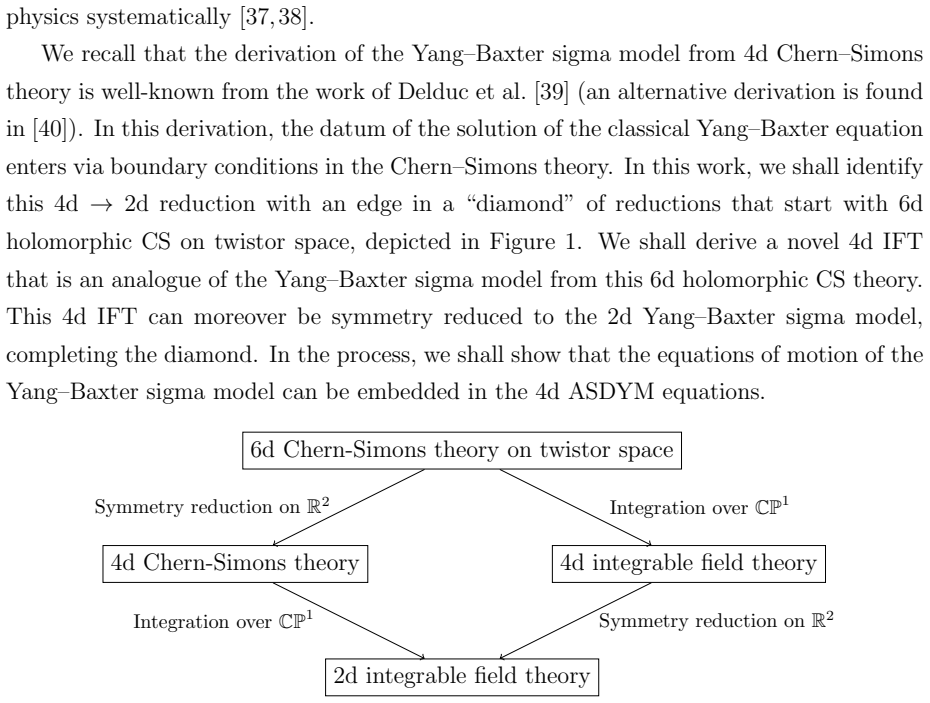
- This construction implies a diamond structure for the Yang-Baxter sigma model obtained from twistor space.
Where Pith is reading between the lines
- The embedding of 2d equations into anti-self-dual Yang-Mills may allow techniques from 4d integrable systems to solve or classify solutions of the 2d model.
- Similar twistor-space reductions could produce integrable deformations in other dimensions or with different symmetry groups.
- The semi-local symmetry might have implications for conserved charges or Lax pairs in the quantum version of the 4d theory.
Load-bearing premise
Symmetry reductions from the 6D holomorphic Chern-Simons theory on twistor space to 4D preserve integrability and that specializing the skew-symmetric operator to a modified classical Yang-Baxter solution introduces the claimed semi-local symmetry without inconsistencies.
What would settle it
A direct computation of the equations of motion in the derived 4D theory that fails to match the expected form for the Yang-Baxter sigma model when the operator satisfies the modified classical Yang-Baxter equation.
Figures
read the original abstract
We derive a novel two-field four-dimensional integrable field theory (IFT) from 6d holomorphic Chern-Simons theory on twistor space. The four-dimensional IFT depends on a skew-symmetric linear operator acting on a Lie algebra, and when this operator is specialised to a solution of the modified classical Yang-Baxter equation, the IFT develops a semi-local symmetry associated with this solution. The resulting 4d analogue of the Yang-Baxter sigma model is related by symmetry reduction to the well-known 2d Yang-Baxter sigma model. An important implication that we find is the embedding of the equations of motion of the 2d Yang-Baxter sigma model in the anti-self-dual Yang-Mills equations. The 6d Chern-Simons theory on twistor space can alternatively be symmetry reduced to a 4d Chern-Simons theory configuration with disorder surface defects. The latter realises the Yang-Baxter sigma model, implying a "diamond" for the Yang-Baxter sigma model obtained from twistor space.
Editorial analysis
A structured set of objections, weighed in public.
Referee Report
Summary. The manuscript derives a novel two-field four-dimensional integrable field theory from 6d holomorphic Chern-Simons theory on twistor space. The 4D IFT is controlled by a skew-symmetric linear operator R on a Lie algebra; specializing R to a solution of the modified classical Yang-Baxter equation produces a semi-local symmetry. The resulting 4D Yang-Baxter sigma model is related by symmetry reduction to the standard 2D Yang-Baxter sigma model, with its equations of motion embedded in the anti-self-dual Yang-Mills equations. An alternative reduction to 4D Chern-Simons theory with disorder surface defects realizes the same model, yielding a 'diamond' structure.
Significance. If the derivations hold, the work supplies a twistor-space origin for the Yang-Baxter sigma model that unifies 2D sigma-model integrability with 4D and 6D gauge theory via explicit symmetry reductions. The provision of field redefinitions, the reduced action, and the 4D Lax pair constitutes concrete, checkable content. The embedding of the 2D model into ASDYM and the parameter-free character of the construction are notable strengths that could influence studies of higher-dimensional integrability and twistor applications to field theory.
major comments (3)
- [§2] §2 (reduction step): the preservation of integrability under the 6D-to-4D symmetry reduction must be verified explicitly by showing that the 4D Lax pair remains flat on-shell once the mCYBE condition is imposed on R; the current outline leaves this step implicit.
- [Embedding section] Embedding paragraph (near Eq. for 2D-to-ASDYM map): the precise field identification that embeds the 2D YB sigma-model equations inside the 4D ASDYM equations is asserted but not displayed; without the explicit map it is impossible to confirm that no extraneous constraints appear.
- [§5] §5 (diamond construction): the claim that the 4D Chern-Simons theory with disorder defects reproduces the same equations of motion as the direct 4D IFT reduction requires a side-by-side comparison of the two sets of EOM to substantiate the equivalence.
minor comments (2)
- [Abstract] Abstract: the phrase 'semi-local symmetry' appears without a one-sentence gloss; a brief parenthetical definition would aid readers.
- Notation: the domain and range of the skew-symmetric operator R should be stated once in the introduction with a consistent index convention used thereafter.
Simulated Author's Rebuttal
We thank the referee for the positive assessment and the detailed, constructive comments. We address each major point below and have revised the manuscript accordingly to make the derivations fully explicit.
read point-by-point responses
-
Referee: §2 (reduction step): the preservation of integrability under the 6D-to-4D symmetry reduction must be verified explicitly by showing that the 4D Lax pair remains flat on-shell once the mCYBE condition is imposed on R; the current outline leaves this step implicit.
Authors: We agree that the flatness verification was left implicit. In the revised manuscript we have added an explicit computation of the curvature of the 4D Lax pair. We show that this curvature vanishes identically on-shell precisely when R satisfies the modified classical Yang-Baxter equation, thereby confirming that integrability is preserved under the symmetry reduction. revision: yes
-
Referee: Embedding paragraph (near Eq. for 2D-to-ASDYM map): the precise field identification that embeds the 2D YB sigma-model equations inside the 4D ASDYM equations is asserted but not displayed; without the explicit map it is impossible to confirm that no extraneous constraints appear.
Authors: We acknowledge the omission. The revised version now displays the explicit field identification map that embeds the 2D Yang-Baxter sigma-model fields into the 4D anti-self-dual Yang-Mills fields. We also verify directly that this map introduces no extraneous constraints beyond the original 2D equations of motion. revision: yes
-
Referee: §5 (diamond construction): the claim that the 4D Chern-Simons theory with disorder defects reproduces the same equations of motion as the direct 4D IFT reduction requires a side-by-side comparison of the two sets of EOM to substantiate the equivalence.
Authors: We agree that an explicit comparison is needed. The revised manuscript includes a side-by-side tabulation of the equations of motion obtained from the direct 4D IFT reduction and from the 4D Chern-Simons theory with disorder surface defects, confirming that the two sets are identical. revision: yes
Circularity Check
No significant circularity; derivation from established 6D theory
full rationale
The central construction reduces 6d holomorphic Chern-Simons theory on twistor space to a 4d two-field IFT via explicit symmetry reductions and field redefinitions. The skew-symmetric operator R is introduced as an input and then specialized to solutions of the modified classical Yang-Baxter equation (an external algebraic condition, not derived or fitted inside the paper). The resulting semi-local symmetry, relation to the 2d Yang-Baxter sigma model, and embedding of its equations inside anti-self-dual Yang-Mills all follow directly from the reduction once the mCYBE condition is imposed. No step equates a prediction to its own input by construction, no ansatz is smuggled via self-citation, and the 6D starting point is an independent, externally established theory. Any self-citations are peripheral and non-load-bearing.
Axiom & Free-Parameter Ledger
axioms (2)
- domain assumption Holomorphic Chern-Simons theory on twistor space is a consistent starting point whose symmetry reductions yield integrable 4D theories.
- domain assumption Specialization of the skew-symmetric operator to a solution of the modified classical Yang-Baxter equation produces a well-defined semi-local symmetry.
Lean theorems connected to this paper
-
IndisputableMonolith/Foundation/RealityFromDistinction.leanreality_from_one_distinction unclear?
unclearRelation between the paper passage and the cited Recognition theorem.
We derive a novel two-field four-dimensional integrable field theory (IFT) from 6d holomorphic Chern-Simons theory on twistor space... when this operator is specialised to a solution of the modified classical Yang-Baxter equation
-
IndisputableMonolith/Cost/FunctionalEquation.leanwashburn_uniqueness_aczel unclear?
unclearRelation between the paper passage and the cited Recognition theorem.
The resulting 4d analogue of the Yang-Baxter sigma model is related by symmetry reduction to the well-known 2d Yang-Baxter sigma model... embedding of the equations of motion of the 2d Yang-Baxter sigma model in the anti-self-dual Yang-Mills equations
What do these tags mean?
- matches
- The paper's claim is directly supported by a theorem in the formal canon.
- supports
- The theorem supports part of the paper's argument, but the paper may add assumptions or extra steps.
- extends
- The paper goes beyond the formal theorem; the theorem is a base layer rather than the whole result.
- uses
- The paper appears to rely on the theorem as machinery.
- contradicts
- The paper's claim conflicts with a theorem or certificate in the canon.
- unclear
- Pith found a possible connection, but the passage is too broad, indirect, or ambiguous to say the theorem truly supports the claim.
Forward citations
Cited by 1 Pith paper
-
On the structure of higher-dimensional integrable field theories
Integrable (d+1)-dimensional field theories are obtained via homotopy transfer from cyclic L_infinity-algebras describing topological-holomorphic higher Chern-Simons theories on M × CP¹, with integrability encoded in ...
Reference graph
Works this paper leans on
-
[1]
Supersymmetric gauge theory and the Yangian
K. Costello, “Supersymmetric gauge theory and the Yangian,”arXiv:1303.2632 [hep-th]. 31
work page internal anchor Pith review Pith/arXiv arXiv
-
[2]
Gauge Theory and Integrability, I
K. Costello, E. Witten, and M. Yamazaki, “Gauge Theory and Integrability, I,” ICCM Not.06no. 1, (2018) 46–119,arXiv:1709.09993 [hep-th]
work page internal anchor Pith review Pith/arXiv arXiv 2018
-
[3]
Gauge Theory and Integrability, II
K. Costello, E. Witten, and M. Yamazaki, “Gauge Theory and Integrability, II,” ICCM Not.06no. 1, (2018) 120–146,arXiv:1802.01579 [hep-th]
work page internal anchor Pith review Pith/arXiv arXiv 2018
-
[4]
Q-operators are ’t Hooft lines,
K. Costello, D. Gaiotto, and J. Yagi, “Q-operators are ’t Hooft lines,” arXiv:2103.01835 [hep-th]
-
[5]
Gauge Theory And Integrability, III,
K. Costello and M. Yamazaki, “Gauge Theory And Integrability, III,” arXiv:1908.02289 [hep-th]
-
[6]
Dualities and Discretizations of Integrable Quantum Field Theories from 4d Chern-Simons Theory,
M. Ashwinkumar, J.-i. Sakamoto, and M. Yamazaki, “Dualities and Discretizations of Integrable Quantum Field Theories from 4d Chern-Simons Theory,”Advances in Theoretical and Mathematical Physics(9, 2023) ,arXiv:2309.14412 [hep-th]
-
[7]
Equivalence of 1-loop RG flows in 4d Chern-Simons and integrable 2d sigma-models,
N. Levine, “Equivalence of 1-loop RG flows in 4d Chern-Simons and integrable 2d sigma-models,”Phys. Lett. B862(2025) 139325,arXiv:2309.16753 [hep-th]
-
[8]
A generalized 4d Chern-Simons theory,
D. M. Schmidtt, “A generalized 4d Chern-Simons theory,”JHEP11(2023) 144, arXiv:2307.10428 [hep-th]
-
[9]
Contact 4d Chern-Simons theory: generalities,
D. M. Schmidtt, “Contact 4d Chern-Simons theory: generalities,”JHEP12(2025) 078,arXiv:2508.19375 [hep-th]
-
[10]
Branes and Categorifying Integrable Lattice Models,
M. Ashwinkumar, M.-C. Tan, and Q. Zhao, “Branes and Categorifying Integrable Lattice Models,”Adv. Theor. Math. Phys.24no. 1, (2020) 1–24,arXiv:1806.02821 [hep-th]
-
[11]
Unification of integrability in supersymmetric gauge theories,
K. Costello and J. Yagi, “Unification of integrability in supersymmetric gauge theories,”Adv. Theor. Math. Phys.24no. 8, (2020) 1931–2041,arXiv:1810.01970 [hep-th]
-
[12]
Unifying lattice models, links and quantum geometric Langlands via branes in string theory,
M. Ashwinkumar and M.-C. Tan, “Unifying lattice models, links and quantum geometric Langlands via branes in string theory,”Adv. Theor. Math. Phys.24no. 7, (2020) 1681–1721,arXiv:1910.01134 [hep-th]. 32
-
[13]
Topological holography: The example of the D2-D4 brane system,
N. Ishtiaque, S. Faroogh Moosavian, and Y. Zhou, “Topological holography: The example of the D2-D4 brane system,”SciPost Phys.9no. 2, (2020) 017, arXiv:1809.00372 [hep-th]
-
[14]
Integrable Lattice Models and Holography,
M. Ashwinkumar, “Integrable Lattice Models and Holography,”JHEP02(2021) 227,arXiv:2003.08931 [hep-th]
-
[15]
T Tand root-T Tdeformations in four-dimensional Chern-Simons theory,
J.-i. Sakamoto, R. Tateo, and M. Yamazaki, “T Tand root-T Tdeformations in four-dimensional Chern-Simons theory,”JHEP01(2026) 084,arXiv:2509.12303 [hep-th]
-
[16]
The Courant-Hilbert construction in 4D Chern-Simons theory,
O. Fukushima, T. Matsumoto, and K. Yoshida, “The Courant-Hilbert construction in 4D Chern-Simons theory,”JHEP01(2026) 122,arXiv:2509.22080 [hep-th]
-
[17]
Courant-Hilbert deformations of Yang-Baxter sigma models,
O. Fukushima, T. Matsumoto, and K. Yoshida, “Courant-Hilbert deformations of Yang-Baxter sigma models,”arXiv:2602.04662 [hep-th]
-
[18]
The homological algebra of 2d integrable field theories,
M. Benini, A. Schenkel, and B. Vicedo, “The homological algebra of 2d integrable field theories,”arXiv:2601.19993 [hep-th]
-
[19]
Hamiltonian Analysis of Doubled 4d Chern-Simons,
J. Stedman, “Hamiltonian Analysis of Doubled 4d Chern-Simons,” arXiv:2601.18647 [hep-th]
-
[20]
The Self-Duality Equations on a Riemann Surface and Four-Dimensional Chern-Simons Theory,
R. Bittleston, L. Mason, and S. F. Moosavian, “The Self-Duality Equations on a Riemann Surface and Four-Dimensional Chern-Simons Theory,”arXiv:2601.05309 [hep-th]
-
[21]
Integrable models from 4d holomorphic BF theory,
L. T. Cole and B. Hoare, “Integrable models from 4d holomorphic BF theory,” arXiv:2512.15566 [hep-th]
-
[22]
Twists of trigonometric sigma models,
R. Hamidi and B. Hoare, “Twists of trigonometric sigma models,”JHEP08(2025) 090,arXiv:2504.18492 [hep-th]
-
[23]
L. J. Mason and N. M. J. Woodhouse,Integrability, self-duality, and twistor theory. Oxford University Press, 1996
work page 1996
-
[24]
Twistors, the ASD Yang-Mills equations and 4d Chern-Simons theory,
R. Bittleston and D. Skinner, “Twistors, the ASD Yang-Mills equations and 4d Chern-Simons theory,”JHEP02(2023) 227,arXiv:2011.04638 [hep-th]. 33
-
[25]
Twistor Actions for Integrable Systems,
R. F. Penna, “Twistor Actions for Integrable Systems,”JHEP09(2021) 140, arXiv:2011.05831 [hep-th]
-
[26]
Deformed integrable models from holomorphic Chern-Simons theory,
Y.-J. He, J. Tian, and B. Chen, “Deformed integrable models from holomorphic Chern-Simons theory,”Sci. China Phys. Mech. Astron.65no. 10, (2022) 100413, arXiv:2105.06826 [hep-th]
-
[27]
Integrable Deformations from Twistor Space,
L. T. Cole, R. A. Cullinan, B. Hoare, J. Liniado, and D. C. Thompson, “Integrable Deformations from Twistor Space,”SciPost Phys.17(2024) 008, arXiv:2311.17551 [hep-th]
-
[28]
Gauging The Diamond: Integrable Coset Models from Twistor Space,
L. T. Cole, R. A. Cullinan, B. Hoare, J. Liniado, and D. C. Thompson, “Gauging The Diamond: Integrable Coset Models from Twistor Space,”arXiv:2407.09479 [hep-th]
-
[29]
From Diamond Gaugings to Dualisations,
D. Chatzis, J. M. Marley, and D. C. Thompson, “From Diamond Gaugings to Dualisations,”arXiv:2512.17751 [hep-th]
-
[30]
Yang-Baxter $\sigma$-models and dS/AdS T-duality
C. Klimcik, “Yang-Baxter sigma models and dS/AdS T duality,”JHEP12(2002) 051,arXiv:hep-th/0210095
work page internal anchor Pith review Pith/arXiv arXiv 2002
-
[31]
On integrability of the Yang-Baxter $\si$-model
C. Klimcik, “On integrability of the Yang-Baxter sigma-model,”J. Math. Phys.50 (2009) 043508,arXiv:0802.3518 [hep-th]
work page internal anchor Pith review Pith/arXiv arXiv 2009
-
[32]
Yang-Baxter sigma models based on the CYBE
T. Matsumoto and K. Yoshida, “Yang–Baxter sigma models based on the CYBE,” Nucl. Phys. B893(2015) 287–304,arXiv:1501.03665 [hep-th]
work page internal anchor Pith review Pith/arXiv arXiv 2015
-
[33]
An integrable deformation of the AdS_5 x S^5 superstring action
F. Delduc, M. Magro, and B. Vicedo, “An integrable deformation of theAdS 5 ×S 5 superstring action,”Phys. Rev. Lett.112no. 5, (2014) 051601,arXiv:1309.5850 [hep-th]
work page internal anchor Pith review Pith/arXiv arXiv 2014
-
[34]
Jordanian deformations of the AdS_5xS^5 superstring
I. Kawaguchi, T. Matsumoto, and K. Yoshida, “Jordanian deformations of the AdS5xS5 superstring,”JHEP04(2014) 153,arXiv:1401.4855 [hep-th]
work page internal anchor Pith review Pith/arXiv arXiv 2014
-
[35]
Derivation of the action and symmetries of the q-deformed AdS_5 x S^5 superstring
F. Delduc, M. Magro, and B. Vicedo, “Derivation of the action and symmetries of theq-deformedAdS 5 ×S 5 superstring,”JHEP10(2014) 132,arXiv:1406.6286 [hep-th]. 34
work page internal anchor Pith review Pith/arXiv arXiv 2014
-
[36]
Yang-Baxter deformations of the AdS5×S5 supercoset sigma model from 4D Chern-Simons theory,
O. Fukushima, J.-i. Sakamoto, and K. Yoshida, “Yang-Baxter deformations of the AdS5×S5 supercoset sigma model from 4D Chern-Simons theory,”JHEP09(2020) 100,arXiv:2005.04950 [hep-th]
-
[37]
Resurgence in the bi-Yang-Baxter model,
L. Schepers and D. C. Thompson, “Resurgence in the bi-Yang-Baxter model,”Nucl. Phys. B964(2021) 115308,arXiv:2007.03683 [hep-th]
-
[38]
Asymptotics in the bi-Yang-Baxter sigma model,
M. Ashwinkumar, D. Orlando, S. Reffert, and G. Sberveglieri, “Asymptotics in the bi-Yang-Baxter sigma model,”Phys. Rev. D112no. 12, (2025) 125023, arXiv:2501.18458 [hep-th]
-
[39]
A unifying 2D action for integrableσ-models from 4D Chern–Simons theory,
F. Delduc, S. Lacroix, M. Magro, and B. Vicedo, “A unifying 2D action for integrableσ-models from 4D Chern–Simons theory,”Lett. Math. Phys.110no. 7, (2020) 1645–1687,arXiv:1909.13824 [hep-th]
-
[40]
Comments onη-deformed principal chiral model from 4D Chern-Simons theory,
O. Fukushima, J.-i. Sakamoto, and K. Yoshida, “Comments onη-deformed principal chiral model from 4D Chern-Simons theory,”Nucl. Phys. B957(2020) 115080, arXiv:2003.07309 [hep-th]
-
[41]
A Kahler-Chern-Simons Theory and Quantization of Instanton Moduli Spaces,
V. P. Nair and J. Schiff, “A Kahler-Chern-Simons Theory and Quantization of Instanton Moduli Spaces,”Phys. Lett. B246(1990) 423–429
work page 1990
-
[42]
Kahler Chern-Simons theory and symmetries of antiselfdual gauge fields,
V. P. Nair and J. Schiff, “Kahler Chern-Simons theory and symmetries of antiselfdual gauge fields,”Nucl. Phys. B371(1992) 329–352. 35
work page 1992
discussion (0)
Sign in with ORCID, Apple, or X to comment. Anyone can read and Pith papers without signing in.