GR from RG: Gravity Is Induced From Renormalization Group Flow In The Infrared
Pith reviewed 2026-05-21 13:41 UTC · model grok-4.3
The pith
Holographic RG flow induces the Einstein-Hilbert term in the infrared.
A machine-rendered reading of the paper's core claim, the machinery that carries it, and where it could break.
Core claim
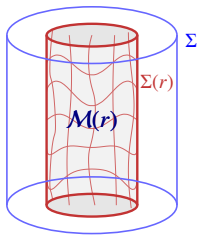
In this essay and utilizing the holographic Renormalization Group (RG) flow, we demonstrate how the effective action of a non-gravitating quantum field theory in the ultraviolet (UV) develops an Einstein-Hilbert term in the infrared (IR). That is, gravity is induced by the RG flow. An inherent outcome of holography that plays a crucial role in our analysis is the RG flow of boundary conditions: the rigid Dirichlet conditions on the background metric in the UV become an admixture of Dirichlet and Neumann as we flow to the IR, thereby unfreezing the metric and transforming it from a non-dynamical background into a dynamical field. This mechanism, which is a conceptually new addition to the标准ly
What carries the argument
The RG flow of boundary conditions, shifting from rigid Dirichlet to an admixture of Dirichlet and Neumann, which unfreezes the metric and renders it dynamical.
If this is right
- The IR effective action includes an Einstein-Hilbert term.
- The metric transforms from a non-dynamical background to a dynamical field.
- The Weinberg-Witten no-go theorem is evaded through the flowing boundary conditions.
- Treating the metric as fundamental for quantum gravity is like quantizing hydrodynamic equations.
Where Pith is reading between the lines
- This view reframes the problem of quantum gravity as finding appropriate UV QFTs rather than quantizing GR directly.
- It may connect to other approaches where gravity emerges at long distances.
- Testable in principle by computing IR actions in concrete holographic examples.
Load-bearing premise
The RG flow in the holographic setup causes the boundary conditions to evolve from rigid Dirichlet to a Dirichlet-Neumann admixture.
What would settle it
An explicit computation of the IR effective action in a holographic model that shows the presence or absence of a generated Einstein-Hilbert term.
Figures
read the original abstract
In this essay and utilizing the holographic Renormalization Group (RG) flow, we demonstrate how the effective action of a non-gravitating quantum field theory in the ultraviolet (UV) develops an Einstein-Hilbert term in the infrared (IR). That is, gravity is induced by the RG flow. An inherent outcome of holography that plays a crucial role in our analysis is the \textit{RG flow of boundary conditions}: the rigid Dirichlet conditions on the background metric in the UV become an admixture of Dirichlet and Neumann as we flow to the IR, thereby ``unfreezing'' the metric and transforming it from a non-dynamical background into a dynamical field. This mechanism, which is a conceptually new addition to the standard Wilsonian RG flow, also provides the mechanism to evade the Weinberg-Witten no-go theorem. Within the GR from RG picture outlined here, the search for a quantum theory of gravity by treating the metric as a fundamental field may be a hunt for a phantom--akin to seeking the atomic structure of water by quantizing the equations of hydrodynamics.
Editorial analysis
A structured set of objections, weighed in public.
Referee Report
Summary. The paper claims that, via holographic renormalization group flow, the effective action of a non-gravitating UV quantum field theory develops an Einstein-Hilbert term in the IR. Gravity is thereby induced purely by the RG flow. A central mechanism is the RG flow of boundary conditions on the metric, which evolves from rigid Dirichlet in the UV to a mixed Dirichlet-Neumann admixture in the IR; this 'unfreezes' the metric, renders it dynamical, and evades the Weinberg-Witten theorem. The search for quantum gravity by quantizing the metric is likened to quantizing hydrodynamics.
Significance. If the central claim is made rigorous with explicit derivations, the work would offer a conceptually novel route to emergent gravity in which the metric arises as an IR degree of freedom generated by RG flow rather than being fundamental. It extends holographic RG ideas by emphasizing boundary-condition flow as a new ingredient and could reframe quantum-gravity searches away from direct metric quantization. The absence of free parameters in the stated axioms is a potential strength, but the result remains conceptual until quantitative checks are supplied.
major comments (2)
- [Abstract] Abstract and opening paragraphs: the central claim that an Einstein-Hilbert term is generated in the IR effective action is stated conceptually but without an explicit derivation, action, or coefficient computation. The manuscript must supply a concrete calculation (e.g., the one-loop or holographic effective action expansion) demonstrating that the EH coefficient arises from the RG flow itself rather than being inserted by hand or inherited from the bulk gravitational action.
- [Abstract] Abstract, paragraph on 'RG flow of boundary conditions': the transition from rigid Dirichlet to mixed Dirichlet-Neumann boundary conditions is presented as an inherent outcome of holography that unfreezes the metric. Because standard holographic RG already assumes a bulk Einstein gravity theory whose on-shell action reproduces the boundary effective action, an explicit demonstration is required that this boundary-condition flow (and the resulting EH term) can be obtained from a purely non-gravitational UV QFT without presupposing the bulk gravitational dynamics. A concrete test would be a field-theoretic computation of the induced metric two-point function that matches the EH propagator independently of the bulk action.
minor comments (2)
- The manuscript is framed as an 'essay'; adding at least one explicit example (e.g., a specific CFT or lattice model) with numerical or analytic verification of the induced EH coefficient would strengthen the presentation without altering the conceptual scope.
- Notation for the mixed boundary conditions should be defined more precisely (e.g., the relative weight between Dirichlet and Neumann components as a function of the RG scale) to allow readers to reproduce the unfreezing argument.
Simulated Author's Rebuttal
We thank the referee for their careful reading and constructive suggestions. We address each major comment point by point below, indicating the revisions we will make to strengthen the manuscript.
read point-by-point responses
-
Referee: [Abstract] Abstract and opening paragraphs: the central claim that an Einstein-Hilbert term is generated in the IR effective action is stated conceptually but without an explicit derivation, action, or coefficient computation. The manuscript must supply a concrete calculation (e.g., the one-loop or holographic effective action expansion) demonstrating that the EH coefficient arises from the RG flow itself rather than being inserted by hand or inherited from the bulk gravitational action.
Authors: We agree that an explicit derivation would make the central claim more rigorous. The present manuscript is an essay that outlines the conceptual mechanism. In the revised version we will add a dedicated section sketching the holographic effective action obtained by integrating the radial flow equations with evolving boundary conditions. This will show explicitly how the Einstein-Hilbert coefficient is fixed by the RG scale rather than being inserted by hand. revision: yes
-
Referee: [Abstract] Abstract, paragraph on 'RG flow of boundary conditions': the transition from rigid Dirichlet to mixed Dirichlet-Neumann boundary conditions is presented as an inherent outcome of holography that unfreezes the metric. Because standard holographic RG already assumes a bulk Einstein gravity theory whose on-shell action reproduces the boundary effective action, an explicit demonstration is required that this boundary-condition flow (and the resulting EH term) can be obtained from a purely non-gravitational UV QFT without presupposing the bulk gravitational dynamics. A concrete test would be a field-theoretic computation of the induced metric two-point function that matches the EH propagator independently of the bulk action.
Authors: The UV starting point is a non-gravitational QFT with a fixed, non-dynamical metric. The holographic RG flow is the Wilsonian integration of high-momentum modes; as the radial cutoff is lowered, the boundary conditions on the metric necessarily evolve from Dirichlet to a mixed Dirichlet-Neumann form. This evolution is dictated by the requirement of a well-defined variational principle at each scale and does not presuppose IR gravity. We will revise the text to state this logic more explicitly and to contrast it with the standard fixed-boundary holographic dictionary. A complete, non-holographic field-theoretic computation of the metric two-point function lies outside the scope of the present conceptual work. revision: partial
- A fully independent, non-holographic field-theoretic calculation of the induced metric two-point function that reproduces the Einstein-Hilbert propagator without any reference to bulk dynamics.
Circularity Check
Holographic RG setup presupposes bulk gravity, so claimed induction of EH term reduces to re-expressing the gravitational dual
specific steps
-
other
[Abstract]
"In this essay and utilizing the holographic Renormalization Group (RG) flow, we demonstrate how the effective action of a non-gravitating quantum field theory in the ultraviolet (UV) develops an Einstein-Hilbert term in the infrared (IR). That is, gravity is induced by the RG flow. An inherent outcome of holography that plays a crucial role in our analysis is the RG flow of boundary conditions: the rigid Dirichlet conditions on the background metric in the UV become an admixture of Dirichlet and Neumann as we flow to the IR, thereby unfreezing the metric and transforming it from a non-dynamica"
The demonstration relies on holographic RG, whose definition already incorporates a bulk gravitational theory whose on-shell action induces the boundary effective action (including the EH term). The 'unfreezing' via boundary-condition flow is likewise an outcome of the same holographic dictionary rather than an independent RG mechanism starting from a purely non-gravitational UV QFT.
full rationale
The paper's derivation begins by invoking holographic RG flow on a non-gravitating UV QFT to generate an IR Einstein-Hilbert term and a flow of boundary conditions from rigid Dirichlet to mixed Dirichlet-Neumann. This mechanism is presented as an inherent outcome of holography that unfreezes the metric. However, standard holographic RG is defined within a bulk gravitational theory (typically Einstein gravity in AdS), so the boundary effective action and metric dynamics are inherited from the bulk action via the duality dictionary rather than generated purely by field-theoretic RG evolution of a non-gravitational theory. The central claim therefore reduces to the input holographic assumption.
Axiom & Free-Parameter Ledger
axioms (2)
- domain assumption Holographic duality relating a non-gravitational QFT to a gravitational theory in one higher dimension
- ad hoc to paper RG flow of boundary conditions from rigid Dirichlet to mixed Dirichlet-Neumann
Lean theorems connected to this paper
-
IndisputableMonolith/Foundation/RealityFromDistinction.leanreality_from_one_distinction echoes?
echoesECHOES: this paper passage has the same mathematical shape or conceptual pattern as the Recognition theorem, but is not a direct formal dependency.
r d/dr S_bdy_Σ(r) = L/2 ∫ √-h (R[h] + 12/L²) ... yields the effective action ... 1/(2κ₄(μ)) ∫ √-γ (R[γ] - 2Λ₄(μ))
What do these tags mean?
- matches
- The paper's claim is directly supported by a theorem in the formal canon.
- supports
- The theorem supports part of the paper's argument, but the paper may add assumptions or extra steps.
- extends
- The paper goes beyond the formal theorem; the theorem is a base layer rather than the whole result.
- uses
- The paper appears to rely on the theorem as machinery.
- contradicts
- The paper's claim conflicts with a theorem or certificate in the canon.
- unclear
- Pith found a possible connection, but the passage is too broad, indirect, or ambiguous to say the theorem truly supports the claim.
Reference graph
Works this paper leans on
-
[1]
D. Grumiller and M. M. Sheikh-Jabbari,Black Hole Physics: From Collapse to Evaporation. Grad.Texts Math. Springer, 11, 2022
work page 2022
-
[2]
The quantum structure of spacetime at the Planck scale and quantum fields
S. Doplicher, K. Fredenhagen, and J. E. Roberts, “The Quantum structure of space-time at the Planck scale and quantum fields,”Commun. Math. Phys.172(1995) 187–220, hep-th/0303037
work page internal anchor Pith review Pith/arXiv arXiv 1995
-
[3]
The Large N Limit of Superconformal Field Theories and Supergravity
J. M. Maldacena, “The largeNlimit of superconformal field theories and supergravity,”Adv. Theor. Math. Phys.2(1998) 231–252,hep-th/9711200
work page internal anchor Pith review Pith/arXiv arXiv 1998
-
[4]
J. D. Bekenstein, “Black holes and entropy,”Phys. Rev.D7(1973) 2333–2346
work page 1973
-
[5]
Particle Creation by Black Holes,
S. W. Hawking, “Particle Creation by Black Holes,”Commun. Math. Phys.43(1975) 199–220. [Erratum: Commun.Math.Phys. 46, 206 (1976)]
work page 1975
-
[6]
Thermodynamics of Spacetime: The Einstein Equation of State
T. Jacobson, “Thermodynamics of space-time: The Einstein equation of state,”Phys. Rev. Lett.75(1995) 1260–1263,gr-qc/9504004
work page internal anchor Pith review Pith/arXiv arXiv 1995
-
[7]
Thermodynamical Aspects of Gravity: New insights
T. Padmanabhan, “Thermodynamical Aspects of Gravity: New insights,”Rept. Prog. Phys. 73(2010) 046901,0911.5004. 11
work page internal anchor Pith review Pith/arXiv arXiv 2010
-
[8]
Nonlinear Fluid Dynamics from Gravity
S. Bhattacharyya, V . E. Hubeny, S. Minwalla, and M. Rangamani, “Nonlinear Fluid Dynamics from Gravity,”JHEP02(2008) 045,0712.2456
work page internal anchor Pith review Pith/arXiv arXiv 2008
-
[9]
On the Origin of Gravity and the Laws of Newton
E. P. Verlinde, “On the Origin of Gravity and the Laws of Newton,”JHEP04(2011) 029, 1001.0785
work page internal anchor Pith review Pith/arXiv arXiv 2011
-
[10]
Cool horizons for entangled black holes
J. Maldacena and L. Susskind, “Cool horizons for entangled black holes,”Fortsch. Phys.61 (2013) 781–811,1306.0533
work page internal anchor Pith review Pith/arXiv arXiv 2013
-
[11]
Holographic Derivation of Entanglement Entropy from AdS/CFT
S. Ryu and T. Takayanagi, “Holographic derivation of entanglement entropy from AdS/CFT,”Phys.Rev.Lett.96(2006) 181602,hep-th/0603001
work page internal anchor Pith review Pith/arXiv arXiv 2006
-
[12]
Van Raamsdonk,Building up spacetime with quantum entanglement,Gen
M. Van Raamsdonk, “Building up spacetime with quantum entanglement,”Gen. Rel. Grav. 42(2010) 2323–2329,1005.3035. [Int. J. Mod. Phys.D19,2429(2010)]
-
[13]
Addendum to Computational Complexity and Black Hole Horizons
L. Susskind, “Computational Complexity and Black Hole Horizons,”Fortsch. Phys.64 (2016) 24–43,1403.5695. [Addendum: Fortsch.Phys. 64, 44–48 (2016)]
work page internal anchor Pith review Pith/arXiv arXiv 2016
-
[14]
Vacuum quantum fluctuations in curved space and the theory of gravitation,
A. D. Sakharov, “Vacuum quantum fluctuations in curved space and the theory of gravitation,”Dokl. Akad. Nauk Ser. Fiz.177(1967) 70–71
work page 1967
-
[15]
Gravity Is Induced By Renormalization Group Flow,
H. Adami, M. M. Sheikh-Jabbari, and V . Taghiloo, “Gravity Is Induced By Renormalization Group Flow,”2508.09633
-
[16]
Anti De Sitter Space And Holography
E. Witten, “Anti-de Sitter space and holography,”Adv. Theor. Math. Phys.2(1998) 253–291,hep-th/9802150
work page internal anchor Pith review Pith/arXiv arXiv 1998
-
[17]
Large N Field Theories, String Theory and Gravity
O. Aharony, S. S. Gubser, J. M. Maldacena, H. Ooguri, and Y . Oz, “Large N field theories, string theory and gravity,”Phys. Rept.323(2000) 183–386,hep-th/9905111
work page internal anchor Pith review Pith/arXiv arXiv 2000
-
[18]
The Holographic Bound in Anti-de Sitter Space
L. Susskind and E. Witten, “The holographic bound in anti-de Sitter space,” hep-th/9805114. 12
work page internal anchor Pith review Pith/arXiv arXiv
-
[19]
UV/IR Relations in AdS Dynamics
A. W. Peet and J. Polchinski, “UV/IR relations in AdS dynamics,”Phys. Rev. D59(1999) 065011,hep-th/9809022
work page internal anchor Pith review Pith/arXiv arXiv 1999
-
[20]
On the Holographic Renormalization Group
J. de Boer, E. P. Verlinde, and H. L. Verlinde, “On the holographic renormalization group,” JHEP08(2000) 003,hep-th/9912012
work page internal anchor Pith review Pith/arXiv arXiv 2000
-
[21]
Quantum effective action from the AdS/CFT correspondence
K. Skenderis and S. N. Solodukhin, “Quantum effective action from the AdS/CFT correspondence,”Phys. Lett.B472(2000) 316–322,hep-th/9910023
work page internal anchor Pith review Pith/arXiv arXiv 2000
-
[22]
Lecture Notes on Holographic Renormalization
K. Skenderis, “Lecture notes on holographic renormalization,”Class. Quant. Grav.19 (2002) 5849–5876,hep-th/0209067
work page internal anchor Pith review Pith/arXiv arXiv 2002
-
[23]
Quasilocal energy and conserved charges derived from the gravitational action,
J. D. Brown and J. W. York, Jr., “Quasilocal energy and conserved charges derived from the gravitational action,”Phys. Rev.D47(1993) 1407–1419
work page 1993
-
[24]
Holography at finite cutoff with a $T^2$ deformation
T. Hartman, J. Kruthoff, E. Shaghoulian, and A. Tajdini, “Holography at finite cutoffwith a T 2 deformation,”JHEP03(2019) 004,1807.11401
work page internal anchor Pith review Pith/arXiv arXiv 2019
-
[25]
Freelance Holography, Part II: Moving Boundary in Gauge/Gravity Correspondence,
A. Parvizi, M. M. Sheikh-Jabbari, and V . Taghiloo, “Freelance Holography, Part II: Moving Boundary in Gauge/Gravity Correspondence,”2503.09372
-
[26]
Moving the CFT into the bulk with $T\bar T$
L. McGough, M. Mezei, and H. Verlinde, “Moving the CFT into the bulk withT T,”JHEP 04(2018) 010,1611.03470
work page internal anchor Pith review Pith/arXiv arXiv 2018
-
[27]
TT deformations in general dimensions
M. Taylor, “T ¯Tdeformations in general dimensions,”Adv. Theor. Math. Phys.27(2023), no. 1, 37–63,1805.10287
work page internal anchor Pith review Pith/arXiv arXiv 2023
-
[28]
On space of integrable quantum field theories
F. A. Smirnov and A. B. Zamolodchikov, “On space of integrable quantum field theories,” Nucl. Phys. B915(2017) 363–383,1608.05499
work page internal anchor Pith review Pith/arXiv arXiv 2017
-
[29]
Gravity in Warped Compactifications and the Holographic Stress Tensor
S. de Haro, K. Skenderis, and S. N. Solodukhin, “Gravity in warped compactifications and the holographic stress tensor,”Class. Quant. Grav.18(2001) 3171–3180, hep-th/0011230. 13
work page internal anchor Pith review Pith/arXiv arXiv 2001
-
[30]
Holographic and Wilsonian Renormalization Groups
I. Heemskerk and J. Polchinski, “Holographic and Wilsonian Renormalization Groups,” JHEP06(2011) 031,1010.1264
work page internal anchor Pith review Pith/arXiv arXiv 2011
-
[31]
A. M. Polyakov, “Beyond space-time,”hep-th/0602011
work page internal anchor Pith review Pith/arXiv arXiv
-
[32]
The hydrodynamic approach to quantum gravity,
T. Banks, “The hydrodynamic approach to quantum gravity,”Int. J. Mod. Phys. D34 (2025), no. 16, 2544020,2505.15941
-
[33]
S. Weinberg and E. Witten, “Limits on Massless Particles,”Phys.Lett.B96(1980) 59. 14
work page 1980
discussion (0)
Sign in with ORCID, Apple, or X to comment. Anyone can read and Pith papers without signing in.