Recognition: 2 theorem links
· Lean TheoremResummation of threshold double logarithms in quarkonium fragmentation functions
Pith reviewed 2026-05-15 22:55 UTC · model grok-4.3
The pith
Resumming threshold double logarithms renders quarkonium fragmentation functions positive and fully perturbative.
A machine-rendered reading of the paper's core claim, the machinery that carries it, and where it could break.
Core claim
The authors derive a resummation formalism for threshold double logarithms in quarkonium fragmentation functions within the NRQCD factorization framework, providing explicit formulas for the resummed functions that are finite and positive definite at all orders in perturbation theory.
What carries the argument
The resummation formalism that organizes soft gluon emissions to exponentiate the threshold double logarithms in the NRQCD factorization for fragmentation functions.
Load-bearing premise
The assumption that threshold double logarithms can be resummed to all orders within the NRQCD factorization formalism while remaining entirely perturbative and free of nonperturbative model dependence.
What would settle it
An explicit numerical evaluation of the resummed fragmentation function that produces negative values at some momentum fraction would falsify the positivity guarantee.
Figures


read the original abstract
We develop a formalism for resumming threshold double logarithms that appear in fragmentation functions for production of heavy quarkonia. Threshold singularities appear in fixed-order calculations of quarkonium fragmentation functions in the nonrelativistic QCD factorization formalism due to radiation of soft gluons. Because of this, fixed-order quarkonium fragmentation functions are not positive definite, and can lead to unphysically negative cross sections. This problem can be resolved by resumming threshold logarithms to all orders in perturbation theory, which renders the fragmentation functions finite and ensures the positivity of cross sections. We present a detailed derivation of the resummation formalism and derive the formula for resummed quarkonium fragmentation functions, which can be computed entirely within perturbation theory without the need for nonperturbative model functions.
Editorial analysis
A structured set of objections, weighed in public.
Referee Report
Summary. The manuscript develops a resummation formalism for threshold double logarithms appearing in quarkonium fragmentation functions within NRQCD factorization. Fixed-order calculations exhibit threshold singularities from soft-gluon radiation, rendering the FFs non-positive-definite and leading to unphysical negative cross sections. The authors derive an all-orders resummed expression for these FFs, claiming the result is finite, positive-definite, and computable entirely within perturbation theory with no nonperturbative model functions required.
Significance. If the central claim is substantiated, the work would provide a systematic perturbative solution to a known limitation in quarkonium phenomenology, enabling reliable predictions for processes where threshold logarithms dominate. This strengthens the predictive power of NRQCD by extending factorization to resummed level without ad-hoc inputs, with direct relevance to LHC and future collider analyses of heavy-quarkonium production.
major comments (2)
- [Abstract] Abstract and the derivation of the resummed formula: the claim that the resummed FFs 'can be computed entirely within perturbation theory without the need for nonperturbative model functions' is load-bearing for the paper's main result. Standard NRQCD factorization writes D_{i→H}(z) = ∑_n C_n(z,μ) ⟨O_n^H⟩, with ⟨O_n^H⟩ nonperturbative LDMEs. The manuscript must explicitly demonstrate (via the evolution kernel or Sudakov factor) that resummation either renders all LDMEs perturbative or eliminates reference to them; otherwise the positivity and perturbative character do not follow.
- [Derivation of resummed formula] Derivation section (around the definition of the resummed FF): the threshold resummation is performed on the short-distance coefficients, but the overall normalization and z-shape still inherit the color and scale structure of the LDMEs. A concrete check is needed showing that the resummed object remains independent of nonperturbative inputs after matching to the fixed-order result; without this, the statement that no model functions are required is not yet established.
minor comments (1)
- [Introduction] Notation for the resummed fragmentation function should be introduced with an explicit equation number early in the text to aid readability.
Simulated Author's Rebuttal
We thank the referee for the careful reading and constructive comments, which help us strengthen the presentation of our resummation formalism. We address each major comment below and will revise the manuscript to provide the requested clarifications and explicit demonstrations.
read point-by-point responses
-
Referee: [Abstract] Abstract and the derivation of the resummed formula: the claim that the resummed FFs 'can be computed entirely within perturbation theory without the need for nonperturbative model functions' is load-bearing for the paper's main result. Standard NRQCD factorization writes D_{i→H}(z) = ∑_n C_n(z,μ) ⟨O_n^H⟩, with ⟨O_n^H⟩ nonperturbative LDMEs. The manuscript must explicitly demonstrate (via the evolution kernel or Sudakov factor) that resummation either renders all LDMEs perturbative or eliminates reference to them; otherwise the positivity and perturbative character do not follow.
Authors: We agree that the abstract phrasing requires clarification to prevent misinterpretation. Our resummation acts exclusively on the short-distance coefficients C_n(z, μ) through the evolution kernel and associated Sudakov factor, which resums the threshold double logarithms arising from soft-gluon radiation to all orders in α_s. The LDMEs ⟨O_n^H⟩ remain nonperturbative matrix elements as in standard NRQCD factorization and are not rendered perturbative by the resummation. However, the resummed FFs require no additional nonperturbative model functions to parametrize the z-dependence or to restore positivity; the all-order Sudakov factor ensures finiteness and positivity of the coefficients independently of the specific LDME values. We will revise the abstract to state explicitly that the resummation is performed on the perturbative coefficients while retaining the standard NRQCD LDMEs. We will also add an explicit demonstration in the derivation section showing how the Sudakov factor cancels the threshold singularities order-by-order, guaranteeing positivity without reference to extra model inputs. revision: yes
-
Referee: [Derivation of resummed formula] Derivation section (around the definition of the resummed FF): the threshold resummation is performed on the short-distance coefficients, but the overall normalization and z-shape still inherit the color and scale structure of the LDMEs. A concrete check is needed showing that the resummed object remains independent of nonperturbative inputs after matching to the fixed-order result; without this, the statement that no model functions are required is not yet established.
Authors: We acknowledge the need for an explicit matching check. In the revised manuscript we will insert a dedicated subsection that performs the matching of the resummed FF to the fixed-order result at the first few orders in α_s. This check will demonstrate that the nonperturbative LDMEs factor out consistently as overall normalization constants, while the z-shape in the threshold region is fully determined by the perturbative resummed coefficients. After matching, the resummed FF depends on nonperturbative inputs solely through the standard LDMEs; no additional model functions are introduced. The positivity of the resummed object follows directly from the exponentiated Sudakov factor, which is independent of the LDME color and scale structure. This addition will substantiate that the threshold-resummed FFs are computable within perturbation theory once the LDMEs are specified by other means (data or lattice). revision: yes
Circularity Check
Derivation self-contained within perturbative NRQCD resummation
full rationale
The paper provides a detailed derivation of the resummation formalism for threshold double logarithms in quarkonium fragmentation functions directly from the NRQCD factorization framework. The central result—the formula for resummed fragmentation functions—is obtained by resumming soft-gluon contributions to all orders in perturbation theory, rendering the functions finite and positive without introducing fitted parameters or external nonperturbative models. No load-bearing steps reduce by construction to prior inputs, self-citations, or ansatze; the derivation addresses fixed-order singularities through explicit resummation kernels and evolution equations that remain fully perturbative. The approach is self-contained against external benchmarks and does not rely on uniqueness theorems or renamed empirical patterns.
Axiom & Free-Parameter Ledger
axioms (1)
- domain assumption NRQCD factorization applies to quarkonium fragmentation functions
Lean theorems connected to this paper
-
IndisputableMonolith/Cost/FunctionalEquation.leanwashburn_uniqueness_aczel unclear?
unclearRelation between the paper passage and the cited Recognition theorem.
We develop a formalism for resumming threshold double logarithms... soft factorization of the quarkonium fragmentation function in terms of soft functions... resummation by exponentiation
-
IndisputableMonolith/Foundation/RealityFromDistinction.leanreality_from_one_distinction unclear?
unclearRelation between the paper passage and the cited Recognition theorem.
Grammer-Yennie approximation... Wilson lines... soft functions S(z)
What do these tags mean?
- matches
- The paper's claim is directly supported by a theorem in the formal canon.
- supports
- The theorem supports part of the paper's argument, but the paper may add assumptions or extra steps.
- extends
- The paper goes beyond the formal theorem; the theorem is a base layer rather than the whole result.
- uses
- The paper appears to rely on the theorem as machinery.
- contradicts
- The paper's claim conflicts with a theorem or certificate in the canon.
- unclear
- Pith found a possible connection, but the passage is too broad, indirect, or ambiguous to say the theorem truly supports the claim.
Reference graph
Works this paper leans on
-
[1]
Then βnβ′ terms can be rewritten as nβnβ′ =− (n·p) 2 p2(d−1) gββ ′ + nβnβ′ + (n·p) 2 p2(d−1) gββ ′ ,(59) where the terms in the parentheses vanish when contracted with the isotropic tensorI ββ ′ . By using this we can write the isotropic and anisotropic contributions as I αα′ T ΠJ αβα′β′Sββ ′ 3P [1] isotropic =−(d−2)S ββ ′ 3P [1]gββ ′ × ...
-
[2]
Real diagrams We first consider the real diagrams, where a gluon attaches to the lightlike or timelike Wilson lines. The matrix element ofW( 3S[8] 1 )cb on the vacuum and the one-gluon state is given at leading nonvanishing order by ⟨g(k)|W( 3S[8] 1 )cb|0⟩=−g ip·ϵ ∗(k) k·p+iε f xcaδba −g in·ϵ ∗(k) k·n+iε f xbaδca +O(g 3),(96) whereϵ(k) is the polarization...
-
[3]
Virtual diagrams The contribution from the virtual diagrams that come from the exchange of a gluon between the lightlike and timelike Wilson lines is SNLO 3S[8] 1 (z) virtual = 2Re Z k −gnµ i k·n+iε f xba −igµνδbc k2 +iε × −gpν i −k·p+iε f xca 2πδ(P +(1−z)) = Reig 2(N 2 c −1)C A Z k 2πδ(1−z) (k2 +iε)(k·n+iε)(−k·p+iε) .(102) We use the shorthand Z k =µ ′2ϵ...
-
[4]
Results and discussion The 3S[8] 1 soft function at NLO is given by the sum of Eqs. (100), (105), and (110). The result is SNLO 3S[8] 1 (z) = αsCA(N 2 c −1) P + µ 2m 2ϵ 2ϵ−1 UV −2 +ϵπ 2/6 +O(ϵ 2) (1−z) 1+2ϵ −δ(1−z) 1 ϵUV 1 ϵUV − 1 ϵIR +δ(1−z) 1 ϵUV − 1 ϵIR .(111) The term involving (1−z) −1−2ϵ comes from the real diagram, while the terms proportional toϵ ...
-
[5]
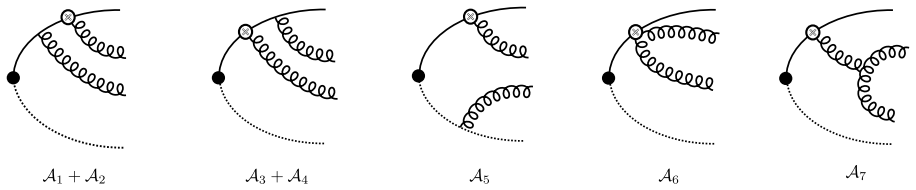
Planar diagrams From the per-diagram results available in Ref. [44], we know that the double UV pole arises from the diagram where an additional virtual gluon is exchanged between the timelike and lightlike Wilson lines. As we will see later, these double UV poles will only arise from planar diagrams shown in Fig. 3. Here we first consider the contributio...
-
[6]
UV power counting Now we consider the remaining NLO diagrams that contribute toS 3P [8](z). As we have discussed previously, threshold double logarithms can only arise inS 3P [8](z) at NLO from double UV poles multiplying (1−z) −1−nϵ. We will show in this section that none of the remaining diagrams can produce double UV poles, so that they can be discarde...
-
[7]
with thek − 1 andk − 2 integrals. In most 40 cases, general form of thek 1⊥ andk 2⊥ integrals at large|k 1⊥|and|k 2⊥|can be written as Z dd−2k1⊥dd−2k2⊥ k2a 1⊥k2b 2⊥(k2 1⊥ +k 2 2⊥)c ,(135) after suitable rescaling ofk 1⊥ andk 2⊥. There are exceptional cases when a factor ofk 1 ·k 2 appears in the numerator or in the denominator; we will later examine these...
-
[8]
The diagramA ∗ 5A7 needs more work
The resulting integral is now UV finite in bothk 1⊥ andk 2⊥. The diagramA ∗ 5A7 needs more work. If we only collect the terms that provide a UV- divergent power count, we have Z dPSk1 Z dPSk2 k0 2/ √ 2−k + 1 (k0 2)2/k1 ·k 2 (k0 1)2k+ 2 (k0 1 +k 0 2)2 2πδ(k + 1 +k + 2 −P +(1−z)).(139) If we first integrate overk − 1 andk − 2 by using the on-shell delta fun...
-
[9]
Results and discussion The 3P [8] soft function at NLO is given by S3P [8](z) =−(1−ϵ) (N 2 c −4)(N 2 c −1) Nc 1 πm2P + × (πµ′2/m2)ϵΓ(1 +ϵ) (1−z) 1+2ϵ − αsCA(πµ′2/m2)2ϵ 2π ϵ−2 UV +O(ϵ −1) (1−z) 1+4ϵ +O(α 2 s) ,(143) where we neglect contributions at orderα s that do not produce threshold double logarithms. At orderα s, the expansion in powers ofϵproduces m...
-
[10]
Isotropic contribution Similarly to the 3P [8] case, we first consider the planar diagrams. The virtual correction to the matrix element of the operatorW b β(3P [1]) between the vacuum and the one-gluon 45 state yields ⟨ga,α(l)|W b β(3P [1])|0⟩|virtual =ig 2CAδabpµ(lµδα β −l βδα µ) Z k −i k2 +iε p·n i −k·n+iε × " i l·p+iε 2 i (l+k)·p+iε + i l·p+iε i (l+k)...
-
[11]
The strategy of the calculation is similar to the isotropic case
Anisotropic contribution It remains to show that the anisotropic contributionS T T 3P [8](z) does not contain threshold double logarithms. The strategy of the calculation is similar to the isotropic case. The UV-divergent contribution to the virtual planar diagram involves the same one-loop integral I(l), and is given by ST T 3P [1](z)|virtual, UV =−g 2(N...
-
[12]
Results and discussion As we have shown by explicit calculation, the threshold double logarithm in the isotropic contributionS 3P [1](z) is equal to theS 3P [8](z), with the replacement (N 2 c −4)/N c →1 in the overall color factor. Thus if we collect only the contributions relevant for threshold double logarithms, we have S3P [1](z)|threshold = N 2 c −1 ...
work page 2023
-
[13]
J. Kodaira and L. Trentadue, Summing Soft Emission in QCD, Phys. Lett. B112, 66 (1982)
work page 1982
-
[14]
J. Kodaira and L. Trentadue, Single Logarithm Effects in electron-Positron Annihilation, Phys. Lett. B123, 335 (1983)
work page 1983
-
[15]
C. T. H. Davies, B. R. Webber, and W. J. Stirling, Drell-Yan Cross-Sections at Small Trans- verse Momentum,1, I.95 (1984)
work page 1984
-
[16]
J. C. Collins, D. E. Soper, and G. F. Sterman, Transverse Momentum Distribution in Drell- Yan Pair and W and Z Boson Production, Nucl. Phys. B250, 199 (1985)
work page 1985
-
[17]
G. F. Sterman, Summation of Large Corrections to Short Distance Hadronic Cross-Sections, Nucl. Phys. B281, 310 (1987)
work page 1987
-
[18]
S. Catani and L. Trentadue, Resummation of the QCD Perturbative Series for Hard Processes, Nucl. Phys. B327, 323 (1989)
work page 1989
-
[19]
S. Catani and L. Trentadue, Comment on QCD exponentiation at large x, Nucl. Phys. B353, 183 (1991). 57
work page 1991
- [20]
- [21]
- [22]
- [23]
- [24]
- [25]
-
[26]
E. L. Berger and H. Contopanagos, The Perturbative resummed series for top quark production in hadron reactions, Phys. Rev. D54, 3085 (1996), arXiv:hep-ph/9603326
work page internal anchor Pith review Pith/arXiv arXiv 1996
-
[27]
The Resummation of Soft Gluon in Hadronic Collisions
S. Catani, M. L. Mangano, P. Nason, and L. Trentadue, The Resummation of soft gluons in hadronic collisions, Nucl. Phys. B478, 273 (1996), arXiv:hep-ph/9604351
work page internal anchor Pith review Pith/arXiv arXiv 1996
-
[28]
G. T. Bodwin, E. Braaten, and G. P. Lepage, Rigorous QCD analysis of inclusive annihilation and production of heavy quarkonium, Phys. Rev. D51, 1125 (1995), [Erratum: Phys.Rev.D 55, 5853 (1997)], arXiv:hep-ph/9407339
work page internal anchor Pith review Pith/arXiv arXiv 1995
-
[29]
E. Braaten and J. Lee, Next-to-leading order calculation of the color octet 3S(1) gluon fragmen- tation function for heavy quarkonium, Nucl. Phys. B586, 427 (2000), arXiv:hep-ph/0004228
work page internal anchor Pith review Pith/arXiv arXiv 2000
- [30]
-
[31]
G. T. Bodwin, H. S. Chung, U-R. Kim, and J. Lee, Fragmentation contributions toJ/ψpro- duction at the Tevatron and the LHC, Phys. Rev. Lett.113, 022001 (2014), arXiv:1403.3612 [hep-ph]
work page internal anchor Pith review Pith/arXiv arXiv 2014
-
[32]
G. T. Bodwin, K.-T. Chao, H. S. Chung, U-R. Kim, J. Lee, and Y.-Q. Ma, Fragmentation contributions to hadroproduction of promptJ/ψ,χ cJ, andψ(2S) states, Phys. Rev. D93, 034041 (2016), arXiv:1509.07904 [hep-ph]. 58
work page internal anchor Pith review Pith/arXiv arXiv 2016
- [33]
-
[34]
A.-P. Chen, Y.-Q. Ma, and C. Meng, Resolving negative cross section of quarkonium hadropro- duction using soft gluon factorization, Phys. Rev. D108, 014003 (2023), arXiv:2304.04552 [hep-ph]
-
[35]
G. Aadet al.(ATLAS), Measurement of the production cross-section ofJ/ψandψ(2S) mesons in pp collisions at √s= 13 TeV with the ATLAS detector, Eur. Phys. J. C84, 169 (2024), arXiv:2309.17177 [hep-ex]
- [36]
-
[37]
G. Grammer, Jr. and D. R. Yennie, Improved treatment for the infrared divergence problem in quantum electrodynamics, Phys. Rev. D8, 4332 (1973)
work page 1973
-
[38]
J. C. Collins and D. E. Soper, Parton Distribution and Decay Functions, Nucl. Phys. B194, 445 (1982)
work page 1982
- [39]
- [40]
- [41]
-
[42]
Dimensional Regularization in Quarkonium Calculations
E. Braaten and Y.-Q. Chen, Dimensional regularization in quarkonium calculations, Phys. Rev. D55, 2693 (1997), arXiv:hep-ph/9610401
work page internal anchor Pith review Pith/arXiv arXiv 1997
-
[43]
G. T. Bodwin and J. Lee, Relativistic corrections to gluon fragmentation into spin triplet S wave quarkonium, Phys. Rev. D69, 054003 (2004), arXiv:hep-ph/0308016
work page internal anchor Pith review Pith/arXiv arXiv 2004
-
[44]
Next-to-leading order Calculation of a Fragmentation Function in a Light-Cone Gauge
J. Lee, Next-to-leading order calculation of a fragmentation function in a light-cone gauge, Phys. Rev. D71, 094007 (2005), arXiv:hep-ph/0504285
work page internal anchor Pith review Pith/arXiv arXiv 2005
- [45]
-
[46]
Heavy quarkonium fragmentation functions from a heavy quark pair. I. $S$ wave
Y.-Q. Ma, J.-W. Qiu, and H. Zhang, Heavy quarkonium fragmentation functions from a heavy quark pair. I.Swave, Phys. Rev. D89, 094029 (2014), arXiv:1311.7078 [hep-ph]
work page internal anchor Pith review Pith/arXiv arXiv 2014
-
[47]
Gluon Fragmentation into Heavy Quarkonium
E. Braaten and T. C. Yuan, Gluon fragmentation into heavy quarkonium, Phys. Rev. Lett. 71, 1673 (1993), arXiv:hep-ph/9303205
work page internal anchor Pith review Pith/arXiv arXiv 1993
-
[48]
Analytical calculation for the gluon fragmentation into spin-triplet S-wave quarkonium
P. Zhang, Y.-Q. Ma, Q. Chen, and K.-T. Chao, Analytical calculation for the gluon fragmen- tation into spin-triplet S-wave quarkonium, Phys. Rev. D96, 094016 (2017), arXiv:1708.01129 [hep-ph]
work page internal anchor Pith review Pith/arXiv arXiv 2017
-
[49]
Gluon fragmentation into quarkonium at next-to-leading order
P. Artoisenet and E. Braaten, Gluon fragmentation into quarkonium at next-to-leading order, JHEP04, 121, arXiv:1412.3834 [hep-ph]
work page internal anchor Pith review Pith/arXiv arXiv
-
[50]
Gluon fragmentation into quarkonium at next-to-leading order using FKS subtraction
P. Artoisenet and E. Braaten, Gluon fragmentation into quarkonium at next-to-leading order using FKS subtraction, JHEP01, 227, arXiv:1810.02448 [hep-ph]
work page internal anchor Pith review Pith/arXiv arXiv
-
[51]
Fragmentation functions of polarized heavy quarkonium
Y.-Q. Ma, J.-W. Qiu, and H. Zhang, Fragmentation functions of polarized heavy quarkonium, J. High Energy Phys.06, 021, arXiv:1501.04556 [hep-ph]
work page internal anchor Pith review Pith/arXiv arXiv
-
[52]
J. C. Collins and D. E. Soper, Back-To-Back Jets in QCD, Nucl. Phys. B193, 381 (1981), [Erratum: Nucl.Phys.B 213, 545 (1983)]
work page 1981
-
[53]
P. L. Cho, M. B. Wise, and S. P. Trivedi, Gluon fragmentation into polarized charmonium, Phys. Rev. D51, R2039 (1995), arXiv:hep-ph/9408352
work page internal anchor Pith review Pith/arXiv arXiv 1995
-
[54]
G. T. Bodwin, X. Garcia i Tormo, and J. Lee, Factorization in exclusive quarkonium produc- tion, Phys. Rev. D81, 114014 (2010), arXiv:1003.0061 [hep-ph]
work page internal anchor Pith review Pith/arXiv arXiv 2010
-
[55]
A. M. Polyakov, Gauge Fields as Rings of Glue, Nucl. Phys. B164, 171 (1980)
work page 1980
- [56]
-
[57]
N. Brambilla, H. S. Chung, and A. Vairo, Inclusive Hadroproduction ofP-Wave Heavy Quarko- nia in Potential Nonrelativistic QCD, Phys. Rev. Lett.126, 082003 (2021), arXiv:2007.07613 [hep-ph]
-
[58]
N. Brambilla, H. S. Chung, and A. Vairo, Inclusive production of heavy quarkonia in pNRQCD, JHEP09, 032, arXiv:2106.09417 [hep-ph]
-
[59]
Recoil and Threshold Corrections in Short-distance Cross Sections
E. Laenen, G. Sterman, and W. Vogelsang, Recoil and threshold corrections in short distance cross-sections, Phys. Rev. D63, 114018 (2001), arXiv:hep-ph/0010080. 60
work page internal anchor Pith review Pith/arXiv arXiv 2001
-
[60]
Resummation for QCD Hard Scattering
N. Kidonakis and G. F. Sterman, Resummation for QCD hard scattering, Nucl. Phys. B505, 321 (1997), arXiv:hep-ph/9705234
work page internal anchor Pith review Pith/arXiv arXiv 1997
-
[61]
Threshold Resummation for Dijet Cross Sections
N. Kidonakis, G. Oderda, and G. F. Sterman, Threshold resummation for dijet cross-sections, Nucl. Phys. B525, 299 (1998), arXiv:hep-ph/9801268
work page internal anchor Pith review Pith/arXiv arXiv 1998
-
[62]
Evolution of Color Exchange in QCD Hard Scattering
N. Kidonakis, G. Oderda, and G. F. Sterman, Evolution of color exchange in QCD hard scattering, Nucl. Phys. B531, 365 (1998), arXiv:hep-ph/9803241
work page internal anchor Pith review Pith/arXiv arXiv 1998
-
[63]
Sudakov resummation of multiparton QCD cross sections
R. Bonciani, S. Catani, M. L. Mangano, and P. Nason, Sudakov resummation of multiparton QCD cross-sections, Phys. Lett. B575, 268 (2003), arXiv:hep-ph/0307035
work page internal anchor Pith review Pith/arXiv arXiv 2003
- [64]
-
[65]
B. Grinstein, L. Maiani, and A. D. Polosa, Radiative decays of X(3872) discriminate between the molecular and compact interpretations, Phys. Rev. D109, 074009 (2024), arXiv:2401.11623 [hep-ph]
-
[66]
E. Braaten and R. Bruschini, Exotic hidden-heavy hadrons and where to find them, Phys. Lett. B863, 139386 (2025), arXiv:2409.08002 [hep-ph]
-
[67]
N. Brambilla, A. Mohapatra, T. Scirpa, and A. Vairo, Nature ofχc1(3872) and Tcc+(3875), Phys. Rev. Lett.135, 131902 (2025), arXiv:2411.14306 [hep-ph]
- [68]
- [69]
discussion (0)
Sign in with ORCID, Apple, or X to comment. Anyone can read and Pith papers without signing in.