Theory of Steady States for Lindblad Equations beyond Time-Independence: Classification, Uniqueness and Symmetry
Pith reviewed 2026-05-15 22:20 UTC · model grok-4.3
The pith
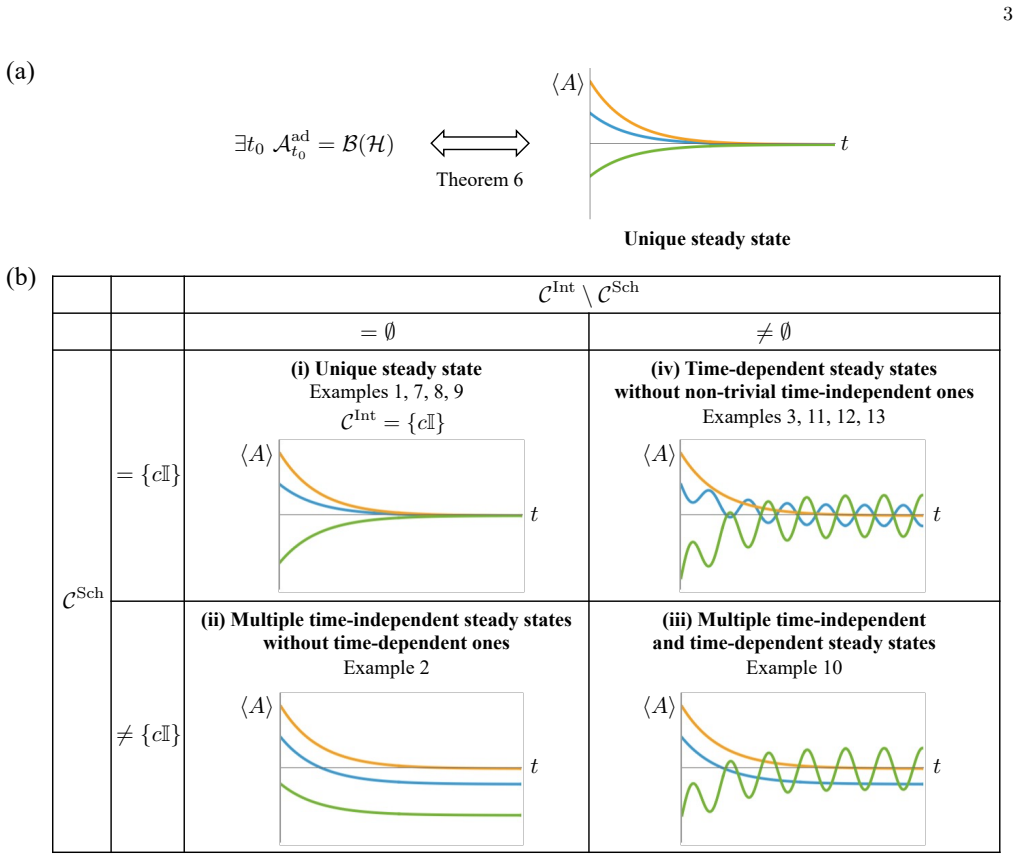
The algebra generated by GKSL generators determines uniqueness of steady states for time-dependent Lindblad equations, with interaction-picture strong symmetry producing oscillatory asymptotics.
A machine-rendered reading of the paper's core claim, the machinery that carries it, and where it could break.
Core claim
We establish a criterion for the uniqueness of steady states formulated in terms of the algebra generated by the GKSL generators and necessary and sufficient when the generators are analytic functions of time. We introduce strong symmetry in the Schrödinger picture, which controls time-independent steady states, and strong symmetry in the interaction picture, which is responsible for non-trivial time-dependent steady states such as coherent oscillations. This classification encompasses established mechanisms such as strong dynamical symmetry and Floquet dynamical symmetry and reveals symmetry-predicted time-dependent asymptotic dynamics in a novel class of open quantum systems.
What carries the argument
The algebra generated by the GKSL generators together with strong symmetry defined separately in the Schrödinger picture and in the interaction picture.
If this is right
- If the algebra generated by the GKSL generators is the full operator algebra, a unique steady state exists.
- Strong symmetry in the interaction picture implies the existence of time-dependent steady states exhibiting coherent oscillations.
- Strong symmetry in the Schrödinger picture implies the existence of time-independent steady states.
- The classification recovers strong dynamical symmetry and Floquet dynamical symmetry as special cases of interaction-picture symmetry.
- The results apply uniformly to periodic, quasiperiodic, and certain classes of random recurrent time dependence.
Where Pith is reading between the lines
- Engineers could use the algebraic criterion to select time-dependent drives that enforce a desired unique steady state in quantum hardware.
- The interaction-picture symmetry concept may connect to Floquet engineering techniques already used in closed systems.
- Testing the criterion on concrete many-body spin chains with quasiperiodic drives would provide direct numerical checks.
Load-bearing premise
The generators have recurrent time dependence and the jump operators are Hermitian, with the uniqueness criterion holding only for analytic functions of time.
What would settle it
An explicit set of analytic recurrent generators whose generated algebra is irreducible yet multiple distinct steady states coexist would falsify the uniqueness criterion.
Figures


read the original abstract
We present a rigorous and comprehensive classification of the asymptotic behavior of time-dependent Gorini-Kossakowski-Sudarshan-Lindblad (GKSL) equations under the assumption of Hermitian jump operators. Our results apply to a broad class of GKSL equations whose time dependence is assumed to be recurrent, including time-independent, periodic, quasiperiodic, and certain classes of random time dependence. Our main contributions are twofold: first, we establish a criterion for the uniqueness of steady states. The criterion is formulated in terms of the algebra generated by the GKSL generators and provides a necessary and sufficient condition when the generators are analytic functions of time. We demonstrate the utility of our criterion through prototypical examples, including quantum many-body spin chains. Second, we extend the concept of strong symmetry for time-dependent GKSL equations by introducing two distinct forms, strong symmetry in the Schr\"odinger picture and that in the interaction picture, and completely classify the asymptotic dynamics with them. More concretely, we rigorously uncover that the strong symmetry in the interaction picture is responsible for non-trivial time-dependent steady states, such as coherent oscillations, whereas that in the Schr\"odinger picture controls the existence of time-independent steady states. This classification not only encompasses established mechanisms underlying non-trivial oscillatory steady states, such as strong dynamical symmetry and Floquet dynamical symmetry, but also reveals symmetry-predicted, time-dependent asymptotic dynamics in a novel class of open quantum systems. Our framework thus provides a rigorous foundation for controlling dissipative quantum systems in a time-dependent manner.
Editorial analysis
A structured set of objections, weighed in public.
Referee Report
Summary. The manuscript develops a rigorous classification of the asymptotic behavior of time-dependent GKSL (Lindblad) equations with Hermitian jump operators under recurrent time dependence, encompassing time-independent, periodic, quasiperiodic, and certain random cases. Its central contributions are an algebraic criterion for uniqueness of steady states formulated via the algebra generated by the GKSL generators (necessary and sufficient when generators are analytic in time) and a complete classification of dynamics via two forms of strong symmetry (Schrödinger-picture symmetry controlling time-independent steady states and interaction-picture symmetry responsible for non-trivial time-dependent states such as coherent oscillations). The framework is illustrated on quantum spin-chain examples.
Significance. If the algebraic uniqueness criterion and symmetry classification extend rigorously beyond analytic generators, the work would supply a parameter-free algebraic tool for predicting and engineering steady-state behavior in driven open quantum systems. It unifies prior notions such as strong dynamical symmetry and Floquet dynamical symmetry while identifying new mechanisms for oscillatory asymptotics, with direct relevance to dissipative quantum control and many-body open-system dynamics.
major comments (2)
- [§3] §3 (uniqueness criterion, main theorem): the necessary-and-sufficient algebraic condition is established only for analytic time dependence of the generators. The subsequent application to quasiperiodic and random recurrent cases (e.g., §5 spin-chain examples) invokes closure of the generated algebra without an explicit uniformity or ergodicity argument that would guarantee the same control when analyticity is dropped; non-uniform limits permitted by recurrent but non-analytic dependence could therefore evade the criterion.
- [§4] §4 (interaction-picture strong symmetry): the claim that interaction-picture symmetry is responsible for coherent oscillations is supported by the analytic case but lacks a concrete extension argument or counter-example for general recurrent generators; the classification therefore rests on an unstated continuity property of the symmetry operators under the recurrence.
minor comments (2)
- [§2] The definition of the algebra generated by the GKSL generators and its commutant should be stated explicitly in the preliminaries with a short example to remove ambiguity when the criterion is applied to many-body systems.
- [§5] In the spin-chain illustrations, the explicit form of the time-dependent generators and the verification that they satisfy the algebraic condition could be expanded by one or two lines to permit independent checking.
Simulated Author's Rebuttal
We thank the referee for their careful reading of the manuscript and for the constructive comments. We address each major point below and indicate the revisions we will make to improve the rigor and clarity of the presentation.
read point-by-point responses
-
Referee: [§3] §3 (uniqueness criterion, main theorem): the necessary-and-sufficient algebraic condition is established only for analytic time dependence of the generators. The subsequent application to quasiperiodic and random recurrent cases (e.g., §5 spin-chain examples) invokes closure of the generated algebra without an explicit uniformity or ergodicity argument that would guarantee the same control when analyticity is dropped; non-uniform limits permitted by recurrent but non-analytic dependence could therefore evade the criterion.
Authors: We agree that the necessary-and-sufficient algebraic uniqueness criterion is established rigorously only under the assumption of analytic time dependence of the generators. The applications in §5 to quasiperiodic and certain random recurrent cases rely on algebraic closure but do not supply an explicit uniformity or ergodicity argument that would extend the necessity direction to non-analytic generators. We will revise §3 to state the analyticity assumption more prominently and add a remark clarifying the scope; we will also insert a short discussion in §5 noting that additional conditions (such as uniform recurrence) may be needed to guarantee the criterion in the non-analytic setting. revision: yes
-
Referee: [§4] §4 (interaction-picture strong symmetry): the claim that interaction-picture symmetry is responsible for coherent oscillations is supported by the analytic case but lacks a concrete extension argument or counter-example for general recurrent generators; the classification therefore rests on an unstated continuity property of the symmetry operators under the recurrence.
Authors: We acknowledge that the classification of asymptotic dynamics via interaction-picture strong symmetry, including its responsibility for coherent oscillations, is developed in detail for analytic generators. The manuscript does not provide an explicit continuity or extension argument that would cover arbitrary recurrent (non-analytic) generators, nor does it discuss potential counter-examples. We will revise §4 to include a brief discussion of the continuity property under recurrence and either sketch a possible extension under suitable uniformity assumptions or note the limitation explicitly, thereby making the scope of the classification transparent. revision: yes
Circularity Check
No significant circularity; algebraic criterion is self-contained
full rationale
The paper derives a necessary-and-sufficient uniqueness criterion from the algebra generated by the GKSL generators under the explicit restriction to analytic time dependence, then classifies asymptotic dynamics via strong symmetries in Schrödinger and interaction pictures. These steps rely on standard algebraic properties of Lindblad operators and recurrent time dependence without reducing any central claim to a fitted parameter, self-definition, or load-bearing self-citation chain. The analytic restriction is stated upfront rather than smuggled in, and no renaming of known results or ansatz importation occurs. The framework is therefore self-contained against external benchmarks.
Axiom & Free-Parameter Ledger
axioms (3)
- domain assumption Jump operators are Hermitian.
- domain assumption Time dependence of the GKSL generators is recurrent (periodic, quasiperiodic, or certain random cases).
- domain assumption Generators are analytic functions of time for the uniqueness criterion.
Reference graph
Works this paper leans on
-
[1]
The proof is given in Appendix H
There exists a time-dependent steady state, i.e., there is a time-dependentρ ∗ t that does not converge to any time-independent density matrix ast→ ∞ such that lim t→∞ ρt =ρ ∗ t ,(79) for some initial conditionρ 0. The proof is given in Appendix H. There, we use the following Lemma proven in Appendix I, which follows from Theorem 2. Lemma 10.Letρ ∗ t be a...
-
[2]
Strong dynamical symmetry To see a situation such thatC Int \ CSch ̸=∅holds, we first consider a time-independent LiouvillianLand focus on a symmetryAthat satisfies the following condition: [H, A] = ΩAand [L m, A] = 0∀m(80) with non-zero real Ω. Such a symmetry is often called a strong dynamical symmetry [39], and with this type of symmetry, the Liouvilli...
-
[3]
Floquet dynamical symmetry The counterpart of the strong dynamical symmetry in a time-periodic Liouvillian is called the Floquet dynam- ical symmetry [56, 96]. For a time-periodic Hamiltonian 13 Ht =H t+T and time-indepedent jump operators{L m}, Ais called Floquet dynamical symmetry if UT AU † T =e −iΩT A(Ω̸= 0) (97) [Lm, UtAU † t ] = 0∀m, t,(98) whereU t...
-
[4]
Moreover, unlike the strong dynamical symmetry in the time-independent case,A †A, AA † /∈ CSch in general. Thus, it is possible thatC Sch ={cI|c∈C}andC Int \ CSch ̸=∅, which implies class (iv), i.e., time-dependent steady states without non-trivial time-independent ones in Definition 1. Example11.In Ref. [56], the authors proposed a dissi- pative Hubbard ...
-
[5]
Time-quasiperiodic case In this section, we see applications of Theorems 8 and 9 to quasiperiodic systems, which cannot be explained by the existing approaches. The simplest example is the following toy model: Example12.Consider the GKSL equation onH=C 3 defined through H= ω1 0 0 0 0 0 0 0−ω 2 , Lt = 0e −iω1t 0 eiω1t 0e −iω2t 0e iω2t 0 . (...
-
[6]
Thus,U F has two eigenmodes with eigenvalue 1:Iandσ z
When sin(gT /4) = 0, i.e.,gT= 4mπfor some in- tegerm,K 0 ∝IandK 1 ∝σ z. Thus,U F has two eigenmodes with eigenvalue 1:Iandσ z. Therefore, the steady state is not unique, and the eigenmode σz leads to a time-dependent steady state
-
[7]
Thus,σ z is an eigenmode ofU F with eigenvalue−1
When cos(gT /4) = 0, i.e.,gT= (4m−2)πfor some integerm,K 0 ∝σ x andK 1 ∝σ y. Thus,σ z is an eigenmode ofU F with eigenvalue−1. As a result, the steady state is not unique, with the eigenmode σz leading to a time-dependent steady state
-
[8]
This can be proved by checking that span{K2 0 , K0K1, K1K0, K2 1 }=B(H) [80, 81]
Finally, when sin(gT /4),cos(gT /4)̸= 0, i.e., gT̸= 2mπfor any integerm,U F is mix- ing. This can be proved by checking that span{K2 0 , K0K1, K1K0, K2 1 }=B(H) [80, 81]. By writings= sin(gT /2) andc= cos(gT /2), we have K2 0 ∝cI−isσ x,(E8) K0K1 ∝cσ z −sσ y,(E9) K1K0 ∝σ z,(E10) K2 1 ∝I.(E11) SincegT̸= 2mπfor any integerm,s̸= 0 and c̸= 1,−1. Thus, I∝K 2 1 ...
-
[9]
Gorini, Completely positive dynamical semigroups of N-level systems, J
V. Gorini, Completely positive dynamical semigroups of N-level systems, J. Math. Phys.17, 821 (1976)
work page 1976
-
[10]
Lindblad, On the generators of quantum dynamical semigroups, Commn
G. Lindblad, On the generators of quantum dynamical semigroups, Commn. Math. Phys.48, 119 (1976)
work page 1976
-
[11]
H.-P. Breuer and F. Petruccione,The Theory of Open Quantum Systems, 1st ed. (Oxford University PressOx- ford, 2007)
work page 2007
-
[12]
´A. Rivas and S. F. Huelga,Open Quantum Systems: An Introduction, SpringerBriefs in Physics (Springer Berlin Heidelberg, Berlin, Heidelberg, 2012)
work page 2012
-
[13]
A. Trushechkin, Unified Gorini-Kossakowski-Lindblad- Sudarshan quantum master equation beyond the secular approximation, Phys. Rev. A103, 062226 (2021)
work page 2021
-
[14]
Mori, Floquet States in Open Quantum Systems, Annu
T. Mori, Floquet States in Open Quantum Systems, Annu. Rev. Condens. Matter Phys.14, 35 (2023)
work page 2023
-
[15]
K. Shiraishi, M. Nakagawa, T. Mori, and M. Ueda, Quantum master equation for many-body systems: Derivation based on the Lieb-Robinson bound, Phys. Rev. B111, 184311 (2025)
work page 2025
-
[16]
Z. Gong, R. Hamazaki, and M. Ueda, Discrete Time- Crystalline Order in Cavity and Circuit QED Systems, Phys. Rev. Lett.120, 040404 (2018)
work page 2018
- [17]
- [18]
-
[19]
P. Kongkhambut, J. Skulte, L. Mathey, J. G. Cosme, A. Hemmerich, and H. Keßler, Observation of a contin- uous time crystal, Science377, 670 (2022)
work page 2022
-
[20]
J. Tindall, C. S´ anchez Mu˜ noz, B. Buˇ ca, and D. Jaksch, Quantum synchronisation enabled by dynamical sym- metries and dissipation, New J. Phys.22, 013026 (2020)
work page 2020
-
[21]
F. Schmolke and E. Lutz, Noise-Induced Quantum Syn- chronization, Phys. Rev. Lett.129, 250601 (2022)
work page 2022
- [22]
-
[23]
M. M. Wolf, J. Eisert, T. S. Cubitt, and J. I. Cirac, As- sessing Non-Markovian Quantum Dynamics, Phys. Rev. Lett.101, 150402 (2008)
work page 2008
- [24]
-
[25]
F. Verstraete, M. M. Wolf, and J. Ignacio Cirac, Quan- tum computation and quantum-state engineering driven by dissipation, Nature Phys5, 633 (2009)
work page 2009
-
[26]
P. M. Harrington, E. J. Mueller, and K. W. Murch, Engineered dissipation for quantum information science, Nat Rev Phys4, 660 (2022)
work page 2022
-
[27]
Y. Li, P. Sala, and F. Pollmann, Hilbert space fragmen- tation in open quantum systems, Phys. Rev. Research 5, 043239 (2023)
work page 2023
-
[28]
K. Stannigel, P. Hauke, D. Marcos, M. Hafezi, S. Diehl, M. Dalmonte, and P. Zoller, Constrained Dynamics via the Zeno Effect in Quantum Simulation: Implementing Non-Abelian Lattice Gauge Theories with Cold Atoms, Phys. Rev. Lett.112, 120406 (2014)
work page 2014
-
[29]
S. Maity and R. Hamazaki, Kinetically constrained models constructed from dissipative quantum dynam- ics, Phys. Rev. B110, 014301 (2024)
work page 2024
-
[30]
Spohn, An algebraic condition for the approach to equilibrium of an open N-level system, Lett
H. Spohn, An algebraic condition for the approach to equilibrium of an open N-level system, Lett. Math. Phys.2, 33 (1977)
work page 1977
-
[31]
Frigerio, Quantum dynamical semigroups and ap- proach to equilibrium, Lett
A. Frigerio, Quantum dynamical semigroups and ap- proach to equilibrium, Lett. Math. Phys.2, 79 (1977)
work page 1977
-
[32]
Frigerio, Stationary states of quantum dynamical semigroups, Commun
A. Frigerio, Stationary states of quantum dynamical semigroups, Commun. Math. Phys.63, 269 (1978)
work page 1978
-
[33]
Spohn, Kinetic equations from Hamiltonian dynam- ics: Markovian limits, Rev
H. Spohn, Kinetic equations from Hamiltonian dynam- ics: Markovian limits, Rev. Mod. Phys.52, 569 (1980)
work page 1980
-
[34]
F. Fagnola and R. Rebolledo, Subharmonic projections for a quantum Markov semigroup, J. Math. Phys.43, 1074 (2002)
work page 2002
-
[35]
B. Baumgartner, H. Narnhofer, and W. Thirring, Anal- ysis of quantum semigroups with GKS–Lindblad gener- ators: I. Simple generators, J. Phys. A: Math. Theor. 41, 065201 (2008)
work page 2008
-
[36]
B. Baumgartner and H. Narnhofer, Analysis of quantum semigroups with GKS–Lindblad generators: II. General, J. Phys. A: Math. Theor.41, 395303 (2008)
work page 2008
-
[37]
D. Nigro, On the uniqueness of the steady-state solution of the Lindblad–Gorini–Kossakowski–Sudarshan equa- tion, J. Stat. Mech.2019, 043202 (2019)
work page 2019
- [38]
-
[39]
H. Yoshida, Uniqueness of steady states of Gorini- 24 Kossakowski-Sudarshan-Lindblad equations: A simple proof, Phys. Rev. A109, 022218 (2024)
work page 2024
-
[40]
Y. Zhang and T. Barthel, Criteria for Davies irreducibil- ity of Markovian quantum dynamics, J. Phys. A: Math. Theor.57, 115301 (2024)
work page 2024
-
[41]
D. Amato and P. Facchi, Number of steady states of quantum evolutions, Sci Rep14, 14366 (2024)
work page 2024
-
[42]
M. Seltmann and B. Buˇ ca, UniqueNESS: Graph theory approach to the uniqueness of non-equilibrium station- ary states of the Lindblad master equation, J. Phys. A: Math. Theor.59, 165203 (2026)
work page 2026
-
[43]
R. Hamazaki, K. Mochizuki, H. Oshima, and Y. Fuji, An introduction to monitored quantum systems and quantum trajectories: Spectrum, typicality, and phases, Progress of Theoretical and Experimental Physics , ptag055 (2026)
work page 2026
-
[44]
F. Fagnola and F. Girotti, Irreducibility of Quantum Markov Semigroups, uniqueness of invariant states and related properties (2025), arXiv:2512.11517 [quant-ph]
-
[45]
B. Buˇ ca and T. Prosen, A note on symmetry reductions of the Lindblad equation: Transport in constrained open spin chains, New J. Phys.14, 073007 (2012)
work page 2012
-
[46]
V. V. Albert and L. Jiang, Symmetries and conserved quantities in Lindblad master equations, Phys. Rev. A 89, 022118 (2014)
work page 2014
- [47]
-
[48]
G. Piccitto, M. Wauters, F. Nori, and N. Shammah, Symmetries and conserved quantities of boundary time crystals in generalized spin models, Phys. Rev. B104, 014307 (2021)
work page 2021
- [49]
-
[50]
M. Hajduˇ sek, P. Solanki, R. Fazio, and S. Vinjanampa- thy, Seeding Crystallization in Time, Phys. Rev. Lett. 128, 080603 (2022)
work page 2022
-
[51]
T. Prosen and E. Ilievski, Nonequilibrium Phase Tran- sition in a Periodically Driven X Y Spin Chain, Phys. Rev. Lett.107, 060403 (2011)
work page 2011
-
[52]
D. Vorberg, W. Wustmann, R. Ketzmerick, and A. Eckardt, Generalized Bose-Einstein Condensation into Multiple States in Driven-Dissipative Systems, Phys. Rev. Lett.111, 240405 (2013)
work page 2013
-
[53]
F. Haddadfarshi, J. Cui, and F. Mintert, Completely Positive Approximate Solutions of Driven Open Quan- tum Systems, Phys. Rev. Lett.114, 130402 (2015)
work page 2015
-
[54]
C. M. Dai, Z. C. Shi, and X. X. Yi, Floquet theorem with open systems and its applications, Phys. Rev. A 93, 032121 (2016)
work page 2016
-
[55]
M. Fitzpatrick, N. M. Sundaresan, A. C. Y. Li, J. Koch, and A. A. Houck, Observation of a Dissipative Phase Transition in a One-Dimensional Circuit QED Lattice, Phys. Rev. X7, 011016 (2017)
work page 2017
-
[56]
M. Hartmann, D. Poletti, M. Ivanchenko, S. Denisov, and P. H¨ anggi, Asymptotic Floquet states of open quan- tum systems: The role of interaction, New J. Phys.19, 083011 (2017)
work page 2017
-
[57]
T. N. Ikeda and M. Sato, General description for nonequilibrium steady states in periodically driven dis- sipative quantum systems, Sci. Adv.6, eabb4019 (2020)
work page 2020
-
[58]
A. Schnell, A. Eckardt, and S. Denisov, Is there a Flo- quet Lindbladian?, Phys. Rev. B101, 100301 (2020)
work page 2020
-
[59]
G. P. Fedorov, S. V. Remizov, D. S. Shapiro, W. V. Pogosov, E. Egorova, I. Tsitsilin, M. Andronik, A. A. Dobronosova, I. A. Rodionov, O. V. Astafiev, and A. V. Ustinov, Photon Transport in a Bose-Hubbard Chain of Superconducting Artificial Atoms, Phys. Rev. Lett. 126, 180503 (2021)
work page 2021
-
[60]
A. Schnell, S. Denisov, and A. Eckardt, High-frequency expansions for time-periodic Lindblad generators, Phys. Rev. B104, 165414 (2021)
work page 2021
- [61]
- [62]
-
[63]
H. Chen, Y.-M. Hu, W. Zhang, M. A. Kurniawan, Y. Shao, X. Chen, A. Prem, and X. Dai, Periodically driven open quantum systems: Spectral properties and nonequilibrium steady states, Phys. Rev. B109, 184309 (2024)
work page 2024
-
[64]
K. Chinzei and T. N. Ikeda, Time Crystals Protected by Floquet Dynamical Symmetry in Hubbard Models, Phys. Rev. Lett.125, 060601 (2020)
work page 2020
- [65]
- [66]
- [67]
-
[68]
V. Noviˇ cenko, E. Anisimovas, and G. Juzeli¯ unas, Flo- quet analysis of a quantum system with modulated pe- riodic driving, Phys. Rev. A95, 023615 (2017)
work page 2017
-
[69]
D. Cubero and F. Renzoni, Asymptotic theory of quasiperiodically driven quantum systems, Phys. Rev. E97, 062139 (2018)
work page 2018
-
[70]
H. Zhao, F. Mintert, and J. Knolle, Floquet Time Spirals and Stable Discrete Time Quasi-Crystals in Quasi-Periodically Driven Quantum Many-Body Sys- tems, Phys. Rev. B100, 134302 (2019)
work page 2019
- [71]
-
[72]
D. Malz and A. Smith, Topological two-dimensional Flo- quet lattice on a single superconducting qubit, Phys. Rev. Lett.126, 163602 (2021)
work page 2021
-
[73]
W. Beatrez, C. Fleckenstein, A. Pillai, E. Sanchez, A. Akkiraju, J. Alcala, S. Conti, P. Reshetikhin, E. Druga, M. Bukov, and A. Ajoy, Observation of a critical prethermal discrete time crystal created by two-frequency driving, Nat. Phys.19, 407 (2023), arXiv:2201.02162 [quant-ph]
-
[74]
H. K. Park, J. Jeon, G. Y. Cho, and S. Lee, Control- lable Floquet edge modes in a multi-frequency driving system, Phys. Rev. B107, 085141 (2023)
work page 2023
- [75]
-
[76]
G. He, B. Ye, R. Gong, C. Yao, Z. Liu, K. W. Murch, 25 N. Y. Yao, and C. Zu, Experimental Realization of Dis- crete Time Quasi-Crystals, Phys. Rev. X15, 011055 (2025)
work page 2025
- [77]
-
[78]
B. Lapierre, K. Choo, A. Tiwari, C. Tauber, T. Neu- pert, and R. Chitra, The fine structure of heating in a quasiperiodically driven critical quantum system, Phys. Rev. Research2, 033461 (2020)
work page 2020
-
[79]
S. Pilatowsky-Cameo, C. B. Dag, W. W. Ho, and S. Choi, Complete Hilbert-Space Ergodicity in Quan- tum Dynamics of Generalized Fibonacci Drives, Phys. Rev. Lett.131, 250401 (2023)
work page 2023
-
[80]
T. Mori, H. Zhao, F. Mintert, J. Knolle, and R. Moess- ner, Rigorous Bounds on the Heating Rate in Thue- Morse Quasiperiodically and Randomly Driven Quan- tum Many-Body Systems, Phys. Rev. Lett.127, 050602 (2021)
work page 2021
discussion (0)
Sign in with ORCID, Apple, or X to comment. Anyone can read and Pith papers without signing in.