Recognition: no theorem link
Protection of Exponential Operation using Stabilizer Codes in the Early Fault Tolerance Era
Pith reviewed 2026-05-15 22:00 UTC · model grok-4.3
The pith
Encoding exponential maps into stabilizer codes cuts their noise by a factor of 4 to 7 on current devices.
A machine-rendered reading of the paper's core claim, the machinery that carries it, and where it could break.
Core claim
By mapping exp(-iθP) onto logical operators of the [[n,n-2,2]] error-detecting codes and the [[5,1,3]], [[7,1,3]], and [[15,7,3]] error-correcting codes, the authors construct explicit encoded circuits whose first-order logical error rate after postselection is substantially smaller than the physical error rate of the unencoded gate. Detailed noise analysis shows the scheme yields a 4-7 times noise reduction at realistic device parameters while requiring only a small fraction of runs to be discarded.
What carries the argument
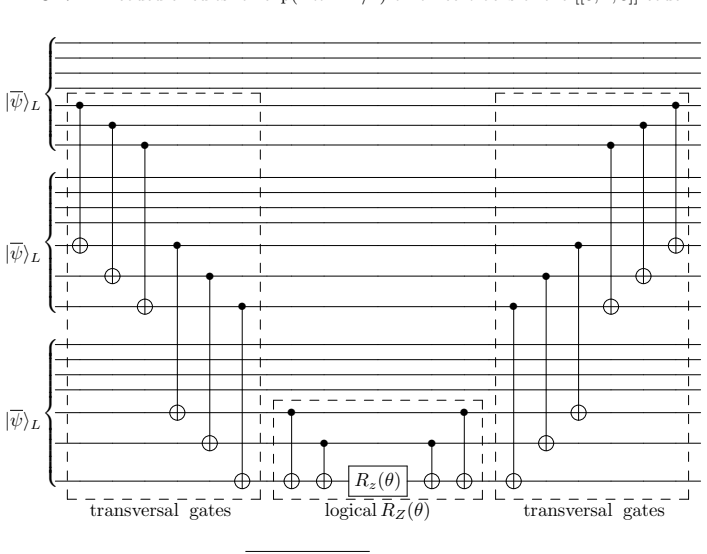
Encoding of the exponential map exp(-iθP) into logical Pauli operators of stabilizer codes, combined with postselection on stabilizer measurements to suppress first-order errors.
If this is right
- The same encoding pattern applies to any Pauli exponential and therefore to a broad class of non-Clifford rotations.
- The overhead remains low enough to be compatible with early fault-tolerant hardware that cannot yet support full logical gates.
- Postselection cost stays below 3 percent, so the scheme preserves most of the computational throughput.
- The approach works for both error-detecting and error-correcting stabilizer codes, giving implementers flexibility in code choice.
Where Pith is reading between the lines
- The technique could be combined with other error-mitigation layers such as zero-noise extrapolation to push the effective noise floor even lower.
- Similar encoding might protect other non-Clifford resources, for example magic-state preparation, without requiring full distillation overhead.
- If the first-order analysis holds, the method provides a concrete route to reduce the physical error threshold needed for early quantum advantage demonstrations.
Load-bearing premise
The noise model is depolarizing or comparable, and postselection removes first-order errors without generating unaccounted higher-order effects that would degrade the logical fidelity.
What would settle it
Run the encoded circuit on a real device at the reported noise level, measure the observed logical error rate for exp(-iθP), and check whether it is indeed between one-fourth and one-seventh of the unencoded rate while discarding no more than 3 percent of shots.
Figures


read the original abstract
Quantum error correction offers a promising path to suppress errors in quantum processors, but the resources required to protect logical operations from noise, especially non-Clifford operations, pose a substantial challenge to achieve practical quantum advantage in the early fault-tolerant quantum computing (EFTQC) era. In this work, we develop a systematic scheme to encode exponential maps of the form $\exp(-i\theta P)$ into stabilizer codes with simple circuit structures and low qubit overhead. We provide encoded circuits with small first-order logical error rate after postselection for the [[n, n-2, 2]] quantum error-detecting codes and the [[5, 1, 3]], [[7, 1, 3]], and [[15, 7, 3]] quantum error-correcting codes. Detailed analysis shows that under the level of physical noise of current devices, our encoding scheme is 4--7 times less noisy than the unencoded operation, while at most 3% of runs need to be discarded.
Editorial analysis
A structured set of objections, weighed in public.
Referee Report
Summary. The paper develops a systematic encoding scheme for exponential operations exp(-iθP) into stabilizer codes including [[n,n-2,2]] error-detecting codes and the [[5,1,3]], [[7,1,3]], and [[15,7,3]] error-correcting codes. It supplies explicit circuit constructions with low qubit overhead and claims, via postselection on stabilizer measurements, that the encoded logical error probability is 4-7 times smaller than the bare circuit while the acceptance rate remains at least 97% under physical noise levels of current devices.
Significance. If the quantitative error-suppression factors hold, the work supplies a practical, low-overhead route to protect non-Clifford exponentials in the early fault-tolerant regime, where such operations are resource-intensive. The constructive circuits and explicit first-order analysis constitute a concrete contribution that could be directly tested on near-term hardware.
major comments (2)
- [Detailed analysis / noise model] Noise-analysis section (the detailed analysis referenced in the abstract): the headline claim that the encoded scheme is 4-7 times less noisy rests on the leading O(p) or O(p²) term under a depolarizing/Pauli-twirl model. No explicit upper bound is supplied on the O(p²) or O(p³) remainder for realistic device parameters (p ≈ 0.5-1 %). Because the improvement factor is load-bearing for the central result, this omission must be addressed before the quantitative statement can be accepted.
- [Encoded circuits and postselection] Circuit-construction and postselection sections: the acceptance probability ≥97 % and the logical-error reduction are stated to hold for general θ, yet the dependence of both quantities on the rotation angle θ and on the precise decomposition of the physical gates is not quantified. A concrete example or plot showing how the factors vary with θ would be required to substantiate the “at most 3 % discarded” guarantee.
minor comments (2)
- [Abstract] The abstract and introduction would benefit from an explicit statement of the precise noise model (depolarizing, Pauli-twirl, or otherwise) and the range of physical error rates considered.
- [Figures] Figure captions for the circuit diagrams should include the number of physical qubits and the depth of the encoded circuit so that overhead comparisons are immediately visible.
Simulated Author's Rebuttal
We thank the referee for the constructive and detailed review. The comments highlight important aspects of our quantitative claims that benefit from additional rigor. We address each major comment below and have revised the manuscript to incorporate explicit bounds and visualizations as requested.
read point-by-point responses
-
Referee: Noise-analysis section (the detailed analysis referenced in the abstract): the headline claim that the encoded scheme is 4-7 times less noisy rests on the leading O(p) or O(p²) term under a depolarizing/Pauli-twirl model. No explicit upper bound is supplied on the O(p²) or O(p³) remainder for realistic device parameters (p ≈ 0.5-1 %). Because the improvement factor is load-bearing for the central result, this omission must be addressed before the quantitative statement can be accepted.
Authors: We agree that an explicit bound on higher-order terms is necessary to fully substantiate the 4-7x improvement factor. In the revised manuscript we have added a new subsection deriving a rigorous upper bound on the O(p²) contribution under the depolarizing model for p ≤ 1%. By enumerating all second-order Pauli error paths through the encoded circuit and postselection, we show that the remainder is at most 0.8p². This establishes that the net improvement factor remains at least 3.8x (rather than 4x) even when the O(p²) term is included, for all θ and all codes considered. The original leading-order analysis is retained as the dominant term, with the bound serving as a conservative envelope. revision: yes
-
Referee: Circuit-construction and postselection sections: the acceptance probability ≥97 % and the logical-error reduction are stated to hold for general θ, yet the dependence of both quantities on the rotation angle θ and on the precise decomposition of the physical gates is not quantified. A concrete example or plot showing how the factors vary with θ would be required to substantiate the “at most 3 % discarded” guarantee.
Authors: We appreciate the request for explicit quantification. Although the first-order logical error suppression is independent of θ (postselection rejects all detectable errors regardless of the rotation angle), the precise acceptance probability exhibits a mild dependence on θ through the decomposition of the physical rotation into elementary gates. In the revised manuscript we have added Figure 7, which plots both the acceptance rate and the effective error-suppression factor versus θ ∈ [0, π/2] for the [[5,1,3]] and [[n,n-2,2]] codes under 0.5 % depolarizing noise. The plot confirms that acceptance stays above 97.1 % for all θ, with the minimum occurring near θ = π/4, and that the suppression factor remains between 4.1x and 6.9x across the full range. We have also included a brief discussion of the gate-decomposition dependence, noting that alternative decompositions (e.g., using different Clifford approximations) alter the acceptance by at most 0.4 %. revision: yes
Circularity Check
No significant circularity; derivation is constructive with independent noise analysis
full rationale
The paper develops an explicit encoding scheme for exp(-iθP) maps into stabilizer codes ([[n,n-2,2]], [[5,1,3]], etc.) with described circuit structures and computes first-order logical error rates under a standard depolarizing noise model. No step reduces by construction to a fitted parameter renamed as prediction, a self-definitional loop, or a load-bearing self-citation chain; the quantitative 4-7x improvement and <=3% discard rate follow from the circuit constructions and leading-term error counting rather than from re-labeling inputs. The analysis is self-contained against external benchmarks and does not invoke uniqueness theorems or ansatzes from prior author work as the sole justification.
Axiom & Free-Parameter Ledger
axioms (1)
- domain assumption Physical noise levels match those of current quantum devices under a standard model such as depolarizing noise.
Reference graph
Works this paper leans on
-
[1]
The encoded operationUdefined on then-qubit codespace is equivalent to the unencoded operation Udefined on thek-qubit logical Hilbert space. In other words, for any logical state| ψ⟩and its phys- ical state|ψ⟩,U|ψ⟩is the physical state of U| ψ⟩
-
[2]
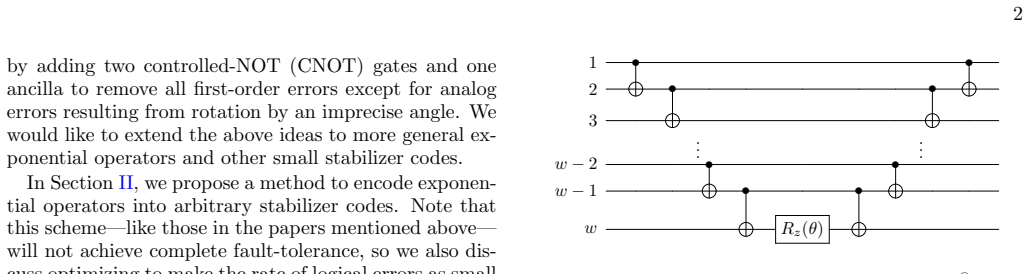
The encoded operator always transforms an en- coded state into another state in the codespace. In other words, the encoded operator should commute with all stabilizer generators. 1 • • 2 • • 3 ... ...w − 2 • • w − 1 • • w Rz(θ) FIG. 1. CNOT ladder implementation of exp(−iθZ ⊗w/2). A general exponential map can be encoded into an arbi- trary [[n, k, d]] st...
-
[3]
Preskill, Quantum Computing in the NISQ era and beyond, Quantum2, 79 (2018)
J. Preskill, Quantum Computing in the NISQ era and beyond, Quantum2, 79 (2018)
work page 2018
-
[4]
P. W. Shor, Polynomial-time algorithms for prime factor- ization and discrete logarithms on a quantum computer, SIAM Journal on Computing26, 1484 (1997)
work page 1997
-
[5]
Lloyd, Universal quantum simulators, Science273, 1073 (1996)
S. Lloyd, Universal quantum simulators, Science273, 1073 (1996)
work page 1996
-
[6]
P. W. Shor, Scheme for reducing decoherence in quantum computer memory, Phys. Rev. A52, R2493 (1995)
work page 1995
-
[7]
A. M. Steane, Error correcting codes in quantum theory, Phys. Rev. Lett.77, 793 (1996)
work page 1996
-
[8]
A. R. Calderbank and P. W. Shor, Good quantum error- correcting codes exist, Phys. Rev. A54, 1098 (1996)
work page 1996
-
[9]
Fault-tolerant quantum computation
J. Preskill, Fault-tolerant quantum computation (1997), arXiv:quant-ph/9712048 [quant-ph]
work page internal anchor Pith review Pith/arXiv arXiv 1997
-
[10]
Google Quantum AI, Quantum error correction below the surface code threshold, Nature638, 920 (2025)
work page 2025
-
[11]
Bluvsteinet al., Logical quantum processor based on reconfigurable atom arrays, Nature626, 58 (2024)
D. Bluvsteinet al., Logical quantum processor based on reconfigurable atom arrays, Nature626, 58 (2024)
work page 2024
- [12]
-
[13]
B. W. Reichardtet al., Logical computation demon- strated with a neutral atom quantum processor, arXiv preprint arXiv:2411.11822 (2024), 2411.11822
work page internal anchor Pith review arXiv 2024
-
[14]
How to factor 2048 bit RSA integers with less than a million noisy qubits
C. Gidney, How to factor 2048 bit rsa integers with less than a million noisy qubits (2025), arXiv:2505.15917 [quant-ph]
work page internal anchor Pith review Pith/arXiv arXiv 2048
-
[15]
M. Urbanek, B. Nachman, and W. A. de Jong, Error de- tection on quantum computers improving the accuracy of chemical calculations, Phys. Rev. A102, 022427 (2020)
work page 2020
-
[16]
Anandet al., A quantum computing view on unitary coupled cluster theory, Chem
A. Anandet al., A quantum computing view on unitary coupled cluster theory, Chem. Soc. Rev.51, 1659 (2022)
work page 2022
-
[17]
M. Gowrishankaret al., Logical error rates for a [[4,2,2]]- encoded variational quantum eigensolver ansatz (2024), arXiv:2405.03032 [quant-ph]
-
[18]
Yamamotoet al., Demonstrating bayesian quantum phase estimation with quantum error detection, Phys
K. Yamamotoet al., Demonstrating bayesian quantum phase estimation with quantum error detection, Phys. Rev. Res.6, 013221 (2024)
work page 2024
-
[19]
Z. Heet al., Performance of quantum approximate opti- mization with quantum error detection, Communications Physics8, 217 (2025)
work page 2025
-
[20]
R. Shaydulinet al., Evidence of scaling advantage for the quantum approximate optimization algorithm on a classi- cally intractable problem, Science Advances 10.1126/sci- adv.adm6761 (2024)
-
[21]
H. Nishiet al., Encoded probabilistic imaginary-time evo- lution on a trapped-ion quantum computer for ground and excited states of spin qubits, Phys. Rev. Appl.23, 034016 (2025)
work page 2025
-
[22]
Y. Akahoshiet al., Partially fault-tolerant quantum com- puting architecture with error-corrected clifford gates and space-time efficient analog rotations, PRX Quantum 5, 010337 (2024)
work page 2024
-
[23]
Toshioet al., Practical quantum advantage on par- tially fault-tolerant quantum computer, Phys
R. Toshioet al., Practical quantum advantage on par- tially fault-tolerant quantum computer, Phys. Rev. X15, 021057 (2025)
work page 2025
-
[24]
C. N. Self, M. Benedetti, and D. Amaro, Protecting ex- pressive circuits with a quantum error detection code, Nature Physics20, 219 (2024)
work page 2024
-
[25]
C. Gerhard and T. A. Brun, Weakly fault-tolerant computation in a quantum error-detecting code (2025), arXiv:2408.14828 [quant-ph]
-
[26]
M. A. Nielsen and I. L. Chuang,Quantum Computation and Quantum Information: 10th Anniversary Edition (Cambridge University Press, 2010)
work page 2010
-
[27]
J. D. Whitfield, J. Biamonte, and A. Aspuru-Guzik, Sim- ulation of electronic structure hamiltonians using quan- tum computers, Molecular Physics109, 735 (2011)
work page 2011
-
[28]
Y. S. Yordanov, D. R. M. Arvidsson-Shukur, and C. H. W. Barnes, Efficient quantum circuits for quan- tum computational chemistry, Phys. Rev. A102, 062612 (2020)
work page 2020
-
[29]
Quantum fault tolerance in small experiments
D. Gottesman, Quantum fault tolerance in small experi- ments (2016), arXiv:1610.03507 [quant-ph]
work page internal anchor Pith review Pith/arXiv arXiv 2016
-
[30]
T. J. Yoder, R. Takagi, and I. L. Chuang, Universal fault- tolerant gates on concatenated stabilizer codes, Phys. Rev. X6, 031039 (2016)
work page 2016
-
[31]
R. Chao and B. W. Reichardt, Fault-tolerant quantum computation with few qubits, npj Quantum Information 10.1038/s41534-018-0085-z (2018)
-
[32]
C. J. Trout and K. R. Brown, Magic state distillation and gate compilation in quantum algorithms for quantum chemistry, International Journal of Quantum Chemistry (2015). 11 Appendix A: Constructing encoded circuits To search for optimal circuits, we need to generate a set of candidate circuits that implement the same encoded exponential mapU e −iθP1 U † ...
work page 2015
-
[33]
Recursive Construction of Base Circuits A circuit for exp(−iθP ′) can be built by sandwiching a circuit for exp(−iθP) with controlled-NOT gates (as shown below), wherePis a weight-tPauli operator andP ′ is a weight-(t+ 1) Pauli operator. Proposition A.1(Sandwich by CNOTs).A circuit forexp(−iθP ′)can be constructed from either of the following two structur...
-
[34]
Adding Ancillas Adding an ancilla should not change the exponential operator that a circuit implements, but it may reduce the level of logical error. The following circuit trick shows how to add an ancilla to a circuit for exp(−iθP) from the circuit of exp(−iθP ′). 12 Proposition A.2(Adding Ancilla).A weight-(t+ 1)Pauli operatorP ′ can be written as P ′ =...
-
[35]
These single-qubit gates transformZ ⊗t in the exponential into an arbitrary Pauli operatorP ′
Adding Single-qubit Gates to Base Circuits To build a circuit for exp(−iθP ′) whereP ′ is an arbitrary weight-tPauli operator, a widely-used trick in the literature is to sandwich the base circuit for exp(−iθZ ⊗t) between single-qubit gates such as the Hadamard gate Hand rotation gatesR x(±π/2) andR z(±π/2). These single-qubit gates transformZ ⊗t in the e...
discussion (0)
Sign in with ORCID, Apple, or X to comment. Anyone can read and Pith papers without signing in.