Recognition: 2 theorem links
· Lean TheoremUniversal Quantum Gate Set from Multiple-Braiding Sequences in SU(2)_k (k>2, kneq 4) Anyon Models
Pith reviewed 2026-05-15 22:10 UTC · model grok-4.3
The pith
Multiple-braiding sequences implement a universal quantum gate set in SU(2)_k anyon models for most cases
A machine-rendered reading of the paper's core claim, the machinery that carries it, and where it could break.
Core claim
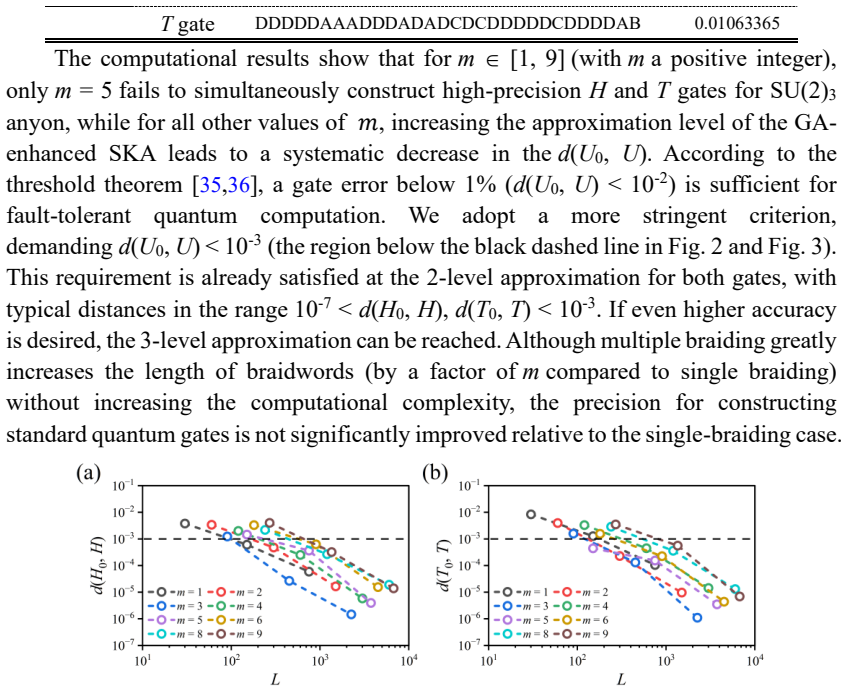
The authors derive multiple elementary braiding matrices from the q-deformed representation theory of SU(2) and demonstrate numerically that finite products of these matrices for multiplicities one to nine approximate the universal gate set consisting of the Hadamard gate, the T gate, and the CNOT gate in the SU(2)_3 and SU(2)_5 models. All but one of the nine cases succeed; high-precision H and T gates are obtained via a genetic-algorithm-enhanced Solovay-Kitaev procedure, while expanding the operation count to thirty permits direct approximation of a locally equivalent CNOT. Even-order braiding sequences reduce the number of non-Abelian anyons needed.
What carries the argument
Multiple elementary braiding matrices derived from q-deformed SU(2) representation theory, which serve as generators whose finite products are optimized to approximate target gates.
If this is right
- Universal quantum computation follows from the existence of approximating sequences in eight of the nine examined cases.
- Even-order braiding sequences achieve the same universality while requiring fewer non-Abelian anyons.
- High-precision single-qubit gates are reachable by combining the matrices with standard approximation algorithms.
- Direct approximation of two-qubit gates becomes possible once the allowed sequence length is extended modestly.
- Braiding-based topological quantum computation gains a practical implementation path in these models.
Where Pith is reading between the lines
- The same multiple-braiding construction may extend to other anyon models whose braiding matrices are known from representation theory.
- Physical implementations could test the claim by preparing the required number of anyons and measuring the effective gate fidelity after each sequence.
- If the numerical precision carries over to hardware, error rates in topological qubits might be lowered by the reduced anyon count of even-order braids.
- Further search over higher multiplicities or different optimization targets could yield shorter sequences for the same gates.
Load-bearing premise
The derived q-deformed braiding matrices accurately correspond to the physical anyon braiding operations that can be performed in a laboratory.
What would settle it
An explicit calculation for one of the successful multiplicities showing that the closure of the generated group lies at a finite distance from the target universal gate set and cannot reach arbitrary precision.
Figures

read the original abstract
We study the implementation of a universal quantum gate set via multiple-braiding within $SU(2)_k$ ($k > 2$, $k \neq 4$) anyon models. The multiple elementary braiding matrices (MEBMs) are derived from the $q$-deformed representation theory of $SU(2)$. Braiding multiplicities from one to nine are examined as building blocks for $\{H, T, \text{CNOT}\}$ in $SU(2)_3$ and $SU(2)_5$. Only one case fails to support universality; high-precision $H$ and $T$ gates can be achieved by a Genetic Algorithm enhanced Solovay--Kitaev Algorithm, and expanding operations to 30 enables direct approximation of a locally equivalent CNOT for the remaining eight. Notably, even-order braiding operations offer a physical advantage by reducing the number of non-Abelian anyons required in braiding-based topological quantum computing (TQC). Our numerical results provide strong evidence that most multiple-braiding sequences in $SU(2)_k$ ($k > 2$, $k \neq 4$) anyon models are capable of universal quantum computation.
Editorial analysis
A structured set of objections, weighed in public.
Referee Report
Summary. The paper claims that multiple elementary braiding matrices (MEBMs) derived from q-deformed SU(2) representation theory in SU(2)_k (k>2, k≠4) anyon models can implement a universal gate set {H, T, CNOT} for most examined cases. Using a genetic algorithm enhanced Solovay-Kitaev method, high-precision approximations to H and T are obtained for multiplicities 1-9 in SU(2)_3 and SU(2)_5 (only one failure), and up to 30 operations suffice for a locally equivalent CNOT in the remaining eight cases; the work also notes a physical advantage in reducing the number of non-Abelian anyons required.
Significance. If the numerical approximations meet fault-tolerance thresholds and the generated subgroups are dense, the result would be significant for braiding-based topological quantum computation by showing that multiple-braiding sequences enable universality with fewer physical resources than single-braiding approaches.
major comments (2)
- [Abstract and Numerical Results] Abstract and numerical results section: the claim of 'high-precision' H and T approximations via the genetic-enhanced SKA reports no operator-norm distances, diamond-norm errors, or explicit convergence criteria for the eight successful cases, leaving the support for arbitrary-precision universality heuristic rather than quantitative.
- [Discussion] Universality discussion: no analytic argument or explicit check is supplied that the subgroup generated by the MEBMs is dense in SU(2) or U(4), which is required for the Solovay-Kitaev theorem to guarantee that finite sequences can achieve arbitrary precision beyond the specific numerical searches performed.
minor comments (2)
- [Methods] Provide the explicit matrix representations of the MEBMs for at least one multiplicity to allow independent verification of the q-deformed derivation.
- [Results] Clarify the precise definition and target matrix used for the 'locally equivalent CNOT' in the 30-operation approximations.
Simulated Author's Rebuttal
We thank the referee for the careful review and constructive comments on our manuscript. We address each major comment point by point below, indicating where revisions will be made.
read point-by-point responses
-
Referee: [Abstract and Numerical Results] Abstract and numerical results section: the claim of 'high-precision' H and T approximations via the genetic-enhanced SKA reports no operator-norm distances, diamond-norm errors, or explicit convergence criteria for the eight successful cases, leaving the support for arbitrary-precision universality heuristic rather than quantitative.
Authors: We agree that the presentation would benefit from explicit quantitative metrics. In the revised manuscript, we will add tables in the numerical results section reporting the operator-norm distances and diamond-norm errors achieved for the H and T approximations in the eight successful cases, along with the precise convergence criteria, population sizes, and precision thresholds employed in the genetic algorithm enhanced Solovay-Kitaev algorithm. This will render the claims quantitative. revision: yes
-
Referee: [Discussion] Universality discussion: no analytic argument or explicit check is supplied that the subgroup generated by the MEBMs is dense in SU(2) or U(4), which is required for the Solovay-Kitaev theorem to guarantee that finite sequences can achieve arbitrary precision beyond the specific numerical searches performed.
Authors: We acknowledge that a rigorous analytic demonstration of density would allow direct invocation of the Solovay-Kitaev theorem without qualification. However, establishing density analytically for the subgroups generated by these specific MEBMs requires advanced results from quantum group representation theory that lie outside the scope of this primarily numerical study. Our genetic-algorithm searches demonstrate that high-precision approximations are attainable in practice, which is consistent with (but does not prove) density. We will revise the discussion to explicitly state this limitation and clarify that universality is supported by the numerical evidence for the examined models and multiplicities. revision: partial
- Analytic proof that the subgroups generated by the MEBMs are dense in SU(2) or U(4)
Circularity Check
No circularity: derivation from q-deformed representation theory plus independent numerical search is self-contained
full rationale
The paper derives MEBMs explicitly from standard q-deformed SU(2) representation theory (external to the paper) and then performs separate numerical optimization via a Genetic Algorithm enhanced Solovay-Kitaev procedure to locate approximating sequences for H, T, and CNOT. No equation reduces a claimed prediction to a fitted parameter by construction, no load-bearing premise rests on a self-citation chain, and no ansatz is smuggled in; the numerical results are offered as computational evidence rather than tautological outputs. The derivation chain therefore remains independent of the target universality claim.
Axiom & Free-Parameter Ledger
axioms (1)
- domain assumption The q-deformed representation theory of SU(2) yields the correct elementary braiding matrices for the anyon models under study.
Lean theorems connected to this paper
-
IndisputableMonolith/Cost/FunctionalEquation.leanwashburn_uniqueness_aczel unclear?
unclearRelation between the paper passage and the cited Recognition theorem.
We employ the GA-enhanced SKA to compile standard H and T gates using both MEBMs (m = 1,2,3,4,6,7,8,9) ... only m=5 fails ... d(U0,U)<10^{-3}
-
IndisputableMonolith/Foundation/AlexanderDuality.leanalexander_duality_circle_linking unclear?
unclearRelation between the paper passage and the cited Recognition theorem.
double-braiding within SU(2)_k (k>2,k≠4) anyon models is dense in SU(2)
What do these tags mean?
- matches
- The paper's claim is directly supported by a theorem in the formal canon.
- supports
- The theorem supports part of the paper's argument, but the paper may add assumptions or extra steps.
- extends
- The paper goes beyond the formal theorem; the theorem is a base layer rather than the whole result.
- uses
- The paper appears to rely on the theorem as machinery.
- contradicts
- The paper's claim conflicts with a theorem or certificate in the canon.
- unclear
- Pith found a possible connection, but the passage is too broad, indirect, or ambiguous to say the theorem truly supports the claim.
Forward citations
Cited by 1 Pith paper
-
Entangling gates for the SU(N) anyons
The paper outlines the generalization of cabling-based entangling gates to SU(N) anyons and identifies differences and new problems that arise.
Reference graph
Works this paper leans on
-
[1]
Quantum computational supremacy, Nature 549 (2017) 203, https://doi.org/10.1038/nature23458
Harrow A W and Montanaro A. Quantum computational supremacy, Nature 549 (2017) 203, https://doi.org/10.1038/nature23458
-
[2]
Nayak C, Simon S H, Stern A, Freedman M, and Das Sarma S. Non -Abelian anyons and topological quantum computation, Reviews of Modern Physics 80 (2008) 1083, https://doi.org/10.1103/RevModPhys.80.1083
-
[3]
Kitaev A Y . Fault-tolerant quantum computation by anyons, Annals of Physics 303 (2003) 2, https://doi.org/10.1016/S0003-4916(02)00018-0
work page internal anchor Pith review doi:10.1016/s0003-4916(02)00018-0 2003
-
[4]
Wang D, Kong L, Fan P, Chen H, Zhu S, Liu W, Cao L, Sun Y , Du S, and Schneeloch J. Evidence for Majorana bound states in an iron -based superconductor, Science 362 (2018) 333, https://doi.org/10.1126/science.aao1797
-
[5]
Kasahara Y , Ohnishi T, Mizukami Y , Tanaka O, Ma S, Sugii K, Kurita N, Tanaka H, Nasu J, and Motome Y . Majorana quantization and half-integer thermal quantum Hall effect in a Kitaev spin liquid, Nature 559 (2018) 227, https://doi.org/10.1038/s41586- 018-0274-0
-
[6]
Witten E. Quantum field theory and the Jones polynomial, Communications in Mathematical Physics 121 (1989) 351, https://doi.org/10.1007/BF01217730
-
[7]
Freedman M H, Larsen M J, and Wang Z. The Two -Eigenvalue Problem and Density¶of Jones Representation of Braid Groups, Communications in Mathematical Physics 228 (2002) 177, https://doi.org/10.1007/s002200200636
-
[8]
Long J, Li Y , Zhong J, and Meng L. The construction of a universal quantum gate set for the SU(2)k (k=5,6,7) anyon models via genetic optimized algorithm, Physics Letters A 565 (2026) 131142, https://doi.org/10.1016/j.physleta.2025.131142
-
[9]
Fan Z and de Garis H. Braid matrices and quantum gates for Ising anyons topological quantum computation, The European Physical Journal B 74 (2010) 419, https://doi.org/10.1140/epjb/e2010-00087-4
-
[10]
Cui S X and Wang Z. Universal quantum computation with metaplectic anyons, Journal of Mathematical Physics 56 (2015), https://doi.org/10.1063/1.4914941
-
[11]
Zhang S -Q, Hong J -S, Xue Y , Luo X-J, Yu L-W, Liu X -J, and Liu X. Ancilla -free scheme of deterministic topological quantum gates for Majorana qubits, Physical 14 / 15 Review B 109 (2024) 165302, https://doi.org/10.1103/PhysRevB.109.165302
-
[12]
Zhan Y-M, Mao G-D, Chen Y-G, Yu Y , and Luo X. Dissipationless topological quantum computation for Majorana objects in the sparse -dense mixed encoding process, Physical Review A 110 (2024) 022609, https://doi.org/10.1103/PhysRevA.110.022609
-
[13]
Ezawa M. Systematic construction of topological -nontopological hybrid universal quantum gates based on many -body Majorana fermion interactions, Physical Review B 110 (2024) 045417, https://doi.org/10.1103/PhysRevB.110.045417
-
[14]
Levaillant C, Bauer B, Freedman M, Wang Z, and Bonderson P. Universal gates via fusion and measurement operations on SU (2) 4 anyons, Physical Review A 92 (2015) 012301, https://doi.org/10.1103/PhysRevA.92.012301
-
[15]
Ilyas M, Cui S, and Perkowski M. Ternary logic design in topological quantum computing, Journal of Physics A: Mathematical and Theoretical 55 (2022) 305302, https://doi.org/10.1088/1751-8121/ac7b55
-
[16]
Hormozi L, Zikos G, Bonesteel N E, and Simon S H. Topological quantum compiling, Physical Review B 75 (2007) 165310, https://doi.org/10.1103/PhysRevB.75.165310
-
[17]
Dawson C M and Nielsen M A. The Solovay-Kitaev algorithm, Quantum Information & Computation 6 (2006) 81, https://dl.acm.org/doi/abs/10.5555/2011679.2011685
-
[18]
Kliuchnikov V , Bocharov A, and Svore K M. Asymptotically Optimal Topological Quantum Compiling, Physical Review Letters 112 (2014) 140504, https://doi.org/10.1103/PhysRevLett.112.140504
-
[19]
Génetay Johansen E and Simula T J P Q. Fibonacci anyons versus Majorana fermions: A Monte Carlo approach to the compilation of braid circuits in SU (2) k anyon models, PRX Quantum 2 (2021) 010334, https://doi.org/10.1103/PRXQuantum.2.010334
-
[20]
Long J, Huang X, Zhong J, and Meng L. Genetic algorithm enhanced Solovay-Kitaev algorithm for quantum compiling of Fibonacci anyons, Physica Scripta (2025), https://doi.org/10.1088/1402-4896/ae1d30
-
[21]
Zhang Y-H, Zheng P-L, Zhang Y , and Deng D-L. Topological quantum compiling with reinforcement learning, Physical Review Letters 125 (2020) 170501, https://doi.org/10.1103/PhysRevLett.125.170501
-
[22]
Topological quantum computation, Physics today 59 (2006) 32, https://doi.org/10.1063/1.2337825
Das Sarma S, Freedman M, and Nayak C. Topological quantum computation, Physics today 59 (2006) 32, https://doi.org/10.1063/1.2337825
-
[23]
Burke P C, Aravanis C, Aspman J, Mareček J, and Vala J. Topological quantum compilation of two -qubit gates, Physical Review A 110 (2024) 052616, https://doi.org/10.1103/PhysRevA.110.052616
-
[24]
Mironov S and Morozov A. Entangling gates from cabling of knots, The European Physical Journal C 85 (2025) 799, https://doi.org/10.1140/epjc/s10052-025-14492-4
-
[25]
Tounsi A, Belaloui N E, Louamri M M, Benslama A, and Rouabah M T. Optimized topological quantum compilation of three-qubit controlled gates in the Fibonacci anyon model: A controlled -injection approach, Physical Review A 110 (2024) 012603, https://doi.org/10.1103/PhysRevA.110.012603
-
[26]
Xu H and Taylor J. Unified approach to topological quantum computation with anyons: From qubit encoding to Toffoli gate, Physical Review A 84 (2011) 012332, https://doi.org/10.1103/PhysRevA.84.012332 15 / 15
-
[27]
Kaufmann A L and Cui S X. Universal topological quantum computing via double - braiding in SU(2) Witten–Chern–Simons theory, Quantum Information Processing 24 (2025) 14, https://doi.org/10.1007/s11128-024-04633-1
-
[28]
Simon S H, Bonesteel N E, Freedman M H, Petrovic N, and Hormozi L. Topological Quantum Computing with Only One Mobile Quasiparticle, Physical Review Letters 96 (2006) 070503, https://doi.org/10.1103/PhysRevLett.96.070503
-
[29]
Kazhdan D and Lusztig G. Affine Lie algebras and quantum groups, International Mathematics Research Notices 1991 (1991) 21, https://doi.org/10.1155/S1073792891000041
-
[30]
Slingerland R A a J K. Topological qubit design and leakage, New Journal of Physics 13 (2011), https://doi.org/10.1088/1367-2630/13/6/065030
-
[31]
Cui S X, Tian K T, V asquez J F, Wang Z, and Wong H M. The search for leakage-free entangling Fibonacci braiding gates, Journal of Physics A: Mathematical and Theoretical 52 (2019) 455301, https://doi.org/10.1088/1751-8121/ab488e
-
[32]
Wang Z, Topological Quantum Computation (American Mathematical Society, 2010), V ol. 112
work page 2010
-
[33]
Long J, Zhong J, and Meng L. Topological quantum compilation of metaplectic anyons based on the genetic optimized algorithms, Physical Review A 112 (2025) 022421, https://doi.org/10.1103/js85-r2m7
-
[34]
Field B and Simula T. Introduction to topological quantum computation with non - Abelian anyons, Quantum Science and Technology 3 (2018) 045004, https://doi.org/10.1088/2058-9565/aacad2
-
[35]
Fowler A G, Stephens A M, and Groszkowski P. High -threshold universal quantum computation on the surface code, Physical Review A 80 (2009) 052312, https://doi.org/10.1103/PhysRevA.80.052312
-
[36]
Fowler A G, Mariantoni M, Martinis J M, and Cleland A N. Surface codes: Towards practical large -scale quantum computation, Physical Review A 86 (2012) 032324, https://doi.org/10.1103/PhysRevA.86.032324
discussion (0)
Sign in with ORCID, Apple, or X to comment. Anyone can read and Pith papers without signing in.