Recognition: 2 theorem links
· Lean TheoremNovel Constraints on Spin-Dependent Light Dark Matter Scattering
Pith reviewed 2026-05-15 21:24 UTC · model grok-4.3
The pith
SNO data excludes spin-dependent dark matter-nucleon cross sections above 10^{-33} cm² for masses below 1.5 MeV.
A machine-rendered reading of the paper's core claim, the machinery that carries it, and where it could break.
Core claim
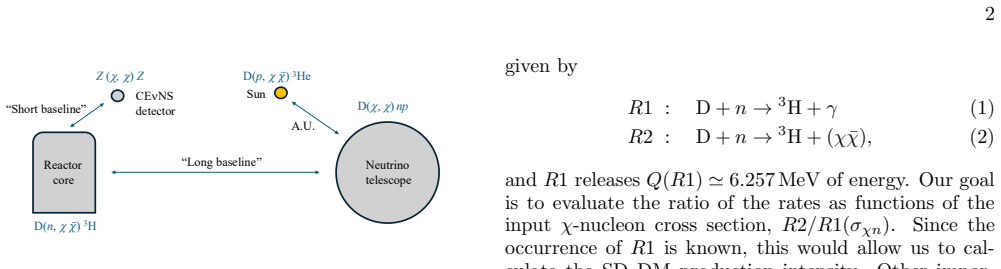
Pair production of MeV-scale dark matter via the D(n, χ χ-bar)^3He reaction occurs inside CANDU reactors; a fraction of the produced particles exceed the threshold for deuteron disintegration D(χ, χ)np inside SNO, adding to the neutral-current rate. Comparing the expected addition to the measured SNO rate yields an upper bound σ_χp ≲ 10^{-33} cm² for m_χ ≤ 1.5 MeV. An analogous process in the Sun gives a weaker bound around 10^{-37} cm² in the kinematically allowed region, while small near detectors at reactors yield only subdominant sensitivity via coherent nuclear recoil.
What carries the argument
The D(n, χ χ-bar)^3He reaction, which produces dark-matter pairs with sufficient energy to trigger deuteron breakup at SNO and thereby augment the neutral-current deuteron-disintegration signal.
If this is right
- Cross sections larger than ~10^{-33} cm² are ruled out for dark-matter masses up to 1.5 MeV.
- Solar production supplies an independent but weaker constraint near 10^{-37} cm² wherever kinematics allow.
- Small detectors placed near CANDU reactors have lower reach than the SNO-based limit for this interaction channel.
- The method demonstrates that reactor neutrino facilities can serve as production sites for light dark matter searches.
Where Pith is reading between the lines
- Improved modeling of SNO backgrounds could tighten the bound without new hardware.
- The same production channel could be studied at other heavy-water reactors or with future neutrino detectors.
- Light dark matter searches may benefit from combining reactor flux calculations with underground neutral-current measurements.
- If the bound is robust, it motivates dedicated calculations of reactor dark-matter spectra for other detector technologies.
Load-bearing premise
That the dominant source of any extra deuteron-disintegration events at SNO is dark matter produced in the D(n, χ χ-bar)^3He channel and that backgrounds and detector efficiencies are modeled correctly.
What would settle it
A re-analysis of SNO neutral-current data that finds the observed rate fully consistent with solar neutrinos alone, with no room for an additional contribution at the level predicted for cross sections near 10^{-33} cm².
Figures


read the original abstract
We explore the sensitivity of the SNO experiment to light dark matter particles $\chi$ with spin-dependent interactions with nucleons. We show that the pair-production of MeV scale dark matter is possible in heavy water (CANDU) reactors via ${\rm D}(n,\chi\bar\chi)^3{\rm He}$, and calculate the expected rate within the simplest models of $\chi$-nucleon interactions. %Heavy water nuclear reactors serve as an excellent production method for spin-dependent dark matter. Owing to a sizable $Q$-value for this reaction, a large fraction of DM particles produced this way are above the threshold for deuteron disintegration, ${\rm D}(\chi,\chi)np$, which adds to the SNO neutral current signal. Evaluating the CANDU-to-SNO scheme for the production and detection of DM, we derive novel constraints for the $\chi$-nucleon spin-dependent cross sections, showing that cross sections above $\sigma_{\chi p} \sim 10^{-33}\,{\rm cm}^{2}$ are generally excluded if $m_\chi \leq1.5$\,MeV. An isospin-mirror reaction will occur in the Sun, and for the kinematically allowed region it excludes a portion of parameter space with cross sections on the order $10^{-37}\,{\rm cm}^{2}$. We also evaluate the potential sensitivity of small ``near" detectors placed in close proximity to a CANDU reactor to search for a coherent nuclear recoil, finding subdominant sensitivity.
Editorial analysis
A structured set of objections, weighed in public.
Referee Report
Summary. The manuscript proposes pair production of light spin-dependent dark matter χ in CANDU reactors via the reaction D(n, χχ̄)^3He, followed by χ-induced deuteron breakup D(χ,χ)np that augments the SNO neutral-current signal. From the resulting flux and SNO data it derives an exclusion σ_χp ≳ 10^{-33} cm² for m_χ ≤ 1.5 MeV, with a weaker solar constraint at ~10^{-37} cm² and a subdominant projection for near-reactor coherent-recoil detectors.
Significance. A valid result would furnish novel reactor- and solar-based limits on spin-dependent DM-nucleon scattering in the sub-MeV mass window, complementing existing direct-detection and beam-dump bounds.
major comments (2)
- [Abstract and production section] Abstract and §2 (production mechanism): the reaction D(n, χχ̄)^3He violates charge conservation. The initial state has total charge Z = 1 (deuteron Z = 1 + neutron Z = 0), while the final state has Z = 2 from ^3He with no compensating charged particle or DM charge introduced. This renders the predicted DM flux identically zero, so the headline exclusion cannot be obtained.
- [SNO analysis section] §3 (SNO analysis): the numerical limit σ_χp ∼ 10^{-33} cm² is quoted without explicit background-subtraction procedure, detection efficiency, or error propagation for the added NC deuteron-disintegration events. The claim therefore rests on an incompletely documented subtraction from the published SNO NC rate.
minor comments (2)
- [Notation] Notation for the spin-dependent cross section is introduced as σ_χp but later referenced inconsistently; a single symbol and definition should be used throughout.
- [Solar constraint paragraph] The isospin-mirror solar reaction is mentioned only briefly; a short kinematic or rate comparison table would clarify why its reach is three orders of magnitude weaker.
Simulated Author's Rebuttal
We thank the referee for the careful reading of our manuscript and for identifying the critical issues raised in the report. We address each major comment below.
read point-by-point responses
-
Referee: [Abstract and production section] Abstract and §2 (production mechanism): the reaction D(n, χχ̄)^3He violates charge conservation. The initial state has total charge Z = 1 (deuteron Z = 1 + neutron Z = 0), while the final state has Z = 2 from ^3He with no compensating charged particle or DM charge introduced. This renders the predicted DM flux identically zero, so the headline exclusion cannot be obtained.
Authors: We agree that the reaction D(n, χχ̄)^3He as written violates charge conservation: the initial state (deuteron + neutron) has total electric charge +1 while the final state (^3He + χχ̄) has charge +2 assuming neutral DM. This was an error in the proposed production mechanism, which invalidates the predicted DM flux and the associated exclusion limits derived from the CANDU-to-SNO channel. We will revise the manuscript to remove all references to this reaction, the resulting DM flux calculation, and the headline constraint σ_χp ≳ 10^{-33} cm². We are examining whether any alternative, charge-conserving production channels exist for light spin-dependent DM in reactors, but no such mechanism is currently identified in the work. revision: yes
-
Referee: [SNO analysis section] §3 (SNO analysis): the numerical limit σ_χp ∼ 10^{-33} cm² is quoted without explicit background-subtraction procedure, detection efficiency, or error propagation for the added NC deuteron-disintegration events. The claim therefore rests on an incompletely documented subtraction from the published SNO NC rate.
Authors: We acknowledge that §3 lacked sufficient detail on the background subtraction, detection efficiency, and error propagation for the additional neutral-current events. In the revised manuscript we will expand this section to explicitly describe the procedure for subtracting the standard SNO NC rate, the efficiency for detecting the DM-induced deuteron breakup events, and the full propagation of statistical and systematic uncertainties into the quoted cross-section limit. revision: yes
Circularity Check
No significant circularity: constraints derived from external data and standard rates
full rationale
The paper's derivation chain calculates DM production via the stated reactor reaction and subsequent detection in SNO using standard nuclear reaction rates, external CANDU flux estimates, and SNO neutral-current data. No equation or result reduces by construction to a fitted parameter from the same dataset, a self-referential definition, or a load-bearing self-citation chain. The excluded cross-section value is obtained by comparing predicted signal addition against external benchmarks rather than internal fitting, rendering the central claim independent of its own inputs.
Axiom & Free-Parameter Ledger
axioms (2)
- standard math Standard nuclear reaction rates and Q-values for D(n,3He) and related channels
- domain assumption Spin-dependent χ-nucleon interaction operator in the simplest models
invented entities (1)
-
light dark matter particle χ
no independent evidence
Lean theorems connected to this paper
-
IndisputableMonolith/Cost/FunctionalEquation.leanwashburn_uniqueness_aczel unclear?
unclearRelation between the paper passage and the cited Recognition theorem.
We parameterize DM-nucleon interaction via contact operators... H_χN = 4 A_N (S_χ · S_N) δ³(r_χ - r_N)
-
IndisputableMonolith/Foundation/AbsoluteFloorClosure.leanabsolute_floor_iff_bare_distinguishability unclear?
unclearRelation between the paper passage and the cited Recognition theorem.
dBr_χχ̄ / dE_χ = 8×10^{-4} × (σ_χp / 10^{-32} cm²) × (1 MeV / m_χ)² dF(E_χ)/dE_χ
What do these tags mean?
- matches
- The paper's claim is directly supported by a theorem in the formal canon.
- supports
- The theorem supports part of the paper's argument, but the paper may add assumptions or extra steps.
- extends
- The paper goes beyond the formal theorem; the theorem is a base layer rather than the whole result.
- uses
- The paper appears to rely on the theorem as machinery.
- contradicts
- The paper's claim conflicts with a theorem or certificate in the canon.
- unclear
- Pith found a possible connection, but the passage is too broad, indirect, or ambiguous to say the theorem truly supports the claim.
Reference graph
Works this paper leans on
-
[1]
Forℓ col,r=0 = 3×10 −3R⊙, the probability for fewer than 80 collision drops below 10 −3. Therefore,ℓ col,r=0 = 5×10 −3R⊙ reasonably determines the minimum colli- sion length and the maximum cross section that can be probed, which we conservatively evaluate at the highest energy point,Q−m χ, whereQ=Q(R4) = 5.49 MeV. Taking the number density of protons in ...
-
[2]
G. Bertone, D. Hooper, and J. Silk, Particle dark mat- ter: evidence, candidates and constraints, Physics Re- ports405, 279 (2005)
work page 2005
-
[3]
B. W. Lee and S. Weinberg, Cosmological Lower Bound on Heavy Neutrino Masses, Phys. Rev. Lett.39, 165 (1977)
work page 1977
-
[4]
T. K. Buiet al.(TESSERACT), First Limits on Light Dark Matter Interactions in a Low Threshold Two- Channel Athermal Phonon Detector from the TESSER- ACT Collaboration, Phys. Rev. Lett.135, 161002 (2025), arXiv:2503.03683 [hep-ex]
work page internal anchor Pith review Pith/arXiv arXiv 2025
-
[5]
Novel direct detection constraints on light dark matter
T. Bringmann and M. Pospelov, Novel direct detection constraints on light dark matter, Phys. Rev. Lett.122, 171801 (2019), arXiv:1810.10543 [hep-ph]
work page internal anchor Pith review Pith/arXiv arXiv 2019
-
[6]
Probing sub-GeV Dark Matter with conventional detectors
C. Kouvaris and J. Pradler, Probing sub-GeV Dark Mat- ter with conventional detectors, Phys. Rev. Lett.118, 031803 (2017), arXiv:1607.01789 [hep-ph]
work page internal anchor Pith review Pith/arXiv arXiv 2017
- [7]
-
[8]
Neutralino Inelastic Scattering with Subsequent Detection of Nuclear Gamma Rays
J. Engel and P. Vogel, Neutralino inelastic scattering with subsequent detection of nuclear gamma-rays, Phys. Rev. D61, 063503 (2000), arXiv:hep-ph/9910409
work page internal anchor Pith review Pith/arXiv arXiv 2000
-
[9]
Neutrino Physics with Dark Matter Experiments and the Signature of New Baryonic Neutral Currents
M. Pospelov, Neutrino Physics with Dark Matter Exper- iments and the Signature of New Baryonic Neutral Cur- rents, Phys. Rev. D84, 085008 (2011), arXiv:1103.3261 [hep-ph]
work page internal anchor Pith review Pith/arXiv arXiv 2011
-
[10]
Signatures of Dark Matter Scattering Inelastically Off Nuclei
L. Baudis, G. Kessler, P. Klos, R. F. Lang, J. Men´ endez, S. Reichard, and A. Schwenk, Signatures of Dark Mat- ter Scattering Inelastically Off Nuclei, Phys. Rev. D88, 115014 (2013), arXiv:1309.0825 [astro-ph.CO]
work page internal anchor Pith review Pith/arXiv arXiv 2013
-
[11]
B. Dutta, W.-C. Huang, and J. L. Newstead, Probing the Dark Sector with Nuclear Transition Photons, Phys. Rev. Lett.131, 111801 (2023), arXiv:2302.10250 [hep-ph]
- [12]
-
[13]
S. N. Gninenko, N. V. Krasnikov, and V. A. Matveev, Muon g-2 and searches for a new leptophobic sub-GeV dark boson in a missing-energy experiment at CERN, Phys. Rev. D91, 095015 (2015), arXiv:1412.1400 [hep- ph]
work page internal anchor Pith review Pith/arXiv arXiv 2015
-
[14]
Testing GeV-Scale Dark Matter with Fixed-Target Missing Momentum Experiments
E. Izaguirre, G. Krnjaic, P. Schuster, and N. Toro, Test- ing GeV-Scale Dark Matter with Fixed-Target Miss- ing Momentum Experiments, Phys. Rev. D91, 094026 (2015), arXiv:1411.1404 [hep-ph]
work page internal anchor Pith review Pith/arXiv arXiv 2015
-
[15]
Exploring Portals to a Hidden Sector Through Fixed Targets
B. Batell, M. Pospelov, and A. Ritz, Exploring Portals to a Hidden Sector Through Fixed Targets, Phys. Rev. D80, 095024 (2009), arXiv:0906.5614 [hep-ph]
work page internal anchor Pith review Pith/arXiv arXiv 2009
-
[16]
New Electron Beam-Dump Experiments to Search for MeV to few-GeV Dark Matter
E. Izaguirre, G. Krnjaic, P. Schuster, and N. Toro, New Electron Beam-Dump Experiments to Search for MeV to few-GeV Dark Matter, Phys. Rev. D88, 114015 (2013), arXiv:1307.6554 [hep-ph]
work page internal anchor Pith review Pith/arXiv arXiv 2013
-
[17]
Strong Constraints on Sub-GeV Dark Matter from SLAC Beam Dump E137
B. Batell, R. Essig, and Z. Surujon, Strong Constraints on Sub-GeV Dark Sectors from SLAC Beam Dump E137, Phys. Rev. Lett.113, 171802 (2014), arXiv:1406.2698 [hep-ph]
work page internal anchor Pith review Pith/arXiv arXiv 2014
- [18]
- [19]
- [20]
- [21]
-
[22]
Direct observation of coherent elastic antineutrino–nucleus scattering,
N. Ackermannet al., Direct observation of coherent elas- tic antineutrino–nucleus scattering, Nature643, 1229 (2025), arXiv:2501.05206 [hep-ex]
- [23]
-
[24]
K. Eguchiet al.(KamLAND), First results from Kam- LAND: Evidence for reactor anti-neutrino disappear- ance, Phys. Rev. Lett.90, 021802 (2003), arXiv:hep- ex/0212021
- [25]
-
[26]
A. Abuslemeet al.(JUNO), First measurement of reactor neutrino oscillations at JUNO (2025), arXiv:2511.14593 [hep-ex]
-
[27]
B. Dutta, W.-C. Huang, J. L. Newstead, and V. Pandey, Inelastic nuclear scattering from neutrinos and dark mat- ter, Phys. Rev. D106, 113006 (2022), arXiv:2206.08590 [hep-ph]
- [28]
-
[29]
V. B. Berestetskii, E. M. Lifshitz, and L. P. Pitaevskii, Quantum Electrodynamics, 2nd ed., Course of Theoreti- cal Physics, Vol. 4 (Pergamon Press, Oxford, 1982)
work page 1982
-
[30]
A. A. Aguilar-Arevaloet al.(CONNIE), Searches for CEνNS and Physics beyond the Standard Model us- ing Skipper-CCDs at CONNIE (2024), arXiv:2403.15976 [hep-ex]
work page internal anchor Pith review Pith/arXiv arXiv 2024
-
[31]
H. M. Changet al.(TEXONO), Search of axions at the Kuo-Sheng nuclear power station with a high-purity germanium detector, Phys. Rev. D75, 052004 (2007), arXiv:hep-ex/0609001
work page internal anchor Pith review Pith/arXiv arXiv 2007
-
[32]
B. Xin, H. T. Wong, C. Y. Chang, C. P. Chen, H. B. Li, J. Li, F. S. Lee, S. T. Lin, V. Singh, F. Vannucci, S. C. Wu, Q. Yue, and Z. Y. Zhou, Production of electron neutrinos at nuclear power reactors and the prospects for neutrino physics, Physical Review D72, 10.1103/phys- revd.72.012006 (2005)
-
[33]
L. I. Schiff, On the Capture of Thermal Neutrons by 11 Deuterons, Phys. Rev.52, 242 (1937)
work page 1937
-
[34]
R. J. Pearson, A. B. Antoniazzi, and W. J. Nuttall, Tri- tium supply and use: a key issue for the development of nuclear fusion energy, Fusion Engineering and Design 136, 1140 (2018), special Issue: Proceedings of the 13th International Symposium on Fusion Nuclear Technology (ISFNT-13)
work page 2018
-
[35]
E. G. Adelbergeret al., Solar fusion cross sections II: the pp chain and CNO cycles, Rev. Mod. Phys.83, 195 (2011), arXiv:1004.2318 [nucl-ex]
work page internal anchor Pith review Pith/arXiv arXiv 2011
-
[36]
Combined Analysis of all Three Phases of Solar Neutrino Data from the Sudbury Neutrino Observatory
B. Aharmimet al.(SNO), Combined Analysis of all Three Phases of Solar Neutrino Data from the Sudbury Neutrino Observatory, Phys. Rev. C88, 025501 (2013), arXiv:1109.0763 [nucl-ex]
work page internal anchor Pith review Pith/arXiv arXiv 2013
- [37]
-
[38]
Neutrino-Deuteron Scattering in Effective Field Theory at Next-to-Next-to Leading Order
M. Butler, J.-W. Chen, and X. Kong, Neutrino deuteron scattering in effective field theory at next-to-next- to-leading order, Phys. Rev. C63, 035501 (2001), arXiv:nucl-th/0008032
work page internal anchor Pith review Pith/arXiv arXiv 2001
-
[39]
Neutrino-deuteron reactions at solar neutrino energies
S. Nakamura, T. Sato, S. Ando, T. S. Park, F. Myhrer, V. P. Gudkov, and K. Kubodera, Neutrino deuteron re- actions at solar neutrino energies, Nucl. Phys. A707, 561 (2002), arXiv:nucl-th/0201062
work page internal anchor Pith review Pith/arXiv arXiv 2002
-
[40]
J. A. Grifols, E. Masso, and S. Mohanty, Neutrino mag- netic moments and photodisintegration of deuterium, Phys. Lett. B587, 184 (2004), arXiv:hep-ph/0401144
work page internal anchor Pith review Pith/arXiv arXiv 2004
-
[41]
I. A. E. Agency, Power reactor information system, (PRIS): Canada country statistics and reactor details (2024)
work page 2024
- [42]
- [43]
- [44]
-
[45]
A. Aguilar-Arevaloet al.(CONNIE), Search for light me- diators in the low-energy data of the CONNIE reactor neutrino experiment, JHEP04, 054, arXiv:1910.04951 [hep-ex]
-
[46]
F. T. Avignone, C. Baktash, W. C. Barker, F. P. Calaprice, R. W. Dunford, W. C. Haxton, D. Kahana, R. T. Kouzes, H. S. Miley, and D. M. Moltz, Search for Axions From the 1115-kev Transition of65Cu, Phys. Rev. D37, 618 (1988)
work page 1988
-
[47]
B. Xinet al.(TEXONO), Production of electron neutri- nos at nuclear power reactors and the prospects for neu- trino physics, Phys. Rev. D72, 012006 (2005), arXiv:hep- ex/0502001
- [48]
discussion (0)
Sign in with ORCID, Apple, or X to comment. Anyone can read and Pith papers without signing in.