Recognition: 2 theorem links
· Lean TheoremPerformance of the Endcap Time-of-Flight detector in the STAR beam-energy scan
Pith reviewed 2026-05-15 20:50 UTC · model grok-4.3
The pith
The endcap time-of-flight detector achieved 70 ps time resolution and 70% PID efficiency in STAR fixed-target collisions.
A machine-rendered reading of the paper's core claim, the machinery that carries it, and where it could break.
Core claim
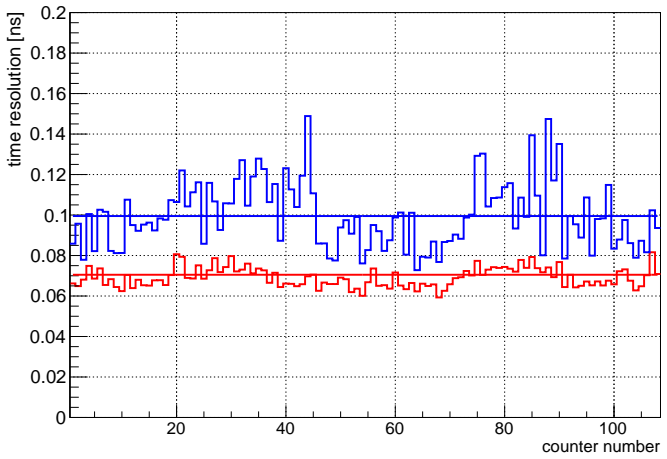
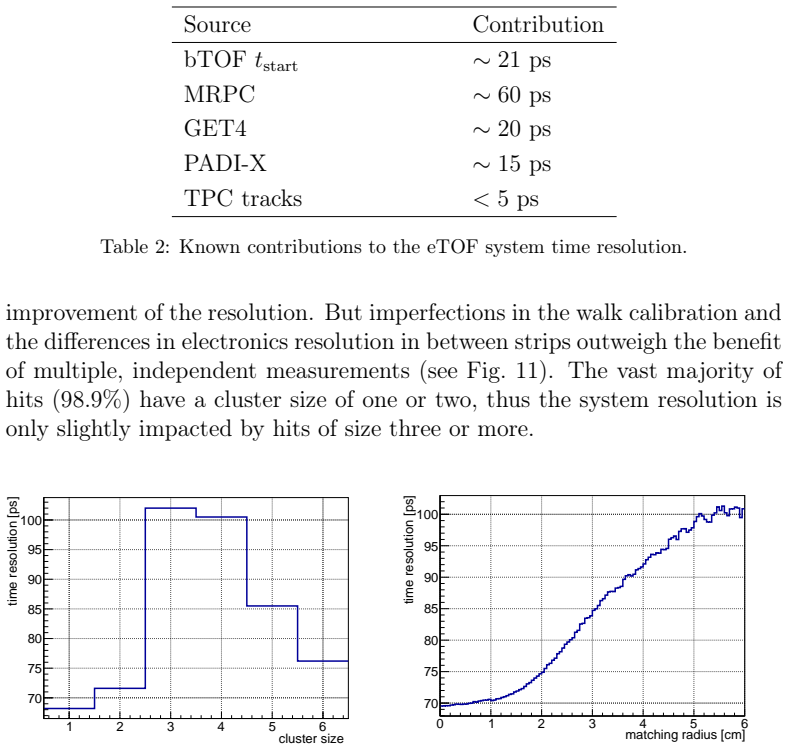
The eTOF subsystem achieved a time resolution of about 70 ps and a particle identification efficiency of about 70 percent, meeting the design goals of the project for the fixed-target program.
What carries the argument
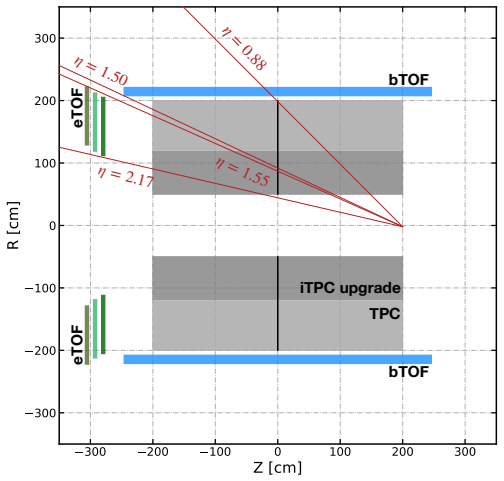
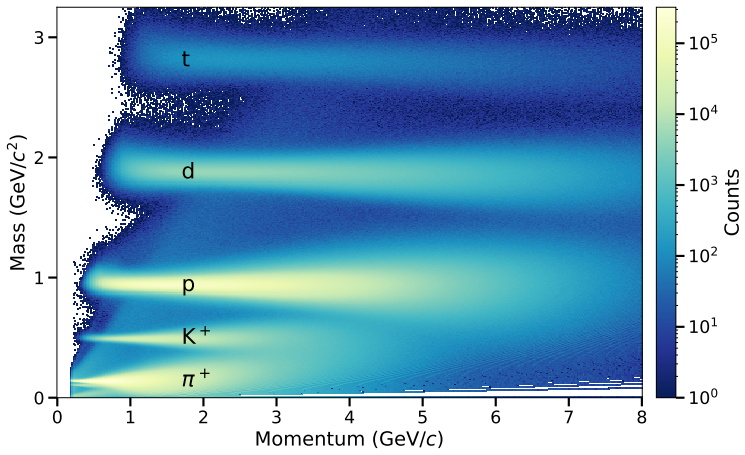
The adapted endcap time-of-flight detector system including its geometrical layout, acceptance, calibration, hit reconstruction, and particle identification techniques.
If this is right
- The subsystem enables mid-rapidity particle identification for fixed-target collisions at RHIC.
- It extends the beam energy scan to center-of-mass energies from 3.0 to 7.7 GeV.
- The performance validates adaptation of CBM readout electronics for use at STAR.
- Data collected supports detailed analyses of particle spectra and collective flow at low collision energies.
Where Pith is reading between the lines
- The successful adaptation suggests similar detector modules could be deployed quickly at other low-energy facilities.
- Longer-term data taking could reveal whether timing resolution degrades under sustained high-rate fixed-target operation.
- The quoted efficiencies set a baseline for planning upgrades that target even lower energies or higher multiplicities.
Load-bearing premise
The reported time resolution and PID efficiency after calibration and reconstruction accurately represent detector performance across all data-taking conditions without major unaccounted systematic effects from the fixed-target environment.
What would settle it
A direct comparison of the 70 ps resolution against independent measurements from known particle masses or Monte Carlo simulations matched to the exact fixed-target geometry and beam energies.
Figures




read the original abstract
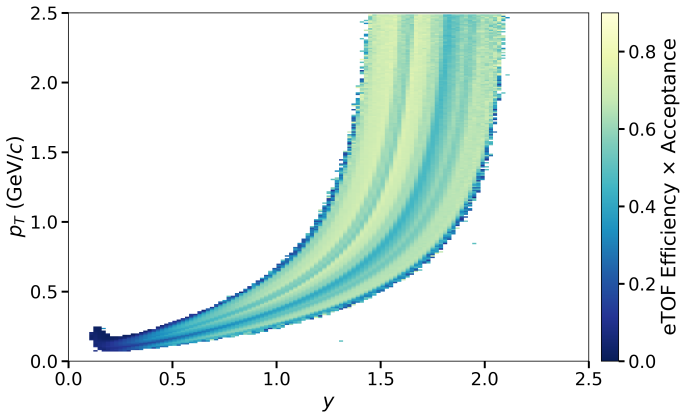
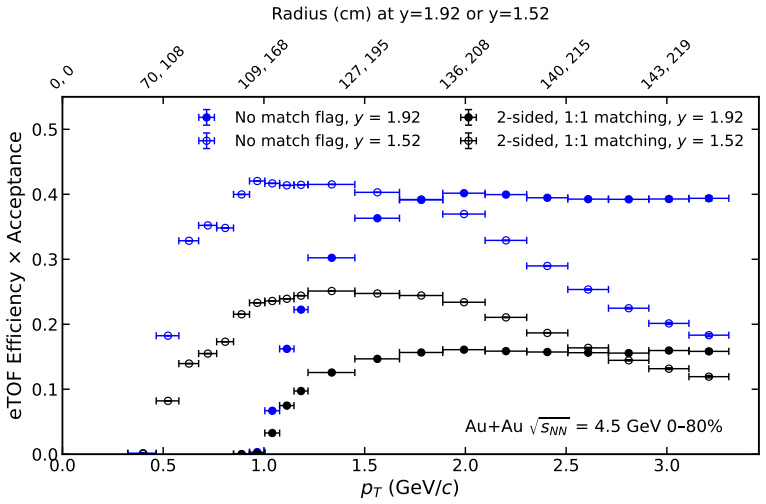
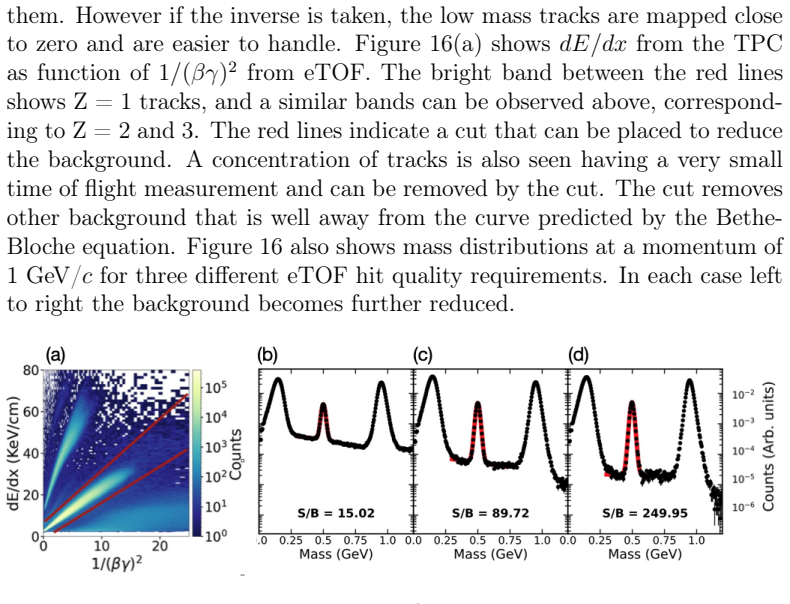
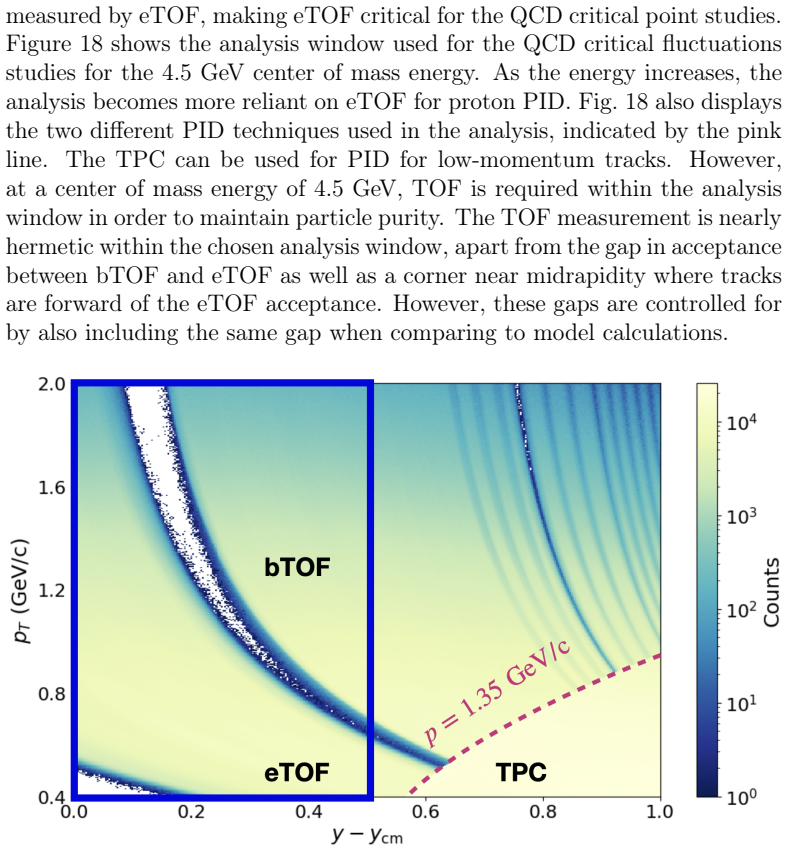
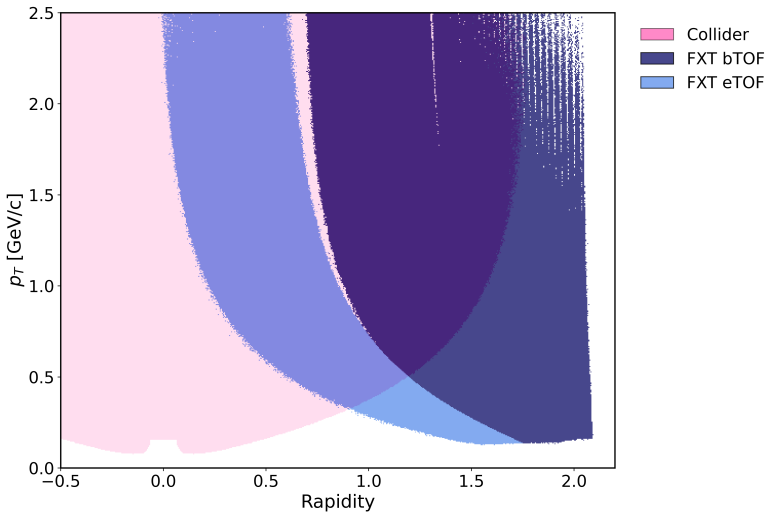
The STAR experiment at RHIC at Brookhaven National Laboratory completed the installation of an endcap time-of-flight subsystem (eTOF) in February 2019. The eTOF subsystem provided essential mid-rapidity particle identification (PID) for the fixed-target (FXT) portion of phase II of the beam energy scan (BES II). The FXT program allowed BES II to include center-of-mass energies from $\sqrt{s_{_{NN}}} = 3.0$ GeV to $\sqrt{s_{_{NN}}} = 7.7$ GeV, not accessible by colliding beams. The eTOF detectors and readout electronics were designed for the CBM experiment at FAIR and adapted for use at STAR. In this paper, we describe the details of the system in terms of geometrical layout, acceptance, calibration, hit reconstruction, and particle identification. The system achieved a time resolution of about 70 ps and a PID efficiency of about 70\%, meeting the design goals of the project.
Editorial analysis
A structured set of objections, weighed in public.
Referee Report
Summary. The paper presents the performance of the Endcap Time-of-Flight (eTOF) detector installed in the STAR experiment for the fixed-target portion of the Beam Energy Scan II. It covers the geometrical layout, acceptance, calibration, hit reconstruction, and particle identification procedures. The system is reported to have achieved a time resolution of about 70 ps and a PID efficiency of about 70%, meeting the design goals for mid-rapidity PID in collisions at center-of-mass energies from 3.0 to 7.7 GeV.
Significance. If validated, these results confirm the successful integration and operation of the adapted CBM eTOF detectors in the STAR fixed-target environment. This enables critical particle identification for the low-energy range of the BES II program, which is not accessible via collider mode, thereby supporting key physics measurements in heavy-ion collisions at RHIC. The empirical nature of the metrics provides direct validation of the detector technology.
major comments (1)
- [Performance evaluation] The headline performance metrics of ~70 ps time resolution and ~70% PID efficiency are presented without explicit studies or plots showing their dependence on beam energy, event multiplicity, or hit position within the endcap. Given the differences in track angles and backgrounds in the fixed-target setup compared to collider running, this omission makes it difficult to assess if the quoted values are representative across the full range of data-taking conditions from 3 to 7.7 GeV.
minor comments (2)
- [Abstract] The abstract uses approximate values ('about 70 ps' and 'about 70%') without cross-referencing the precise measurements or figures in the main text.
- [Methods] Additional details on the error analysis or systematic uncertainties in the time resolution measurement would strengthen the presentation.
Simulated Author's Rebuttal
We thank the referee for the constructive comment and the recommendation for minor revision. We address the point below and will incorporate additional studies into the revised manuscript.
read point-by-point responses
-
Referee: [Performance evaluation] The headline performance metrics of ~70 ps time resolution and ~70% PID efficiency are presented without explicit studies or plots showing their dependence on beam energy, event multiplicity, or hit position within the endcap. Given the differences in track angles and backgrounds in the fixed-target setup compared to collider running, this omission makes it difficult to assess if the quoted values are representative across the full range of data-taking conditions from 3 to 7.7 GeV.
Authors: We agree that explicit studies of the performance metrics as functions of beam energy, event multiplicity, and hit position would provide a more complete assessment, particularly given the fixed-target geometry. In the revised manuscript we will add figures showing the time resolution versus hit position within the endcap and the PID efficiency versus beam energy and multiplicity, using the full set of BES-II FXT data from 3.0 to 7.7 GeV. These additions will demonstrate that the headline values of approximately 70 ps and 70% are representative across the reported range. revision: yes
Circularity Check
No significant circularity in empirical performance metrics
full rationale
The manuscript reports measured detector performance (time resolution ~70 ps, PID efficiency ~70%) extracted directly from calibration, hit reconstruction, and data analysis in the STAR FXT environment. These quantities are empirical observables obtained from the detector response itself rather than quantities derived via equations, fitted parameters renamed as predictions, or self-citation chains. No load-bearing step reduces by construction to its own inputs; the central claims rest on experimental data and are self-contained against external benchmarks.
Axiom & Free-Parameter Ledger
axioms (1)
- standard math Standard time-of-flight relation between measured flight time, momentum, and particle mass for identification.
Lean theorems connected to this paper
-
IndisputableMonolith/Cost/FunctionalEquation.leanwashburn_uniqueness_aczel unclear?
unclearRelation between the paper passage and the cited Recognition theorem.
The system achieved a time resolution of about 70 ps and a PID efficiency of about 70%, meeting the design goals of the project.
-
IndisputableMonolith/Foundation/AbsoluteFloorClosure.leanreality_from_one_distinction unclear?
unclearRelation between the paper passage and the cited Recognition theorem.
The eTOF detectors and readout electronics were designed for the CBM experiment at FAIR and adapted for use at STAR.
What do these tags mean?
- matches
- The paper's claim is directly supported by a theorem in the formal canon.
- supports
- The theorem supports part of the paper's argument, but the paper may add assumptions or extra steps.
- extends
- The paper goes beyond the formal theorem; the theorem is a base layer rather than the whole result.
- uses
- The paper appears to rely on the theorem as machinery.
- contradicts
- The paper's claim conflicts with a theorem or certificate in the canon.
- unclear
- Pith found a possible connection, but the passage is too broad, indirect, or ambiguous to say the theorem truly supports the claim.
Reference graph
Works this paper leans on
-
[1]
M. Aggarwal, et al., An experimental exploration of the qcd phase dia- gram: the search for the critical point and the onset of de-confinement (2010).doi:arXiv:1007.2613
work page internal anchor Pith review Pith/arXiv arXiv 2010
-
[2]
L. Adamczyk, et al., Bulk Properties of the Medium Produced in Rel- ativistic Heavy-Ion Collisions from the Beam Energy Scan Program, Phys. Rev. C 96 (2017) 044904.doi:10.1103/PhysRevC.96.044904
-
[3]
K. H. Ackermann, et al., STAR detector overview, Nucl. Instrum. Meth. A 499 (2003) 624–632.doi:10.1016/S0168-9002(02)01960-5
-
[4]
W. J. Llope, Multigap RPCs in the STAR experiment at RHIC, Nucl. Instrum. Meth. A 661 (2012) S110–S113.doi:10.1016/j.nima.2010. 07.086
-
[5]
STAR-CBM eTOF Group, Physics Program for the STAR/CBM eTOF Upgrade (2016).arXiv:1609.05102. 29
work page internal anchor Pith review Pith/arXiv arXiv 2016
-
[6]
M. Anderson, et al., The STAR time projection chamber: a unique tool for studying high multiplicity events at RHIC, Nucl. Instrum. Meth. A 499 (2003) 659–678.doi:10.1016/S0168-9002(02)01964-2
-
[7]
Yang, The STAR beam energy scan phase II physics and upgrades, Nucl
C. Yang, The STAR beam energy scan phase II physics and upgrades, Nucl. Phys. A 967 (2017) 800–803.doi:10.1016/j.nuclphysa.2017. 05.042
-
[8]
Shen, et al., MWPC prototyping and performance test for the STAR inner TPC upgrade, Nucl
F. Shen, et al., MWPC prototyping and performance test for the STAR inner TPC upgrade, Nucl. Instrum. Meth. A 896 (2018) 90–95.doi: 10.1016/j.nima.2018.04.019
-
[9]
STAR Collaboration, Technical Design Report for the iTPC Upgrade, Tech. Rep. STAR Note 644 (2015). URLhttps://drupal.star.bnl.gov/STAR/files/TDRiTPCUpgrade_ final.pdf
work page 2015
-
[10]
P. Fonte, C. Williams, A. Smirnitsky, A new high resolution time-of- flight technology, Nucl. Instrum. Meth. A 443 (2000) 201–204.doi: 10.1016/S0168-9002(99)01217-6
-
[11]
Deppner, et al., The CBM time-of-flight wall, Nucl
I. Deppner, et al., The CBM time-of-flight wall, Nucl. Instrum. Meth. A 661 (2012) S121–S124.doi:10.1016/j.nima.2010.09.165
-
[12]
I. Deppner, N. Herrmann, The CBM Time-of-Flight system, JINST 14 (2019) C09020.doi:10.1088/1748-0221/14/09/C09020
-
[13]
J.-B. Wang, et al., Development of multi-gap resistive plate chambers with low-resistive silicate glass electrodes for operation at high particle fluxes and large transported charges, Nucl. Instrum. Meth. A 621 (2010) 151–156.doi:10.1016/j.nima.2010.04.056
-
[14]
K. Wang, J. Zhou, X. Wang, X. Li, D. Hu, Y. Sun, Batch testing and noise rate optimization of MRPC3b for CBM-TOF/STAR-eTOF, Nucl. Instrum. Meth. A 1057 (2023) 168778.doi:10.1016/j.nima.2023. 168778
-
[15]
Zhou, et al., MRPC3b for CBM-TOF, JINST 14 (2019) C06008.doi: 10.1088/1748-0221/14/06/C06008
J. Zhou, et al., MRPC3b for CBM-TOF, JINST 14 (2019) C06008.doi: 10.1088/1748-0221/14/06/C06008. 30
-
[16]
D. Hu, et al., MRPC3b mass production for CBM-TOF and eTOF at STAR, JINST 14 (2019) C06013.doi:10.1088/1748-0221/14/06/ C06013
-
[17]
M. Ciobanu, et al., New Models of PADI, an Ultrafast Preampli- fier–Discriminator ASIC for Time-of-Flight Measurements, IEEE Trans. Nucl. Sci. 68 (2021) 1325–1333.doi:10.1109/TNS.2021.3073487
-
[19]
H. Deppe, H. Flemming, CBM-Collaboration, The gsi event-driven tdc with 4 channels get4, Verhandlungen der Deutschen Physikalischen Gesellschaft (2010).doi:10.1109/NSSMIC.2009.5401741
-
[20]
J. D. Cuvelant, et al., Technical design report for the CBM online systems – part i, DAQ and FLES entry stage, Tech. Rep. GSI-2023- 00739, GSI Helmholtz Centre for Heavy Ion Research (2023).doi: 10.15120/GSI-2023-00739
-
[21]
M. Al-Turany, D. Klein, T. Kollegger, A. Rybalchenko, N. Winckler, Fairmq (2018).doi:10.5281/ZENODO.3362435. URLhttps://zenodo.org/record/3362435
-
[22]
Bichsel, Straggling in thin silicon detectors, Rev
H. Bichsel, Straggling in thin silicon detectors, Rev. Mod. Phys. 60 (1988) 663–699.doi:10.1103/RevModPhys.60.663
-
[23]
H. Bichsel, A method to improve tracking and particle identification in TPCs and silicon detectors, Nucl. Instrum. Meth. A 562 (2006) 154–197. doi:10.1016/j.nima.2006.03.009
-
[24]
Bethe, Braking formula for electrons of relativistic speed, Eur
H. Bethe, Braking formula for electrons of relativistic speed, Eur. Phys. J. H 39 (2014) 537–542.doi:10.1140/epjh/e2014-50028-5
-
[25]
M. Stephanov, K. Rajagopal, E. Shuryak, Event-by-event fluctuations in heavy ion collisions and the QCD critical point, Phys. Rev. D 60 (1999) 114028.doi:10.1103/PhysRevD.60.114028
-
[26]
S. Gupta, et al., Scale for the phase diagram of quantum chromodynam- ics, Science 332 (2011) 1525–1528.doi:10.1126/science.1204621. 31
-
[28]
P. Braun-Munzinger, J. Stachel, J. P. Wessels, N. Xu, Thermal equili- bration and expansion in nucleus-nucleus collisions at the AGS, Phys. Lett. B 344 (1995) 43–48.doi:10.1016/0370-2693(94)01534-J
-
[29]
W. Cassing, E. L. Bratkovskaya, Hadronic and electromagnetic probes of hot and dense nuclear matter, Phys. Rept. 308 (1999) 65–233.doi: 10.1016/S0370-1573(98)00028-3
-
[30]
Y. B. Ivanov, Baryon Stopping in Heavy-Ion Collisions atElab = 2– 160 GeV/nucleon, Phys. Lett. B 690 (2010) 358–361.doi:10.1016/j. physletb.2010.05.051
work page doi:10.1016/j 2010
-
[31]
Y. B. Ivanov, Alternative Scenarios of Relativistic Heavy-Ion Collisions: I. Baryon Stopping, Phys. Rev. C 87 (2013) 064904.doi:10.1103/ PhysRevC.87.064904
work page 2013
-
[32]
Y. B. Ivanov, D. Blaschke, Baryon Stopping in Heavy-Ion Collisions at Elab = 2A–200A GeV, Eur. Phys. J. A 52 (2016) 237.doi:10.1140/ epja/i2016-16237-4
work page 2016
-
[33]
Y. B. Ivanov, D. Blaschke, Robustness of the Baryon-Stopping Signal for the Onset of Deconfinement in Relativistic Heavy-Ion Collisions, Phys. Rev. C 92 (2015) 024916.doi:10.1103/PhysRevC.92.024916
-
[34]
Ahle, et al., An Excitation Function ofK− andK + Production in Au+Au Reactions at the AGS, Phys
L. Ahle, et al., An Excitation Function ofK− andK + Production in Au+Au Reactions at the AGS, Phys. Lett. B 476 (2000) 1–10.doi: 10.1016/S0370-2693(00)00916-3
-
[35]
and others, Energy Dependence of Pion and Kaon Production in Central Pb+Pb Collisions, Phys
Alt, C. and others, Energy Dependence of Pion and Kaon Production in Central Pb+Pb Collisions, Phys. Rev. C 77 (2008) 024903.doi: 10.1103/PhysRevC.77.024903
-
[36]
I. G. Bearden, et al., Strange Meson Enhancement in PbPb Collisions, Phys. Lett. B 471 (1999) 6–12.doi:10.1016/S0370-2693(99)01327-1
-
[37]
J. L. Klay, et al., Longitudinal Flow of Protons from 2-8 AGeV Cen- tral Au+Au Collisions, Phys. Rev. C 65 (2002) 044902.doi:10.1103/ PhysRevC.65.044902. 32
work page 2002
-
[38]
L. Ahle, et al., Centrality dependence of kaon yields in Si + A and Au + Au collisions at relativistic energies, Phys. Rev. C 60 (1999) 044904. doi:10.1103/PhysRevC.60.044904. 33
discussion (0)
Sign in with ORCID, Apple, or X to comment. Anyone can read and Pith papers without signing in.