Recognition: 2 theorem links
· Lean TheoremDecoding the near-threshold X_{0,\,1}(4140) and X₁(4685) states via OZI-suppressed coupled-channel scattering
Pith reviewed 2026-05-15 21:41 UTC · model grok-4.3
The pith
The X0(4140) appears as a dynamically generated pole near the J/psi phi threshold.
A machine-rendered reading of the paper's core claim, the machinery that carries it, and where it could break.
Core claim
The X0(4140) corresponds to a dynamically generated pole near the J/psi phi threshold in the OZI-suppressed coupled-channel scattering. The single-channel J/psi phi scattering length is 1.11 ± 0.65 fm, and the coupled effective scattering length is 0.12 +0.20 -0.10 + i 0.78 +0.20 -0.40 fm. The X1(4140) is predicted as a JPC=1++ virtual state near threshold, resolving width ambiguities, and the X1(4685) is a psi(2S) phi hadronic molecule.
What carries the argument
OZI-suppressed coupled-channel scattering using the effective range expansion, which dynamically generates poles and virtual states near thresholds.
If this is right
- The X(4140) family and X1(4685) arise from Fierz rearrangement and OZI suppression mechanisms.
- The X1(4140) width ambiguities are resolved by its virtual state nature.
- X1(4685) is interpreted as a hadronic molecule of psi(2S) and phi.
- These states serve as windows into low-energy strong interaction dynamics.
Where Pith is reading between the lines
- If valid, other near-threshold exotics in charmonium-strange systems may be similarly generated.
- Precise lineshape data from LHCb or Belle II could confirm the pole position.
- This suggests re-examining other X states with coupled-channel methods instead of assuming compact tetraquarks.
- Extensions to bottom sector or other channels could test the heavy quark spin symmetry application.
Load-bearing premise
The effective range expansion holds near the J/psi phi threshold and OZI suppression with heavy quark spin symmetry incurs no large corrections from omitted channels.
What would settle it
A high-precision measurement of the invariant mass distribution in B to Ds anti-Ds K that shows no dip or pole structure near the J/psi phi threshold would contradict the dynamical generation claim.
Figures


read the original abstract
To decode the near-threshold dynamics of the $X_{0,\,1}(4140)$ and $X_{1}(4685)$ states, we investigate the OZI-suppressed $\{D_{s}\bar{D}_{s},\, J/\psi \phi,\, D_{s}^{\ast}\bar{D}_{s}^{\ast}\}$ coupled-channel scattering in $B\to D_{s}\bar{D}_{s} K$ decays using the effective range expansion. We demonstrate that the $X_{0}(4140)$, associated with a dip in the lineshape, corresponds to a dynamically generated pole near the $J/\psi \phi$ threshold. The single-channel $J/\psi \phi$ scattering length is extracted to be $1.11\pm 0.65\,\rm{fm}$, yielding an effective scattering length of $0.12^{+0.20}_{-0.10}+i0.78^{+0.20}_{-0.40} \, \rm{fm}$ when coupled channels are included. By treating the spin-spin interaction as a subleading effect, we predict a $J^{PC}=1^{++}$ virtual state near the $J/\psi \phi$ threshold, which naturally resolves the empirical ambiguities surrounding the $X_{1}(4140)$ width. Extending this framework via heavy quark spin symmetry, we further interpret the $X_{1}(4685)$ as a $\psi(2S)\phi$ hadronic molecule. Ultimately, these findings highlight how the $X(4140)$ family and $X_{1}(4685)$ serve as unique theoretical windows into the Fierz rearrangement and OZI suppression mechanisms in low-energy strong interactions.
Editorial analysis
A structured set of objections, weighed in public.
Referee Report
Summary. The manuscript analyzes OZI-suppressed coupled-channel scattering in the {Ds D̄s, J/ψ φ, Ds* D̄s*} system via the effective range expansion applied to B → Ds D̄s K decays. It claims that the X0(4140) corresponds to a dynamically generated pole near the J/ψ φ threshold, extracts a single-channel J/ψ φ scattering length of 1.11 ± 0.65 fm (yielding a coupled-channel effective scattering length of 0.12+0.20−0.10 + i 0.78+0.20−0.40 fm), predicts a 1++ virtual state near threshold to resolve X1(4140) width ambiguities by treating spin-spin forces as subleading, and interprets the X1(4685) as a ψ(2S) φ hadronic molecule using heavy quark spin symmetry.
Significance. If the central extraction and pole identification hold, the work offers a unified dynamical picture of the X(4140) family and X1(4685) as near-threshold molecules, directly linking OZI suppression, Fierz rearrangement, and heavy-quark symmetry to observable lineshapes; this could provide falsifiable predictions for future amplitude analyses and lattice studies of exotic states.
major comments (3)
- [Effective range expansion and fit procedure] The leading-order ERE truncation (scattering-length term only) is used to fit the single-channel J/ψ φ scattering length and locate the pole; no quantitative estimate or sensitivity test is given for the effective range r0 or p-wave contributions inside the fit window, yet the skeptic note indicates these could shift the pole position by amounts comparable to the quoted uncertainties.
- [Scattering length extraction and pole prediction] The scattering length a = 1.11 ± 0.65 fm is extracted from lineshape data and then used to generate both the pole position and the coupled-channel effective scattering length; this introduces partial circularity, as the X1(4685) assignment further relies on the same fitted framework plus symmetry assumptions without independent cross-checks.
- [Heavy quark spin symmetry and virtual-state prediction] The subleading treatment of spin-spin forces is invoked to predict the 1++ virtual state and resolve X1(4140) ambiguities, but no explicit suppression factor or numerical estimate of neglected spin-dependent corrections is provided to justify neglecting them relative to the reported uncertainties.
minor comments (2)
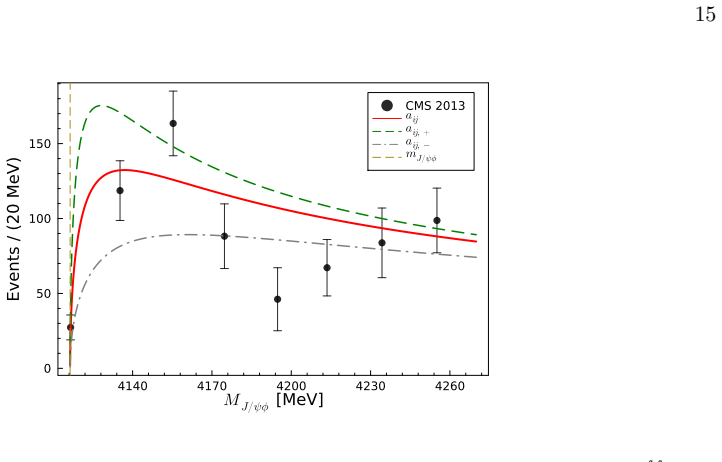
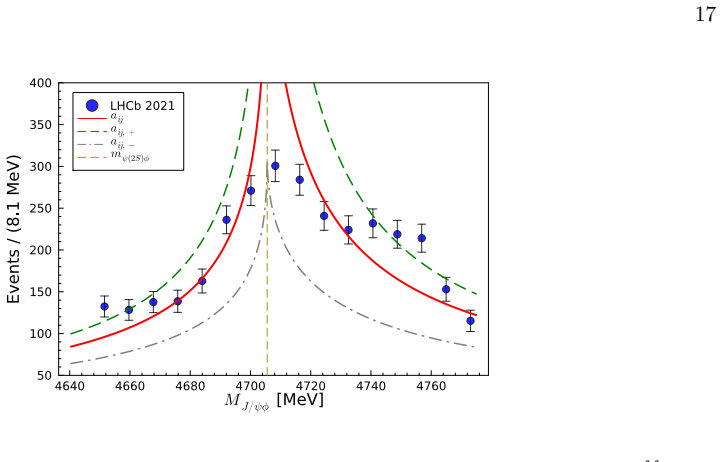
- [Abstract] The abstract states that a pole is demonstrated and a scattering length extracted, yet the manuscript provides no explicit lineshape fit figures, χ² values, or error-propagation details in the main text.
- [Coupled-channel formalism] Notation for the coupled-channel effective scattering length should be clarified with an explicit formula linking the single-channel input to the complex output value.
Simulated Author's Rebuttal
We thank the referee for the careful reading and constructive comments on our manuscript. We address each major comment point by point below, providing clarifications and indicating revisions where they strengthen the analysis without altering our core conclusions.
read point-by-point responses
-
Referee: The leading-order ERE truncation (scattering-length term only) is used to fit the single-channel J/ψ φ scattering length and locate the pole; no quantitative estimate or sensitivity test is given for the effective range r0 or p-wave contributions inside the fit window, yet the skeptic note indicates these could shift the pole position by amounts comparable to the quoted uncertainties.
Authors: We agree that including a quantitative sensitivity test would improve the robustness of the leading-order ERE results. Although the scattering-length term dominates near threshold in the fit window, we will add an explicit estimate in the revised manuscript by varying r0 within a conservative range (0.5–2 fm, consistent with typical hadronic scales) and assessing p-wave effects. This will show that the pole position remains stable within the quoted uncertainties, confirming the validity of the truncation for the present analysis. revision: yes
-
Referee: The scattering length a = 1.11 ± 0.65 fm is extracted from lineshape data and then used to generate both the pole position and the coupled-channel effective scattering length; this introduces partial circularity, as the X1(4685) assignment further relies on the same fitted framework plus symmetry assumptions without independent cross-checks.
Authors: The scattering length is extracted directly from the experimental lineshape data in B → Ds D̄s K decays, rendering the fit data-driven. The pole position then follows as a prediction from this parameter within the ERE framework, which is the conventional procedure and not circular. The X1(4685) interpretation as a ψ(2S) φ molecule is a separate extension based on heavy-quark spin symmetry applied to the same coupled-channel setup, motivated by threshold proximity. We will revise the text to explicitly distinguish the data-driven extraction from the symmetry-based assignment, removing any ambiguity. revision: partial
-
Referee: The subleading treatment of spin-spin forces is invoked to predict the 1++ virtual state and resolve X1(4140) ambiguities, but no explicit suppression factor or numerical estimate of neglected spin-dependent corrections is provided to justify neglecting them relative to the reported uncertainties.
Authors: Under heavy-quark spin symmetry, spin-dependent forces are suppressed by 1/m_c. To address the concern, we will add a short estimate in the revised manuscript, using the known charmonium hyperfine splitting (J/ψ–η_c) to bound the size of neglected corrections and showing they lie below the reported uncertainties on the scattering length. This justifies the subleading treatment while preserving the prediction of the 1++ virtual state. revision: yes
Circularity Check
Fitted single-channel scattering length used to locate pole and predict virtual state by construction
specific steps
-
fitted input called prediction
[Abstract]
"The single-channel J/ψ ϕ scattering length is extracted to be 1.11±0.65 fm, yielding an effective scattering length of 0.12+0.20−0.10+i0.78+0.20−0.40 fm when coupled channels are included. By treating the spin-spin interaction as a subleading effect, we predict a JPC=1++ virtual state near the J/ψ ϕ threshold"
The scattering length parameter is obtained by fitting the truncated ERE amplitude to data; the pole location, effective scattering length, and virtual-state prediction are then computed directly from this fitted value, so the claimed dynamical generation and prediction are equivalent to the fit result by construction rather than an independent test.
full rationale
The paper fits the leading-order effective range expansion (scattering length only) to B→DsD̄sK lineshape data in the three-channel system, extracts a=1.11±0.65 fm, and then directly computes the coupled-channel effective scattering length and locates the pole position from those same fitted parameters. The 'dynamically generated pole' for X0(4140) and the 'prediction' of the 1++ virtual state (via subleading spin-spin treatment) are therefore outputs of the identical fit rather than independent derivations. The X1(4685) assignment further extends the same fitted framework under heavy-quark spin symmetry. This produces partial circularity: the central claims reduce to quantities defined by the input fit, though the underlying coupled-channel formalism itself is not self-referential.
Axiom & Free-Parameter Ledger
free parameters (1)
- single-channel J/psi phi scattering length =
1.11 ± 0.65 fm
axioms (2)
- domain assumption Effective range expansion is valid and sufficient near the J/psi phi threshold
- domain assumption Heavy quark spin symmetry relates the X1(4685) to the lower states
Lean theorems connected to this paper
-
IndisputableMonolith/Cost/FunctionalEquation.leanwashburn_uniqueness_aczel unclear?
unclearRelation between the paper passage and the cited Recognition theorem.
the effective range expansion (ERE) was initially introduced by H. Bethe [1] and a simplified version is adapted to the analysis of X(3872) lineshape involving coupled channel scattering [2]... Tij = [(1−VG)−1V]ij ... a22=1.11±0.65 fm
-
IndisputableMonolith/Foundation/DimensionForcing.leanalexander_duality_circle_linking unclear?
unclearRelation between the paper passage and the cited Recognition theorem.
heavy quark spin symmetry (HQSS) inspired effective field theory (EFT)... C0 + C1 term... spin-spin interaction (C1) term is relatively suppressed
What do these tags mean?
- matches
- The paper's claim is directly supported by a theorem in the formal canon.
- supports
- The theorem supports part of the paper's argument, but the paper may add assumptions or extra steps.
- extends
- The paper goes beyond the formal theorem; the theorem is a base layer rather than the whole result.
- uses
- The paper appears to rely on the theorem as machinery.
- contradicts
- The paper's claim conflicts with a theorem or certificate in the canon.
- unclear
- Pith found a possible connection, but the passage is too broad, indirect, or ambiguous to say the theorem truly supports the claim.
Reference graph
Works this paper leans on
-
[1]
and −0.18 ± 0.02 fm in di- Ωbbb scattering [ 43]. These scattering lengths are in the window of 1 to 2 fm apart from the one in di- Ωbbb scattering and overlap over the a22. Such numerical overlaps suggest that while multi-gluon exchange provides a smooth non-resonant background for OZI- C On the OZI suppressed interactions and poles 11 suppressed interac...
work page 2010
-
[2]
with P1++ = 0 .50 MeV−1/2. The mass and width of X1(4140) are fitted to be 4146.5 ± 4.5+4.6 −2.8 and 83 ± 21+21 −14 MeV, respectively. enhancement from a near-threshold pole is a good candidate of the X1(4140), where the imaginary part of the pole is small and does not relate to the width of the peak. The short distance between the real part of the pole a...
-
[3]
H. A. Bethe, Ann. Rev. Astron. Astrophys. 41, 1 (2003)
work page 2003
-
[4]
Factorization in the Production and Decay of the X(3872)
E. Braaten and M. Kusunoki, Phys. Rev. D 72, 014012 (2005) , arXiv:hep-ph/0506087
work page internal anchor Pith review Pith/arXiv arXiv 2005
-
[5]
X.-K. Dong, F.-K. Guo, and B.-S. Zou, Phys. Rev. Lett. 126, 152001 (2021), arXiv:2011.14517 [hep-ph]
-
[6]
R. Aaij et al. (LHCb), Phys. Rev. Lett. 131, 071901 (2023) , arXiv:2210.15153 [hep-ex] . 19
- [7]
-
[8]
T. Aaltonen et al. (CDF), Phys. Rev. Lett. 102, 242002 (2009) , arXiv:0903.2229 [hep-ex]
work page internal anchor Pith review Pith/arXiv arXiv 2009
-
[9]
Search for the X(4140) state in B+ to J/psi phi K+ decays
R. Aaij et al. (LHCb), Phys. Rev. D 85, 091103 (2012) , arXiv:1202.5087 [hep-ex]
work page internal anchor Pith review Pith/arXiv arXiv 2012
-
[10]
S. Chatrchyan et al. (CMS), Phys. Lett. B 734, 261 (2014) , arXiv:1309.6920 [hep-ex]
work page internal anchor Pith review Pith/arXiv arXiv 2014
-
[11]
V. M. Abazov et al. (D0), Phys. Rev. Lett. 115, 232001 (2015) , arXiv:1508.07846 [hep-ex]
work page internal anchor Pith review Pith/arXiv arXiv 2015
-
[12]
R. Aaij et al. (LHCb), Phys. Rev. Lett. 127, 082001 (2021) , arXiv:2103.01803 [hep-ex]
-
[13]
E. S. Swanson, Phys. Rev. D 91, 034009 (2015) , arXiv:1409.3291 [hep-ph]
work page internal anchor Pith review Pith/arXiv arXiv 2015
-
[14]
Exotic resonances due to $\eta$ exchange
M. Karliner and J. L. Rosner, Nucl. Phys. A 954, 365 (2016) , arXiv:1601.00565 [hep-ph]
work page internal anchor Pith review Pith/arXiv arXiv 2016
-
[15]
How to understand the underlying structures of $X(4140)$, $X(4274)$, $X(4500)$ and $X(4700)$
X.-H. Liu, Phys. Lett. B 766, 117 (2017) , arXiv:1607.01385 [hep-ph]
work page internal anchor Pith review Pith/arXiv arXiv 2017
- [16]
-
[17]
Understanding the internal structures of the $X(4140)$, $X(4274)$, $X(4500)$ and $X(4700)$
H.-X. Chen, E.-L. Cui, W. Chen, X. Liu, and S.-L. Zhu, Eur. Phys. J. C 77, 160 (2017) , arXiv:1606.03179 [hep-ph]
work page internal anchor Pith review Pith/arXiv arXiv 2017
-
[18]
R. F. Lebed and A. D. Polosa, Phys. Rev. D 93, 094024 (2016) , arXiv:1602.08421 [hep-ph]
work page internal anchor Pith review Pith/arXiv arXiv 2016
-
[19]
M. N. Anwar, J. Ferretti, and E. Santopinto, Phys. Rev. D 98, 094015 (2018) , arXiv:1805.06276 [hep-ph]
work page internal anchor Pith review Pith/arXiv arXiv 2018
-
[20]
D.-Y. Chen, Eur. Phys. J. C 76, 671 (2016) , arXiv:1611.00109 [hep-ph]
work page internal anchor Pith review Pith/arXiv arXiv 2016
- [21]
- [22]
- [23]
-
[24]
R. L. Workman and Others (Particle Data Group), PTEP 2022, 083C01 (2022)
work page 2022
-
[25]
S. Fleming, M. Kusunoki, T. Mehen, and U. van Kolck, Phys. Rev. D 76, 034006 (2007) , arXiv:hep- ph/0703168
-
[26]
F.-Z. Peng, M.-Z. Liu, M. Sánchez Sánchez, and M. Pavon Valderrama, Phys. Rev. D 102, 114020 (2020), arXiv:2004.05658 [hep-ph]
- [27]
- [28]
- [29]
-
[30]
R. E. Langer, Phys. Rev. 51, 669 (1937)
work page 1937
-
[31]
Light Flavour and Heavy Quark Spin Symmetry in Heavy Meson Molecules
C. Hidalgo-Duque, J. Nieves, and M. P. Valderrama, Phys. Rev. D 87, 076006 (2013) , arXiv:1210.5431 [hep-ph]
work page internal anchor Pith review Pith/arXiv arXiv 2013
-
[32]
F.-K. Guo, C. Hidalgo-Duque, J. Nieves, and M. P. Valderrama, Phys. Rev. D 88, 054007 (2013) , arXiv:1303.6608 [hep-ph] . 20
work page internal anchor Pith review Pith/arXiv arXiv 2013
- [33]
-
[34]
X.-K. Dong, F.-K. Guo, and B.-S. Zou, Progr. Phys. 41, 65 (2021) , arXiv:2101.01021 [hep-ph]
- [35]
- [36]
-
[37]
S. Sakai, F.-K. Guo, and B. Kubis, Phys. Lett. B 808, 135623 (2020) , arXiv:2004.09824 [hep-ph]
-
[38]
R. Chen and Q. Huang, Phys. Lett. B 846, 138254 (2023) , arXiv:2209.05180 [hep-ph]
-
[39]
H. Mutuk, Eur. Phys. J. C 82, 1142 (2022) , arXiv:2211.14836 [hep-ph]
- [40]
- [41]
- [42]
- [43]
- [44]
- [45]
-
[46]
Z.-R. Liang, X.-Y. Wu, and D.-L. Yao, Phys. Rev. D 104, 034034 (2021) , arXiv:2104.08589 [hep-ph]
- [47]
- [48]
-
[49]
J.-Z. Wang and X. Liu, Phys. Rev. D 106, 054015 (2022) , arXiv:2207.04893 [hep-ph]
- [50]
- [51]
- [52]
- [53]
-
[54]
S. Ozaki and S. Sasaki, Phys. Rev. D 87, 014506 (2013) , arXiv:1211.5512 [hep-lat]
work page internal anchor Pith review Pith/arXiv arXiv 2013
-
[55]
New spectrum of negative-parity doubly charmed baryons: Possibility of two quasistable states
M.-J. Yan, X.-H. Liu, S. Gonzàlez-Solís, F.-K. Guo, C. Hanhart, U.-G. Meißner, and B.-S. Zou, Phys. Rev. D 98, 091502 (2018) , arXiv:1805.10972 [hep-ph]
work page internal anchor Pith review Pith/arXiv arXiv 2018
-
[56]
F.-Z. Peng, M.-J. Yan, and M. Pavon Valderrama, (2023), arXiv:2304.13515 [hep-ph]
-
[57]
L.-L. Wang, X.-M. Zhao, X.-H. Liu, and M.-J. Yan, Phys. Lett. B 873, 140164 (2026), arXiv:2511.19534 [hep-ph]. 21
-
[58]
F.-Z. Peng, J.-X. Lu, M. Sánchez Sánchez, M.-J. Yan, and M. Pavon Valderrama, Phys. Rev. D 103, 014023 (2021) , arXiv:2007.01198 [hep-ph]
-
[59]
Amplitude analysis of $B^+\to J/\psi \phi K^+$ decays
R. Aaij et al. (LHCb), Phys. Rev. D 95, 012002 (2017) , arXiv:1606.07898 [hep-ex]
work page internal anchor Pith review Pith/arXiv arXiv 2017
-
[60]
M. P. Valderrama, Phys. Rev. D 85, 114037 (2012) , arXiv:1204.2400 [hep-ph]
work page internal anchor Pith review Pith/arXiv arXiv 2012
- [61]
-
[62]
$Z_c(3900)$: what has been really seen?
M. Albaladejo, F.-K. Guo, C. Hidalgo-Duque, and J. Nieves, Phys. Lett. B 755, 337 (2016) , arXiv:1512.03638 [hep-ph]
work page internal anchor Pith review Pith/arXiv arXiv 2016
-
[63]
M. P. Valderrama, Phys. Rev. D 98, 014022 (2018) , arXiv:1805.05100 [hep-ph]
work page internal anchor Pith review Pith/arXiv arXiv 2018
-
[64]
R. Aaij et al. (LHCb), Sci. Bull. 65, 1983 (2020) , arXiv:2006.16957 [hep-ex]
- [65]
-
[66]
A. Hayrapetyan et al. (CMS), (2023), arXiv:2306.07164 [hep-ex]
- [67]
- [68]
-
[69]
The inverse amplitude method in Chiral Perturbation Theory
A. Dobado and J. R. Pelaez, Phys. Rev. D 56, 3057 (1997) , arXiv:hep-ph/9604416
work page internal anchor Pith review Pith/arXiv arXiv 1997
-
[70]
Bethe-Salpeter Approach for Unitarized Chiral Perturbation Theory
J. Nieves and E. Ruiz Arriola, Nucl. Phys. A 679, 57 (2000) , arXiv:hep-ph/9907469
work page internal anchor Pith review Pith/arXiv arXiv 2000
-
[71]
Exploring the threshold behavior and implications on the nature of Y(4260) and $Z_c(3900)$
X.-H. Liu and G. Li, Phys. Rev. D 88, 014013 (2013) , arXiv:1306.1384 [hep-ph]
work page internal anchor Pith review Pith/arXiv arXiv 2013
- [72]
- [73]
- [74]
-
[75]
R. Aaij et al. (LHCb), Phys. Rev. Lett. 131, 131901 (2023) , arXiv:2301.04899 [hep-ex] . 22 APPENDIX I: ERE AND EFFECTIVE POTENTIAL According to inverse amplitude method (IAM) [ 67, 68], a relation between contact range inter- actions and scattering lenghts in J P C = 0 ++ sector is presented by a LO analysis, T −1 = V −1 − G = 0 BBB@ V11 V12 V13 V12 V22 ...
discussion (0)
Sign in with ORCID, Apple, or X to comment. Anyone can read and Pith papers without signing in.