Recognition: 2 theorem links
· Lean TheoremSuperiority of Krylov shadow tomography in estimating quantum Fisher information: From bounds to exactness
Pith reviewed 2026-05-15 21:12 UTC · model grok-4.3
The pith
Krylov shadow tomography yields bounds on quantum Fisher information that converge exponentially to the true value and match it exactly for low-rank states.
A machine-rendered reading of the paper's core claim, the machinery that carries it, and where it could break.
Core claim
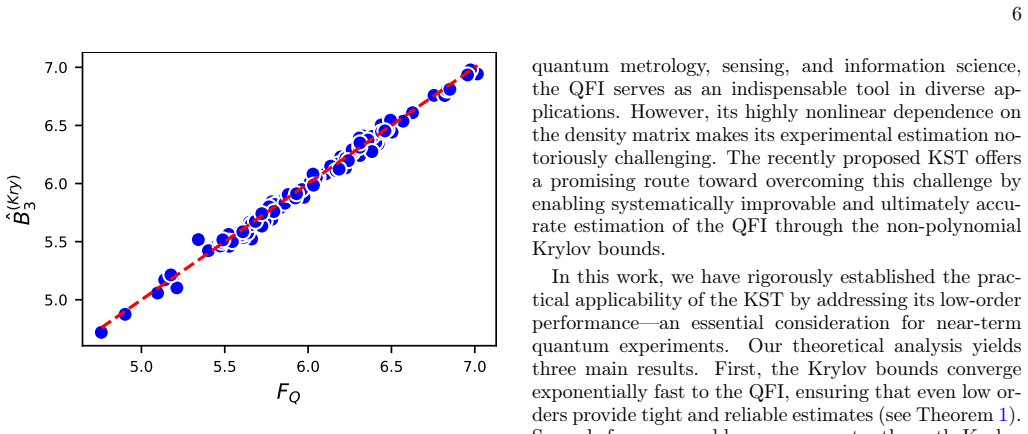
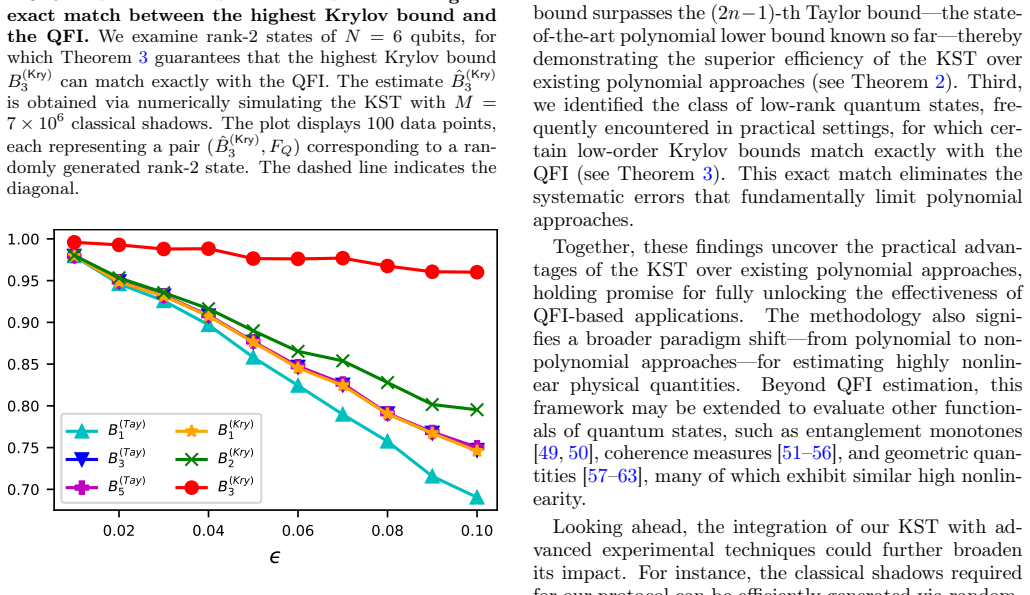
The Krylov bounds on the quantum Fisher information converge exponentially fast to the exact QFI with increasing order and surpass all previously known polynomial lower bounds; moreover, certain low-order Krylov bounds coincide exactly with the QFI for low-rank states.
What carries the argument
Krylov bounds constructed via Krylov shadow tomography, which generate a hierarchy of increasingly tight lower bounds on the QFI by projecting onto successive Krylov subspaces from shadow data.
If this is right
- Low-order Krylov bounds already deliver exact QFI estimates for the low-rank states that dominate many experimental platforms.
- Exponential convergence guarantees that moderate-order bounds beat the best polynomial bounds available today.
- Shadow measurements suffice to compute these bounds, avoiding the need for full state tomography.
- The method therefore supplies a practical route to tighter QFI-based protocols in quantum sensing.
Where Pith is reading between the lines
- Hardware implementations could test whether the exponential convergence survives realistic noise levels in current quantum devices.
- The same Krylov construction might be applied to other quadratic forms in quantum information, such as variances of observables.
- If low-rank structure is preserved under common noise channels, the exact-match regime could extend to open-system metrology.
Load-bearing premise
Low-rank states occur frequently enough in practical quantum systems that the exact-match property of low-order Krylov bounds becomes broadly useful.
What would settle it
A concrete low-rank state (for example a rank-2 mixed state prepared on a few qubits) together with its exact QFI value where even the lowest-order Krylov bound deviates from the true number.
Figures


read the original abstract
Estimating the quantum Fisher information (QFI) is a crucial yet challenging task with widespread applications across quantum science and technologies. The recently proposed Krylov shadow tomography (KST) opens a new avenue for this task by introducing a series of Krylov bounds on the QFI. In this work, we address the practical applicability of the KST, unveiling that the Krylov bounds of low orders already enable efficient and accurate estimation of the QFI. We show that the Krylov bounds converge to the QFI exponentially fast with increasing order and can surpass the state-of-the-art polynomial lower bounds known to date. Moreover, we show that certain low-order Krylov bound can already match the QFI exactly for low-rank states prevalent in practical settings. Such exact match is beyond the reach of polynomial lower bounds proposed previously. These theoretical findings, solidified by extensive numerical simulations, demonstrate practical advantages over existing polynomial approaches, holding promise for fully unlocking the effectiveness of QFI-based applications.
Editorial analysis
A structured set of objections, weighed in public.
Referee Report
Summary. The paper introduces Krylov shadow tomography (KST) as a method for estimating the quantum Fisher information (QFI). It establishes that Krylov bounds converge exponentially to the exact QFI with increasing subspace order, outperform existing polynomial lower bounds, and achieve exact equality with the QFI for certain low-order bounds when applied to low-rank states that are common in practice. These theoretical results are supported by numerical simulations demonstrating practical advantages over prior approaches.
Significance. If the central claims hold, the work provides a meaningful improvement in QFI estimation by replacing polynomial bounds with exponentially convergent ones and enabling exact recovery for low-rank states. This is relevant for quantum metrology and sensing applications where QFI quantifies precision limits. The combination of theoretical convergence guarantees and simulation evidence strengthens the case for KST as a practical tool, though its advantage depends on efficient shadow-based implementation.
major comments (2)
- [§4.1, Theorem 1] §4.1, Theorem 1: The exponential convergence rate is derived from the residual norm in the Krylov subspace; however, the proof sketch does not explicitly bound the dependence on the minimal spectral gap of the QFI operator, leaving open whether the rate remains exponential for degenerate or near-degenerate cases common in mixed states.
- [§5.2, Eq. (22)] §5.2, Eq. (22): The claim that a low-order Krylov bound exactly equals the QFI for rank-r states relies on the subspace containing the support of the state; the argument would benefit from an explicit rank threshold (e.g., order ≥ 2r) and a counter-example check for states with rank close to that threshold.
minor comments (2)
- [Figure 3] Figure 3: The legend for the polynomial baseline curves is missing the explicit polynomial degree used; adding this would clarify the comparison.
- [§2] Notation: The symbol K_m for the m-th Krylov subspace is introduced without a clear definition of the generating vector; a short reminder in §2 would aid readability.
Simulated Author's Rebuttal
We thank the referee for the positive evaluation and the constructive comments on the convergence analysis and the exactness claim for low-rank states. We address each major comment below and will incorporate clarifications into the revised manuscript.
read point-by-point responses
-
Referee: [§4.1, Theorem 1] §4.1, Theorem 1: The exponential convergence rate is derived from the residual norm in the Krylov subspace; however, the proof sketch does not explicitly bound the dependence on the minimal spectral gap of the QFI operator, leaving open whether the rate remains exponential for degenerate or near-degenerate cases common in mixed states.
Authors: We appreciate this observation. The proof of Theorem 1 relies on the residual norm ||(I - P_K) A |ψ⟩|| where A is the QFI operator and P_K projects onto the Krylov subspace. The exponential decay follows from the fact that the residual contracts by a factor strictly less than 1 at each iteration, provided the minimal spectral gap Δ > 0. For degenerate or near-degenerate spectra the contraction factor approaches 1, slowing the rate, but the convergence remains exponential (with a Δ-dependent prefactor). We will revise the proof sketch in §4.1 to state the explicit bound O((1 - cΔ)^k) for order k and add a short remark clarifying the behavior for small Δ. This does not alter the main claim but improves rigor. revision: yes
-
Referee: [§5.2, Eq. (22)] §5.2, Eq. (22): The claim that a low-order Krylov bound exactly equals the QFI for rank-r states relies on the subspace containing the support of the state; the argument would benefit from an explicit rank threshold (e.g., order ≥ 2r) and a counter-example check for states with rank close to that threshold.
Authors: We agree that an explicit threshold strengthens the presentation. For a rank-r state ρ, the Krylov subspace generated by repeated application of the QFI operator (or its square root) on the support of ρ becomes invariant once the order reaches 2r-1; hence the bound in Eq. (22) equals the exact QFI for all orders k ≥ 2r. We will insert this precise statement together with a brief justification based on the dimension of the minimal invariant subspace. For completeness we will also note that when k < 2r the equality may fail and provide a simple two-qubit rank-2 counter-example (product state with k=1) showing strict inequality. These additions will appear in the revised §5.2. revision: yes
Circularity Check
No significant circularity in derivation chain
full rationale
The paper derives Krylov bounds on the QFI directly from the definition of the quantum Fisher information operator via Krylov subspace construction. Exponential convergence follows from standard properties of Krylov expansions and operator norms, while exact matching for low-rank states is a direct algebraic consequence of the subspace spanning the support of the state. No equation reduces a claimed prediction to a fitted parameter, self-referential definition, or load-bearing self-citation chain; the results are self-contained mathematical derivations confirmed by simulations, with no reduction to inputs by construction.
Axiom & Free-Parameter Ledger
axioms (1)
- domain assumption Krylov subspace methods applied to the quantum Fisher information operator produce valid bounds
Lean theorems connected to this paper
-
IndisputableMonolith/Cost/FunctionalEquation.leanwashburn_uniqueness_aczel unclear?
unclearRelation between the paper passage and the cited Recognition theorem.
B(Kry)_n := ||L_n||_ρ^2 … B(Kry)_1 < … < B(Kry)_{n*} = F_Q … E(Kry)_n ≤ 4[(√κ(ρ)−1)/(√κ(ρ)+1)]^{2n}
-
IndisputableMonolith/Foundation/ArithmeticFromLogic.leanLogicNat recovery and orbit embedding unclear?
unclearRelation between the paper passage and the cited Recognition theorem.
K_n := span{i[ρ,H], R_ρ(i[ρ,H]), …, R_ρ^{n-1}(i[ρ,H])} … n* ≤ N[S] ≤ r(r+1)/2
What do these tags mean?
- matches
- The paper's claim is directly supported by a theorem in the formal canon.
- supports
- The theorem supports part of the paper's argument, but the paper may add assumptions or extra steps.
- extends
- The paper goes beyond the formal theorem; the theorem is a base layer rather than the whole result.
- uses
- The paper appears to rely on the theorem as machinery.
- contradicts
- The paper's claim conflicts with a theorem or certificate in the canon.
- unclear
- Pith found a possible connection, but the passage is too broad, indirect, or ambiguous to say the theorem truly supports the claim.
Forward citations
Cited by 1 Pith paper
-
Krylov Distribution and Universal Convergence of Quantum Fisher Information
A spectral-resolvent Krylov framework defines a distribution for quantum Fisher information and identifies universal exponential or algebraic convergence regimes based on the Liouville spectrum.
Reference graph
Works this paper leans on
-
[1]
,ˆρ(M) };// Load classical shadows
ImportS(ρ;M) ={ˆρ (1), . . . ,ˆρ(M) };// Load classical shadows
-
[2]
SplitS(ρ;M)into(2n+ 1)equally sized subsets S1, . . . , S2n+1 and compute ˆρi = 1 ⌊M/(2n+ 1)⌋ X j∈Si ˆρ(j), i= 1,· · ·,2n+ 1; // Construct2n+ 1batch shadows 3.Fork= 0to2n−1do ˆTk ← 1 (k+ 2)! 2n+1 k+2 X i1̸=···̸=ik+2 tr i[ˆρi1 , H]R ˆρi2 ◦ · · · ◦ R ˆρik+1 (i[ˆρik+2 , H]) ; // EstimateT k using U-statistics 4.A←[ ˆTi+j−1]n i,j=1;b←[ ˆTi−1]n i=1;// ComputeA...
-
[3]
C. W. Helstrom,Quantum Detection and Estimation Theory(Academic, New York, 1976)
work page 1976
-
[4]
A. S. Holevo,Probabilistic and Statistical Aspects of Quantum Theory(Edizioni della Normale, Pisa, Italy, 2011)
work page 2011
-
[5]
S. L. Braunstein and C. M. Caves, Statistical distance and the geometry of quantum states, Phys. Rev. Lett. 72, 3439 (1994)
work page 1994
- [6]
-
[7]
D.-J. Zhang and J. Gong, Dissipative adiabatic measure- ments: Beating the quantum Cramér-Rao bound, Phys. Rev. Research2, 023418 (2020)
work page 2020
-
[8]
C. W. Helstrom, Minimum mean-squared error of esti- matesinquantumstatistics,Phys.Lett.25A,101(1967)
work page 1967
-
[9]
G. Tóth and I. Apellaniz, Quantum metrology from a quantum information science perspective, J. Phys. A: Math. Theor.47, 424006 (2014)
work page 2014
-
[10]
L.Zhang, A.Datta,andI.A.Walmsley,Precisionmetrol- ogy using weak measurements, Phys. Rev. Lett.114, 210801 (2015)
work page 2015
-
[11]
X.-M. Lu, S. Yu, and C. H. Oh, Robust quantum metro- logical schemes based on protection of quantum Fisher information, Nat. Commun.6, 7282 (2015)
work page 2015
-
[12]
S. Zhou, M. Zhang, J. Preskill, and L. Jiang, Achieving the Heisenberg metrology using quantum error correc- tion, Nat. Commun.9, 78 (2018). 8
work page 2018
-
[13]
K. Bai, Z. Peng, H.-G. Luo, and J.-H. An, Retrieving ideal precision in noisy quantum optical metrology, Phys. Rev. Lett.123, 040402 (2019)
work page 2019
-
[14]
L. Xu, Z. Liu, A. Datta, G. C. Knee, J. S. Lundeen, Y.-q. Lu, and L. Zhang, Approaching quantum-limited metrology with imperfect detectors by using weak-value amplification, Phys. Rev. Lett.125, 080501 (2020)
work page 2020
-
[15]
X. Yang, J. Thompson, Z. Wu, M. Gu, X. Peng, and J. Du, Probe optimization for quantum metrology via closed-loop learning control, npj Quant. Inf.6, 62 (2020)
work page 2020
-
[16]
D.-J. Zhang and D. M. Tong, Approaching Heisenberg- scalable thermometry with built-in robustness against noise, npj Quant. Inf.8, 81 (2022)
work page 2022
- [17]
-
[18]
Z.-Y. Zhou, J.-T. Qiu, and D.-J. Zhang, Strict hierar- chy of optimal strategies for global estimations: Linking global estimations with local ones, Phys. Rev. Research 6, L032048 (2024)
work page 2024
-
[19]
D.-J. Zhang and D. M. Tong, Inferring physical prop- erties of symmetric states from the fewest copies, Phys. Rev. Lett.133, 040202 (2024)
work page 2024
-
[20]
Z.-Y. Zhou and D.-J. Zhang, Retrieving maximum infor- mation of symmetric states from their corrupted copies, Phys. Rev. A111, 022424 (2025)
work page 2025
-
[21]
V. Montenegro, C. Mukhopadhyay, R. Yousefjani, S. Sarkar, U. Mishra, M. G. Paris, and A. Bayat, Re- view: Quantum metrology and sensing with many-body systems, Phys. Rep.1134, 1 (2025)
work page 2025
-
[22]
S. Boixo and A. Monras, Operational interpretation for global multipartite entanglement, Phys. Rev. Lett.100, 100503 (2008)
work page 2008
-
[23]
L. Pezzé and A. Smerzi, Entanglement, nonlinear dy- namics, and the Heisenberg limit, Phys. Rev. Lett.102, 100401 (2009)
work page 2009
-
[24]
G. Tóth and T. Vértesi, Quantum states with a posi- tive partial transpose are useful for metrology, Phys. Rev. Lett.120, 020506 (2018)
work page 2018
-
[25]
G. Tóth, T. Vértesi, P. Horodecki, and R. Horodecki, Ac- tivating hidden metrological usefulness, Phys. Rev. Lett. 125, 020402 (2020)
work page 2020
-
[26]
Z. Ren, W. Li, A. Smerzi, and M. Gessner, Metrologi- cal detection of multipartite entanglement from Young diagrams, Phys. Rev. Lett.126, 080502 (2021)
work page 2021
-
[27]
K. C. Tan, V. Narasimhachar, and B. Regula, Fisher in- formation universally identifies quantum resources, Phys. Rev. Lett.127, 200402 (2021)
work page 2021
-
[28]
Y. Yang, B. Yadin, and Z.-P. Xu, Quantum-enhanced metrology with network states, Phys. Rev. Lett.132, 210801 (2024)
work page 2024
-
[29]
J. J. Meyer, Fisher information in noisy intermediate- scale quantum applications, Quantum5, 539 (2021)
work page 2021
-
[30]
L. Jiao, W. Wu, S.-Y. Bai, and J.-H. An, Quantum metrology in the noisy intermediate-scale quantum era, Adv. Quant. Technol.2023, 2300218 (2023)
work page 2023
-
[31]
T. Haug and M. Kim, Generalization of quantum ma- chine learning models using quantum Fisher information metric, Phys. Rev. Lett.133, 050603 (2024)
work page 2024
-
[32]
V. Gebhart, R. Santagati, A. A. Gentile, E. M. Gauger, D. Craig, N. Ares, L. Banchi, F. Marquardt, L. Pezzè, and C. Bonato, Learning quantum systems, Nat. Rev. Phys.5, 141 (2023)
work page 2023
-
[33]
I. Apellaniz, M. Kleinmann, O. Gühne, and G. Tóth, Optimal witnessing of the quantum Fisher information with few measurements, Phys. Rev. A95, 032330 (2017)
work page 2017
- [34]
- [35]
-
[36]
A. Rath, C. Branciard, A. Minguzzi, and B. Vermersch, Quantum Fisher information from randomized measure- ments, Phys. Rev. Lett.127, 260501 (2021)
work page 2021
- [37]
-
[38]
M. Halla, Estimation of quantum Fisher information via Stein’s Identity in variational quantum algorithms, Quantum9, 1798 (2025)
work page 2025
-
[39]
D.-J. Zhang and D. M. Tong, Krylov shadow tomogra- phy: Efficient estimation of quantum Fisher information, Phys. Rev. Lett.134, 110802 (2025)
work page 2025
-
[40]
N. J. Higham,The Princeton Companion to Applied Mathematics(Princeton University Press, Princeton, NJ, 2015)
work page 2015
- [41]
- [42]
-
[43]
D.Gross, Y.-K.Liu, S.T.Flammia, S.Becker,andJ.Eis- ert, Quantum state tomography via compressed sensing, Phys. Rev. Lett.105, 150401 (2010)
work page 2010
-
[44]
W.-T. Liu, T. Zhang, J.-Y. Liu, P.-X. Chen, and J.-M. Yuan, Experimental quantum state tomography via com- pressed sampling, Phys. Rev. Lett.108, 170403 (2012)
work page 2012
-
[45]
M. G. A. Paris, Quantum estimation for quantum tech- nology, Int. J. Quantum Inform.07, 125 (2009)
work page 2009
-
[46]
Y. Zhou and Z. Liu, A hybrid framework for estimating nonlinear functions of quantum states, npj Quantum Inf. 10, 62 (2024)
work page 2024
-
[47]
X.-J. Peng, Q. Liu, L. Liu, T. Zhang, Y. Zhou, and H. Lu, Experimental shadow tomography beyond single-copy measurements, Phys. Rev. Applied23, 014075 (2025)
work page 2025
-
[48]
J. Liesen and Z. Strakos,Krylov Subspace Methods: Prin- ciples and Analysis(Oxford University, New York, 2012)
work page 2012
-
[49]
A. Rath, V. Vitale, S. Murciano, M. Votto, J. Dubail, R. Kueng, C. Branciard, P. Calabrese, and B. Vermer- sch, Entanglement barrier and its symmetry resolution: Theory and experimental observation, PRX Quantum4, 010318 (2023)
work page 2023
-
[50]
Preskill, Quantum computing in the NISQ era and beyond, Quantum2, 79 (2018)
J. Preskill, Quantum computing in the NISQ era and beyond, Quantum2, 79 (2018)
work page 2018
-
[51]
R. Horodecki, P. Horodecki, M. Horodecki, and K. Horodecki, Quantum entanglement, Rev. Mod. Phys. 81, 865 (2009)
work page 2009
- [52]
-
[53]
A. Streltsov, G. Adesso, and M. B. Plenio, Colloquium: Quantum coherence as a resource, Rev. Mod. Phys.89, 041003 (2017)
work page 2017
-
[54]
D.-J. Zhang, X.-D. Yu, H.-L. Huang, and D. M. Tong, Universal freezing of asymmetry, Phys. Rev. A95, 022323 (2017). 9
work page 2017
-
[55]
M.-L. Hu, X. Hu, J. Wang, Y. Peng, Y.-R. Zhang, and H. Fan, Quantum coherence and geometric quantum dis- cord, Phys. Rep.762, 1 (2018)
work page 2018
- [56]
- [57]
-
[58]
M.-M. Du, A. S. Khan, Z.-Y. Zhou, and D.-J. Zhang, Correlation-induced coherence and its use in detecting quantum phase transitions, Sci. China-Phys. Mech. As- tron.65, 100311 (2022)
work page 2022
-
[59]
A. C. M. Carollo and J. K. Pachos, Geometric phases and criticality in spin-chain systems, Phys. Rev. Lett. 95, 157203 (2005)
work page 2005
-
[60]
Zhu, Scaling of geometric phases close to the quan- tum phase transition in theXYspin chain, Phys
S.-L. Zhu, Scaling of geometric phases close to the quan- tum phase transition in theXYspin chain, Phys. Rev. Lett.96, 077206 (2006)
work page 2006
-
[61]
P. Zanardi, P. Giorda, and M. Cozzini, Information- theoretic differential geometry of quantum phase tran- sitions, Phys. Rev. Lett.99, 100603 (2007)
work page 2007
-
[62]
L. C. Venuti and P. Zanardi, Quantum critical scaling of the geometric tensors, Phys. Rev. Lett.99, 095701 (2007)
work page 2007
-
[63]
D.-J.Zhang, Q.-h.Wang,andJ.Gong,Quantumgeomet- ric tensor inPT-symmetric quantum mechanics, Phys. Rev. A99, 042104 (2019)
work page 2019
- [64]
-
[65]
L. Zhou and D.-J. Zhang, Non-Hermitian Floquet topo- logical matter—A review, Entropy25, 1401 (2023)
work page 2023
-
[66]
T. Xin, X. Nie, X. Kong, J. Wen, D. Lu, and J. Li, Quantum pure state tomography via variational hy- brid quantum-classical method, Phys. Rev. Applied13, 024013 (2020)
work page 2020
-
[67]
H. Kwon and J. Bae, A hybrid quantum-classical ap- proach to mitigating measurement errors in quantum al- gorithms, IEEE Trans. Comput.70, 1401 (2021)
work page 2021
-
[68]
Gärttner, Readout error mitigated quantum state tomography tested on superconducting qubits, Commun
A.S.Aasen, A.DiGiovanni, H.Rotzinger, A.V.Ustinov, and M. Gärttner, Readout error mitigated quantum state tomography tested on superconducting qubits, Commun. Phys.7, 301 (2024)
work page 2024
-
[69]
H.Jnane, J.Steinberg, Z.Cai, H.C.Nguyen,andB.Koc- zor, Quantum error mitigated classical shadows, PRX Quantum5, 010324 (2024). Acknowledgements This work is supported by the National Natural Science Foundation of China under Grant No. 12275155 and the Shandong Provincial Young Scientists Fund under Grant No. ZR2025QB16. The funders played no role in study...
work page 2024
-
[70]
D.-J. Zhang and D. M. Tong, Krylov shadow tomography: Efficient estimation of quantum Fisher information, Phys. Rev. Lett.134, 110802 (2025)
work page 2025
-
[71]
A. R. Horn and C. R. Johnson,Topics in Matrix Analysis(Cambridge University Press, Cambridge, England, 1994)
work page 1994
-
[72]
M. Hestenes and E. Stiefel, Methods of conjugate gradients for solving linear systems, J. Res. Natl. Bur. Stand.49, 409 (1952)
work page 1952
-
[73]
J. Liesen and Z. Strakos,Krylov Subspace Methods: Principles and Analysis(Oxford University, New York, 2012)
work page 2012
discussion (0)
Sign in with ORCID, Apple, or X to comment. Anyone can read and Pith papers without signing in.