REVIEW 5 major objections 4 minor 1 cited by
LERD: Latent Event-Relational Dynamics for Neurodegenerative Classification
T0 review · 5 major / 4 minor · reviewed 2026-08-02 · deepseek-v4-flash
Pith's one-line read Latent event model beats deep baselines on Alzheimer's EEG
desk verdict LERD's architecture is a genuinely new combination for event-based EEG modeling, but its central Theorem 4.1 proof is algebraically wrong and the AUC on Cohort B contradicts the 'consistently outperforms' claim. read the letter →
The pith
A machine-rendered reading of the paper's core claim, the machinery that carries it, and where it could break.
The reading
What carries the argument
The central object is the event posterior differential equation (EPDE), a continuous-time map that produces the expected next event time as the solution of an initial-value problem; its derivative evaluated at t gives the event-time posterior density. Coupled with it are the mean-evolving lognormal process (MELP), which samples inter-event intervals from a lognormal mixture whose means come from the EPDE predictions, and the event-relational graph (ERG), whose edge weights take the form exp(−α|lag|) computed from cross-channel event timing. The dLIF (differentiable leaky-integrate-and-fire) prior supplies the biophysical constraints — positive bounded rates, leak, refractory gating, and a pl
What would settle it
Compute U_ε and the true KL by direct quadrature for a handful of simple densities q (e.g., lognormal mixtures) and bounded rates r; if U_ε < KL in any case, Theorem 4.1 is false and the training objective is not the claimed bound.
Extended reading notes
Core claim
The paper's central claim is that the timing of unobserved neural events, and a directed graph of how those events couple across channels, can be learned from raw EEG without any event or edge annotations, and that this learned structure is both predictive and physiologically meaningful. Concretely, LERD couples three components: an event posterior differential equation (EPDE) that outputs posterior next-event-time distributions, a mean-evolving lognormal process (MELP) that turns those into stochastic inter-event intervals, and an event-relational graph (ERG) in which edge weights are a smooth decreasing function of cross-channel event lags, echoing spike-timing-dependent plasticity. The di
Load-bearing premise
The training procedure relies on Theorem 4.1's claim that the computable quantity U_ε really upper-bounds the intractable divergence between the model's inferred event-timing distribution and its electrophysiological prior; if that inequality fails, the objective stops being a valid variational bound and the theoretical grounding of the method collapses.
Editorial extensions
If this is right
- EEG-based dementia assessment could come with interpretable latent summaries — event rates, timing, and connectivity graphs — instead of black-box scores.
- The inferred dLIF frequency distributions encode the established AD slowing gradient (AD < MCI < healthy controls), making the model's latent variables usable as disease-progression summaries.
- The stability result guarantees that the inferred event-relational graph changes at most linearly with timing noise, so graph-level group comparisons are robust to jitter.
- The IVP-based upper bound, if valid, supplies a computationally tractable surrogate for a path-space KL term, enabling variational training with an ODE-defined prior.
Reading between the lines
- Not tested in the paper: regressing LERD's inferred event-rate and graph summaries against MMSE scores could reveal whether the latent dynamics carry graded cognitive information beyond binary AD/control labels.
- The KL bound in Theorem 4.1 is immediately checkable by numerical quadrature on simple densities and rates; even if the bound fails, the method might still work as a regularizer, but the theoretical status would change.
- The lag-to-edge mechanism suggests a portable principle: any multichannel time series with latent discrete events — spike trains, financial ticks, network alarms — could use the same timing-based map to expose directed relational structure without annotations.
Editorial analysis
A structured set of objections, weighed in public.
Referee Report
Summary. The paper presents LERD, an end-to-end Bayesian latent event-relational dynamical system for EEG-based classification of Alzheimer's disease and related disorders. The model combines an Event Posterior Differential Equation (EPDE), a Mean-Evolving Lognormal Process (MELP), a differentiable leaky-integrate-and-fire (dLIF) prior, and an event-relational graph (ERG) whose edges are a smooth function of cross-channel event lags. Training uses a variational objective in which the intractable KL between the EPDE-induced posterior and the dLIF prior is replaced by an allegedly tractable IVP-based upper bound (Theorem 4.1). The paper also claims stability guarantees for the ERG with respect to lag noise (Theorem A.1), and reports experiments on synthetic data and two AD EEG cohorts.
Significance. If the theoretical and empirical claims were sound, LERD would be a notable contribution: it attempts to inject electrophysiological structure into a latent dynamical model while retaining end-to-end trainability and producing interpretable event-rate and graph summaries. The paper's positive aspects include a reasonable experimental design with cross-subject folds, multiple baselines, and an attempt at synthetic ground-truth evaluation. The stability result in Theorem A.1 is elementary but correct. However, the central theoretical claim underlying the training objective — Theorem 4.1 — is algebraically false as stated, and the claimed tail bound does not follow from the cited Lemma. Moreover, the empirical evaluation contains a major internal inconsistency in the reported AUC, and the 'physiology-aligned graph summaries' are partly constructed from the same observable statistics they are claimed to corroborate. These issues are load-bearing for the paper's stated contributions, so the manuscript cannot be accepted in its current form.
major comments (5)
- [Theorem 4.1 / Appendix B, Eq. (8)-(11)] The change of variables in Eq. (8) is algebraically wrong. With m = -e^{-t}, M = t, the Jacobian gives dt = -dm/m, so the correct transformed integrand is g_corr(m) = -q(M)/m · log(q(M)/(r(M)e^{-∫_0^M r})), with no 1/M factor either outside or inside the logarithm. The paper's Eq. (8) has an extra q(M)/(mM) and an extra M in the log denominator. Direct substitution shows ∫ g dm equals ∫ q(t)/t log(q(t)/(t p_r(t))) dt, not KL(q∥p_r). Consequently Eq. (10) is false. The integration limits are also incorrect: for t ∈ [0,S], m runs from -1 to -e^{-S}, but G(-ε) = ∫_{-e^{-S}}^{-ε} g corresponds to t ∈ [S, -log ε], not [0,S]. For a simple example (q uniform on [0,1], r=1), the expression G(-ε) diverges as ε→0 rather than converging to KL=1/2. Since U_ε from Eq. (11) is used in Eq. (1) as the KL regularizer in training, the theoretical foundation of the variational objective collapses.
- [Section 4.3 / Theorem 4.1 vs. Eq. (1)] Even if Eq. (8) were corrected, Theorem 4.1 concerns the KL between two one-dimensional densities q(t) and p_r(t) on [0,S]. The training objective in Eq. (1) requires KL between path measures over latent event times T^{(n)}, and the paper explicitly states that this path KL is intractable. No reduction from the path-level KL to a single-event density KL is provided. The dLIF prior in Eq. (4) is also not normalized on a finite interval [0,S] unless S=∞, so the 'KL' in Eq. (10) is not a proper KL for finite S. Thus the theorem, even if corrected, would not justify replacing KL_T^{(n)} with U_ε.
- [Appendix B, Eq. (11) and Lemma B.1] The tail bound U_ε is unsupported. The proof claims that |∫_{-ε}^0 g| ≤ |∫_{-2ε}^{-ε} g|, stating that Lemma B.1 (shift-stability of IVP solutions, from Huang et al. 2021) controls the tail near the singular endpoint. Lemma B.1 is a statement about the difference between two IVP solutions under a shift of the vector field; it does not compare integrals of an arbitrary integrand on two adjacent intervals. No other argument for this inequality is given. Consequently Eq. (11) is not established, and the claimed convergence U_ε → KL is also not shown. This is not a presentation issue: the proof of the paper's core theoretical result is invalid.
- [Appendix E.4, Tables 5 and 6] The reported AUCs contradict the abstract's claim that LERD 'consistently outperforms strong baselines.' On AD Cohort B (Table 6), LERD's AUC is 0.8383 ± 0.0578, while every baseline has AUC above 0.9486 (e.g., ADFormer 0.9714, EEGNet 0.9494). On Cohort A (Table 5), LERD's AUC (0.8143) is lower than LCADNet's (0.8462). This is a large and unexplained discrepancy with the accuracy/F1 results in Table 2, where LERD is highest. Since the paper does not discuss AUC in the main text, the reader cannot tell whether the appendix tables are misreported, whether the AUC is computed at a different granularity, or whether the accuracy gains come at the cost of ranking quality. This needs clarification and, if the numbers are correct, substantially weakens the 'consistently outperforms' claim.
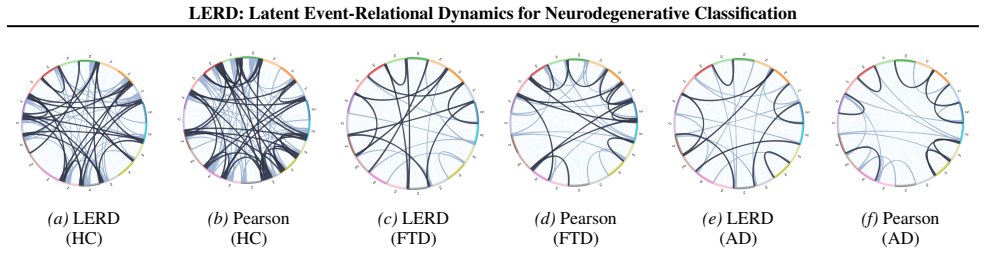
- [Sections 4.6 and 6.2, Eq. (24)-(25)] The graph summaries are not independent discoveries. Eq. (24)-(25) define the ERG regularizer R_ERG as a Fisher-z alignment between the inferred adjacency and the Pearson correlation of the same EEG signal, and Section 6.2 explicitly admits that 'Some similarity to Pearson graphs is expected because we include a weak Fisher-z alignment term.' Figure 3 then presents LERD's ERGs against Pearson graphs as if this were a validation of the model's physiology-aligned graph recovery. This is circular. The dLIF frequency distributions in Figure 2 are also derived from a model trained with label supervision, so they cannot be presented as confirmatory physiological evidence. The abstract's claim that LERD 'yields physiology-aligned ... graph summaries' is thus overstated.
minor comments (4)
- [Equations (12)-(15)] The EPDE expected-next-event-time update in Eq. (12) does not condition on survival: ∫_{\tilde t}^\infty t q(t) dt should be normalized by P(T > \tilde t) to be a conditional expectation. As written, the formula is not the expected next event time given the previous event at \tilde t.
- [Appendix E.4, Table 5] The LCADNet row in Table 5 appears to be missing a delimiter: '0.7006±0.0491 0.8445±0.03580.8462±0.0495' should likely be '0.8445±0.0358, 0.8462±0.0495'.
- [Algorithm 4] The loss in Algorithm 4 includes a term λ_spk L_spk, but no definition of L_spk is provided in the main text or appendices beyond a vague mention of 'spike-informed' losses. This should be specified or removed.
- [Appendix B, Eq. (10)] The improper integral notation ∫_0^{-e^{-S}} g(m) dm is confusing because the upper limit is negative. The limits of integration should be written explicitly as ∫_{-1}^{-e^{-S}}, which would make the mapping to [0,S] clear.
Circularity Check
Graph summaries are regularized toward Pearson correlations of the same EEG and the KL bound's proof leans on an inapplicable self-cited lemma; classification benchmarks remain independent.
-
fitted input called prediction
[Section 4.6, Eq. (24)-(25); Section 6.2]
"To weakly align ERG connectivity with an observable statistic from X^(n) (e.g., Pearson correlation s^(n)_ij ∈(−1,1)), we use Fisher–z matching ... R^(n)_ERG = Σ_{i<j} [ (z^(obs)_ij − z^(pred)_ij)^2/(2σ^2) + ½ log σ^2 ]. ... Some similarity to Pearson graphs is expected because we include a weak Fisher–z alignment term that encourages (but does not enforce) agreement with correlation-based summaries."
The ERG adjacency is explicitly trained to match Fisher-z-transformed Pearson correlations computed from the very same input X^(n). The paper then presents the resulting HC-denser/FTD-AD-sparser connectivity as a model-derived latent summary that 'helps characterize group-level dynamical differences.' Because the target statistic is an input and the model is optimized toward it, the recovered group-level graph trend is partly built in by construction, not independently discovered from event timing. The word 'weak' and β weighting make the forcing partial, so this is a partial, acknowledged reduction rather than a fully forced prediction.
-
self citation load bearing
[Appendix B, Lemma B.1 and Eq. (11); Section 4.3, Theorem 4.1]
"Lemma B.1 (Shift–stability of IVPs (Huang et al., 2021)). ... The last inequality uses Lemma B.1 (applied to the IVPs G′1(m)=g(m) and G′2(m)=g(m) shifted by ε) to control the tail near the singular endpoint and the fact that r is bounded in [a, b], ensuring g remains controlled as m→0−."
The key inequality in Theorem 4.1, Eq. (11), is what makes the training objective's KL term a tractable 'upper bound.' The proof's tail-control step is justified solely by citing Lemma B.1 from the authors' own prior STRODE paper (Huang et al., 2021; co-author Hengguan Huang). The lemma is a shift-stability statement for IVP solutions and does not imply the integral-tail dominance |∫_{−ε}^0 g| ≤ |∫_{−2ε}^{−ε} g|. The load-bearing step therefore reduces to an inapplicable self-citation rather than a derivation from the theorem's assumptions. (Separately, the change-of-variables in Eq. (8) appears algebraically wrong, but that is a correctness issue, not a circularity.)
full rationale
The paper's headline empirical claim—LERD outperforming strong baselines on two AD EEG cohorts under a cross-subject protocol—is externally benchmarked and does not reduce to its inputs; likewise, the synthetic event-recovery experiments are a self-contained generative task. Those parts are not circular. The circularity concerns are concentrated in the interpretative and theoretical claims. First, the ERG is regularized toward Pearson correlations of the same EEG (Eq. 24-25), and the paper acknowledges that similarity to Pearson graphs is expected; the group-level connectivity differences displayed as 'physiology-aligned' summaries are therefore partly constructed from the observable statistic they are supposed to characterize, though the weak β weighting prevents this from being a fully forced prediction. Second, the tractable KL bound that justifies the variational objective is established via a proof that invokes Lemma B.1 from the authors' own prior work; that lemma does not supply the needed tail inequality, so the 'first-principles' bound is not independently derived. The proof also appears to contain a Jacobian error (an extra 1/M factor), but an incorrect proof is not the same as circularity. Overall, the central classification contribution retains independent content, and no step makes the main accuracy result equivalent to its inputs; the circularity is partial and localized to the latent-summary and theory framing.
Assumptions & free parameters
free parameters (6)
- dLIF drive b_c(t) =
learned neural mapping (Eq. 5)
- Edge-map slope α =
not reported
- Loss weights β, λ_LIF, λ_aux, λ_spk, λ_graph =
not reported
- Fisher-z alignment scale σ =
fixed or learned
- MELP scales s_c,j and mixture weights w_c,j =
learned
- KL bound parameters ε, ODE solver settings =
not specified
assumptions (5)
- domain assumption Latent event times can be inferred from scalp EEG without annotations via the EPDE/MELP parameterization.
- ad hoc to paper The change of variables in Appendix B is algebraically correct (Eq. 8).
- ad hoc to paper Lemma B.1 (shift-stability of IVPs, cited from Huang et al. 2021) can bound the tail integral of an arbitrary integrand near a singular endpoint.
- domain assumption The dLIF prior is an appropriate phenomenological model for population-level EEG event rates.
- domain assumption The STDP-shaped lag-to-edge mapping captures disease-relevant interactions.
Cite this review
Pith. "Pith review of LERD: Latent Event-Relational Dynamics for Neurodegenerative Classification." pith.science (2026). https://pith.science/paper/HXMKBAAV
@misc{pith2026260218195,
  author       = {Pith},
  title        = {Pith review of: LERD: Latent Event-Relational Dynamics for Neurodegenerative Classification},
  year         = {2026},
  howpublished = {\url{https://pith.science/paper/HXMKBAAV}},
  note         = {Machine review of arXiv:2602.18195}
}
read the original abstract
Alzheimer's disease (AD) alters brain electrophysiology and disrupts multichannel EEG dynamics, making accurate and clinically useful EEG-based diagnosis increasingly important for screening and disease monitoring. However, many existing approaches rely on black-box classifiers and do not explicitly model the latent event timing and cross-channel coordination behind their decisions. To address these limitations, we propose LERD, an end-to-end Bayesian latent event--relational dynamical system that infers latent neural events and their relational structure directly from multichannel EEG without event or interaction annotations. LERD combines a continuous-time event inference module with a stochastic event-generation process to capture flexible temporal patterns, while incorporating an electrophysiology-inspired dynamical prior to guide learning in a principled way. We further provide theoretical analysis that yields a tractable IVP-based KL regularizer and stability guarantees for the inferred relational dynamics. Extensive experiments on synthetic benchmarks and two real-world AD EEG cohorts demonstrate that LERD consistently outperforms strong baselines and yields physiology-aligned rate, timing, and graph summaries that help characterize group-level dynamical differences.
Figures


Figures from the paper (1 more)

Forward citations
Cited by 1 Pith paper
-
iLoRA: Bayesian Low-Rank Adaptation with Latent Interaction Graphs for Microbiome Diagnosis
iLoRA is the first Bayesian graph-conditioned LoRA framework that infers latent interaction graphs to generate input-dependent low-rank updates, jointly learning predictions and structure for microbiome diagnosis.
Reference graph
Works this paper leans on
-
[2024]
doi: 10.3233/ADR-230159. Feldman, D. E. The spike-timing dependence of plasticity. Neuron, 75(4):556–571, 2012. doi: 10.1016/j.neuron. 2012.08.001. Habiba, M. and Pearlmutter, B. A. Neural ordinary differ- ential equation based recurrent neural network model. In 2020 31st Irish signals and systems conference (ISSC), pp. 1–6. IEEE, 2020. Huang, H., Liu, H....
arXiv 2012
-
[2025]
URL https: //braininformatics.springeropen.com/ articles/10.1186/s40708-025-00260-3
doi: 10.1186/s40708-025-00260-3. URL https: //braininformatics.springeropen.com/ articles/10.1186/s40708-025-00260-3. Vicchietti, M. L., Ramos, F. M., Betting, L. E., and Campanharo, A. S. L. O. Computational methods of eeg signals analysis for Alzheimer’s disease classifica- tion.Scientific Reports, 13:8184, 2023. doi: 10.1038/ s41598-023-32664-8. Wang, ...
arXiv 2023
Reviewed August 2, 2026 · model on record in the stance chip above.
Discussion (0). Continue with ORCID to comment.