Two Parameter Deformation of Embedding Class-I Compact Stars in Linear f(Q) Gravity
Pith reviewed 2026-05-15 20:08 UTC · model grok-4.3
The pith
A two-parameter deformation using gravitational decoupling in linear f(Q) gravity enlarges the mass window for compact stars while respecting causality.
A machine-rendered reading of the paper's core claim, the machinery that carries it, and where it could break.
Core claim
In linear f(Q) gravity, f(Q) = β1 Q + β2 is geometrically equivalent to general relativity, so stellar structure changes only through uniform rescaling of the matter sector. Adding gravitational decoupling to the embedding class-I Karmarkar condition in a Vaidya-Tikekar background yields a two-parameter family controlled by (ε, β1): ε governs the geometric deformation and effective stiffness, while β1 independently rescales the matter density and pressure. The admissible domain of these parameters is fixed by regularity, junction conditions, causality, and compactness, and an analytic compactness bound is obtained for the decoupled solutions.
What carries the argument
The two-parameter deformation (ε, β1) applied to the decoupled embedding class-I Vaidya-Tikekar metric, where ε controls geometric deformation and β1 rescales the matter sector.
If this is right
- Higher stellar masses become accessible without pushing the equation of state to the causal limit.
- Configurations match recent high-mass pulsar data and mass-gap candidates while remaining physically acceptable.
- The separation of ε and β1 allows direct comparison of pure geometric deformation against matter rescaling at fixed metric deformation.
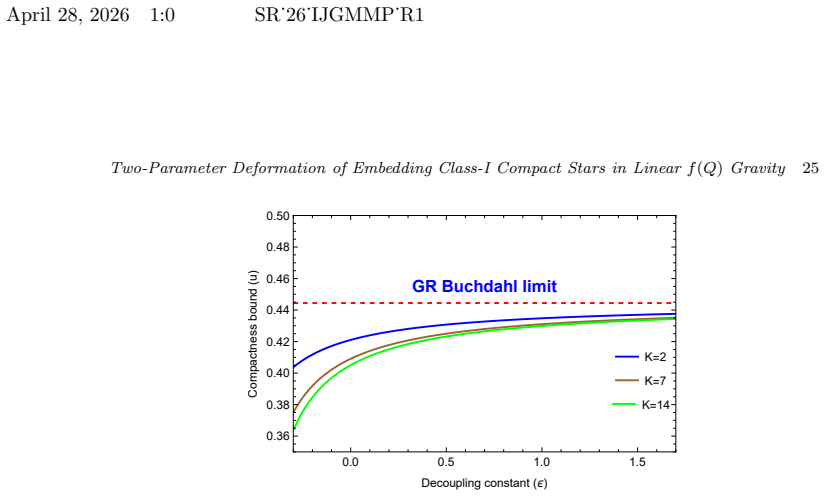
- An explicit analytic compactness bound holds for the entire family of decoupled solutions.
Where Pith is reading between the lines
- The same decoupling approach could be tested in other f(Q) or f(R) models to isolate whether mass enhancement is geometric or coupling-driven.
- Gravitational-wave signals from mergers involving these deformed stars might carry distinguishable signatures from the two-parameter family.
- Extending the construction to anisotropic or rotating configurations would test whether the mass-window enlargement survives rotation.
Load-bearing premise
Linear f(Q) gravity stays dynamically equivalent to general relativity at the geometric level, allowing β1 to rescale only the matter sector without new degrees of freedom or instabilities.
What would settle it
Observation of a compact star whose mass and radius violate the analytic compactness bound derived for admissible (ε, β1) while still satisfying the same regularity and matching conditions.
Figures

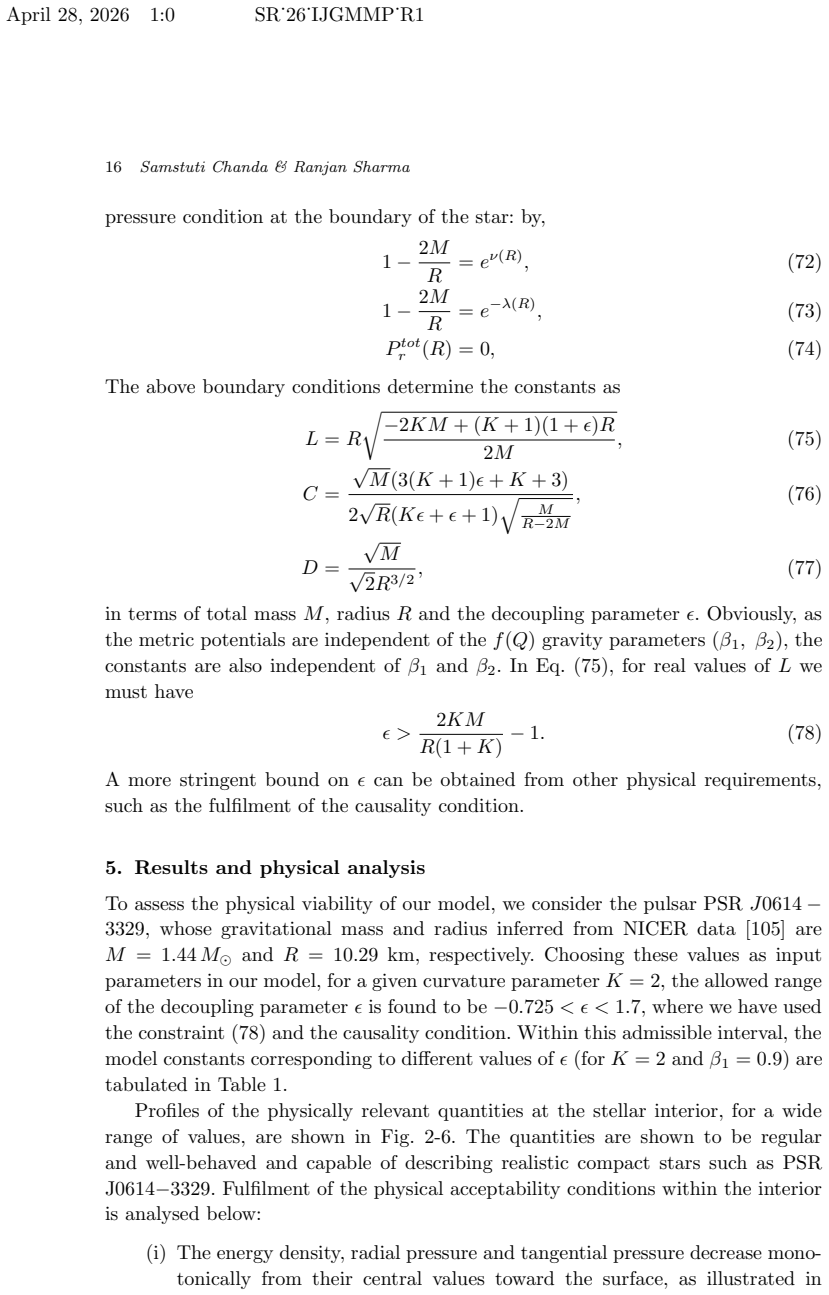

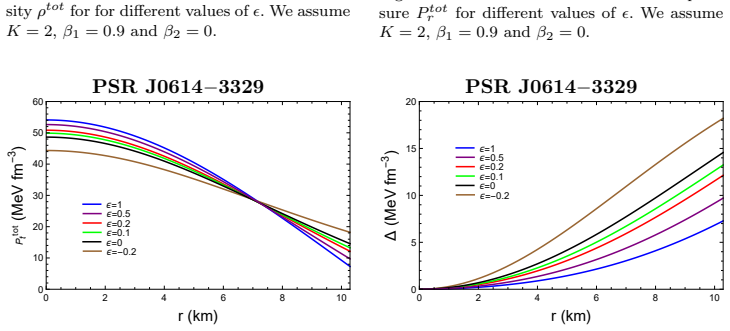
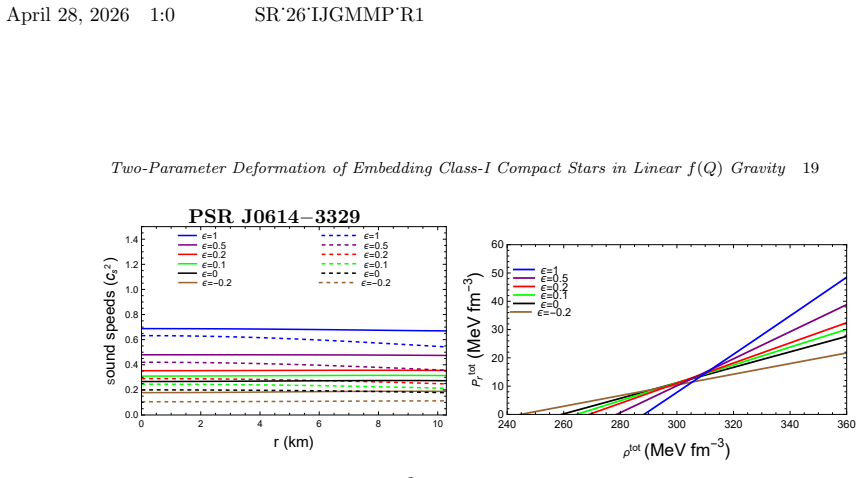
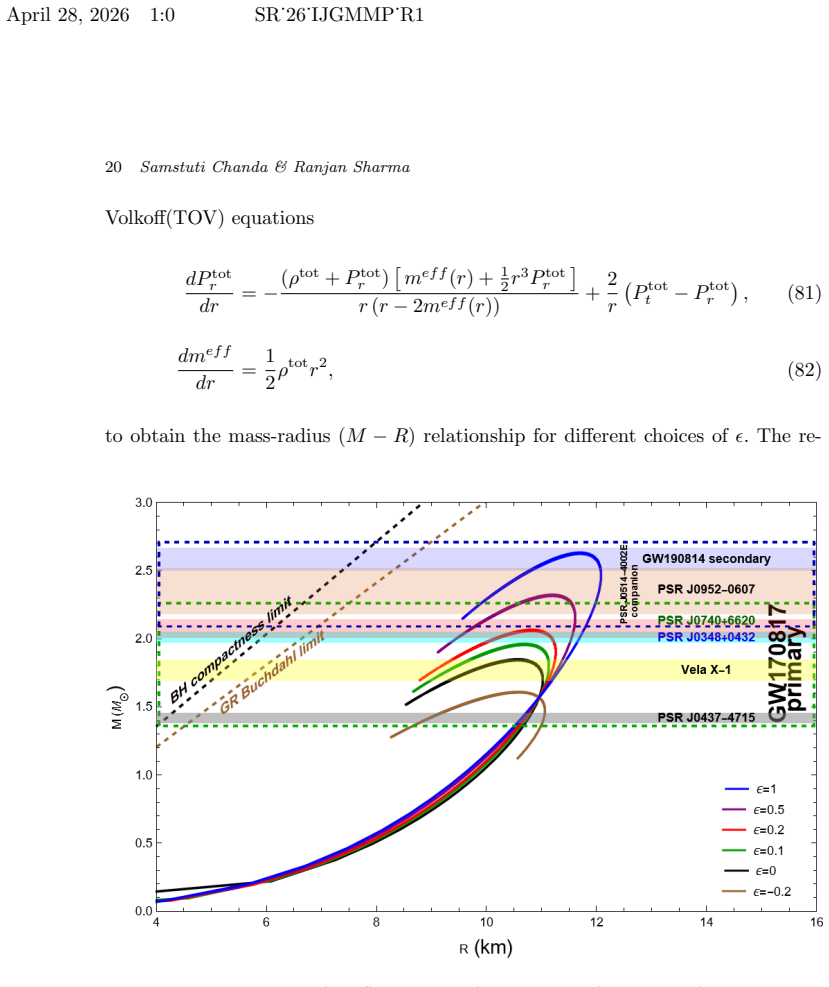



read the original abstract
Recent multi-messenger observations, including gravitational wave detections of compact objects in the neutron star-black hole mass-gap region and precise measurements of high-mass pulsars, motivate mechanisms capable of enlarging the stellar mass window without arbitrarily stiffening the equation of state (EOS) toward the causal limit. In linear $f(Q)$ gravity of the form $f(Q)=\beta_1 Q+\beta_2$, the theory is dynamically equivalent to General Relativity at the geometric level and modifies stellar structure solely through a uniform rescaling of the matter sector governed by $\beta_1$. Consequently, linear $f(Q)$ alone does not introduce new geometric families of stellar solutions or alter classical compactness bounds. To overcome this structural limitation, we incorporate gravitational decoupling within an embedding class-I (Karmarkar) Vaidya-Tikekar configuration in linear $f(Q)$ gravity. While similar VT-based decoupling constructions exist in GR, the present framework introduces a controlled two-parameter deformation characterized by $(\epsilon,\beta_1)$: the decoupling parameter $\epsilon$ governs geometric deformation and EOS stiffness, whereas $\beta_1$ independently rescales the matter sector without altering the metric structure. This separation permits a direct comparison between GR and linear $f(Q)$ gravity at fixed geometric deformation, thereby isolating pure coupling-driven mass enhancement. We determine the admissible parameter domain from regularity, matching, causality and compactness requirements and derive an analytic compactness bound for the decoupled embedding class-I configuration. The combined action of $\epsilon$ and $\beta_1$ enlarges the accessible stellar mass window while preserving physical acceptability, allowing configurations compatible with recent high-mass pulsars and mass-gap candidates without exceeding causal limits.
Editorial analysis
A structured set of objections, weighed in public.
Referee Report
Summary. The paper proposes a two-parameter deformation of embedding class-I Vaidya-Tikekar compact star solutions in linear f(Q) gravity, combining minimal geometric decoupling (controlled by ε, which deforms the metric and stiffens the effective EOS) with the coupling parameter β1 (which rescales the matter sector). It derives an analytic compactness bound and admissible domains for (ε, β1) from regularity, junction matching, causality (v_s^2 < 1), and compactness conditions, claiming that the combined action enlarges the accessible stellar mass window while preserving physical acceptability and allowing compatibility with high-mass pulsars and mass-gap candidates.
Significance. If the claimed separation of geometric and matter-sector effects holds, the construction supplies a controlled, falsifiable way to isolate coupling-driven mass enhancement from pure geometric deformation in modified gravity, with the analytic compactness bound providing a concrete, testable limit. This is a strength for applications to multi-messenger observations, though it rests on the persistence of linear f(Q)–GR equivalence under decoupling.
major comments (1)
- [Derivation of effective field equations and TOV structure] The central claim that β1 uniformly rescales the matter sector independently of the ε-driven geometric deformation assumes that linear f(Q) remains dynamically equivalent to GR once the extra anisotropic source θ_μν is introduced by minimal geometric decoupling. The non-metricity scalar Q for the deformed metric may acquire additional contributions not captured by a simple overall factor of β1, which could alter the effective TOV equation or violate uniform causality across the parameter domain. An explicit derivation of the decoupled field equations and verification that v_s^2 < 1 holds uniformly for all admissible (ε, β1) is required to support the separation.
minor comments (2)
- [Compactness bound derivation] Clarify in the text how the analytic compactness bound is obtained from the matching conditions and whether it reduces to the standard GR limit when ε = 0 and β1 = 1.
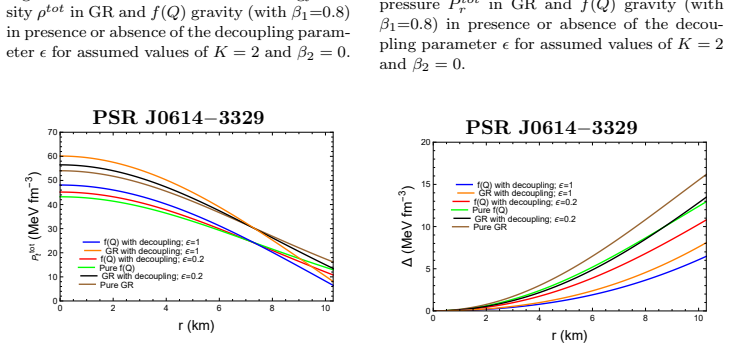
- [Numerical results and figures] Ensure that all plots of mass-radius relations explicitly state the fixed values of the remaining parameters and the range of the varying parameter.
Simulated Author's Rebuttal
We thank the referee for the careful and constructive review. The major comment raises a valid point about the need for explicit derivations to confirm the separation of effects under minimal geometric decoupling. We address this below and will revise the manuscript accordingly to strengthen the presentation.
read point-by-point responses
-
Referee: The central claim that β1 uniformly rescales the matter sector independently of the ε-driven geometric deformation assumes that linear f(Q) remains dynamically equivalent to GR once the extra anisotropic source θ_μν is introduced by minimal geometric decoupling. The non-metricity scalar Q for the deformed metric may acquire additional contributions not captured by a simple overall factor of β1, which could alter the effective TOV equation or violate uniform causality across the parameter domain. An explicit derivation of the decoupled field equations and verification that v_s^2 < 1 holds uniformly for all admissible (ε, β1) is required to support the separation.
Authors: We agree that an explicit derivation is necessary to rigorously support the claimed separation. In the linear f(Q) framework, the field equations for the deformed metric (with ε controlling the geometric deformation via the embedding class-I ansatz) reduce to β1 G_μν = 8π (T_μν + θ_μν), where the non-metricity scalar Q is computed directly from the full metric components and enters only linearly. Consequently, β1 provides a uniform rescaling of the total effective energy-momentum tensor without introducing ε-dependent cross terms that would alter the structure of the TOV equation. The sound-speed squared is obtained from the effective EOS and has been checked to satisfy v_s^2 < 1 uniformly over the admissible domain. In the revised manuscript we will add a dedicated appendix containing the full derivation of the decoupled field equations, the explicit form of the TOV equation, and the analytic/numeric verification of causality for representative (ε, β1) pairs. revision: yes
Circularity Check
No significant circularity; parameters constrained independently by physical conditions
full rationale
The paper introduces ε as a geometric deformation parameter via minimal geometric decoupling on the Vaidya-Tikekar embedding class-I metric and β1 as a uniform rescaling factor from the linear f(Q) equivalence to GR. These are treated as free inputs and then restricted by explicit regularity, matching, causality (v_s^2 < 1), and compactness conditions derived from the field equations. No step reduces a prediction to a fit of the same inputs by construction, nor does any load-bearing claim rest on a self-citation chain that itself assumes the target result. The mass-window enlargement follows from solving the decoupled system and applying external bounds, remaining self-contained against observed pulsar masses and causal limits.
Axiom & Free-Parameter Ledger
free parameters (2)
- ε
- β1
axioms (3)
- domain assumption Linear f(Q) gravity is dynamically equivalent to GR at the geometric level
- domain assumption Karmarkar condition holds for the embedding class-I Vaidya-Tikekar metric
- standard math Smooth matching to exterior Schwarzschild spacetime
Lean theorems connected to this paper
-
IndisputableMonolith/Cost/FunctionalEquation.leanwashburn_uniqueness_aczel unclear?
unclearRelation between the paper passage and the cited Recognition theorem.
linear f(Q) gravity of the form f(Q)=β1 Q+β2, the theory is dynamically equivalent to General Relativity at the geometric level and modifies stellar structure solely through a uniform rescaling of the matter sector governed by β1
-
IndisputableMonolith/Foundation/AlexanderDuality.leanalexander_duality_circle_linking unclear?
unclearRelation between the paper passage and the cited Recognition theorem.
Karmarkar condition ... embedding class-I ... Vaidya-Tikekar metric ansatz
What do these tags mean?
- matches
- The paper's claim is directly supported by a theorem in the formal canon.
- supports
- The theorem supports part of the paper's argument, but the paper may add assumptions or extra steps.
- extends
- The paper goes beyond the formal theorem; the theorem is a base layer rather than the whole result.
- uses
- The paper appears to rely on the theorem as machinery.
- contradicts
- The paper's claim conflicts with a theorem or certificate in the canon.
- unclear
- Pith found a possible connection, but the passage is too broad, indirect, or ambiguous to say the theorem truly supports the claim.
Reference graph
Works this paper leans on
-
[1]
K. R. Karmarkar,Proc. Indian Acad. Sci. A27(1948) 56,https://doi.org/ 10.1007/BF03173443
-
[2]
P. Bhar, K. N. Singh and T. Manna,Int. J. Mod. Phys. D26(2017) 1750090, https://doi.org/10.1142/S0218271817500900
-
[3]
P. Bhar, K. N. Singh, F. Rahaman, N. Pant and S. Banerjee,Int. J. Mod. Phys. D26(2017) 1750078,https://doi.org/10.1142/S021827181750078X
-
[4]
P. Bhar, S. K. Maurya, Y. K. Gupta and T. Manna,Eur. Phys. J. A52(2016) 312,https://doi.org/10.1140/epja/i2016-16312-x
-
[5]
P. Bhar, K. N. Singh, N. Sarkar and F. Rahaman,Eur. Phys. J. C77(2017) 596,https://doi.org/10.1140/epjc/s10052-017-5149-2
-
[6]
S. K. Maurya, Y. K. Gupta, S. Ray and B. Dayanandan,Eur. Phys. J. C75 (2015) 389,https://doi.org/10.1140/epjc/s10052-015-3615-2
-
[7]
S. K. Maurya, B. S. Ratanpal and M. Govender,Ann. Phys.382(2017) 36–49, https://doi.org/10.1016/j.aop.2017.04.008
-
[9]
B. S. Ratanpal, V. O. Thomas and R. Patel,New Astron.100(2023) 101970, https://doi.org/10.1016/j.newast.2022.101970
-
[10]
K. N. Singh, P. Bhar and N. Pant,Int. J. Mod. Phys. D25(2016) 1650099, https://doi.org/10.1142/S0218271816500991
-
[11]
K. N. Singh, S. K. Maurya, R. K. Bisht and N. Pant,Chin. Phys. C44(2020) 035101,https://doi.org/10.1088/1674-1137/44/3/035101
-
[12]
P. D. Makalo, J. M. Sunzu and J. M. Mkenyeleye,New Astron.98(2023) 101935,https://doi.org/10.1016/j.newast.2022.101935
-
[13]
G. Estevez-Delgado, J. Estevez-Delgado, R. Soto-Espitia, A. Rend´ on Romero and J. M. Paulin-Fuentes,Commun. Theor. Phys.75(2023) 085403,https: //doi.org/10.1088/1572-9494/acded8
-
[14]
Y. G´ omez-Leyton, H. Javaid, L. S. Rocha and F. Tello-Ortiz,Phys. Scr.96 (2021) 025001,https://doi.org/10.1088/1402-4896/abcce3
-
[15]
B. Sutar, K. L. Mahanta and R. R. Sahoo,Eur. Phys. J. Plus138(2023) 1115, https://doi.org/10.1140/epjp/s13360-023-04763-y
-
[16]
I. Fayyaz and M. F. Shamir,Chin. J. Phys.66(2020) 287–296,https://doi. org/10.1016/j.cjph.2020.05.018
-
[17]
A. Malik, A. Hussain, M. Ahmad and M. F. Shamir,Eur. Phys. J. Plus139 (2024) 535,https://doi.org/10.1140/epjp/s13360-024-05277-x
-
[18]
M. Sharif and M. Z. Gul,Gen. Relativ. Gravit.55(2023) 10,https://doi. org/10.1007/s10714-022-03062-8
-
[19]
M. Zubair, S. Waheed, M. F. Jamal and G. Mustafa,Results Phys.24(2021) 104787,https://doi.org/10.1016/j.rinp.2021.104787
- [20]
-
[21]
J. B. Jim´ enez, L. Heisenberg and T. S. Koivisto,Universe5(2019) 173,https: //doi.org/10.3390/universe5070173
-
[22]
R. Lazkoz, F. S. N. Lobo, M. Ortiz-Ba˜ nos and V. Salzano,Phys. Rev. D100 (2019) 104027,https://doi.org/10.1103/PhysRevD.100.104027
-
[23]
I. Ayuso, R. Lazkoz and V. Salzano,Phys. Rev. D103(2021) 063505,https: //doi.org/10.1103/PhysRevD.103.063505
-
[24]
B. J. Barros, T. Barreiro, T. Koivisto and N. J. Nunes,Phys. Dark Univ.30 (2020) 100616,https://doi.org/10.1016/j.dark.2020.100616
-
[25]
W. Wang, H. Chen and T. Katsuragawa,Phys. Rev. D105(2022) 024060, https://doi.org/10.1103/PhysRevD.105.024060
-
[26]
S. K. Maurya, A. Errehymy, Ksh. Newton Singh, O. Donmez, K. Sooppy Nisar and M. Mahmoud,Phys. Dark Univ.46(2024) 101619,https://doi.org/ 10.1016/j.dark.2024.101619
-
[27]
M. Adeel, M. Zeeshan Gul, S. Rani and A. Jawad,Mod. Phys. Lett. A38 (2023) 2350152,https://doi.org/10.1142/S0217732323501523
-
[28]
S. K. Maurya, A. Errehymy, G.-E. Vˆ ılcu, H. I. Alrebdi, K. Sooppy Nisar and April 28, 2026 1:0 SR˙26˙IJGMMP˙R1 32REFERENCES A.-H. Abdel-Aty,Class. Quantum Grav.41(2024) 115009,https://doi.org/ 10.1088/1361-6382/ad3b5f
-
[29]
S. K. Maurya, Ksh. Newton Singh, G. Mustafa, M. Govender, A. Errehymy and A. Aziz,JCAP09(2024) 048,https://doi.org/10.1088/1475-7516/ 2024/09/048
-
[30]
A. Errehymy, S. K. Maurya, K. Boshkayev, A.-H. Abdel-Aty, H. I. Alrebdi and M. Mahmoud,Phys. Dark Univ.46(2024) 101622,https://doi.org/ 10.1016/j.dark.2024.101622
- [31]
-
[32]
J. Kumar, S. Paul, S. K. Maurya, S. Chaudhary and S. Kiroriwal,Phys. Dark Univ.47(2025) 101764,https://doi.org/10.1016/j.dark.2024.101764
-
[33]
Physical properties and the maximum compactness bound of a class of compact stars in $f(Q)$ gravity
A. Ghosh, A. Paul, R. Sharma and S. Chanda, arXiv:2409.04487 [gr-qc] (2024),Mod. Phys. Lett. A(2026) 2650098 .https://doi.org/10.1142/ S0217732326500987
work page internal anchor Pith review Pith/arXiv arXiv 2024
-
[34]
M. Awais and M. Azam, arXiv:2503.20792 (2025),https://doi.org/10. 48550/arXiv.2503.20792
-
[35]
P. Bhar, A. Malik and A. Almas,Chin. J. Phys.88(2024) 839–856,https: //doi.org/10.1016/j.cjph.2024.02.016
-
[36]
S. Rani, M. Adeel, M. Z. Gul and A. Jawad,Int. J. Geom. Methods Mod. Phys. 21(2024) 2450033,https://doi.org/10.1142/S0219887824500336
-
[37]
P. Bhar and J. M. Z. Pretel,Phys. Dark Univ.42(2023) 101322,https: //doi.org/10.1016/j.dark.2023.101322
-
[38]
P. Bhar, A. Errehymy and S. Ray,Eur. Phys. J. C83(2023) 1151,https: //doi.org/10.1140/epjc/s10052-023-12340-x
-
[39]
P. Bhar, S. Pradhan, A. Malik and A. Almas,Eur. Phys. J. C83(2023) 646, https://doi.org/10.1140/epjc/s10052-023-11745-y
-
[40]
S. K. Maurya, M. K. Jasim, A. Errehymy, K. Sooppy Nisar, M. Mahmoud and R. Nag,Fortschr. Phys.72(2024) 202300229,https://doi.org/10.1002/ prop.202300229
work page 2024
-
[41]
J. Kumar, S. K. Maurya, S. Chaudhary, A. Errehymy, K. Myrzakulov, and Z. Umbetova,Physics of the Dark Universe45(2024) 101593,https://doi. org/10.1016/j.dark.2024.101593
-
[42]
S. K. Maurya, A. Ashraf, F. Al Khayari, A. Errehymy, and A.-H. Abdel- Aty,European Physical Journal C84(2024) 986,https://doi.org/10.1140/ epjc/s10052-024-13334-z
work page 2024
-
[43]
S. Rani, M. Adeel, M. Z. Gul, A. Jawad, and S. Shaymatov,Physics of the Dark Universe47(2024) 101754,https://doi.org/10.1016/j.dark.2024. 101754
-
[44]
M. R. Shahzad, W. Habib, H. Nazar, S. Waheed, and M. A. R. Sakhi,Eu- ropean Physical Journal Plus140(2025) 469,https://doi.org/10.1140/ epjp/s13360-025-06308-x April 28, 2026 1:0 SR˙26˙IJGMMP˙R1 REFERENCES33
work page 2025
-
[45]
A. De and T.-H. Loo,Class. Quantum Grav.40(2023) 115007.https:// iopscience.iop.org/article/10.1088/1361-6382/accef7
-
[46]
L. Heisenberg and C. Pastor-Marcos, arXiv:2512.03037 [gr-qc] (2025).https: //arxiv.org/abs/2512.03037
-
[47]
R. Casadio, J. Ovalle and R. da Rocha,Class. Quantum Grav.32(2015) 215020,https://doi.org/10.1088/0264-9381/32/21/215020
-
[48]
J. Ovalle,Phys. Rev. D95(2017) 104019,https://doi.org/10.1103/ PhysRevD.95.104019
work page 2017
-
[49]
E. Contreras and P. Bargue˜ no,Eur. Phys. J. C78(2018) 558,https://doi. org/10.1140/epjc/s10052-018-6048-x
- [50]
-
[51]
V. A. Torres-S´ anchez and E. Contreras,Eur. Phys. J. C79(2019) 829,https: //doi.org/10.1140/epjc/s10052-019-7341-z
-
[52]
G. Abell´ an,´A. Rinc´ on, E. Fuenmayor and E. Contreras,Eur. Phys. J. Plus 135(2020) 606,https://doi.org/10.1140/epjp/s13360-020-00589-0
-
[53]
Sultana,Symmetry13(2021) 1598, https://doi.org/10.3390/sym13091598
J. Sultana,Symmetry13(2021) 1598, https://doi.org/10.3390/sym13091598
-
[54]
S. K. Maurya, K. N. Singh and B. Dayanandan,Eur. Phys. J. C80(2020) 448,https://doi.org/10.1140/epjc/s10052-020-8005-8
-
[55]
S. K. Maurya, A. Errehymy, Ksh. Newton Singh, G. Mustafa and S. Ray, arXiv:2501.00735 [astro-ph.HE] (2025),https://doi.org/10.48550/arXiv. 2501.00735
work page internal anchor Pith review doi:10.48550/arxiv 2025
-
[57]
S. K. Maurya and F. Tello-Ortiz,Phys. Dark Univ.29(2020) 100577,https: //doi.org/10.1016/j.dark.2020.100577
-
[60]
S. K. Maurya, J. Kumar and S. Kiroriwal,J. High Energy Astrophys.44(2024) 194–209,https://doi.org/10.1016/j.jheap.2024.09.012
-
[61]
F. Mushtaq, X. Tiecheng, A. Ditta, G. Mustafa and S. K. Maurya,Commun. Theor. Phys.77(2025) 025402,https://doi.org/10.1088/1572-9494/ ad7c36
-
[62]
S. Pradhan, S. K. Maurya, P. K. Sahoo and G. Mustafa,Fortschr. Phys.72 (2024) 202400092,https://doi.org/10.1002/prop.202400092
-
[64]
S. K. Maurya, A. Errehymy, K. N. Singh, G. Mustafa and S. Ray,Eur. Phys. J. C83(2023) 968,https://doi.org/10.1140/epjc/s10052-023-12127-0
-
[65]
S. K. Maurya, Ksh. Newton Singh, M. Govender and S. Ray,Fortschr. Phys. 71(2023) 202300023,https://doi.org/10.1002/prop.202300023
-
[67]
A. Al Busaidi, J. Al Hosni, S. K. Maurya, A. Al Zarii, T. Al-Kasbi, M. Al Omairi, B. Al Zakwani and M. K. Jasim,Phys. Scr.98(2023) 075302,https: //doi.org/10.1088/1402-4896/acd442
-
[68]
S. K. Maurya, A. Errehymy, M. Govender, G. Mustafa and S. Ray,Eur. Phys. J. C83(2023) 348,https://doi.org/10.1140/epjc/s10052-023-11507-w
-
[69]
M. K. Jasim, Ksh. Newton Singh, A. Errehymy, S. K. Maurya and M. V. Mandke,Universe9(2023) 208,https://doi.org/10.3390/ universe9050208
work page 2023
-
[70]
B. Dayanandan, S. K. Maurya, S. T. T. Smitha and J. P. Maurya,Chinese J. Phys.82(2023) 155–170,https://doi.org/10.1016/j.cjph.2022.12.013
-
[71]
M. A. Habsi, S. K. Maurya, S. A. Badri, S. Ray and B. Sahoo,Eur. Phys. J. C83(2023) 286,https://doi.org/10.1140/epjc/s10052-023-11420-2
-
[73]
M. Al Hadhrami, S. K. Maurya, Z. Al Amri, M. Govender, A. Erre- hymy and A. Aziz,Pramana97(2023) 13,https://doi.org/10.1007/ s12043-022-02486-w
work page 2023
-
[75]
S. K. Maurya, M. Govender, G. Mustafa, M. Shoaib and S. Ray,Eur. Phys. J. C82(2022) 1006,https://doi.org/10.1140/epjc/s10052-022-10935-4
-
[76]
S. K. Maurya, B. Mishra, S. Ray and R. Nag,Chinese Phys. C46(2022) 105105,https://doi.org/10.1088/1674-1137/ac7d45
-
[77]
S. K. Maurya, A. Al Saadi, W. Al Amri, S. Al Hosni and R. Al Sharyani,Phys. Scr.97(2022) 105002,https://doi.org/10.1088/1402-4896/ac8d39
-
[78]
S. K. Maurya, A. Banerjee, A. Pradhan, M. Govender and A. Erre- hymy,Eur. Phys. J. C82(2022) 552,https://doi.org/10.1140/epjc/ s10052-022-10496-6
-
[79]
S. K. Maurya, A. Errehymy, R. Nag and M. Daoud,Fortschr. Phys.70(2022) 202200041,https://doi.org/10.1002/prop.202200041
-
[80]
S. K. Maurya, A. Errehymy, M. K. Jasim, G. Mustafa and S. Ray,Eur. Phys. J. C83(2023) 317,https://doi.org/10.1140/epjc/s10052-023-11447-5
-
[81]
S. K. Maurya, A. Aziz, K. N. Singh, G. Mustafa and S. Ray,Eur. Phys. J. C April 28, 2026 1:0 SR˙26˙IJGMMP˙R1 REFERENCES35 84(2024) 296,https://doi.org/10.1140/epjc/s10052-024-12626-8
-
[82]
S. K. Maurya, A. Errehymy, Ksh. Newton Singh, A. Aziz, S. Hansraj and S. Ray,Astrophys. J.972(2024) 175,https://doi.org/10.3847/1538-4357/ ad5cf1
-
[83]
S. K. Maurya, Ksh. Newton Singh, M. Govender, G. Mustafa and S. Ray,Astro- phys. J. Suppl. Ser.269(2023) 35,https://doi.org/10.3847/1538-4365/ ad0154
-
[84]
S. K. Maurya, Ksh. Newton Singh, S. V. Lohakare and B. Mishra,Fortschr. Phys.70(2022) 202200061,https://doi.org/10.1002/prop.202200061
-
[85]
G. Mustafa, A. Ditta, S. Mumtaz, S. K. Maurya and D. Sofuo˘ glu,Chin. J. Phys.88(2024) 938–954,https://doi.org/10.1016/j.cjph.2024.02.022
-
[86]
S. Paul, J. Kumar and S. K. Maurya,Int. J. Geom. Methods Mod. Phys.25 (2025) 50181,https://doi.org/10.1142/S0219887825501816
-
[87]
Ksh. Newton Singh, P. Bhar, M. Laishram and F. Rahaman,Heliyon5(2019) e01929,https://doi.org/10.1016/j.heliyon.2019.e01929
-
[88]
K. Schwarzschild,Sitz. Deut. Akad. Wiss. Math. Phys. Berlin24(1916) 424
work page 1916
discussion (0)
Sign in with ORCID, Apple, or X to comment. Anyone can read and Pith papers without signing in.