Recognition: 1 theorem link
· Lean TheoremExponential Quintessence Model: Analytical Quantification of the Fine-Tuning Problem in Dark Energy
Pith reviewed 2026-05-15 21:02 UTC · model grok-4.3
The pith
An exponential quintessence model relaxes dark energy fine-tuning by dozens of orders of magnitude.
A machine-rendered reading of the paper's core claim, the machinery that carries it, and where it could break.
Core claim
By assuming a kination epoch, analytical constraints on initial conditions for the exponential quintessence field are obtained that satisfy BBN and yield the observed dark energy density today, indicating a relaxation of fine-tuning by dozens of orders of magnitude relative to the cosmological constant.
What carries the argument
The exponential potential of the quintessence field, used to analytically constrain initial conditions during the kination epoch.
If this is right
- The initial conditions are consistent with Big Bang Nucleosynthesis bounds.
- The current dark energy density is reproduced without severe fine-tuning.
- The model predicts time-varying dark energy consistent with DESI hints.
- Future observations of the gravitational wave background can test the scenario.
Where Pith is reading between the lines
- If correct, dynamical dark energy models may require less tuning than static ones across a wider range of potentials.
- Similar analytical methods could be applied to other early-universe epochs or potentials to quantify tuning in alternative cosmologies.
- Precise measurements of the dark energy equation of state could confirm or rule out the exponential form.
Load-bearing premise
The derivation relies on the assumption that a kination epoch occurred in the early universe.
What would settle it
A precise measurement showing that dark energy is exactly constant with no variation, or gravitational wave background data that does not match the amplitude expected from the kination phase in this model.
Figures


read the original abstract
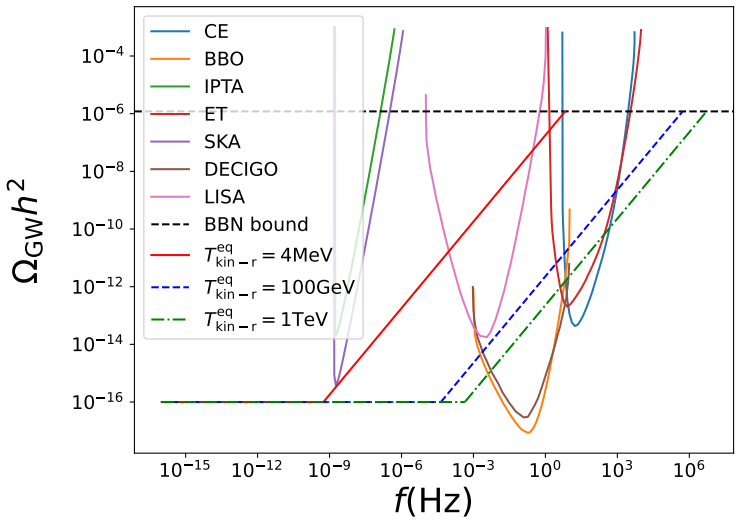
In this paper, we investigate a quintessence field with an exponential potential motivated by the suggestion of time-varying dark energy from the DESI galaxy survey. Assuming a kination epoch in the early Universe, we analytically derive constraints on initial conditions that are consistent with Big Bang Nucleosynthesis and the current dark energy density. Compared to the severe 120-digit fine-tuning required for dark energy to be a cosmological constant, our result suggests that the degree of fine-tuning is naturally relaxed by dozens of orders of magnitude. Furthermore, we discuss the method for testing this model through future observations of the gravitational wave background.
Editorial analysis
A structured set of objections, weighed in public.
Referee Report
Summary. The paper analytically derives constraints on the initial conditions (field value and velocity) for an exponential quintessence model, assuming an early kination epoch. These constraints ensure consistency with Big Bang Nucleosynthesis and the observed present-day dark energy density Ω_DE. The central claim is that this setup relaxes the fine-tuning problem by dozens of orders of magnitude relative to the 120-digit tuning required for a cosmological constant, with additional discussion of tests via the gravitational wave background.
Significance. If the kination-based derivation holds, the work offers an analytical quantification of initial-condition volume in quintessence that could substantially alleviate the cosmological constant problem, providing a concrete measure of naturalness. The analytical approach is a strength, as it enables explicit constraints rather than purely numerical exploration, and the suggestion of gravitational wave tests adds falsifiability.
major comments (2)
- [derivation of initial conditions (abstract and main text)] The headline result—that fine-tuning is relaxed by dozens of orders of magnitude—depends entirely on the assumption of an early kination epoch to derive the initial conditions (φ, φ̇) that keep the field frozen through BBN and roll to match Ω_DE today. The manuscript provides no independent justification that kination arises naturally without additional tuning, nor does it recompute the viable initial-condition measure under standard radiation-dominated evolution from earlier times. This assumption is load-bearing for the central claim.
- [comparison to cosmological constant fine-tuning] The initial conditions are explicitly chosen to reproduce the observed present-day dark energy density, introducing a partial circularity in the fine-tuning quantification. While the analytical form mitigates some dependence, the paper should clarify how much of the 'relaxation' is due to fitting to the target Ω_DE versus genuine dynamical naturalness.
minor comments (2)
- The abstract states an analytical derivation exists, yet the manuscript should include explicit equations, error analysis, and validation against numerical integration to make the support for the central claim fully verifiable.
- Add a brief discussion of how the allowed initial-condition volume changes if the kination phase is removed, to address the robustness of the fine-tuning relaxation.
Simulated Author's Rebuttal
We thank the referee for their thorough review and valuable feedback on our paper. We address each major comment in detail below, providing clarifications and indicating revisions made to the manuscript.
read point-by-point responses
-
Referee: [derivation of initial conditions (abstract and main text)] The headline result—that fine-tuning is relaxed by dozens of orders of magnitude—depends entirely on the assumption of an early kination epoch to derive the initial conditions (φ, φ̇) that keep the field frozen through BBN and roll to match Ω_DE today. The manuscript provides no independent justification that kination arises naturally without additional tuning, nor does it recompute the viable initial-condition measure under standard radiation-dominated evolution from earlier times. This assumption is load-bearing for the central claim.
Authors: We agree that the kination epoch is central to our analysis and the headline result. Our manuscript explicitly assumes this epoch as part of the model setup, motivated by post-inflationary scenarios where the scalar field kinetic energy dominates before transitioning to radiation domination. To strengthen the paper, we have added references and a brief discussion in the introduction explaining why kination is a reasonable assumption in certain theoretical frameworks, such as those arising from string theory moduli stabilization. Regarding recomputing under standard radiation-dominated evolution, we note that our focus is on the kination case to demonstrate the relaxation possible in that context; a full recomputation would require a separate study but we have added a comment in the conclusions suggesting this as future work. We do not claim that kination arises without any tuning, but rather quantify the fine-tuning reduction conditional on the kination assumption. revision: partial
-
Referee: [comparison to cosmological constant fine-tuning] The initial conditions are explicitly chosen to reproduce the observed present-day dark energy density, introducing a partial circularity in the fine-tuning quantification. While the analytical form mitigates some dependence, the paper should clarify how much of the 'relaxation' is due to fitting to the target Ω_DE versus genuine dynamical naturalness.
Authors: We appreciate this observation on potential circularity. The initial conditions are constrained to ensure the field reaches the observed Ω_DE today while satisfying BBN bounds, but the fine-tuning measure is the logarithmic volume of the allowed initial condition space in the (φ, φ̇) plane. This volume is large compared to the extreme precision needed for a cosmological constant, where the energy density must be tuned to 1 part in 10^120 without any dynamical mechanism. The analytical derivation shows that for exponential potentials, the field can start from a wide range of values and still freeze until late times. In the revised version, we have included an explicit comparison paragraph in section 4, distinguishing the dynamical naturalness (insensitivity to initial conditions within the basin) from the boundary condition of matching Ω_DE. The relaxation by dozens of orders refers to the size of this basin relative to the CC case. revision: yes
Circularity Check
No significant circularity; derivation uses explicit dynamical assumptions to compute initial-condition volume
full rationale
The paper states its kination-epoch assumption upfront and derives analytic bounds on initial (φ, φ̇) so the field stays frozen through BBN and reaches the observed Ω_DE today. The fine-tuning relaxation claim is obtained by measuring the volume of that dynamically allowed region relative to Planck-scale naturalness; the observed density is used only as an external benchmark, not redefined into the result. No equation reduces to its own input by construction, no self-citation supplies a load-bearing uniqueness theorem, and the kination premise is not smuggled via prior work. The calculation is therefore self-contained against the stated assumptions.
Axiom & Free-Parameter Ledger
free parameters (1)
- Initial field value and velocity
axioms (1)
- domain assumption Existence of a kination epoch prior to radiation domination
Forward citations
Cited by 2 Pith papers
-
Exponential Quintessence: Analytic Relationship Between the Current Equation of State Parameter and the Potential Parameter
For an exponential quintessence potential, an analytic formula links the current equation-of-state w_φ0 to the potential slope λ while enforcing prior radiation and matter domination, yielding the bound λ < 1.94 at Ω_...
-
Simple Analytical Solutions of the Wheeler-DeWitt Equation in the Classical Hamilton-Jacobi Limit
Imposing |Ψ|=1 on the Wheeler-DeWitt wave function determines the scalar potential form and yields analytical solutions for the scale factor and field in the cosine case with negative cosmological constant.
Reference graph
Works this paper leans on
-
[1]
In the following subsection, we analytically analyze the behavior of the scalar field in each epoch
The upper panels show the kinetic and potential energies ofϕseparately, while the lower panels present the total (kinetic + potential) energy density ofϕ. In the following subsection, we analytically analyze the behavior of the scalar field in each epoch. A. Kination Phase First, we consider the kination phase. In this phase, the potential term in the equ...
-
[2]
In the top panels (a), and (b), we show each component of ϕwhich is the kinetic energy or the potential energy separately. On the other hand, in the bottom panels (c), (d), we show the total(kinetic + potential) energy density ofϕ. This leads to ˙ϕ= C t (13) whereCis a constant and solved to beC=± q 2 3 mpl. Therefore,ϕis given by ϕ=ϕ i ± √ 6mpl(N−N i),(1...
-
[3]
This indicates that forλ > √ 6, the potential energy decreases more rapidly than kinetic energy, whereas forλ < √ 6, it decreases more slowly than the kinetic energy. B. F reezing Phase Since the kinetic energy decreases more rapidly (∝a −6) than radiation (∝a −4), the scalar field eventually becomes subdominant. Once the scalar field becomes subdominant ...
-
[4]
Similarly in the matter domination, the terms keep the ratio: ¨ϕ 3H ˙ϕ = 1 2 and V,ϕ 3H ˙ϕ =− 3 2. 11 Finally, the field settles into its asymptotic state, which is either the scaling solution with matter or the domination of scalar field. The detail of this final stage does not affect the degree of fine-tuning for the initial conditions, and thus we can ...
-
[5]
The Cosmological Constant Problem and Quintessence
V. Sahni, The Cosmological constant problem and quintessence, Class. Quant. Grav.19, 3435 (2002), arXiv:astro-ph/0202076
work page internal anchor Pith review Pith/arXiv arXiv 2002
-
[6]
P. J. E. Peebles and B. Ratra, The Cosmological Constant and Dark Energy, Rev. Mod. Phys. 75, 559 (2003), arXiv:astro-ph/0207347. 18
work page internal anchor Pith review Pith/arXiv arXiv 2003
-
[7]
A. G. Adameet al.(DESI), DESI 2024 VI: cosmological constraints from the measurements of baryon acoustic oscillations, JCAP02, 021, arXiv:2404.03002 [astro-ph.CO]
work page internal anchor Pith review Pith/arXiv arXiv 2024
-
[8]
DESI DR2 Results II: Measurements of Baryon Acoustic Oscillations and Cosmological Constraints
M. Abdul Karimet al.(DESI), DESI DR2 results. II. Measurements of baryon acoustic os- cillations and cosmological constraints, Phys. Rev. D112, 083515 (2025), arXiv:2503.14738 [astro-ph.CO]
work page internal anchor Pith review Pith/arXiv arXiv 2025
-
[9]
Y. Tada and T. Terada, Quintessential interpretation of the evolving dark energy in light of DESI observations, Phys. Rev. D109, L121305 (2024), arXiv:2404.05722 [astro-ph.CO]
- [10]
-
[11]
Cosmological Constraints on Late-time Entropy Production
M. Kawasaki, K. Kohri, and N. Sugiyama, Cosmological constraints on late time entropy production, Phys. Rev. Lett.82, 4168 (1999), arXiv:astro-ph/9811437
work page internal anchor Pith review Pith/arXiv arXiv 1999
-
[12]
MeV-scale Reheating Temperature and Thermalization of Neutrino Background
M. Kawasaki, K. Kohri, and N. Sugiyama, MeV scale reheating temperature and thermaliza- tion of neutrino background, Phys. Rev. D62, 023506 (2000), arXiv:astro-ph/0002127
work page internal anchor Pith review Pith/arXiv arXiv 2000
-
[13]
K. Ichikawa, M. Kawasaki, and F. Takahashi, The Oscillation effects on thermalization of the neutrinos in the Universe with low reheating temperature, Phys. Rev. D72, 043522 (2005), arXiv:astro-ph/0505395
work page internal anchor Pith review Pith/arXiv arXiv 2005
-
[14]
P. F. de Salas, M. Lattanzi, G. Mangano, G. Miele, S. Pastor, and O. Pisanti, Bounds on very low reheating scenarios after Planck, Phys. Rev. D92, 123534 (2015), arXiv:1511.00672 [astro-ph.CO]
work page internal anchor Pith review Pith/arXiv arXiv 2015
-
[15]
T. Hasegawa, N. Hiroshima, K. Kohri, R. S. L. Hansen, T. Tram, and S. Hannestad, MeV-scale reheating temperature and thermalization of oscillating neutrinos by radiative and hadronic decays of massive particles, JCAP12, 012, arXiv:1908.10189 [hep-ph]
-
[16]
N. Barbieri, T. Brinckmann, S. Gariazzo, M. Lattanzi, S. Pastor, and O. Pisanti, Current Constraints on Cosmological Scenarios with Very Low Reheating Temperatures, Phys. Rev. Lett.135, 181003 (2025), arXiv:2501.01369 [astro-ph.CO]
-
[17]
P. G. Ferreira and M. Joyce, Cosmology with a primordial scaling field, Phys. Rev. D58, 023503 (1998), arXiv:astro-ph/9711102
work page internal anchor Pith review Pith/arXiv arXiv 1998
-
[18]
E. J. Copeland, A. R. Liddle, and D. Wands, Exponential potentials and cosmological scaling solutions, Phys. Rev. D57, 4686 (1998), arXiv:gr-qc/9711068
work page internal anchor Pith review Pith/arXiv arXiv 1998
-
[19]
J. J. Halliwell, Scalar Fields in Cosmology with an Exponential Potential, Phys. Lett. B185, 19 341 (1987)
work page 1987
-
[20]
A. B. Burd and J. D. Barrow, Inflationary Models with Exponential Potentials, Nucl. Phys. B308, 929 (1988), [Erratum: Nucl.Phys.B 324, 276–276 (1989)]
work page 1988
-
[21]
L. A. Urena-Lopez, Unified description of the dynamics of quintessential scalar fields, JCAP 03, 035, arXiv:1108.4712 [astro-ph.CO]
work page internal anchor Pith review Pith/arXiv arXiv
-
[22]
Dynamics of cosmological scalar fields
N. Tamanini, Dynamics of cosmological scalar fields, Phys. Rev. D89, 083521 (2014), arXiv:1401.6339 [gr-qc]
work page internal anchor Pith review Pith/arXiv arXiv 2014
-
[23]
R. J. van den Hoogen, A. A. Coley, and D. Wands, Scaling solutions in Robertson-Walker space-times, Class. Quant. Grav.16, 1843 (1999), arXiv:gr-qc/9901014
work page internal anchor Pith review Pith/arXiv arXiv 1999
-
[24]
Dynamical Analysis of Scalar Field Cosmologies with Spatial Curvature
M. Gosenca and P. Coles, Dynamical Analysis of Scalar Field Cosmologies with Spatial Cur- vature, Open J. Astrophys.1, 1 (2016), arXiv:1502.04020 [gr-qc]
work page internal anchor Pith review Pith/arXiv arXiv 2016
-
[25]
C. G. Boehmer, T. Harko, and S. V. Sabau, Jacobi stability analysis of dynamical sys- tems: Applications in gravitation and cosmology, Adv. Theor. Math. Phys.16, 1145 (2012), arXiv:1010.5464 [math-ph]
work page internal anchor Pith review Pith/arXiv arXiv 2012
-
[26]
A. Sava¸ s Arapo˘ glu and A. Emrah Y¨ ukselci, Dynamical System Analysis of Quintessence Models with Exponential Potential - Revisited, Mod. Phys. Lett. A34, 1950069 (2019), arXiv:1711.03824 [gr-qc]
-
[27]
Dynamical systems applied to cosmology: dark energy and modified gravity
S. Bahamonde, C. G. B¨ ohmer, S. Carloni, E. J. Copeland, W. Fang, and N. Tamanini, Dynam- ical systems applied to cosmology: dark energy and modified gravity, Phys. Rept.775-777, 1 (2018), arXiv:1712.03107 [gr-qc]
work page internal anchor Pith review Pith/arXiv arXiv 2018
-
[28]
E. J. Copeland, M. Sami, and S. Tsujikawa, Dynamics of dark energy, Int. J. Mod. Phys. D 15, 1753 (2006), arXiv:hep-th/0603057
work page internal anchor Pith review Pith/arXiv arXiv 2006
-
[29]
De Sitter Space and the Swampland
G. Obied, H. Ooguri, L. Spodyneiko, and C. Vafa, De Sitter Space and the Swampland (2018), arXiv:1806.08362 [hep-th]
work page internal anchor Pith review Pith/arXiv arXiv 2018
-
[30]
A. R. Liddle, A. Mazumdar, and F. E. Schunck, Assisted inflation, Phys. Rev. D58, 061301 (1998), arXiv:astro-ph/9804177
work page internal anchor Pith review Pith/arXiv arXiv 1998
-
[31]
K. A. Malik and D. Wands, Dynamics of assisted inflation, Phys. Rev. D59, 123501 (1999), arXiv:astro-ph/9812204
work page internal anchor Pith review Pith/arXiv arXiv 1999
-
[32]
Cosmological Scaling Solutions for Multiple Scalar Fields
T. Chiba, A. De Felice, and S. Tsujikawa, Cosmological Scaling Solutions for Multiple Scalar Fields, Phys. Rev. D90, 023516 (2014), arXiv:1403.7604 [gr-qc]
work page internal anchor Pith review Pith/arXiv arXiv 2014
-
[33]
G. Alestas, M. Caldarola, I. Ocampo, S. Nesseris, and S. Tsujikawa, DESI constraints on 20 two-field quintessence with exponential potentials (2025), arXiv:2510.21627 [astro-ph.CO]
-
[34]
D. Andriot, S. Parameswaran, D. Tsimpis, T. Wrase, and I. Zavala, Exponential quintessence: curved, steep and stringy?, JHEP08, 117, arXiv:2405.09323 [hep-th]
-
[35]
S. Bhattacharya, G. Borghetto, A. Malhotra, S. Parameswaran, G. Tasinato, and I. Zavala, Cosmological constraints on curved quintessence, JCAP09, 073, arXiv:2405.17396 [astro- ph.CO]
- [36]
- [37]
-
[38]
Z. Bayat and M. P. Hertzberg, Examining quintessence models with DESI data, JCAP08, 065, arXiv:2505.18937 [astro-ph.CO]
-
[39]
A. Pourtsidou, Exponential quintessence with momentum coupling to dark matter, JCAP02, 014, arXiv:2509.15091 [astro-ph.CO]
-
[40]
C. F. Kolda and W. Lahneman, Exponential quintessence and the end of acceleration (2001), arXiv:hep-ph/0105300
work page internal anchor Pith review Pith/arXiv arXiv 2001
-
[41]
Fine Tuning in Quintessence Models with Exponential Potentials
U. Fran¸ ca and R. Rosenfeld, Fine tuning in quintessence models with exponential potentials, JHEP10, 015, arXiv:astro-ph/0206194
work page internal anchor Pith review Pith/arXiv arXiv
- [42]
-
[43]
Y. Gouttenoire, G. Servant, and P. Simakachorn, Kination cosmology from scalar fields and gravitational-wave signatures (2021), arXiv:2111.01150 [hep-ph]
- [44]
- [45]
-
[46]
H. Yanagisawaet al., EMPRESS. XV. A New Determination of the Primordial Helium Abun- dance Suggesting a Moderately LowY P Value (2025), arXiv:2506.24050 [astro-ph.GA]
work page internal anchor Pith review Pith/arXiv arXiv 2025
-
[47]
Reheating After Quintessential Inflation and Gravitational Waves
H. Tashiro, T. Chiba, and M. Sasaki, Reheating after quintessential inflation and gravitational 21 waves, Class. Quant. Grav.21, 1761 (2004), arXiv:gr-qc/0307068
work page internal anchor Pith review Pith/arXiv arXiv 2004
-
[48]
K. Schmitz, New Sensitivity Curves for Gravitational-Wave Signals from Cosmological Phase Transitions, JHEP01, 097, arXiv:2002.04615 [hep-ph]
-
[49]
New constraints on primordial gravitational waves from Planck 2015
L. Pagano, L. Salvati, and A. Melchiorri, New constraints on primordial gravitational waves from Planck 2015, Phys. Lett. B760, 823 (2016), arXiv:1508.02393 [astro-ph.CO]. 22
work page internal anchor Pith review Pith/arXiv arXiv 2015
discussion (0)
Sign in with ORCID, Apple, or X to comment. Anyone can read and Pith papers without signing in.