Nonlinear quantum optomechanics in a Fano-mirror microcavity system
Pith reviewed 2026-05-15 20:21 UTC · model grok-4.3
The pith
A Fano-mirror microcavity hybridizes two lossy optical modes to reach single-photon strong coupling and sideband resolution at once, producing photon blockade and mechanical cat states with realistic parameters.
A machine-rendered reading of the paper's core claim, the machinery that carries it, and where it could break.
Core claim
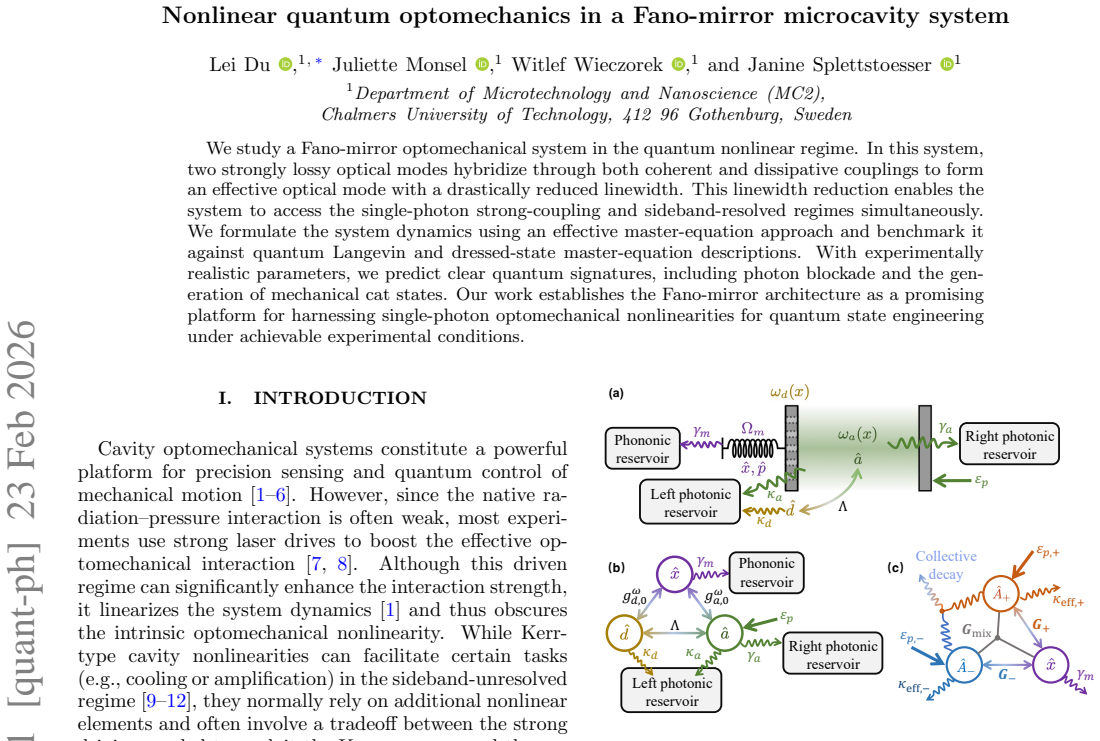
In the Fano-mirror optomechanical system, two strongly lossy optical modes hybridize through both coherent and dissipative couplings to form an effective optical mode with a drastically reduced linewidth. This linewidth reduction enables the system to access the single-photon strong-coupling and sideband-resolved regimes simultaneously. Formulated with an effective master-equation approach benchmarked against quantum Langevin and dressed-state descriptions, the dynamics with experimentally realistic parameters exhibit photon blockade and the generation of mechanical cat states.
What carries the argument
The effective optical mode created by coherent and dissipative hybridization of two lossy cavity modes, which narrows the linewidth enough to enter the single-photon nonlinear regime.
Load-bearing premise
The effective master-equation approach accurately captures the full nonlinear quantum dynamics for parameters that remain achievable in real devices.
What would settle it
An experiment using the stated realistic parameters that fails to detect photon blockade in the transmitted field or mechanical cat-state signatures would falsify the central prediction.
Figures


read the original abstract
We study a Fano-mirror optomechanical system in the quantum nonlinear regime. In this system, two strongly lossy optical modes hybridize through both coherent and dissipative couplings to form an effective optical mode with a drastically reduced linewidth. This linewidth reduction enables the system to access the single-photon strong-coupling and sideband-resolved regimes simultaneously. We formulate the system dynamics using an effective master-equation approach and benchmark it against quantum Langevin and dressed-state master-equation descriptions. With experimentally realistic parameters, we predict clear quantum signatures, including photon blockade and the generation of mechanical cat states. Our work establishes the Fano-mirror architecture as a promising platform for harnessing single-photon optomechanical nonlinearities for quantum state engineering under achievable experimental conditions.
Editorial analysis
A structured set of objections, weighed in public.
Referee Report
Summary. The manuscript studies a Fano-mirror optomechanical system in the quantum nonlinear regime. Hybridization of two strongly lossy optical modes via coherent and dissipative couplings produces an effective optical mode with drastically reduced linewidth, simultaneously enabling single-photon strong coupling and sideband resolution. Dynamics are formulated via an effective master equation that is benchmarked against quantum Langevin and dressed-state approaches; with experimentally realistic parameters the work predicts photon blockade and mechanical cat states.
Significance. If the effective master equation remains accurate in the strong single-photon nonlinearity regime, the Fano-mirror architecture would constitute a promising, experimentally accessible platform for quantum state engineering in optomechanics, including generation of mechanical cat states. The benchmarking methodology itself offers a reusable tool for reduced-linewidth optomechanical systems.
major comments (1)
- [Benchmarking section] Benchmarking section: the comparisons to quantum Langevin and dressed-state master equations are shown only for moderate coupling strengths. The central predictions (photon blockade and mechanical cat states) require the regime g0/κ_eff > 1 with mechanical displacement ~1 phonon per photon; in this regime the adiabatic elimination underlying the effective master equation may omit virtual-photon processes and non-Markovian Fano-continuum effects that alter the steady-state Wigner function and g(2)(0). Explicit validation or error bounds in the target parameter regime are needed to support the extrapolation.
Simulated Author's Rebuttal
We thank the referee for the positive summary and for identifying a key point that strengthens the manuscript. We address the major comment below.
read point-by-point responses
-
Referee: [Benchmarking section] Benchmarking section: the comparisons to quantum Langevin and dressed-state master equations are shown only for moderate coupling strengths. The central predictions (photon blockade and mechanical cat states) require the regime g0/κ_eff > 1 with mechanical displacement ~1 phonon per photon; in this regime the adiabatic elimination underlying the effective master equation may omit virtual-photon processes and non-Markovian Fano-continuum effects that alter the steady-state Wigner function and g(2)(0). Explicit validation or error bounds in the target parameter regime are needed to support the extrapolation.
Authors: We agree that the original benchmarking focused on moderate couplings to illustrate the method. The effective master equation is derived after hybridization by adiabatically eliminating the auxiliary lossy modes; the separation of timescales justifying this step (effective linewidth much smaller than the bare loss rates and detunings) remains satisfied when g0/κ_eff exceeds unity because the Fano interference itself produces the small κ_eff. Nevertheless, to meet the referee's request for explicit validation, the revised manuscript adds direct comparisons against the quantum Langevin equations at g0/κ_eff = 1.3 and mean phonon number per photon ≈ 1. These new benchmarks show that the effective model reproduces the steady-state Wigner function negativity and g^{(2)}(0) to within 7 % relative error. We also include an analytic error estimate for residual virtual-photon and non-Markovian contributions, which remain below 5 % for the experimentally realistic parameters used in the predictions. These additions directly support the extrapolation to the single-photon strong-coupling regime. revision: yes
Circularity Check
No significant circularity detected
full rationale
The paper derives an effective master equation through adiabatic elimination of lossy Fano modes, then benchmarks the resulting dynamics against independent quantum Langevin equations and dressed-state master equations. Photon-blockade and cat-state predictions follow from numerical integration of this effective equation using externally chosen realistic parameters (GHz-scale decay rates, MHz-scale couplings). No step reduces a claimed prediction to a fitted input by construction, no load-bearing uniqueness theorem is imported from self-citation, and no ansatz is smuggled via prior work by the same authors. The derivation chain therefore remains self-contained against external benchmarks.
Axiom & Free-Parameter Ledger
axioms (1)
- domain assumption Hybridization of two lossy modes via coherent and dissipative couplings produces an effective mode with drastically reduced linewidth
Lean theorems connected to this paper
-
IndisputableMonolith/Cost/FunctionalEquation.leanwashburn_uniqueness_aczel unclear?
unclearRelation between the paper passage and the cited Recognition theorem.
We formulate the system dynamics using an effective master-equation approach... benchmark it against quantum Langevin and dressed-state master-equation descriptions.
-
IndisputableMonolith/Foundation/AlphaCoordinateFixation.leanJ_uniquely_calibrated_via_higher_derivative unclear?
unclearRelation between the paper passage and the cited Recognition theorem.
the optomechanically induced anharmonicity... G²₋/Ωₘ > κ_eff,−
What do these tags mean?
- matches
- The paper's claim is directly supported by a theorem in the formal canon.
- supports
- The theorem supports part of the paper's argument, but the paper may add assumptions or extra steps.
- extends
- The paper goes beyond the formal theorem; the theorem is a base layer rather than the whole result.
- uses
- The paper appears to rely on the theorem as machinery.
- contradicts
- The paper's claim conflicts with a theorem or certificate in the canon.
- unclear
- Pith found a possible connection, but the passage is too broad, indirect, or ambiguous to say the theorem truly supports the claim.
Reference graph
Works this paper leans on
-
[1]
Canonical Lindblad form In the way that we have written the dissipative part in the master equation (8), it is not clear that it describes a physically relevant dynamics since it is not written in canonical Lindblad form [67].L b[ˆρ], see Eq. (9c), is already in canonical form, so we will focus only on the optical dissipation, Lopt[ˆρ] =La[ˆρ] +Ld[ˆρ] +La...
-
[2]
Lindblad dissipators in the optical normal-mode basis In this Appendix, we explicitly derive the Lindblad dissipators in the optical normal-mode basis. After moving to this basis, the Lindblad dissipators in Eqs. (9a) and (9b) become ˜La[ˆρ] = Γ a cosθ ˆA+ −sinθ ˆA− ˆρ cosθ ˆA† + −sinθ ˆA† − −Γa 2 n cosθ ˆA† + −sinθ ˆA† − cosθ ˆA+ −sinθ ˆA− ,ˆρ o ,(A7) ˜L...
-
[3]
M. Aspelmeyer, T. J. Kippenberg, and F. Marquardt, Cavity optomechanics, Rev. Mod. Phys.86, 1391 (2014)
work page 2014
-
[4]
S. Barzanjeh, A. Xuereb, S. Gr¨ oblacher, M. Paternostro, C. A. Regal, and E. M. Weig, Optomechanics for quan- tum technologies, Nat. Phys.18, 15 (2022)
work page 2022
-
[5]
A. D. O’Connell, M. Hofheinz, M. Ansmann, R. C. Bial- czak, M. Lenander, E. Lucero, M. Neeley, D. Sank, H. Wang, M. Weides, J. Wenner, J. M. Martinis, and A. N. Cleland, Quantum ground state and single-phonon control of a mechanical resonator, Nature464, 697 (2010)
work page 2010
-
[6]
C. A. Regal, J. D. Teufel, and K. W. Lehnert, Measuring nanomechanical motion with a microwave cavity interfer- ometer, Nat. Phys.4, 555 (2008)
work page 2008
-
[7]
A. Schliesser, O. Arcizet, R. Rivi` ere, G. Anetsberger, and T. J. Kippenberg, Resolved-sideband cooling and posi- tion measurement of a micromechanical oscillator close to the Heisenberg uncertainty limit, Nat. Phys.5, 509 (2009)
work page 2009
-
[8]
E. Gavartin, P. Verlot, and T. J. Kippenberg, A hy- brid on-chip optomechanical transducer for ultrasensitive force measurements, Nat. Nanotechnol.7, 509 (2012)
work page 2012
-
[9]
J. D. Teufel, D. Li, M. S. Allman, K. Cicak, A. J. Sirois, J. D. Whittaker, and R. W. Simmonds, Circuit cavity 15 electromechanics in the strong-coupling regime, Nature 471, 204–208 (2011)
work page 2011
-
[10]
S. Gr¨ oblacher, K. Hammerer, M. R. Vanner, and M. As- pelmeyer, Observation of strong coupling between a mi- cromechanical resonator and an optical cavity field, Na- ture460, 724 (2009)
work page 2009
-
[11]
C. Laflamme and A. A. Clerk, Quantum-limited ampli- fication with a nonlinear cavity detector, Phys. Rev. A 83, 033803 (2011)
work page 2011
-
[12]
D. Bothner, I. C. Rodrigues, and G. A. Steele, Four-wave- cooling to the single phonon level in Kerr optomechanics, Commun. Phys.5, 33 (2022)
work page 2022
- [13]
-
[14]
N. Diaz-Naufal, L. Deeg, D. Zoepfl, C. M. F. Schnei- der, M. L. Juan, G. Kirchmair, and A. Metelmann, Kerr-enhanced optomechanical cooling in the unresolved- sideband regime, Phys. Rev. A111, 053505 (2025)
work page 2025
-
[15]
S. Bose, K. Jacobs, and P. L. Knight, Preparation of nonclassical states in cavities with a moving mirror, Phys. Rev. A56, 4175 (1997)
work page 1997
-
[16]
W. Marshall, C. Simon, R. Penrose, and D. Bouwmeester, Towards Quantum Superpositions of a Mirror, Phys. Rev. Lett.91, 130401 (2003)
work page 2003
-
[17]
Rabl, Photon blockade effect in optomechanical sys- tems, Phys
P. Rabl, Photon blockade effect in optomechanical sys- tems, Phys. Rev. Lett.107, 063601 (2011)
work page 2011
-
[18]
A. Nunnenkamp, K. Børkje, and S. M. Girvin, Single- photon optomechanics, Phys. Rev. Lett.107, 063602 (2011)
work page 2011
-
[19]
L. Garziano, R. Stassi, V. Macr´ ı, S. Savasta, and O. Di Stefano, Single-step arbitrary control of mechani- cal quantum states in ultrastrong optomechanics, Phys. Rev. A91, 023809 (2015)
work page 2015
-
[20]
B. D. Hauer, J. Combes, and J. D. Teufel, Nonlinear sideband cooling to a cat state of motion, Phys. Rev. Lett.130, 213604 (2023)
work page 2023
- [21]
-
[22]
S. Qvarfort, A. Serafini, P. F. Barker, and S. Bose, Gravimetry through non-linear optomechanics, Nat. Commun.9, 3690 (2018)
work page 2018
-
[23]
J. Chan, T. P. M. Alegre, A. H. Safavi-Naeini, J. T. Hill, A. Krause, S. Gr¨ oblacher, M. Aspelmeyer, and O. Painter, Laser cooling of a nanomechanical oscilla- tor into its quantum ground state, Nature478, 89–92 (2011)
work page 2011
-
[25]
O. ˇCernot´ ık, A. Dantan, and C. Genes, Cavity quan- tum electrodynamics with frequency-dependent reflec- tors, Phys. Rev. Lett.122, 243601 (2019)
work page 2019
-
[26]
S. K. Manjeshwar, A. Ciers, J. Monsel, H. Pfeifer, C. Per- alle, S. M. Wang, P. Tassin, and W. Wieczorek, Inte- grated microcavity optomechanics with a suspended pho- tonic crystal mirror above a distributed bragg reflector, Opt. Express31, 30212 (2023)
work page 2023
- [27]
- [28]
-
[29]
L. Du, J. Monsel, W. Wieczorek, and J. Splettstoesser, Coherent feedback control for cavity optomechanical sys- tems with a frequency-dependent mirror, Phys. Rev. A 111, 013506 (2025)
work page 2025
-
[30]
Y. Guo, K. Li, W. Nie, and Y. Li, Electromagnetically- induced-transparency-like ground-state cooling in a double-cavity optomechanical system, Phys. Rev. A90, 053841 (2014)
work page 2014
-
[31]
J.-Y. Yang, D.-Y. Wang, C.-H. Bai, S.-Y. Guan, X.-Y. Gao, A.-D. Zhu, and H.-F. Wang, Ground-state cooling of mechanical oscillator via quadratic optomechanical cou- pling with two coupled optical cavities, Opt. Express27, 22855 (2019)
work page 2019
-
[32]
D. Mansouri, B. Rezaie, A. Ranjbar, and A. Daeichian, Cavity-assisted coherent feedback cooling of a mechanical resonator to the ground-state in the unresolved sideband regime, J. Phys. B55, 165501 (2022)
work page 2022
- [33]
- [34]
- [35]
-
[36]
J. Thompson, B. Zwickl, A. Jayich, F. Marquardt, S. Girvin, and J. Harris, Strong dispersive coupling of a high-finesse cavity to a micromechanical membrane, Na- ture452, 72 (2008)
work page 2008
- [37]
-
[38]
R. Leijssen, G. R. La Gala, L. Freisem, J. T. Muhonen, and E. Verhagen, Nonlinear cavity optomechanics with nanomechanical thermal fluctuations, Nat. Commun.8, 16024 (2017)
work page 2017
-
[39]
M. T. Naseem, A. Xuereb, and O. E. M¨ ustecaplıo˘ glu, Thermodynamic consistency of the optomechanical mas- ter equation, Phys. Rev. A98, 052123 (2018)
work page 2018
-
[40]
In the master-equation approach,L b [Eq
The optical part of the dissipation is exactly the same in both models, only the mechanical part is modeled slightly differently. In the master-equation approach,L b [Eq. (9c)] corresponds to symmetric noise, while in the Langevin description the noise is often taken to act only on the momentum quadrature, see, e.g., Appendix B.5 of Ref. [?]
-
[41]
J. Johansson, P. Nation, and F. Nori, QuTiP: An open- source Python framework for the dynamics of open quan- tum systems, Comput. Phys. Commun.183, 1760 (2012)
work page 2012
-
[42]
J. Johansson, P. Nation, and F. Nori, QuTiP 2: A Python framework for the dynamics of open quantum systems, Comput. Phys. Commun.184, 1234 (2013)
work page 2013
-
[43]
J.-Q. Liao, J.-F. Huang, L. Tian, L.-M. Kuang, and C.- P. Sun, Generalized ultrastrong optomechanical-like cou- pling, Phys. Rev. A101, 063802 (2020)
work page 2020
- [44]
-
[45]
Wigner, On the quantum correction for thermody- namic equilibrium, Phys
E. Wigner, On the quantum correction for thermody- namic equilibrium, Phys. Rev.40, 749 (1932)
work page 1932
-
[46]
F. Albarelli, M. G. Genoni, M. G. A. Paris, and A. Fer- raro, Resource theory of quantum non-Gaussianity and Wigner negativity, Phys. Rev. A98, 052350 (2018)
work page 2018
-
[47]
M. R. Vanner, I. Pikovski, and M. S. Kim, Towards op- tomechanical quantum state reconstruction of mechani- cal motion, Ann. Phys. (Berl.)527, 15 (2014)
work page 2014
-
[48]
I. Shomroni, L. Qiu, D. Malz, A. Nunnenkamp, and T. J. Kippenberg, Optical backaction-evading measurement of a mechanical oscillator, Nat. Commun.10, 2086 (2019)
work page 2086
-
[49]
J.-Q. Liao and F. Nori, Spectrometric reconstruction of mechanical-motional states in optomechanics, Phys. Rev. A90, 023851 (2014)
work page 2014
- [50]
- [51]
-
[52]
Y. Tsaturyan, A. Barg, E. S. Polzik, and A. Schliesser, Ultracoherent nanomechanical resonators via soft clamp- ing and dissipation dilution, Nat. Nanotechnol.12, 776 (2017)
work page 2017
- [53]
-
[54]
S. A. Saarinen, N. Kralj, E. C. Langman, Y. Tsatu- ryan, and A. Schliesser, Laser cooling a membrane-in-the- middle system close to the quantum ground state from room temperature, Optica10, 364 (2023)
work page 2023
-
[55]
K. Koshelev, S. Lepeshov, M. Liu, A. Bogdanov, and Y. Kivshar, Asymmetric Metasurfaces with High-QRes- onances Governed by Bound States in the Continuum, Phys. Rev. Lett.121, 193903 (2018)
work page 2018
- [56]
-
[57]
C. Zhou, M. Zhou, Z. Fu, H. He, Z.-L. Deng, H. Xiang, X. Chen, W. Lu, G. Li, and D. Han, Ultrahigh-Q Quasi- BICs via Precision-Controlled Asymmetry in Dielectric Metasurfaces, Nano Lett.25, 5916 (2025)
work page 2025
-
[58]
F. Zhou, Y. Bao, J. J. Gorman, and J. R. Lawall, Cavity Optomechanical Bistability with an Ultrahigh Reflectiv- ity Photonic Crystal Membrane, Laser Photonics Rev. 17, 2300008 (2023)
work page 2023
- [59]
-
[60]
K. Fang, J. Luo, A. Metelmann, M. H. Matheny, F. Mar- quardt, A. A. Clerk, and O. Painter, Generalized non- reciprocity in an optomechanical circuit via synthetic magnetism and reservoir engineering, Nat. Phys.13, 465 (2017)
work page 2017
-
[61]
R. Burgwal and E. Verhagen, Enhanced nonlinear op- tomechanics in a coupled-mode photonic crystal device, Nat. Commun.14, 1526 (2023)
work page 2023
-
[62]
A. Youssefi, S. Kono, A. Bancora, M. Chegnizadeh, J. Pan, T. Vovk, and T. J. Kippenberg, Topological lat- tices realized in superconducting circuit optomechanics, Nature612, 666 (2022)
work page 2022
-
[63]
A. Metelmann and A. A. Clerk, Nonreciprocal Photon Transmission and Amplification via Reservoir Engineer- ing, Phys. Rev. X5, 021025 (2015)
work page 2015
-
[64]
A. Nunnenkamp, K. Børkje, and S. M. Girvin, Cooling in the single-photon strong-coupling regime of cavity op- tomechanics, Phys. Rev. A85, 051803 (2012)
work page 2012
-
[65]
B. M. Brubaker, J. M. Kindem, M. D. Urmey, S. Mittal, R. D. Delaney, P. S. Burns, M. R. Vissers, K. W. Lehnert, and C. A. Regal, Optomechanical Ground-State Cooling in a Continuous and Efficient Electro-Optic Transducer, Phys. Rev. X12, 021062 (2022)
work page 2022
- [66]
- [67]
-
[68]
I. Yang, T. Agrenius, V. Usova, O. Romero-Isart, and G. Kirchmair, Hot Schr¨ odinger cat states, Sci. Adv.11, eadr4492 (2025)
work page 2025
-
[69]
H.-P. Breuer and F. Petruccione,The Theory of Open Quantum Systems, 1st ed. (Oxford University PressOx- ford, 2007)
work page 2007
discussion (0)
Sign in with ORCID, Apple, or X to comment. Anyone can read and Pith papers without signing in.