REVIEW 4 major objections 5 minor 12 references
KnapSpec: Self-Speculative Decoding via Adaptive Layer Selection as a Knapsack Problem
T0 review · 4 major / 5 minor · reviewed 2026-08-02 · deepseek-v4-flash
Pith's one-line read KnapSpec claims that choosing which layers a draft pass keeps inside an LLM is a knapsack problem — each layer priced by measured latency, valued by closeness to the full model — solved on the fly for up to 1.47× faster inference.
desk verdict KnapSpec's knapsack formulation for SSD is a real contribution, but the theory overclaims and Table 2's TPT/speedup mismatch needs checking. read the letter →
The pith
A machine-rendered reading of the paper's core claim, the machinery that carries it, and where it could break.
The reading
What carries the argument
The load-bearing device is the Tokens-per-Time objective, TPT(S,γ) = ((1−α_S^{γ+1})/(1−α_S))·1/(γ·t_Draft(S)+t_Target) — accepted tokens per step over drafting-plus-verification time — paired with a 0/1 knapsack reformulation of layer choice. Each layer item carries a weight (measured latency; Attention grows with context, MLP flat) and a value (cosine similarity to the full model's reference hidden state). A parallel dynamic program keeps the higher of 'execute' or 'skip' per layer and latency budget, giving one candidate layer set per budget; grid search over draft length maximizes TPT. Lemma 4.1 is the theoretical ligament: for equal-norm embeddings, cosine similarity above a margin-depen
What would settle it
Run the paper's dynamic program on a small model (say 8–16 layers) and exhaustively enumerate all layer subsets for every latency budget: if the DP's chosen sets are not the true maximizers of cos(f(X), f^(S)(X)), or if a discarded set yields materially higher measured TPT, the central speedup claim fails. A second check: measure real hidden states against Lemma 4.1's bound (equal norms, margin-dependent cosine threshold); if the bound is never satisfied on real activations, the theoretical licence for cosine similarity as a value proxy is void.
Extended reading notes
Core claim
The paper's central claim: draft-model selection for self-speculative decoding should be a 0/1 knapsack problem over a Tokens-per-Time objective, where Attention and MLP layers carry separate context-dependent latency weights and each layer's value is cosine similarity to the full model's hidden state. A parallel dynamic program yields one candidate layer set per latency budget; a grid search over draft length maximizes TPT. A proven sufficient condition (Lemma 4.1) makes high cosine similarity guarantee identical greedy token selection. Experiments report up to 1.47× speedups over training-free SSD baselines.
Load-bearing premise
The entire speedup claim rests on the Section 3.4 dynamic program assuming that greedily keeping, at each layer and latency budget, the state with higher cosine similarity to the full model's reference hidden state yields layer sets that are near-optimal for the global objective — a local-choice rule with no proof of global optimality — and on Lemma 4.1, which gives only a per-token sufficient condition, not a bound on the acceptance rate.
Editorial extensions
If this is right
- Long-context inference speeds up without any training: up to 1.47× wall-clock improvement on models from 1B to 70B, with the target model's output distribution unchanged.
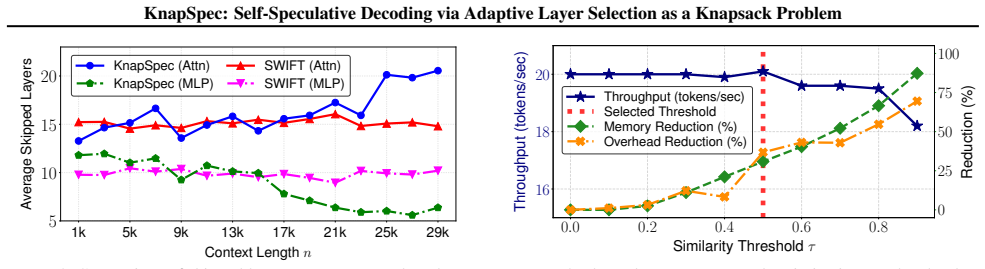
- The optimal draft configuration is context-dependent: as sequence length grows, the solver skips Attention layers more aggressively than MLP layers, so a fixed layer choice becomes stale in long sessions.
- Tokens-per-time is a better optimization target than acceptance rate: it correlates with measured throughput at 0.837 versus 0.538, so SSD methods that maximize acceptance alone are leaving speed on the table.
- Cosine similarity gets a formal licence: Lemma 4.1's sufficient condition means maximizing hidden-state cosine similarity under a latency budget is a defensible stand-in for maximizing draft acceptance.
- The approach is plug-and-play for Transformer LLMs: one-time latency profiling plus on-the-fly re-solving, with no fine-tuning and no auxiliary draft model.
Reading between the lines
- If the DP's greedy local rule is only near-optimal, an exact knapsack or beam-search variant — or exhaustive enumeration on a small model — would show how much headroom remains; the paper's pruning thresholds (τ=0.5, skip cap K/2) mark where the approximation is trusted.
- The knapsack packing is not limited to latency: the same item/value structure could be run over memory, energy, or KV-cache budgets, yielding draft configurations tuned to different serving constraints.
- The Attention-versus-MLP finding distills into a portable design rule: long-context drafters should shed attention capacity first as context grows — a heuristic any SSD scheduler could adopt without re-running the DP.
- Lemma 4.1's threshold depends on the unknown LM-head margin and assumes equal embedding norms; whether real activations satisfy the bound is directly measurable, and if they do, cosine checks could replace acceptance-rate estimation in other decoding schemes.
Editorial analysis
A structured set of objections, weighed in public.
Referee Report
Summary. KnapSpec proposes a training-free self-speculative decoding method that selects which Attention and MLP layers to skip by formulating layer selection as a knapsack problem. The method defines a Tokens-per-Time (TPT) objective that combines an estimated acceptance rate with hardware-specific, context-length-dependent layer latencies, generates candidate layer sets via a dynamic program, and then picks the best (S, γ) by grid search. The paper claims the first rigorous theory for cosine similarity as a proxy for token acceptance rate, and reports consistent speedups up to 1.47× over state-of-the-art self-speculative baselines on Qwen3 and Llama3 models.
Significance. If the central claims hold, KnapSpec is practically useful: it is training-free, adapts to context length, decouples Attention and MLP latency, and is evaluated across a wide range of model sizes (1B–70B) and benchmarks. The ablation studies on optimization interval and similarity threshold are informative, and the idea of explicitly optimizing a hardware-aware TPT objective is a reasonable step forward. However, the advertised optimality of the DP search and the claimed theoretical foundation for cosine similarity are not established, and the reported TPT ratios do not match the reported wall-clock speedups. These issues are load-bearing for the central speedup claim, so the paper needs substantial revision rather than acceptance in its current form.
major comments (4)
- [§3.4, Eq. (8) and Algorithm 1] The DP retains exactly one hidden state g[i,j] per (layer, budget) pair, chosen greedily by instantaneous cosine similarity to X^(i). This is asserted to produce near-optimal solutions to Eq. (6), but no optimality or approximation bound is provided. Cosine similarity of composed nonlinear layers is not separable or additive over skipped layers, so a partial state with lower intermediate cosine may become the best after later layers, or may yield a higher acceptance rate. Section 3.3 explicitly states that A contains the selections that maximize the proxy for αS for every possible drafting cost; this is unsupported. If the true optimizer is absent from A, the TPT grid search cannot recover the global optimum of Eq. (5), so the headline speedup is not tied to the claimed optimal configuration. In addition, the main-text Algorithm 1 and Appendix C Algorithm 1 are inconsistent (initializati
- [§4, Lemma 4.1 and following text] Lemma 4.1 is correct as a sufficient condition for a single greedy token match when the two embeddings have equal norm, but it does not establish that maximizing cosine similarity maximizes the acceptance rate αS. The lemma gives a per-token guarantee depending on the margin ξ(x) and on max_j ||w_i* - w_j||, with no aggregate statement over the token distribution and no bound on αS. The conclusion in the text—argmax_S αS ≈ argmax_S cos(f(X), f(S)(X))—and the repeated phrase "rigorous proxy" therefore overreach. This is load-bearing because Eq. (6) uses cosine similarity as the value that the DP maximizes. The theoretical section should be reframed as a heuristic justification, or an expectation/margin bound over tokens should be proved.
- [Table 2, TPT vs. speedup] The TPT values are inconsistent with the reported speedups. For Llama3.1-70B GovReport, the AR TPT is 6.75 and KnapSpec TPT is 13.00, a ratio of 1.93, yet the reported wall-clock speedup is 1.47. For Qwen3-32B AIME24, the ratio is 31.06/19.65 ≈ 1.58, but the reported speedup is 1.43. If TPT is the tokens-per-time objective of Eq. (4), its ratio relative to AR should equal the wall-clock speedup under the same measurement conditions. The discrepancy suggests that the TPT numbers are computed from the estimated α on a small cache and the optimal γ*, while the speedup is measured end-to-end with the dynamic confidence-based exiting of §3.5. The paper should clarify which quantity is reported, and ideally report actual measured TPT. As written, this undermines the claim that TPT is directly aligned with wall-clock speed.
- [§3.6, runtime and memory complexity] The complexity claims do not account for the size of the DP table. In Algorithm 1, g has size (2L+1) × (K+1) × r × d, and K = (w_Attn + w_MLP)L. Since w_Attn ≈ t_Attn/Δ and t_Attn = Θ(n), K grows linearly with context length n. The naive memory is therefore O(n L^2 r d), not O(nL). The claimed reduction to O(L) memory under parallel DP is unsupported, because backtracking (Algorithm 2) requires access to previous rows or parent pointers; no such compressed representation is described. The time-complexity analysis also needs to state how K scales with n. If the optimization overhead is larger than claimed, the "on-the-fly" adaptation for long contexts needs to be re-examined.
minor comments (5)
- [§3.2, last sentence] The text says "demonstrating that TPL is a superior metric to represent actual speed", but the comparison in Figure 2 is between TPT and acceptance rate, not TPL. This appears to be a typo and should read TPT.
- [Eq. (7) vs. Algorithm 1] The recurrence in Eq. (7) defines h_s = g[i-1, j-w_i], while Algorithm 1 writes g[i, j+w] = g[i-1, j] for a skip. These are equivalent only with a different index convention; the paper should use one consistent convention to avoid confusion about what "skipped weight j" means.
- [§4, Lemma 4.1] The equal-norm assumption ||x'|| = ||x|| is stated as empirically supported by RMSNorm, but intermediate hidden states after residual connections and attention/MLP transformations can vary in norm. A short discussion or empirical check of this assumption would be helpful, especially since the proof relies on it.
- [Appendix C, Algorithm 2] The backtracking condition g[i,j] = g[i-1,j-w] compares matrix identities; if two different paths produce identical hidden states, this test may be ambiguous. The pseudocode should specify how ties are broken.
- [§5.2, Figure 4] The caption and text report memory reduction and overhead reduction on the same plot; the curves are not defined in the caption. Please label the axes and legend more explicitly.
Circularity Check
No significant circularity: the knapsack candidate search, TPT selection, and cosine lemma are derived independently and evaluated against measured wall-clock speedups.
full rationale
KnapSpec's derivation chain is self-contained. Eq. (4) defines TPT using measured latencies and an estimated acceptance rate b_alpha_S (Eq. 9); the DP (Alg. 1, Eq. 8) produces candidate layer sets by maximizing cosine similarity to full-model reference states; the grid search then chooses the TPT-maximizing pair. No parameter fitted to the reported speedups is renamed as a prediction: t_Attn and t_MLP are pre-profiled hardware latencies, b_alpha_S is a history-based estimator, and hyperparameters (tau, tau_conf, m, D) are free design choices. Lemma 4.1 is a standard margin/Cauchy-Schwarz sufficient-condition argument and does not assume the target result; the accompanying prose overstates it as a full justification of cosine as a proxy, but this is an overclaim, not a circular reduction. The only author-overlapping citation (Choi et al. 2025, which includes I. Han) appears in a background list and is not load-bearing. Concerns raised by a skeptical reading - the DP keeps only one hidden state per (i,j) with no optimality proof, and Table 2's TPT ratios (e.g., GovReport Llama3.1-70B: 13.00/6.75 ~= 1.93) do not match the reported spd 1.47 - are soundness/consistency issues, not cases where the output equals the input by construction.
Assumptions & free parameters
free parameters (6)
- Hardware latencies t_Attn, t_MLP (and normalized weights w_Attn, w_MLP) =
not reported; measured per hardware
- Cosine pruning threshold τ =
0.5
- Confidence threshold τ_conf =
0.7
- Cache window m =
5
- Maximum draft length D =
10
- Optimization interval T =
64 (models <10B), 128 (larger)
assumptions (6)
- domain assumption Greedy decoding is the setting; acceptance means argmax agreement with the target model.
- domain assumption Attention latency grows linearly with context length while MLP latency is constant.
- ad hoc to paper Maximizing cosine similarity under a latency budget is a reliable surrogate for maximizing acceptance rate.
- domain assumption Hidden-state norms are approximately equal (RMSNorm effect), so Lemma 4.1's norm condition holds.
- ad hoc to paper The DP's local greedy cosine choice at each layer yields near-optimal solutions to global cosine maximization Eq. (6).
- domain assumption Acceptance rate estimated on the recent m=5 tokens predicts near-future acceptance rates.
Cite this review
Pith. "Pith review of KnapSpec: Self-Speculative Decoding via Adaptive Layer Selection as a Knapsack Problem." pith.science (2026). https://pith.science/paper/EUPESO65
@misc{pith2026260220217,
  author       = {Pith},
  title        = {Pith review of: KnapSpec: Self-Speculative Decoding via Adaptive Layer Selection as a Knapsack Problem},
  year         = {2026},
  howpublished = {\url{https://pith.science/paper/EUPESO65}},
  note         = {Machine review of arXiv:2602.20217}
}
read the original abstract
Self-speculative decoding (SSD) accelerates LLM inference by skipping layers to create an efficient draft model, yet existing methods often rely on static heuristics that ignore the dynamic computational overhead of attention in long-context scenarios. We propose KnapSpec, a training-free framework that reformulates draft model selection as a knapsack problem to maximize tokens-per-time throughput. By decoupling Attention and MLP layers and modeling their hardware-specific latencies as functions of context length, KnapSpec adaptively identifies optimal draft configurations on the fly via a parallel dynamic programming algorithm. Furthermore, we provide the first rigorous theoretical analysis establishing cosine similarity between hidden states as a mathematically sound proxy for the token acceptance rate. This foundation allows our method to maintain high drafting faithfulness while navigating the shifting bottlenecks of real-world hardware. Our experiments on Qwen3 and Llama3 demonstrate that KnapSpec consistently outperforms state-of-the-art SSD baselines, achieving up to 1.47x wall-clock speedup across various benchmarks. Our plug-and-play approach ensures high-speed inference for long sequences without requiring additional training or compromising the target model's output distribution.
Figures


Figures from the paper (2 more)


Reference graph
Works this paper leans on
-
[1]
Chen, C., Borgeaud, S., Irving, G., Lespiau, J.-B., Sifre, L., and Jumper, J. Accelerating large language model decoding with speculative sampling.arXiv preprint arXiv:2302.01318,
-
[4]
A survey on code generation with llm-based agents.arXiv preprint arXiv:2508.00083,
Dong, Y ., Jiang, X., Qian, J., Wang, T., Zhang, K., Jin, Z., and Li, G. A survey on code generation with llm-based agents.arXiv preprint arXiv:2508.00083,
-
[6]
Booksum: A collection of datasets for long- form narrative summarization
Kry´sci´nski, W., Rajani, N., Agarwal, D., Xiong, C., and Radev, D. Booksum: A collection of datasets for long- form narrative summarization. InFindings of the asso- ciation for computational linguistics: EMNLP 2022, pp. 6536–6558,
2022
-
[8]
Speculative decoding: Exploiting speculative execu- tion for accelerating seq2seq generation
Xia, H., Ge, T., Wang, P., Chen, S.-Q., Wei, F., and Sui, Z. Speculative decoding: Exploiting speculative execu- tion for accelerating seq2seq generation. InFindings of the Association for Computational Linguistics: EMNLP 2023, pp. 3909–3925,
2023
-
[9]
Xia, H., Li, Y ., Zhang, J., Du, C., and Li, W. Swift: On-the- fly self-speculative decoding for llm inference accelera- tion.arXiv preprint arXiv:2410.06916,
-
[10]
Qwen3 technical report.arXiv preprint arXiv:2505.09388,
Yang, A., Li, A., Yang, B., Zhang, B., Hui, B., Zheng, B., Yu, B., Gao, C., Huang, C., Lv, C., et al. Qwen3 technical report.arXiv preprint arXiv:2505.09388,
-
[11]
E., Gao, L., Jiang, C., and Annavaram, M
9 KnapSpec: Self-Speculative Decoding via Adaptive Layer Selection as a Knapsack Problem Zarch, H. E., Gao, L., Jiang, C., and Annavaram, M. Del: Context-aware dynamic exit layer for efficient self- speculative decoding.arXiv preprint arXiv:2504.05598,
-
[12]
and Math-AI, T
Zhang, Y . and Math-AI, T. American invitational mathemat- ics examination (aime) 2024,
2024
Show all 12 references
-
[2022]
R., Lu, P., Chen, B., Rezagholizadeh, M., and Kobyzev, I
Metel, M. R., Lu, P., Chen, B., Rezagholizadeh, M., and Kobyzev, I. Draft on the fly: Adaptive self-speculative decoding using cosine similarity. InFindings of the As- sociation for Computational Linguistics: EMNLP 2024,
2024
-
[2023]
Clasp: In- context layer skip for self-speculative decoding.arXiv preprint arXiv:2505.24196,
Chen, L., Shan, R., Wang, H., Wang, L., Liu, Z., Luo, R., Wang, J., Alinejad-Rokny, H., and Yang, M. Clasp: In- context layer skip for self-speculative decoding.arXiv preprint arXiv:2505.24196,
-
[2024]
The llama 3 herd of models.arXiv preprint arXiv:2407.21783,
Grattafiori, A., Dubey, A., Jauhri, A., Pandey, A., Kadian, A., Al-Dahle, A., Letman, A., Mathur, A., Schelten, A., Vaughan, A., et al. The llama 3 herd of models.arXiv preprint arXiv:2407.21783,
-
[2025]
Mamba drafters for speculative decoding.arXiv preprint arXiv:2506.01206,
Choi, D., Oh, S., Dingliwal, S., Tack, J., Kim, K., Song, W., Kim, S., Han, I., Shin, J., Galstyan, A., et al. Mamba drafters for speculative decoding.arXiv preprint arXiv:2506.01206,
Reviewed August 2, 2026 · model on record in the stance chip above.
Discussion (0). Sign in to comment.