Recognition: 2 theorem links
· Lean TheoremLinking Leptogenesis and Asymmetric Dark Matter: A Testable Framework for Neutrino Mass and the Matter-Antimatter Asymmetry
Pith reviewed 2026-05-15 19:47 UTC · model grok-4.3
The pith
Heavy Majorana neutrino decay generates both the observed baryon asymmetry and asymmetric dark matter abundance at TeV scales.
A machine-rendered reading of the paper's core claim, the machinery that carries it, and where it could break.
Core claim
In the co-genesis scenario the hierarchical coupling structure allows enhanced CP violation while supporting a low-scale seesaw mechanism at order O(2) TeV. This setup links light neutrino masses directly to the Majorana mass term and yields spin-independent cross sections for dark matter heavier than 10 GeV that can be tested in current direct detection experiments, while also motivating searches inside the neutrino fog for lighter masses.
What carries the argument
The co-genesis regime with its hierarchical Yukawa couplings, which simultaneously supplies large CP violation, controls washout, and transfers asymmetry to the dark sector through decays and 2-to-2 scatterings.
If this is right
- Spin-independent cross sections for dark matter above 10 GeV fall within reach of existing direct detection experiments.
- Lighter dark matter masses motivate dedicated searches inside the neutrino fog region.
- Lepton-number violation becomes possible at experimentally accessible TeV energies.
- Light neutrino masses are directly tied to the same Majorana mass term that drives the asymmetries.
Where Pith is reading between the lines
- Observation of the predicted cross sections would tie three major cosmic puzzles to a single particle and scale.
- Collider experiments could target production of the heavy Majorana neutrino at comparable energies.
- The model supplies a concrete target for interpreting future null results in direct detection as bounds on leptogenesis parameters.
Load-bearing premise
A hierarchical coupling structure can produce enough CP violation, keep washout under control, and match the observed neutrino mass scale at roughly 2 TeV without extra tuning or conflict with existing bounds.
What would settle it
Direct detection experiments reporting no spin-independent events at the cross sections predicted for dark matter masses above 10 GeV, or precision measurements of neutrino masses that cannot be reproduced by a Majorana scale near 2 TeV.
Figures


read the original abstract
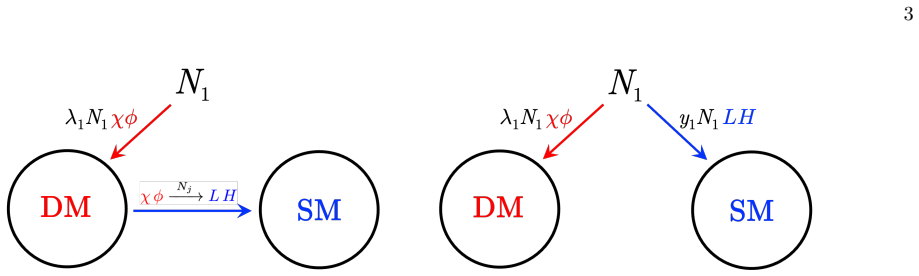
We investigate a minimal extension of the Leptogenesis framework that simultaneously explains the observed baryon asymmetry and dark matter (DM) abundance through the decay of a heavy Majorana neutrino. In this scenario, CP violation arises from complex Yukawa couplings, enabling the generation of asymmetries in both the Standard Model (SM) and DM sectors. We explore two regimes: (i) wash-in, where an initial dark asymmetry is transferred to SM leptons by $2 \leftrightarrow 2$ scattering processes; and (ii) co-genesis, featuring a hierarchical coupling structure that allows enhanced CP violation while supporting a low-scale seesaw mechanism at order $\mathcal{O}(2)$ TeV. This setup not only links light neutrino masses to the Majorana mass term but also suggests that lepton-number violation may occur at experimentally accessible energy scales. In the co-genesis scenario, we show spin-independent cross sections for DM heavier than 10 GeV that can be tested in current direct detection experiments and motivate the exploration of cross sections inside the neutrino fog for lighter DM masses, establishing asymmetric leptogenesis as a predictive benchmark framework for direct-detection experiments and identifying a new hierarchical-coupling regime enabling TeV-scale leptogenesis.
Editorial analysis
A structured set of objections, weighed in public.
Referee Report
Summary. The paper proposes a minimal extension of leptogenesis in which the out-of-equilibrium decay of a heavy Majorana neutrino simultaneously generates the observed baryon asymmetry and an asymmetric dark matter abundance. It examines two regimes—wash-in, where an initial dark-sector asymmetry is transferred to SM leptons via 2↔2 scattering, and co-genesis, which employs a hierarchical Yukawa structure to enhance CP violation while permitting a type-I seesaw at O(2) TeV—thereby linking light neutrino masses to the Majorana mass scale and predicting spin-independent DM-nucleon cross sections testable by current direct-detection experiments for m_DM > 10 GeV.
Significance. If the co-genesis mechanism can be shown to operate without additional tuning, the framework would furnish a predictive, testable connection among neutrino masses, leptogenesis, and asymmetric dark matter, supplying concrete benchmarks for direct-detection searches (including the neutrino fog) and identifying a new hierarchical-coupling regime for TeV-scale leptogenesis.
major comments (1)
- [co-genesis scenario] Co-genesis scenario: the claim that a hierarchical Yukawa ansatz simultaneously yields sufficient CP asymmetry (ε_1 ~ 10^{-6}–10^{-7}), suppresses washout (K ≪ 1), and reproduces m_ν ≈ 0.05 eV at M_N ~ 2 TeV is load-bearing yet unsupported by explicit demonstration. The standard expressions ε_1 ≈ (3/16π)(M_1/M_j) Im[(Y†Y)_{1j}^2]/(Y†Y)_{11} and Γ ~ (Y†Y)M_1/(8π) imply that the imaginary parts needed for η_B ≈ 6×10^{-10} typically drive at least one diagonal entry of Y†Y large enough that K > 10, erasing the asymmetry. The manuscript must supply the explicit Yukawa matrix, the solved Boltzmann trajectories, and a parameter scan confirming viability without extra flavor suppression or resonance.
minor comments (1)
- The abstract states specific spin-independent cross sections for m_DM > 10 GeV and motivates exploration inside the neutrino fog, but the derivation of these values, including any dependence on the DM–lepton coupling and the resulting relic density, should be shown explicitly with error estimates.
Simulated Author's Rebuttal
We thank the referee for their careful reading and constructive comments. We agree that the co-genesis scenario requires explicit verification to support its viability and will revise the manuscript accordingly.
read point-by-point responses
-
Referee: Co-genesis scenario: the claim that a hierarchical Yukawa ansatz simultaneously yields sufficient CP asymmetry (ε_1 ~ 10^{-6}–10^{-7}), suppresses washout (K ≪ 1), and reproduces m_ν ≈ 0.05 eV at M_N ~ 2 TeV is load-bearing yet unsupported by explicit demonstration. The standard expressions ε_1 ≈ (3/16π)(M_1/M_j) Im[(Y†Y)_{1j}^2]/(Y†Y)_{11} and Γ ~ (Y†Y)M_1/(8π) imply that the imaginary parts needed for η_B ≈ 6×10^{-10} typically drive at least one diagonal entry of Y†Y large enough that K > 10, erasing the asymmetry. The manuscript must supply the explicit Yukawa matrix, the solved Boltzmann trajectories, and a parameter scan confirming viability without extra flavor suppression or resonance.
Authors: We agree that an explicit demonstration is essential. In the revised manuscript we will include a concrete hierarchical Yukawa matrix realizing ε_1 ∼ 10^{-6}–10^{-7} with K ≪ 1, numerical solutions of the Boltzmann equations showing the time evolution of the lepton and DM asymmetries, and a parameter scan over the relevant couplings and mass ratios that simultaneously reproduces η_B ≈ 6×10^{-10}, m_ν ≈ 0.05 eV, and the observed DM abundance at M_N ∼ 2 TeV without additional flavor suppression or resonance. revision: yes
Circularity Check
No circularity: derivation chain is self-contained with independent parameter choices
full rationale
The abstract outlines a minimal leptogenesis extension with co-genesis via hierarchical Yukawa couplings to simultaneously address baryon asymmetry, DM abundance, and neutrino masses at O(2) TeV. No equations, Boltzmann solutions, or self-citations are exhibited that reduce any 'prediction' (such as DM cross sections) to a direct fit or redefinition of the input asymmetries. The hierarchical structure is presented as an ansatz enabling the regime, but the resulting cross-section claims follow from solving the model dynamics rather than tautological re-expression of fitted values. The framework remains externally falsifiable via direct detection and does not rely on load-bearing self-citations or self-definitional loops.
Axiom & Free-Parameter Ledger
free parameters (2)
- Majorana neutrino mass
- Complex Yukawa couplings
axioms (2)
- domain assumption Standard Model extended by heavy Majorana neutrinos
- standard math CP violation generated by complex phases in Yukawa couplings
invented entities (1)
-
Asymmetric dark matter component generated by neutrino decay
no independent evidence
Lean theorems connected to this paper
-
IndisputableMonolith/Cost/FunctionalEquation.leanwashburn_uniqueness_aczel unclear?
unclearRelation between the paper passage and the cited Recognition theorem.
hierarchical coupling structure that allows enhanced CP violation while supporting a low-scale seesaw mechanism at order O(2) TeV... |λ2| ≫ |y2| > |λ1| ∼ |y1|
-
IndisputableMonolith/Foundation/RealityFromDistinction.leanreality_from_one_distinction unclear?
unclearRelation between the paper passage and the cited Recognition theorem.
Boltzmann equations... dY_ΔL/dz1 = Γ_N1/H1 ε_L ... − Γ_N2/H1 Br_L2 Br_χ2 I_T+,2 ...
What do these tags mean?
- matches
- The paper's claim is directly supported by a theorem in the formal canon.
- supports
- The theorem supports part of the paper's argument, but the paper may add assumptions or extra steps.
- extends
- The paper goes beyond the formal theorem; the theorem is a base layer rather than the whole result.
- uses
- The paper appears to rely on the theorem as machinery.
- contradicts
- The paper's claim conflicts with a theorem or certificate in the canon.
- unclear
- Pith found a possible connection, but the passage is too broad, indirect, or ambiguous to say the theorem truly supports the claim.
Reference graph
Works this paper leans on
-
[1]
wheresis the Mandelstam variable centre of mass Energy (see Appendix for the full cross sections). B. Analytical Approximations In this section we provide analytical approximations to demonstrate how the RHN mass bounds in the wash- in and co-genesis regimes arise, and build an intuition for the existing scale relations. Out of equilibrium analytical solu...
work page internal anchor Pith review Pith/arXiv arXiv 2011
-
[2]
The Waning of the WIMP? A Review of Models, Searches, and Constraints
G. Arcadi, M. Dutra, P. Ghosh, M. Lindner, Y. Mambrini, M. Pierre et al.,The waning of the WIMP? A review of models, searches, and constraints, Eur. Phys. J. C78(2018) 203 [1703.07364]
work page internal anchor Pith review Pith/arXiv arXiv 2018
-
[3]
Particle Dark Matter: Evidence, Candidates and Constraints
G. Bertone, D. Hooper and J. Silk,Particle dark matter: Evidence, candidates and constraints,Phys. Rept.405(2005) 279 [hep-ph/0404175]
work page internal anchor Pith review Pith/arXiv arXiv 2005
-
[4]
M. Pospelov, A. Ritz and M.B. Voloshin,Secluded WIMP Dark Matter,Phys. Lett. B662(2008) 53 [0711.4866]
work page internal anchor Pith review Pith/arXiv arXiv 2008
-
[5]
K. Griest and D. Seckel,Three exceptions in the calculation of relic abundances,Phys. Rev. D43(1991) 3191
work page 1991
-
[6]
Review of asymmetric dark matter
K. Petraki and R.R. Volkas,Review of asymmetric dark matter,Int. J. Mod. Phys. A28(2013) 1330028 [1305.4939]
work page internal anchor Pith review Pith/arXiv arXiv 2013
-
[7]
Leptogenesis as a Common Origin for Matter and Dark Matter
H. An, S.-L. Chen, R.N. Mohapatra and Y. Zhang, Leptogenesis as a Common Origin for Matter and Dark Matter,JHEP03(2010) 124 [0911.4463]
work page internal anchor Pith review Pith/arXiv arXiv 2010
-
[8]
Asymmetric Dark Matter from Leptogenesis
A. Falkowski, J.T. Ruderman and T. Volansky, 16 Asymmetric Dark Matter from Leptogenesis,JHEP05 (2011) 106 [1101.4936]
work page internal anchor Pith review Pith/arXiv arXiv 2011
-
[9]
Sakharov,Violation of CP Invariance, C asymmetry, and baryon asymmetry of the universe, Pisma Zh
A.D. Sakharov,Violation of CP Invariance, C asymmetry, and baryon asymmetry of the universe, Pisma Zh. Eksp. Teor. Fiz.5(1967) 32
work page 1967
-
[10]
D. Bodeker and W. Buchmuller,Baryogenesis from the weak scale to the grand unification scale,Rev. Mod. Phys.93(2021) 035004 [2009.07294]
-
[11]
S. Davidson, E. Nardi and Y. Nir,Leptogenesis,Phys. Rept.466(2008) 105 [0802.2962]
work page internal anchor Pith review Pith/arXiv arXiv 2008
-
[12]
Three-Flavoured Non-Resonant Leptogenesis at Intermediate Scales
K. Moffat, S. Pascoli, S.T. Petcov, H. Schulz and J. Turner,Three-flavored nonresonant leptogenesis at intermediate scales,Phys. Rev. D98(2018) 015036 [1804.05066]
work page internal anchor Pith review Pith/arXiv arXiv 2018
- [13]
- [14]
- [15]
-
[16]
D.E. Kaplan, M.A. Luty and K.M. Zurek,Asymmetric Dark Matter,Phys. Rev. D79(2009) 115016 [0901.4117]
work page internal anchor Pith review Pith/arXiv arXiv 2009
-
[17]
S. Chand, Avnish and P. Poulose,Dark Matter-Driven Low-Scale Leptogenesis via Neutrino Portal,arXiv e-prints(2025) [2512.24032]
-
[18]
Asymmetric Dark Matter: Theories, Signatures, and Constraints
K.M. Zurek,Asymmetric Dark Matter: Theories, Signatures, and Constraints,Phys. Rept.537(2014) 91 [1308.0338]
work page internal anchor Pith review Pith/arXiv arXiv 2014
-
[19]
Secretly Asymmetric Dark Matter
P. Agrawal, C. Kilic, S. Swaminathan and C. Trendafilova,Secretly Asymmetric Dark Matter, Phys. Rev. D95(2017) 015031 [1608.04745]
work page internal anchor Pith review Pith/arXiv arXiv 2017
- [20]
-
[21]
S. Kanemura, S.-P. Li and K.-P. Xie,Asteroid-mass soliton as the dark matter-baryon coincidence solution, Phys. Rev. D112(2025) L091701 [2504.08304]
-
[22]
C. Dessert, C. Kilic, C. Trendafilova and Y. Tsai, Addressing Astrophysical and Cosmological Problems With Secretly Asymmetric Dark Matter,Phys. Rev. D 100(2019) 015029 [1811.05534]
- [23]
- [24]
-
[25]
K. Schmitz and X.-J. Xu,Wash-in leptogenesis after the evaporation of primordial black holes,Phys. Lett. B 849(2024) 138473 [2311.01089]
- [26]
-
[27]
A. Pilaftsis and T.E.J. Underwood,Resonant leptogenesis,Nucl. Phys. B692(2004) 303 [hep-ph/0309342]
work page internal anchor Pith review Pith/arXiv arXiv 2004
-
[28]
Low-scale leptogenesis assisted by a real scalar singlet
T. Alanne, T. Hugle, M. Platscher and K. Schmitz, Low-scale leptogenesis assisted by a real scalar singlet, JCAP03(2019) 037 [1812.04421]
work page internal anchor Pith review Pith/arXiv arXiv 2019
- [29]
-
[30]
Near-Resonant Thermal Leptogenesis
A. Spalding,Near-Resonant Thermal Leptogenesis, arXiv e-prints(2026) [2602.04772]. [31]Super-Kamiokandecollaboration,Evidence for oscillation of atmospheric neutrinos,Phys. Rev. Lett. 81(1998) 1562 [hep-ex/9807003]. [32]SNOcollaboration,Direct evidence for neutrino flavor transformation from neutral current interactions in the Sudbury Neutrino Observatory...
work page internal anchor Pith review Pith/arXiv arXiv 2026
-
[31]
Y. Cai, T. Han, T. Li and R. Ruiz,Lepton Number Violation: Seesaw Models and Their Collider Tests, Front. in Phys.6(2018) 40 [1711.02180]
work page internal anchor Pith review Pith/arXiv arXiv 2018
-
[32]
S.-P. Li and X.-J. Xu,Dark matter produced from right-handed neutrinos,JCAP06(2023) 047 [2212.09109]
-
[33]
S. Mahapatra, P.K. Paul, N. Sahu and P. Shukla, Asymmetric long-lived dark matter and leptogenesis from the type-III seesaw framework,Phys. Rev. D111 (2025) 015043 [2305.11138]
-
[34]
A lower bound on the right-handed neutrino mass from leptogenesis
S. Davidson and A. Ibarra,A Lower bound on the right-handed neutrino mass from leptogenesis,Phys. Lett. B535(2002) 25 [hep-ph/0202239]
work page internal anchor Pith review Pith/arXiv arXiv 2002
-
[35]
Do experiments suggest a hierarchy problem?
F. Vissani,Do experiments suggest a hierarchy problem?,Phys. Rev. D57(1998) 7027 [hep-ph/9709409]. [40]LZcollaboration,Dark Matter Search Results from 4.2 Tonne-Years of Exposure of the LUX-ZEPLIN (LZ) Experiment,Phys. Rev. Lett.135(2025) 011802 [2410.17036]
work page internal anchor Pith review Pith/arXiv arXiv 1998
-
[36]
US Cosmic Visions: New Ideas in Dark Matter 2017: Community Report
M. Battaglieri et al.,US Cosmic Visions: New Ideas in Dark Matter 2017: Community Report, inU.S. Cosmic Visions: New Ideas in Dark Matter, 7, 2017 [1707.04591]
work page internal anchor Pith review Pith/arXiv arXiv 2017
-
[37]
Direct Detection of Sub-GeV Dark Matter
R. Essig, J. Mardon and T. Volansky,Direct Detection of Sub-GeV Dark Matter,Phys. Rev. D85(2012) 076007 [1108.5383]
work page internal anchor Pith review Pith/arXiv arXiv 2012
-
[38]
Direct Detection of sub-GeV Dark Matter with Semiconductor Targets
R. Essig, M. Fernandez-Serra, J. Mardon, A. Soto, T. Volansky and T.-T. Yu,Direct Detection of sub-GeV Dark Matter with Semiconductor Targets,JHEP05 (2016) 046 [1509.01598]
work page internal anchor Pith review Pith/arXiv arXiv 2016
- [39]
-
[40]
Directly detecting sub-GeV dark matter with electrons from nuclear scattering
M.J. Dolan, F. Kahlhoefer and C. McCabe,Directly detecting sub-GeV dark matter with electrons from nuclear scattering,Phys. Rev. Lett.121(2018) 101801 [1711.09906]
work page internal anchor Pith review Pith/arXiv arXiv 2018
-
[41]
Precise Relic WIMP Abundance and its Impact on Searches for Dark Matter Annihilation
G. Steigman, B. Dasgupta and J.F. Beacom,Precise Relic WIMP Abundance and its Impact on Searches for Dark Matter Annihilation,Phys. Rev. D86(2012) 023506 [1204.3622]
work page internal anchor Pith review Pith/arXiv arXiv 2012
-
[42]
Yet Another Introduction to Dark Matter
M. Bauer and T. Plehn,Yet Another Introduction to Dark Matter: The Particle Physics Approach, vol. 959 ofLecture Notes in Physics, Springer (2019), 10.1007/978-3-030-16234-4, [1705.01987]
work page internal anchor Pith review Pith/arXiv arXiv doi:10.1007/978-3-030-16234-4 2019
-
[43]
On Effective Degrees of Freedom in the Early Universe
L. Husdal,On Effective Degrees of Freedom in the Early Universe,Galaxies4(2016) 78 [1609.04979]
work page internal anchor Pith review Pith/arXiv arXiv 2016
-
[44]
Light Dark Matter from Leptogenesis
A. Falkowski, E. Kuflik, N. Levi and T. Volansky,Light Dark Matter from Leptogenesis,Phys. Rev. D99 (2019) 015022 [1712.07652]
work page internal anchor Pith review Pith/arXiv arXiv 2019
-
[45]
The Sphaleron Rate in the Minimal Standard Model
M. D’Onofrio, K. Rummukainen and A. Tranberg, 17 Sphaleron Rate in the Minimal Standard Model,Phys. Rev. Lett.113(2014) 141602 [1404.3565]
work page internal anchor Pith review Pith/arXiv arXiv 2014
-
[46]
BBN for the LHC: constraints on lifetimes of the Higgs portal scalars
A. Fradette and M. Pospelov,Bbn constraints on light hidden sector particles with higgs portal couplings, Phys. Rev. D96(2017) 075033 [1706.01920]
work page internal anchor Pith review Pith/arXiv arXiv 2017
-
[47]
Decay and Detection of a Light Scalar Boson Mixing with the Higgs
M.W. Winkler,Decay and detection of a light scalar boson mixing with the higgs boson,Phys. Rev. D99 (2019) 015018 [1809.01876]. [53]CMScollaboration,Search for invisible decays of the Higgs boson produced via vector boson fusion in proton-proton collisions at s=13 TeV,Phys. Rev. D 105(2022) 092007 [2201.11585]. [54]ATLAScollaboration,Combination of search...
work page internal anchor Pith review Pith/arXiv arXiv 2019
-
[48]
Implications of LHC searches for Higgs--portal dark matter
A. Djouadi, O. Lebedev, Y. Mambrini and J. Quevillon, Implications of LHC searches for Higgs–portal dark matter,Phys. Lett. B709(2012) 65 [1112.3299]
work page internal anchor Pith review Pith/arXiv arXiv 2012
-
[49]
J. Ikemoto, N. Haba, S. Yasuhiro and T. Yamada, Higgs portal majorana fermionic dark matter with the freeze-in mechanism,PTEP2023(2023) 083B04 [2212.14660]
-
[50]
S. Matsumoto, Y.-L.S. Tsai and P.-Y. Tseng,Light Fermionic WIMP Dark Matter with Light Scalar Mediator,JHEP07(2019) 050 [1811.03292]. [59]SENSEIcollaboration,SENSEI: Direct-Detection Constraints on Sub-GeV Dark Matter from a Shallow Underground Run Using a Prototype Skipper-CCD, Phys. Rev. Lett.122(2019) 161801 [1901.10478]. [60]SENSEIcollaboration,SENSEI...
- [51]
- [52]
-
[53]
Improving Electro-Weak Fits with TeV-scale Sterile Neutrinos
E. Akhmedov, A. Kartavtsev, M. Lindner, L. Michaels and J. Smirnov,Improving Electro-Weak Fits with TeV-scale Sterile Neutrinos,JHEP05(2013) 081 [1302.1872]
work page internal anchor Pith review Pith/arXiv arXiv 2013
-
[54]
J. Billard, L. Strigari and E. Figueroa-Feliciano, Implication of neutrino backgrounds on the reach of next generation dark matter direct detection experiments,Phys. Rev. D89(2014) 023524 [1307.5458]
work page internal anchor Pith review Pith/arXiv arXiv 2014
-
[55]
Complementarity of dark matter detectors in light of the neutrino background
F. Ruppin, J. Billard, E. Figueroa-Feliciano and L. Strigari,Complementarity of dark matter detectors in light of the neutrino background,Phys. Rev. D90 (2014) 083510 [1408.3581]
work page internal anchor Pith review Pith/arXiv arXiv 2014
-
[56]
Readout strategies for directional dark matter detection beyond the neutrino background
C.A.J. O’Hare, A.M. Green, J. Billard, E. Figueroa-Feliciano and L.E. Strigari,Readout strategies for directional dark matter detection beyond the neutrino background,Phys. Rev. D92(2015) 063518 [1505.08061]
work page internal anchor Pith review Pith/arXiv arXiv 2015
-
[57]
E. Bertuzzo, F.F. Deppisch, S. Kulkarni, Y.F. Perez Gonzalez and R. Zukanovich Funchal,Dark Matter and Exotic Neutrino Interactions in Direct Detection Searches,JHEP04(2017) 073 [1701.07443]
-
[58]
Oscillating neutrinos and mu --> e, gamma
J.A. Casas and A. Ibarra,Oscillating neutrinos and µ→e, γ,Nucl. Phys. B618(2001) 171 [hep-ph/0103065]
work page internal anchor Pith review Pith/arXiv arXiv 2001
-
[59]
Casas-Ibarra Parametrization and Unflavored Leptogenesis
Z.-z. Xing,Casas-Ibarra Parametrization and Unflavored Leptogenesis,Chin. Phys. C34(2010) 1 [0902.2469]
work page internal anchor Pith review Pith/arXiv arXiv 2010
-
[60]
Towards a complete theory of thermal leptogenesis in the SM and MSSM
G.F. Giudice, A. Notari, M. Raidal, A. Riotto and A. Strumia,Towards a complete theory of thermal leptogenesis in the SM and MSSM,Nucl. Phys. B685 (2004) 89 [hep-ph/0310123]
work page internal anchor Pith review Pith/arXiv arXiv 2004
-
[61]
Neutralino Relic Density including Coannihilations
J. Edsjo and P. Gondolo,Neutralino relic density including coannihilations,Phys. Rev. D56(1997) 1879 [hep-ph/9704361]
work page internal anchor Pith review Pith/arXiv arXiv 1997
discussion (0)
Sign in with ORCID, Apple, or X to comment. Anyone can read and Pith papers without signing in.