REVIEW 3 major objections 5 minor 23 references
The state space of higher-order optical modes is an octant sphere spanned by a torus.
Reviewed by Pith at T0; open to challenge. T0 means a machine referee read the full paper against a public rubric. the ladder, T0–T4 →
T0 review · deepseek-v4-flash
2026-08-02 20:51 UTC pith:GJZPXM6A
load-bearing objection Solid and useful CP^2 octant picture for second-order HG/LG modes; the higher-N extension is sloppy and the physical converter matrices need verification before the torus claims are trusted. the 3 major comments →
Geometric representation of higher-order optical modes
The pith
A machine-rendered reading of the paper's core claim, the machinery that carries it, and where it could break.
Core claim
The central claim is that a three-state optical mode space, such as the second-order modes spanned by HG20, HG11, HG02 or by LG2_0, LG0_1, LG^-2_0, is exactly the complex projective plane CP^2, and that this space admits a coordinate system where every state is written as e^{iδ}( sinθ cosφ e^{iχ1}|ψ1> + sinθ sinφ e^{iχ2}|ψ2> + cosθ |ψ3> ). The angles θ and φ determine the relative weights of the three basis states, locating the state on an octant (a positive eighth of a sphere); the phases χ1 and χ2 place the state on a torus above that octant point. Two-state superpositions live on the octant edges, which are ordinary Poincaré spheres; the corners are the basis states themselves. In the HG
What carries the argument
The carrying object is the octant–torus parametrization of CP^2: a four-parameter chart (θ, φ, χ1, χ2) in which θ and φ encode the relative amplitudes of the three basis states (the octant) and χ1, χ2 encode their phases (the torus fiber). The key identities are the diagonal phase-only SU(3) matrices for the mode converter in the HG basis (phases −2φ and −φ) and for the image rotator in the LG basis (phases 4Δ and 2Δ); these make the devices act as translations along the torus. The edges of the octant are identified with standard two-state Poincaré spheres, embedding them as subspaces of the larger space. This structure is the reason transition probabilities and geometric phases can be read
Load-bearing premise
The whole torus-only action of mode converters and rotators rests on the assumption that the standard converter and rotator matrices are diagonal phase-only unitaries in the HG and LG bases respectively; if a real device mixes the basis amplitudes, the states would leave the torus and the claimed trajectories would not hold.
What would settle it
Send a known superposition on an octant edge (e.g., (HG20+HG02)/√2) through a π/2 converter and measure the output mode decomposition; if the ratio of HG20 to HG02 changes or an HG11 component appears, the phase-only diagonal assumption fails. More generally, check the predicted torus coordinate shift (χ1 = −π, χ2 = −π/2) by interferometric phase measurement.
If this is right
- If the octant picture is correct, every two-mode Poincaré sphere for orbital angular momentum sits as an edge of a single state-space diagram, so mode transformations can be planned across the whole space, not just along one sphere.
- Because converters and rotators are diagonal in the appropriate bases, their action on any superposition is a simple shift of the phase coordinates; this turns state manipulation into a visual, geometric operation.
- The same parametrization generalizes to CP^{N-1} for order-N modes, so high-dimensional mode spaces become hyperoctants-times-tori, giving a concrete picture for optical qudits.
- The octant edges trace vortex dynamics: a ℓ=+2 to ℓ=0 transition splits a vortex into two charge-+1 singularities that annihilate with opposite-charge vortices from infinity, and handedness reversal passes through a zero-OAM state.
- The representation provides a natural setting for higher-dimension Berry phases and topological invariants, since the Fubini-Study structure is encoded in the coordinates.
Where Pith is reading between the lines
- My inference: the strongest experimental lever is the torus-only action of a π/2 converter; if a real cylindrical-lens converter mixes HG amplitudes for off-axis superpositions, the claimed octant coordinates would shift, which can be tested by measuring modal content after conversion.
- My inference: the octant picture suggests a direct method for geodesic (shortest-path) state transfer on CP^2, since the Fubini-Study metric is simple in these coordinates; this could give explicit pulse sequences for qudit gates.
- My inference: extending to vector (polarization-structured) modes would yield a product-space geometry, likely with new topological features from the composite nature of the mode; the paper notes this but does not develop it.
- My inference: the hyperoctant coordinates have coordinate singularities (like the ψ3=0 locus), so understanding chart transitions might reveal global invariants of CP^{N-1} that could be probed optically.
Editorial analysis
A structured set of objections, weighed in public.
Referee Report
Summary. The paper proposes a geometric representation of the pure state space of higher-order optical modes as the positive octant of a sphere fibered by a torus. For second-order modes (N=2, with three basis modes), it writes the canonical CP^2 parametrization in Eq. (1), identifies the octant edges with two-mode superpositions, and claims that mode converters and image rotators act as translations on the torus while leaving the octant point fixed. It then sketches a generalization to arbitrary order N, asserting the state space is CP^{N-1} and giving a recurrence for the amplitudes (Eqs. 7,8). The central second-order geometric picture is standard and essentially correct, but the generalization has an off-by-one error, and the physical mode-converter/rotator analysis appears to rely on nonstandard or incorrect matrices.
Significance. If the identified issues are fixed, the octant picture could be a useful visualization and practical tool for optical qudits and structured light, embedding the well-known OAM Poincaré spheres as two-mode subspaces and connecting to Fubini-Study geometry and geometric phases. The manuscript is compact and aims for a broad audience, so the pedagogical value is potentially high. However, the claimed novelty over the standard CP^n parametrization (refs [6,13]) lies in the optical applications and the extension beyond second order; those parts currently contain substantive errors, so the significance as written is reduced.
major comments (3)
- [Generalization (final paragraph, Eqs. 7,8)] The state-space dimension is off by one. A mode of order N has N+1 basis modes (for N=2: HG20, HG11, HG02), so the pure state space is CP^N, not CP^{N-1}. Eq. (7) itself uses N+1 kets, confirming this. The text should say 'positive hyperoctant of an N-sphere spanned by an N-torus.' Additionally, Eq. (8) has typos: the first line contains 'sinθ2' and 'sinϑ3·...·sinϑn' even for N=2, making the normalization unclear. With corrected indices (n0 = cosϑ1 sinϑ2 ... sinϑN, etc.) the recurrence is a standard hyperspherical parametrization and does sum to 1, but the printed formulas are not valid as written.
- [Eq. (4) and surrounding text] The claimed φ-converter matrix C_HG(φ) = e^{i2φ} diag(e^{-i2φ}, e^{-iφ}, 1) is diagonal in the HG basis. A real cylindrical-lens mode converter (ref. [16]) is not diagonal; e.g., the standard π/2 converter maps HG20 to LG_0^2, a superposition of all three HG modes. A diagonal phase-only matrix leaves HG20 as HG20 and cannot 'transform a mode with no orbital angular momentum into one possessing it.' Thus the central claim that converters act purely as torus translations (leaving θ,φ unchanged) is not supported. The author should either derive the correct O'Neil-Courtial matrix and analyze its (non-torus) action, or explicitly limit the claim to a different 'phase-only' device and rename it.
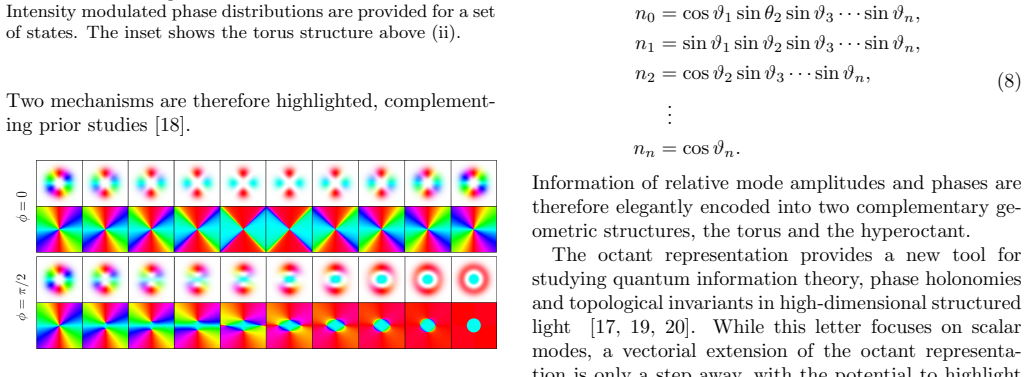
- [Eqs. (3) and (5)] The mode labels are inconsistent with the paper's own convention LG_p^ℓ. In Eq. (3), |LG_0^1> is a first-order mode (ℓ=1, p=0), not a second-order mode. The state (HG20+HG02)/√2 is the second-order mode LG_1^0. Similarly, the three LG states in Eq. (5) should be LG_0^2, LG_1^0, LG_0^{-2} (not LG_2^0, LG_0^1, LG_-2^0). These errors affect the assignment of octant edges to OAM Poincaré spheres and the phase-evolution discussion in Fig. 3.
minor comments (5)
- [Eq. (4) text] The sentence says 'the overall phase factor e^{-i2φ} can be discarded' but the matrix contains e^{+i2φ}; the sign should be corrected.
- [Introduction, first sentence] 'Hermite-Gaussian modesHG nm modes' has a missing space; also define the HG and LG index conventions explicitly before use.
- [Eq. (8)] Indices are inconsistent: 'sinθ2' should be 'sinϑ2', and the ellipsis 'sinϑ3·...·sinϑn' should be 'sinϑ2·...·sinϑN' for N>2. Clarify that N is the mode order and there are N angles ϑ1,...,ϑN.
- [References] Reference [14] is incomplete (publisher/place missing). Some reference titles are sentence-case inconsistently; unified formatting would help.
- [Figure captions] Fig. 3 caption 'for increasing θ and fixed φ' is vague; specify which φ is used and the base states. The inset in Figs. 1 and 2 should indicate the torus coordinates (χ1,χ2).
Circularity Check
No significant circularity: the geometric representation and device actions are imported from external references, and no fitted quantity is relabeled as a prediction.
full rationale
The paper's octant parametrization of CP^2 (Eq. 1) is taken from the independent quantum-state geometry literature (Bengtsson–Zyczkowski [6], Bengtsson–Brännlund–Życzkowski [13]), and the mode-converter and mode-rotator matrices (Eqs. 4 and 6) are taken from O'Neil–Courtial [15]. These are external, pre-existing results used as inputs, not conclusions derived from the paper's own fitting or from its own earlier claims. There are no fitted parameters, no data subset used to 'predict' a closely related quantity, and no uniqueness theorem from the authors' prior work is invoked to force the representation. The self-citations ([8] for geometric phases, [21,22] for optical skyrmions) appear only as motivational context and are not load-bearing. The final generalization 'For a mode of order N, the state space CP^{N-1}' with Eq. (8) appears internally inconsistent with the paper's own N=2 CP^2 example, but that is a correctness/indexing issue, not a circular reduction: it does not turn an input into an output by construction. Accordingly, no circular step is identified.
Axiom & Free-Parameter Ledger
axioms (4)
- domain assumption Pure states of fixed-order optical modes form CP^2 for second order and CP^N for an N-th-order mode (N+1 basis states), under normalization and global phase equivalence.
- domain assumption The phi-converter and rotator matrices of O'Neil and Courtial [15] (Eqs. 4 and 6) are diagonal phase-only matrices in the HG and LG bases respectively.
- standard math Equation (1) covers CP^2 away from the psi3=0 locus, and three coordinate charts are sufficient to cover the full space.
- standard math The positive hyperoctant parametrization of Eqs. (7)-(8) is a valid hyperspherical coordinate system for the simplex of amplitudes.
read the original abstract
An octant representation of higher-order optical modes that includes Laguerre-Gaussian and Hermite-Gaussian modes is presented. The octant picture captures the high-dimensional nature of three-state optical systems and beyond, with standard Poincar\'e spheres for orbital angular momentum forming subspaces of the entire state space. This representation enables intuitive manipulation of both classical modes and optical qudits and provides a framework for extending Berry phases and topological invariants to high dimensions.
Figures


Reference graph
Works this paper leans on
-
[1]
Bloch, Nuclear induction, Phys
F. Bloch, Nuclear induction, Phys. Rev.70, 460 (1946)
1946
-
[2]
Poincar´ e,Th´ eorie math´ ematique de la lumi` ere (Gabay, 1892)
H. Poincar´ e,Th´ eorie math´ ematique de la lumi` ere (Gabay, 1892)
-
[3]
M. J. Padgett and J. Courtial, Poincar´ e-sphere equivalent for light beams containing orbital angular momentum, Opt. Lett.24, 430 (1999)
1999
-
[4]
Milione, H
G. Milione, H. I. Sztul, D. A. Nolan, and R. R. Alfano, Higher-order Poincar´ e sphere, Stokes parameters, and the angular momentum of light, Phys. Rev. Lett.107, 053601 (2011)
2011
-
[5]
Mirhosseini, O
M. Mirhosseini, O. S. Maga˜ na-Loaiza, M. N. O’Sullivan, B. Rodenburg, M. Malik, M. P. J. Lavery, M. J. Pad- gett, D. J. Gauthier, and R. W. Boyd, High-dimensional quantum cryptography with twisted light, New Journal of Physics17, 033033 (2015)
2015
-
[6]
Bengtsson and K
I. Bengtsson and K. Zyczkowski,Geometry of Quan- tum States: An Introduction to Quantum Entanglement (Cambridge University Press, 2006)
2006
-
[7]
G. F. Calvo, Wigner representation and geometric trans- formations of optical orbital angular momentum spatial modes, Opt. Lett.30, 1207 (2005)
2005
-
[8]
Cisowski, J
C. Cisowski, J. B. G¨ otte, and S. Franke-Arnold, Collo- quium: Geometric phases of light: Insights from fiber bundle theory, Rev. Mod. Phys.94, 031001 (2022)
2022
-
[9]
M. A. Nielsen, M. R. Dowling, M. Gu, and A. C. Doherty, Quantum computation as geometry, Science311, 1133 (2006)
2006
-
[10]
D. C. Brody and L. P. Hughston, Geometric quantum mechanics, J. Geom. Phys.38, 19 (2001), arXiv:quant- ph/9906086
arXiv 2001
-
[11]
Majorana, Atomi orientati in campo magnetico vari- abile, Il Nuovo Cimento9, 43 (1932)
E. Majorana, Atomi orientati in campo magnetico vari- abile, Il Nuovo Cimento9, 43 (1932)
1932
-
[12]
Facchi, R
P. Facchi, R. Kulkarni, V. Man’ko, G. Marmo, E. Sudar- shan, and F. Ventriglia, Classical and quantum Fisher information in the geometrical formulation of quantum mechanics, Physics Letters A374, 4801 (2010)
2010
-
[13]
I. Bengtsson, J. Braennlund, and K. Zyczkowski, CPn, or, entanglement illustrated, Int. J. Mod. Phys. A17, 4675 (2002), arXiv:quant-ph/0108064
Pith/arXiv arXiv 2002
-
[14]
Nakahara,Geometry, topology and physics(2003) bristol, UK: Hilger (1990) 505 p
M. Nakahara,Geometry, topology and physics(2003) bristol, UK: Hilger (1990) 505 p. (Graduate student series in physics)
2003
-
[15]
A. T. O’Neil and J. Courtial, Mode transformations in terms of the constituent Hermite–Gaussian or La- guerre–Gaussian modes and the variable-phase mode converter, Optics Communications181, 35 (2000)
2000
-
[16]
Beijersbergen, L
M. Beijersbergen, L. Allen, H. van der Veen, and J. Wo- erdman, Astigmatic laser mode converters and transfer of orbital angular momentum, Optics Communications 96, 123 (1993)
1993
-
[17]
S. J. M. Habraken and G. Nienhuis, Geometric phases in higher-order transverse optical modes, inComplex Light and Optical Forces IV, edited by E. J. Galvez, D. L. An- drews, and J. Gl¨ uckstad (SPIE, 2010)
2010
-
[18]
Molina-Terriza, Vortex transformations and vortex dynamics in optical fields, inThe Angular Momentum of Light, edited by D
G. Molina-Terriza, Vortex transformations and vortex dynamics in optical fields, inThe Angular Momentum of Light, edited by D. L. Andrews and M. Babiker (Cam- bridge University Press, 2012) p. 31–50
2012
-
[19]
E. J. Galvez and M. A. O’Connell, Existence and absence of geometric phases due to mode transformations of high- order modes, inNanomanipulation with Light, Vol. 5736, edited by D. L. Andrews, International Society for Optics and Photonics (SPIE, 2005) pp. 166 – 172
2005
-
[20]
van Enk, Geometric phase, transformations of gaus- sian light beams and angular momentum transfer, Optics Communications102, 59 (1993)
S. van Enk, Geometric phase, transformations of gaus- sian light beams and angular momentum transfer, Optics Communications102, 59 (1993)
1993
-
[21]
Cisowski, C
C. Cisowski, C. Ross, and S. Franke-Arnold, Build- ing paraxial optical skyrmions using rational maps, Ad- vanced Photonics Research4, 2200350 (2023)
2023
-
[22]
Z. Ye, S. M. Barnett, S. Franke-Arnold, J. B. G¨ otte, A. McWilliam, F. C. Speirits, and C. M. Cisowski, The- ory of paraxial optical skyrmions, Proceedings of the Royal Society A: Mathematical, Physical and Engineer- ing Sciences480, 20240109 (2024)
2024
-
[23]
G. W. Gibbons and C. N. Pope, Cp2 as a gravitational instanton, Commun. Math. Phys.61, 239 (1978)
1978
discussion (0)
Sign in with ORCID, Apple, or X to comment. Anyone can read and Pith papers without signing in.