REVIEW 4 major objections 4 minor 84 references
Two radio flares from the nucleus of NGC 4845, separated by about 1513 days, are best explained as a star that returns to its black hole each orbit and is only partially torn apart, making IGR J12580+0134 a candidate repeating partial tidal
Reviewed by Pith at T0; open to challenge. T0 means a machine referee read the full paper against a public rubric. the ladder, T0–T4 →
T0 review · deepseek-v4-flash
2026-08-02 20:49 UTC pith:5THMIUIK
load-bearing objection New VLA/VLASS epochs make IGR J12580+0134 a plausible repeating-pTDE candidate, but the paper's central 'more natural' claim is asserted rather than tested, and a 0.3c/0.03c inconsistency in the text blurs the energetics. the 4 major comments →
IGR J12580+0134: A Possible Repeated Partial Tidal Disruption Event Inferred from Late-Time Radio Re-brightenin
The pith
A machine-rendered reading of the paper's core claim, the machinery that carries it, and where it could break.
Core claim
On the paper's own terms, the discovery is that the 2011 X-ray/radio tidal disruption event in NGC 4845 did not end with the first flare. Archival and newly analyzed radio data show a second, well-defined L-band flare peaking in May 2016, about 1513 days after the first, and a possible third late-time rebrightening. Modeling the second flare with a synchrotron afterglow framework yields a sub-relativistic outflow (velocity about 0.03c) with an isotropic-equivalent kinetic energy of roughly 3 x 10^50 erg expanding into a constant-density medium, requiring only about 0.06 solar masses of ejected material. Because the recurrence timescale and energy budget match what a surviving, partially stri
What carries the argument
The load-bearing objects are: (1) the assumption that the observed 1513-day separation between the two L-band radio peaks equals the orbital period of the returning star — the paper writes this as ΔT_obs = T_orb - T_peak,1 + T_peak,2 and then assumes the two fallback-to-radio delays are equal — and (2) the synchrotron afterglow model for the second flare, which converts radio light curves into outflow velocity, kinetic energy, and ambient density. The orbital consequences come from requiring the pericenter of a very eccentric orbit (e ≈ 0.997) to reach the tidal radius, and from the scenario in which the star was captured by the black hole when a stellar binary was tidally separated. Togethe
Load-bearing premise
The paper's period of 1513 days is read directly off the spacing of the two radio peaks, which equates the radio-peak delays of the two flares; the authors themselves note those delays should differ because the star is spun up and loses mass, so if the second flare's radio peak lagged the first by a different interval, the period—and everything derived from it—shifts.
What would settle it
Continue monitoring the source in the L band: if the pTDE picture is right, a third flare should appear roughly 1513 days after the 2016 peak (i.e., around 2020, with subsequent episodes following the same cadence) with comparable luminosity and spectral evolution. If instead the source decays monotonically after the 2016 flare with no such recurrence, the outflow-interaction explanation is favored.
If this is right
- If IGR J12580+0134 is a repeating pTDE, the same black hole should produce further radio flares roughly every 1513 days as the surviving star returns, making future reactivation episodes predictable in time.
- The 2016 radio flare without a bright X-ray counterpart would be understood as a natural consequence of low-mass fallback during partial stripping, rather than as evidence against renewed accretion.
- Repeating pTDEs turn radio light curves into a direct probe of the orbit and mass-loss history of a star around a supermassive black hole, complementary to single-flare TDE studies.
- The inferred ~0.06 solar masses stripped during the second encounter implies that radio observations can reveal episodic mass loss even when X-ray emission is faint or obscured, widening the search for pTDEs.
- The recurrence timescale places IGR J12580+0134 alongside other known repeating pTDE candidates, whose periods range from about 115 days to roughly 6000 days.
Where Pith is reading between the lines
- Because the two radio peaks must each lag their fallback peak by a delay that the paper itself notes should differ (the star spins up and loses mass), the true orbital period may deviate from 1513 days; the value is best treated as an estimate, not a measured period.
- The same 'two radio bumps separated by years' pattern, when found in other late-time radio re-brightening TDEs, could serve as a relatively cheap screen for new repeating pTDE candidates before deeper X-ray follow-up.
- If successive passages strip progressively less mass, a natural prediction is that each subsequent radio flare should be fainter or less energetic than the last; the current data hint at this pattern but do not establish it.
- A key alternative — that the 2016 flare is a delayed forward-shock brightening from the 2011 event — is most sharply distinguished from the pTDE scenario by the shape of the late-time decline and by the presence or absence of further flares, so continued monitoring after each flare will discriminate better than peak timing alone.
Editorial analysis
A structured set of objections, weighed in public.
Referee Report
Summary. The paper reanalyzes multi-epoch VLA/VLASS and X-ray data for the nuclear transient IGR J12580+0134 in NGC 4845. It identifies an L-band radio peak in 2012 (associated with the 2011 TDE) and a rebrightening peak in 2016, separated by about 1513 days, plus a possible later rebrightening. The 2016 flare is modeled with a synchrotron afterglow framework (PyFRS) using MCMC, fixing the ambient-density slope k=0 and outflow velocity v=0.03c, yielding E_iso ~ 3e50 erg and an inferred outflow mass ~0.19 M_sun. From these energetics the paper estimates a second-encounter disrupted mass M_2 ~ 0.06 M_sun and argues that the recurrence timescale and radio energetics make IGR J12580+0134 a candidate repeating partial tidal disruption event (pTDE), more natural than the earlier outflow–CNM interaction interpretation. The paper also discusses the lack of X-ray/optical counterparts and possible explanations.
Significance. If established, this would add IGR J12580+0134 to the small but growing sample of repeating pTDE candidates, with a recurrence period of about 4.1 yr and a radio-dominated late-time flare, providing a useful target for long-term monitoring and a test of partial-disruption recurrence models. The paper's strengths include the compilation of a long-baseline multi-frequency radio dataset, the addition of new VLA/VLASS epochs, the use of a public afterglow modeling code with MCMC sampling, and an independent spectral-index consistency check. However, because the outflow velocity is fixed rather than constrained, the recurrence period is inferred under an unvalidated peak-delay assumption, and the competing CNM-interaction scenario is not quantitatively fitted to the same data, the central 'more natural' pTDE claim is not yet supported at the level the paper claims.
major comments (4)
- [Abstract vs §3.2/§4.1] The header abstract states v~0.3c, while the full-text abstract, §4.1, and §3.2 fix v=0.03c in the MCMC analysis. This is not a cosmetic discrepancy: M_out and M_2 in Eq. (9) scale as v^-2, and the 'characteristic velocity' is an input rather than an output of the fit. All radio-energetics and partial-disruption-mass arguments therefore depend on this fixed, disputed value. Please correct the inconsistency and, ideally, marginalize over v or justify the fixed value directly from the data.
- [§3.1, Eq. (1)] The 1513-day peak separation is used as the orbital period after acknowledging that Delta T_obs = T_orb - T_peak,1 + T_peak,2 and that the two peak delays generally differ. The subsequent semimajor-axis, eccentricity (e~0.9974), and Hills-mechanism consistency checks all inherit this equality. Since the 2012 radio peak is tied to the original TDE outflow and the 2016 peak is modeled with a different, non-relativistic outflow, there is no justification for assuming T_peak,1 = T_peak,2. Please provide an uncertainty range or a physical argument; otherwise the inferred period and all orbital parameters carry an unquantified systematic error.
- [§§4.1, 5] The paper's central comparative claim—that a repeating pTDE is 'more natural' than the Perlman et al. (2022) outflow–CNM interaction interpretation—is not tested. The second flare is fitted only with the PyFRS afterglow model; the competing model is neither fitted to the same VLA light curves nor shown to be unable to produce a rebrightening peaking ~1513 days after the first event. A concrete delayed-shock or density-encounter model would be needed to support 'more natural'. Without this, the comparison is an assertion rather than a result.
- [§3.2, Eq. (9)] The numerical mass estimates are internally inconsistent with the stated inputs. Setting E_true ~ 0.5 M_out v^2 ~ E_iso with v=0.03c and E_iso=2.99e50 erg gives M_out ~0.37 M_sun (or ~0.12 M_sun for E_iso=1e50), not 0.186 M_sun as printed; the coefficient 0.062 in Eq. (9) differs from 2E_iso/v^2 by a factor of about two. Moreover, f_M and xi are free efficiencies, so M_2 can vary by orders of magnitude. Please clarify the beaming/energy-conversion convention and propagate uncertainties, or present the mass argument only as a rough scaling.
minor comments (4)
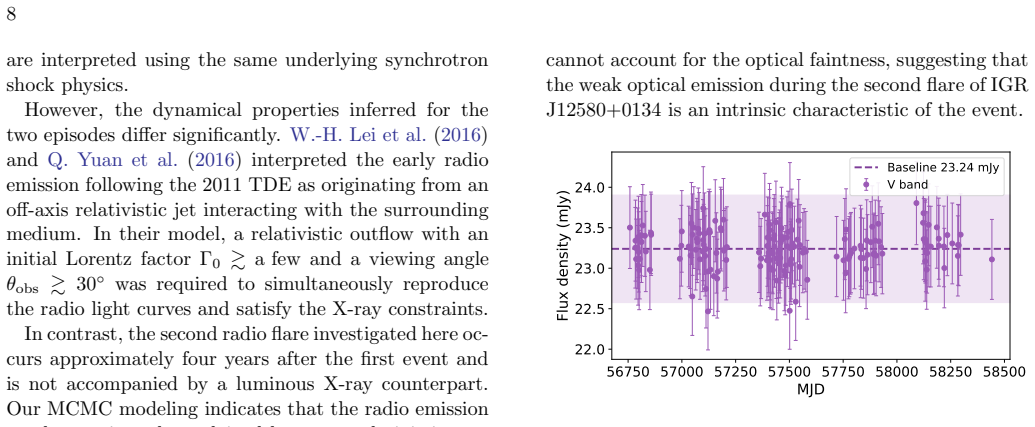
- [Figure 3 caption] The caption contains raw placeholder text (e.g., '/uni00000014/...') and is unreadable. The figure/caption needs to be regenerated.
- [Table 1] Table 1 heading is typeset as 'T able 1'; also check the alignment of the table columns.
- [Abstract/body consistency] The abstract mentions a possible third late-time rebrightening flare, but the body does not identify or analyze this third flare explicitly. Please add a pointer to the relevant figure/table or remove the claim.
- [Language and references] Minor language issues: §2.1 has 'theVery Large Array Sky Survey' (missing space) and §4.2 has 'we can compute a upper limit' (should be 'an upper limit'). Some references contain malformed volume/page data (e.g., Wang et al. 2025, Science Advances, '11, 25.9068'); please check all entries.
Circularity Check
No significant circularity: the 1513-day recurrence is read from the light curve, and the fixed-velocity afterglow assumptions are stated as assumptions rather than disguised predictions.
full rationale
The paper's central inference chain is not circular. The ~1513 day recurrence is read directly from the L-band light curve (Table 2) and is not defined by the pTDE model; Eq. (1) explicitly separates T_orb from the radio-peak delays and acknowledges that T_peak,1 and T_peak,2 will generally differ, so taking T_orb ≈ ΔT_obs is a stated assumption about equal delays, not a definitional identity. The Hills-mechanism consistency check uses standard published relations (Eqs. 3–8) and external M_BH–σ constraints rather than the paper's own conclusions. The afterglow/MCMC modeling of the second flare fixes v = 0.03c as an input, and the E_iso/M_2 estimates in Eq. (9) are explicitly conditional on that assumption; the paper does not present v as an independent prediction, so no fitted quantity is renamed as a prediction. The self-citations (Lei et al. 2016, Yuan et al. 2016) are prior published models/data, not unverified uniqueness claims, and the central candidate claim does not reduce to them. The main weaknesses—an abstract/body velocity inconsistency (0.3c vs 0.03c) and the lack of a quantitative fit of the competing outflow–CNM model—are correctness and evidence limitations, which the paper itself partly acknowledges (sparse coverage, non-identical peak delays), not circular reductions.
Axiom & Free-Parameter Ledger
free parameters (6)
- Outflow velocity v =
0.03c (fixed)
- Ambient density profile index k =
0 (assumed constant-density ISM)
- Second-flare zero-point time t0 =
MJD 57340
- MCMC afterglow parameters (E_iso, n, p, epsilon_e, epsilon_B) =
E_iso ≈ 2.99e50 erg; p ≈ 2.7 (see Fig. 3b)
- Mass/energy conversion efficiencies f_M and xi =
not constrained (appear in Eq. 9)
- Penetration factor beta_* =
0.7
axioms (5)
- domain assumption The standard synchrotron afterglow model (PyFRS) describes the radio emission from a non-relativistic outflow in a constant-density medium.
- domain assumption The radio light-curve peaks trace the fallback-rate peaks, and the delay between fallback peak and radio peak is the same for both flares.
- domain assumption The Hills mechanism can capture a star into a ~1500-day orbit around the ~10^6 M_sun black hole in NGC 4845.
- domain assumption The disk emission subtraction and the X-ray column density adopted from prior work (Irwin et al. 2015; Nikolajuk & Walter 2013; Danehkar 2025) are correct.
- domain assumption The 2023 NICER faint flares are related to the same accretion flow/central black hole.
read the original abstract
Repeating partial tidal disruption events (pTDEs) provide a direct probe of stellar orbits and episodic mass loss around supermassive black holes, but robust identification requires multi-band and multi-epoch evidence. %consistent with a single physical origin. We investigate whether the late-time radio rebrightening of the nuclear transient IGR~J12580+0134 in NGC~4845 can be explained as a repeating pTDE, using multi-epoch Karl G.\ Jansky VLA observations together with X-ray constraints from \textit{Swift}/XRT and \textit{NICER}. Through a systematic analysis of the radio data, we identify two well-defined radio flares and a possible third late-time rebrightening flare. Modeling the second flare with a synchrotron afterglow framework using Markov Chain Monte Carlo fitting is consistent with a sub-relativistic outflow with a characteristic velocity of order ${v \simeq 0.3c}$, an isotropic-equivalent kinetic energy of order ${10^{50}}$ erg, and an approximately constant-density circumnuclear medium. No significant contemporaneous brightening is detected by \textit{Swift}/XRT during the 2016 radio flare, while faint \textit{NICER} flares in 2023 suggest intermittent low-level accretion. We also considered several possible interpretations for the late-time radio rebrightening, and found that the repeated pTDE scenario provides a more natural overall explanation for the observed phenomenology. Given the currently sparse data coverage, continued sensitive radio and X-ray monitoring will be essential to test this interpretation and to search for future reactivations.
Figures


Reference graph
Works this paper leans on
-
[1]
D., van Velzen, S., Horesh, A., & Zauderer, B
Alexander, K. D., van Velzen, S., Horesh, A., & Zauderer, B. A. 2020, Space Science Reviews, 216, 81
2020
-
[2]
Angus, C. R., Smith, A. J., Magill, D., et al. 2026, https://arxiv.org/abs/2601.04406
arXiv 2026
-
[3]
2014, ApJ, 793, 38, doi: 10.1088/0004-637X/793/1/38
Arcavi, I., Gal-Yam, A., Sullivan, M., et al. 2014, ApJ, 793, 38, doi: 10.1088/0004-637X/793/1/38
-
[4]
R., Nixon, C., & Pasham, D
Bandopadhyay, A., Coughlin, E. R., Nixon, C., & Pasham, D. R. 2024, The Astrophysical Journal, 974, 80
2024
-
[5]
2015, A&A, 581, A17, doi: 10.1051/0004-6361/201525965
Campana, S., Mainetti, D., Colpi, M., et al. 2015, A&A, 581, A17, doi: 10.1051/0004-6361/201525965
-
[6]
Cardelli, J. A., Clayton, G. C., & Mathis, J. S. 1989, ApJ, 345, 245, doi: 10.1086/167900
doi:10.1086/167900 1989
-
[7]
2021, ApJ, 914, 69, doi: 10.3847/1538-4357/abf9a7
Chen, J.-H., & Shen, R.-F. 2021, ApJ, 914, 69, doi: 10.3847/1538-4357/abf9a7
-
[8]
2023, ApJ, 947, 32, doi: 10.3847/1538-4357/acbfb6
Chen, J.-H., Shen, R.-F., & Liu, S.-F. 2023, ApJ, 947, 32, doi: 10.3847/1538-4357/acbfb6
-
[9]
1980, Astronomy and Astrophysics, vol
Clark, B. 1980, Astronomy and Astrophysics, vol. 89, no. 3, Sept. 1980, p. 377, 378., 89, 377
1980
-
[10]
J., Cotton, W., Greisen, E., et al
Condon, J. J., Cotton, W., Greisen, E., et al. 1998, The Astronomical Journal, 115, 1693
1998
-
[11]
Coughlin, E. R., & Nixon, C. J. 2019, The Astrophysical Journal Letters, 883, L17, doi: 10.3847/2041-8213/ab412d
-
[12]
Coughlin, E. R., & Nixon, C. J. 2022, Monthly Notices of the Royal Astronomical Society: Letters, 517, L26, doi: 10.1093/mnrasl/slac106
-
[13]
R., & Nixon, C
Cufari, M., Coughlin, E. R., & Nixon, C. 2022, The Astrophysical Journal Letters, 929, L20
2022
-
[14]
2025, The Astrophysical Journal, 986, 50, doi: 10.3847/1538-4357/adce7e
Danehkar, A. 2025, The Astrophysical Journal, 986, 50, doi: 10.3847/1538-4357/adce7e
-
[15]
Evans, P. A., Nixon, C. J., Campana, S., et al. 2023, Nature Astronomy, 7, 1368, doi: 10.1038/s41550-023-02073-y
-
[16]
2000, ApJL, 539, L9, doi: 10.1086/312838
Ferrarese, L., & Merritt, D. 2000, ApJL, 539, L9, doi: 10.1086/312838
doi:10.1086/312838 2000
-
[17]
2024, ApJ, 977, 197, doi: 10.3847/1538-4357/ad8886
Fu, S.-Y., Xu, D., Lei, W.-H., et al. 2024, ApJ, 977, 197, doi: 10.3847/1538-4357/ad8886
-
[18]
2013, New Astronomy Reviews, 57, 141
Gao, H., Lei, W.-H., Zou, Y.-C., Wu, X.-F., & Zhang, B. 2013, New Astronomy Reviews, 57, 141
2013
-
[19]
2000, ApJL, 539, L13, doi: 10.1086/312840
Gebhardt, K., Bender, R., Bower, G., et al. 2000, ApJL, 539, L13, doi: 10.1086/312840
doi:10.1086/312840 2000
-
[20]
1995, A&A, 299, L5, doi: 10.48550/arXiv.astro-ph/9505085
Grupe, D., Beuermann, K., Mannheim, K., et al. 1995, A&A, 299, L5, doi: 10.48550/arXiv.astro-ph/9505085
-
[21]
2015, ApJL, 803, L28, doi: 10.1088/2041-8205/803/2/L28
Grupe, D., Komossa, S., & Saxton, R. 2015, ApJL, 803, L28, doi: 10.1088/2041-8205/803/2/L28
-
[22]
2024, ApJ, 969, 98, doi: 10.3847/1538-4357/ad4530
Grupe, D., Komossa, S., & Wolsing, S. 2024, ApJ, 969, 98, doi: 10.3847/1538-4357/ad4530
-
[23]
2013, The Astrophysical Journal, 767, 25, doi: 10.1088/0004-637X/767/1/25
Guillochon, J., & Ramirez-Ruiz, E. 2013, The Astrophysical Journal, 767, 25, doi: 10.1088/0004-637X/767/1/25
-
[24]
Guolo, M., Pasham, D. R., Zajaˇ cek, M., et al. 2024, Nature Astronomy, 8, 347, doi: 10.1038/s41550-023-02178-4
-
[25]
2023, ApJ, 942, 9, doi: 10.3847/1538-4357/aca283
Hammerstein, E., van Velzen, S., Gezari, S., et al. 2023, ApJ, 942, 9, doi: 10.3847/1538-4357/aca283
-
[26]
2022, Research in Astronomy and Astrophysics, 22, 055004, doi: 10.1088/1674-4527/ac5800
Hampel, J., Komossa, S., Greiner, J., et al. 2022, Research in Astronomy and Astrophysics, 22, 055004, doi: 10.1088/1674-4527/ac5800
-
[27]
Hills, J. G. 1988, Nature, 331, 687
1988
-
[28]
T., Auchettl, K., Hoogendam, W
Hinkle, J. T., Auchettl, K., Hoogendam, W. B., et al. 2025, https://arxiv.org/abs/2412.15326
Pith/arXiv arXiv 2025
-
[29]
2023, ApJL, 956, L46, doi: 10.3847/2041-8213/acffc5
Huang, S., Jiang, N., Shen, R.-F., Wang, T., & Sheng, Z. 2023, ApJL, 956, L46, doi: 10.3847/2041-8213/acffc5
-
[30]
2013, The Astronomical Journal, 146, 164, doi: 10.1088/0004-6256/146/6/164
Irwin, J., Krause, M., English, J., et al. 2013, The Astronomical Journal, 146, 164, doi: 10.1088/0004-6256/146/6/164
-
[31]
Irwin, J. A., Henriksen, R. N., Krause, M., et al. 2015, ApJ, 809, 172, doi: 10.1088/0004-637X/809/2/172
-
[32]
Irwin, J. A., Beck, R., Benjamin, R. A., et al. 2012, The Astronomical Journal, 144, 43, doi: 10.1088/0004-6256/144/2/43
-
[33]
Ji, S., Wang, Z., Zhu, L., Geier, S., & Gupta, A. C. 2025, https://arxiv.org/abs/2508.09408
Pith/arXiv arXiv 2025
-
[34]
1999, A&A, 343, 775, doi: 10.48550/arXiv.astro-ph/9901141
Komossa, S., & Bade, N. 1999, A&A, 343, 775, doi: 10.48550/arXiv.astro-ph/9901141
-
[35]
Lacy, M., Baum, S. A., Chandler, C. J., et al. 2020, Publications of the Astronomical Society of the Pacific, 132, 035001, doi: 10.1088/1538-3873/ab63eb
-
[36]
2016, The Astrophysical Journal, 816, 20, doi: 10.3847/0004-637X/816/1/20
Lei, W.-H., Yuan, Q., Zhang, B., & Wang, D. 2016, The Astrophysical Journal, 816, 20, doi: 10.3847/0004-637X/816/1/20
-
[37]
2025, arXiv e-prints, arXiv:2509.25877, doi: 10.48550/arXiv.2509.25877
Li, D., Zhang, W., Yang, J., et al. 2025, arXiv e-prints, arXiv:2509.25877, doi: 10.48550/arXiv.2509.25877
-
[38]
2024, The Astrophysical Journal Letters, 971, L26, doi: 10.3847/2041-8213/ad638e
Lin, Z., Jiang, N., Wang, T., et al. 2024, The Astrophysical Journal Letters, 971, L26, doi: 10.3847/2041-8213/ad638e
-
[39]
Liu, Z., Ryu, T., Goodwin, A. J., et al. 2024, A&A, 683, L13, doi: 10.1051/0004-6361/202348682
-
[40]
2023, MNRAS, 524, 6247, doi: 10.1093/mnras/stad2203
Lu, W., & Quataert, E. 2023, MNRAS, 524, 6247, doi: 10.1093/mnras/stad2203
-
[41]
2014, A&A, 570, A13, doi: 10.1051/0004-6361/201423496
Vauglin, I. 2014, A&A, 570, A13, doi: 10.1051/0004-6361/201423496
-
[42]
2025, https://arxiv.org/abs/2505.16867
Makrygianni, L., Arcavi, I., Newsome, M., et al. 2025, https://arxiv.org/abs/2505.16867
Pith/arXiv arXiv 2025
-
[43]
2023, MNRAS, 520, 3549, doi: 10.1093/mnras/stad022
Malyali, A., Liu, Z., Rau, A., et al. 2023, MNRAS, 520, 3549, doi: 10.1093/mnras/stad022
-
[44]
2015, The Astrophysical Journal, 805, L4, doi: 10.1088/2041-8205/805/1/l4
Mandel, I., & Levin, Y. 2015, The Astrophysical Journal, 805, L4, doi: 10.1088/2041-8205/805/1/l4
-
[45]
McConnell, N. J., & Ma, C.-P. 2013, The Astrophysical Journal, 764, 184, doi: 10.1088/0004-637X/764/2/184 13
-
[46]
2007, in ASP Conference Series, Vol
Golap, K. 2007, in ASP Conference Series, Vol. 376, Astronomical Data Analysis Software and Systems XVI (ADASS XVI), ed. R. A. Shaw, F. Hill, & D. J. Bell (Astronomical Society of the Pacific), 127 Niko lajuk, M., & Walter, R. 2013, Astronomy & Astrophysics, 552, A75
2007
-
[47]
2024, https://arxiv.org/abs/2406.18124
Pasham, D., Coughlin, E., Guolo, M., et al. 2024, https://arxiv.org/abs/2406.18124
Pith/arXiv arXiv 2024
-
[48]
V., Shappee, B
Payne, A. V., Shappee, B. J., Hinkle, J. T., et al. 2021, The Astrophysical Journal, 910, 125
2021
-
[49]
Payne, A. V., Shappee, B. J., Hinkle, J. T., et al. 2022, ApJ, 926, 142, doi: 10.3847/1538-4357/ac480c
-
[50]
Payne, A. V., Auchettl, K., Shappee, B. J., et al. 2023, ApJ, 951, 134, doi: 10.3847/1538-4357/acd455
-
[51]
Perley, R. A., & Butler, B. J. 2013, The Astrophysical Journal Supplement Series, 204, 19, doi: 10.1088/0067-0049/204/2/19
-
[52]
S., Meyer, E
Perlman, E. S., Meyer, E. T., Wang, Q. D., et al. 2017, The Astrophysical Journal, 842, 126
2017
-
[53]
Perlman, E. S., Meyer, E. T., Wang, Q. D., et al. 2022, The Astrophysical Journal, 925, 143, doi: 10.3847/1538-4357/ac3bba
-
[54]
Pfister, H., Volonteri, M., Dai, J. L., & Colpi, M. 2020, MNRAS, 497, 2276, doi: 10.1093/mnras/staa1962
-
[55]
1989, in Symposium-International Astronomical Union, Vol
Phinney, E. 1989, in Symposium-International Astronomical Union, Vol. 136, Cambridge University Press, 543–553
1989
-
[56]
Predehl, P., & Schmitt, J. H. M. M. 1995, A&A, 293, 889
1995
-
[57]
Quinlan, G. D. 1996, New Astronomy, 1, 35, doi: https://doi.org/10.1016/S1384-1076(96)00003-6
-
[58]
Rau, U., & Cornwell, T. J. 2011, Astronomy & Astrophysics, 532, A71
2011
-
[59]
Rees, M. J. 1988, Nature, 333, 523
1988
-
[60]
Ryu, T., Krolik, J., Piran, T., & Noble, S. C. 2020a, The Astrophysical Journal, 904, 100, doi: 10.3847/1538-4357/abb3ce
-
[61]
2019, ApJL, 871, L17, doi: 10.3847/2041-8213/aafc64
Shen, R.-F. 2019, ApJL, 871, L17, doi: 10.3847/2041-8213/aafc64
-
[62]
Somalwar, J. J., Ravi, V., Yao, Y., et al. 2025, ApJ, 985, 175, doi: 10.3847/1538-4357/adcc19
-
[63]
Stone, N. C., & Metzger, B. D. 2016, MNRAS, 455, 859, doi: 10.1093/mnras/stv2281
-
[64]
C., Vasiliev, E., Kesden, M., et al
Stone, N. C., Vasiliev, E., Kesden, M., et al. 2020, Space Science Reviews, 216, 35, doi: 10.1007/s11214-020-00651-4
-
[65]
2025, arXiv preprint arXiv:2501.01824
Sun, J., Guo, H., Gu, M., et al. 2025, arXiv preprint arXiv:2501.01824
Pith/arXiv arXiv 2025
-
[66]
Sun, L., Jiang, N., Dou, L., et al. 2024, Astronomy & amp; Astrophysics, 692, A262, doi: 10.1051/0004-6361/202452380 van Velzen, S., Holoien, T. W.-S., Onori, F., Hung, T., &
-
[67]
2020, SSRv, 216, 124, doi: 10.1007/s11214-020-00753-z
Arcavi, I. 2020, SSRv, 216, 124, doi: 10.1007/s11214-020-00753-z
-
[68]
M., Franckowiak, A., van Velzen, S., et al
Veres, P. M., Franckowiak, A., van Velzen, S., et al. 2025, https://arxiv.org/abs/2408.17419
arXiv 2025
-
[69]
2011, The Astronomer’s Telegram, 3108, 1
Walter, R., Bordas, P., Bozzo, E., et al. 2011, The Astronomer’s Telegram, 3108, 1
2011
-
[70]
2024, ApJ, 960, 69, doi: 10.3847/1538-4357/ad0bfb
Wang, M., Ma, Y., Wu, Q., & Jiang, N. 2024, ApJ, 960, 69, doi: 10.3847/1538-4357/ad0bfb
-
[71]
2025, Science Advances, 11, 25.9068, doi: 10.1126/sciadv.ady9068
Wang, Y., Lin, Z., Wu, L., et al. 2025, Science Advances, 11, 25.9068, doi: 10.1126/sciadv.ady9068
-
[72]
2025, https://arxiv.org/abs/2510.26561
Wang, Y., Wang, T., Huang, S., et al. 2025, https://arxiv.org/abs/2510.26561
arXiv 2025
-
[73]
Wevers, T., Pasham, D. R., van Velzen, S., et al. 2019, MNRAS, 488, 4816, doi: 10.1093/mnras/stz1976
-
[74]
Wevers, T., Coughlin, E. R., Pasham, D. R., et al. 2023, ApJL, 942, L33, doi: 10.3847/2041-8213/ac9f36
-
[75]
2015, The Astronomical Journal, 150, 81, doi: 10.1088/0004-6256/150/3/81
Wiegert, T., Irwin, J., Miskolczi, A., et al. 2015, The Astronomical Journal, 150, 81, doi: 10.1088/0004-6256/150/3/81
-
[76]
2018, MNRAS, 479, 1569, doi: 10.1093/mnras/sty1423
Wu, X.-J., & Yuan, Y.-F. 2018, MNRAS, 479, 1569, doi: 10.1093/mnras/sty1423
-
[77]
2024, Transient Name Server AstroNote, 43, 1
Yao, Y., Chornock, R., LeBaron, N., et al. 2024, Transient Name Server AstroNote, 43, 1
2024
-
[78]
2026, https://arxiv.org/abs/2601.12691
Yao, Y., Sun, L., Wu, T., et al. 2026, https://arxiv.org/abs/2601.12691
Pith/arXiv arXiv 2026
-
[79]
2023, ApJL, 955, L6, doi: 10.3847/2041-8213/acf216
Yao, Y., Ravi, V., Gezari, S., et al. 2023, ApJL, 955, L6, doi: 10.3847/2041-8213/acf216
-
[80]
Yu, N., Ho, L. C., Wang, J., & Li, H. 2022, ApJS, 261, 21, doi: 10.3847/1538-4365/ac626b
discussion (0)
Sign in with ORCID, Apple, or X to comment. Anyone can read and Pith papers without signing in.