REVIEW 4 major objections 4 minor 4 references
Asymptotic Theory and Sequential Testing for Adaptive Bandits
T0 review · 4 major / 4 minor · reviewed 2026-08-02 · deepseek-v4-flash
Pith's one-line read A urn-based bandit can support valid sequential tests if interim analyses are re-indexed by information time, under which the statistics converge to Brownian motion and classical alpha-spending boundaries apply.
desk verdict Genuinely novel inference framework for sequential testing under bandit allocation, but the printed central variance formula is internally inconsistent, every proof is deferred to a missing supplement, and the foundational lemmas are imported from an unpublished self-citation. read the letter →
The pith
A machine-rendered reading of the paper's core claim, the machinery that carries it, and where it could break.
The reading
What carries the argument
The load-bearing machinery is the UNB reinforcement rule plus the information-time reparametrization. At each round the weight vector X_t is drawn from a multivariate hypergeometric distribution with the cumulative weighted reward vector R_{t-1} as ball counts; this gives better arms stochastically larger weights while keeping some exploration. The estimators are weighted sample means whose covariance explicitly includes a batching factor (Q/N-1) and cross-arm correlations. The information fraction I_n=1/hat sigma_{h,n}^2 and the exponent gamma=mu_{h,min}/mu^* define the inverse map g(t)=t^{1/gamma}; this is the time change that restores the canonical covariance sqrt(t_i/t_j), so the designe
What would settle it
Simulate a two-arm UNB with N_t>1 and correlated rewards at known means mu_1>mu_2; regress log cumulative weight W_{n,2} on log n over a long horizon and check whether the slope approaches mu_2/mu_1. Then, at pre-planned information fractions, estimate the empirical covariance of (Psi_n(g(t_i)), Psi_n(g(t_j))) over many replications; a systematic departure from sqrt(t_i/t_j) would refute Theorem 4.3 and Corollary 4.4.
Extended reading notes
Core claim
The central claim is that UNB turns sublinear, heterogeneous sample accumulation into a tractable feature. Although each suboptimal arm's cumulative weight grows only as n^{mu_k/mu^*} almost surely, the weighted mean estimators satisfy a stable FCLT with time-scaling D(t)=diag(t^{mu_k/(2 mu^*)}), and the information fraction t_n(r)=I_{floor(nr)}/I_n converges a.s. to r^gamma, gamma=mu_{h,min}/mu^*. Under the inverse map g(t)=t^{1/gamma}, the re-indexed statistic B_n(t)=sqrt{t} h(hat mu_{floor(n g(t))})/hat sigma converges weakly to standard Brownian motion (Theorem 4.3). Any finite set of sequential statistics therefore has covariance Cov(Z_i,Z_j)=sqrt(t_i/t_j) (Corollary 4.4), so alpha-spen
Load-bearing premise
The load-bearing premise is the unproved-in-this-manuscript assertion (Appendix A, Lemmas A.1–A.2, deferred to a companion paper) that under UNB each suboptimal arm's cumulative weight grows a.s. as n^{mu_k/mu^*}; if the true exponent differs, the information-fraction transformation to Brownian motion—and with it the alpha-spending Type I error control—collapses.
Editorial extensions
If this is right
- Group-sequential boundaries from classical designs can be used under UNB allocation: the asymptotic joint law at information fractions is the canonical multivariate normal with Cov(Z_i,Z_j)=sqrt(t_i/t_j), so alpha-spending rules control the overall Type I error.
- The framework covers linear contrasts and smooth nonlinear functionals h(mu) via the Delta method, so A/B comparisons, threshold benchmarks, and lift-type effects can all be tested sequentially.
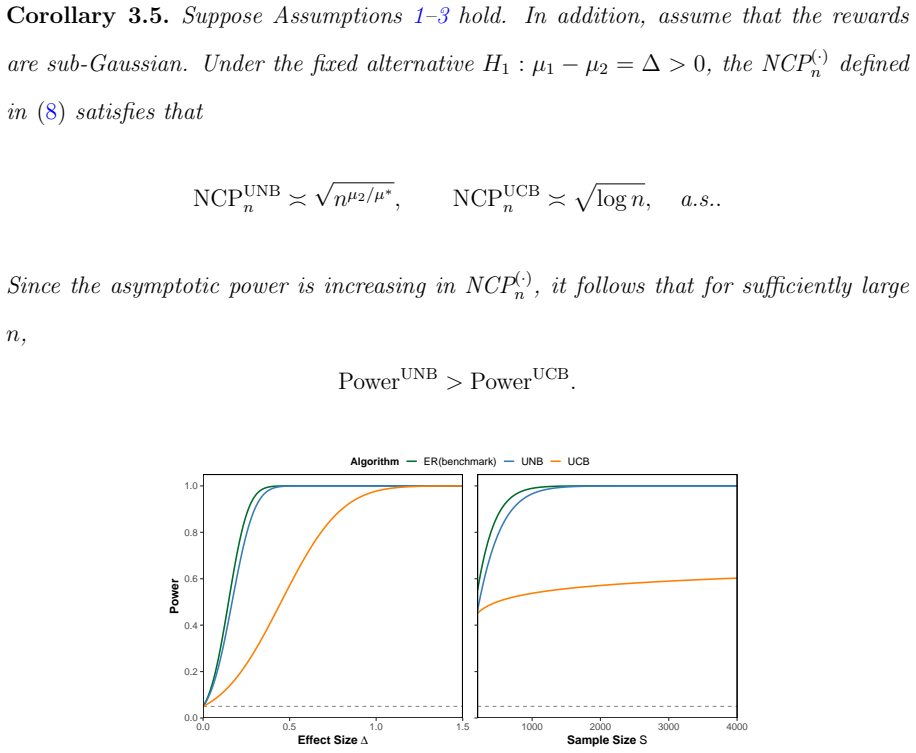
- Asymptotic power tends to 1 at a polynomial rate n^{mu_{h,min}/(2 mu^*)}, which the paper contrasts with the sqrt(log n) non-centrality of UCB-based inference.
- The variance estimator must include the adaptive batching factor and cross-arm correlations; omitting it inflates Type I error in multi-draw and correlated-reward settings.
- Simulation and semi-synthetic data analyses show empirical size near nominal while UNB assigns fewer observations to the inferior arm than equal randomization, with comparable average sample numbers and higher reward accumulation.
Reading between the lines
- Because the Brownian limit depends only on arm-weight growth exponents n^{alpha_k}, the same information-time recipe may work for other adaptive rules with polynomial allocation rates; the exponent ratio, not the urn mechanism, is likely the essential design quantity.
- The unproved growth-rate lemma is empirically checkable: under heavy-tailed or correlated rewards, log-log regressions of cumulative suboptimal-arm weight on time would reveal whether the exponent mu_k/mu^* actually holds before relying on alpha-spending boundaries.
- In multi-play bandits generally (N_t>1), the variance-inflation factor warns that treating each play as an independent observation understates uncertainty; this cautions against pseudo-count inference outside UNB as well.
- If the growth-rate lemma holds only under narrower conditions than stated, the paper's information-planning formula and its inflation factor would need recalibration before deployment; this is a testable, design-level consequence.
Editorial analysis
A structured set of objections, weighed in public.
Referee Report
Summary. The paper proposes Urn Bandit (UNB), an adaptive allocation rule in which each round's arm weights are drawn from a multivariate hypergeometric distribution based on cumulative weighted rewards. It claims two main theoretical contributions: (i) a joint CLT and a stable FCLT for weighted sample-mean estimators under non-i.i.d., non-sub-Gaussian rewards with cross-arm dependence and sublinear growth of suboptimal-arm sample sizes; and (ii) an information-fraction reparametrization under which the sequential test statistic converges to standard Brownian motion, justifying classical alpha-spending boundaries. A two-arm power comparison predicts UNB's noncentrality grows as n^{mu_2/(2 mu*)}, beating UCB's sqrt(log n) rate while remaining close to equal randomization. Simulations across Bernoulli/Poisson/Exponential rewards and a semi-synthetic ride-sharing study are reported.
Significance. Should these claims hold, the paper would make a useful contribution: it would provide a bandit allocation with native, asymptotically valid sequential inference without sub-Gaussian assumptions, an explicit correction for batch-sampling and cross-arm covariance, and a polynomial-information rate for the tested contrast. The information-fraction transformation from the mixed time-scaling D(t) to a canonical Brownian motion is conceptually appealing. The paper does not include code, and the theoretical proofs are deferred; the simulation results are internally consistent with the qualitative claims. The significance is conditional on resolving the issues below, particularly the inverted variance formula and the unproved foundational allocation rates.
major comments (4)
- [Section 3.2, Theorem 3.2] Theorem 3.2 defines sigma^2_{h,n} = sum_{i,j} partial_i h partial_j h sqrt(W_{n,i}W_{n,j}) [Sigma_hat_n]_{ij}. This is inconsistent with Theorem 3.1. Since Theorem 3.1 states that sqrt(W_{n,k})(mu_hat_{k,n} - mu_k) has covariance Sigma_hat_n, the delta method requires the quadratic form sum_{i,j} partial_i h partial_j h [Sigma_hat_n]_{ij}/sqrt(W_{n,i}W_{n,j}). As printed, for arms with W_{n,k} as n, sigma^2_{h,n} = O_p(n), so Psi_n = h(mu_hat_n)/sigma_hat_{h,n} converges in probability to 0, contradicting the claimed N(0,1) limit. The same inverted scaling appears in the factorization after Theorem 3.2, while Algorithm 2 line 16 and Table 3 use the inverse scaling. The theorem must be corrected; as it stands the central test statistic is invalid.
- [Section 4.1, Theorem 4.1] Theorem 4.1 states M_n(.) => G(.) stably and gives Cov(G(t)|F_infty) = D(t) V D(t). This specifies only the marginal covariance of G at each fixed t. The subsequent Theorem 4.3 and Corollary 4.4 require the full covariance kernel Cov(G(t),G(s)) to conclude that (Psi_n(g(t_1)),...,Psi_n(g(t_K))) has the canonical covariance sqrt(t_i/t_j). Without this kernel, or an explicit independent-increment/martingale structure on the transformed time scale, the Brownian limit and the alpha-spending validity do not follow from the stated theorem. Please state the full covariance structure or supply the argument that implies it.
- [Appendix A, Lemmas A.1-A.2] Appendix A states Lemmas A.1-A.2, giving a.s. concentration of allocation on optimal arms and W_{n,k} = O_{a.s.}(n^{mu_k/mu*}) for suboptimal arms, and says 'Proofs of these lemmas are provided in Yang et al. (2024)'. These lemmas are foundational to every subsequent result: the CLT normalization sqrt(W_{n,k}), the FCLT scaling matrix D(t), the exponent gamma = mu_{h,min}/mu* in Lemma 4.2, and the power rate in Theorem 3.4. A citation to an overlapping-authorship unpublished preprint is not sufficient. The manuscript must either prove these lemmas in the supplement or state and verify the exact conditions under which they hold.
- [Section 2.1, Algorithm 1] The allocation is defined by X_t ~ Multi-Hyper(N_t; R_{t-1}), but R_{t-1} is a cumulative weighted reward vector. For continuous rewards such as Poisson and Exponential in Section 5, R_{t-1} is not integer-valued, so the multivariate hypergeometric distribution is undefined as stated. Please define precisely how X_t is generated from real-valued R_{t-1}, and confirm that Lemmas A.1-A.2 and the subsequent asymptotic results apply to that mechanism. Without this, the algorithm is not fully specified and the simulations are not reproducible from the text.
minor comments (4)
- [Algorithm 2, line 16] The plug-in variance estimator uses b_t = (partial_1 h(mu)/sqrt(W_{t,1}), ...), with derivatives evaluated at mu rather than mu_hat_t. This is inconsistent with Theorem 3.2, where derivatives are evaluated at the estimator. Replace mu by mu_hat_t.
- [Table 4, caption] The notation S is used for the total sample size in Table 4 but is not defined in the caption or in Section 5.1. Define S and the reported quantity S_inf explicitly.
- [Assumptions and Lemma A.2] The framework implicitly assumes mu_k > 0. If mu_k = 0, the claimed rate W_{n,k} = O(n^{mu_k/mu*}) = O(1) makes the sqrt(W_{n,k}) normalization degenerate, and Assumption 2's rate o(n^{-mu_k/(2 mu*)}) is only o(1). Add an explicit lower bound on the means or explain how zero-mean arms are handled.
- [Equation (4)] The estimator Sigma_hat_n is not guaranteed to be positive semidefinite in finite samples because the term (m_hat_{Q,n}/m_hat_{N,n} - 1) can be negative when estimated from small samples. A truncation or projection step would make the variance estimator usable in practice; this is a small but helpful clarification.
Circularity Check
Foundation outsourced to a self-cited preprint: Lemmas A.1-A.2 supply the sublinear-rate exponent that Theorem 4.1, Lemma 4.2, and the Brownian information-time claim all reuse.
-
self citation load bearing
[Appendix A (Lemmas A.1-A.2), relied on by Theorem 3.1, Theorem 3.4, Theorem 4.1, Lemma 4.2, and Corollary 4.4]
"This section collects several key asymptotic properties of the UNB allocation process, which are foundational to our main results. Proofs of these lemmas are provided in Yang et al. (2024)."
The central derivation chain is not self-contained: the a.s. concentration of allocation on optimal arms and, crucially, the sublinear rate W_{n,k}=O(n^{mu_k/mu*}) are asserted in Lemmas A.1-A.2 but their proofs are deferred to a preprint (Yang et al. 2024) whose first author is the present paper's first author. The same exponent mu_k/mu* then reappears unchanged in Theorem 4.1's time-scaling matrix D(t)=diag(t^{mu_k/(2mu*)}), in Lemma 4.2's information-fraction law (r/s)^{mu_{h,min}/mu*}, and in Theorem 3.4's power rate n^{mu_{h,min}/(2mu*)}. Thus the Brownian-motion information-time result is not derived in this paper; its key quantitative input is imported from an unverified, overlapping-authorship citation. This is load-bearing self-citation: if Lemma A.2 is not accepted, the downstrea
full rationale
The paper's substantive steps—the joint CLT for weighted estimators, the FCLT with heterogeneous scaling, and the information-fraction transformation—are not definitionally circular and are not merely renamed known results; they are genuine asymptotic claims that go beyond their assumptions. However, the entire edifice rests on Lemmas A.1-A.2, whose proofs are not included in this manuscript and are instead attributed to a self-cited preprint by overlapping authorship. The exact sublinear exponent mu_k/mu* from Lemma A.2 is reused as the scaling exponent in Theorem 4.1 and as gamma=mu_{h,min}/mu* in Lemma 4.2, so the paper's central Brownian-motion prediction inherits its rate from an unproved self-citation. This warrants a moderate circularity score rather than 0. Separately, Theorem 3.2's printed variance formula appears to multiply by sqrt(W_i W_j) instead of dividing, which would make the test statistic degenerate; I regard that as an internal correctness/typographical issue, not as circularity, and it does not further raise the circularity score. The simulations and real-data analyses are external benchmarks and do not themselves create circularity.
Assumptions & free parameters
free parameters (3)
- Reinforcement budget N_t =
user-specified (N_t = 4 in the correlated-arm simulations)
- Burn-in period n_0 =
not reported in the manuscript
- Information-inflation factor L (and look count K) =
set by the alpha-spending rule and K (Section 4.3); K=10 in the real-data study
assumptions (7)
- domain assumption Assumption 1: sup_{n,k} E[xi_{n,k}^3] < C (uniformly bounded third moments)
- domain assumption Assumption 2: |mu_{k,n} - mu_k| = o(n^(-mu_k/(2*mu*))) for each arm, requiring mu_k > 0 and mu* > 0
- domain assumption Assumption 3: h is C^1 near mu and some slowest involved arm has nonzero gradient
- domain assumption Conditional independence: given F_{t-1}, X_t (hypergeometric weights) is independent of xi_t with E[xi_{t,k}|F_{t-1}] = mu_{k,t}
- ad hoc to paper Lemmas A.1-A.2 (attributed to Yang et al. 2024): a.s. concentration of allocation on optimal arms and W_{n,k} = O_{a.s.}(n^(mu_k/mu*)) for suboptimal arms
- standard math Renyi stable convergence (Hall and Heyde 1980) as the FCLT mode
- standard math Canonical group-sequential covariance structure and information-fraction design (Jennison and Turnbull 2000; Lan and DeMets 1983)
invented entities (2)
-
UNB (Urn Bandit) allocation process
-
Batch-sampling variance correction (Q/N - 1)
Cite this review
Pith. "Pith review of Asymptotic Theory and Sequential Testing for Adaptive Bandits." pith.science (2026). https://pith.science/paper/M4NSEZUH
@misc{pith2026260222768,
  author       = {Pith},
  title        = {Pith review of: Asymptotic Theory and Sequential Testing for Adaptive Bandits},
  year         = {2026},
  howpublished = {\url{https://pith.science/paper/M4NSEZUH}},
  note         = {Machine review of arXiv:2602.22768}
}
read the original abstract
Multi-armed bandit (MAB) processes constitute a foundational subclass of reinforcement learning problems and represent a central topic in statistical decision theory. Yet, conducting valid sequential testing under adaptive allocation remains challenging due to the lack of asymptotic theory under non-i.i.d. reward sequences and sublinear sample sizes for some arms. To address this open challenge, we propose an Urn Bandit (UNB) process to integrate the reinforcement mechanism of urn probabilistic models with MAB principles, ensuring almost sure concentration of allocation proportions on optimal arms. We establish a joint functional central limit theorem (FCLT) for consistent estimators of expected rewards under non-i.i.d. reward sequences with non-sub-Gaussian tails and pairwise cross-arm dependence. To overcome the limitations of existing methods that focus mainly on cumulative regret and therefore provide only algorithmic performance guarantees without supporting valid sequential testing, we develop an asymptotic theory for sequential test statistics under the proposed UNB process. The resulting framework enables a broad class of sequential inference procedures, such as A/B testing and policy evaluation. Simulation studies and real data analysis demonstrate that UNB maintains testing performance comparable to that of the equal randomization (ER) design while achieving improved reward accumulation relative to ER.
Figures


Figures from the paper (3 more)


Reference graph
Works this paper leans on
-
[1969]
J. Y. Audibert, R. Munos, and C. Szepesv´ ari. Exploration–exploitation tradeoff using variance estimates in multi-armed bandits.Theoretical Computer Science, 410(19): 1876–1902,
1902
-
[2002]
Y. Chen and J. Lu. A characterization of sample adaptivity in UCB data.arXiv preprint arXiv:2503.04855,
-
[2016]
L. Yang, J. Hu, J. Li, and Z. Bai. Asymptotic properties of a multicolored random reinforced urn model with an application to multi-armed bandits.arXiv preprint arXiv:2406.10854,
-
[2019]
K. Khamaru and C. Zhang. Inference with the upper confidence bound algorithm.arXiv preprint arXiv:2408.04595,
Reviewed August 2, 2026 · model on record in the stance chip above.
Discussion (0). Continue with ORCID to comment.