Nuclear binding, correlations, and the A-dependence of the EMC effect
Pith reviewed 2026-05-15 19:07 UTC · model grok-4.3
The pith
The slope of the EMC effect ratio correlates linearly with average nucleon removal energy when plotted against the dynamical scaling variable ỹ.
A machine-rendered reading of the paper's core claim, the machinery that carries it, and where it could break.
Core claim
The analysis of Jefferson Lab data shows that the A-dependence of the EMC effect, measured by the slope dR_A(ỹ)/dỹ, exhibits a linear correlation with the average nucleon removal energy ⟨E_A⟩, when the scaling variable ỹ is used to account for dynamical effects in interacting many-particle systems. Correlation effects are important in computing ⟨E_A⟩ from nuclear models.
What carries the argument
The scaling variable ỹ, designed to capture dynamical effects in many-particle systems, and the average nucleon removal energy ⟨E_A⟩, computed including correlation effects.
If this is right
- The EMC effect size in different nuclei is determined primarily by nuclear binding as reflected in ⟨E_A⟩.
- Using ỹ allows better description of the data than traditional scaling variables.
- Correlation effects must be included to reliably calculate ⟨E_A⟩ and thus predict the EMC effect.
- The linear relation suggests a direct link between nucleon removal energy and modifications to nuclear structure functions.
Where Pith is reading between the lines
- If the correlation holds, measurements of removal energies in new nuclei could predict their EMC effect slopes without full structure function calculations.
- This approach might extend to other probes of nuclear structure like neutrino scattering where binding effects matter.
- The emphasis on correlations implies that mean-field models alone would miss the A-dependence trend.
Load-bearing premise
The scaling variable ỹ accurately captures the dynamical effects present in the scattering data, and the average nucleon removal energy is computed reliably when nuclear correlation effects are included.
What would settle it
A measurement or calculation showing that the slope dR_A(ỹ)/dỹ does not vary linearly with ⟨E_A⟩ across a wider range of nuclei would disprove the hinted correlation.
Figures


read the original abstract
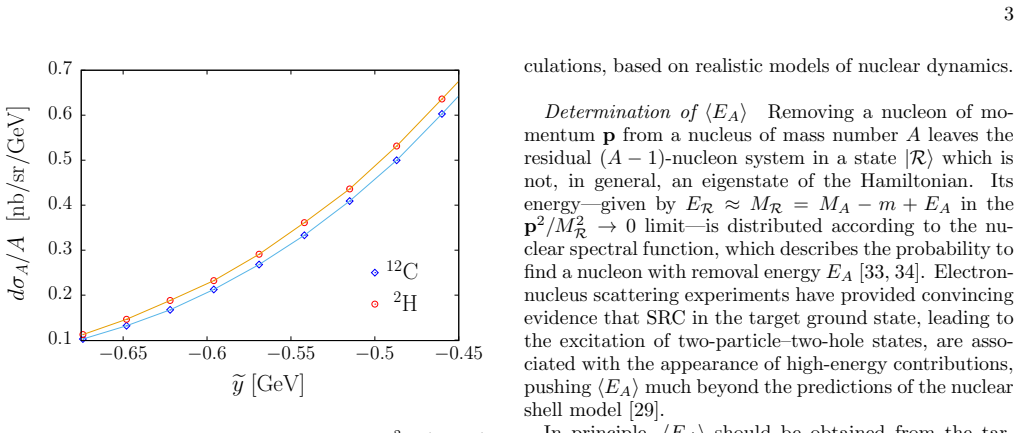
The measurements of inclusive electron scattering from nuclear targets carried out at the Thomas Jefferson National Accelerator Facility in the mid 2000s have provided valuable novel information on the $A$-dependence of the modifications of nuclear structure functions known as EMC effect. We argue that these data are best described in terms of the scaling variable $\widetilde{y}$, designed to take into account dynamical effects in interacting many-particle systems, and analyse the $A$-dependence of the slope of the inclusive cross section ratios, $R_A = (\sigma_A/A)/(\sigma_2/2)$, providing a measure of the size of the EMC effect in the region where nuclear binding plays a leading role. The results of our study clearly hint at a linear correlation between $dR_A(\widetilde{y})/d\widetilde{y}$ and the average nucleon removal energy $\langle E_A \rangle$. The role of correlation effects in the determination of $\langle E_A \rangle$ is highlighted.
Editorial analysis
A structured set of objections, weighed in public.
Referee Report
Summary. The manuscript reanalyzes Jefferson Lab inclusive electron-scattering data on the A-dependence of the EMC effect. It argues that the scaling variable ỹ, constructed to incorporate dynamical many-body effects, provides a better description than conventional variables in the binding-dominated region. From the slopes dR_A(ỹ)/dỹ of the per-nucleon cross-section ratios R_A, the authors extract a hinted linear correlation with the average nucleon removal energy ⟨E_A⟩ and emphasize the importance of short-range correlations in the evaluation of ⟨E_A⟩.
Significance. If the reported linear relation survives quantitative scrutiny, the work would furnish direct empirical support for linking the EMC effect to nuclear binding and correlation physics, offering a new observable for testing many-body models of nuclear structure. The methodological choice of ỹ is a potentially useful advance over standard y-scaling, provided its advantages are demonstrated with explicit metrics.
major comments (3)
- [Abstract] Abstract and results section: the assertion that the data are 'best described' by ỹ is not accompanied by any quantitative comparison (χ², AIC, or goodness-of-fit metrics) against the conventional y-scaling variable; without such a test the preference for ỹ remains qualitative.
- [Results] Results section (discussion of dR_A(ỹ)/dỹ): no uncertainties are reported on the extracted slopes, no error propagation from the JLab cross-section ratios is shown, and no statistical significance (p-value or correlation coefficient with uncertainty) is given for the linear fit to ⟨E_A⟩, rendering the 'clearly hint' claim impossible to evaluate.
- [⟨E_A⟩ evaluation] Section on ⟨E_A⟩ evaluation: the paper highlights the role of correlations but does not present a side-by-side comparison of the linear correlation obtained with mean-field versus correlated ⟨E_A⟩ values; the skeptic note indicates that the slope can shift by an amount comparable to the observed scatter, which must be quantified to establish that correlations are essential rather than incidental.
minor comments (2)
- [Introduction] The definition of the ratio R_A should be restated explicitly in the main text (not only in the abstract) for readers who skip the abstract.
- [Data analysis] Figure captions (or the text describing the data selection) should list the precise kinematic cuts and A values used for the slope extraction to allow reproducibility.
Simulated Author's Rebuttal
We thank the referee for the careful reading and constructive comments. We agree that quantitative support and error analysis will strengthen the manuscript and will incorporate the suggested additions in the revised version. Our responses to the major comments are given below.
read point-by-point responses
-
Referee: [Abstract] Abstract and results section: the assertion that the data are 'best described' by ỹ is not accompanied by any quantitative comparison (χ², AIC, or goodness-of-fit metrics) against the conventional y-scaling variable; without such a test the preference for ỹ remains qualitative.
Authors: We acknowledge that the preference for ỹ was stated qualitatively. In the revised manuscript we will add explicit χ² per degree of freedom (and, if appropriate, AIC) comparisons between fits performed with ỹ and with the conventional y variable over the binding-dominated region, thereby providing a quantitative metric for the claim. revision: yes
-
Referee: [Results] Results section (discussion of dR_A(ỹ)/dỹ): no uncertainties are reported on the extracted slopes, no error propagation from the JLab cross-section ratios is shown, and no statistical significance (p-value or correlation coefficient with uncertainty) is given for the linear fit to ⟨E_A⟩, rendering the 'clearly hint' claim impossible to evaluate.
Authors: We agree that uncertainties and statistical measures are required. The revised results section will include propagated uncertainties on the extracted slopes dR_A(ỹ)/dỹ, the Pearson correlation coefficient with its uncertainty, and the p-value of the linear fit to ⟨E_A⟩. revision: yes
-
Referee: [⟨E_A⟩ evaluation] Section on ⟨E_A⟩ evaluation: the paper highlights the role of correlations but does not present a side-by-side comparison of the linear correlation obtained with mean-field versus correlated ⟨E_A⟩ values; the skeptic note indicates that the slope can shift by an amount comparable to the observed scatter, which must be quantified to establish that correlations are essential rather than incidental.
Authors: We will add a direct side-by-side comparison (new figure or table) of the linear correlation obtained with mean-field ⟨E_A⟩ values versus the values that include short-range correlations. The change in slope will be quantified and compared with the observed scatter to demonstrate the impact of correlations. revision: yes
Circularity Check
No significant circularity: correlation is empirical observation between independent data-derived slope and model-computed removal energy
full rationale
The paper extracts the slope dR_A(ỹ)/dỹ directly from Jefferson Lab inclusive cross-section ratios in the binding-dominated region and reports its linear correlation with ⟨E_A⟩ obtained from separate nuclear many-body calculations. No equation in the abstract or described chain shows the slope being defined in terms of ⟨E_A⟩ or vice versa; the scaling variable ỹ is motivated by dynamical considerations but does not mathematically force the reported correlation coefficient. The role of correlations in ⟨E_A⟩ is highlighted as a modeling choice, yet the two quantities remain independently sourced—one from experiment, one from theory—without self-definitional reduction or load-bearing self-citation that collapses the result to its inputs. This is a standard empirical correlation analysis and scores as non-circular.
Axiom & Free-Parameter Ledger
Reference graph
Works this paper leans on
-
[1]
CERN Courier9, 362 (1982)
work page 1982
-
[2]
J. J. Aubert,et al.(EMC Collaboration), Phys. Lett. B 123, 275 (1983)
work page 1983
-
[3]
Bari,et al.(BCDMS Collaboration), Phys
G. Bari,et al.(BCDMS Collaboration), Phys. Lett. B 163, 282 (1985)
work page 1985
-
[4]
Ashman,et al.(EMC Collaboration), Phys
J. Ashman,et al.(EMC Collaboration), Phys. Lett. B 202, 603 (1988)
work page 1988
- [5]
-
[6]
Ackerstaff,et al.(HERMES Collaboration), Phys
K. Ackerstaff,et al.(HERMES Collaboration), Phys. Lett. B475, 386 (2000)
work page 2000
-
[7]
Airapetian,et al., (HERMES Collaboration), Phys
A. Airapetian,et al., (HERMES Collaboration), Phys. Lett. B567, 339 (2003)
work page 2003
- [8]
-
[9]
J. Arrington, A. Daniel, D. B. Day, N. Fomin, D. Gaskell, and P. Solvignon, Phys. Rev. C86, 065204 (2012)
work page 2012
-
[10]
Schmookleret al.(CLAS Collaboration), Nature566, 354 (2019)
B. Schmookleret al.(CLAS Collaboration), Nature566, 354 (2019)
work page 2019
- [11]
-
[12]
Karki,et al.(Hall C Collaboration), Phys
A. Karki,et al.(Hall C Collaboration), Phys. Rev. C 108, 035201 (2023)
work page 2023
-
[13]
D. W. Higinbotham, G. A. Miller, O. Hen, and K. Rith, CERN Courier53, 24 (2013)
work page 2013
- [14]
-
[15]
D. F. Geesaman, K. Saito, and A. W. Thomas, Ann. Rev. Nucl. Part. Sci.45, 337 (1995)
work page 1995
-
[16]
P. R. Norton, Rept. Prog. Phys.66, 1253 (2003)
work page 2003
- [17]
-
[18]
C. Ciofi degli Atti and S. Liuti, Phys. Rev. C44, R1269 (1991). 6
work page 1991
- [19]
-
[20]
L. B. Weinstein, E. Piasetzky, D. W. Higinbotham, J. Gomez, O. Hen, and R. Shneor, Phys. Rev. Lett.106, 052301 (2011)
work page 2011
-
[21]
O. Hen, E. Piasetzky, and L. B. Weinstein, Phys. Rev. C 85, 047301 (2012)
work page 2012
- [22]
- [23]
-
[24]
Fominet al., Long Range Outlook for Short-Range Correlations (2026), arXiv:2601.09568 [nucl-ex]
N. Fominet al., Long Range Outlook for Short-Range Correlations (2026), arXiv:2601.09568 [nucl-ex]
-
[25]
Nuclear binding, correlations and the origin of EMC effect
O. Benhar and I. Sick, (2012), arXiv:1207.4595 [nucl-th]
work page internal anchor Pith review Pith/arXiv arXiv 2012
- [26]
-
[27]
R. T. Azuah, W. G. Stirling, H. R. Glyde, M. Boninsegni, P. E. Sokol, and S. M. Bennington, Phys. Rev. B56, 14620 (1997)
work page 1997
-
[28]
I. Sick, D. Day, and J. S. McCarthy, Phys. Rev. Lett.45, 871 (1980)
work page 1980
- [29]
- [30]
- [31]
- [32]
- [33]
- [34]
- [35]
-
[36]
A. M. Ankowski, O. Benhar, and M. Sakuda, Phys. Rev. C110, 054612 (2024)
work page 2024
-
[37]
D. S. Koltun, Phys. Rev. Lett.28, 182 (1972)
work page 1972
- [38]
-
[39]
J. Carlson, S. Gandolfi, F. Pederiva, S. C. Pieper, R. Schi- avilla, K. E. Schmidt, and R. B. Wiringa, Rev. Mod. Phys.87, 1067 (2015)
work page 2015
-
[40]
R. B. Wiringa, V. G. J. Stoks, and R. Schiavilla, Phys. Rev. C51, 38 (1995)
work page 1995
-
[41]
S. C. Pieper, AIP Conf. Proc.1011, 143 (2008)
work page 2008
-
[42]
D. Lonardoni, A. Lovato, S. C. Pieper, and R. B. Wiringa, Phys. Rev. C96, 024326 (2017)
work page 2017
-
[43]
B. S. Pudliner, V. R. Pandharipande, J. Carlson, and R. B. Wiringa, Phys. Rev. Lett.74, 4396 (1995)
work page 1995
-
[44]
K. E. Schmidt and S. Fantoni, Phys. Lett. B446, 99 (1999)
work page 1999
- [45]
-
[46]
D. B. Day, J. S. McCarthy, Z. E. Meziani, R. C. Mine- hart, R. M. Sealock, S. T. Thornton, J. Jourdan, I. Sick, B. W. Filippone, R. D. McKeown, R. G. Milner, D. H. Potterveld, and Z. Szalata, Phys. Rev. C40, 1011 (1989)
work page 1989
- [47]
-
[48]
C. Marchand, M. Bernheim, P. C. Dunn, A. G´ erard, J. M. Laget, A. Magnon, J. Morgenstern, J. Mougey, J. Picard, D. Reffay-Pikeroen, S. Turck-Chieze, P. Vernin, M. K. Brussel, G. P. Capitani, E. De Sanctis, S. Frullani, and F. Garibaldi, Phys. Rev. Lett.60, 1703 (1988)
work page 1988
-
[49]
J. J. van Leeuwe, H. P. Blok, J. F. J. van den Brand, H. J. Bulten, G. E. Dodge, R. Ent, W. H. A. Hesselink, E. Jans, W. J. Kasdorp, J. M. Laget, L. Lapik´ as, S. I. Nagorny, C. J. G. Onderwater, A. R. Pellegrino, C. M. Spaltro, J. J. M. Steijger, R. Schiavilla, J. A. Templon, and O. Unal, Phys. Rev. Lett.80, 2543 (1998)
work page 1998
-
[50]
D. Rohe, C. S. Armstrong, R. Asaturyan, O. K. Baker, S. Bueltmann, C. Carasco, D. Day, R. Ent, H. C. Fenker, K. Garrow, A. Gasparian, P. Gueye, M. Hauger, A. Honegger, J. Jourdan, C. E. Keppel, G. Kubon, R. Lindgren, A. Lung, D. J. Mack, J. H. Mitchell, H. Mkrtchyan, D. Mocelj, K. Normand, T. Petitjean, O. Rondon, E. Segbefia, I. Sick, S. Stepanyan, L. Ta...
work page 2004
- [51]
- [52]
- [53]
-
[54]
M. Piarulli, A. Baroni, L. Girlanda, A. Kievsky, A. Lo- vato, E. Lusk, L. E. Marcucci, S. C. Pieper, R. Schiavilla, M. Viviani, and R. B. Wiringa, Phys. Rev. Lett.120, 052503 (2018)
work page 2018
-
[55]
J. E. Lynn, I. Tews, J. Carlson, S. Gandolfi, A. Gezerlis, K. E. Schmidt, and A. Schwenk, Phys. Rev. Lett.116, 062501 (2016). END MA TTER In this Section, we briefly discuss the accuracy of the variational estimates of the nuclear ground-state ener- gies. In addition, in order to illustrate the dependence of our analysis on the model of nuclear dynamics, ...
work page 2016
discussion (0)
Sign in with ORCID, Apple, or X to comment. Anyone can read and Pith papers without signing in.