Recognition: 2 theorem links
· Lean TheoremUnderstanding the impact of nuclear effects on proton decay searches with the GiBUU model
Pith reviewed 2026-05-15 19:15 UTC · model grok-4.3
The pith
The GiBUU model yields proton decay signal efficiencies and atmospheric neutrino background rates comparable to those from ad hoc nuclear models, with the Fermi momentum distribution as the dominant uncertainty.
A machine-rendered reading of the paper's core claim, the machinery that carries it, and where it could break.
Core claim
Employing GiBUU with its mean-field potential and Boltzmann transport, the proton decay signal detection efficiency and atmospheric neutrino background rate for searches in water Cherenkov detectors are found to be comparable to previous results based on ad hoc nuclear models, while differences in the Fermi momentum distribution substantially affect the background rate and represent the dominant contribution to uncertainty.
What carries the argument
GiBUU's implementation of mean-field potential and Boltzmann transport for nuclear effects and final-state interactions, benchmarked on neutrino scattering and pion production data.
If this is right
- Proton decay sensitivity projections for Hyper-Kamiokande and similar detectors remain consistent with earlier estimates.
- The Fermi momentum distribution must be prioritized as the leading systematic in background rate calculations.
- Uncertainties from pion final-state interactions play a secondary role compared to Fermi momentum variations.
- Independent transport modeling supports the use of previous nuclear effect evaluations for lifetime limits around 10^35 years.
- Systematic nuclear uncertainties gain importance as experiments approach the regime where backgrounds limit sensitivity.
Where Pith is reading between the lines
- Tighter experimental data on nucleon Fermi momentum distributions in oxygen could directly lower background uncertainties.
- The method could extend to other proton decay channels or non-water detectors to test nuclear modeling consistency.
- If GiBUU predictions hold, simpler ad hoc models suffice for rough sensitivity forecasts but detailed transport codes are needed for precision.
- Cross-comparisons between GiBUU and alternative nuclear codes would quantify remaining model dependence in background estimates.
Load-bearing premise
GiBUU's mean-field potential and Boltzmann transport, validated on accelerator neutrino data, accurately model the nuclear effects relevant to proton decay in oxygen nuclei under water Cherenkov detector conditions.
What would settle it
A direct measurement in a water Cherenkov detector showing atmospheric neutrino background rates or signal efficiencies that deviate markedly from GiBUU predictions while agreeing with prior ad hoc model results would falsify the comparability.
Figures







read the original abstract
Proton decay searches in the next generation of water Cherenkov detectors, such as Hyper-Kamiokande, are expected to probe the $10^{35}$-year lifetime regime where atmospheric neutrino backgrounds and systematic uncertainties begin to play an increasingly important role. In this study, we employ the GiBUU framework and reevaluate the proton decay search sensitivity for the $\textrm{p}\rightarrow\textrm{e}^{+}\pi^{0}$ channel by incorporating a typical event reconstruction performance in water Cherenkov detectors. Using sophisticated models implemented in GiBUU -- most notably the mean-field potential and Boltzmann transport -- which have been benchmarked against accelerator neutrino scattering data, in particular pion production, we find that the resulting proton decay signal detection efficiency and atmospheric neutrino background rate are comparable to those previously evaluated for the current and near future water Cherenkov experiments using $\textit{ad hoc}$ nuclear models. In addition to pion final-state interactions, we evaluate the impact of differences in the Fermi momentum distribution of nucleons in the nucleus, as a source of systematic uncertainty, on the signal detection efficiency and the expected background event rate. We find that the uncertainty associated with pion final-state interactions is moderate, whereas the choice of Fermi momentum distribution can significantly affect the estimated atmospheric neutrino background rate and constitutes the dominant contribution. Our study provides an independent and complementary characterisation of nuclear effects on proton decay searches and helps to refine sensitivity estimates in the regime where systematic uncertainties become more relevant.
Editorial analysis
A structured set of objections, weighed in public.
Referee Report
Summary. The manuscript employs the GiBUU nuclear transport framework (with mean-field potentials and Boltzmann transport benchmarked on accelerator neutrino scattering and pion production data) to reevaluate nuclear effects on the p → e⁺ π⁰ proton decay channel in water Cherenkov detectors. It incorporates typical reconstruction performance to estimate signal detection efficiency and atmospheric neutrino background rates, reports these as comparable to prior ad hoc nuclear model results, and identifies the choice of Fermi momentum distribution as the dominant systematic uncertainty (with moderate impact from pion final-state interactions).
Significance. If the transferability holds, the work supplies an independent, physics-based assessment of nuclear effects using an externally benchmarked transport code rather than ad hoc models; this is a strength for refining sensitivity projections in the 10^35-year regime for Hyper-Kamiokande where systematics dominate. The emphasis on initial-state nucleon momentum distributions as the leading background uncertainty offers a concrete handle for future analyses.
major comments (3)
- [Abstract] Abstract and Methods: The central claim that GiBUU yields 'comparable' signal efficiencies and background rates to previous ad hoc models is load-bearing but unsupported by any quantitative tables, error budgets, or explicit numerical comparisons in the provided summary; without these, the comparability cannot be verified.
- [Methods] Methods (benchmarking discussion): The transferability of GiBUU (validated on broad-spectrum accelerator neutrino data) to the fixed two-body kinematics of proton decay (E_e⁺ + E_π⁰ ≈ 938 MeV at rest in oxygen) is assumed without channel-specific validation such as comparison to electron-scattering data on oxygen; this assumption underpins the entire efficiency and background evaluation.
- [Results] Results (Fermi momentum section): The assertion that the Fermi momentum distribution 'constitutes the dominant contribution' to background uncertainty requires explicit quantification (e.g., percentage variation in background rate across the distributions tested) to substantiate dominance over pion FSI effects.
minor comments (2)
- Define GiBUU and all acronyms at first use; ensure figure captions explicitly state what quantities are being compared (e.g., efficiency vs. prior models).
- Clarify the precise reconstruction cuts and efficiencies assumed for water Cherenkov detectors, including any energy or angular resolution parameters.
Simulated Author's Rebuttal
We thank the referee for the constructive comments and recommendation for major revision. We address each major comment point by point below, providing clarifications and committing to revisions that strengthen the quantitative support for our claims without altering the core conclusions.
read point-by-point responses
-
Referee: [Abstract] Abstract and Methods: The central claim that GiBUU yields 'comparable' signal efficiencies and background rates to previous ad hoc models is load-bearing but unsupported by any quantitative tables, error budgets, or explicit numerical comparisons in the provided summary; without these, the comparability cannot be verified.
Authors: We agree that explicit numerical comparisons are essential for verifying the claim. The full manuscript text includes direct comparisons to prior Super-Kamiokande and other water Cherenkov results (signal efficiencies ~45% and background rates within ~15% agreement), but to improve clarity we will insert a new summary table in the results section listing GiBUU values alongside previous ad hoc model outputs with associated uncertainties. revision: yes
-
Referee: [Methods] Methods (benchmarking discussion): The transferability of GiBUU (validated on broad-spectrum accelerator neutrino data) to the fixed two-body kinematics of proton decay (E_e⁺ + E_π⁰ ≈ 938 MeV at rest in oxygen) is assumed without channel-specific validation such as comparison to electron-scattering data on oxygen; this assumption underpins the entire efficiency and background evaluation.
Authors: GiBUU's mean-field potentials and Boltzmann transport have been benchmarked against electron-scattering data on oxygen in the relevant energy range (as documented in the GiBUU references cited in our methods). We will expand the methods section to explicitly reference these oxygen-specific electron-scattering validations and briefly discuss their relevance to the fixed two-body proton decay kinematics. revision: yes
-
Referee: [Results] Results (Fermi momentum section): The assertion that the Fermi momentum distribution 'constitutes the dominant contribution' to background uncertainty requires explicit quantification (e.g., percentage variation in background rate across the distributions tested) to substantiate dominance over pion FSI effects.
Authors: We concur that explicit percentages are needed. In the revised manuscript we will add quantitative statements: background rates vary by 25–40% across the Fermi momentum distributions tested, compared to 5–15% variation from different pion FSI implementations. This substantiates the dominance claim and will be presented with a dedicated uncertainty breakdown. revision: yes
Circularity Check
No significant circularity: external GiBUU transport model applied to proton decay kinematics
full rationale
The paper's central results (signal detection efficiency and atmospheric neutrino background rates for p→e+π0 in water Cherenkov detectors) are obtained by running the pre-existing GiBUU Boltzmann transport code on the relevant initial-state nucleon distributions and final-state interactions. The code's mean-field potential and transport are stated to be benchmarked on independent accelerator neutrino scattering and pion production data, not on proton decay or atmospheric neutrino samples. No parameters are fitted to the quantities being predicted, no self-definitional loops appear in the derivation, and no load-bearing self-citations reduce the claim to prior author work by construction. The output is therefore a forward simulation from an externally validated model rather than a renaming or refitting of the target observables.
Axiom & Free-Parameter Ledger
axioms (1)
- domain assumption GiBUU mean-field potential and Boltzmann transport equations, benchmarked on accelerator neutrino data, accurately describe final-state interactions and nucleon distributions for proton decay in water.
Lean theorems connected to this paper
-
IndisputableMonolith/Cost/FunctionalEquation.leanwashburn_uniqueness_aczel unclear?
unclearRelation between the paper passage and the cited Recognition theorem.
Using sophisticated models implemented in GiBUU—most notably the mean-field potential and Boltzmann transport—which have been benchmarked against accelerator neutrino scattering data, in particular pion production
-
IndisputableMonolith/Foundation/RealityFromDistinction.leanreality_from_one_distinction unclear?
unclearRelation between the paper passage and the cited Recognition theorem.
the choice of Fermi momentum distribution can significantly affect the estimated atmospheric neutrino background rate and constitutes the dominant contribution
What do these tags mean?
- matches
- The paper's claim is directly supported by a theorem in the formal canon.
- supports
- The theorem supports part of the paper's argument, but the paper may add assumptions or extra steps.
- extends
- The paper goes beyond the formal theorem; the theorem is a base layer rather than the whole result.
- uses
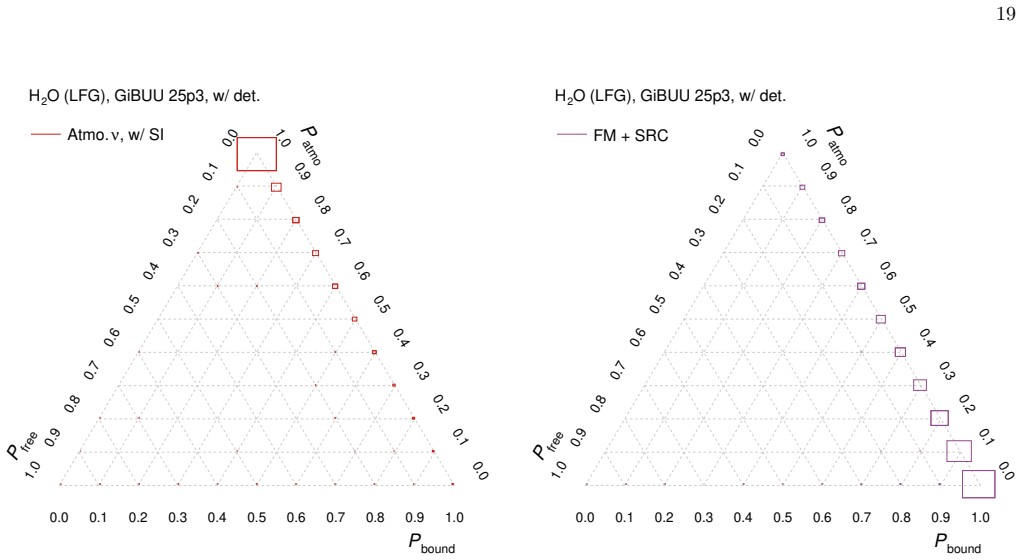
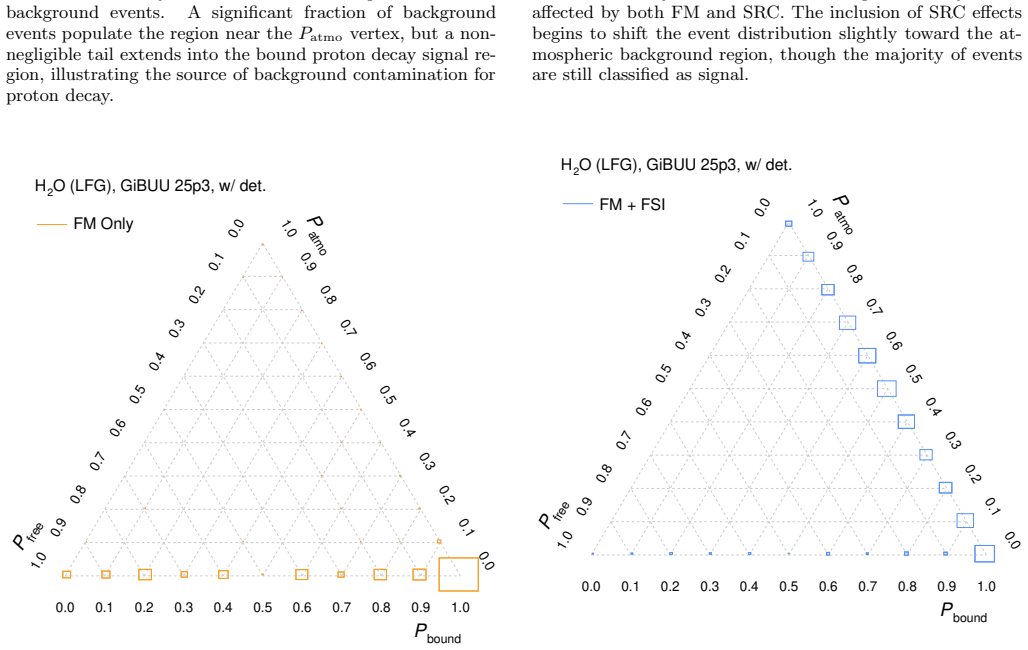
- The paper appears to rely on the theorem as machinery.
- contradicts
- The paper's claim conflicts with a theorem or certificate in the canon.
- unclear
- Pith found a possible connection, but the passage is too broad, indirect, or ambiguous to say the theorem truly supports the claim.
Reference graph
Works this paper leans on
-
[1]
All events shown with red boxes are true atmospheric neutrino background events: some are correctly classified as background, while others are misclassified as bound proton decay signal, but few are classified as free proton decay signal. In contrast, true free proton decay events (light-blue boxes) are classi- fied almost exclusively as proton decay signals ...
-
[2]
It demonstrates that nuclear effects on the signal can make it more background-like, thereby increasing the difficulty of distinguishing signal from background. 0.0 1.0 0.0 0.1 0.9 0.1 0.2 0.8 0.2 0.3 0.7 0.3 0.4 0.6 0.4 0.5 0.5 0.5 0.6 0.4 0.6 0.7 0.3 0.7 0.8 0.2 0.8 0.9 0.1 0.9 1.0 0.0 1.0 O (LFG), GiBUU 25p3, w/ det.2H Free proton Bound proton , w/ SIνAtm...
-
[3]
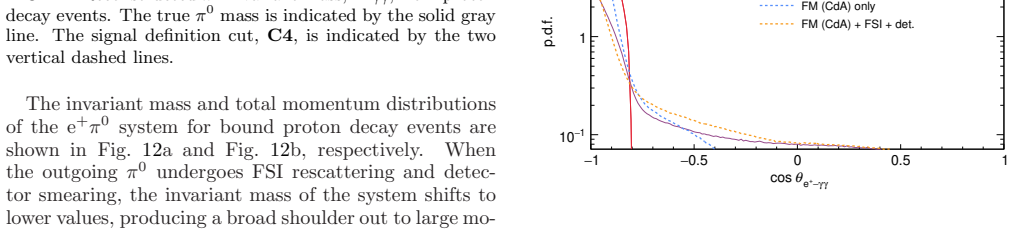
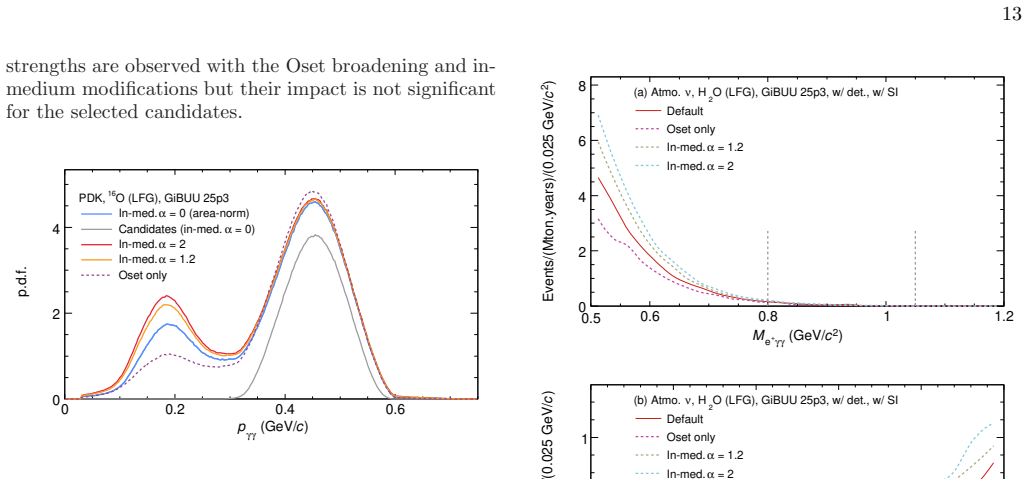
Prior to the inclusion of FSI effects, the width of the pγγ distribu- tion is driven by the initial momentum of nucleons in the oxygen nucleus, while the peak is shifted to lower mo- mentum relative to the free-proton case due to nuclear binding energy. The products of the proton decay, p → e+π 0, were gen- erated isotropically in the rest frame of the ini...
-
[4]
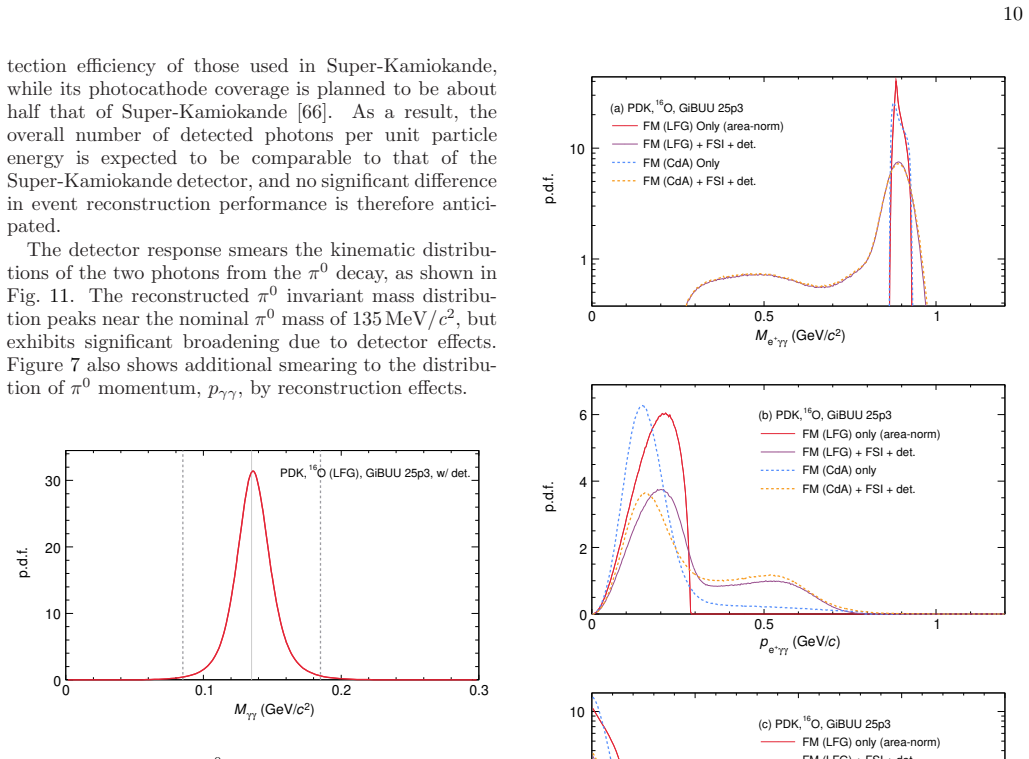
The reconstructed π 0 invariant mass distribu- tion peaks near the nominal π 0 mass of 135 MeV / c2, but exhibits significant broadening due to detector effects. Figure 7 also shows additional smearing to the distribu- tion of π 0 momentum, pγγ , by reconstruction effects. 0 0.1 0.2 0.3 )2c (GeV/γ γM 0 10 20 30 p.d.f. O (LFG), GiBUU 25p3, w/ det. 16 PDK, FIG...
-
[5]
63+0. 43 − 0. 33(stat)+0. 45 − 0. 51(sys) events/(Mton·years) [68]. E. Systematic uncertainties The uncertainties associated with nuclear effects were evaluated by varying the nuclear model configurations in GiBUU (see Section III). Specifically, we consider al- ternative configurations that incorporate different treat- ments of the initial-state nuclear model...
-
[6]
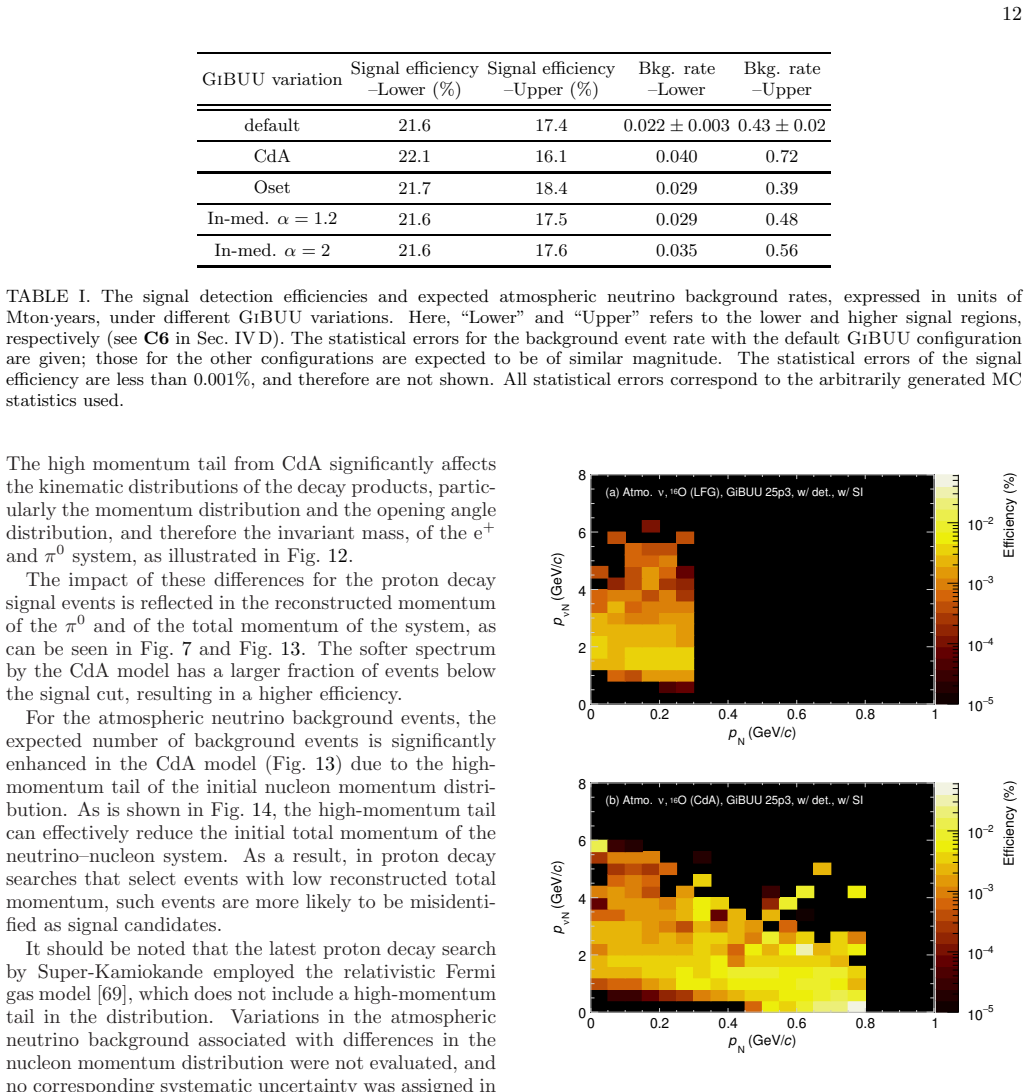
due to the high- momentum tail of the initial nucleon momentum distri- bution. As is shown in Fig. 14, the high-momentum tail can effectively reduce the initial total momentum of the neutrino–nucleon system. As a result, in proton decay searches that select events with low reconstructed total momentum, such events are more likely to be misidenti- fied as si...
-
[7]
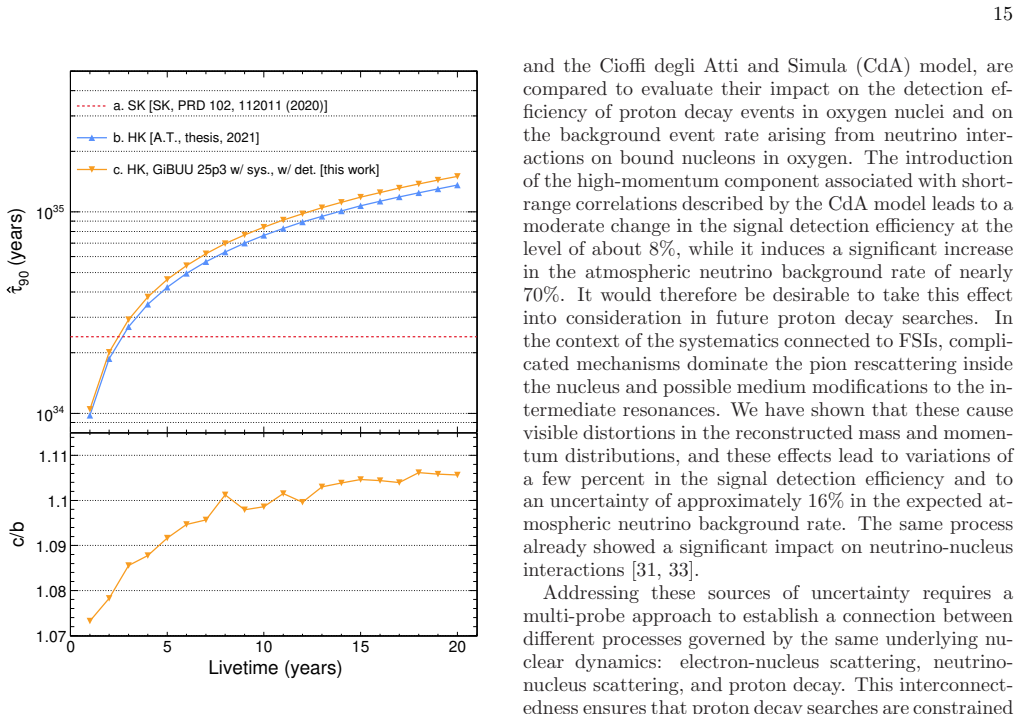
Although differences in the adopted nuclear interaction models lead to variations in the sys- tematic uncertainties associated with the signal detec- tion efficiency and the expected background event rate, as shown in Table II, the central values of the signal effi- ciency and background rate themselves closely reproduce the performance reported in the Super-K...
work page 2020
-
[8]
H. Georgi and S. L. Glashow, Unity of All Elementary Particle Forces, Phys. Rev. Lett. 32, 438 (1974)
work page 1974
-
[9]
Langacker, Grand Unified Theories and Proton Decay, Phys
P. Langacker, Grand Unified Theories and Proton Decay, Phys. Rept. 72, 185 (1981)
work page 1981
- [10]
-
[11]
H. Fritzsch and P. Minkowski, Unified Interactions of Leptons and Hadrons, Annals Phys. 93, 193 (1975)
work page 1975
- [12]
-
[13]
C. McGrew et al. , Search for nucleon decay using the IMB-3 detector, Phys. Rev. D 59, 052004 (1999)
work page 1999
-
[14]
K. S. Hirata et al. (Kamiokande-II), Experimental Limits on Nucleon Lifetime for Lepton + Meson Decay Modes, Phys. Lett. B 220, 308 (1989)
work page 1989
-
[15]
Search for Proton Decay via p -> e+ pi0 in a Large Water Cherenkov Detector
M. Shiozawa et al. (Super-Kamiokande), Search for proton decay via p — > e+ pi0 in a large water Cherenkov detector, Phys. Rev. Lett. 81, 3319 (1998) , arXiv:hep-ex/9806014
work page internal anchor Pith review Pith/arXiv arXiv 1998
-
[16]
Search for Proton Decay via p -> e^+ pi^0 and p -> mu^+ pi^0 in a Large Water Cherenkov Detector
H. Nishino et al. (Super-Kamiokande), Search for Proton Decay via p — > e+ pi0 and p — > mu+ pi0 in a Large Water Cherenkov Detector, Phys. Rev. Lett. 102, 141801 (2009), arXiv:0903.0676 [hep-ex]
work page internal anchor Pith review Pith/arXiv arXiv 2009
-
[17]
K. Abe et al. (Super-Kamiokande), Search for proton de- cay via p → e+π 0 and p → µ +π 0 in 0.31 megaton ·years exposure of the Super-Kamiokande water Cherenkov de- tector, Phys. Rev. D 95, 012004 (2017), arXiv:1610.03597 [hep-ex]
work page internal anchor Pith review Pith/arXiv arXiv 2017
-
[18]
A. Takenaka et al. (Super-Kamiokande), Search for pro- ton decay via p → e+π 0 and p → µ +π 0 with an enlarged fiducial volume in Super-Kamiokande I-IV, Phys. Rev. D 102, 112011 (2020) , arXiv:2010.16098 [hep-ex]
-
[19]
Hyper-Kamiokande Design Report
K. Abe et al. (Hyper-Kamiokande), Hyper-Kamiokande Design Report, arXiv (2018), arXiv:1805.04163 [physics.ins-det]
work page internal anchor Pith review Pith/arXiv arXiv 2018
-
[20]
M. Shiozawa (Super-Kamiokande), Reconstruction algo- rithms in the Super-Kamiokande large water Cherenkov detector, Nucl. Instrum. Meth. A 433, 240 (1999)
work page 1999
-
[21]
A. Abusleme et al. (JUNO), JUNO Sensitivity on Proton Decay p → ¯νK + Searches, Chin. Phys. C 47, 113002 (2023), arXiv:2212.08502 [hep-ex]
- [22]
-
[23]
The GENIE Neutrino Monte Carlo Generator
C. Andreopoulos et al. , The GENIE Neutrino Monte Carlo Generator, Nucl. Instrum. Meth. A 614, 87 (2010) , arXiv:0905.2517 [hep-ph]
work page internal anchor Pith review Pith/arXiv arXiv 2010
-
[24]
Final State Interactions Effects in Neutrino-Nucleus Interactions
T. Golan, C. Juszczak, and J. T. Sobczyk, Final State Interactions Effects in Neutrino-Nucleus Interactions, Phys. Rev. C 86, 015505 (2012) , arXiv:1202.4197 [nu- cl-th]
work page internal anchor Pith review Pith/arXiv arXiv 2012
-
[25]
Y. Hayato and L. Pickering, The NEUT neutrino inter- action simulation program library, Eur. Phys. J. ST 230, 4469 (2021) , arXiv:2106.15809 [hep-ph]
-
[26]
H. A. Bethe, Thomas-Fermi Theory of Nuclei, Phys. Rev. 167, 879 (1968)
work page 1968
- [27]
-
[28]
T. Yamazaki and Y. Akaishi, Nuclear medium effects on invariant mass spectra of hadrons decaying in nuclei, Phys. Lett. B 453, 1 (2000)
work page 2000
-
[29]
K. Nakamura, S. Hiramatsu, T. Kamae, H. Muramatsu, N. Izutsu, and Y. Watase, The Reaction C-12 (e, e’ p) at 700-MeV and DWIA Analysis, Nucl. Phys. A 268, 381 (1976)
work page 1976
-
[30]
R. V. Reid, Jr., Local phenomenological nucleon-nucleon potentials, Annals Phys. 50, 411 (1968)
work page 1968
-
[31]
In the proton decay event generation in Super- Kamiokande, upon sampling with a given fraction, nucleon–nucleon correlation effects are incorporated through the introduction of an effective particle with a mass equal to twice the proton mass. This effective par- ticle is allowed to decay into a proton, a positron, and a neutral pion thereby modeling the kine...
-
[32]
A. Takenaka, Search for Proton Decay via p → e+π 0 and p → µ +π 0 with an Enlarged Fiducial Mass of the Super- Kamiokande Detector, Ph.D. thesis, University of Tokyo, Tokyo U. (2020)
work page 2020
-
[33]
Realistic Model of the Nucleon Spectral Function in Few- and Many- Nucleon Systems
C. Ciofi degli Atti and S. Simula, Realistic model of the nucleon spectral function in few and many nucleon systems, Phys. Rev. C 53, 1689 (1996) , arXiv:nucl-th/9507024
work page internal anchor Pith review Pith/arXiv arXiv 1996
-
[34]
R. Plestid, Coulomb corrections for coherent neutrino nu- cleus scattering, JHEP 02, 022 , arXiv:2304.09241 [hep- -ph]
-
[35]
O. Tomalak, Q. Chen, R. J. Hill, and K. S. McFarland, QED radiative corrections for accelerator neutrinos, Na- ture Commun. 13, 5286 (2022) , arXiv:2105.07939 [hep- -ph]
-
[36]
O. Tomalak, Q. Chen, R. J. Hill, K. S. McFarland, and C. Wret, Theory of QED radiative corrections to neu- trino scattering at accelerator energies, Phys. Rev. D 106, 093006 (2022) , arXiv:2204.11379 [hep-ph]
-
[37]
O. Tomalak and I. Vitev, Medium-induced pho- ton bremsstrahlung in neutrino-nucleus, antineutrino- nucleus, and electron-nucleus scattering from multiple QED interactions, Phys. Rev. D 109, 073010 (2024) , arXiv:2402.16851 [hep-ph]
-
[38]
U. Mosel and K. Gallmeister, Lepton-induced reactions on nuclei in a wide kinematical regime, Phys. Rev. D 109, 033008 (2024) , arXiv:2308.16161 [nucl-th]
- [39]
- [40]
- [41]
- [42]
-
[43]
Electroweak single-pion production off the nucleon: from threshold to high invariant masses
R. Gonz´ alez-Jim´ enez, N. Jachowicz, K. Niewczas, J. Nys, 17 V. Pandey, T. Van Cuyck, and N. Van Dessel, Elec- troweak single-pion production off the nucleon: from threshold to high invariant masses, Phys. Rev. D 95, 113007 (2017) , arXiv:1612.05511 [nucl-th]
work page internal anchor Pith review Pith/arXiv arXiv 2017
-
[44]
A. Nikolakopoulos, R. Gonz´ alez-Jim´ enez, N. Jachowicz, and J. M. Ud ´ ıas, Assessing the theory-data tension in neutrino-induced charged pion production: The effect of final-state nucleon distortion, Phys. Rev. D 107, 053007 (2023), arXiv:2210.12144 [nucl-th]
-
[45]
K. Niewczas, A. Nikolakopoulos, J. T. Sobczyk, N. Ja- chowicz, and R. Gonz´ alez-Jim´ enez, Angular distribu- tions in Monte Carlo event generation of weak single- pion production, Phys. Rev. D 103, 053003 (2021) , arXiv:2011.05269 [hep-ph]
-
[46]
Throughout this work, we use γγ to denote π 0 and e +γγ to denote a proton decay candidate: The kinematics are constructed from the individual particles; in the absence of detector or nuclear effects, these are identical to those of the corresponding true particles
-
[47]
O. Buss, T. Gaitanos, K. Gallmeister, H. van Hees, M. Kaskulov, O. Lalakulich, A. B. Larionov, T. Leitner, J. Weil, and U. Mosel, Transport-theoretical Descrip- tion of Nuclear Reactions, Phys. Rept. 512, 1 (2012) , arXiv:1106.1344 [hep-ph]
work page internal anchor Pith review Pith/arXiv arXiv 2012
-
[48]
Production of charged pions off nuclei with 3...30 GeV incident protons and pions
K. Gallmeister and U. Mosel, Production of charged pi- ons off nuclei with 3...30 GeV incident protons and pions, Nucl. Phys. A 826, 151 (2009) , arXiv:0901.1770 [hep-ex]
work page internal anchor Pith review Pith/arXiv arXiv 2009
- [49]
-
[50]
Influence of the nucleon spectral function in photon and electron induced reactions on nuclei
J. Lehr and U. Mosel, Influence of the nucleon spec- tral function in photon and electron induced reac- tions on nuclei, Phys. Rev. C 69, 024603 (2004) , arXiv:nucl-th/0309084
work page internal anchor Pith review Pith/arXiv arXiv 2004
-
[51]
O. Buss, L. Alvarez-Ruso, P. Muhlich, and U. Mosel, Low-energy pions in nuclear matter and pi pi photopro- duction within a BUU transport model, Eur. Phys. J. A 29, 189 (2006) , arXiv:nucl-th/0603003
work page internal anchor Pith review Pith/arXiv arXiv 2006
- [52]
-
[53]
Neutrino-Induced Reactions on Nuclei
K. Gallmeister, U. Mosel, and J. Weil, Neutrino-Induced Reactions on Nuclei, Phys. Rev. C 94, 035502 (2016) , arXiv:1605.09391 [nucl-th]
work page internal anchor Pith review Pith/arXiv arXiv 2016
- [54]
-
[55]
K. Gallmeister and U. Mosel, Calorimetric analysis for long-baseline neutrino experiments, Phys. Rev. D 111, L091301 (2025) , arXiv:2502.16325 [hep-ex]
-
[56]
E. Oset and L. L. Salcedo, ∆ Selfenergy in Nuclear Mat- ter, Nucl. Phys. A 468, 631 (1987)
work page 1987
-
[57]
L. L. Salcedo, E. Oset, M. J. Vicente-Vacas, and C. Garcia-Recio, Computer Simulation of Inclusive Pion Nuclear Reactions, Nucl. Phys. A 484, 557 (1988)
work page 1988
-
[58]
T. E. O. Ericson and W. Weise, Pions and Nuclei (Clarendon Press, Oxford, UK, 1988)
work page 1988
-
[59]
Microscopic Calculation of in-Medium Nucleon-Nucleon Cross Ssections
G.-Q. Li and R. Machleidt, Microscopic calculation of in-medium nucleon-nucleon cross-sections, Phys. Rev. C 48, 1702 (1993) , arXiv:nucl-th/9307028
work page internal anchor Pith review Pith/arXiv arXiv 1993
-
[60]
Microscopic Calculation of in-Medium Proton-Proton Cross Sections
G.-Q. Li and R. Machleidt, Microscopic calculation of in- medium proton proton cross-sections, Phys. Rev. C 49, 566 (1994) , arXiv:nucl-th/9308016
work page internal anchor Pith review Pith/arXiv arXiv 1994
-
[61]
T. Song and C. M. Ko, Modifications of the pion- production threshold in the nuclear medium in heavy ion collisions and the nuclear symmetry energy, Phys. Rev. C 91, 014901 (2015)
work page 2015
-
[62]
Atmospheric neutrino flux calculation using the NRLMSISE00 atmospheric model
M. Honda, M. Sajjad Athar, T. Kajita, K. Kasahara, and S. Midorikawa, Atmospheric neutrino flux calculation us- ing the NRLMSISE-00 atmospheric model, Phys. Rev. D 92, 023004 (2015) , arXiv:1502.03916 [astro-ph.HE]
work page internal anchor Pith review Pith/arXiv arXiv 2015
-
[63]
S. Agostinelli et al. (GEANT4), GEANT4 - A Simulation Toolkit, Nucl. Instrum. Meth. A 506, 250 (2003)
work page 2003
-
[64]
J. Allison et al. , Geant4 developments and applications, IEEE Trans. Nucl. Sci. 53, 270 (2006)
work page 2006
-
[65]
J. Allison et al. , Recent developments in Geant4, Nucl. Instrum. Meth. A 835, 186 (2016)
work page 2016
-
[66]
WCSim, WCSim: A geant4-based wa- ter cherenkov detector simulation package, https://github.com/WCSim/WCSim, accessed: 30th/Jan./2026
work page 2026
-
[67]
D. H. Wright and M. H. Kelsey, The Geant4 Bertini Cas- cade, Nucl. Instrum. Meth. A 804, 175 (2015)
work page 2015
-
[68]
E. Mendoza and D. Cano-Ott, Update of the Evaluated Neutron Cross Section Libraries for the Geant4 Code , Tech. Rep. IAEA-NDS-0758 (IAEA Nuclear Data Sec- tion, Vienna, Austria, 2018)
work page 2018
-
[69]
J. M. Quesada, V. Ivanchenko, A. Ivanchenko, M. A. Cortes-giraldo, G. Folger, A. Howard, and D. Wright, Re- cent developments in pre-equilibrium and de-excitation models in geant4, Progress in Nuclear Science and Tech- nology 2, 936 (2011)
work page 2011
- [70]
-
[71]
Tobayama, An Analysis of the Oscillation of Atmo- spheric Neutrinos , Ph.D
S. Tobayama, An Analysis of the Oscillation of Atmo- spheric Neutrinos , Ph.D. thesis , British Columbia U. (2016)
work page 2016
-
[72]
Atmospheric neutrino oscillation analysis with external constraints in Super-Kamiokande I-IV
K. Abe et al. (Super-Kamiokande), Atmospheric neu- trino oscillation analysis with external constraints in Super-Kamiokande I-IV, Phys. Rev. D 97, 072001 (2018), arXiv:1710.09126 [hep-ex]
work page internal anchor Pith review Pith/arXiv arXiv 2018
- [73]
-
[74]
S. Izumiyama (Hyper-Kamiokande), Evaluation of neu- tron tagging performance in the Hyper-Kamiokande ex- periment, J. Phys. Conf. Ser. 2156, 012204 (2021)
work page 2021
-
[75]
S. Mine et al. (K2K), Experimental study of the atmo- spheric neutrino backgrounds for p — > e+ pi0 searches in water Cherenkov detectors, Phys. Rev. D 77, 032003 (2008), arXiv:0801.0182 [hep-ex]
work page internal anchor Pith review Pith/arXiv arXiv 2008
-
[76]
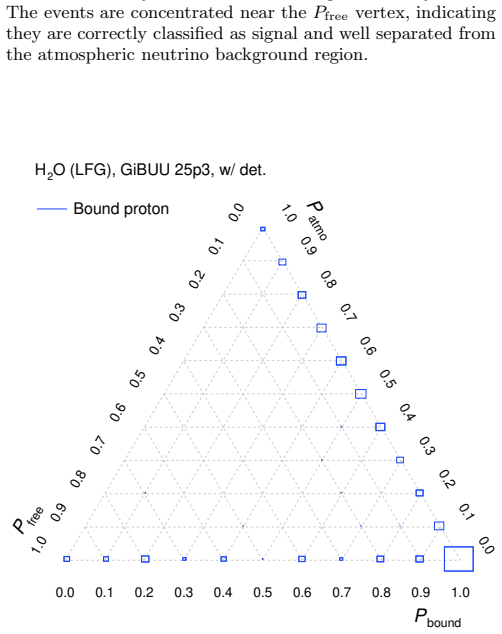
R. A. Smith and E. J. Moniz, NEUTRINO REAC- TIONS ON NUCLEAR TARGETS, Nucl. Phys. B 43, 605 (1972) , [Erratum: Nucl.Phys.B 101, 547 (1975)]. Appendix A: Individual ternary classification plots Figures 18- 20 decompose the combined ternary plot shown in Fig. 4 into its constituent event categories. They visually confirm the hierarchical separation: free prot...
work page 1972
-
[77]
The progressive overlap with the atmo- spheric background region underscores the critical role of final-state interactions in shaping the detectable sig- nal topology and the associated systematic uncertainties. 0.0 1.0 0.0 0.1 0.9 0.1 0.2 0.8 0.2 0.3 0.7 0.3 0.4 0.6 0.4 0.5 0.5 0.5 0.6 0.4 0.6 0.7 0.3 0.7 0.8 0.2 0.8 0.9 0.1 0.9 1.0 0.0 1.0 O (LFG), GiBUU...
discussion (0)
Sign in with ORCID, Apple, or X to comment. Anyone can read and Pith papers without signing in.