Recognition: 2 theorem links
· Lean TheoremStabilizer R\'enyi entropy of 3-uniform hypergraph states
Pith reviewed 2026-05-15 19:09 UTC · model grok-4.3
The pith
The stabilizer Rényi entropy of 3-uniform hypergraph states equals the rank of a matrix built from their hypergraph structure.
A machine-rendered reading of the paper's core claim, the machinery that carries it, and where it could break.
Core claim
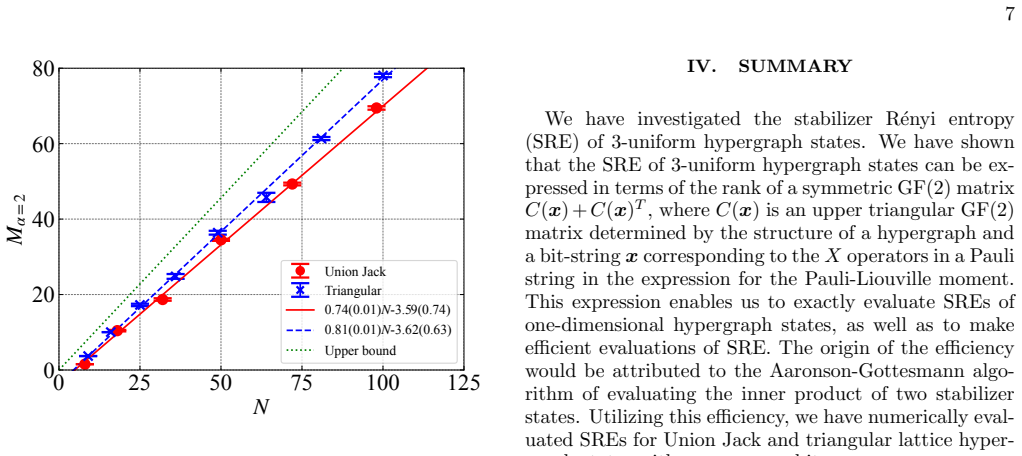
The SRE of 3-uniform hypergraph states can be expressed using the matrix rank, which reduces computational cost from O(2^{3N}) to O(N^3 2^N) for N-qubit states. Based on this result, the SREs of one-dimensional hypergraph states are evaluated exactly and numerical values are obtained for several large-scale 3-uniform hypergraph states.
What carries the argument
The matrix rank of the structure associated with the 3-uniform hypergraph generated by CCZ gates, which directly equals the stabilizer Rényi entropy.
If this is right
- Exact SRE values become available for all one-dimensional 3-uniform hypergraph states.
- Numerical SRE computation scales to systems large enough for practical quantum information tasks.
- Nonstabilizerness can be tracked efficiently in any physical setting that employs 3-uniform hypergraph states.
- The same matrix construction may supply closed-form expressions for other hypergraph-based quantities.
Where Pith is reading between the lines
- The rank reduction could be tested on hypergraphs with mixed uniformity to see whether similar simplifications hold.
- Efficient SRE evaluation may help quantify magic requirements in measurement-based quantum computation circuits built from these states.
- The mapping invites direct comparison between hypergraph-state nonstabilizerness and other magic measures such as mana or robustness of magic.
Load-bearing premise
The states arise only from controlled-controlled-Z gates on triples and the SRE definition maps to matrix rank without extra phase or normalization corrections.
What would settle it
Direct evaluation of the stabilizer Rényi entropy for a small explicit 3-uniform hypergraph state on four or five qubits, followed by comparison to the rank of the corresponding matrix; any mismatch disproves the claimed equality.
Figures


read the original abstract
Nonstabilizerness, also known as magic, plays a central role in universal quantum computation. Hypergraph states are nonstabilizer generalizations of graph states and constitute a key class of quantum states in various areas of quantum physics, such as the demonstration of quantum advantage, measurement-based quantum computation, and the study of topological phases. In this work, we investigate nonstabilizerness of 3-uniform hypergraph states, which are solely generated by controlled-controlled-Z gates, in terms of the stabilizer R\'{e}nyi entropy (SRE). We find that the SRE of 3-uniform hypergraph states can be expressed using the matrix rank, which reduces computational cost from $\mathcal{O}(2^{3N})$ to $\mathcal{O}(N^3 2^{N})$ for $N$-qubit states. Based on this result, we exactly evaluate SREs of one-dimensional hypergraph states. We also present numerical results of SREs of several large-scale 3-uniform hypergraph states. Our results would contribute to an understanding of the role of nonstabilizerness in a wide range of physical settings where hypergraph states are employed.
Editorial analysis
A structured set of objections, weighed in public.
Referee Report
Summary. The manuscript claims that the stabilizer Rényi entropy (SRE) of N-qubit 3-uniform hypergraph states, generated exclusively by controlled-controlled-Z (CCZ) gates on triples, equals a function of the rank of an incidence matrix constructed from the hypergraph. This identity is asserted to reduce the computational cost of SRE from O(2^{3N}) to O(N^3 2^N), enabling exact closed-form results for one-dimensional hypergraph states and numerical evaluation for larger instances.
Significance. If the SRE-to-rank mapping is exact, the work supplies an efficient, scalable route to quantify nonstabilizerness in hypergraph states that appear in quantum-advantage protocols, measurement-based computation, and topological phases. The exact one-dimensional formulas and the reported large-N numerics would constitute concrete, falsifiable predictions for magic in these states.
major comments (2)
- [Section 3] Section 3 (derivation of the rank formula): the central claim that SRE is determined by the rank of the incidence matrix assumes all relevant Pauli overlaps satisfy |<ψ|P|ψ>|^2 ∈ {0,1}. For hypergraphs containing overlapping triples, the product of CCZ gates produces relative phases on computational-basis states; these phases can yield fractional overlaps that a plain rank (over ℝ or GF(2)) does not automatically encode. An explicit algebraic verification or a worked example with at least one shared vertex is required to confirm the mapping remains exact.
- [Section 4] Section 4 (one-dimensional exact results): the closed-form SRE expressions for 1D chains rest directly on the rank identity. If the general mapping requires additional restrictions on hyperedge overlap, the 1D formulas must be re-derived or accompanied by an independent check (e.g., direct computation for small N) that isolates the phase contribution.
minor comments (2)
- The abstract states a naïve cost of O(2^{3N}); clarify whether this refers to a specific enumeration over triple operators or is a loose upper bound, and ensure the improved bound O(N^3 2^N) is stated with the precise matrix-construction cost.
- [Section 2] Notation for the incidence matrix (e.g., its dimensions and field) should be introduced once in Section 2 and used consistently thereafter.
Simulated Author's Rebuttal
We thank the referee for the careful reading and constructive comments. We address each major comment point by point below. The central mapping holds for the states considered, but we will add explicit verifications as requested.
read point-by-point responses
-
Referee: [Section 3] Section 3 (derivation of the rank formula): the central claim that SRE is determined by the rank of the incidence matrix assumes all relevant Pauli overlaps satisfy |<ψ|P|ψ>|^2 ∈ {0,1}. For hypergraphs containing overlapping triples, the product of CCZ gates produces relative phases on computational-basis states; these phases can yield fractional overlaps that a plain rank (over ℝ or GF(2)) does not automatically encode. An explicit algebraic verification or a worked example with at least one shared vertex is required to confirm the mapping remains exact.
Authors: We appreciate the referee's attention to the overlap structure. In the derivation of Section 3, each CCZ gate multiplies computational-basis amplitudes by a phase of exactly ±1 (specifically -1 only when all three qubits are |1⟩). For any product of such gates on a 3-uniform hypergraph, the net phase on each basis state remains ±1. Consequently, when computing ⟨ψ|P|ψ⟩ for Pauli operators P, the resulting squared magnitudes |⟨ψ|P|ψ⟩|^2 are strictly in {0,1} for all terms that enter the SRE sum; no fractional values arise. The incidence-matrix rank (over GF(2)) therefore correctly counts the independent contributions without needing to track continuous phases. To make this transparent, the revised manuscript will include an explicit algebraic verification together with a worked numerical example on a small hypergraph containing one shared vertex (two triples sharing a single qubit), showing direct overlap computation, the resulting binary values, and agreement with the rank formula. revision: yes
-
Referee: [Section 4] Section 4 (one-dimensional exact results): the closed-form SRE expressions for 1D chains rest directly on the rank identity. If the general mapping requires additional restrictions on hyperedge overlap, the 1D formulas must be re-derived or accompanied by an independent check (e.g., direct computation for small N) that isolates the phase contribution.
Authors: The one-dimensional closed forms are obtained by specializing the general rank expression to the incidence matrices of linear hypergraphs; because the phase argument above shows that fractional overlaps do not appear even for overlapping triples, no additional restrictions are required and the formulas need not be re-derived. Nevertheless, we will strengthen the section by adding an independent verification: direct, brute-force evaluation of the SRE (via the original exponential sum) for small chains with N ≤ 5, demonstrating exact numerical agreement with the rank-based closed forms. These checks explicitly isolate the phase contribution and confirm that the 1D results remain valid. revision: yes
Circularity Check
No circularity: direct algebraic identity between SRE and matrix rank
full rationale
The paper presents the SRE-to-matrix-rank mapping as an algebraic identity derived from the definition of 3-uniform hypergraph states generated by CCZ gates and the standard SRE formula. No parameters are fitted to data subsets, no self-citations are used to justify uniqueness or ansatzes, and the claimed complexity reduction follows from the rank computation without redefining inputs in terms of outputs. The derivation chain remains self-contained against the stabilizer formalism and does not reduce to a renaming or self-referential construction.
Axiom & Free-Parameter Ledger
axioms (2)
- standard math Stabilizer Rényi entropy is defined via the usual sum over stabilizer projectors
- domain assumption 3-uniform hypergraph states contain only CCZ gates and no additional phases
Lean theorems connected to this paper
-
IndisputableMonolith/Foundation/AlexanderDuality.leanalexander_duality_circle_linking unclear?
unclearRelation between the paper passage and the cited Recognition theorem.
We find that the SRE of 3-uniform hypergraph states can be expressed using the matrix rank, which reduces computational cost from O(2^{3N}) to O(N^3 2^N)
What do these tags mean?
- matches
- The paper's claim is directly supported by a theorem in the formal canon.
- supports
- The theorem supports part of the paper's argument, but the paper may add assumptions or extra steps.
- extends
- The paper goes beyond the formal theorem; the theorem is a base layer rather than the whole result.
- uses
- The paper appears to rely on the theorem as machinery.
- contradicts
- The paper's claim conflicts with a theorem or certificate in the canon.
- unclear
- Pith found a possible connection, but the passage is too broad, indirect, or ambiguous to say the theorem truly supports the claim.
Reference graph
Works this paper leans on
-
[1]
S. Bravyi and A. Kitaev, Universal quantum computa- tion with ideal Clifford gates and noisy ancillas, Phys. Rev. A71, 022316 (2005)
work page 2005
- [2]
-
[3]
M. Howard and E. Campbell, Application of a resource theory for magic states to fault-tolerant quantum com- puting, Phys. Rev. Lett.118, 090501 (2017)
work page 2017
-
[4]
The Heisenberg Representation of Quantum Computers
D. Gottesman, The Heisenberg representation of quan- tum computers (1998), arXiv:quant-ph/9807006 [quant- ph]
work page internal anchor Pith review Pith/arXiv arXiv 1998
-
[5]
S. Aaronson and D. Gottesman, Improved simulation of stabilizer circuits, Phys. Rev. A70, 052328 (2004)
work page 2004
- [6]
- [7]
-
[8]
X. Wang, M. M. Wilde, and Y. Su, Efficiently computable bounds for magic state distillation, Phys. Rev. Lett.124, 090505 (2020)
work page 2020
- [9]
- [10]
-
[11]
P. Sonya Tarabunga, M. Frau, T. Haug, E. Tirrito, and L. Piroli, A nonstabilizerness monotone from stabilizer- ness asymmetry, Quantum Science and Technology10, 045026 (2025)
work page 2025
-
[12]
M. Heinrich and D. Gross, Robustness of Magic and Symmetries of the Stabiliser Polytope, Quantum3, 132 (2019)
work page 2019
-
[13]
H. Hamaguchi, K. Hamada, and N. Yoshioka, Handbook for Quantifying Robustness of Magic, Quantum8, 1461 (2024)
work page 2024
-
[14]
L. Leone and L. Bittel, Stabilizer entropies are mono- tones for magic-state resource theory, Phys. Rev. A110, L040403 (2024)
work page 2024
-
[15]
G. Lami and M. Collura, Nonstabilizerness via perfect pauli sampling of matrix product states, Phys. Rev. Lett. 131, 180401 (2023)
work page 2023
-
[16]
P. S. Tarabunga and C. Castelnovo, Magic in general- ized Rokhsar-Kivelson wavefunctions, Quantum8, 1347 (2024)
work page 2024
-
[17]
X. Turkeshi, A. Dymarsky, and P. Sierant, Pauli spec- trum and nonstabilizerness of typical quantum many- body states, Phys. Rev. B111, 054301 (2025)
work page 2025
-
[18]
Y.-M. Ding, Z. Wang, and Z. Yan, Evaluating many- body stabilizer R´ enyi entropy by sampling reduced Pauli strings: Singularities, volume law, and nonlocal magic, PRX Quantum6, 030328 (2025)
work page 2025
-
[19]
M. Hoshino, M. Oshikawa, and Y. Ashida, Stabilizer r´ enyi entropy and conformal field theory, Phys. Rev. X 16, 011037 (2026)
work page 2026
- [20]
-
[21]
A. Sinibaldi, A. F. Mello, M. Collura, and G. Carleo, Nonstabilizerness of neural quantum states, Phys. Rev. Res.7, 043289 (2025)
work page 2025
- [22]
-
[23]
R. Qu, J. Wang, Z.-s. Li, and Y.-r. Bao, Encoding hy- pergraphs into quantum states, Phys. Rev. A87, 022311 (2013)
work page 2013
-
[24]
M. Hein, J. Eisert, and H. J. Briegel, Multiparty entan- glement in graph states, Phys. Rev. A69, 062311 (2004)
work page 2004
-
[25]
M. Hein, W. D¨ ur, J. Eisert, R. Raussendorf, M. V. den Nest, and H. J. Briegel, Entanglement in graph states and its applications (2006), arXiv:quant-ph/0602096 [quant- ph]
work page internal anchor Pith review Pith/arXiv arXiv 2006
-
[26]
M. J. Bremner, A. Montanaro, and D. J. Shepherd, Average-case complexity versus approximate simulation of commuting quantum computations, Phys. Rev. Lett. 117, 080501 (2016)
work page 2016
-
[27]
J. Miller and A. Miyake, Hierarchy of universal entangle- ment in 2d measurement-based quantum computation, npj Quantum Information2, 16036 (2016)
work page 2016
-
[28]
Y. Takeuchi, T. Morimae, and M. Hayashi, Quantum computational universality of hypergraph states with Pauli-X and Z basis measurements, Scientific Reports9, 13585 (2019)
work page 2019
-
[29]
M. Gachechiladze, O. G¨ uhne, and A. Miyake, Chang- ing the circuit-depth complexity of measurement-based quantum computation with hypergraph states, Phys. Rev. A99, 052304 (2019)
work page 2019
-
[30]
Yoshida, Topological phases with generalized global symmetries, Phys
B. Yoshida, Topological phases with generalized global symmetries, Phys. Rev. B93, 155131 (2016)
work page 2016
-
[31]
J. Miller and A. Miyake, Latent computational complex- ity of symmetry-protected topological order with frac- tional symmetry, Phys. Rev. Lett.120, 170503 (2018)
work page 2018
-
[32]
R. Raussendorf, D. E. Browne, and H. J. Briegel, Measurement-based quantum computation on cluster states, Phys. Rev. A68, 022312 (2003)
work page 2003
-
[33]
G.-C. Li, L. Chen, S.-Q. Zhang, X.-S. Hong, H. Xu, Y. Liu, Y. Zhou, G. Chen, C.-F. Li, G.-C. Guo, and A. Hamma, Invested and potential magic resources in measurement-based quantum computation, Phys. Rev. Lett.135, 160203 (2025)
work page 2025
-
[34]
J. Chen, Y. Yan, and Y. Zhou, Magic of quantum hyper- graph states, Quantum8, 1351 (2024)
work page 2024
-
[35]
R. Lidl and H. Niederreiter,Finite Fields, 2nd ed., En- cyclopedia of Mathematics and its Applications (Cam- bridge University Press, 1996)
work page 1996
- [36]
- [37]
-
[38]
A. Kissinger and J. van de Wetering, Universal MBQC with generalised parity-phase interactions and Pauli mea- surements, Quantum3, 134 (2019)
work page 2019
discussion (0)
Sign in with ORCID, Apple, or X to comment. Anyone can read and Pith papers without signing in.