REVIEW 3 major objections 5 minor 1 cited by
Nucleon spin is not thermalized in intermediate-energy heavy-ion collisions, a transport-model study argues.
Reviewed by Pith at T0; open to challenge. T0 means a machine referee read the full paper against a public rubric. the ladder, T0–T4 →
T0 review · deepseek-v4-flash
2026-08-02 20:10 UTC pith:MJITIL2Z
load-bearing objection Model comparison shows spin-thermalized formulas overpredict nucleon polarization by ~2-3x at 50-150 AMeV, but the SIBUU benchmark needs a W0=0 control and error bars before the factor is trusted. the 3 major comments →
Is nucleon spin thermalized in intermediate-energy heavy-ion collisions?
The pith
A machine-rendered reading of the paper's core claim, the machinery that carries it, and where it could break.
Core claim
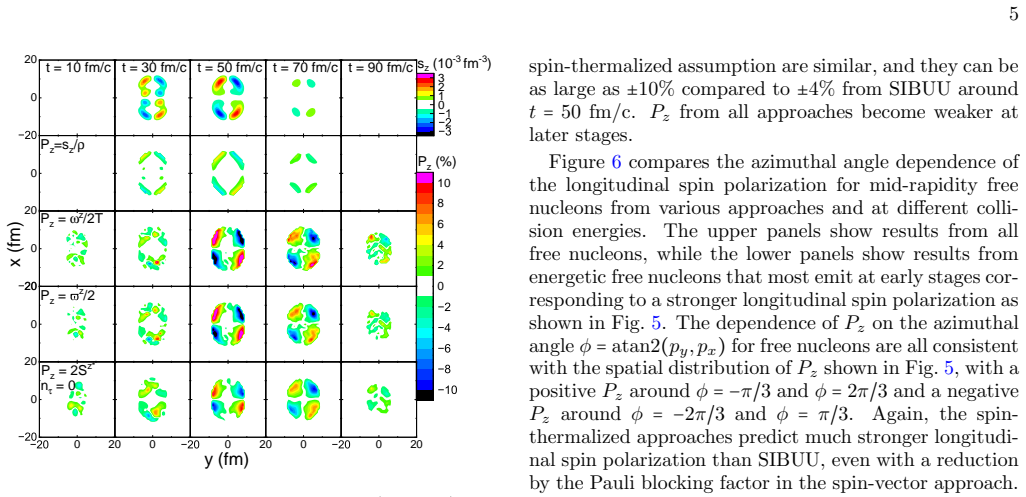
The central claim is that the nucleon spin polarization perpendicular to the reaction plane and along the longitudinal direction is largely overestimated, by roughly a factor of two to three, when one assumes local spin thermalization (P = ω/2T or the thermal-vorticity spin vector) and evaluates the fields from the bulk dynamics of a transport simulation. In the transport model, polarization is generated by the spin-orbit mean-field potential, which attracts spin-up nucleons to the participant region and repels spin-down ones, producing a positive polarization in participant matter and a negative one in spectators; thermalized formulas miss the spectator signal and overpredict the participan
What carries the argument
The key machinery is the SIBUU transport model: a spin-dependent Boltzmann-Uehling-Uhlenbeck equation with 2×2 matrix distribution and single-particle energy, decomposed into spin-averaged and spin-dependent parts. The spin-orbit mean-field potential (Eq. 5) drives spin polarization, while nucleon spins evolve by precession dσ/dt = (2/ħ) h × σ; phase-space densities are updated by test particles. Against this, the author sets the spin-thermalized formulas: P = ω/2T from kinematic vorticity, P = ϖ/2 from thermal vorticity, and the spin-vector expression 2S* with and without Pauli blocking. The comparison of these two mechanisms at freeze-out carries the argument.
Load-bearing premise
The claim depends on the transport model's semiclassical spin-orbit dynamics being an adequate stand-in for real nucleon spin evolution; if spin coherence or collision-generated spin correlations matter, the comparison against thermalized formulas would be unreliable.
What would settle it
A measurement of proton or nucleon spin polarization in intermediate-energy heavy-ion collisions—for instance near 100 AMeV Au+Au using a 12C analyzing-power detector—that yields polarization close to P ≈ ω/2T (around 10%) rather than the few percent predicted by SIBUU would falsify the claim.
If this is right
- If correct, the spin-thermalized assumption that works for hyperons at relativistic energies fails for nucleons at intermediate energies, so hadronic spin dynamics must be treated out of equilibrium.
- Measured proton or nucleon polarization in intermediate-energy collisions near 100 AMeV should be only a few percent, far below the ~10% predicted by vorticity-based formulas.
- The collision-energy dependence provides a clean discriminator: thermalized models predict monotonic increase with beam energy, while the transport model predicts a broad peak near 50–100 AMeV.
- The transport model predicts negative polarization in the spectator region, whereas thermalized approaches give positive everywhere; detecting that sign change would be a direct test.
- Extending spin-dependent transport to covariant form would test whether the failure persists at higher energies where relativistic effects become important.
- The discrepancy quantifies the systematic error incurred by using vorticity-based spin polarization estimates in the hadronic regime.
Where Pith is reading between the lines
- If the spin-orbit-dominated polarization is real, the same mechanism may contribute to Λ hyperon polarization in few-GeV collisions where hadronic matter dominates, potentially explaining the non-monotonic energy dependence hinted at in the STAR and HADES data cited in the paper.
- The factor-of-2–3 gap between thermalized and transport predictions could serve as a natural systematic uncertainty for interpreting any future polarization measurement in this energy range.
- A testable extension: vary the spin-orbit coupling strength W0 in the transport model (already done here, 80 vs 150 MeV fm^5) and compare the scaling of polarization; a measurement would pin down the effective spin-orbit coupling in nuclear matter.
- The single-unit-vector semiclassical approximation for spin may be the weakest link; a full quantum treatment of spin coherence could show whether the overestimation persists or is an artifact.
Editorial analysis
A structured set of objections, weighed in public.
Referee Report
Summary. The paper compares nucleon spin polarization from a non-relativistic spin-dependent transport model (SIBUU) with predictions of spin-thermalized approaches in intermediate-energy heavy-ion collisions. Using Au+Au at 100 AMeV and b=8 fm as the main example, with additional 50 and 150 AMeV results, the author computes P_y and P_z from SIBUU and compares them with P_y = ω_y/(2T), P_y = ϖ_y/2, and P_y = 2S*_y based on kinematic vorticity, thermal vorticity, and the spin-vector formula. The main conclusion is that all spin-thermalized approaches overestimate the SIBUU polarization by roughly a factor of 2-3, both perpendicular to the reaction plane and longitudinally, while the relativistic correction and temperature gradient are found to be small. The paper also shows that the Pauli blocking factor in the spin-vector approach reduces the thermalized polarization but not enough to match SIBUU.
Significance. If the central conclusion is robust, the paper provides a concrete low-energy challenge to the spin-thermalized assumption that has been successful for hyperon polarization at relativistic energies, and it argues for the importance of non-equilibrium spin transport in the hadronic regime. The study uses a well-established model framework and internally consistent comparisons: vorticity and temperature are extracted from the same SIBUU dynamics used to generate the transport polarization, and the comparison between kinematic and thermal vorticity is a useful check. The paper also explicitly acknowledges the absence of experimental data and proposes a possible measurement. However, the quantitative claim of a factor-2-3 overestimate rests on the SIBUU benchmark, whose spin-dependent collision contribution is not isolated and whose statistical and systematic uncertainties are not quantified. These issues are addressable and do not invalidate the approach, but they need to be resolved before the conclusion can be considered fully established.
major comments (3)
- [Equations (1), (13)-(15); Figs. 2, 3, 5, 6] The manuscript attributes the SIBUU polarization entirely to the spin-orbit mean-field potential of Eq. (5), but the spin-dependent collision integral I_c is never isolated. Equations (13)-(15) show only mean-field precession, while the text states that spin-dependent cross sections and Pauli blockings are implemented in the collision term. A W0=0 control run, or a decomposition of the final P_y/P_z into mean-field and collisional contributions, is needed to verify that the polarization is indeed 'generated by the spin-orbit potential' rather than significantly modified by the collision term. Without this, the claimed factor-2-3 overestimate by spin-thermalized approaches could be an artifact of the specific collision implementation.
- [Figs. 2-6; no error bars] The central quantitative comparison—'P_y of a few percent from SIBUU' versus '~10% from thermalized approaches'—is presented without statistical error bars or convergence tests. Since the results depend on finite test-particle sampling and on a low-density freeze-out criterion (ρ < ρ0/8), the authors should report at least ensemble-averaged results with standard deviations (or a convergence study in test-particle number). The lack of any uncertainty estimate makes it difficult to judge whether the reported differences are numerically significant, especially for the non-monotonic energy dependence of SIBUU in Fig. 3 and Fig. 6.
- [Generalization from one reaction scenario; freeze-out criterion] The abstract and summary conclude that 'all spin-thermalized approaches overestimate significantly' in intermediate-energy heavy-ion collisions, but the evidence is limited to Au+Au at one impact parameter (b=8 fm) and three beam energies. The freeze-out density ρ0/8 is an empirical choice, and the conclusions may be sensitive to it. Only the spin-orbit coupling W0 is varied (150 vs 80 MeV fm^5); other model inputs—collision cross sections, Pauli blocking, freeze-out criterion—are fixed. Adding at least one different system size/impact parameter and a sensitivity test of the freeze-out density would materially strengthen the generality of the claim.
minor comments (5)
- [Fig. 5 caption] The caption says 'in the reaction plane' for the z-component of polarization, but the plot is in the transverse (x-y) plane; it should read 'in the transverse plane'.
- [Text near Fig. 3] The phrase 'stronger spin procession' should be 'stronger spin precession'.
- [Eq. (15) and notation] The spin precession equation is written as dσ_i/dt = (2/ħ) h × σ_i; a brief explanation of the conventions (especially the origin of the factor 2) would help readers not familiar with the semiclassical reduction.
- [Figs. 2 and 6 labels] The panels labeled 'nτ = 0' and 'nτ ≠ 0' are clear only after reading the text; a sentence in the caption explaining that these correspond to omitting or including the Pauli blocking factor (1-nτ) in Eq. (27) would improve readability.
- [References] The derivation of Eqs. (13)-(15) relies on Refs. [26,27], which are the author's previous works; this is normal, but a one-sentence summary of the approximations involved (e.g., leading-order semiclassical expansion, test-particle method) would make the manuscript more self-contained.
Circularity Check
No significant circularity: the comparison uses independently formulated spin-thermalized formulas against the author's own transport model, with no fitted parameter or self-citation chain doing the work.
full rationale
The paper's central comparison is model-to-model: SIBUU spin polarization is obtained from the spin-dependent transport equations (Eqs. 1, 13-15), while the spin-thermalized predictions are taken from external references (Refs. [29-32]) using vorticity and temperature fields extracted from the same simulation's bulk dynamics. No parameter of the SIBUU model is fitted to the spin-polarization observables being compared; the spin-orbit coupling W0 is scanned over an empirical range, and the thermalized formulas are not calibrated to SIBUU output. The self-citations to the author's earlier model papers (Refs. [26,27]) provide the transport equations and cross sections, but those prior works are the construction of the benchmark model itself, not an imported conclusion that already states the paper's result. There is no uniqueness theorem invoked from the authors' own work, no ansatz smuggled in via citation, and no quantity is defined in terms of the quantity it is supposed to predict. The final paragraph's admission that no experimental data yet exist and that a covariant model is still needed is a limitation on external validation, not evidence of circularity. The skeptic's concern that the contribution of the spin-dependent collision term I_c is not separately isolated from the mean-field contribution is a legitimate robustness question about the benchmark, but it does not reduce any equation or prediction to its own input; it would affect correctness, not circularity. Under the stated hard rules, no circular step can be quoted and exhibited, so the appropriate score is 0.
Axiom & Free-Parameter Ledger
free parameters (2)
- W0 (spin-orbit coupling coefficient) =
150 MeV fm^5 default; 80 MeV fm^5 in sensitivity test
- Skyrme mean-field parameters (a, b, c, E_sym^pot, gamma_sym, rho0) =
a=-209.2 MeV, b=156.4 MeV, c=1.35, E_sym^pot=18 MeV, gamma_sym=2/3, rho0=0.16 fm^-3
axioms (5)
- domain assumption The spin-dependent BUU equation (Eq. 1) governs the nucleon phase-space distribution
- domain assumption Semiclassical limit: spin is represented by a unit vector expectation value (Eqs. 13-15)
- domain assumption The Skyrme-type spin-orbit interaction (Eq. 8) generates the spin-orbit mean-field potential (Eq. 5)
- domain assumption Spin-thermalized formulas P=omega/(2T) and spin-vector expressions (Eqs. 17, 25-27) correctly encode the thermal-spin equilibrium hypothesis
- ad hoc to paper Freeze-out occurs at local density below rho0/8
read the original abstract
Despite the success of the spin-thermalized assumption in explaining hyperon spin polarizations in relativistic heavy-ion collisions, challenges begin to arise especially at lower collision energies. The present study compares the nucleon spin polarization during the collision process and at the freeze-out stage from a non-relativistic spin-dependent transport model with spin-thermalized approaches in intermediate-energy heavy-ion collisions, where the relativistic effect and the temperature gradient have shown to be unimportant. It is found that both the global and local spin polarizations are largely overestimated from spin-thermalized approaches, compared to those generated by the spin-orbit mean-field potential in transport simulations.
Figures



Forward citations
Cited by 1 Pith paper
-
Global polarization of $\Lambda$, $\Xi^{-}$, and $\Omega^{-}$ hyperons in Au+Au collisions at RHIC BES-II energies
Hydrodynamic calculations show Omega hyperon polarization exceeds that of Lambda and Xi due to spin but falls below STAR data, with particle-antiparticle splitting growing at lower energies and driven by chemical pote...
Reference graph
Works this paper leans on
-
[1]
Kinetic theory of spin-polarized systems in electric and magnetic fields with spin-orbit coupling. i. kinetic equation and anomalous hall and spin-hall ef- fects,
K. Morawetz, “Kinetic theory of spin-polarized systems in electric and magnetic fields with spin-orbit coupling. i. kinetic equation and anomalous hall and spin-hall ef- fects,” Phys. Rev. B92, 245425 (2015)
2015
-
[2]
Global Λ hyperon polariza- tion in nuclear collisions: evidence for the most vortical 6 fluid,
L. Adamczyket al.(STAR), “Global Λ hyperon polariza- tion in nuclear collisions: evidence for the most vortical 6 fluid,” Nature548, 62 (2017)
2017
-
[3]
Global polariza- tion of Λ hyperons in au + au collisions at √sN N=200 gev,
J. Adamet al.(STAR Collaboration), “Global polariza- tion of Λ hyperons in au + au collisions at √sN N=200 gev,” Phys. Rev. C98, 014910 (2018)
2018
-
[4]
Global polariza- tion of Ξ and Ω hyperons in Au+Au collisions at √sN N= 200 GeV,
J. Adamet al.(STAR Collaboration), “Global polariza- tion of Ξ and Ω hyperons in Au+Au collisions at √sN N= 200 GeV,” Phys. Rev. Lett.126, 162301 (2021)
2021
-
[5]
Pattern of global spin alignment ofϕand K ∗0 mesons in heavy-ion collisions,
M. S. Abdallahet al.(STAR), “Pattern of global spin alignment ofϕand K ∗0 mesons in heavy-ion collisions,” Nature614, 244 (2023)
2023
-
[6]
Polarization of Λ ( Λ) hyperons along the beam direction in Au+Au collisions at √sN N=200 GeV,
J. Adamet al.(STAR Collaboration), “Polarization of Λ ( Λ) hyperons along the beam direction in Au+Au collisions at √sN N=200 GeV,” Phys. Rev. Lett.123, 132301 (2019)
2019
-
[7]
Global Λ- hyperon polarization in Au+Au collisions at √sNN = 3GeV,
M. S. Abdallahet al.(STAR Collaboration), “Global Λ- hyperon polarization in Au+Au collisions at √sNN = 3GeV,” Phys. Rev. C104, L061901 (2021)
2021
-
[8]
Measurement of global polar- ization ofλhyperons in few-gev heavy-ion collisions,
R. Abou Yassineet al., “Measurement of global polar- ization ofλhyperons in few-gev heavy-ion collisions,” Physics Letters B835, 137506 (2022)
2022
-
[9]
Study of Λ polarization in relativistic nuclear collisions at √sNN =7.7 –200 GeV,
I. Karpenko and F. Becattini, “Study of Λ polarization in relativistic nuclear collisions at √sNN =7.7 –200 GeV,” Eur. Phys. J. C77, 213 (2017), arXiv:1610.04717 [nucl- th]
Pith/arXiv arXiv 2017
-
[10]
Global Λ polarization in heavy-ion collisions from a transport model,
Hui Li, Long-Gang Pang, Qun Wang, and Xiao-Liang Xia, “Global Λ polarization in heavy-ion collisions from a transport model,” Phys. Rev. C96, 054908 (2017), arXiv:1704.01507 [nucl-th]
Pith/arXiv arXiv 2017
-
[11]
Collective longitudinal polarization in relativistic heavy-ion collisions at very high energy,
F. Becattini and Iu. Karpenko, “Collective longitudinal polarization in relativistic heavy-ion collisions at very high energy,” Phys. Rev. Lett.120, 012302 (2018)
2018
-
[12]
Spin- thermal shear coupling in a relativistic fluid,
F. Becattini, M. Buzzegoli, and A. Palermo, “Spin- thermal shear coupling in a relativistic fluid,” Phys. Lett. B820, 136519 (2021), arXiv:2103.10917 [nucl-th]
Pith/arXiv arXiv 2021
-
[13]
Shear-Induced Spin Polarization in Heavy-Ion Collisions,
Baochi Fu, Shuai Y. F. Liu, Longgang Pang, Huichao Song, and Yi Yin, “Shear-Induced Spin Polarization in Heavy-Ion Collisions,” Phys. Rev. Lett.127, 142301 (2021), arXiv:2103.10403 [hep-ph]
Pith/arXiv arXiv 2021
-
[14]
Spin po- larizations in a covariant angular-momentum-conserved chiral transport model,
Shuai Y. F. Liu, Yifeng Sun, and Che Ming Ko, “Spin po- larizations in a covariant angular-momentum-conserved chiral transport model,” Phys. Rev. Lett.125, 062301 (2020)
2020
-
[15]
Local spin polarization in high energy heavy ion collisions,
Hong-Zhong Wu, Long-Gang Pang, Xu-Guang Huang, and Qun Wang, “Local spin polarization in high energy heavy ion collisions,” Phys. Rev. Res.1, 033058 (2019)
2019
-
[16]
Ring and P
P. Ring and P. Schuck,The Nuclear Many-Body Problem (Springer, Berlin, 1980)
1980
-
[17]
Smith and H.H
H. Smith and H.H. Jensen,Transport Phenomena(Ox- ford University Press, Oxford, 1989)
1989
-
[18]
Time-dependent hartree-fock theory with Skyrme’s interaction,
Y. M. Engel, D. M. Brink, K. Goeke, S. J. Krieger, and D. Vautherin, “Time-dependent hartree-fock theory with Skyrme’s interaction,” Nucl. Phys. A249, 215 (1975)
1975
-
[19]
Hartree-Fock calcu- lations with Skyrme’s interaction. 1. Spherical nuclei,
D. Vautherin and D. M. Brink, “Hartree-Fock calcu- lations with Skyrme’s interaction. 1. Spherical nuclei,” Phys. Rev. C5, 626 (1972)
1972
-
[20]
The Tensor part of the Skyrme energy density functional. I. Spherical nu- clei,
Thomas Lesinski, Michael Bender, Karim Bennaceur, Thomas Duguet, and Jacques Meyer, “The Tensor part of the Skyrme energy density functional. I. Spherical nu- clei,” Phys. Rev. C76, 014312 (2007), arXiv:0704.0731 [nucl-th]
Pith/arXiv arXiv 2007
-
[21]
M. Zalewski, J. Dobaczewski, W. Satula, and T. R. Werner, “Spin-orbit and tensor mean-field effects on spin- orbit splitting including self-consistent core polariza- tions,” Phys. Rev. C77, 024316 (2008), arXiv:0801.0924 [nucl-th]
Pith/arXiv arXiv 2008
-
[22]
M. Bender, K. Bennaceur, T. Duguet, P. H. Heenen, T. Lesinski, and J. Meyer, “Tensor part of the Skyrme energy density functional. II: Deformation properties of magic and semi-magic nuclei,” Phys. Rev. C80, 064302 (2009), arXiv:0909.3782 [nucl-th]
Pith/arXiv arXiv 2009
-
[23]
Dynamics of nuclear fluid. VIII. Time-dependent Hartree-Fock approximation from a classical point of view,
Cheuk-Yin Wong, “Dynamics of nuclear fluid. VIII. Time-dependent Hartree-Fock approximation from a classical point of view,” Phys. Rev. C25, 1460–1475 (1982)
1982
-
[24]
A Guide to micro- scopic models for intermediate-energy heavy ion colli- sions,
G. F. Bertsch and S. Das Gupta, “A Guide to micro- scopic models for intermediate-energy heavy ion colli- sions,” Phys. Rept.160, 189–233 (1988)
1988
-
[25]
Nuclear mean field dynamics in the lattice Hamiltonian Vlasov method,
R. J. Lenk and V. R. Pandharipande, “Nuclear mean field dynamics in the lattice Hamiltonian Vlasov method,” Phys. Rev. C39, 2242 (1989)
1989
-
[26]
Equations of motion of test particles for solving the spin-dependent Boltzmann–Vlasov equation,
Y. Xia, J. Xu, B. A. Li, and W. Q. Shen, “Equations of motion of test particles for solving the spin-dependent Boltzmann–Vlasov equation,” Phys. Lett. B759, 596 (2016)
2016
-
[27]
Simulat- ing spin dynamics with spin-dependent cross sections in heavy-ion collisions,
Y. Xia, J. Xu, B. A. Li, and W. Q. Shen, “Simulat- ing spin dynamics with spin-dependent cross sections in heavy-ion collisions,” Phys. Rev. C96, 044618 (2017)
2017
-
[28]
Nucleon-nucleon scattering analyses. ii. neutron-proton scattering from 0 to 425 mev and proton-proton scatter- ing from 1 to 500 mev,
R. A. Arndt, R. H. Hackman, and L. D. Roper, “Nucleon-nucleon scattering analyses. ii. neutron-proton scattering from 0 to 425 mev and proton-proton scatter- ing from 1 to 500 mev,” Phys. Rev. C15, 1002 (1977)
1977
-
[29]
Rotating quark-gluon plasma in relativistic heavy ion collisions,
Yin Jiang, Zi-Wei Lin, and Jinfeng Liao, “Rotating quark-gluon plasma in relativistic heavy ion collisions,” Phys. Rev. C94, 044910 (2016), [Erratum: Phys.Rev.C 95, 049904 (2017)], arXiv:1602.06580 [hep-ph]
Pith/arXiv arXiv 2016
-
[30]
Global hy- peron polarization at local thermodynamic equilibrium with vorticity, magnetic field, and feed-down,
Francesco Becattini, Iurii Karpenko, Michael Annan Lisa, Isaac Upsal, and Sergei A. Voloshin, “Global hy- peron polarization at local thermodynamic equilibrium with vorticity, magnetic field, and feed-down,” Phys. Rev. C95, 054902 (2017)
2017
-
[31]
Relativistic distribution function for particles with spin at local thermodynamical equilibrium,
F. Becattini, V. Chandra, L. Del Zanna, and E. Grossi, “Relativistic distribution function for particles with spin at local thermodynamical equilibrium,” Annals Phys. 338, 32–49 (2013), arXiv:1303.3431 [nucl-th]
Pith/arXiv arXiv 2013
-
[32]
Polarization of massive fermions in a vorti- cal fluid,
Ren-hong Fang, Long-gang Pang, Qun Wang, and Xin- nian Wang, “Polarization of massive fermions in a vorti- cal fluid,” Phys. Rev. C94, 024904 (2016)
2016
-
[33]
How to determine nucleon po- larization at existing collider experiments?
Yu-Tie Liang, Xiao-Rong Lv, Andrzej Kupsc, Boxing Gou, and Hai-Bo Li, “How to determine nucleon po- larization at existing collider experiments?” Phys. Rev. D112, L031502 (2025)
2025
discussion (0)
Sign in with ORCID, Apple, or X to comment. Anyone can read and Pith papers without signing in.