Global polarization of Λ, Xi⁻, and Ω⁻ hyperons in Au+Au collisions at RHIC BES-II energies
Pith reviewed 2026-06-27 11:45 UTC · model grok-4.3
The pith
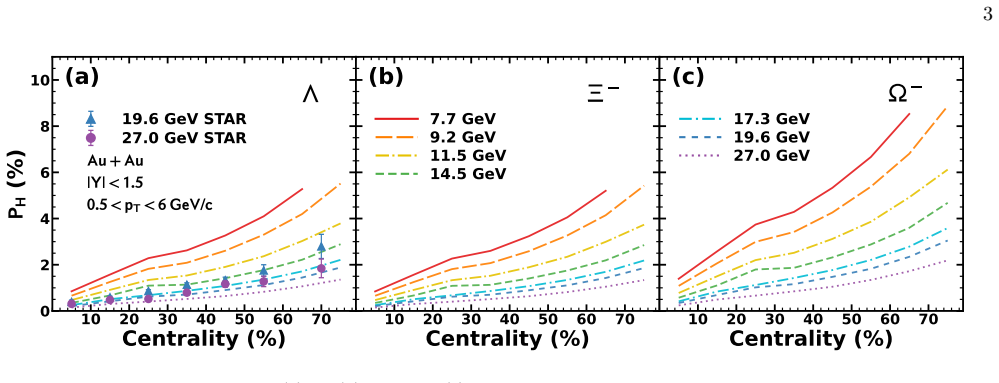
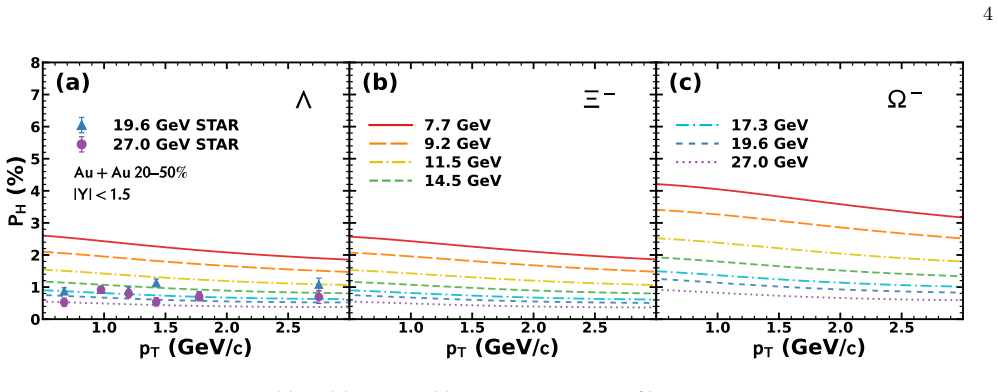
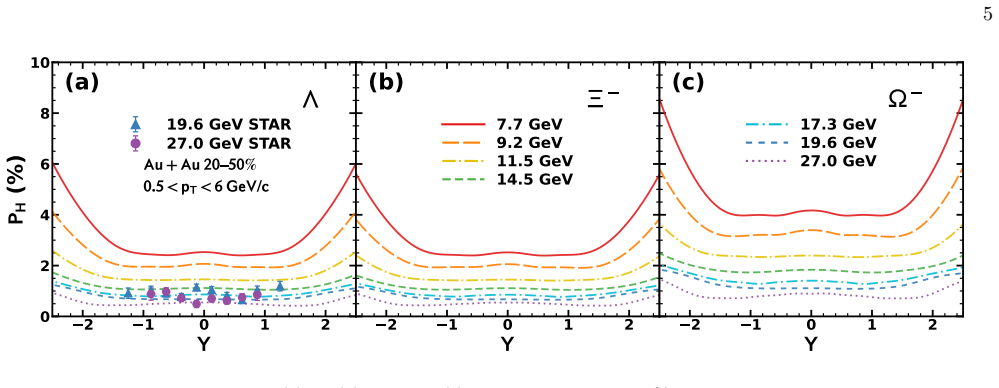
Global polarization of Ω− hyperons exceeds that of Λ and Ξ− due to larger spin but remains below STAR central values in RHIC BES-II collisions.
A machine-rendered reading of the paper's core claim, the machinery that carries it, and where it could break.
Core claim
Using the modified Cooper-Frye formula that includes thermal vorticity, the thermal shear tensor, and the gradient of the baryon chemical potential, together with (3+1)-dimensional viscous hydrodynamics, the global polarizations of Λ, Ξ−, and Ω− are calculated in Au+Au collisions from 7.7 to 27 GeV. The polarization of Ω− is found to be systematically larger than that of Λ and Ξ− owing to its larger spin quantum number, yet remains below the central value of STAR measurements, pointing to possible additional mechanisms such as spin correlations among strange quarks. The hyperon-anti-hyperon polarization splitting increases toward lower energies and is dominated by the chemical-potential-grad
What carries the argument
Modified Cooper-Frye formula incorporating thermal vorticity, thermal shear tensor, and baryon chemical potential gradient to extract spin polarization from hydrodynamic fields.
If this is right
- Ω− polarization is larger than Λ and Ξ− polarization at every energy and centrality because of the difference in spin quantum number.
- The splitting between hyperon and anti-hyperon polarization grows as collision energy decreases.
- The chemical-potential-gradient term supplies the main contribution to the hyperon-anti-hyperon splitting.
- Global polarization values decrease with rising collision energy across the BES-II range.
Where Pith is reading between the lines
- If spin correlations among strange quarks are required to close the gap with STAR data for Ω−, similar internal correlations may affect polarization observables in other multi-strange systems or in lower-energy collisions.
- The systematic underprediction at low energies could point to missing non-equilibrium spin dynamics or limitations of the hydrodynamic description near the QCD critical region.
- Higher-statistics measurements of Ω− polarization versus centrality or rapidity could isolate whether the discrepancy is energy-dependent or tied to strangeness content.
Load-bearing premise
The modified Cooper-Frye formula without explicit internal spin-correlation terms inside the hyperons captures the dominant contributions to global polarization.
What would settle it
A measurement of Ω− global polarization that matches the hydrodynamic calculation without requiring extra quark-spin-correlation terms inside the particle.
Figures

read the original abstract
We investigate the global spin polarization of $\Lambda$ hyperons and the multi-strange hyperons $\Xi^{-}$ and $\Omega^{-}$ in Au+Au collisions across the RHIC Beam Energy Scan II (BES-II) energy range, $\sqrt{s_{NN}}=7.7$--$27$ GeV. The polarization is computed using the modified Cooper--Frye formula, which includes contributions from thermal vorticity, the thermal shear tensor, and the gradient of the baryon chemical potential, combined with the (3+1)-dimensional viscous hydrodynamic framework CLVisc with SMASH initial conditions. We present the global polarization as a function of collision energy, centrality, transverse momentum, and rapidity. We find that the global polarization of $\Omega^{-}$ is systematically larger than those of $\Lambda$ and $\Xi^{-}$ because of its larger spin quantum number, but it remains below the central value of the recent STAR measurement. This discrepancy may suggest that additional mechanisms, such as spin correlations among strange quarks inside the $\Omega^{-}$, could contribute to the observed $\Omega^{-}$ polarization. We also find that the global-polarization splitting between hyperons and anti-hyperons increases toward lower collision energies and is dominated by the chemical-potential-gradient contribution.
Editorial analysis
A structured set of objections, weighed in public.
Referee Report
Summary. The manuscript computes the global polarization of Λ, Ξ−, and Ω− hyperons in Au+Au collisions at √s_NN = 7.7–27 GeV within the CLVisc (3+1)D viscous hydrodynamic framework using SMASH initial conditions. Polarization is obtained from a modified Cooper-Frye formula that incorporates thermal vorticity, the thermal shear tensor, and the baryon chemical potential gradient. The central results are that Ω− polarization exceeds that of Λ and Ξ− owing to its larger spin, yet lies below the STAR central value (suggesting possible strange-quark spin correlations inside Ω−), and that the hyperon–anti-hyperon splitting grows toward lower energies and is dominated by the μ_B-gradient term.
Significance. If robust, the study supplies a systematic energy, centrality, p_T, and rapidity dependence for multi-strange hyperon polarization at BES-II energies and isolates the relative size of the three polarization sources. The explicit use of a viscous hydrodynamic code with documented initial conditions strengthens reproducibility within the field.
major comments (2)
- [Polarization formula section] Polarization formula section (derivation of the modified Cooper-Frye expression): the same functional form is applied to the spin-3/2 Ω− as to the spin-1/2 species, with the difference attributed solely to the spin quantum number. For s = 3/2 the underlying spin-dependent distribution function and the definition of the observable polarization generally involve distinct prefactors multiplying the vorticity, shear, and ∇μ_B terms; without an explicit re-derivation or justification, the predicted ordering P_Ω > P_Λ, Ξ and the size of the discrepancy with STAR data rest on an unverified assumption.
- [Results section] Results section (comparison with STAR data): the statement that the calculated Ω− polarization “remains below the central value of the recent STAR measurement” is presented without reported statistical or systematic uncertainties on the theoretical values, nor any sensitivity scan over hydrodynamic parameters (viscosity, freeze-out temperature, initial conditions). This renders the quantitative discrepancy and the inference that additional mechanisms are required difficult to assess.
minor comments (1)
- Notation for the polarization observable (global vs. local) and the precise definition of “global polarization” for s = 3/2 should be stated explicitly once in the methods to avoid ambiguity when comparing to experimental definitions.
Simulated Author's Rebuttal
We thank the referee for the careful reading of our manuscript and the constructive comments. We address the major comments point by point below and outline the revisions we will make.
read point-by-point responses
-
Referee: [Polarization formula section] Polarization formula section (derivation of the modified Cooper-Frye expression): the same functional form is applied to the spin-3/2 Ω− as to the spin-1/2 species, with the difference attributed solely to the spin quantum number. For s = 3/2 the underlying spin-dependent distribution function and the definition of the observable polarization generally involve distinct prefactors multiplying the vorticity, shear, and ∇μ_B terms; without an explicit re-derivation or justification, the predicted ordering P_Ω > P_Λ, Ξ and the size of the discrepancy with STAR data rest on an unverified assumption.
Authors: We thank the referee for highlighting this subtlety in the polarization formula for different spin values. Our implementation follows the modified Cooper-Frye prescription as extended in prior studies on hyperon polarization, where the spin dependence enters through the overall factor related to the spin quantum number s. Nevertheless, we recognize the value of an explicit justification for s=3/2. In the revised manuscript, we will add a short section or footnote providing the reasoning for the generalization, including how the prefactors are handled for the thermal vorticity, shear, and chemical potential gradient terms. This will strengthen the foundation for the observed ordering P_Ω > P_Λ, Ξ. revision: yes
-
Referee: [Results section] Results section (comparison with STAR data): the statement that the calculated Ω− polarization “remains below the central value of the recent STAR measurement” is presented without reported statistical or systematic uncertainties on the theoretical values, nor any sensitivity scan over hydrodynamic parameters (viscosity, freeze-out temperature, initial conditions). This renders the quantitative discrepancy and the inference that additional mechanisms are required difficult to assess.
Authors: We agree that including uncertainties and sensitivity studies is important for a robust comparison with experimental data. In the updated manuscript, we will report the statistical uncertainties associated with our hydrodynamic calculations and perform additional checks on the sensitivity to variations in the shear viscosity coefficient, the freeze-out temperature, and the choice of initial conditions. These additions will help quantify the significance of the discrepancy with the STAR central value and support our discussion on possible additional mechanisms such as strange-quark spin correlations. revision: yes
Circularity Check
No significant circularity; polarization ordering follows directly from spin factor in standard modified Cooper-Frye formula applied to independent hydro evolution
full rationale
The derivation computes global polarization via the modified Cooper-Frye expression (thermal vorticity + shear + ∇μ_B) on top of CLVisc hydrodynamics with SMASH initial conditions. The result that P_Ω exceeds P_Λ and P_Ξ solely due to the larger spin quantum number (3/2 vs 1/2) is a direct algebraic consequence of the spin-dependent prefactor in that formula, not a fit to the STAR data or a self-referential definition. No load-bearing self-citation, ansatz smuggling, or renaming of known results is present in the provided text; the discrepancy with measurement is reported as an external observation rather than an input. The chain is self-contained against external hydrodynamic and freeze-out benchmarks.
Axiom & Free-Parameter Ledger
Reference graph
Works this paper leans on
-
[1]
thermal”, “th-shear
or quantum kinetic theory [11], the mean spin- polarization vector of spin-sfermions, normalized by the particle number and the spin quantum number, is given by P µ(p) = (s+ 1) R dΣ·pJ µ 5 (p, x) 3mf R dΣ·p f eq ,(1) wherem f is the fermion mass entering the normaliza- tion of the Pauli–Lubanski pseudovector,pµ is the on- shell four-momentum of the fermio...
-
[2]
In this work, we neglect bulk viscosity and set the baryon-diffusion coefficient toCB = 0for simplicity
Their subsequent evolution is described by the (3+1)-dimensional hydrodynamic framework CLVisc through the coupled energy-momentum and particle con- servation equations. In this work, we neglect bulk viscosity and set the baryon-diffusion coefficient toCB = 0for simplicity. We treat the specific shear viscosityCηv as a free parameter. These parameters are...
2021
-
[3]
Adamczyket al., Nature548, 62 (2017), 1701.06657
STAR, L. Adamczyket al., Nature548, 62 (2017), 1701.06657
Pith/arXiv arXiv 2017
-
[4]
Z.-T. Liang and X.-N. Wang, Phys. Rev. Lett. 94, 102301 (2005), nucl-th/0410079, [Erratum: Phys.Rev.Lett. 96, 039901 (2006)]
Pith/arXiv arXiv 2005
-
[5]
Z.-T. Liang and X.-N. Wang, Phys. Lett. B629, 20 (2005), nucl-th/0411101
Pith/arXiv arXiv 2005
-
[6]
STAR, B. I. Abelevet al., Phys. Rev. C76, 024915 (2007), 0705.1691, [Erratum: Phys.Rev.C 95, 039906 (2017)]
Pith/arXiv arXiv 2007
-
[7]
STAR, M. S. Abdallahet al., Phys. Rev. C104, L061901 (2021), 2108.00044
arXiv 2021
-
[8]
ALICE, S. Acharyaet al., Phys. Rev. C101, 044611 (2020), 1909.01281, [Erratum: Phys.Rev.C 105, 029902 (2022)]
arXiv 2020
-
[9]
STAR, J. Adamet al., Phys. Rev. C98, 014910 (2018), 1805.04400
Pith/arXiv arXiv 2018
-
[10]
STAR, M. I. Abdulhamidet al., Phys. Rev. C108, 014910 (2023), 2305.08705
arXiv 2023
-
[11]
STAR, B. E. Aboonaet al., Phys. Lett. B870, 139891 (2025), 2505.05046
arXiv 2025
-
[12]
F. Becattini, V. Chandra, L. Del Zanna, and E. Grossi, Annals Phys.338, 32 (2013), 1303.3431
Pith/arXiv arXiv 2013
-
[13]
R.-h.Fang, L.-g.Pang, Q.Wang, andX.-n.Wang, Phys. Rev. C94, 024904 (2016), 1604.04036
Pith/arXiv arXiv 2016
-
[14]
F. Becattini and F. Piccinini, Annals Phys.323, 2452 (2008), 0710.5694
Pith/arXiv arXiv 2008
-
[15]
B. Betz, M. Gyulassy, and G. Torrieri, Phys. Rev. C 76, 044901 (2007), 0708.0035
Pith/arXiv arXiv 2007
-
[16]
F. Becattini, L. Csernai, and D. Wang, Phys. Rev. C 88, 034905 (2013), 1304.4427, [Erratum: Phys.Rev.C 93, 069901 (2016)]
Pith/arXiv arXiv 2013
-
[17]
L. Csernai, V. Magas, and D. Wang, Phys. Rev. C87, 034906 (2013), 1302.5310
Pith/arXiv arXiv 2013
-
[18]
I. Karpenko and F. Becattini, Eur. Phys. J. C77, 213 (2017), 1610.04717
Pith/arXiv arXiv 2017
-
[19]
Y. Xie, D. Wang, and L. P. Csernai, Phys. Rev. C95, 031901 (2017), 1703.03770
Pith/arXiv arXiv 2017
-
[20]
H. Li, L.-G. Pang, Q. Wang, and X.-L. Xia, Phys. Rev. C96, 054908 (2017), 1704.01507
Pith/arXiv arXiv 2017
- [21]
-
[22]
S. Shi, K. Li, and J. Liao, Phys. Lett. B788, 409 (2019), 1712.00878
Pith/arXiv arXiv 2019
-
[23]
X.-L. Xia, H. Li, Z.-B. Tang, and Q. Wang, Phys. Rev. C98, 024905 (2018), 1803.00867
Pith/arXiv arXiv 2018
-
[24]
S. Shi, H. Zhang, D. Hou, and J. Liao, (2019), 1910.14010
arXiv 2019
-
[25]
B. Fu, K. Xu, X.-G. Huang, and H. Song, Phys. Rev. C103, 024903 (2021), 2011.03740
arXiv 2021
-
[26]
A. Lei, D. Wang, D.-M. zhou, B.-H. Sa, and L. P. Cser- nai, Phys. Rev. C104, 054903 (2021), 2110.13485
arXiv 2021
-
[27]
V. E. Ambrus and M. N. Chernodub, Eur. Phys. J. C 82, 61 (2022), 2010.05831
arXiv 2022
- [28]
- [29]
-
[30]
X.-Y. Wu, C. Yi, G.-Y. Qin, and S. Pu, Phys. Rev. C 105, 064909 (2022), 2204.02218
arXiv 2022
- [31]
-
[32]
HADES, R. Abou Yassineet al., Phys. Lett. B835, 137506 (2022), 2207.05160
arXiv 2022
-
[33]
X.-G. Deng, X.-G. Huang, Y.-G. Ma, and S. Zhang, Phys. Rev. C101, 064908 (2020), 2001.01371
arXiv 2020
-
[34]
Y. B. Ivanov, Phys. Rev. C103, L031903 (2021), 2012.07597
arXiv 2021
-
[35]
X.-G. Deng, X.-G. Huang, and Y.-G. Ma, Phys. Lett. B835, 137560 (2022), 2109.09956
arXiv 2022
-
[36]
C. Yi, S. Pu, L.-G. Pang, G.-Y. Qin, and X.-N. Wang, (2026), 2603.27521
arXiv 2026
-
[37]
Sunet al., Phys
K.-J. Sunet al., Phys. Rev. Lett.134, 022301 (2025)
2025
- [38]
- [39]
- [40]
-
[41]
Y. Hidaka, S. Pu, and D.-L. Yang, Phys. Rev.D97, 016004 (2018), 1710.00278
Pith/arXiv arXiv 2018
-
[42]
S. Y. F. Liu and Y. Yin, Phys. Rev. D104, 054043 (2021), 2006.12421
arXiv 2021
-
[43]
F. Becattini, M. Buzzegoli, and A. Palermo, Phys. Lett. B820, 136519 (2021), 2103.10917
arXiv 2021
-
[44]
S. Y. F. Liu and Y. Yin, JHEP07, 188 (2021), 2103.09200. 7
arXiv 2021
-
[45]
B. Fu, S. Y. F. Liu, L. Pang, H. Song, and Y. Yin, Phys. Rev. Lett.127, 142301 (2021), 2103.10403
arXiv 2021
-
[46]
F. Becattini, M. Buzzegoli, G. Inghirami, I. Karpenko, and A. Palermo, Phys. Rev. Lett.127, 272302 (2021), 2103.14621
arXiv 2021
-
[47]
C. Yi, S. Pu, and D.-L. Yang, Phys. Rev. C104, 064901 (2021), 2106.00238
arXiv 2021
-
[48]
S. Ryu, V. Jupic, and C. Shen, Phys. Rev. C104, 054908 (2021), 2106.08125
arXiv 2021
-
[49]
W. Florkowski, A. Kumar, A. Mazeliauskas, and R. Ry- blewski, Phys. Rev. C105, 064901 (2022), 2112.02799
arXiv 2022
-
[50]
M. Buzzegoli, F. Becattini, G. Inghirami, I. Karpenko, and A. Palermo, Acta Phys. Polon. Supp.16, 39 (2023), 2208.04449
arXiv 2023
- [51]
-
[52]
A. Palermo, E. Grossi, I. Karpenko, and F. Becattini, Eur. Phys. J. C84, 920 (2024), 2404.14295
arXiv 2024
- [53]
-
[54]
STAR, M. Abdulhamidet al., Phys. Rev. Lett.131, 202301 (2023), 2303.09074
arXiv 2023
-
[55]
ALICE, S. Acharyaet al., Phys. Rev. Lett.128, 172005 (2022), 2107.11183
arXiv 2022
-
[56]
S. A. Voloshin, EPJ Web Conf.171, 07002 (2018), 1710.08934
Pith/arXiv arXiv 2018
-
[57]
S. Y. F. Liu, Y. Sun, and C. M. Ko, Phys. Rev. Lett. 125, 062301 (2020), 1910.06774
arXiv 2020
- [58]
- [59]
-
[60]
X.-L. Xia, H. Li, X.-G. Huang, and H. Z. Huang, Phys. Rev. C100, 014913 (2019), 1905.03120
arXiv 2019
-
[61]
F. Becattini, G. Cao, and E. Speranza, Eur. Phys. J. C 79, 741 (2019), 1905.03123
arXiv 2019
- [62]
-
[63]
Y. B. Ivanov, V. D. Toneev, and A. A. Soldatov, Phys. Rev. C100, 014908 (2019), 1903.05455
arXiv 2019
-
[64]
Y. Guo, J. Liao, E. Wang, H. Xing, and H. Zhang, Phys. Rev. C104, L041902 (2021), 2105.13481
arXiv 2021
- [65]
-
[66]
STAR, J. Adamet al., Phys. Rev. Lett.126, 162301 (2021), 2012.13601, [Erratum: Phys.Rev.Lett. 131, 089901 (2023)]
arXiv 2021
- [67]
- [68]
-
[69]
Z. Zhang, J.-p. Lv, Z.-h. Yu, and Z.-t. Liang, Phys. Rev. D110, 074019 (2024), 2406.03840
arXiv 2024
-
[70]
Y.-G. Yang, R.-H. Fang, Q. Wang, and X.-N. Wang, Phys. Rev.C97, 034917 (2018), 1711.06008
Pith/arXiv arXiv 2018
- [71]
-
[72]
X.-L. Xia, H. Li, X.-G. Huang, and H. Zhong Huang, Phys. Lett. B817, 136325 (2021), 2010.01474
arXiv 2021
- [73]
-
[74]
X.-L. Sheng, S.-Y. Yang, Y.-L. Zou, and D. Hou, Eur. Phys. J. C84, 299 (2024), 2209.01872
arXiv 2024
-
[75]
B. Müller and D.-L. Yang, Phys. Rev. D105, L011901 (2022), 2110.15630, [Erratum: Phys.Rev.D 106, 039904 (2022)]
arXiv 2022
- [76]
- [77]
-
[78]
W.-B. Dong, Y.-L. Yin, X.-L. Sheng, S.-Z. Yang, and Q.Wang, Phys.Rev.D109, 056025(2024), 2311.18400
arXiv 2024
- [79]
- [80]
discussion (0)
Sign in with ORCID, Apple, or X to comment. Anyone can read and Pith papers without signing in.