Recognition: 2 theorem links
· Lean TheoremAngular momentum conservation and pion production in intermediate-energy heavy-ion collisions
Pith reviewed 2026-05-15 18:47 UTC · model grok-4.3
The pith
Strict angular momentum conservation boosts total pion yields while lowering the charged pion ratio in heavy-ion collisions.
A machine-rendered reading of the paper's core claim, the machinery that carries it, and where it could break.
Core claim
Enforcing rigorous angular momentum conservation in elastic, inelastic, and decay channels within the IBUU transport model suppresses the absorption of both Δ resonances and pions. This leads to considerably enhanced pion production and a reduced charged pion yield ratio. The AMC effect on the charged pion yield ratio cannot be simply compensated by a density-dependent in-medium Δ production cross section, making incorporation of AMC important for obtaining correct pion multiplicity and ratios relevant to nuclear symmetry energy extraction at high densities.
What carries the argument
The angular momentum conservation (AMC) constraint applied to elastic, inelastic, and decay channels in the isospin-dependent Boltzmann-Uehling-Uhlenbeck (IBUU) transport model, which suppresses absorption of Δ resonances and pions.
Load-bearing premise
The IBUU transport model with the added AMC constraint accurately captures the dominant reaction channels and the observed changes are not artifacts of the specific numerical implementation.
What would settle it
Direct comparison of pion multiplicities and π+/π- ratios from IBUU simulations with versus without the AMC constraint against experimental measurements in intermediate-energy heavy-ion collisions.
Figures


read the original abstract
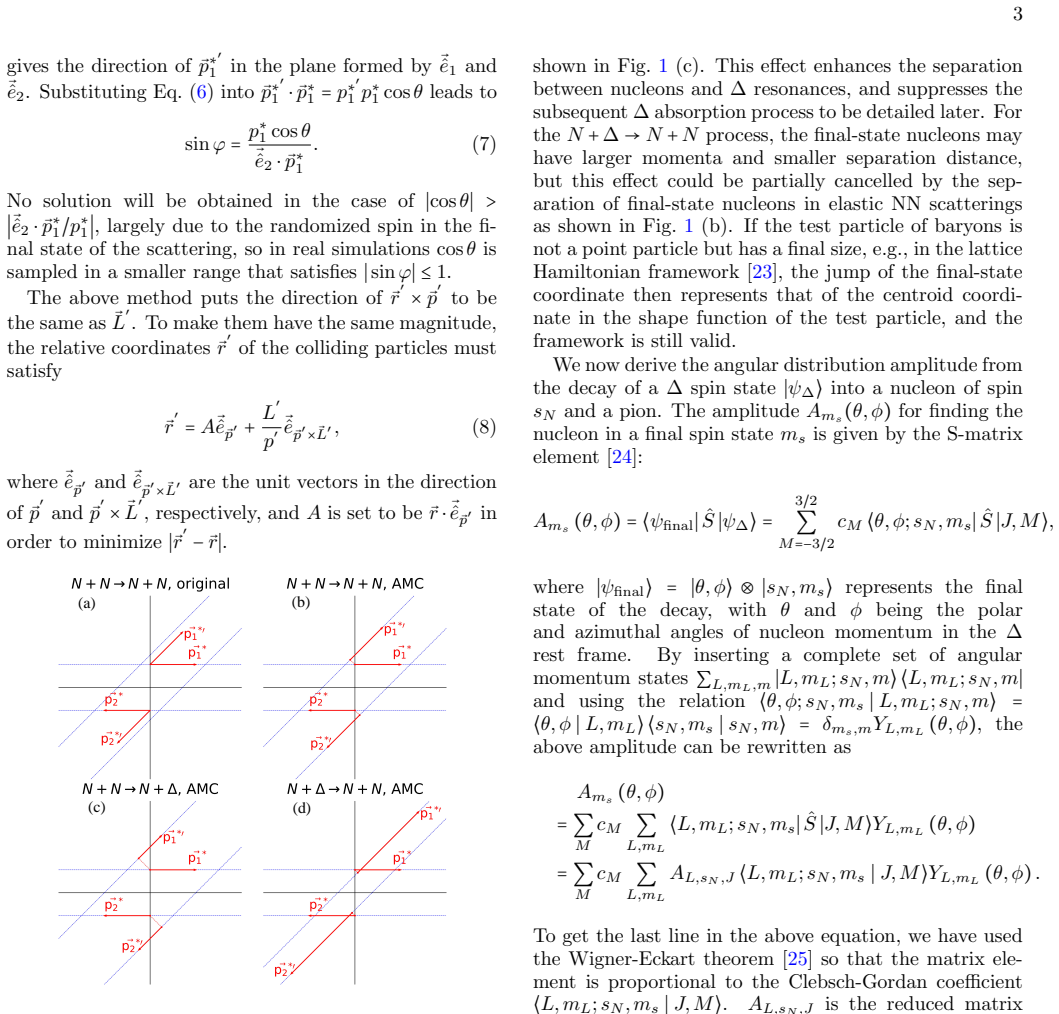
We have studied the effect of rigorous angular momentum conservation (AMC) in elastic, inelastic, and decay channels on pion production in intermediate-energy heavy-ion collisions based on the framework of an isospin-dependent Boltzmann-Uehling-Uhlenbeck (IBUU) transport model. We found that the constraint of AMC suppresses the absorption of both $\Delta$ resonances and pions, thus considerably enhances pion production and meanwhile reduces the charged pion yield ratio. The AMC effect on the charged pion yield ratio can not be simply compensated by a density-dependent in-medium $\Delta$ production cross section. Therefore, incorporating the constraint of AMC is important in obtaining the correct pion multiplicity and charged pion yield ratio by transport simulations, relevant for the extraction of the nuclear symmetry energy at high densities.
Editorial analysis
A structured set of objections, weighed in public.
Referee Report
Summary. The paper studies the impact of enforcing rigorous angular momentum conservation (AMC) in elastic, inelastic, and decay channels within the isospin-dependent Boltzmann-Uehling-Uhlenbeck (IBUU) transport model for intermediate-energy heavy-ion collisions. It reports that AMC suppresses absorption of both Δ resonances and pions, thereby increasing overall pion multiplicity while decreasing the charged-pion yield ratio π−/π+. The authors conclude that this AMC-induced change cannot be reproduced by a density-dependent in-medium Δ-production cross section and is therefore essential for reliable extraction of the nuclear symmetry energy from pion observables.
Significance. If the numerical result is robust, the work identifies a previously under-appreciated systematic effect in standard transport codes that directly affects two key observables (pion multiplicity and π−/π+) used to constrain the high-density symmetry energy. Demonstrating that AMC cannot be mimicked by simple cross-section adjustments would strengthen the case for including exact conservation laws in future simulations and could help reconcile model predictions with experimental data from facilities such as HIAF.
major comments (2)
- [Model and implementation] Implementation of the AMC constraint (described in the model section): the suppression of Δ and pion absorption is achieved by rejecting or adjusting collisions to enforce total angular-momentum conservation. Without an explicit benchmark against deterministic two-body scattering that solves the same kinematics with exact L conservation, it remains possible that the observed reduction in absorption rates arises from lowered sampling efficiency in the stochastic algorithm rather than from conservation physics alone.
- [Results and discussion] Results on compensation by in-medium cross sections (likely §4 or the discussion of density dependence): the claim that the AMC effect “cannot be simply compensated” requires a quantitative side-by-side comparison showing the magnitude of the AMC-induced change versus the change produced by the specific density-dependent Δ-production cross section adopted. The present text does not report the functional form or the resulting ΔN/Δπ ratios for both cases.
minor comments (2)
- [Abstract] The abstract states a clear numerical finding but supplies no quantitative values for the enhancement factor, the change in π−/π+, or any error estimates; these should be added for clarity.
- [Figures and captions] Figure captions and text should explicitly state the impact parameter range, beam energy, and system (e.g., Au+Au at 400 MeV/nucleon) used for the reported ratios so that readers can reproduce the comparison.
Simulated Author's Rebuttal
We thank the referee for the careful reading of our manuscript and the constructive comments. We address each major comment below and have revised the manuscript accordingly where appropriate to strengthen the presentation of our results on angular momentum conservation in the IBUU model.
read point-by-point responses
-
Referee: [Model and implementation] Implementation of the AMC constraint (described in the model section): the suppression of Δ and pion absorption is achieved by rejecting or adjusting collisions to enforce total angular-momentum conservation. Without an explicit benchmark against deterministic two-body scattering that solves the same kinematics with exact L conservation, it remains possible that the observed reduction in absorption rates arises from lowered sampling efficiency in the stochastic algorithm rather than from conservation physics alone.
Authors: We agree that an explicit benchmark would strengthen the implementation section. Our AMC procedure rejects or adjusts collisions that violate total angular momentum conservation after the stochastic sampling of the two-body kinematics; this is a direct enforcement of the conservation law rather than a reduction in sampling efficiency. In the revised manuscript we add a short benchmark subsection comparing absorption probabilities in isolated two-body ΔN and πN collisions with and without the AMC constraint, using both the stochastic IBUU algorithm and a deterministic kinematic solver that enforces exact L conservation. The comparison confirms that the suppression originates from the conservation requirement itself. revision: yes
-
Referee: [Results and discussion] Results on compensation by in-medium cross sections (likely §4 or the discussion of density dependence): the claim that the AMC effect “cannot be simply compensated” requires a quantitative side-by-side comparison showing the magnitude of the AMC-induced change versus the change produced by the specific density-dependent Δ-production cross section adopted. The present text does not report the functional form or the resulting ΔN/Δπ ratios for both cases.
Authors: We accept the need for a quantitative comparison. In the revised manuscript we explicitly state the functional form of the density-dependent in-medium Δ-production cross section employed (a parametrization that reduces the cross section at high density). We add a new figure and accompanying table that directly compare the AMC-induced shifts in total pion multiplicity, π−/π+ ratio, and the ΔN/Δπ ratio against the shifts obtained when the same density-dependent cross section is used without AMC. The comparison shows that the AMC effect on the charged-pion ratio is larger in magnitude and opposite in trend to the in-medium cross-section adjustment, confirming that the two cannot be interchanged. revision: yes
Circularity Check
No significant circularity: numerical outcome of enforcing external AMC constraint
full rationale
The paper reports results from adding an angular-momentum-conservation constraint to the existing IBUU transport model and observing its effect on pion multiplicities and ratios. This is a direct numerical consequence of rejecting or adjusting collisions to satisfy an external conservation law, not a quantity defined in terms of the output or fitted to the same observables and then relabeled as a prediction. No self-citation chain, ansatz smuggling, or self-definitional step is present in the abstract or described methodology that would reduce the central claim to its own inputs by construction. The derivation remains independent of the reported results.
Axiom & Free-Parameter Ledger
axioms (1)
- domain assumption The IBUU transport model provides a sufficiently accurate description of the dominant reaction channels at intermediate energies.
Lean theorems connected to this paper
-
IndisputableMonolith/Foundation/AlexanderDuality.leanalexander_duality_circle_linking unclear?
unclearRelation between the paper passage and the cited Recognition theorem.
The constraint of AMC suppresses the absorption of both Δ resonances and pions, thus considerably enhances pion production and meanwhile reduces the charged pion yield ratio.
-
IndisputableMonolith/Foundation/ArithmeticFromLogic.leanembed_injective unclear?
unclearRelation between the paper passage and the cited Recognition theorem.
rigorous angular momentum conservation (AMC) in elastic, inelastic, and decay channels
What do these tags mean?
- matches
- The paper's claim is directly supported by a theorem in the formal canon.
- supports
- The theorem supports part of the paper's argument, but the paper may add assumptions or extra steps.
- extends
- The paper goes beyond the formal theorem; the theorem is a base layer rather than the whole result.
- uses
- The paper appears to rely on the theorem as machinery.
- contradicts
- The paper's claim conflicts with a theorem or certificate in the canon.
- unclear
- Pith found a possible connection, but the passage is too broad, indirect, or ambiguous to say the theorem truly supports the claim.
Reference graph
Works this paper leans on
-
[1]
Isospin Asymmetry in Nuclei and Neutron Stars
Andrew W. Steiner, Madappa Prakash, James M. Lat- timer, and Paul J. Ellis, “Isospin asymmetry in nuclei and neutron stars,” Phys. Rept.411, 325–375 (2005), arXiv:nucl-th/0410066
work page internal anchor Pith review Pith/arXiv arXiv 2005
-
[2]
Neutron Star Observations: Prognosis for Equation of State Con- straints,
James M. Lattimer and Maddapa Prakash, “Neutron Star Observations: Prognosis for Equation of State Con- straints,” Phys. Rept.442, 109–165 (2007), arXiv:astro- ph/0612440
-
[3]
Equations of state for supernovae and compact stars
M. Oertel, M. Hempel, T. Kl¨ ahn, and S. Typel, “Equa- tions of state for supernovae and compact stars,” Rev. Mod. Phys.89, 015007 (2017), arXiv:1610.03361 [astro- ph.HE]
work page internal anchor Pith review Pith/arXiv arXiv 2017
-
[4]
Reaction Dynamics with Exotic Beams
V. Baran, M. Colonna, V. Greco, and M. Di Toro, “Re- action dynamics with exotic beams,” Phys. Rept.410, 335–466 (2005), arXiv:nucl-th/0412060
work page internal anchor Pith review Pith/arXiv arXiv 2005
-
[5]
Recent Progress and New Challenges in Isospin Physics with Heavy-Ion Reactions
Bao-An Li, Lie-Wen Chen, and Che Ming Ko, “Recent Progress and New Challenges in Isospin Physics with Heavy-Ion Reactions,” Phys. Rept.464, 113–281 (2008), arXiv:0804.3580 [nucl-th]
work page internal anchor Pith review Pith/arXiv arXiv 2008
-
[6]
Bao-An Li, “Probing the high density behavior of nu- clear symmetry energy with high-energy heavy ion colli- sions,” Phys. Rev. Lett.88, 192701 (2002), arXiv:nucl- th/0205002
-
[7]
High Density Behaviour of Nuclear Symmetry Energy and High Energy Heavy-Ion Collisions
Bao-An Li, “High density behavior of nuclear symmetry energy and high-energy heavy ion collisions,” Nucl. Phys. A708, 365–390 (2002), arXiv:nucl-th/0206053
work page internal anchor Pith review Pith/arXiv arXiv 2002
-
[8]
Circumstantial evidence for a soft nuclear symmetry energy at supra-saturation densities
Zhigang Xiao, Bao-An Li, Lie-Wen Chen, Gao-Chan Yong, and Ming Zhang, “Circumstantial Evidence for a Soft Nuclear Symmetry Energy at Suprasatura- tion Densities,” Phys. Rev. Lett.102, 062502 (2009), arXiv:0808.0186 [nucl-th]
work page internal anchor Pith review Pith/arXiv arXiv 2009
-
[9]
Probing high-density behavior of symmetry energy from pion emission in heavy-ion collisions
Zhao-Qing Feng and Gen-Ming Jin, “Probing high- density behavior of symmetry energy from pion emis- sion in heavy-ion collisions,” Phys. Lett. B683, 140–144 (2010), arXiv:0904.2990 [nucl-th]
work page internal anchor Pith review Pith/arXiv arXiv 2010
-
[10]
Symmetry energy and pion production in the Boltzmann-Langevin approach,
Wen-Jie Xie, Jun Su, Long Zhu, and Feng-Shou Zhang, “Symmetry energy and pion production in the Boltzmann-Langevin approach,” Phys. Lett. B718, 1510–1514 (2013)
work page 2013
-
[11]
Jun Xuet al.(TMEP), “Comparing pion production in transport simulations of heavy-ion collisions at 270AMeV under controlled conditions,” Phys. Rev. C109, 044609 (2024), arXiv:2308.05347 [nucl-th]
-
[12]
Taesoo Song and Che Ming Ko, “Modifications of the pion-production threshold in the nuclear medium in heavy ion collisions and the nuclear symmetry energy,” Phys. Rev. C91, 014901 (2015)
work page 2015
-
[13]
Medium effects on pion production in heavy ion collisions
Zhen Zhang and Che Ming Ko, “Medium effects on pion production in heavy ion collisions,” Phys. Rev. C95, 064604 (2017), arXiv:1701.06682 [nucl-th]
work page internal anchor Pith review Pith/arXiv arXiv 2017
-
[14]
Subthreshold pion production within a transport description of central Au+Au collisions
Jun Hong and P. Danielewicz, “Subthreshold pion pro- duction within a transport description of central Au + Au collisions,” Phys. Rev. C90, 024605 (2014), arXiv:1307.7654 [nucl-th]
work page internal anchor Pith review Pith/arXiv arXiv 2014
-
[15]
Energy dependence of pion in-medium effects on \pi^-/\pi^+ ratio in heavy-ion collisions
Jun Xu, Lie-Wen Chen, Che Ming Ko, Bao-An Li, and Yu-Gang Ma, “Energy dependence of pion in-medium ef- fects on theπ−/π+ ratio in heavy-ion collisions,” Phys. Rev. C87, 067601 (2013), arXiv:1305.0091 [nucl-th]
work page internal anchor Pith review Pith/arXiv arXiv 2013
-
[16]
Isospin-dependent pion in-medium effects on charged pion ratio in heavy ion collisions
Jun Xu, Che Ming Ko, and Yongseok Oh, “Isospin- dependent pion in-medium effects on charged pion ratio in heavy ion collisions,” Phys. Rev. C81, 024910 (2010), arXiv:0906.1602 [nucl-th]
work page internal anchor Pith review Pith/arXiv arXiv 2010
-
[17]
Probing neutron-proton dynamics by pions
Natsumi Ikeno, Akira Ono, Yasushi Nara, and Akira Ohnishi, “Probing neutron-proton dynamics by pions,” Phys. Rev. C93, 044612 (2016), [Erratum: Phys.Rev.C 97, 069902 (2018)], arXiv:1601.07636 [nucl-th]
work page internal anchor Pith review Pith/arXiv arXiv 2016
-
[18]
Conservation laws and nu- clear transport models,
C. Gale and S. Das Gupta, “Conservation laws and nu- clear transport models,” Phys. Rev. C42, 1577 (1990)
work page 1990
-
[19]
M. D. Cozma, “The impact of energy conservation in transport models on theπ −/π+ multiplicity ratio in heavy-ion collisions and the symmetry energy,” Phys. Lett. B753, 166–172 (2016), arXiv:1409.3110 [nucl-th]
work page internal anchor Pith review Pith/arXiv arXiv 2016
-
[20]
Rong-Jun Liu and Jun Xu, “Revisiting Angular Mo- mentum Conservation in Transport Simulations of Intermediate-Energy Heavy-Ion Collisions,” Universe9, 36 (2023), arXiv:2301.07907 [nucl-th]
-
[21]
Rong-Jun Liu and Jun Xu, “Spin dynamics in intermediate-energy heavy-ion collisions with rigorous angular momentum conservation,” Phys. Rev. C109, 014615 (2024), arXiv:2311.13769 [nucl-th]
-
[22]
A Guide to micro- scopic models for intermediate-energy heavy ion colli- sions,
G. F. Bertsch and S. Das Gupta, “A Guide to micro- scopic models for intermediate-energy heavy ion colli- sions,” Phys. Rept.160, 189–233 (1988)
work page 1988
-
[23]
Nuclear mean field dynamics in the lattice Hamiltonian Vlasov method,
R. J. Lenk and V. R. Pandharipande, “Nuclear mean field dynamics in the lattice Hamiltonian Vlasov method,” Phys. Rev. C39, 2242–2249 (1989)
work page 1989
-
[24]
On the General Theory of Collisions for Particles with Spin,
M. Jacob and G. C. Wick, “On the General Theory of Collisions for Particles with Spin,” Annals Phys.7, 404– 428 (1959)
work page 1959
-
[25]
Eugene Wigner,Group theory: and its application to the quantum mechanics of atomic spectra(1959)
work page 1959
discussion (0)
Sign in with ORCID, Apple, or X to comment. Anyone can read and Pith papers without signing in.