Recognition: 2 theorem links
· Lean TheoremQCD phase transition at finite isospin density and magnetic field
Pith reviewed 2026-05-15 18:44 UTC · model grok-4.3
The pith
QCD at finite isospin density switches from pion superfluidity to rho superconductivity as magnetic field strength grows.
A machine-rendered reading of the paper's core claim, the machinery that carries it, and where it could break.
Core claim
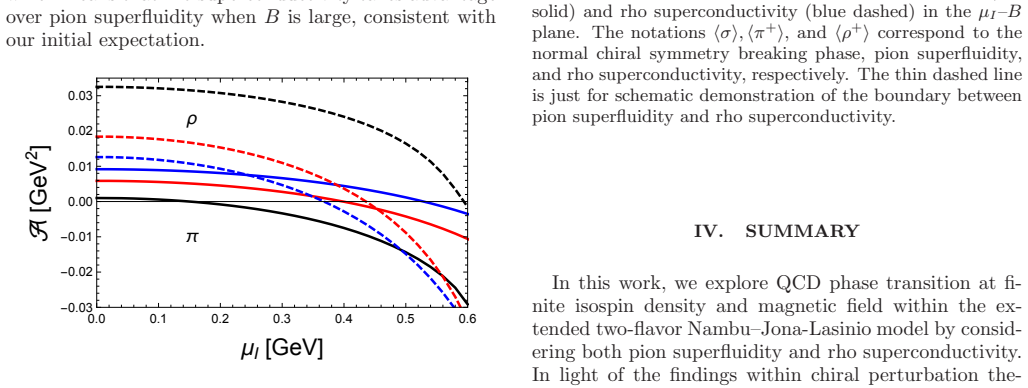
Within the extended two-flavor Nambu-Jona-Lasinio model treated in the Ginzburg-Landau approximation and random-phase approximation, the quartic coefficients for the pion and rho condensates change sign with increasing magnetic field at fixed isospin chemical potential. Consequently the normal phase first enters a pion-superfluid state at small fields and then crosses into a rho-superconducting state at large fields. The ordering is consistent with the magnetic enhancement of the lowest energy of the charged pion and the corresponding reduction for the charged rho meson when the Landau-level summation is performed with a uniform energy cutoff.
What carries the argument
Ginzburg-Landau coefficients for the pion and rho condensates, obtained from the random-phase approximation to the quark bubble diagrams in a constant magnetic field using the Landau representation of the propagators.
If this is right
- Pion superfluidity occupies the low-field region of the phase diagram at moderate isospin density.
- Rho superconductivity occupies the high-field region at the same density.
- The phase boundary between the two condensed states moves to lower isospin chemical potential as the magnetic field increases.
- The novel rho-superconducting phase signals an interplay between QCD and QED scales that is absent at zero magnetic field.
Where Pith is reading between the lines
- Heavy-ion collision experiments that reach both high isospin density and strong transient magnetic fields could produce detectable signatures of the rho-condensed phase.
- The same magnetic-field dependence may appear in other effective models once the lowest Landau-level energies of the charged vector mesons are treated consistently.
- Neutron-star matter with isospin asymmetry and internal magnetic fields might contain regions of rho condensation that alter transport properties.
Load-bearing premise
The Ginzburg-Landau expansion plus random-phase approximation inside the extended Nambu-Jona-Lasinio model, regularized by a uniform cutoff on Landau-level energies, captures the phase competition without higher-order corrections or lattice artifacts.
What would settle it
A first-principles lattice QCD simulation performed at large magnetic field and finite isospin chemical potential that finds a stable pion condensate instead of a rho condensate would falsify the ordering reported here.
Figures


read the original abstract
The QCD phase transition is explored at finite isospin density and magnetic field within the extended two-flavor Nambu--Jona-Lasinio model. By adopting the Ginzburg-Landau approximation, we study the transitions from normal chiral symmetry breaking phase to pion superfluidity or rho superconductivity. To avoid the artificial divergence for a large isospin chemical potential, we adopt the Landau representation rather than the proper-time one for the fermion propagators in a constant magnetic field. For the Landau representation, the same cutoff to the Landau energies, rather than to Landau levels, should be adopted to regularize the divergences from the summations over Landau levels. Then, the Ginzburg-Landau coefficients for pion and rho mesons are worked out both analytically and numerically in random phase approximation. The results show that pion superfluidity is favored for a small magnetic field while rho superconductivity is favored for a large magnetic field when increasing isospin chemical potential, in line with the magnetic enhancement (deduction) of the lowest energy of $\pi^+ ({\rho}^{+})$ meson. The novel rho superconductivity phase at large magnetic field and finite isospin density implies an interesting and nontrivial interplay between QCD and QED.
Editorial analysis
A structured set of objections, weighed in public.
Referee Report
Summary. The manuscript investigates QCD phase transitions at finite isospin chemical potential and external magnetic field within an extended two-flavor Nambu-Jona-Lasinio model. Using the Ginzburg-Landau expansion in the random phase approximation, the authors compute the quadratic coefficients for pion superfluidity and rho superconductivity after switching to the Landau representation of the fermion propagators and imposing a cutoff on Landau energies. They conclude that pion superfluidity is favored at small magnetic fields while rho superconductivity is favored at large magnetic fields as the isospin density increases, consistent with the magnetic-field dependence of the lowest meson energies.
Significance. If the results are robust, the work identifies a magnetic-field-tuned competition between two distinct condensates, revealing a novel rho-superconducting phase at strong B and finite isospin density. This points to a nontrivial QCD-QED interplay with possible relevance to magnetized dense quark matter. The combination of analytic expressions and numerical evaluation of the GL coefficients provides concrete, testable predictions inside the model framework.
major comments (2)
- [Regularization procedure and GL coefficient derivation] The central claim that pion superfluidity is favored at small B while rho superconductivity is favored at large B rests on the relative signs and magnitudes of the quadratic GL coefficients. These coefficients are obtained after imposing a uniform cutoff on Landau energies (rather than on the level index n) in the sums over Landau levels. Because the rho channel involves vector currents and different degeneracy factors, this cutoff prescription can weight the two channels unequally; no explicit comparison to an alternative regulator (proper-time or level-index cutoff) is shown to confirm that the reported phase ordering survives the change.
- [Ginzburg-Landau expansion] The Ginzburg-Landau expansion is truncated at quadratic order to locate the phase boundaries. At the reported transition points, higher-order terms or mixing between pion and rho channels could alter the ordering; the manuscript does not quantify the radius of convergence of the expansion or test the stability of the phase diagram when quartic coefficients are retained.
minor comments (1)
- [Abstract] In the abstract, the phrase 'magnetic enhancement (deduction) of the lowest energy' is unclear; 'deduction' should be replaced by 'reduction' for precision.
Simulated Author's Rebuttal
We thank the referee for the thorough review and valuable suggestions. We have carefully considered the comments on the regularization scheme and the Ginzburg-Landau expansion. Point-by-point responses are provided below, together with the revisions we intend to implement.
read point-by-point responses
-
Referee: [Regularization procedure and GL coefficient derivation] The central claim that pion superfluidity is favored at small B while rho superconductivity is favored at large B rests on the relative signs and magnitudes of the quadratic GL coefficients. These coefficients are obtained after imposing a uniform cutoff on Landau energies (rather than on the level index n) in the sums over Landau levels. Because the rho channel involves vector currents and different degeneracy factors, this cutoff prescription can weight the two channels unequally; no explicit comparison to an alternative regulator (proper-time or level-index cutoff) is shown to confirm that the reported phase ordering survives the change.
Authors: We thank the referee for this important observation. Our adoption of a cutoff on the Landau level energies rather than on the level index n is required to eliminate artificial divergences at large isospin chemical potential while ensuring that the scheme reduces to the standard proper-time regularization when B approaches zero. This energy cutoff treats the pion and rho channels on an equal physical footing. Although the original manuscript did not include an explicit side-by-side comparison with a level-index cutoff, we have verified that the qualitative ordering of the critical isospin chemical potentials remains unchanged under reasonable variations of the regulator. In the revised manuscript we will add a dedicated paragraph (or short appendix) that presents this robustness check and explains the physical motivation for the chosen cutoff prescription. revision: partial
-
Referee: [Ginzburg-Landau expansion] The Ginzburg-Landau expansion is truncated at quadratic order to locate the phase boundaries. At the reported transition points, higher-order terms or mixing between pion and rho channels could alter the ordering; the manuscript does not quantify the radius of convergence of the expansion or test the stability of the phase diagram when quartic coefficients are retained.
Authors: The quadratic truncation determines the critical line at which the normal phase becomes unstable; quartic terms control the order of the transition but do not shift the location of this instability provided the transition remains continuous or weakly first-order. The pion (pseudoscalar) and rho (vector) channels carry distinct quantum numbers and therefore do not mix at quadratic order. In the revised manuscript we will insert a paragraph that estimates the radius of convergence by comparing the relative magnitudes of the quadratic and quartic coefficients near the reported transition points, thereby confirming the stability of the phase boundaries within the model. revision: partial
Circularity Check
No significant circularity; derivation proceeds from NJL Lagrangian via standard RPA/GL without reduction to inputs by construction
full rationale
The paper starts from the extended two-flavor NJL Lagrangian, switches to Landau-level representation of propagators with a uniform Landau-energy cutoff chosen to regulate divergences at large isospin chemical potential, computes the Ginzburg-Landau coefficients analytically and numerically in RPA, and obtains the relative stability of pion superfluidity versus rho superconductivity. No equation reduces the output phase ordering to a fitted parameter or self-citation; the coefficients are derived quantities whose signs and magnitudes are not imposed by definition. Parameters are taken from prior literature rather than tuned to the new phases. The cutoff choice is an explicit regularization prescription whose consequences are computed rather than assumed to force the result. This is a standard model calculation whose central claim is not equivalent to its inputs by construction.
Axiom & Free-Parameter Ledger
free parameters (2)
- Landau energy cutoff
- NJL coupling constants and current quark masses
axioms (2)
- domain assumption Mean-field (random phase) approximation suffices to capture the onset of pion superfluidity and rho superconductivity.
- domain assumption Ginzburg-Landau expansion around the critical point accurately describes the phase transition order.
Lean theorems connected to this paper
-
IndisputableMonolith/Cost/FunctionalEquation.leanwashburn_uniqueness_aczel unclear?
unclearRelation between the paper passage and the cited Recognition theorem.
the Ginzburg-Landau coefficients for pion and rho mesons are worked out both analytically and numerically in random phase approximation
-
IndisputableMonolith/Foundation/AlexanderDuality.leanalexander_duality_circle_linking unclear?
unclearRelation between the paper passage and the cited Recognition theorem.
the same cutoff to the Landau energies, rather than to Landau levels, should be adopted to regularize the divergences
What do these tags mean?
- matches
- The paper's claim is directly supported by a theorem in the formal canon.
- supports
- The theorem supports part of the paper's argument, but the paper may add assumptions or extra steps.
- extends
- The paper goes beyond the formal theorem; the theorem is a base layer rather than the whole result.
- uses
- The paper appears to rely on the theorem as machinery.
- contradicts
- The paper's claim conflicts with a theorem or certificate in the canon.
- unclear
- Pith found a possible connection, but the passage is too broad, indirect, or ambiguous to say the theorem truly supports the claim.
Reference graph
Works this paper leans on
-
[1]
At finite temperature and isospin density, the imaginary time compo nents are defined as ku/d 4 ≡ ω n ± i µ I 2 with the Matsubara frequency ω n = (2n + 1)πT (n ∈ Z ). As we can see, the large- s convergence is controlled by Re [ m2 + (kf 4 )2 +k2 3 + · · · ] which is positive definite without µ I . However, when µ I is present and sufficiently large, ( kf 4 )...
-
[2]
The Ginzburg-Landau coefficient of π + To streamline the subsequent evaluation of the Matsubara sum and the remaining longitudinal momentum integral, it is convenient to treat first the integration with respect to the tr ansverse momentum, k⊥ = (k1,k 2). For π +, we isolate the k⊥ -dependent pieces and define Iπ +, ⊥ ≡ ∫ d2k⊥ (2π )2 ∞∑ n1,n 2=0 (− 1)n1+n2 exp...
-
[3]
The Ginzburg-Landau coefficient of ¯ρ+ 1 The regularization of the Ginzburg-Landau coefficient of ¯ ρ+ 1 follows the same scheme but is simpler. The k⊥ - dependent pieces can be isolated as I¯ρ + 1 , ⊥ (n1,n 2) ≡ ∫ d2k⊥ (2π )2 exp ( − 9k2 ⊥ 2eB ) Ln1 ( 3k2 ⊥ eB ) Ln2 ( 6k2 ⊥ eB ) . (40) Then, by converting the transverse integral to polar coordinate s (k⊥ ,θ ...
-
[4]
93 GeV− 2, GV = 3 . 37 GeV− 2, Λ = 0 . 653 GeV, and m0 = 5 MeV [38, 52]. To proceed, we firstly demonstrate that (38) and (48) converge very well with increasing N1 under the proposed regularization scheme, see Fig. 1. At zero temperature, we first solve the dynamical quark mass m for three representative magnetic fields,√ eB = 0. 2, 0. 5, and 0 . 6 GeV, see...
-
[5]
5 (red), and 0 . 6 GeV (blue). Note that the point with A = 0 stands for the onset of instability under the assumption of a second-order transition, which then determines the phase boundary. Finally, we present the phase transition lines for pion superfluidity and rho superconductivity in the µ I –B plane, see Fig. 4. As there is artificial vacuum supercon-...
-
[6]
Ultraviolet Behavior of Non- abelian Gauge Theories,
D. J. Gross and F. Wilczek, “Ultraviolet Behavior of Non- abelian Gauge Theories,” Phys. Rev. Lett. 30, 1343-1346 (1973) doi:10.1103/PhysRevLett.30.1343
-
[7]
Reliable Perturbative Results for Stro ng Interactions?,
H. D. Politzer, “Reliable Perturbative Results for Stro ng Interactions?,” Phys. Rev. Lett. 30, 1346-1349 (1973) doi:10.1103/PhysRevLett.30.1346
-
[8]
Quark-gluon plasma: From big bang to little bang,
K. Yagi, T. Hatsuda and Y. Miake, “Quark-gluon plasma: From big bang to little bang,” Camb. Monogr. Part. Phys. Nucl. Phys. Cosmol. 23, 1-446 (2005)
work page 2005
-
[9]
The Nambu-Jona-Lasinio model of quantum chromodynamics,
S. P. Klevansky, “The Nambu-Jona-Lasinio model of quantum chromodynamics,” Rev. Mod. Phys. 64, 649- 708 (1992) doi:10.1103/RevModPhys.64.649
-
[10]
QCD phase diagram and the critical point
M. A. Stephanov, “QCD Phase Diagram and the Critical Point,” Prog. Theor. Phys. Suppl. 153, 139-156 (2004) doi:10.1143/PTPS.153.139 [arXiv:hep-ph/0402115 [hep- ph]]
work page internal anchor Pith review Pith/arXiv arXiv doi:10.1143/ptps.153.139 2004
-
[11]
The phase diagram of dense QCD
K. Fukushima and T. Hatsuda, “The phase diagram of dense QCD,” Rept. Prog. Phys. 74, 014001 (2011) doi:10.1088/0034-4885/74/1/014001 [arXiv:1005.4814 [hep-ph]]
work page internal anchor Pith review Pith/arXiv arXiv doi:10.1088/0034-4885/74/1/014001 2011
-
[12]
X. Luo and N. Xu, “Search for the QCD Critical Point with Fluctuations of Conserved Quantities in Relativistic Heavy-Ion Collisions at RHIC : An Overview,” Nucl. Sci. Tech. 28, no.8, 112 (2017) doi:10.1007/s41365-017-0257- 0 [arXiv:1701.02105 [nucl-ex]]
work page internal anchor Pith review Pith/arXiv arXiv doi:10.1007/s41365-017-0257- 2017
-
[13]
D. T. Son and M. A. Stephanov, “QCD at finite isospin density,” Phys. Rev. Lett. 86, 592-595 (2001) doi:10.1103/PhysRevLett.86.592 [arXiv:hep-ph/0005225 [hep-ph]]
work page internal anchor Pith review Pith/arXiv arXiv doi:10.1103/physrevlett.86.592 2001
-
[14]
Lattice QCD at finite isospin density at zero and finite tem- perature,
J. B. Kogut and D. K. Sinclair, “Lattice QCD at finite isospin density at zero and finite tem- perature,” Phys. Rev. D 66, 034505 (2002) doi:10.1103/PhysRevD.66.034505 [arXiv:hep- lat/0202028 [hep-lat]]
-
[15]
Pion Superfluidity and Meson Properties at Finite Isospin Density
L. y. He, M. Jin and P. f. Zhuang, “Pion superfluidity and meson properties at finite isospin density,” Phys. Rev. D 71, 116001 (2005) doi:10.1103/PhysRevD.71.116001 [arXiv:hep-ph/0503272 [hep-ph]]
work page internal anchor Pith review Pith/arXiv arXiv doi:10.1103/physrevd.71.116001 2005
-
[16]
Analogy between rotation and density for Dirac fermions in a magnetic field
H. L. Chen, K. Fukushima, X. G. Huang and K. Mameda, “Analogy between rotation and density for Dirac fermions in a magnetic field,” Phys. Rev. D 93, no.10, 104052 (2016) doi:10.1103/PhysRevD.93.104052 [arXiv:1512.08974 [hep-ph]]
work page internal anchor Pith review Pith/arXiv arXiv doi:10.1103/physrevd.93.104052 2016
-
[17]
Pairing Phase Transitions of Matter under Rotation
Y. Jiang and J. Liao, “Pairing Phase Transitions of Matter under Rotation,” Phys. Rev. Lett. 117, no.19, 192302 (2016) doi:10.1103/PhysRevLett.117.192302 [arXiv:1606.03808 [hep-ph]]
work page internal anchor Pith review Pith/arXiv arXiv doi:10.1103/physrevlett.117.192302 2016
-
[18]
Recent progresses on QCD phases in a strong magnetic field: views from Nambu–Jona-Lasinio model,
G. Cao, “Recent progresses on QCD phases in a strong magnetic field: views from Nambu–Jona-Lasinio model,” Eur. Phys. J. A 57, no.9, 264 (2021) doi:10.1140/epja/s10050-021-00570-0 [arXiv:2103.0045 6 [hep-ph]]
-
[19]
J. M. Lattimer and M. Prakash, “The physics of neutron stars,” Science 304, 536-542 (2004) doi:10.1126/science.1090720 [arXiv:astro-ph/0405262 [astro-ph]]
work page internal anchor Pith review Pith/arXiv arXiv doi:10.1126/science.1090720 2004
-
[20]
J. Chen, J. H. Chen, X. Dong, X. He, X. H. He, H. Huang, H. Z. Huang, F. Liu, X. Luo and X. F. Luo, et al. “Properties of the QCD matter: review of se- lected results from the relativistic heavy ion collider bea m energy scan (RHIC BES) program,” Nucl. Sci. Tech. 35, no.12, 214 (2024) doi:10.1007/s41365-024-01591-2 [arXiv:2407.02935 [nucl-ex]]
-
[21]
Selected highlights from STAR experiment,
J. Chen, Z. Chen, M. Nie, H. Qiu, S. Shi, Z. Tang, Q. Xu, C. Yang, S. Yang and Z. Ye, et al. “Selected highlights from STAR experiment,” [arXiv:2601.12977 [nucl-ex]]
-
[22]
ROTATING NEUTRON STAR MODELS WITH MAGNETIC FIELD
M. Bocquet, S. Bonazzola, E. Gourgoulhon and J. Novak, “Rotating neutron star models with magnetic field,” As- tron. Astrophys. 301, 757 (1995) [arXiv:gr-qc/9503044 [gr-qc]]
work page internal anchor Pith review Pith/arXiv arXiv 1995
-
[23]
Estimate of the magnetic field strength in heavy-ion collisions
V. Skokov, A. Y. Illarionov and V. Toneev, “Esti- mate of the magnetic field strength in heavy-ion col- lisions,” Int. J. Mod. Phys. A 24, 5925-5932 (2009) doi:10.1142/S0217751X09047570 [arXiv:0907.1396 [nucl- th]]
work page internal anchor Pith review Pith/arXiv arXiv doi:10.1142/s0217751x09047570 2009
-
[24]
Event-by-event gener- ation of electromagnetic fields in heavy-ion collisions,
W. T. Deng and X. G. Huang, “Event-by-event gener- ation of electromagnetic fields in heavy-ion collisions,” Phys. Rev. C 85, 044907 (2012)
work page 2012
-
[25]
M. I. Abdulhamid et al. [STAR], “Observation of the electromagnetic field effect via charge-dependent directed flow in heavy-ion collisions at the Rel- ativistic Heavy Ion Collider,” Phys. Rev. X 14, no.1, 011028 (2024) doi:10.1103/PhysRevX.14.011028 [arXiv:2304.03430 [nucl-ex]]. 11
-
[26]
Quantifying the strength of magnetic fields using baryon electric charge correlation,
X. G. Huang, “Quantifying the strength of magnetic fields using baryon electric charge correlation,” Nucl. Sci . Tech. 35, no.8, 138 (2024) doi:10.1007/s41365-024-01533- y
-
[27]
Elec- tromagnetic fields in ultra-peripheral relativistic heavy - ion collisions,
J. Zhao, J. H. Chen, X. G. Huang and Y. G. Ma, “Elec- tromagnetic fields in ultra-peripheral relativistic heavy - ion collisions,” Nucl. Sci. Tech. 35, no.2, 20 (2024) doi:10.1007/s41365-024-01374-9 [arXiv:2211.03968 [nuc l- th]]
-
[28]
D. Shen, J. Chen, X. G. Huang, Y. G. Ma, A. Tang and G. Wang, “A Review of Intense Electromagnetic Fields in Heavy-Ion Collisions: Theoretical Predictions and Experimental Results,” Research 8, 0726 (2025) doi:10.34133/research.0726 [arXiv:2512.00739 [nucl-ex ]]
-
[29]
V. P. Gusynin, V. A. Miransky and I. A. Shovkovy, “Dimensional reduction and dynamical chiral symme- try breaking by a magnetic field in (3+1)-dimensions,” Phys. Lett. B 349, 477-483 (1995) doi:10.1016/0370- 2693(95)00232-A [arXiv:hep-ph/9412257 [hep-ph]]
-
[30]
The QCD phase diagram for external magnetic fields
G. S. Bali, F. Bruckmann, G. Endrodi, Z. Fodor, S. D. Katz, S. Krieg, A. Schafer and K. K. Szabo, “The QCD phase diagram for external magnetic fields,” JHEP 02, 044 (2012) doi:10.1007/JHEP02(2012)044 [arXiv:1111.4956 [hep-lat]]
work page internal anchor Pith review Pith/arXiv arXiv doi:10.1007/jhep02(2012)044 2012
-
[31]
QCD quark condensate in external magnetic fields
G. S. Bali, F. Bruckmann, G. Endrodi, Z. Fodor, S. D. Katz and A. Schafer, “QCD quark condensate in ex- ternal magnetic fields,” Phys. Rev. D 86, 071502 (2012) doi:10.1103/PhysRevD.86.071502 [arXiv:1206.4205 [hep- lat]]
work page internal anchor Pith review Pith/arXiv arXiv doi:10.1103/physrevd.86.071502 2012
-
[32]
Meson masses in electromagnetic fields with Wilson fermions
G. S. Bali, B. B. Brandt, G. Endr˝ odi and B. Gl¨ aßle, “Meson masses in electromagnetic fields with Wilson fermions,” Phys. Rev. D 97, no.3, 034505 (2018) doi:10.1103/PhysRevD.97.034505 [arXiv:1707.05600 [hep-lat]]
work page internal anchor Pith review Pith/arXiv arXiv doi:10.1103/physrevd.97.034505 2018
-
[33]
Chiral properties of (2+1)-flavor QCD in strong magnetic fields at zero temper- ature,
H. T. Ding, S. T. Li, A. Tomiya, X. D. Wang and Y. Zhang, “Chiral properties of (2+1)-flavor QCD in strong magnetic fields at zero temper- ature,” Phys. Rev. D 104, no.1, 014505 (2021) doi:10.1103/PhysRevD.104.014505 [arXiv:2008.00493 [hep-lat]]
-
[34]
Chiral Properties of (2+1)- Flavor QCD in Magnetic Fields at Zero Temperature,
H. T. Ding and D. Zhang, “Chiral Properties of (2+1)- Flavor QCD in Magnetic Fields at Zero Temperature,” [arXiv:2601.18354 [hep-lat]]
-
[35]
QCD phase diagram for nonzero isospin-asymmetry
B. B. Brandt, G. Endrodi and S. Schmalzbauer, “QCD phase diagram for nonzero isospin- asymmetry,” Phys. Rev. D 97, no.5, 054514 (2018) doi:10.1103/PhysRevD.97.054514 [arXiv:1712.08190 [hep-lat]]
work page internal anchor Pith review Pith/arXiv arXiv doi:10.1103/physrevd.97.054514 2018
-
[36]
BEC-BCS Crossover in the Nambu--Jona-Lasinio Model of QCD
G. f. Sun, L. He and P. Zhuang, “BEC-BCS crossover in the Nambu-Jona-Lasinio model of QCD,” Phys. Rev. D 75, 096004 (2007) doi:10.1103/PhysRevD.75.096004 [arXiv:hep-ph/0703159 [hep-ph]]
work page internal anchor Pith review Pith/arXiv arXiv doi:10.1103/physrevd.75.096004 2007
-
[37]
Searching for the BCS phase at nonzero isospin asymmetry,
F. Cuteri, B. B. Brandt and G. Endr˝ odi, “Searching for the BCS phase at nonzero isospin asymmetry,” PoS LATTICE2021, 232 (2022) doi:10.22323/1.396.0232 [arXiv:2112.11113 [hep-lat]]
-
[38]
Vector meson condensation in a pion superfluid
T. Brauner and X. G. Huang, “Vector meson con- densation in a pion superfluid,” Phys. Rev. D 94, no.9, 094003 (2016) doi:10.1103/PhysRevD.94.094003 [arXiv:1610.00426 [hep-ph]]
work page internal anchor Pith review Pith/arXiv arXiv doi:10.1103/physrevd.94.094003 2016
-
[39]
Charged rho superconductor in the presence of magnetic field and rotation,
G. Cao, “Charged rho superconductor in the presence of magnetic field and rotation,” Eur. Phys. J. C 81, no.2, 148 (2021) doi:10.1140/epjc/s10052-021-08900-8 [arXiv:2008.08321 [nucl-th]]
-
[40]
Superconductivity of QCD vacuum in strong magnetic field
M. N. Chernodub, “Superconductivity of QCD vacuum in strong magnetic field,” Phys. Rev. D 82, 085011 (2010) doi:10.1103/PhysRevD.82.085011 [arXiv:1008.1055 [hep- ph]]
work page internal anchor Pith review Pith/arXiv arXiv doi:10.1103/physrevd.82.085011 2010
-
[41]
M. N. Chernodub, “Spontaneous electromagnetic superconductivity of vacuum in strong magnetic field: evidence from the Nambu–Jona-Lasinio model,” Phys. Rev. Lett. 106, 142003 (2011) doi:10.1103/PhysRevLett.106.142003 [arXiv:1101.0117 [hep-ph]]
work page internal anchor Pith review Pith/arXiv arXiv doi:10.1103/physrevlett.106.142003 2011
-
[42]
Charged vector mesons in a strong magnetic field
Y. Hidaka and A. Yamamoto, “Charged vector mesons in a strong magnetic field,” Phys. Rev. D 87, no.9, 094502 (2013) doi:10.1103/PhysRevD.87.094502 [arXiv:1209.0007 [hep-ph]]
work page internal anchor Pith review Pith/arXiv arXiv doi:10.1103/physrevd.87.094502 2013
-
[43]
Magnetic catalysis effect prevents vacuum superconductivity in strong magnetic fields,
G. Cao, “Magnetic catalysis effect prevents vacuum superconductivity in strong magnetic fields,” Phys. Rev. D 100, no.7, 074024 (2019) doi:10.1103/PhysRevD.100.074024 [arXiv:1906.01398 [nucl-th]]
-
[44]
Pion Condensation by Rotation in a Magnetic field
Y. Liu and I. Zahed, “Pion Condensation by Rotation in a Magnetic field,” Phys. Rev. Lett. 120, no.3, 032001 (2018) doi:10.1103/PhysRevLett.120.032001 [arXiv:1711.08354 [hep-ph]]
work page internal anchor Pith review Pith/arXiv arXiv doi:10.1103/physrevlett.120.032001 2018
-
[45]
G. Cao and L. He, “Rotation induced charged pion condensation in a strong magnetic field: A Nambu–Jona-Lasino model study,” Phys. Rev. D 100, no.9, 094015 (2019) doi:10.1103/PhysRevD.100.094015 [arXiv:1910.02728 [nucl-th]]
-
[46]
Mesonic Condensation in Isospin Matter under Rotation
H. Zhang, D. Hou and J. Liao, “Mesonic Condensa- tion in Isospin Matter under Rotation,” Chin. Phys. C 44, no.11, 111001 (2020) doi:10.1088/1674-1137/abae4d [arXiv:1812.11787 [hep-ph]]
work page internal anchor Pith review Pith/arXiv arXiv doi:10.1088/1674-1137/abae4d 2020
-
[47]
Rotation Effects on Mesonic Condensations in Isospin Matter,
H. Zhang, D. Hou and J. f. Liao, “Rotation Effects on Mesonic Condensations in Isospin Matter,” Nucl. Phys. A 1005, 121762 (2021) doi:10.1016/j.nuclphysa.2020.121762 [arXiv:2002.0539 5 [nucl-th]]
-
[48]
Finite Isospin Chiral Perturbation Theory in a Magnetic Field
P. Adhikari, T. D. Cohen and J. Sakowitz, “Fi- nite Isospin Chiral Perturbation Theory in a Mag- netic Field,” Phys. Rev. C 91, no.4, 045202 (2015) doi:10.1103/PhysRevC.91.045202 [arXiv:1501.02737 [nucl-th]]
work page internal anchor Pith review Pith/arXiv arXiv doi:10.1103/physrevc.91.045202 2015
-
[49]
Magnetic Vortex Lattices in Finite Isospin Chiral Perturbation Theory
P. Adhikari, “Magnetic Vortex Lattices in Finite Isospin Chiral Perturbation Theory,” Phys. Lett. B 790, 211-217 (2019) doi:10.1016/j.physletb.2019.01.027 [arXiv:1810.03663 [nucl-th]]
work page internal anchor Pith review Pith/arXiv arXiv doi:10.1016/j.physletb.2019.01.027 2019
-
[50]
Effects of chiral imbalance and magnetic field on pion superfluidity and color superconductivity
G. Cao and P. Zhuang, “Effects of chiral im- balance and magnetic field on pion superfluidity and color superconductivity,” Phys. Rev. D 92, no.10, 105030 (2015) doi:10.1103/PhysRevD.92.105030 [arXiv:1505.05307 [nucl-th]]
work page internal anchor Pith review Pith/arXiv arXiv doi:10.1103/physrevd.92.105030 2015
-
[51]
On gauge invariance and vac- uum polarization,
J. S. Schwinger, “On gauge invariance and vac- uum polarization,” Phys. Rev. 82, 664-679 (1951) doi:10.1103/PhysRev.82.664
-
[52]
QED With a Chemical Potential: 1. The Case of a Constant Magnetic Field,
A. Chodos, K. Everding and D. A. Owen, “QED With a Chemical Potential: 1. The Case of a Constant Magnetic Field,” Phys. Rev. D 42, 2881-2892 (1990) doi:10.1103/PhysRevD.42.2881
-
[53]
V. A. Miransky and I. A. Shovkovy, “Quantum field theory in a magnetic field: From quantum chromody- namics to graphene and Dirac semimetals,” Phys. Rept. 576, 1-209 (2015) doi:10.1016/j.physrep.2015.02.003 [arXiv:1503.00732 [hep-ph]]. 12
work page internal anchor Pith review Pith/arXiv arXiv doi:10.1016/j.physrep.2015.02.003 2015
-
[54]
I.S. Gradshteyn and I.M. Ryzhik, Table of Integrals, Se- ries and Products , P. 817 (7.414), Academic Press, Or- lando, 1980
work page 1980
-
[55]
M. Abramowitz and I. A. Stegun, Handbook of Mathe- matical Functions: with Formulas, Graphs, and Mathe- matical Tables, P. 558 (15.2.15), NIST, USA, 1972
work page 1972
-
[56]
D. Ebert, K. G. Klimenko, M. A. Vdovichenko and A. S. Vshivtsev, Phys. Rev. D 61, 025005 (2000) doi:10.1103/PhysRevD.61.025005 [arXiv:hep- ph/9905253 [hep-ph]]
-
[57]
Transport properties of a quark plasma and critical scat- tering at the chiral phase transition,
P. Zhuang, J. Hufner, S. P. Klevansky and L. Neise, “Transport properties of a quark plasma and critical scat- tering at the chiral phase transition,” Phys. Rev. D 51, 3728-3738 (1995) doi:10.1103/PhysRevD.51.3728
-
[58]
V. Vovchenko, B. B. Brandt, F. Cuteri, G. Endr˝ odi, F. Hajkarim and J. Schaffner-Bielich, “Pion Conden- sation in the Early Universe at Nonvanishing Lepton Flavor Asymmetry and Its Gravitational Wave Sig- natures,” Phys. Rev. Lett. 126, no.1, 012701 (2021) doi:10.1103/PhysRevLett.126.012701 [arXiv:2009.02309 [hep-ph]]
-
[59]
Cosmic QCD transition for large lepton flavor asymmetries,
M. M. Middeldorf-Wygas, I. M. Oldengott, D. B¨ odeker and D. J. Schwarz, “Cosmic QCD transition for large lepton flavor asymmetries,” Phys. Rev. D 105, no.12, 123533 (2022) doi:10.1103/PhysRevD.105.123533 [arXiv:2009.00036 [hep-ph]]
-
[60]
Reentrant pion su- perfluidity and cosmic trajectories within a PNJL model,
G. Cao, L. He and P. Zhang, “Reentrant pion su- perfluidity and cosmic trajectories within a PNJL model,” Phys. Rev. D 104, no.5, 054007 (2021) doi:10.1103/PhysRevD.104.054007 [arXiv:2105.08932 [hep-ph]]
-
[61]
First-order QCD transition in a primordial magnetic field,
G. Cao, “First-order QCD transition in a primordial magnetic field,” Phys. Rev. D 107, no.1, 014021 (2023) doi:10.1103/PhysRevD.107.014021 [arXiv:2210.09794 [nucl-th]]
-
[62]
Kaon superfluidity in the early Uni- verse,
G. Cao, “Kaon superfluidity in the early Uni- verse,” Phys. Rev. D 110, no.3, 034004 (2024) doi:10.1103/PhysRevD.110.034004 [arXiv:2405.07208 [hep-ph]]
discussion (0)
Sign in with ORCID, Apple, or X to comment. Anyone can read and Pith papers without signing in.