Recognition: 1 theorem link
· Lean TheoremT_{cc} pole trajectory
Pith reviewed 2026-05-15 18:30 UTC · model grok-4.3
The pith
Lattice QCD tracks the T_cc tetraquark pole position as quark masses are varied.
A machine-rendered reading of the paper's core claim, the machinery that carries it, and where it could break.
Core claim
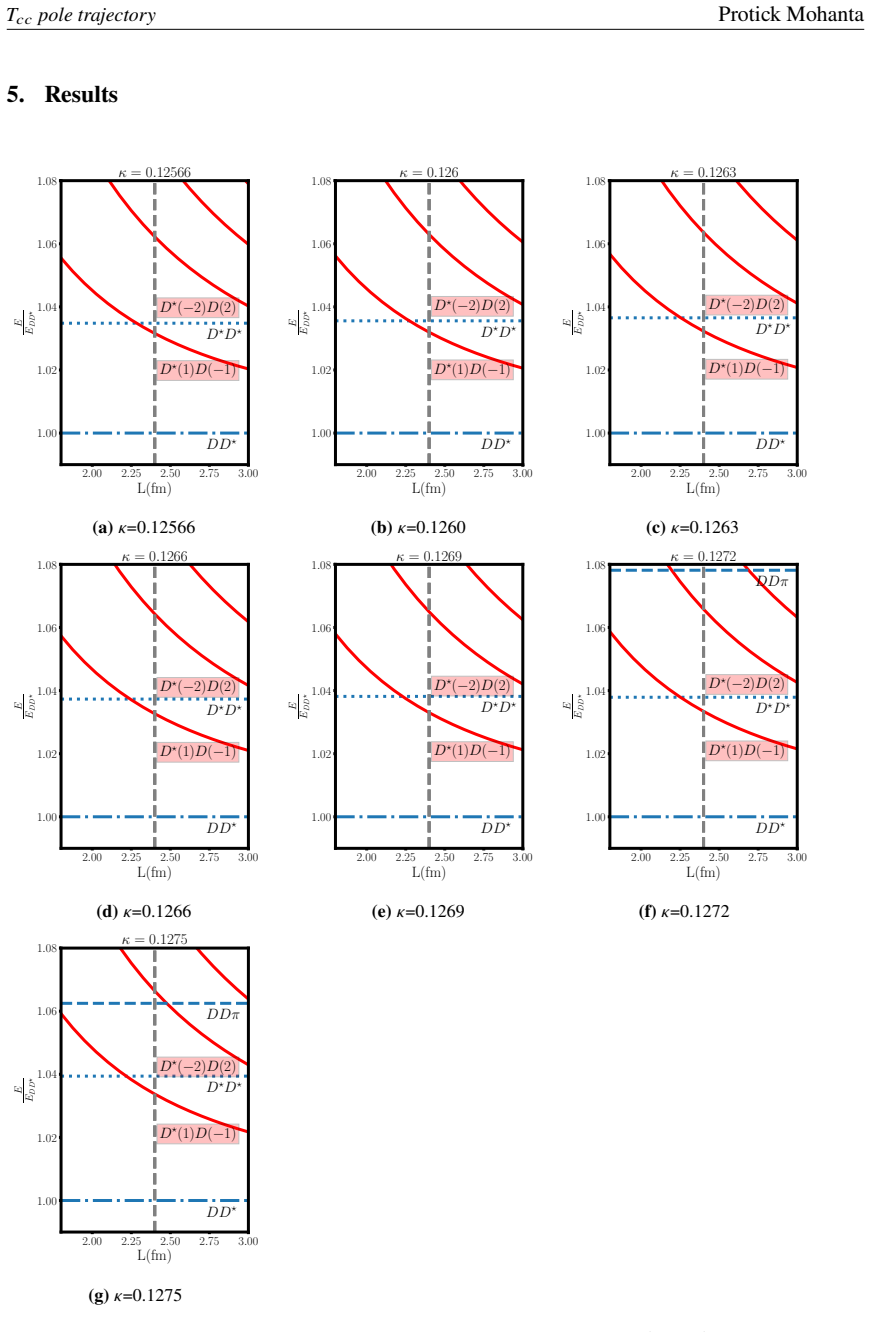
By fitting the lattice spectra with the modified Lüscher condition, the pole trajectory of the T_cc state is obtained as a continuous function of the heavy and light quark masses, showing its position relative to threshold at each point.
What carries the argument
Modified Lüscher method that adjusts the standard finite-volume quantization condition to remove non-analytic contributions from the left-hand cut in the scattering amplitude.
If this is right
- The pole position at physical quark masses indicates whether T_cc appears as a bound state or resonance.
- Discretization effects are quantified by comparing results at the two lattice spacings.
- Mass variation reveals how binding evolves when moving away from the physical point.
- The extracted trajectory supplies input for effective theories describing near-threshold states.
Where Pith is reading between the lines
- The same modified method could be tested on other near-threshold exotic states where left-hand cuts interfere with standard analysis.
- If the trajectory passes through the physical point at the experimental binding energy, it would support the tetraquark interpretation over a pure molecular picture.
- Extending the calculation to a third, finer lattice spacing would strengthen control over cutoff effects on the pole location.
Load-bearing premise
The modified Lüscher method correctly handles the left-hand cut non-analyticity and the operator basis isolates the 0(1+) state without missing relevant contributions.
What would settle it
Extracting the same finite-volume energies with the standard Lüscher condition near the left-hand cut and finding a visibly different pole trajectory would contradict the central result.
Figures



read the original abstract
We investigate the spectrum of doubly charmed tetraquark $T_{cc}$ with quantum number $I(J^P) = 0(1^+)$ using MILC's $N_f = 2+1+1$ HISQ gauge ensembles at two lattice spacings. We have included diquark-antidiquark operator together with molecular and scattering operators in our analysis and varied both the heavy and light quark masses. We employ the anisotropic Clover action for heavy quarks, and $O(a)$-improved Wilson--Clover action for the light (up/down) quarks. In order to handle the non-analyticity near the Left Hand Cut we use modified L\"uschers method when close to it.
Editorial analysis
A structured set of objections, weighed in public.
Referee Report
Summary. The manuscript investigates the spectrum and pole trajectory of the doubly charmed tetraquark T_cc with I(J^P)=0(1^+) on MILC N_f=2+1+1 HISQ ensembles at two lattice spacings. It employs a mixed operator basis consisting of diquark-antidiquark, molecular, and scattering operators, uses anisotropic Clover fermions for the heavy quarks and O(a)-improved Wilson-Clover for the light quarks, varies both heavy and light quark masses, and applies a modified Lüscher formalism to handle non-analyticities near the left-hand cut.
Significance. If the central extraction holds, the work would supply a controlled lattice determination of the T_cc pole trajectory across a range of quark masses, providing quantitative input on whether the state is a bound state, virtual state, or resonance and on its dependence on the heavy-quark mass. The use of multiple ensembles, a comprehensive operator basis, and explicit treatment of the left-hand cut are methodological strengths that increase the potential impact on exotic-hadron phenomenology.
major comments (2)
- [§4.3] §4.3 and Fig. 7: the stability of the extracted pole trajectory under variations of the fit range and the number of included operators is not quantified with a systematic error budget; without this, it is difficult to judge whether the reported mass dependence is robust against the choice of analysis window.
- [§3.2] §3.2, Eq. (12): the modified Lüscher quantization condition is stated without an explicit derivation or numerical test showing that it reproduces the standard Lüscher result in kinematic regions safely away from the left-hand cut; such a cross-check is load-bearing for the reliability of the trajectory near threshold.
minor comments (3)
- [Abstract] The abstract would be strengthened by quoting at least one central numerical result (e.g., the pole position at the physical point) together with its uncertainty.
- [Table 2] Table 2: the caption should explicitly state the number of configurations and the number of sources per configuration used for each ensemble.
- [§2] Notation for the left-hand cut position is introduced in §2 but not consistently used in later figures; a single symbol or definition would improve readability.
Simulated Author's Rebuttal
We thank the referee for the careful reading of our manuscript and the positive assessment of its potential impact. We address the two major comments point by point below. Both points are constructive and we will incorporate the requested improvements in the revised version.
read point-by-point responses
-
Referee: [§4.3] §4.3 and Fig. 7: the stability of the extracted pole trajectory under variations of the fit range and the number of included operators is not quantified with a systematic error budget; without this, it is difficult to judge whether the reported mass dependence is robust against the choice of analysis window.
Authors: We agree that quantifying the stability under variations of the fit range and operator basis with an explicit systematic error is necessary for a robust assessment of the mass dependence. In the revised manuscript we will perform additional fits with varied time ranges and subsets of the operator basis (diquark, molecular, and scattering), report the observed shifts in the extracted pole positions, and include the maximum variation as a systematic uncertainty in the final error budget for the pole trajectory. revision: yes
-
Referee: [§3.2] §3.2, Eq. (12): the modified Lüscher quantization condition is stated without an explicit derivation or numerical test showing that it reproduces the standard Lüscher result in kinematic regions safely away from the left-hand cut; such a cross-check is load-bearing for the reliability of the trajectory near threshold.
Authors: We acknowledge that an explicit cross-check would strengthen confidence in the modified quantization condition. In the revision we will add a brief outline of the modification (following the standard derivation of the Lüscher condition but accounting for the left-hand cut) together with a numerical test on a kinematic point safely away from the cut, demonstrating numerical agreement with the standard Lüscher formula to within statistical precision. This test will be included in §3.2 or an appendix. revision: yes
Circularity Check
No significant circularity detected
full rationale
The derivation relies on external MILC N_f=2+1+1 HISQ ensembles, standard anisotropic Clover and O(a)-improved Wilson-Clover actions, a mixed operator basis, and a modified Lüscher formalism applied to lattice correlation functions. No equation or claim reduces the extracted T_cc pole trajectory to a parameter fitted from the same data or to a self-citation chain; the central result is obtained by fitting independent lattice data under stated assumptions that do not presuppose the pole location.
Axiom & Free-Parameter Ledger
free parameters (2)
- heavy and light quark masses
- lattice spacings
axioms (1)
- domain assumption Modified Lüscher method correctly handles non-analyticity near the left-hand cut
Lean theorems connected to this paper
-
IndisputableMonolith/Foundation/AbsoluteFloorClosure.leanreality_from_one_distinction unclear?
unclearRelation between the paper passage and the cited Recognition theorem.
We employ the anisotropic Clover action for heavy quarks... modified Lüscher’s method when close to it.
What do these tags mean?
- matches
- The paper's claim is directly supported by a theorem in the formal canon.
- supports
- The theorem supports part of the paper's argument, but the paper may add assumptions or extra steps.
- extends
- The paper goes beyond the formal theorem; the theorem is a base layer rather than the whole result.
- uses
- The paper appears to rely on the theorem as machinery.
- contradicts
- The paper's claim conflicts with a theorem or certificate in the canon.
- unclear
- Pith found a possible connection, but the passage is too broad, indirect, or ambiguous to say the theorem truly supports the claim.
Reference graph
Works this paper leans on
-
[1]
R. Aaijet al.(LHCb Collaboration), Nat. Commun.13, 3351 (2022) doi:10.1038/s41467- 022-30206-w
-
[2]
H. X. Chen, W. Chen, X. Liu, Y. R. Liu, and S. L. Zhu, 2023 Rep. Prog. Phys.86, 026201 (2023) doi:10.1088/1361-6633/aca3b6
-
[3]
A. Francis, R.J. Hudspith, R. Lewis and K. Maltman, Phys. Rev. Lett.118, 142001 (2017) doi:10.1103/PhysRevLett.118.142001
-
[4]
A. Francis, R.J. Hudspith, R. Lewis and K. Maltman, Phys. Rev. D99, 054505 (2019) doi:10.1103/PhysRevD.99.054505
-
[5]
P. Junnarkar, N. Mathur and M. Padmanath, Phys. Rev. D99, 034507 (2019) doi:10.1103/PhysRevD.99.034507
-
[6]
L. Leskovec, S. Meinel, M. Pflaumer and M. Wagner, Phys. Rev. D100, 014503 (2019) doi:10.1103/PhysRevD.100.014503
-
[7]
P Mohanta and S Basak, Phys. Rev. D102, 094516 (2020) doi:10.1103/PhysRevD.102.094516
-
[8]
Meng-Lin Duet al.Phys. Rev. Lett.131, 131903 (2023) doi:10.1103/PhysRevLett.131.131903
-
[9]
M. T. Hansen, F. R. López and S R. Sharpe, JHEP06(2024) 051 doi:10.1007/JHEP06(2024)051
-
[10]
M. Padmanath and S. Prelovsek, Phys. Rev. Lett.129, 032002 (2022) doi:10.1103/PhysRevLett.129.032002
-
[11]
G. K. C. Cheung, C. E. Thomas, J. J. Dudek, and R. G. Edwards, JHEP.11(2017) 033 doi:10.1007/JHEP11(2017)033. 9 𝑇𝑐𝑐 pole trajectoryProtick Mohanta
-
[12]
J. B. Chenget al.2021 Chinese Phys. C45043102 doi:10.1088/1674-1137/abde2f
-
[13]
E. J. Eichten and C. Quigg, Phys. Rev. Lett.119, 202002 (2017) doi:10.1103/PhysRevLett.119.202002
-
[14]
T. Mehen, Phys. Rev. D96, 094028 (2017) doi:10.1103/PhysRevD.96.094028
-
[15]
K. C. Bowleret al.Phys. Rev. D54, 3619 (1996) doi:10.1103/PhysRevD.54.3619
-
[16]
A. Abdel-Rehim, C. Alexandrou, J. Berlin, M. D. Brida, J. Finken- rath, M. Wagner, Comput. Phys. Commun.220(2017): 97-121, url=https://api.semanticscholar.org/CorpusID:22282306
work page 2017
-
[17]
S. Prelovsek, E. Ortiz-Pacheco, S. Collins, L. Leskovec, M. Padmanath and I. Vujmilovic, Phys. Rev. D112, no.1, 014507 (2025) doi:10.1103/rlgp-c9tb [arXiv:2504.03473 [hep-lat]]
-
[18]
P. Mohanta and S. Basak, Phys. Rev. D101, no.9, 094503 (2020) doi:10.1103/PhysRevD.101.094503 [arXiv:1911.03741 [hep-lat]]
-
[19]
R.J.Dowdall,C.T.H.Davies,G.P.LepageandC.McNeile,Phys.Rev.D88,074504(2013) doi:10.1103/PhysRevD.88.074504 [arXiv:1303.1670 [hep-lat]]
work page internal anchor Pith review Pith/arXiv arXiv doi:10.1103/physrevd.88.074504 2013
-
[20]
N. H. Christ, M. Li, and H. W. Lin, Phys. Rev. D 76, 074505 (2007) doi:10.1103/PhysRevD.76.074505
-
[21]
H.W.Lin,andN.Christ,Phys.Rev.D76,074506(2007)doi:10.1103/PhysRevD.76.074506
-
[22]
B- and D-meson decay constants from three-flavor lattice QCD
A. Bazavovet al.[Fermilab Lattice and MILC], Phys. Rev. D85, 114506 (2012) doi:10.1103/PhysRevD.85.114506 [arXiv:1112.3051 [hep-lat]]
work page internal anchor Pith review Pith/arXiv arXiv doi:10.1103/physrevd.85.114506 2012
-
[23]
Heavy Quark Physics, A Manohar & M Wise, (2023) Cambridge University Press, doi:https://doi.org/10.1017/9781009402125
-
[24]
A.Bazavovet al.[MILC],Phys.Rev.D82,074501(2010)doi:10.1103/PhysRevD.82.074501 [arXiv:1004.0342 [hep-lat]]. 10
work page internal anchor Pith review Pith/arXiv arXiv doi:10.1103/physrevd.82.074501 2010
discussion (0)
Sign in with ORCID, Apple, or X to comment. Anyone can read and Pith papers without signing in.