Recognition: 2 theorem links
· Lean TheoremNaturalness and Fisher Information
Pith reviewed 2026-05-15 17:53 UTC · model grok-4.3
The pith
The Fisher information metric supplies a geometric measure of fine-tuning whose eigenvalues generalize the Barbieri-Giudice criterion to multiple correlated parameters.
A machine-rendered reading of the paper's core claim, the machinery that carries it, and where it could break.
Core claim
Fine-tuning is quantified by the non-zero eigenvalues of the rescaled fine-tuning matrix F_ij obtained from the Fisher information matrix. This matrix encodes the sensitivity of observables to parameters through information divergences and, by Chentsov's theorem, supplies the physically natural metric on parameter space. When observables outnumber parameters, F_ij is the pullback of the Euclidean metric from observable space to the manifold of admissible predictions; large eigenvalues then correspond to stretched directions and indicate fine-tuning. The construction reproduces the Barbieri-Giudice measure in the single-parameter limit and extends it to correlated multi-parameter cases, as is
What carries the argument
The rescaled fine-tuning matrix F_ij derived from the Fisher information matrix, whose non-zero eigenvalues serve as the quantitative measure of fine-tuning and admit a pullback-metric interpretation when observables exceed parameters.
If this is right
- The single-parameter limit recovers the standard Barbieri-Giudice fine-tuning measure.
- Correlations among parameters are automatically incorporated through the off-diagonal entries of F_ij.
- Large eigenvalues of the pullback metric flag directions in which observables are highly sensitive to small parameter changes.
- The same construction applies uniformly to dimensional transmutation, fixed-point theories, and the hierarchy problem.
Where Pith is reading between the lines
- The geometric view suggests that naturalness can be rephrased as the absence of extreme stretching in the map from parameters to observables.
- The measure may be used to scan entire model spaces by computing the eigenvalue spectrum of F_ij at each point.
- Extensions to theories with continuous symmetries would require a suitable invariant probability distribution over observables.
Load-bearing premise
A probability distribution over observables can be assigned to every point in parameter space such that information divergences correctly capture parameter sensitivity and Chentsov's theorem selects the Fisher metric.
What would settle it
A concrete model in which the non-zero eigenvalues of F_ij assign large fine-tuning to a direction that physical intuition regards as natural, or small fine-tuning to a direction widely viewed as finely tuned.
Figures

read the original abstract
Fine-tuning and naturalness, the sensitivity of low-energy observables to small changes in the fundamental parameters of a theory, are cornerstones of physics beyond the Standard Model. We propose a new measure of fine-tuning based on information theory. To each point in parameter space we associate a probability distribution over observables. Divergence measures encode the sensitivity of observables to model parameters and determine a Riemannian metric on parameter space. By Chentsov's theorem, the physically motivated metric is the Fisher information metric, up to scaling. We propose a rescaled fine-tuning matrix $\mathcal{F}_{ij}$ derived from the Fisher information matrix, whose non-zero eigenvalues serve as our measure of fine-tuning. When the number of observables exceeds the number of parameters, $\mathcal{F}_{ij}$ admits a natural geometric interpretation as the pullback of the Euclidean metric from observable space to the submanifold of admissible predictions, with large eigenvalues corresponding to highly stretched directions and indicative of fine-tuning. Our measure reproduces the familiar Barbieri--Giudice criterion as a special case, while generalising it to multiple correlated parameters. We illustrate its behaviour on dimensional transmutation, the Wilson--Fisher fixed point, a simple model of the hierarchy problem, and the electron Yukawa coupling, finding agreement with physical intuition in each case.
Editorial analysis
A structured set of objections, weighed in public.
Referee Report
Summary. The manuscript proposes a new information-theoretic measure of fine-tuning. To each point in parameter space it associates a probability distribution over observables; divergence measures then induce the Fisher information metric on parameter space (via Chentsov's theorem). A rescaled fine-tuning matrix F_ij is defined from this metric, and its non-zero eigenvalues are proposed as the quantitative measure of fine-tuning. When the number of observables exceeds the number of parameters, F_ij is interpreted geometrically as the pullback of the Euclidean metric on observable space. The construction reproduces the Barbieri-Giudice criterion as a special case and is applied to dimensional transmutation, the Wilson-Fisher fixed point, a hierarchy-problem toy model, and the electron Yukawa coupling.
Significance. If the construction proves robust, the work supplies a geometric and information-theoretic foundation for naturalness that generalizes the Barbieri-Giudice measure to correlated parameters and supplies an explicit pullback interpretation. The reproduction of the standard criterion in a limiting case and the explicit link to the Fisher metric (justified by Chentsov's theorem) are concrete strengths that could make the proposal useful for systematic scans of BSM parameter spaces.
major comments (2)
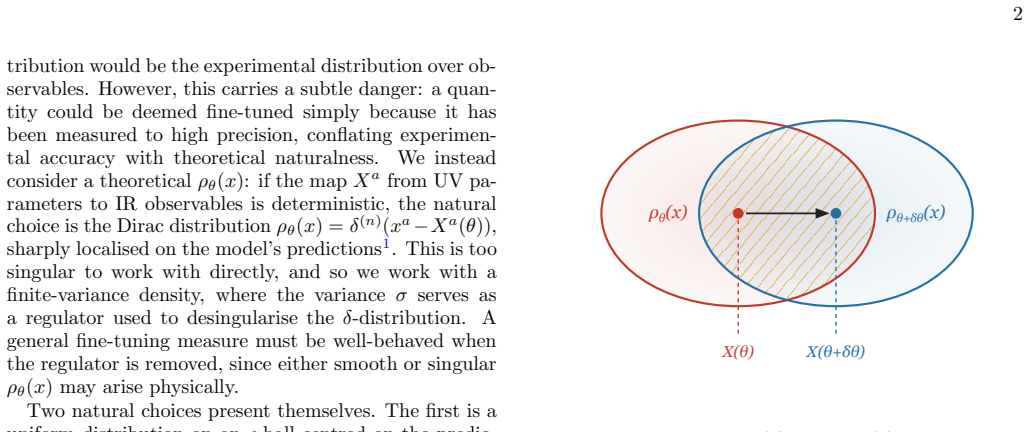
- [Definition of p(o|θ) and the rescaled matrix F_ij (following Chentsov's theorem)] The central construction begins by associating an arbitrary probability distribution p(o|θ) to each point θ in parameter space so that a divergence can define the Fisher metric. When observables are deterministic functions of parameters, the natural choice is a delta function whose Fisher information is singular; any finite-width regularization (Gaussian width, observable covariance, etc.) introduces an arbitrary scale that propagates directly into the eigenvalues of the rescaled matrix F_ij. The manuscript recovers the Barbieri-Giudice numbers only for one specific surrogate; a different width or covariance can change both the numerical values and the ordering of fine-tuned directions. This choice is load-bearing for the claim that the eigenvalues furnish a well-defined, physically motivated measure.
- [Geometric interpretation paragraph and definition of F_ij] The geometric pullback interpretation (F_ij as the pullback of the Euclidean metric from observable space) is stated for the case where the number of observables exceeds the number of parameters. The manuscript does not specify how the rescaling that produces F_ij from the Fisher matrix is performed in this over-determined regime, nor whether the resulting eigenvalues remain invariant under reparameterizations of the observables. Without an explicit formula or proof of invariance, the geometric claim cannot be verified from the given equations.
minor comments (1)
- [Abstract] The abstract states that the measure 'finds agreement with physical intuition in each case' but supplies no quantitative metric (e.g., comparison of eigenvalue ratios to the Barbieri-Giudice Δ values). Adding a short table or sentence with the numerical agreement would improve readability.
Simulated Author's Rebuttal
We thank the referee for the careful reading and constructive comments on our manuscript. The points raised highlight areas where additional clarification is needed, and we have revised the text accordingly to address them explicitly.
read point-by-point responses
-
Referee: The central construction begins by associating an arbitrary probability distribution p(o|θ) to each point θ in parameter space so that a divergence can define the Fisher metric. When observables are deterministic functions of parameters, the natural choice is a delta function whose Fisher information is singular; any finite-width regularization introduces an arbitrary scale that propagates directly into the eigenvalues of the rescaled matrix F_ij. The manuscript recovers the Barbieri-Giudice numbers only for one specific surrogate; a different width or covariance can change both the numerical values and the ordering of fine-tuned directions. This choice is load-bearing for the claim that the eigenvalues furnish a well-defined, physically motivated measure.
Authors: We agree that the regularization scale in p(o|θ) affects the absolute eigenvalues when observables are deterministic. The rescaling to define F_ij is chosen to isolate relative sensitivities (recovering the Barbieri-Giudice logarithmic derivatives in the appropriate limit). We have revised the manuscript to add an explicit discussion of how the distribution should be selected based on physical uncertainties (e.g., experimental resolutions or theoretical widths), and we include a brief example showing that the ordering of fine-tuned directions is stable for consistent choices of regularization. The measure is therefore well-defined once the physical context fixes p(o|θ). revision: yes
-
Referee: The geometric pullback interpretation (F_ij as the pullback of the Euclidean metric from observable space) is stated for the case where the number of observables exceeds the number of parameters. The manuscript does not specify how the rescaling that produces F_ij from the Fisher matrix is performed in this over-determined regime, nor whether the resulting eigenvalues remain invariant under reparameterizations of the observables. Without an explicit formula or proof of invariance, the geometric claim cannot be verified from the given equations.
Authors: We have revised the manuscript to supply the explicit formula for the rescaled matrix in the over-determined regime: F_ij equals the pullback of the Euclidean metric, F_ij = sum_k (∂o_k/∂θ_i)(∂o_k/∂θ_j) (up to the overall normalization already fixed by the Fisher construction). We have also added a short proof that the eigenvalues are invariant under orthogonal reparameterizations of the observables, as required by the Euclidean structure. These additions make the geometric interpretation directly verifiable from the equations. revision: yes
Circularity Check
Rescaling of Fisher metric defined internally; derivation self-contained
full rationale
The paper begins with the standard construction of the Fisher information metric on parameter space via an arbitrary but fixed association of p(o|θ) and application of Chentsov's theorem, which is an external result. It then explicitly defines a rescaled matrix F_ij within the paper itself and interprets its eigenvalues geometrically as the pullback of the Euclidean metric on observable space. This rescaling and the resulting fine-tuning measure do not reduce by the paper's equations to any fitted quantity or to the target data; they remain a proposal that reproduces the Barbieri-Giudice measure only for a specific choice of distribution. No load-bearing step collapses to a self-citation or to a definition that presupposes the output.
Axiom & Free-Parameter Ledger
axioms (1)
- standard math Chentsov's theorem: the Fisher information metric is the unique (up to scaling) Riemannian metric invariant under Markov embeddings.
invented entities (1)
-
rescaled fine-tuning matrix F_ij
no independent evidence
Lean theorems connected to this paper
-
IndisputableMonolith/Cost/FunctionalEquationwashburn_uniqueness_aczel unclear?
unclearRelation between the paper passage and the cited Recognition theorem.
We propose a rescaled fine-tuning matrix F_ij derived from the Fisher information matrix, whose non-zero eigenvalues serve as our measure of fine-tuning... Fij(θ) = sum_a ∂X_a/∂θ_i ∂X_a/∂θ_j
-
IndisputableMonolith/Foundation/AbsoluteFloorClosurereality_from_one_distinction unclear?
unclearRelation between the paper passage and the cited Recognition theorem.
By Chentsov’s theorem, the physically motivated metric is the Fisher information metric
What do these tags mean?
- matches
- The paper's claim is directly supported by a theorem in the formal canon.
- supports
- The theorem supports part of the paper's argument, but the paper may add assumptions or extra steps.
- extends
- The paper goes beyond the formal theorem; the theorem is a base layer rather than the whole result.
- uses
- The paper appears to rely on the theorem as machinery.
- contradicts
- The paper's claim conflicts with a theorem or certificate in the canon.
- unclear
- Pith found a possible connection, but the passage is too broad, indirect, or ambiguous to say the theorem truly supports the claim.
Reference graph
Works this paper leans on
-
[1]
the observables are measured to high precision
-
[2]
the observables are highly sensitive to the input parameters, i.e.∂X a/∂θ i ≫X a; or
-
[3]
the model has large cancellations amongst param- eters – for instance,X a ∼θ i andX b ∼θ j −θ i, yet ⟨X b⟩ ≪ ⟨X a⟩. The first case is clearly not a form of fine-tuning, which is precisely why we proposed to use a theoretical dis- tribution rather than an experimental one in the in- troduction. For a theoretical distribution this depen- dence shows up as d...
-
[4]
Dynamics of Spontaneous Symmetry Breaking in the Weinberg-Salam Theory,
L. Susskind, “Dynamics of Spontaneous Symmetry Breaking in the Weinberg-Salam Theory,”Phys. Rev. D 20(1979) 2619–2625
work page 1979
-
[5]
Softly Broken Supersymmetry and SU(5),
S. Dimopoulos and H. Georgi, “Softly Broken Supersymmetry and SU(5),”Nucl. Phys. B193(1981) 150–162
work page 1981
-
[6]
Supersymmetry, Supergravity and Particle Physics,
H. P. Nilles, “Supersymmetry, Supergravity and Particle Physics,”Phys. Rept.110(1984) 1–162
work page 1984
-
[7]
The Search for Supersymmetry: Probing Physics Beyond the Standard Model,
H. E. Haber and G. L. Kane, “The Search for Supersymmetry: Probing Physics Beyond the Standard Model,”Phys. Rept.117(1985) 75–263
work page 1985
-
[8]
S. Dimopoulos and L. Susskind, “Mass Without Scalars,”Nucl. Phys. B155(1979) 237–252
work page 1979
-
[9]
D. B. Kaplan, H. Georgi, and S. Dimopoulos, “Composite Higgs Scalars,”Phys. Lett. B136(1984) 187–190
work page 1984
-
[10]
The Cosmological Constant Problem,
S. Weinberg, “The Cosmological Constant Problem,” Rev. Mod. Phys.61(1989) 1–23
work page 1989
-
[11]
The Anthropic Landscape of String Theory
L. Susskind, “The Anthropic landscape of string theory,”arXiv:hep-th/0302219
work page internal anchor Pith review Pith/arXiv arXiv
-
[12]
N. Arkani-Hamed and S. Dimopoulos, “Supersymmetric unification without low energy supersymmetry and signatures for fine-tuning at the LHC,”JHEP06(2005) 073,arXiv:hep-th/0405159
work page internal anchor Pith review Pith/arXiv arXiv 2005
-
[13]
The Hierarchy Problem and New Dimensions at a Millimeter
N. Arkani-Hamed, S. Dimopoulos, and G. R. Dvali, “The Hierarchy problem and new dimensions at a millimeter,”Phys. Lett. B429(1998) 263–272, arXiv:hep-ph/9803315
work page internal anchor Pith review Pith/arXiv arXiv 1998
-
[14]
A Large Mass Hierarchy from a Small Extra Dimension
L. Randall and R. Sundrum, “A Large mass hierarchy from a small extra dimension,”Phys. Rev. Lett.83 (1999) 3370–3373,arXiv:hep-ph/9905221
work page internal anchor Pith review Pith/arXiv arXiv 1999
-
[15]
Observables in Low-Energy Superstring Models,
J. R. Ellis, K. Enqvist, D. V. Nanopoulos, and F. Zwirner, “Observables in Low-Energy Superstring Models,”Mod. Phys. Lett. A1(1986) 57
work page 1986
-
[16]
Upper Bounds on Supersymmetric Particle Masses,
R. Barbieri and G. F. Giudice, “Upper Bounds on Supersymmetric Particle Masses,”Nucl. Phys. B306 (1988) 63–76
work page 1988
-
[17]
Naturalness Priors and Fits to the Constrained Minimal Supersymmetric Standard Model
B. C. Allanach, “Naturalness priors and fits to the constrained minimal supersymmetric standard model,” Phys. Lett. B635(2006) 123–130, 9 arXiv:hep-ph/0601089
work page internal anchor Pith review Pith/arXiv arXiv 2006
-
[18]
Bayesian approach and Naturalness in MSSM analyses for the LHC
M. E. Cabrera, J. A. Casas, and R. Ruiz de Austri, “Bayesian approach and Naturalness in MSSM analyses for the LHC,”JHEP03(2009) 075,arXiv:0812.0536 [hep-ph]
work page internal anchor Pith review Pith/arXiv arXiv 2009
-
[19]
G. W. Anderson and D. J. Castano, “Measures of fine tuning,”Phys. Lett. B347(1995) 300–308, arXiv:hep-ph/9409419
work page internal anchor Pith review Pith/arXiv arXiv 1995
-
[20]
Naturalness and superpartner masses or when to give up on weak scale supersymmetry
G. W. Anderson and D. J. Castano, “Naturalness and superpartner masses or when to give up on weak scale supersymmetry,”Phys. Rev. D52(1995) 1693–1700, arXiv:hep-ph/9412322
work page internal anchor Pith review Pith/arXiv arXiv 1995
-
[21]
P. Athron and D. J. Miller, “A New Measure of Fine Tuning,”Phys. Rev. D76(2007) 075010, arXiv:0705.2241 [hep-ph]
work page internal anchor Pith review Pith/arXiv arXiv 2007
-
[22]
Quantified naturalness from Bayesian statistics
S. Fichet, “Quantified naturalness from Bayesian statistics,”Phys. Rev. D86(2012) 125029, arXiv:1204.4940 [hep-ph]
work page internal anchor Pith review Pith/arXiv arXiv 2012
-
[23]
CMSSM, naturalness and the "fine-tuning price" of the Very Large Hadron Collider
A. Fowlie, “CMSSM, naturalness and the ”fine-tuning price” of the Very Large Hadron Collider,”Phys. Rev. D90(2014) 015010,arXiv:1403.3407 [hep-ph]
work page internal anchor Pith review Pith/arXiv arXiv 2014
-
[24]
Precise interpretations of traditional fine-tuning measures,
A. Fowlie and G. Herrera, “Precise interpretations of traditional fine-tuning measures,”Phys. Rev. D111 no. 1, (2025) 015020,arXiv:2406.03533 [hep-ph]
-
[25]
Bayesian naturalness of the CMSSM and CNMSSM
D. Kim, P. Athron, C. Bal´ azs, B. Farmer, and E. Hutchison, “Bayesian naturalness of the CMSSM and CNMSSM,”Phys. Rev. D90no. 5, (2014) 055008, arXiv:1312.4150 [hep-ph]
work page internal anchor Pith review Pith/arXiv arXiv 2014
-
[26]
Naturalness made easy: two-loop naturalness bounds on minimal SM extensions
J. D. Clarke and P. Cox, “Naturalness made easy: two-loop naturalness bounds on minimal SM extensions,”JHEP02(2017) 129,arXiv:1607.07446 [hep-ph]
work page internal anchor Pith review Pith/arXiv arXiv 2017
-
[27]
Critical exponents in 3.99 dimensions,
K. G. Wilson and M. E. Fisher, “Critical exponents in 3.99 dimensions,”Phys. Rev. Lett.28(1972) 240–243
work page 1972
-
[28]
Naturalness, chiral symmetry, and spontaneous chiral symmetry breaking,
G. ’t Hooft, “Naturalness, chiral symmetry, and spontaneous chiral symmetry breaking,”NATO Sci. Ser. B59(1980) 135–157
work page 1980
-
[29]
Relative Entropy and Proximity of Quantum Field Theories
V. Balasubramanian, J. J. Heckman, and A. Maloney, “Relative Entropy and Proximity of Quantum Field Theories,”JHEP05(2015) 104,arXiv:1410.6809 [hep-th]
work page internal anchor Pith review Pith/arXiv arXiv 2015
-
[30]
Misanthropic entropy and renormalization as a communication channel,
R. Fowler and J. J. Heckman, “Misanthropic entropy and renormalization as a communication channel,”Int. J. Mod. Phys. A37no. 16, (2022) 2250109, arXiv:2108.02772 [hep-th]
-
[31]
Relative entropy in Field Theory, the H theorem and the renormalization group
J. C. Gaite, “Relative entropy in field theory, the H theorem and the renormalization group,” in3rd International Conference on Renormalization Group (RG 96). 8, 1996.arXiv:hep-th/9610040
work page internal anchor Pith review Pith/arXiv arXiv 1996
-
[32]
Information Geometry and the Renormalization Group
R. Maity, S. Mahapatra, and T. Sarkar, “Information Geometry and the Renormalization Group,”Phys. Rev. E92no. 5, (2015) 052101,arXiv:1503.03978 [cond-mat.stat-mech]
work page internal anchor Pith review Pith/arXiv arXiv 2015
-
[33]
Relative entropy and the RG flow
H. Casini, E. Teste, and G. Torroba, “Relative entropy and the RG flow,”JHEP03(2017) 089, arXiv:1611.00016 [hep-th]
work page internal anchor Pith review Pith/arXiv arXiv 2017
-
[34]
Renormalization group flow as optimal transport,
J. Cotler and S. Rezchikov, “Renormalization group flow as optimal transport,”Phys. Rev. D108no. 2, (2023) 025003,arXiv:2202.11737 [hep-th]
-
[35]
The Inverse of Exact Renormalization Group Flows as Statistical Inference,
D. S. Berman and M. S. Klinger, “The Inverse of Exact Renormalization Group Flows as Statistical Inference,” Entropy26no. 5, (2024) 389,arXiv:2212.11379 [hep-th]
-
[36]
Infinite Distance Limits and Information Theory,
J. Stout, “Infinite Distance Limits and Information Theory,”arXiv:2106.11313 [hep-th]
-
[37]
Infinite Distances and Factorization,
J. Stout, “Infinite Distances and Factorization,” arXiv:2208.08444 [hep-th]
-
[38]
Amari,Information geometry and its applications
S.-i. Amari,Information geometry and its applications. Springer, 2016
work page 2016
-
[39]
Bounding scalar operator dimensions in 4D CFT
R. Rattazzi, V. S. Rychkov, E. Tonni, and A. Vichi, “Bounding scalar operator dimensions in 4D CFT,” JHEP12(2008) 031,arXiv:0807.0004 [hep-th]
work page internal anchor Pith review Pith/arXiv arXiv 2008
-
[40]
N. N. Chentsov,Statistical decision rules and optimal inference. American Mathematical Society, 1982
work page 1982
-
[41]
T. M. Cover and J. A. Thomas,Elements of information theory (wiley series in telecommunications and signal processing). Wiley-interscience, 2006
work page 2006
-
[42]
Fine Tuning Problem and the Renormalization Group,
C. Wetterich, “Fine Tuning Problem and the Renormalization Group,”Phys. Lett. B140(1984) 215–222
work page 1984
discussion (0)
Sign in with ORCID, Apple, or X to comment. Anyone can read and Pith papers without signing in.