Recognition: 2 theorem links
· Lean TheoremTackling multiphysics problems via finite element-guided physics-informed operator learning
Pith reviewed 2026-05-15 18:16 UTC · model grok-4.3
The pith
Finite element residuals let neural operators learn coupled multiphysics solutions without labeled data.
A machine-rendered reading of the paper's core claim, the machinery that carries it, and where it could break.
Core claim
The framework learns an operator from the input space to the solution space with a weighted residual formulation based on the finite element method, enabling discretization-independent prediction beyond the training resolution without relying on labeled simulation data. The present framework for multiphysics problems is implemented and verified on nonlinear coupled thermo-mechanical problems, including two- and three-dimensional representative volume elements with varying heterogeneous microstructures and a close-to-reality industrial casting example under varying boundary conditions.
What carries the argument
Finite element weighted residual loss that replaces data supervision by integrating the governing PDE residuals against test functions over mesh elements.
If this is right
- The trained operator produces accurate fields on meshes finer or coarser than those used during training.
- It generalizes to new boundary conditions and heterogeneous material fields not present in the training set.
- Fourier neural operators integrated with the loss achieve high accuracy on regular domains through spectral learning.
- An implicit conditional neural-field operator handles complex irregular geometries with lower computational cost.
- A single monolithic network trained across all parameters suffices for accurate parametric predictions.
Where Pith is reading between the lines
- The method could replace repeated finite-element solves inside design-optimization loops where the same physics is queried many times under changing inputs.
- Because the loss is mesh-based, the framework naturally extends to hybrid workflows that combine operator evaluations on coarse regions with conventional finite-element solves near sharp interfaces.
- Sample-quality studies imply that deliberate coverage of the input parameter space during data generation is more important than network architecture choices for reliable generalization.
- Time-dependent extensions would require augmenting the residual loss with appropriate time-discretization terms to learn evolution operators for transient multiphysics.
Load-bearing premise
The finite element weighted residual loss is assumed to enforce the full nonlinear coupled physics across arbitrary domains and boundary conditions without extra constraints or labeled data.
What would settle it
Train the operator on one set of meshes and boundary conditions, then compare its predictions on a new irregular three-dimensional domain with unseen material distributions against independent high-fidelity finite element solutions computed at higher resolution; large pointwise or energy-norm deviations would falsify the claim.
Figures








read the original abstract
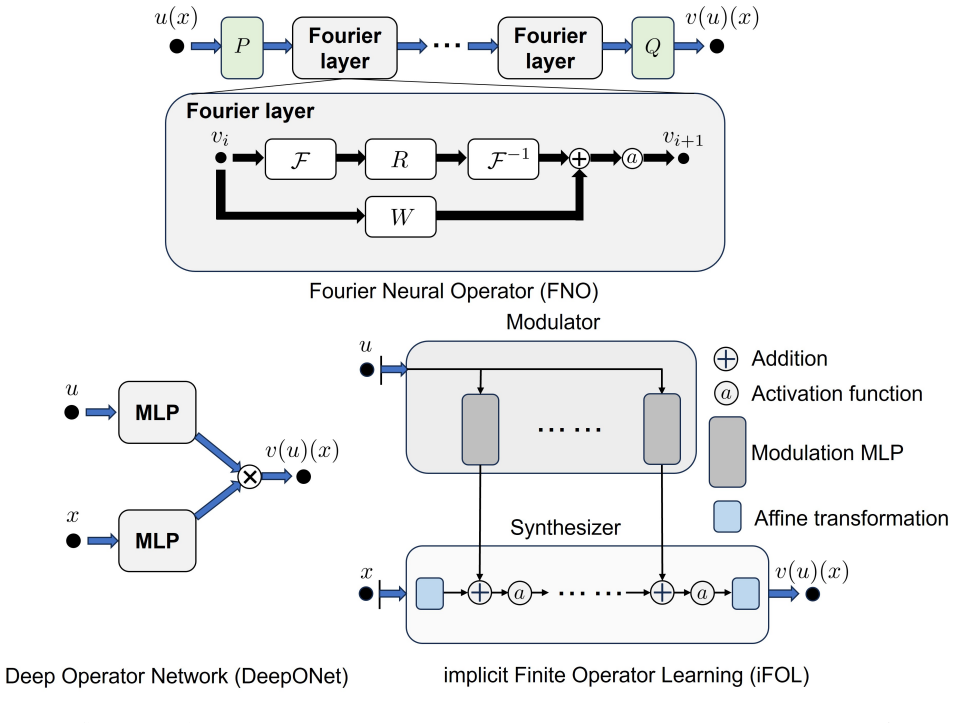
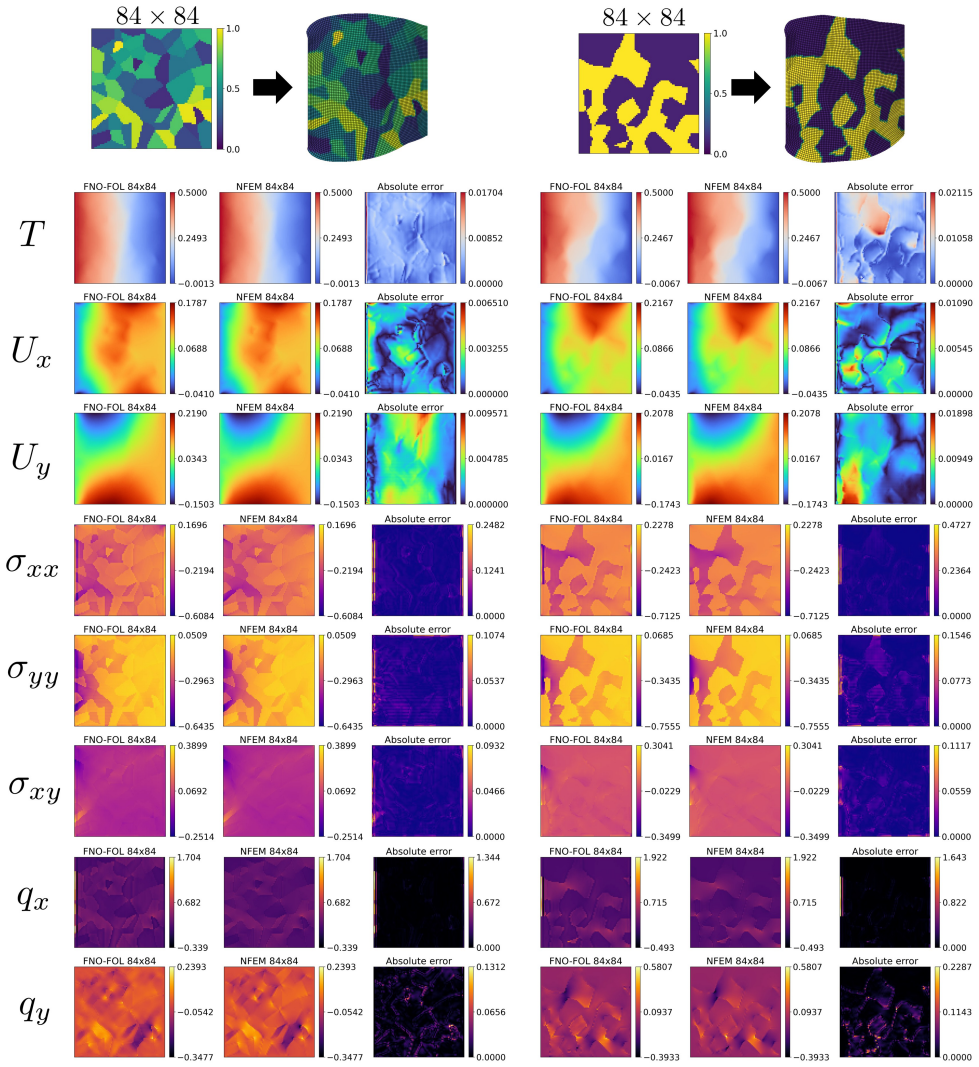
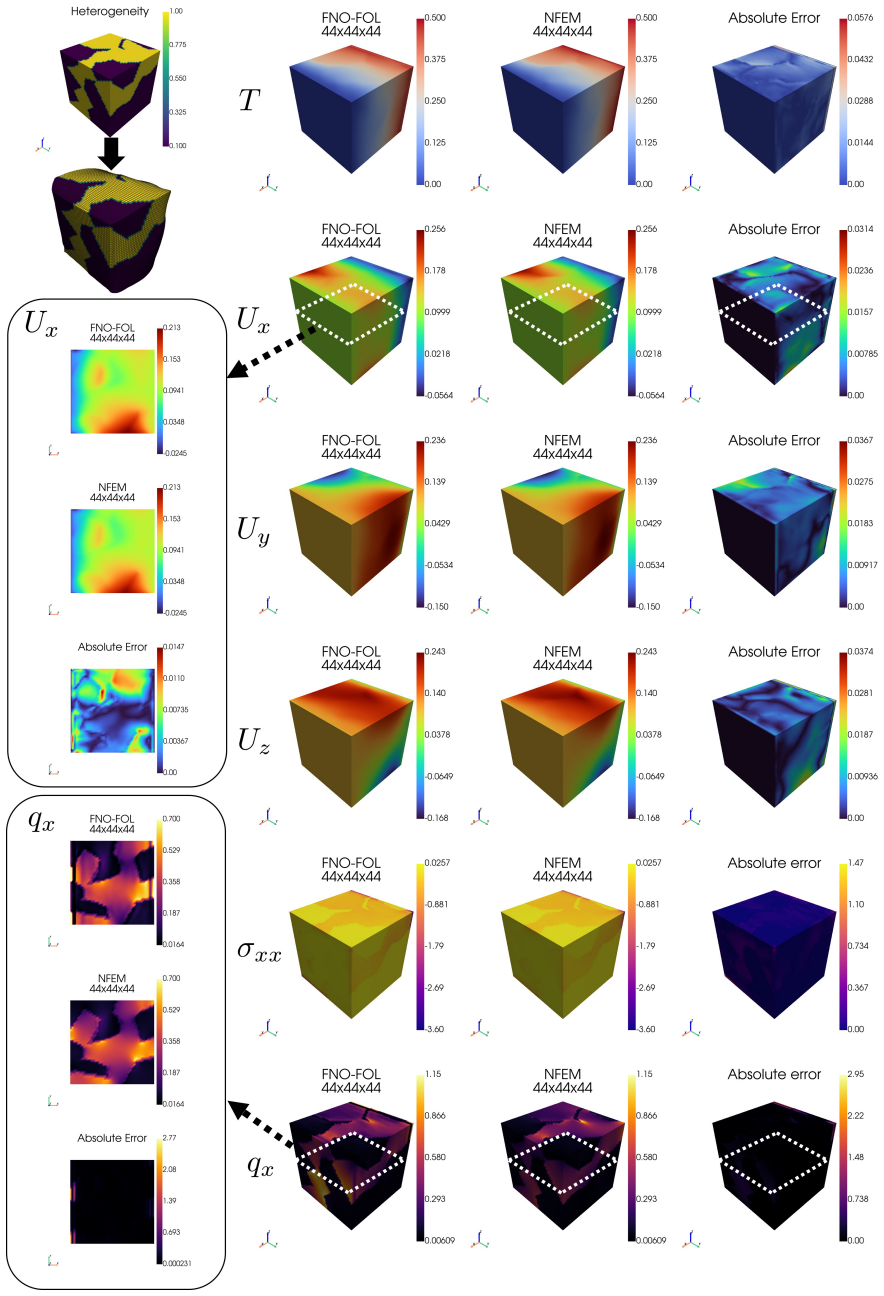
This work presents a finite element-guided physics-informed operator learning framework for multiphysics problems with coupled partial differential equations (PDEs) on arbitrary domains. The proposed framework learns an operator from the input space to the solution space with a weighted residual formulation based on the finite element method, enabling discretization-independent prediction beyond the training resolution without relying on labeled simulation data. The present framework for multiphysics problems is implemented in Folax, a JAX-based operator learning platform, and is verified on nonlinear coupled thermo-mechanical problems. Two- and three-dimensional representative volume elements with varying heterogeneous microstructures, and a close-to-reality industrial casting example under varying boundary conditions are investigated as the example problems. We investigate the potential of several neural operators combined with the proposed finite element-guided approach, including Fourier neural operators (FNOs), deep operator networks (DeepONets), and a newly proposed implicit finite operator learning (iFOL) approach based on conditional neural fields. The results demonstrate that FNOs yield highly accurate solution operators on regular domains, where the global features can be efficiently learned in the spectral domain, and iFOL offers efficient parametric operator learning capabilities for complex and irregular geometries. Furthermore, studies on training strategies, network decomposition, and training sample quality reveal that a monolithic training strategy using a single network is sufficient for accurate predictions, while training sample quality strongly influences performance. Overall, the present approach highlights the potential of physics-informed operator learning with a finite element-based loss as a unified and scalable approach for coupled multiphysics simulations.
Editorial analysis
A structured set of objections, weighed in public.
Referee Report
Summary. The paper presents a finite element-guided physics-informed operator learning framework for multiphysics problems with coupled PDEs on arbitrary domains. It learns an operator from input to solution space via a weighted residual formulation derived from the finite element method, enabling discretization-independent predictions beyond training resolution without labeled simulation data. The approach is implemented in Folax and verified on nonlinear coupled thermo-mechanical problems, including 2D/3D representative volume elements with heterogeneous microstructures and an industrial casting example under varying boundary conditions. Several neural operators are investigated, including FNOs, DeepONets, and a proposed implicit finite operator learning (iFOL) method.
Significance. If the central claim holds, the work offers a potentially significant advance in physics-informed operator learning by providing a data-free, discretization-independent method for coupled multiphysics simulations on complex domains. The integration of FEM-based residuals with architectures like FNO and iFOL could reduce reliance on expensive labeled simulations, with particular value for industrial applications involving heterogeneous materials and varying conditions.
major comments (2)
- [Abstract] Abstract: The verification on nonlinear coupled thermo-mechanical problems is asserted but unsupported by any quantitative error metrics, baseline comparisons, or details on how the weighted residual loss is computed and balanced for the coupled fields; this directly limits assessment of whether the loss enforces the full physics.
- [Abstract] Abstract: The central claim that the finite element-based weighted residual loss suffices to train an accurate operator for coupled nonlinear PDEs, boundary conditions, and interface conditions on arbitrary domains lacks specification on enforcement of essential boundary conditions or handling of stiff loss landscapes from nonlinear coupling.
minor comments (1)
- [Abstract] The abstract refers to 'studies on training strategies, network decomposition, and training sample quality' without indicating where these are detailed or what specific findings are reported.
Simulated Author's Rebuttal
We thank the referee for the constructive feedback on our manuscript. We agree that the abstract requires additional quantitative details and clarifications to strengthen the presentation of our claims. We have prepared revisions to address both major comments directly in the abstract and supporting sections.
read point-by-point responses
-
Referee: [Abstract] Abstract: The verification on nonlinear coupled thermo-mechanical problems is asserted but unsupported by any quantitative error metrics, baseline comparisons, or details on how the weighted residual loss is computed and balanced for the coupled fields; this directly limits assessment of whether the loss enforces the full physics.
Authors: We acknowledge this limitation in the current abstract. The full manuscript (Section 4) reports relative L2 errors below 2% for temperature and 3% for displacement fields across the RVE and casting examples, with comparisons to FEM reference solutions. The weighted residual loss is formulated as a sum of physics-specific residuals with adaptive weighting factors (detailed in Eq. (7) and Section 3.2) to balance the coupled thermo-mechanical terms. We will revise the abstract to include these specific error metrics and a brief description of the loss balancing procedure. revision: yes
-
Referee: [Abstract] Abstract: The central claim that the finite element-based weighted residual loss suffices to train an accurate operator for coupled nonlinear PDEs, boundary conditions, and interface conditions on arbitrary domains lacks specification on enforcement of essential boundary conditions or handling of stiff loss landscapes from nonlinear coupling.
Authors: Essential boundary conditions are enforced weakly through the finite-element weighted residual formulation (Section 3.1), consistent with standard FEM variational principles; no additional penalty terms are required. For stiff loss landscapes arising from nonlinear coupling, we use a monolithic training strategy with gradient clipping and scheduled learning rates (Section 5.3). We will add a concise statement to the abstract summarizing these mechanisms while retaining the focus on the overall framework. revision: yes
Circularity Check
No significant circularity; framework derives from standard FEM variational principles and neural operator training
full rationale
The paper introduces a weighted residual loss derived from finite-element test functions to supervise neural operators (FNO, DeepONet, iFOL) on multiphysics inputs without labeled solutions. This loss is constructed from the standard weak form of the coupled thermo-mechanical PDEs and is minimized over a distribution of input parameters (microstructures, boundary conditions). No step equates the learned operator output to its training inputs by definition, nor renames a fitted quantity as a prediction; the operator is a parametric approximator whose generalization to unseen resolutions or domains is an empirical claim supported by numerical verification on 2D/3D RVEs and industrial casting examples. Any self-citations to prior operator-learning work are not load-bearing for the central claim, which remains independently verifiable through the physics residual.
Axiom & Free-Parameter Ledger
free parameters (1)
- neural operator hyperparameters
axioms (1)
- domain assumption A weighted residual formulation derived from finite element discretization accurately enforces the governing coupled PDEs without labeled data.
invented entities (1)
-
implicit finite operator learning (iFOL)
no independent evidence
Lean theorems connected to this paper
-
IndisputableMonolith/Cost/FunctionalEquationwashburn_uniqueness_aczel unclear?
unclearRelation between the paper passage and the cited Recognition theorem.
The thermo-mechanically coupled system is enforced using a composite loss function comprising thermal (Lt) and mechanical (Lu) terms through a weighted residual formulation based on the finite element method with the predicted solution field as the test function
-
IndisputableMonolith/Foundation/AlphaCoordinateFixationJ_uniquely_calibrated_via_higher_derivative unclear?
unclearRelation between the paper passage and the cited Recognition theorem.
L = Lt + Lu = Σ (T_θ)^T r_t + Σ (U_θ)^T r_u
What do these tags mean?
- matches
- The paper's claim is directly supported by a theorem in the formal canon.
- supports
- The theorem supports part of the paper's argument, but the paper may add assumptions or extra steps.
- extends
- The paper goes beyond the formal theorem; the theorem is a base layer rather than the whole result.
- uses
- The paper appears to rely on the theorem as machinery.
- contradicts
- The paper's claim conflicts with a theorem or certificate in the canon.
- unclear
- Pith found a possible connection, but the passage is too broad, indirect, or ambiguous to say the theorem truly supports the claim.
Reference graph
Works this paper leans on
-
[1]
Seid Koric and Brian G. Thomas. Efficient thermo-mechanical model for so- lidification processes.International Journal for Numerical Methods in Engi- neering, 66(12):1955–1989, 2006. doi: https://doi.org/10.1002/nme.1614. URL https://onlinelibrary.wiley.com/doi/abs/10.1002/nme.1614
-
[2]
Matthew LS Zappulla, Seong-Mook Cho, Seid Koric, Hyoung-Jun Lee, Seon-Hyo Kim, and Brian G Thomas. Multiphysics modeling of continuous casting of stainless steel.Journal of Materials Processing Technology, 278:116469, 2020
work page 2020
-
[3]
Hui Ruan, Shahed Rezaei, Yangyiwei Yang, Dietmar Gross, and Bai-Xiang Xu. A thermo-mechanical phase-field fracture model: Application to hot cracking simulations in additive manufacturing.Journal of the Mechanics and Physics of Solids, 172: 105169, 2023. ISSN 0022-5096. doi: https://doi.org/10.1016/j.jmps.2022.105169. URL https://www.sciencedirect.com/sci...
-
[4]
Benjamin Loret, Tomasz Hueckel, and Alessandro Gajo. Chemo-mechanical coupling in saturated porous media: elastic–plastic behaviour of homoionic expansive clays.Interna- tional Journal of Solids and Structures, 39(10):2773–2806, 2002
work page 2002
-
[5]
Lei Zhou and Michael Z Hou. A new numerical 3d-model for simulation of hydraulic fracturing in consideration of hydro-mechanical coupling effects.International Journal of Rock Mechanics and Mining Sciences, 60:370–380, 2013
work page 2013
-
[6]
Tobias Hofmann, Daniel Westhoff, Julian Feinauer, Heiko Andrä, Jochen Zausch, Volker Schmidt, and Ralf Müller. Electro-chemo-mechanical simulation for lithium ion batteries across the scales.International Journal of Solids and Structures, 184:24–39, 2020
work page 2020
-
[7]
NicholasGenevaandNicholasZabaras. Modelingthedynamicsofpdesystemswithphysics- constrained deep auto-regressive networks.Journal of Computational Physics, 403:109056, 2020
work page 2020
-
[8]
Han Gao, Luning Sun, and Jian-Xun Wang. Phygeonet: Physics-informed geometry- adaptive convolutional neural networks for solving parameterized steady-state pdes on irregular domain.Journal of Computational Physics, 428:110079, 2021. 30
work page 2021
-
[9]
Reeju Pokharel, Anup Pandey, and Alexander Scheinker. Physics-informed data-driven surrogate modeling for full-field 3d microstructure and micromechanical field evolution of polycrystalline materials.JOM, 73(11):3371–3382, 2021
work page 2021
-
[10]
Xin-Yang Liu, Min Zhu, Lu Lu, Hao Sun, and Jian-Xun Wang. Multi-resolution partial differential equations preserved learning framework for spatiotemporal dynamics.Commu- nications Physics, 7(1):31, 2024
work page 2024
-
[11]
C Hu, S Martin, and R Dingreville. Accelerating phase-field predictions via recurrent neural networks learning the microstructure evolution in latent space.Computer Methods in Applied Mechanics and Engineering, 397:115128, 2022
work page 2022
-
[12]
Learning mesh-based simulation with graph networks
Tobias Pfaff, Meire Fortunato, Alvaro Sanchez-Gonzalez, and Peter Battaglia. Learning mesh-based simulation with graph networks. InInternational conference on learning rep- resentations, 2020
work page 2020
-
[13]
Jiagang Qu, Weihua Cai, and Yijun Zhao. Learning time-dependent pdes with a linear and nonlinear separate convolutional neural network.Journal of Computational Physics, 453: 110928, 2022
work page 2022
-
[14]
Romit Maulik, Bethany Lusch, and Prasanna Balaprakash. Reduced-order modeling of advection-dominated systems with recurrent neural networks and convolutional autoen- coders.Physics of Fluids, 33(3), 2021
work page 2021
-
[15]
Federico Pichi, Beatriz Moya, and Jan S Hesthaven. A graph convolutional autoencoder ap- proach to model order reduction for parametrized pdes.Journal of Computational Physics, 501:112762, 2024
work page 2024
-
[16]
Nicola Rares Franco, Stefania Fresca, Filippo Tombari, and Andrea Manzoni. Deep learning-based surrogate models for parametrized pdes: Handling geometric variability through graph neural networks.Chaos: An Interdisciplinary Journal of Nonlinear Science, 33(12), 2023
work page 2023
-
[17]
William D Fries, Xiaolong He, and Youngsoo Choi. Lasdi: Parametric latent space dynam- ics identification.Computer Methods in Applied Mechanics and Engineering, 399:115436, 2022
work page 2022
-
[18]
Christophe Bonneville, Youngsoo Choi, Debojyoti Ghosh, and Jonathan L Belof. Gplasdi: Gaussian process-based interpretable latent space dynamics identification through deep autoencoder.Computer Methods in Applied Mechanics and Engineering, 418:116535, 2024
work page 2024
-
[19]
Alessandro Longhi, Danny Lathouwers, and Zoltán Perkó. Latent space modeling of para- metric and time-dependent pdes using neural odes.Computer Methods in Applied Mechan- ics and Engineering, 448:118394, 2026
work page 2026
- [20]
-
[21]
Revanth Mattey and Susanta Ghosh. A novel sequential method to train physics informed neural networks for allen cahn and cahn hilliard equations.Computer Methods in Applied Mechanics and Engineering, 390:114474, 2022. ISSN 00457825
work page 2022
-
[22]
Navid Zobeiry and Keith D. Humfeld. A physics-informed machine learning approach for solving heat transfer equation in advanced manufacturing and engineering applications. Engineering Applications of Artificial Intelligence, 101:104232, 2021. ISSN 09521976
work page 2021
-
[23]
Chi Zhao, Feifei Zhang, Wenqiang Lou, Xi Wang, and Jianyong Yang. A comprehensive review of advances in physics-informed neural networks and their applications in complex fluid dynamics.Physics of Fluids, 36(10), 2024
work page 2024
-
[24]
Kevrekidis, Lu Lu, Paris Perdikaris, Sifan Wang, and Liu Yang
George Em Karniadakis, Ioannis G. Kevrekidis, Lu Lu, Paris Perdikaris, Sifan Wang, and Liu Yang. Physics-informed machine learning.Nature Reviews Physics, 3(6):422–440, 2021
work page 2021
-
[25]
Ameya D Jagtap, Zhiping Mao, Nikolaus Adams, and George Em Karniadakis. Physics- informed neural networks for inverse problems in supersonic flows.Journal of Computa- tional Physics, 466:111402, 2022
work page 2022
-
[26]
Zheyuan Hu, Khemraj Shukla, George Em Karniadakis, and Kenji Kawaguchi. Tackling the curse of dimensionality with physics-informed neural networks.Neural Networks, 176: 106369, 2024
work page 2024
-
[27]
Haoteng Hu, Lehua Qi, and Xujiang Chao. Physics-informed neu- ral networks (pinn) for computational solid mechanics: Numerical frame- works and applications.Thin-Walled Structures, 205:112495, 2024. ISSN 0263-8231. doi: https://doi.org/10.1016/j.tws.2024.112495. URL https://www.sciencedirect.com/science/article/pii/S0263823124009364
-
[28]
Nanxi Chen, Chuanjie Cui, Rujin Ma, Airong Chen, and Sifan Wang. Sharp- pinns: Staggered hard-constrained physics-informed neural networks for phase field mod- elling of corrosion.Computer Methods in Applied Mechanics and Engineering, 447: 118346, 2025. ISSN 0045-7825. doi: https://doi.org/10.1016/j.cma.2025.118346. URL https://www.sciencedirect.com/scien...
-
[29]
Ali Harandi, Ahmad Moeineddin, Michael Kaliske, Stefanie Reese, and Shahed Rezaei. Mixed formulation of physics-informed neural networks for thermo-mechanically coupled systems and heterogeneous domains.International Journal for Numerical Methods in En- gineering, 125(4):e7388, 2024
work page 2024
-
[30]
Mahmoud Khadijeh, Veronica Cerqueglini, Cor Kasbergen, Sandra Erkens, and Aika- terini Varveri. Multistage physics informed neural network for solving coupled mul- tiphysics problems in material degradation and fluid dynamics.Engineering with Computers, 2025. ISSN 1435-5663. doi: 10.1007/s00366-025-02174-4. URL https://doi.org/10.1007/s00366-025-02174-4
-
[31]
Sina Amini Niaki, Ehsan Haghighat, Trevor Campbell, Anoush Poursar- tip, and Reza Vaziri. Physics-informed neural network for modelling the thermochemical curing process of composite-tool systems during manufac- ture.Computer Methods in Applied Mechanics and Engineering, 384:113959, 32
-
[32]
doi: https://doi.org/10.1016/j.cma.2021.113959
ISSN 0045-7825. doi: https://doi.org/10.1016/j.cma.2021.113959. URL https://www.sciencedirect.com/science/article/pii/S0045782521002966
-
[33]
Khemraj Shukla, Zongren Zou, Chi Hin Chan, Additi Pandey, Zhicheng Wang, and George Em Karniadakis. Neurosem: A hybrid framework for simulat- ing multiphysics problems by coupling pinns and spectral elements.Com- puter Methods in Applied Mechanics and Engineering, 433:117498, 2025. ISSN 0045-7825. doi: https://doi.org/10.1016/j.cma.2024.117498. URL https:...
-
[34]
Fourier Neural Operator for Parametric Partial Differential Equations
ZongyiLi, NikolaKovachki, KamyarAzizzadenesheli, BurigedeLiu, KaushikBhattacharya, Andrew Stuart, and Anima Anandkumar. Fourier neural operator for parametric partial differential equations.arXiv preprint arXiv:2010.08895, 2020
work page internal anchor Pith review Pith/arXiv arXiv 2010
-
[35]
Zongyi Li, Hongkai Zheng, Nikola Kovachki, David Jin, Haoxuan Chen, Burigede Liu, Kamyar Azizzadenesheli, and Anima Anandkumar. Physics-informed neural operator for learning partial differential equations.ACM/JMS Journal of Data Science, 2021
work page 2021
-
[36]
Meer Mehran Rashid, Tanu Pittie, Souvik Chakraborty, and NM Anoop Krishnan. Learn- ing the stress-strain fields in digital composites using fourier neural operator.Iscience, 25 (11), 2022
work page 2022
-
[37]
Lu Lu, Pengzhan Jin, Guofei Pang, Zhongqiang Zhang, and George Em Karniadakis. Learning nonlinear operators via deeponet based on the universal approximation theo- rem of operators.Nature Machine Intelligence, 3(3):218–229, 2021. ISSN 2522-5839. doi: 10.1038/s42256-021-00302-5. URLhttps://doi.org/10.1038/s42256-021-00302-5
-
[38]
Somdatta Goswami, Minglang Yin, Yue Yu, and George Em Karniadakis. A physics- informedvariationaldeeponetforpredictingcrackpathinquasi-brittlematerials.Computer Methods in Applied Mechanics and Engineering, 391:114587, 2022. ISSN 00457825
work page 2022
-
[39]
Junyan He, Seid Koric, Shashank Kushwaha, Jaewan Park, Diab Abueidda, and Iwona Ja- siuk. Novel deeponet architecture to predict stresses in elastoplastic structures with variable complex geometries and loads.Computer Methods in Applied Mechanics and Engineering, 415:116277, 2023. ISSN 00457825
work page 2023
-
[40]
Minglang Yin, Ehsan Ban, Bruno V Rego, Enrui Zhang, Cristina Cavinato, Jay D Humphrey, and George Em Karniadakis. Simulating progressive intramural damage lead- ing to aortic dissection using deeponet: an operator–regression neural network.Journal of the Royal Society Interface, 19(187):20210670, 2022
work page 2022
-
[41]
Qianying Cao, Somdatta Goswami, and George Em Karniadakis. Laplace neural operator for solving differential equations.Nature Machine Intelligence, 6(6):631–640, 2024
work page 2024
-
[42]
Craig R Gin, Daniel E Shea, Steven L Brunton, and J Nathan Kutz. Deepgreen: deep learning of green’s functions for nonlinear boundary value problems.Scientific Reports, 11 (1):21614, 2021
work page 2021
-
[43]
Tapas Tripura and Souvik Chakraborty. Wavelet neural operator for solving parametric partial differential equations in computational mechanics problems.Computer Methods in Applied Mechanics and Engineering, 404:115783, 2023. 33
work page 2023
-
[44]
Convolutional neural operators
Bogdan Raonic, Roberto Molinaro, Tobias Rohner, Siddhartha Mishra, and Emmanuel de Bezenac. Convolutional neural operators. InICLR 2023 workshop on physics for ma- chine learning, 2023
work page 2023
-
[45]
U-fno—an enhanced fourier neural operator-based deep-learning model for multiphase flow
Gege Wen, Zongyi Li, Kamyar Azizzadenesheli, Anima Anandkumar, and Sally M Benson. U-fno—an enhanced fourier neural operator-based deep-learning model for multiphase flow. Advances in Water Resources, 163:104180, 2022
work page 2022
-
[46]
Jinglai Zheng, Hanying Hu, Jie Huang, Buyue Zhao, and Haiming Huang. Cf-deeponet: Deep operator neural networks for solving compressible flows.Aerospace Science and Tech- nology, page 110329, 2025
work page 2025
-
[47]
Zongyi Li, Daniel Zhengyu Huang, Burigede Liu, and Anima Anandkumar. Fourier neural operator with learned deformations for pdes on general geometries.Journal of Machine Learning Research, 24(388):1–26, 2023
work page 2023
-
[48]
Ali Harandi, Hooman Danesh, Kevin Linka, Stefanie Reese, and Shahed Rezaei. Spifol: A spectral-based physics-informed finite operator learning for prediction of mechanical behavior of microstructures.Journal of the Mechanics and Physics of Solids, page 106219, 2025
work page 2025
-
[49]
Meer Mehran Rashid, Souvik Chakraborty, and NM Anoop Krishnan. Revealing the pre- dictive power of neural operators for strain evolution in digital composites.Journal of the Mechanics and Physics of Solids, 181:105444, 2023
work page 2023
-
[50]
Ehsan Haghighat, Umair bin Waheed, and George Karniadakis. En-deeponet: An en- richment approach for enhancing the expressivity of neural operators with applications to seismology.Computer Methods in Applied Mechanics and Engineering, 420:116681, 2024
work page 2024
-
[51]
Wei Li, Martin Z Bazant, and Juner Zhu. Phase-field deeponet: Physics-informed deep operatorneuralnetworkforfastsimulationsofpatternformationgovernedbygradientflows of free-energy functionals.Computer Methods in Applied Mechanics and Engineering, 416: 116299, 2023
work page 2023
-
[52]
Danielle Ciesielski, Yulan Li, Shenyang Hu, Ethan King, Jordan Corbey, and Panos Stinis. Deep operator network surrogate for phase-field modeling of metal grain growth during solidification.Computational Materials Science, 246:113417, 2025
work page 2025
-
[53]
Binh Huy Nguyen and Matti Schneider. Universal fourier neural operators for periodic homogenization problems in linear elasticity.Journal of the Mechanics and Physics of Solids, page 106418, 2025
work page 2025
-
[54]
YuanYin, MatthieuKirchmeyer, Jean-YvesFranceschi, AlainRakotomamonjy, andPatrick Gallinari. Continuous pde dynamics forecasting with implicit neural representations.arXiv preprint arXiv:2209.14855, 2022
-
[55]
Jan Hagnberger, Marimuthu Kalimuthu, Daniel Musekamp, and Mathias Niepert. Vector- ized conditional neural fields: A framework for solving time-dependent parametric partial differential equations, 2024. URLhttps://arxiv.org/abs/2406.03919. 34
-
[56]
Louis Serrano, Lise Le Boudec, Armand Kassaï Koupaï, Thomas X Wang, Yuan Yin, Jean- Noël Vittaut, and Patrick Gallinari. Operator learning with neural fields: Tackling pdes on general geometries.Advances in Neural Information Processing Systems, 36:70581–70611, 2023
work page 2023
-
[57]
Pan Du, Meet Hemant Parikh, Xiantao Fan, Xin-Yang Liu, and Jian-Xun Wang. Condi- tional neural field latent diffusion model for generating spatiotemporal turbulence.Nature Communications, 15(1):10416, 2024
work page 2024
-
[58]
Reza Najian Asl, Yusuke Yamazaki, Kianoosh Taghikhani, Mayu Muramatsu, Markus Apel, and Shahed Rezaei. A physics-informed meta-learning framework for the continuous solution of parametric pdes on arbitrary geometries.Computers & Structures, 322:108102, 2026
work page 2026
-
[59]
Kianoosh Taghikhani, Yusuke Yamazaki, Jerry Paul Varghese, Markus Apel, Reza Najian Asl, and Shahed Rezaei. Neural-initialized newton: Accelerating nonlinear finite elements via operator learning.arXiv preprint arXiv:2511.06802, 2025
-
[60]
Zaki, and George Em Karni- adakis
Shengze Cai, Zhicheng Wang, Lu Lu, Tamer A. Zaki, and George Em Karni- adakis. Deepm&mnet: Inferring the electroconvection multiphysics fields based on operator approximation by neural networks.Journal of Computational Physics, 436: 110296, 2021. ISSN 0021-9991. doi: https://doi.org/10.1016/j.jcp.2021.110296. URL https://www.sciencedirect.com/science/arti...
-
[61]
Yeh, Jean Kossaifi, Kam- yar Azizzadenesheli, and Anima Anandkumar
Md Ashiqur Rahman, Robert Joseph George, Mogab Elleithy, Daniel Leibovici, Zongyi Li, Boris Bonev, Colin White, Julius Berner, Raymond A. Yeh, Jean Kossaifi, Kam- yar Azizzadenesheli, and Anima Anandkumar. Pretraining codomain attention neural operators for solving multiphysics pdes.arXiv preprint arXiv:2403.12553, 2024. URL https://arxiv.org/abs/2403.12553
-
[62]
Biao Yuan, He Wang, Yanjie Song, Ana Heitor, and Xiaohui Chen. High-fidelity mul- tiphysics modelling for rapid predictions using physics-informed parallel neural operator. arXiv preprint arXiv:2502.19543, 2025. URLhttps://arxiv.org/abs/2502.19543
-
[63]
Multi-physics simulations via coupled fourier neural operator.arXiv preprint arXiv:2501.17296, 2025
Shibo Li, Tao Wang, Yifei Sun, and Hewei Tang. Multi-physics simulations via coupled fourier neural operator.arXiv preprint arXiv:2501.17296, 2025. URL https://arxiv.org/abs/2501.17296
-
[64]
Kazuma Kobayashi, Jaewan Park, Qibang Liu, Seid Koric, Diab Abueidda, and Syed Bahauddin Alam. When network architecture meets physics: Deep opera- tor learning for coupled multiphysics.arXiv preprint arXiv:2507.03660, 2025. URL https://arxiv.org/abs/2507.03660
-
[65]
Multiphysics bench: Benchmarking and investigating scientific machine learning for multiphysics pdes
Changfan Yang, Lichen Bai, Yinpeng Wang, Shufei Zhang, and Zeke Xie. Multiphysics bench: Benchmarking and investigating scientific machine learning for multiphysics pdes. arXiv preprint arXiv:2505.17575, 2025. URLhttps://arxiv.org/abs/2505.17575
-
[66]
Somdatta Goswami, Minglang Yin, Yue Yu, and George Em Karniadakis. A physics-informed variational deeponet for predicting crack path in quasi-brittle ma- terials.Computer Methods in Applied Mechanics and Engineering, 391:114587, 35
-
[67]
doi: https://doi.org/10.1016/j.cma.2022.114587
ISSN 0045-7825. doi: https://doi.org/10.1016/j.cma.2022.114587. URL https://www.sciencedirect.com/science/article/pii/S004578252200010X
-
[68]
doi: 10.1038/s41524-024-01488-z
Christophe Bonneville, Nathan Bieberdorf, Arun Hegde, Mark Asta, Habib N. Najm, Laurent Capolungo, and Cosmin Safta. Accelerating phase field simulations through a hybrid adaptive fourier neural operator with u-net backbone.npj Computational Materials, 11(1):14, 2025. ISSN 2057-3960. doi: 10.1038/s41524-024-01488-z. URL https://doi.org/10.1038/s41524-024-01488-z
-
[69]
Reza Najian Asl and Shahed Rezaei. Folax (Finite Operator Learning with JAX), a framework for solving and optimizing pdes by integrating machine learning with numerical methods in computational mechanics., 2025. URL https://github.com/Neural-Mechanics-Lab/folax
work page 2025
-
[70]
Shahed Rezaei, Reza Najian Asl, Shirko Faroughi, Mahdi Asgharzadeh, Ali Harandi, Ra- soul Najafi Koopas, Gottfried Laschet, Stefanie Reese, and Markus Apel. A finite operator learning technique for mapping the elastic properties of microstructures to their mechanical deformations.International Journal for Numerical Methods in Engineering, 126(1):e7637, 2025
work page 2025
-
[71]
Shahed Rezaei, Reza Najian Asl, Kianoosh Taghikhani, Ahmad Moeineddin, Michael Kaliske, and Markus Apel. Finite operator learning: bridging neural operators and numer- ical methods for efficient parametric solution and optimization of pdes.Finite Elements in Analysis and Design, 254:104506, 2026
work page 2026
-
[72]
Yusuke Yamazaki, Ali Harandi, Mayu Muramatsu, Alexandre Viardin, Markus Apel, Tim Brepols, Stefanie Reese, and Shahed Rezaei. A finite element-based physics-informed op- erator learning framework for spatiotemporal partial differential equations on arbitrary domains.Engineering with Computers, 41(1):1–29, 2025
work page 2025
-
[73]
James Cox, Dung D Luong, Vasanth Chakravarthy Shunmugasamy, Nikhil Gupta, Oliver M Strbik III, and Kyu Cho. Dynamic and thermal properties of aluminum alloy a356/silicon carbide hollow particle syntactic foams.Metals, 4(4):530–548, 2014
work page 2014
-
[74]
Sayavur I Bakhtiyarov, Ruel Anthony Overfelt, and Sorin G Teodorescu. Electrical and thermal conductivity of a319 and a356 aluminum alloys.Journal of Materials Science, 36 (19):4643–4648, 2001. 36
work page 2001
discussion (0)
Sign in with ORCID, Apple, or X to comment. Anyone can read and Pith papers without signing in.