Recognition: 2 theorem links
· Lean TheoremScattering and Femtoscopic Correlation Functions of the Sigma_c⁺⁺π⁺, Sigma_c⁰π⁻ and Sigma_b⁺π⁺ Systems
Pith reviewed 2026-05-15 17:02 UTC · model grok-4.3
The pith
The Σ_c⁰π⁻ femtoscopic correlation function is the most suitable observable for constraining the strong dynamics of the isotensor Σ_cπ system.
A machine-rendered reading of the paper's core claim, the machinery that carries it, and where it could break.
Core claim
The authors formulate the strong interaction within two distinct frameworks constrained to reproduce the lowest-lying odd-parity isoscalar spin-1/2 resonances. They compute scattering observables and femtoscopic correlation functions, adding relativistic Coulomb wave functions for charged pairs. Differences between the models in scattering observables arise mainly from the specific ultraviolet regularization schemes. Coulomb effects produce only a very small increase in both the scattering length and the effective range. The resulting correlation functions display analogous global features in the charm and bottom sectors. Strong-interaction-only calculations of the correlation functions show
What carries the argument
Two strong-interaction frameworks constrained to reproduce the Λ_c(2595) and Λ_b(5912) resonances, with femtoscopic correlation functions evaluated using relativistic Coulomb wave functions for charged pairs.
If this is right
- Differences observed in scattering observables between the two models originate primarily from their distinct ultraviolet regularization schemes.
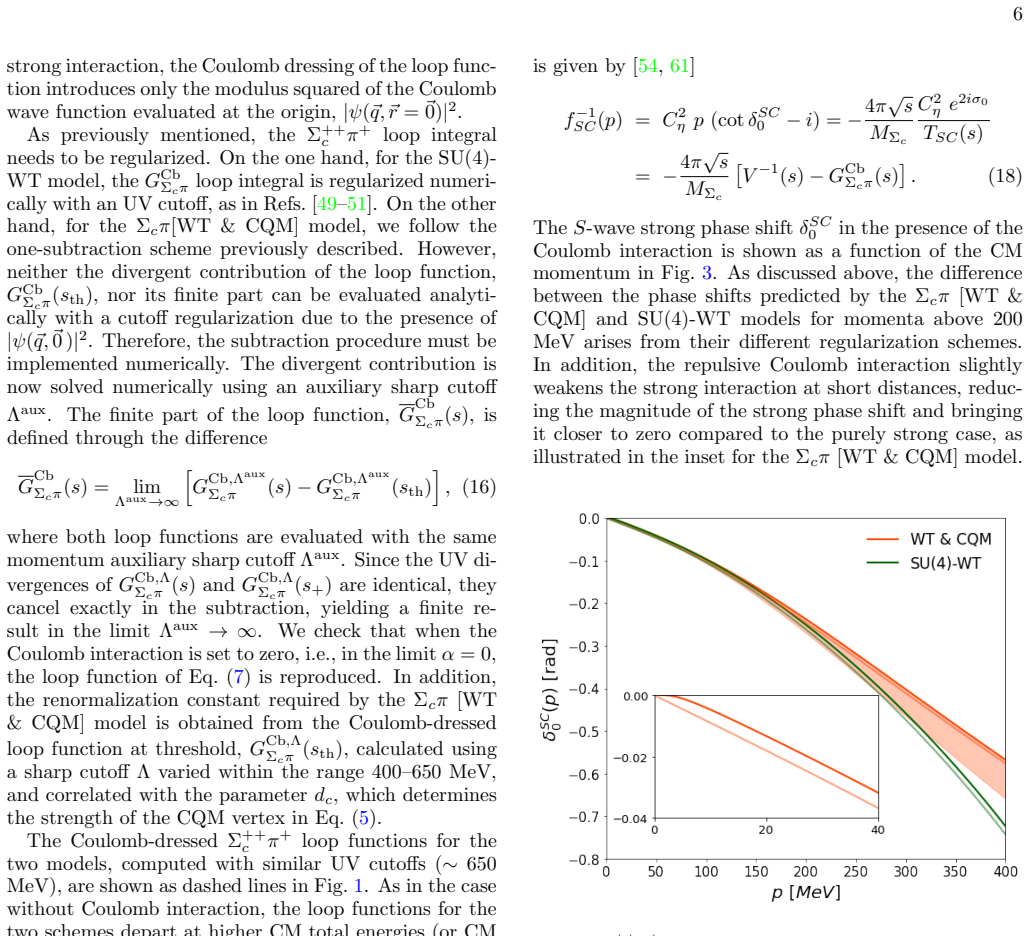
- Inclusion of Coulomb effects induces only a very small increase in both the scattering length and the effective range.
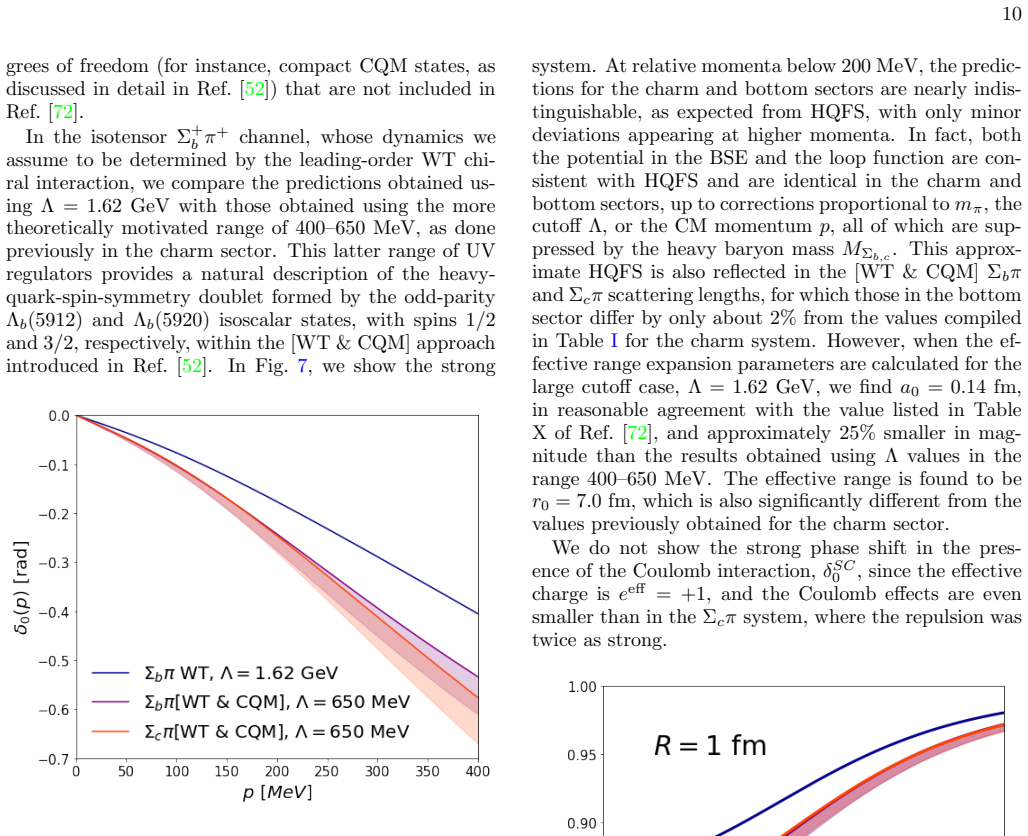
- The correlation functions in the charm and bottom sectors exhibit analogous global features consistent with heavy-quark flavor symmetry.
- The Σ_c^{++}π⁺ and Σ_b⁺π⁺ correlation functions lose most of their ability to discriminate between models once Coulomb repulsion is included.
- The neutral Σ_c⁰π⁻ correlation function, free from Coulomb effects, retains the highest sensitivity to the details of the underlying strong dynamics.
Where Pith is reading between the lines
- Future femtoscopic measurements focused on the neutral Σ_c⁰π⁻ pair could directly test which ultraviolet regularization scheme better describes the I=2 channel.
- The modest size of Coulomb corrections suggests that strong-interaction signals in other charged hadron pairs may remain accessible if electrostatic contributions can be subtracted reliably.
- Heavy-quark symmetry relations established here could be used to predict correlation functions for additional bottom-sector channels once the charm-sector results are validated.
Load-bearing premise
The two strong-interaction models are constrained solely by reproducing the known isoscalar resonances, without independent validation of their ultraviolet regularization schemes in the isotensor I=2 channels.
What would settle it
A measurement of the Σ_c⁰π⁻ femtoscopic correlation function in heavy-ion collisions that matches one model's prediction but deviates from the other's would confirm the discriminating power of the neutral channel.
Figures






read the original abstract
We present predictions for scattering observables and femtoscopic correlation functions (CFs) of the $I=2$ $\Sigma_c^{++}\pi^{+}$, $\Sigma_c^{0}\pi^{-}$ systems and its heavy-flavor counterpart $\Sigma_b^{+}\pi^{+}$. In both heavy-quark sectors, the strong interaction is formulated within two distinct theoretical frameworks, each constrained to reproduce the lowest-lying odd-parity isoscalar spin-$1/2$ resonances, $\Lambda_c(2595)$ and $\Lambda_b(5912)$, respectively. While the $\Sigma_c^{0}\pi^{-}$ pair is governed solely by the strong interaction, electrostatic contributions are included in the other two channels involving charged particles through relativistic Coulomb wave functions. We show that the differences observed in the scattering observables between the two strong-interaction models arise mainly from the specific ultraviolet regularization schemes employed. The inclusion of Coulomb effects induces only a very small increase in both the scattering length and the effective range. The resulting CFs in the charm and bottom sectors display analogous global features, in agreement with expectations from heavy-quark flavor symmetry. Both, the $\Sigma_c^{++}\pi^+$ and $\Sigma_b^{+}\pi^{+}$ CFs, when computed including only the strong interaction, exhibits substantial discriminating power among the different models. However, once Coulomb effects are incorporated, the CFs become largely affected by the repulsive electrostatic interaction, which diminishes their sensitivity to the details of the underlying strong dynamics, thereby reducing the capability to differentiate between theoretical descriptions. Thus, the $\Sigma_c^{0}\pi^{-}$ CF-being free from Coulomb effects-provides the most suitable observable for constraining the strong dynamics of the isotensor $\Sigma_c\pi$ system.
Editorial analysis
A structured set of objections, weighed in public.
Referee Report
Summary. The paper presents predictions for scattering observables (lengths and effective ranges) and femtoscopic correlation functions for the I=2 Σ_c^{++}π^+, Σ_c^0π^-, and Σ_b^+π^+ systems. Two distinct strong-interaction frameworks are employed, each constrained only by reproducing the lowest-lying odd-parity isoscalar resonances Λ_c(2595) and Λ_b(5912). Relativistic Coulomb wave functions are added for the charged channels. Differences between models are attributed primarily to ultraviolet regularization schemes. The analysis concludes that the neutral Σ_c^0π^- correlation function, free of Coulomb effects, offers the greatest sensitivity to the underlying strong dynamics, while Coulomb repulsion in the charged channels reduces model-discriminating power.
Significance. If the central results hold, the work supplies concrete, testable predictions for correlation functions in the charm and bottom sectors that can guide femtoscopic analyses at the LHC. It quantifies the impact of Coulomb interactions on observable sensitivity and illustrates heavy-quark flavor symmetry expectations between charm and bottom sectors. The explicit comparison of two regularization schemes usefully exposes a source of theoretical uncertainty in I=2 predictions.
major comments (2)
- [Section 3] Section 3: Both frameworks are constrained solely by fitting to the I=0 resonances Λ_c(2595) and Λ_b(5912). No lattice datum, sum-rule constraint, or other I=2 observable is used to fix or cross-check the ultraviolet regularization parameters. Consequently, the reported differences in I=2 scattering lengths and effective ranges (Table 2) may reflect scheme dependence rather than robust strong-interaction physics; this assumption is load-bearing for the claim that the neutral CF possesses substantial discriminating power among models.
- [Section 5.3] Section 5.3 and Figure 5: The conclusion that Coulomb effects 'diminish their sensitivity' and thereby reduce the capability to differentiate models is illustrated qualitatively by the CF plots. A quantitative measure (e.g., the ratio of model-to-model variation with versus without Coulomb, or a χ² distinguishability metric at low q) is needed to substantiate that the neutral channel is unambiguously 'the most suitable' observable.
minor comments (3)
- [Abstract] The abstract and Section 1 refer to 'its heavy-flavor counterpart' for the bottom sector; ensure the title and all section headings use consistent notation for the Σ_b^+π^+ system.
- [Eq. (8)] Equation (8) defines the correlation function C(q); the text occasionally employs 'CF' without explicitly restating the momentum argument, which could be clarified for readers unfamiliar with femtoscopy conventions.
- [Figures 3-4] Figures 3 and 4 would benefit from shaded bands indicating the variation induced by the ultraviolet cutoff range; this would make the model-dependence discussion more transparent.
Simulated Author's Rebuttal
We thank the referee for the careful reading of our manuscript and the constructive comments. We address each major comment below and indicate the revisions we will make.
read point-by-point responses
-
Referee: [Section 3] Section 3: Both frameworks are constrained solely by fitting to the I=0 resonances Λ_c(2595) and Λ_b(5912). No lattice datum, sum-rule constraint, or other I=2 observable is used to fix or cross-check the ultraviolet regularization parameters. Consequently, the reported differences in I=2 scattering lengths and effective ranges (Table 2) may reflect scheme dependence rather than robust strong-interaction physics; this assumption is load-bearing for the claim that the neutral CF possesses substantial discriminating power among models.
Authors: We agree with the referee that the models are constrained only by the I=0 resonances, which is a standard approach given the lack of I=2 data. The differences in I=2 observables are indeed due to the different regularization schemes, as stated in the manuscript. This scheme dependence represents the theoretical uncertainty in our predictions. The neutral CF's ability to discriminate is shown by the distinct curves in Figure 5 for the two models. We will add a clarifying statement in Section 3 emphasizing that these are extrapolations and the spread indicates model uncertainty. revision: partial
-
Referee: [Section 5.3] Section 5.3 and Figure 5: The conclusion that Coulomb effects 'diminish their sensitivity' and thereby reduce the capability to differentiate models is illustrated qualitatively by the CF plots. A quantitative measure (e.g., the ratio of model-to-model variation with versus without Coulomb, or a χ² distinguishability metric at low q) is needed to substantiate that the neutral channel is unambiguously 'the most suitable' observable.
Authors: We accept that the current discussion is qualitative and will enhance it with a quantitative measure. Specifically, we will calculate the relative variation between the two models in the correlation function at small q (e.g., the difference in C(q) at q=0 or integrated over low q) for the cases with and without Coulomb. This will be included in Section 5.3 to support the conclusion that the neutral channel is the most suitable. revision: yes
Circularity Check
No significant circularity: I=2 predictions independent of I=0 resonance fits
full rationale
The two frameworks are constrained exclusively by reproducing the external I=0 resonances Λ_c(2595) and Λ_b(5912). Scattering lengths, effective ranges, and CFs for the I=2 channels are then computed as genuine predictions. Differences between models are attributed to distinct UV regularization schemes, but these schemes are not fitted to the I=2 observables themselves, nor do any reported quantities reduce to the resonance inputs by algebraic construction. No self-citation load-bearing steps, uniqueness theorems, or ansatz smuggling are present in the derivation chain. The claim that the neutral Σ_c⁰π⁻ CF is Coulomb-free follows directly from electrostatics and is not circular.
Axiom & Free-Parameter Ledger
free parameters (1)
- ultraviolet regularization parameters
axioms (2)
- domain assumption Heavy-quark flavor symmetry relates the charm and bottom sectors at leading order
- standard math Relativistic Coulomb wave functions correctly capture electrostatic contributions for charged pairs
Lean theorems connected to this paper
-
IndisputableMonolith/Cost/FunctionalEquation.leanwashburn_uniqueness_aczel unclear?
unclearRelation between the paper passage and the cited Recognition theorem.
the differences observed in the scattering observables between the two strong-interaction models arise mainly from the specific ultraviolet regularization schemes employed... UV cutoff Λ... fixed... by the properties of the odd-parity Λc(2595) resonance
-
IndisputableMonolith/Foundation/RealityFromDistinction.leanreality_from_one_distinction unclear?
unclearRelation between the paper passage and the cited Recognition theorem.
both strong-interaction frameworks are constrained solely by reproducing the lowest-lying odd-parity isoscalar spin-1/2 resonances Λc(2595) and Λb(5912)
What do these tags mean?
- matches
- The paper's claim is directly supported by a theorem in the formal canon.
- supports
- The theorem supports part of the paper's argument, but the paper may add assumptions or extra steps.
- extends
- The paper goes beyond the formal theorem; the theorem is a base layer rather than the whole result.
- uses
- The paper appears to rely on the theorem as machinery.
- contradicts
- The paper's claim conflicts with a theorem or certificate in the canon.
- unclear
- Pith found a possible connection, but the passage is too broad, indirect, or ambiguous to say the theorem truly supports the claim.
Reference graph
Works this paper leans on
-
[1]
L. Fabbietti, V. Mantovani Sarti, and O. Vazquez Doce, Ann. Rev. Nucl. Part. Sci.71, 377 (2021), arXiv:2012.09806 [nucl-ex]
-
[2]
J. Adamczewski-Muschet al.(HADES), Phys. Rev. C 94, 025201 (2016), arXiv:1602.08880 [nucl-ex]
work page internal anchor Pith review Pith/arXiv arXiv 2016
-
[3]
V. M. Shapoval, B. Erazmus, R. Lednicky, and Y. M. Sinyukov, Phys. Rev. C92, 034910 (2015), arXiv:1405.3594 [nucl-th]
work page internal anchor Pith review Pith/arXiv arXiv 2015
-
[4]
S. E. Koonin, Phys. Lett. B70, 43 (1977)
work page 1977
- [5]
-
[6]
S. Acharyaet al.(ALICE), Phys. Lett. B774, 64 (2017), arXiv:1705.04929 [nucl-ex]
work page internal anchor Pith review Pith/arXiv arXiv 2017
-
[7]
Kaon femtoscopy in Pb-Pb collisions at $\sqrt{s_{\rm{NN}}}$ = 2.76 TeV
S. Acharyaet al.(ALICE), Phys. Rev. C96, 064613 (2017), arXiv:1709.01731 [nucl-ex]
work page internal anchor Pith review Pith/arXiv arXiv 2017
-
[8]
Measuring K$^0_{\rm S}$K$^{\rm{\pm}}$ interactions using pp collisions at $\sqrt{s}=7$ TeV
S. Acharyaet al.(ALICE), Phys. Lett. B790, 22 (2019), arXiv:1809.07899 [nucl-ex]
work page internal anchor Pith review Pith/arXiv arXiv 2019
-
[9]
S. Acharyaet al.(ALICE), Phys. Rev. C99, 024001 (2019), arXiv:1805.12455 [nucl-ex]
work page internal anchor Pith review Pith/arXiv arXiv 2019
-
[10]
S. Acharyaet al.(ALICE), Phys. Lett. B802, 135223 (2020), arXiv:1903.06149 [nucl-ex]
-
[11]
S. Acharyaet al.(ALICE), Phys. Lett. B797, 134822 (2019), arXiv:1905.07209 [nucl-ex]
-
[12]
S. Acharyaet al.(ALICE), Phys. Rev. Lett.124, 092301 (2020), arXiv:1905.13470 [nucl-ex]
-
[13]
S. Acharyaet al.(ALICE), Phys. Rev. Lett.123, 112002 (2019), arXiv:1904.12198 [nucl-ex]
-
[14]
S. Acharyaet al.(ALICE), Phys. Lett. B805, 135419 (2020), arXiv:1910.14407 [nucl-ex]
-
[15]
S. Acharyaet al.(ALICE), Phys. Rev. C103, 055201 (2021), arXiv:2005.11124 [nucl-ex]
- [16]
-
[17]
S. Acharyaet al.(ALICE), Phys. Lett. B813, 136030 (2021), arXiv:2007.08315 [nucl-ex]
-
[18]
S. Acharyaet al.(ALICE), Phys. Lett. B833, 137272 (2022), arXiv:2104.04427 [nucl-ex]
-
[19]
S. Acharyaet al.(ALICE), Phys. Lett. B833, 137335 (2022), arXiv:2111.06611 [nucl-ex]
-
[20]
S. Acharyaet al.(ALICE), Phys. Lett. B829, 137060 (2022), arXiv:2105.05190 [nucl-ex]
-
[21]
S. Acharyaet al.(ALICE), Phys. Rev. Lett.127, 172301 (2021), arXiv:2105.05578 [nucl-ex]
-
[22]
S. Acharyaet al.(ALICE), Eur. Phys. J. C83, 340 (2023), arXiv:2205.15176 [nucl-ex]
-
[23]
S. Acharyaet al.(ALICE), Phys. Lett. B844, 137223 (2023), arXiv:2204.10258 [nucl-ex]
-
[24]
S. Acharyaet al.(ALICE), Phys. Rev. C107, 054904 (2023), arXiv:2211.15194 [nucl-ex]
-
[25]
S. Acharyaet al.(ALICE), Phys. Lett. B845, 138145 (2023), arXiv:2305.19093 [nucl-ex]
-
[26]
S. Acharyaet al.(ALICE), Eur. Phys. J. A59, 298 (2023), arXiv:2303.13448 [nucl-ex]
-
[27]
S. Acharyaet al.(ALICE), Phys. Rev. C109, 024915 (2024), arXiv:2310.07509 [nucl-ex]
-
[28]
S. Acharyaet al.(ALICE), Phys. Lett. B856, 138915 (2024), arXiv:2312.12830 [hep-ex]
-
[29]
S. Acharyaet al.(ALICE), Eur. Phys. J. C85, 198 (2025), [Erratum: Eur.Phys.J.C 86, 12 (2026)], arXiv:2311.14527 [hep-ph]
-
[30]
S. Acharyaet al.(ALICE), Eur. Phys. J. A61, 194 (2025), arXiv:2502.20200 [nucl-ex]
-
[31]
S. Acharyaet al.(ALICE), Phys. Lett. B871, 139921 (2025), arXiv:2505.01061 [nucl-ex]
-
[32]
S. Acharyaet al.(ALICE), Phys. Rev. D110, 032004 (2024), arXiv:2401.13541 [nucl-ex]
-
[33]
S. Acharyaet al.(ALICE), Phys. Rev. D106, 052010 (2022), arXiv:2201.05352 [nucl-ex]
- [34]
- [35]
- [36]
-
[37]
M. Albaladejo, A. Feijoo, J. Nieves, E. Oset, and I. Vida˜ na, Phys. Rev. D110, 114052 (2024), arXiv:2410.08880 [hep-ph]
- [38]
- [39]
- [40]
-
[41]
M. Albaladejo, J. Nieves, and E. Ruiz-Arriola, Phys. Rev. D108, 014020 (2023), arXiv:2304.03107 [hep-ph]
- [42]
- [43]
- [44]
- [45]
- [46]
-
[47]
Etminan, (2025), arXiv:2506.14724 [nucl-th]
F. Etminan, (2025), arXiv:2506.14724 [nucl-th]
-
[48]
Bethe-Salpeter Approach for Unitarized Chiral Perturbation Theory
J. Nieves and E. Ruiz Arriola, Nucl. Phys. A679, 57 (2000), arXiv:hep-ph/9907469
work page internal anchor Pith review Pith/arXiv arXiv 2000
-
[49]
Coupled-channel study of crypto-exotic baryons with charm
J. Hofmann and M. F. M. Lutz, Nucl. Phys. A763, 90 (2005), arXiv:hep-ph/0507071
work page internal anchor Pith review Pith/arXiv arXiv 2005
-
[50]
D Mesons in Nuclear Matter: A DN Coupled-Channel Equations Approach
T. Mizutani and A. Ramos, Phys. Rev. C74, 065201 (2006), arXiv:hep-ph/0607257
work page internal anchor Pith review Pith/arXiv arXiv 2006
-
[51]
C. E. Jimenez-Tejero, A. Ramos, and I. Vidana, Phys. Rev. C80, 055206 (2009), arXiv:0907.5316 [hep-ph]
work page internal anchor Pith review Pith/arXiv arXiv 2009
- [52]
-
[53]
Spectrum of heavy baryons in the quark model
T. Yoshida, E. Hiyama, A. Hosaka, M. Oka, and K. Sadato, Phys. Rev. D92, 114029 (2015), arXiv:1510.01067 [hep-ph]
work page internal anchor Pith review Pith/arXiv arXiv 2015
-
[54]
M. Albaladejo, A. Garcia-Lorenzo, and J. Nieves, (2025), arXiv:2503.18710 [hep-ph]
- [55]
-
[56]
Quarkonium Contribution to Meson Molecules
E. Cincioglu, J. Nieves, A. Ozpineci, and A. U. Yilmazer, Eur. Phys. J. C76, 576 (2016), arXiv:1606.03239 [hep- 13 ph]
work page internal anchor Pith review Pith/arXiv arXiv 2016
-
[57]
J. Nieves and E. Ruiz Arriola, Phys. Rev. D64, 116008 (2001), arXiv:hep-ph/0104307
work page internal anchor Pith review Pith/arXiv arXiv 2001
-
[58]
Open charm in nuclear matter at finite temperature
L. Tolos, A. Ramos, and T. Mizutani, Phys. Rev. C77, 015207 (2008), arXiv:0710.2684 [nucl-th]
work page internal anchor Pith review Pith/arXiv arXiv 2008
- [59]
- [60]
-
[61]
Coulomb Effects in Low Energy Proton-Proton Scattering
X. Kong and F. Ravndal, Nucl. Phys. A665, 137 (2000), arXiv:hep-ph/9903523
work page internal anchor Pith review Pith/arXiv arXiv 2000
- [62]
-
[63]
A. Koshelkin, Int. J. Theor. Phys.64, 196 (2025), arXiv:2501.13110 [hep-ph]
-
[64]
H. A. Bethe, Phys. Rev.76, 38 (1949)
work page 1949
-
[65]
J. D. Jackson and J. M. Blatt, Rev. Mod. Phys.22, 77 (1950)
work page 1950
- [66]
-
[67]
Causality constraints for charged particles
S. K¨ onig, D. Lee, and H. W. Hammer, J. Phys. G40, 045106 (2013), arXiv:1210.8304 [nucl-th]
work page internal anchor Pith review Pith/arXiv arXiv 2013
- [68]
-
[69]
R. Lednicky, V. Lyuboshitz, and V. Lyuboshitz, Physics of Atomic Nuclei61, 2050 (1998)
work page 2050
-
[70]
R. Molina and E. Oset, Phys. Rev. D112, 096006 (2025), arXiv:2506.03669 [hep-ph]
-
[71]
Can the strong interactions between hadrons be determined using femtoscopy?
E. Epelbaum, S. Heihoff, U.-G. Meißner, and A. Tscher- won, (2025), arXiv:2504.08631 [nucl-th]
work page internal anchor Pith review Pith/arXiv arXiv 2025
-
[72]
J.-X. Lu, Y. Zhou, H.-X. Chen, J.-J. Xie, and L.-S. Geng, Phys. Rev. D92, 014036 (2015), arXiv:1409.3133 [hep- ph]
work page internal anchor Pith review Pith/arXiv arXiv 2015
-
[73]
How the X(5568) challenges our understanding of QCD
F.-K. Guo, U.-G. Meißner, and B.-S. Zou, Commun. Theor. Phys.65, 593 (2016), arXiv:1603.06316 [hep-ph]
work page internal anchor Pith review Pith/arXiv arXiv 2016
-
[74]
Can $X(5568)$ be described as a $B_s\pi$, $B\bar{K}$ resonant state?
M. Albaladejo, J. Nieves, E. Oset, Z.-F. Sun, and X. Liu, Phys. Lett. B757, 515 (2016), arXiv:1603.09230 [hep- ph]
work page internal anchor Pith review Pith/arXiv arXiv 2016
discussion (0)
Sign in with ORCID, Apple, or X to comment. Anyone can read and Pith papers without signing in.