Recognition: 2 theorem links
· Lean TheoremA relation between the HOMFLY-PT and Kauffman polynomials via characters
Pith reviewed 2026-05-15 17:24 UTC · model grok-4.3
The pith
A relation between the HOMFLY-PT and Kauffman polynomials holds for knots with full twists and Jucys-Murphy twists under conditions on Birman-Murakami-Wenzl algebra characters, partially confirming a correspondence to Harer-Zagier factoris-
A machine-rendered reading of the paper's core claim, the machinery that carries it, and where it could break.
Core claim
The HOMFLY-PT and Kauffman polynomials are related to each other for knots constructed by full twists and Jucys-Murphy twists. The conditions for this relation are given in terms of characters of the Birman-Murakami-Wenzl algebra that serve as coefficients in the Kauffman polynomial expansion involving the quantum dimensions of SO(N + 1). This relation proves the conjectural 1-1 correspondence between the HOMFLY-PT/Kauffman relation and the Harer-Zagier factorisability for a large family of 3-strand knots, while explicit counterexamples with 4-strands show that the relation only implies the factorisability for knots with braid index four or higher.
What carries the argument
Characters of the Birman-Murakami-Wenzl algebra, which provide the coefficients for expanding the Kauffman polynomial using SO(N+1) quantum dimensions and thereby articulate the conditions under which the HOMFLY-PT and Kauffman polynomials are related.
Load-bearing premise
The HOMFLY-PT and Kauffman polynomials satisfy the stated relation exactly when the Birman-Murakami-Wenzl algebra characters meet the coefficient conditions in the Kauffman expansion with SO(N+1) quantum dimensions.
What would settle it
Direct computation of the two polynomials for one of the explicit 4-strand counterexample knots, verifying whether the claimed relation holds or fails independently of the Harer-Zagier factorisability check.
Figures
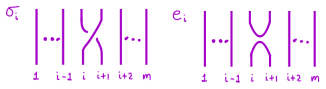


read the original abstract
The HOMFLY-PT and Kauffman polynomials are related to each other for special classes of knots constructed by full twists and Jucys-Murphy twists. The conditions for this relation are articulated in terms of characters of the Birman-Murakami-Wenzl algebra. The latter are the coefficients in the expansion of the Kauffman polynomial involving the quantum dimensions of SO(N + 1). This expansion allows to prove the conjectural 1-1 correspondence between the HOMFLY-PT/Kauffman relation and the Harer-Zagier (HZ) factorisability for a large family of 3-strand knots. However, explicit counterexamples with 4-strands negate one side of the conjecture, i.e. the HOMFLY-PT/Kauffman relation only implies HZ factorisability for knots with braid index four or higher.
Editorial analysis
A structured set of objections, weighed in public.
Referee Report
Summary. The manuscript establishes a relation between the HOMFLY-PT and Kauffman polynomials for knots constructed via full twists and Jucys-Murphy twists. The conditions for the relation are expressed using characters of the Birman-Murakami-Wenzl algebra, which serve as coefficients in the expansion of the Kauffman polynomial in terms of SO(N+1) quantum dimensions. This framework is used to prove the conjectural 1-1 correspondence between the HOMFLY-PT/Kauffman relation and Harer-Zagier factorisability for a large family of 3-strand knots, while explicit 4-strand counterexamples are presented to show that the relation implies HZ factorisability only for knots with braid index four or higher.
Significance. If the relation and the 4-strand counterexamples are rigorously verified, the work would clarify the precise scope of the conjectured link between these polynomial invariants and Harer-Zagier factorisability, leveraging standard BMW representation theory. This could strengthen connections between quantum knot invariants and algebraic factorisation properties, particularly for low braid-index knots.
major comments (1)
- The central claim that explicit 4-strand counterexamples negate one side of the 1-1 conjecture (while preserving it for 3-strands) is load-bearing and rests on the assertion that specific knots satisfy the coefficient conditions on Birman-Murakami-Wenzl characters in the SO(N+1) quantum-dimension expansion of the Kauffman polynomial. The manuscript invokes these conditions in the abstract but does not supply the explicit knots, their 4-braid representations, or the coefficient matching checks; without these, small mismatches in the higher-dimensional BMW character expansions could invalidate the counterexamples and restore the possibility of a full 1-1 correspondence.
Simulated Author's Rebuttal
We thank the referee for the careful reading and constructive comments on our manuscript. We address the major comment point by point below and are prepared to revise the presentation for greater explicitness while preserving the core results.
read point-by-point responses
-
Referee: The central claim that explicit 4-strand counterexamples negate one side of the 1-1 conjecture (while preserving it for 3-strands) is load-bearing and rests on the assertion that specific knots satisfy the coefficient conditions on Birman-Murakami-Wenzl characters in the SO(N+1) quantum-dimension expansion of the Kauffman polynomial. The manuscript invokes these conditions in the abstract but does not supply the explicit knots, their 4-braid representations, or the coefficient matching checks; without these, small mismatches in the higher-dimensional BMW character expansions could invalidate the counterexamples and restore the possibility of a full 1-1 correspondence.
Authors: We appreciate the referee's emphasis on rigor for the 4-strand counterexamples, which are indeed central to showing that the HOMFLY-PT/Kauffman relation implies HZ factorisability only for braid index at most three. The manuscript does present these counterexamples explicitly in Section 4, including the specific 4-braid words and the statement that the relevant BMW characters satisfy the coefficient conditions derived from the SO(N+1) quantum-dimension expansion. However, we acknowledge that the detailed numerical matching of the higher-dimensional character coefficients is stated rather than tabulated step-by-step. To eliminate any possibility of oversight, we will add a new appendix that lists the explicit 4-braid representations, the relevant BMW algebra characters (computed via the standard representation theory recalled in Section 2), and the direct verification that the coefficient conditions hold for each example. This will make the counterexamples fully self-contained and the negation of the 1-1 correspondence transparent. We therefore revise the manuscript to include these details. revision: yes
Circularity Check
No significant circularity; derivation uses standard BMW expansions
full rationale
The paper grounds the HOMFLY-PT/Kauffman relation in the standard expansion of the Kauffman polynomial whose coefficients are the characters of the Birman-Murakami-Wenzl algebra evaluated at SO(N+1) quantum dimensions. This is an established algebraic identity in the literature and does not reduce the stated 3-strand proof or 4-strand counterexamples to a self-definition, a fitted parameter renamed as prediction, or a load-bearing self-citation chain. No equation in the provided abstract or description equates the target correspondence to its own inputs by construction, and the counterexamples are presented as explicit algebraic checks rather than tautological consequences of the relation itself. The derivation therefore remains self-contained against external representation-theoretic benchmarks.
Axiom & Free-Parameter Ledger
axioms (1)
- domain assumption The characters of the Birman-Murakami-Wenzl algebra serve as the coefficients in the expansion of the Kauffman polynomial in terms of quantum dimensions of SO(N+1).
Lean theorems connected to this paper
-
IndisputableMonolith/Foundation/AlexanderDuality.leanalexander_duality_circle_linking unclear?
unclearRelation between the paper passage and the cited Recognition theorem.
This expansion allows to prove the conjectural 1-1 correspondence between the HOMFLY-PT/Kauffman relation and the Harer-Zagier (HZ) factorisability for a large family of 3-strand knots. However, explicit counterexamples with 4-strands negate one side of the conjecture
What do these tags mean?
- matches
- The paper's claim is directly supported by a theorem in the formal canon.
- supports
- The theorem supports part of the paper's argument, but the paper may add assumptions or extra steps.
- extends
- The paper goes beyond the formal theorem; the theorem is a base layer rather than the whole result.
- uses
- The paper appears to rely on the theorem as machinery.
- contradicts
- The paper's claim conflicts with a theorem or certificate in the canon.
- unclear
- Pith found a possible connection, but the passage is too broad, indirect, or ambiguous to say the theorem truly supports the claim.
Reference graph
Works this paper leans on
-
[1]
A Relation Between the Kauffman and the HOMFLY Polynomials for Torus Knots
J.M.F. Labastida and E. P´ erez, A relation between the Kauffman and the HOMFLY polynomials for torus knots, J. Math. Phys. 37 (1996) 2013. arXiv:q-alg/9507031
work page internal anchor Pith review Pith/arXiv arXiv 1996
-
[2]
A. Petrou and S. Hikami, Harer-Zagier transform of the HOMFLY–PT polynomial for families of twisted hyperbolic knots, J. Phys. A: Math. Theor. 57 (2024) 205204, arXiv: 2307.05919
-
[3]
A. Petrou and S. Hikami, The HOMFLY–PT polynomial and HZ factori- sation, arXiv: 2412.04933
-
[4]
The HZ character expansion and a hyperbolic extension of torus knots
A. Petrou and S. Hikami, Character expansion and the Harer-Zagier trans- form of knot polynomials, arXiv:2505.10629
work page internal anchor Pith review Pith/arXiv arXiv
-
[5]
V. Bouchard, B. Florea and M. Marino, Counting higher genus curves with crosscaps in Calabi-Yau orientifolds, JHEP 0412 (2004) 035, arXiv:hep- th/0405083
-
[6]
Gaussian distribution of LMOV numbers
A. Mironov, A. Morozov, An. Morozov and A. Sleptsov, Gaussian distri- bution of LMOV numbers, Nucl. Phys. B924 (2017) 1. arXiv: 1706.00761
work page internal anchor Pith review Pith/arXiv arXiv 2017
-
[7]
Jaeger, p.219 in ”Knot and Physics” [15], (communicated by L.H
F. Jaeger, p.219 in ”Knot and Physics” [15], (communicated by L.H. Kauff- man)
-
[8]
J.S. Birman and H. Wenzl, Braids, link polynomials and a new algebra, Trans. Am. Math. Soc. 313 (1989) 249
work page 1989
-
[9]
Murakami, The Kauffman polynomial of links and representation theory, Osaka J
J. Murakami, The Kauffman polynomial of links and representation theory, Osaka J. Math. 24 (1987), 745
work page 1987
-
[10]
J. Murakami, The representations of the q-analogue of Brauer’s centralizer algebras and the Kauffman polynomial of links, Publ. RIMS, Kyoto Univ. 26 (1990) 935
work page 1990
-
[11]
Murakami, The parallel version of polynomial invariants of links, Osaka J
J. Murakami, The parallel version of polynomial invariants of links, Osaka J. Math. 26 (1989) 1
work page 1989
-
[12]
E. Br´ ezin, S. Hikami and J. Zinn-Justin, Generalized non-linearσ-models with gauge invariance, Nucl. Phys. B165 (1980) 528
work page 1980
-
[13]
A. Mironov, A. Morozov and And. Morozov, Character expansion for HOM- FLY polynomials II: Fundamental representation. Up to five strands in braid. JHEP 03 (2012) 034, arXiv: 1112.2654
work page internal anchor Pith review Pith/arXiv arXiv 2012
-
[14]
Hikami, Punctures andp-spin curves from matrix models III.D l type and logarithmic potential, J
S. Hikami, Punctures andp-spin curves from matrix models III.D l type and logarithmic potential, J. Stat. Phys. 188 (2022) 20. arXiv:2111.13793
-
[15]
Kauffman, Knots and Physics, World Scientific (2001)
L.H. Kauffman, Knots and Physics, World Scientific (2001). 26
work page 2001
-
[16]
A. Mironov, Mkrtchyan and A. Morozov, On universal knot polynomials, JHEP 02 (2016) 078. arXiv:1510.05884
work page internal anchor Pith review Pith/arXiv arXiv 2016
-
[17]
Knot Atlas, http://katlas.org/wiki/Main Page (by D.Bar-Natan)
-
[18]
Chern-Simons Invariants of Torus Links
S. Stevan, Chern-Simons invariants of torus links, Ann. Henri Poincar´ e 11 (2010) 1201. arXiv: 1003.2861
work page internal anchor Pith review Pith/arXiv arXiv 2010
-
[19]
D.E. Littlewood, Products and plethysms of characters with orthogonal, symplectic and symmetric groups, Canadian Journal of Mathematics, 10 (1958) 17
work page 1958
-
[20]
Weyl, The classical groups, their invariants and representations, 2nd ed., Princeton Univ
H. Weyl, The classical groups, their invariants and representations, 2nd ed., Princeton Univ. Press, Princeton, N.J. (1946)
work page 1946
-
[21]
Turaev, Faithful linear representations of the braid groups
V. Turaev, Faithful linear representations of the braid groups. Asterisque- Societe-Mathematique De France. 276 (2002) 389-410
work page 2002
-
[22]
Wenzl, Quantum groups and subfactors of type B, C, and D
H. Wenzl, Quantum groups and subfactors of type B, C, and D. Commun. Math. Phys. 133, 383–432 (1990). https://doi.org/10.1007/BF02097374
-
[23]
M. Khovanov, A. Categorification of the Jones polynomial, Duke Math J. 101 (2000) 359, arXiv:math.QA/9908171
-
[24]
L.Kauffman and S. Lins, Temperley-Lieb recoupling theory and invariants of 3-manifold, Annals of Math Studies 134 (1994)
work page 1994
-
[25]
Braiding Operators are Universal Quantum Gates
L.H. Kauffman and S.J. Lomonaco Jr., Braiding operators are universal quantum gates, New J. Phys. 6 (2004) 134. arXiv:quant-ph/0401090
work page internal anchor Pith review Pith/arXiv arXiv 2004
-
[26]
M-Theory and Topological Strings--II
R. Gopakumar and C. Vafa, M-theory and topological strings-II, arXiv: hep-th/9812127
work page internal anchor Pith review Pith/arXiv arXiv
-
[27]
Knot theory and a physical state of quantum gravity
T. Liko and L.H. Kauffman, Knot theory and a physical state of quantum gravity, Class. Quantum Grav. 23 (2006) R63, arXiv:hep-th/0505069
work page internal anchor Pith review Pith/arXiv arXiv 2006
-
[28]
W. Fulton and J. Harris, Representation theory, A first course, Chap. 20, Springer (2004). 27
work page 2004
discussion (0)
Sign in with ORCID, Apple, or X to comment. Anyone can read and Pith papers without signing in.