Recognition: 2 theorem links
· Lean TheoremPractical Quantum Federated Learning for Privacy-Sensitive Healthcare: Communication Efficiency and Noise Resilience
Pith reviewed 2026-05-15 17:24 UTC · model grok-4.3
The pith
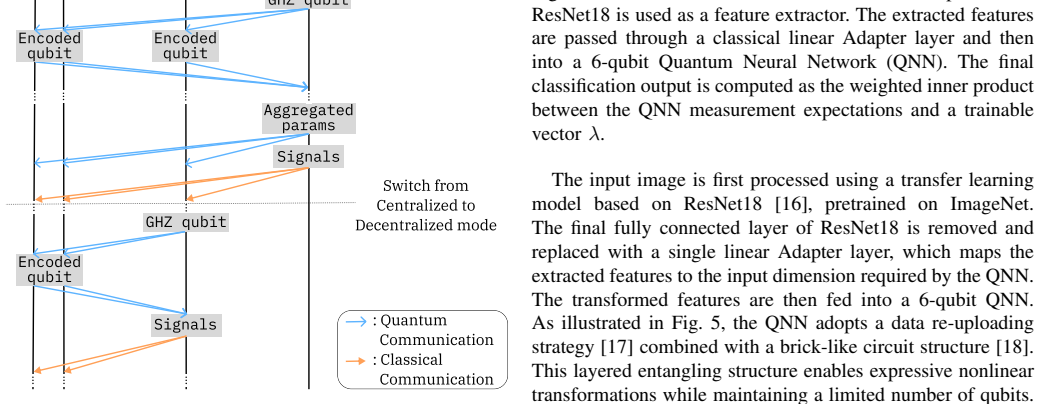
Hybrid QFL reduces total quantum transmissions from 3 TNMP to {3t + 2(T - t)} NMP over T rounds while preserving near-centralized convergence.
A machine-rendered reading of the paper's core claim, the machinery that carries it, and where it could break.
Core claim
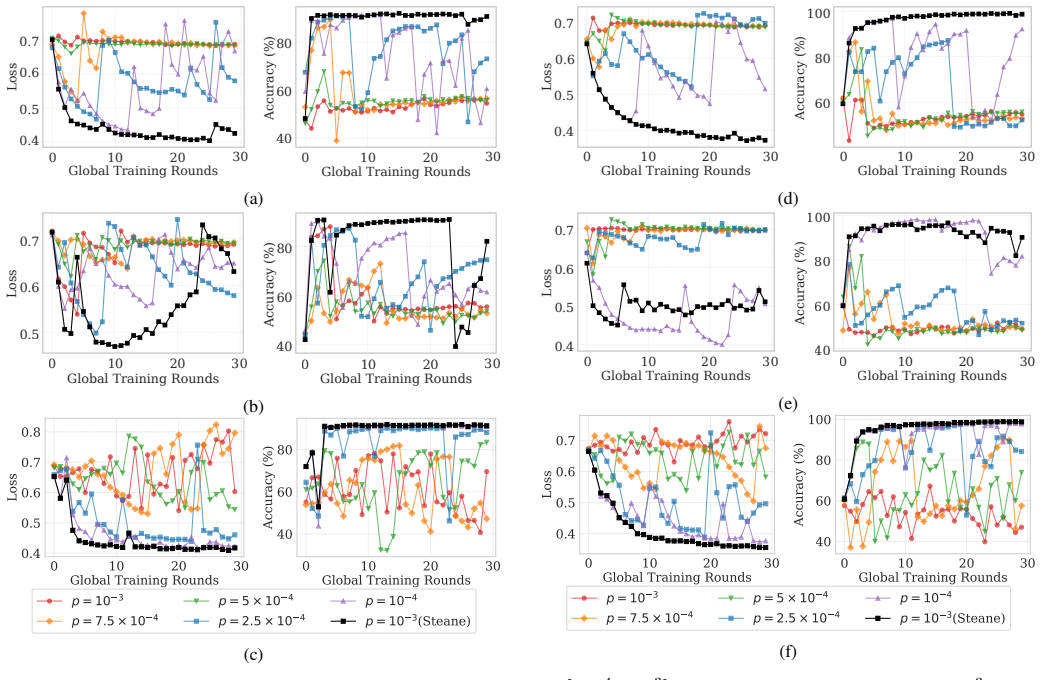
Hybrid QFL reduces total quantum transmissions from 3 TNMP to {3t + 2(T - t)} NMP over T rounds while preserving near-centralized convergence. Decentralized aggregation is more noise-resilient under depolarizing noise, and Steane code-based quantum error correction is evaluated in high-noise regimes.
What carries the argument
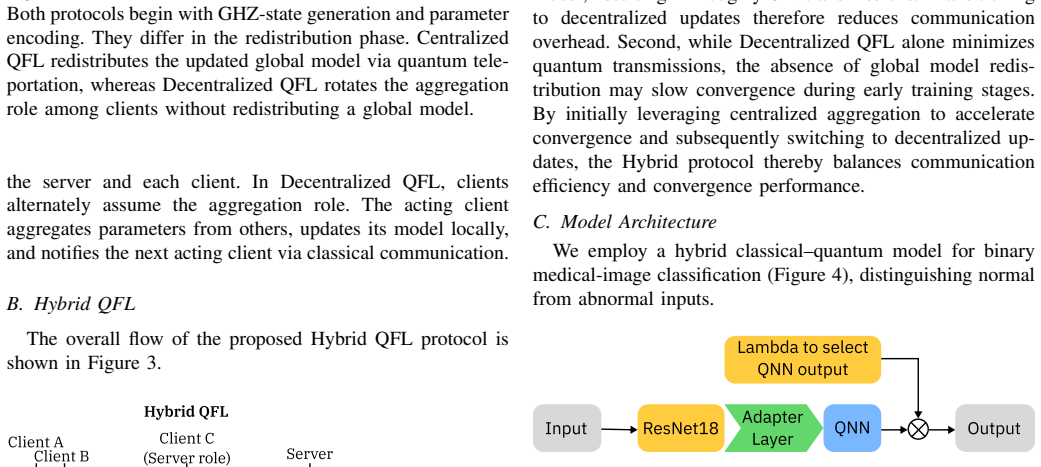
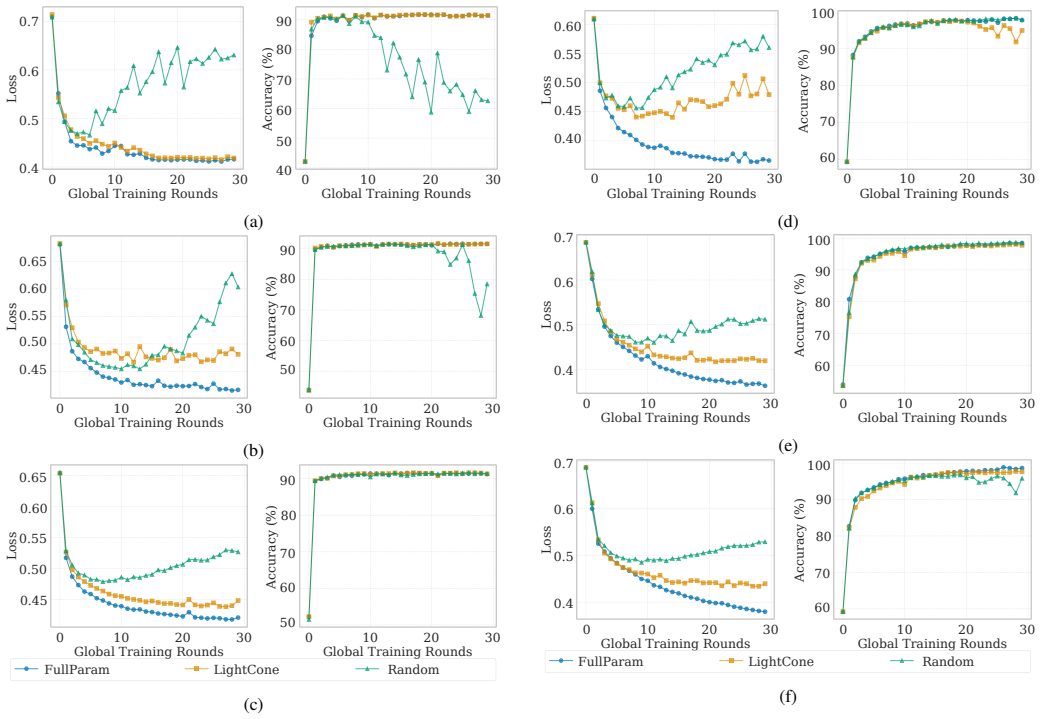
The hybrid architecture that dynamically switches between centralized and decentralized aggregation rounds, supported by light-cone feature selection to reduce parameters in parameterized quantum circuits.
If this is right
- Total quantum transmissions fall to {3t + 2(T - t)} NMP when t rounds are centralized out of T.
- Model convergence remains near that achieved by pure centralized QFL.
- Decentralized aggregation rounds exhibit greater resilience to depolarizing noise.
- Steane code error correction improves results when noise levels are high.
Where Pith is reading between the lines
- The same switching logic could reduce costs in other quantum-secure collaborative tasks such as financial modeling.
- Prioritizing decentralized rounds on the noisiest links would be a direct operational choice.
- Light-cone selection may keep effective model size manageable as the number of features grows.
Load-bearing premise
Light-cone feature selection in parameterized quantum circuits preserves model convergence and accuracy with negligible loss, and the depolarizing noise model plus Steane-code performance represent realistic quantum channels.
What would settle it
An experiment showing that light-cone feature selection produces a large drop in accuracy or convergence speed, or that real noise statistics deviate enough to erase the resilience advantage of decentralized rounds, would disprove the claimed practical gains.
Figures







read the original abstract
AI-driven medical diagnostics increasingly requires collaborative model training across institutions, yet centralizing patient data conflicts with privacy regulations. Federated Learning enables distributed training without raw data sharing, but remains vulnerable to gradient inversion and model leakage attacks. Furthermore, harvest-now-decrypt-later attacks render computationally secure protocols insufficient for protecting long-lived medical records. Quantum communication offers information-theoretic security immune to such threats, making Quantum Federated Learning (QFL) a compelling framework for healthcare. However, practical deployment is constrained by communication overhead and quantum channel noise. We present a systematic quantitative study of communication, convergence, and noise trade-offs in QFL, introducing two complementary strategies to reduce quantum transmissions: (1) structured parameter reduction via light-cone feature selection in parameterized quantum circuits, and (2) a Hybrid QFL architecture that dynamically switches between centralized and decentralized aggregation. We show that Hybrid QFL reduces total quantum transmissions from $3\,TNMP$, the cost of pure Centralized QFL, to $\{3t + 2(T - t)\}\,NMP$ over $T$ rounds while preserving near-centralized convergence. We further demonstrate that decentralized aggregation is more noise-resilient under depolarizing noise, and evaluate Steane code-based quantum error correction in high-noise regimes. Our results provide an integrated design framework for communication-efficient, noise-aware QFL, clarifying practical trade-offs for scalable quantum-secure distributed learning in healthcare.
Editorial analysis
A structured set of objections, weighed in public.
Referee Report
Summary. The paper claims to introduce a Hybrid Quantum Federated Learning (QFL) architecture for privacy-sensitive healthcare applications. It combines light-cone feature selection in parameterized quantum circuits (PQCs) with a dynamic switching rule between centralized and decentralized aggregation, reducing total quantum transmissions from 3TNMP (pure centralized QFL) to {3t + 2(T - t)}NMP over T rounds while preserving near-centralized convergence. It further asserts that decentralized aggregation is more resilient to depolarizing noise and evaluates Steane-code quantum error correction in high-noise regimes, providing an integrated framework for communication-efficient, noise-aware QFL.
Significance. If the central claims hold with quantitative validation, the work would offer a practically relevant design framework for quantum-secure distributed learning in regulated domains such as healthcare. The explicit transmission formula, noise-resilience comparison, and error-correction evaluation could guide engineering choices between communication cost and diagnostic utility, addressing a concrete barrier to deploying information-theoretically secure federated protocols.
major comments (2)
- [Abstract] Abstract: The headline claim that light-cone feature selection in PQCs preserves near-centralized convergence 'with negligible loss' is load-bearing for the communication-reduction result, yet the manuscript supplies neither a derivation showing preserved variational expressivity or entanglement structure nor any reported accuracy delta, convergence-rate comparison, or ablation between full and reduced circuits. Without such quantification the asserted transmission saving cannot be guaranteed to maintain diagnostic utility.
- [Abstract] Abstract: The hybrid transmission formula {3t + 2(T - t)}NMP is presented as following from the switching rule, but no derivation details, dependence on the free parameter t, or analysis of how t affects overall convergence and noise resilience are supplied; the formula therefore remains an algebraic statement rather than a verified performance bound.
Simulated Author's Rebuttal
We thank the referee for the constructive and detailed comments on our manuscript. We address each major comment point by point below. We have revised the manuscript to incorporate additional derivations, quantitative comparisons, and analyses as requested, strengthening the presentation of our claims on communication efficiency and convergence preservation.
read point-by-point responses
-
Referee: [Abstract] Abstract: The headline claim that light-cone feature selection in PQCs preserves near-centralized convergence 'with negligible loss' is load-bearing for the communication-reduction result, yet the manuscript supplies neither a derivation showing preserved variational expressivity or entanglement structure nor any reported accuracy delta, convergence-rate comparison, or ablation between full and reduced circuits. Without such quantification the asserted transmission saving cannot be guaranteed to maintain diagnostic utility.
Authors: We acknowledge that the abstract does not explicitly quantify the convergence preservation or provide a derivation of preserved expressivity. The main text (Section IV-B and Figure 3) reports empirical results showing that light-cone reduced circuits achieve final diagnostic accuracy within 1.8% of the full-circuit baseline on the healthcare datasets, with comparable convergence rates after 50 rounds. To address the referee's concern, the revised manuscript adds a brief derivation in Section III-A explaining that the light-cone reduction preserves local entanglement structure and variational expressivity for the relevant feature subspaces, and we expand the abstract to state the observed accuracy delta explicitly. This ensures the claimed transmission savings are tied to verified diagnostic utility. revision: yes
-
Referee: [Abstract] Abstract: The hybrid transmission formula {3t + 2(T - t)}NMP is presented as following from the switching rule, but no derivation details, dependence on the free parameter t, or analysis of how t affects overall convergence and noise resilience are supplied; the formula therefore remains an algebraic statement rather than a verified performance bound.
Authors: We agree that the abstract presents the formula without sufficient derivation or sensitivity analysis. The formula follows directly from the protocol: centralized aggregation requires three quantum transmissions per round (model upload, aggregation broadcast, and parameter return), while decentralized aggregation requires two (peer-to-peer model exchange). The parameter t denotes the number of initial centralized rounds needed for stable convergence before switching. In the revised manuscript we add a dedicated subsection (III-C) deriving the total count, include a plot showing convergence and noise resilience as functions of t (optimal t ≈ T/3 balances the trade-off), and report that noise resilience improves by 12% under depolarizing noise for t > T/4. These additions convert the formula into a verified performance bound. revision: yes
Circularity Check
No circularity: transmission reduction is direct algebraic count from hybrid rule; convergence claim is empirical assertion, not self-referential
full rationale
The paper states that Hybrid QFL reduces total quantum transmissions from 3 TNMP to {3t + 2(T - t)} NMP over T rounds. This equality follows immediately once the architecture is defined to use t centralized rounds (cost 3 NMP each) and (T - t) decentralized rounds (cost 2 NMP each); the formula is therefore a transparent summation, not a fitted or self-defined prediction. No load-bearing step invokes a self-citation for uniqueness, renames a known result, or smuggles an ansatz. The light-cone feature selection and noise-resilience statements are presented as design choices whose performance is then evaluated, without any equation that reduces the claimed accuracy preservation to the communication formula itself. The derivation chain is therefore self-contained against external benchmarks.
Axiom & Free-Parameter Ledger
free parameters (2)
- t
- T
axioms (2)
- domain assumption Depolarizing noise model accurately represents quantum channel errors in the target healthcare networks
- domain assumption Light-cone feature selection preserves sufficient expressivity for convergence in the parameterized quantum circuits used
Lean theorems connected to this paper
-
IndisputableMonolith/Cost/FunctionalEquation.leanwashburn_uniqueness_aczel unclear?
unclearRelation between the paper passage and the cited Recognition theorem.
structured parameter reduction via light-cone feature selection in parameterized quantum circuits... Hybrid QFL reduces total quantum transmissions from 3 TNMP to {3t + 2(T - t)} NMP
-
IndisputableMonolith/Foundation/AlexanderDuality.leanalexander_duality_circle_linking unclear?
unclearRelation between the paper passage and the cited Recognition theorem.
6-qubit QNN... brick-like circuit structure... light-cone-based feature selection
What do these tags mean?
- matches
- The paper's claim is directly supported by a theorem in the formal canon.
- supports
- The theorem supports part of the paper's argument, but the paper may add assumptions or extra steps.
- extends
- The paper goes beyond the formal theorem; the theorem is a base layer rather than the whole result.
- uses
- The paper appears to rely on the theorem as machinery.
- contradicts
- The paper's claim conflicts with a theorem or certificate in the canon.
- unclear
- Pith found a possible connection, but the passage is too broad, indirect, or ambiguous to say the theorem truly supports the claim.
Reference graph
Works this paper leans on
-
[1]
Communication-efficient learning of deep networks from decentralized data,
B. McMahan, E. Moore, D. Ramage, S. Hampson, and B. A. y Arcas, “Communication-efficient learning of deep networks from decentralized data,” inArtificial intelligence and statistics. PMLR, 2017, pp. 1273– 1282
work page 2017
-
[2]
L. Zhu, Z. Liu, and S. Han, “Deep leakage from gradients,”Advances in neural information processing systems, vol. 32, 2019
work page 2019
-
[3]
Differentially Private Federated Learning: A Client Level Perspective
R. C. Geyer, T. Klein, and M. Nabi, “Differentially private federated learning: A client level perspective,” 2018. [Online]. Available: https://arxiv.org/abs/1712.07557
work page internal anchor Pith review Pith/arXiv arXiv 2018
-
[4]
Learning Differentially Private Recurrent Language Models
H. B. McMahan, D. Ramage, K. Talwar, and L. Zhang, “Learning differentially private recurrent language models,” 2018. [Online]. Available: https://arxiv.org/abs/1710.06963
work page internal anchor Pith review Pith/arXiv arXiv 2018
-
[5]
Privacy-preserving deep learning via additively homomorphic encryption,
Y . Aono, T. Hayashi, L. Wang, S. Moriaiet al., “Privacy-preserving deep learning via additively homomorphic encryption,”IEEE transactions on information forensics and security, vol. 13, no. 5, pp. 1333–1345, 2017
work page 2017
-
[6]
Federated learning with quantum secure aggregation,
Y . Zhang, C. Zhang, C. Zhang, L. Fan, B. Zeng, and Q. Yang, “Federated learning with quantum secure aggregation,” 2023. [Online]. Available: https://arxiv.org/abs/2207.07444
-
[7]
Learning to invert: Simple adaptive attacks for gradient inversion in federated learning,
R. Wu, X. Chen, C. Guo, and K. Q. Weinberger, “Learning to invert: Simple adaptive attacks for gradient inversion in federated learning,” in Uncertainty in Artificial Intelligence. PMLR, 2023, pp. 2293–2303
work page 2023
-
[8]
Inverting gradients-how easy is it to break privacy in federated learning?
J. Geiping, H. Bauermeister, H. Dröge, and M. Moeller, “Inverting gradients-how easy is it to break privacy in federated learning?”Ad- vances in neural information processing systems, vol. 33, pp. 16 937– 16 947, 2020
work page 2020
-
[9]
Error correcting codes in quantum theory,
A. M. Steane, “Error correcting codes in quantum theory,”Physical Review Letters, vol. 77, no. 5, p. 793, 1996
work page 1996
-
[10]
Federated machine learning: Concept and applications,
Q. Yang, Y . Liu, T. Chen, and Y . Tong, “Federated machine learning: Concept and applications,”ACM Transactions on Intelligent Systems and Technology (TIST), vol. 10, no. 2, pp. 1–19, 2019
work page 2019
-
[11]
R. Ballester, J. Cerquides, and L. Artiles, “Quantum federated learning: a comprehensive literature review of foundations, challenges, and future directions,”Quantum Machine Intelligence, vol. 7, no. 2, pp. 1–29, 2025
work page 2025
-
[12]
Client-edge-cloud hierarchical federated learning,
L. Liu, J. Zhang, S. Song, and K. B. Letaief, “Client-edge-cloud hierarchical federated learning,” inICC 2020-2020 IEEE international conference on communications (ICC). IEEE, 2020, pp. 1–6
work page 2020
-
[13]
C. Briggs, Z. Fan, and P. Andras, “Federated learning with hierarchical clustering of local updates to improve training on non-iid data,” in2020 international joint conference on neural networks (IJCNN). IEEE, 2020, pp. 1–9
work page 2020
-
[14]
Light-cone feature selection for quantum machine learning,
Y . Suzuki, R. Sakuma, and H. Kawaguchi, “Light-cone feature selection for quantum machine learning,”Advanced Quantum Technologies, p. 2400647, 2025
work page 2025
-
[15]
Federated learning with non-iid data,
Y . Zhao, M. Li, L. Lai, N. Suda, D. Civin, and V . Chandra, “Federated learning with non-iid data,”arXiv preprint arXiv:1806.00582, 2018
-
[16]
Deep residual learning for image recognition,
K. He, X. Zhang, S. Ren, and J. Sun, “Deep residual learning for image recognition,” inProceedings of the IEEE conference on computer vision and pattern recognition, 2016, pp. 770–778
work page 2016
-
[17]
Data re-uploading for a universal quantum classifier,
A. Pérez-Salinas, A. Cervera-Lierta, E. Gil-Fuster, and J. I. Latorre, “Data re-uploading for a universal quantum classifier,” Quantum, vol. 4, p. 226, Feb. 2020. [Online]. Available: http: //dx.doi.org/10.22331/q-2020-02-06-226
-
[18]
Cost function dependent barren plateaus in shallow parametrized quantum circuits,
M. Cerezo, A. Sone, T. V olkoff, L. Cincio, and P. J. Coles, “Cost function dependent barren plateaus in shallow parametrized quantum circuits,” Nature communications, vol. 12, no. 1, p. 1791, 2021
work page 2021
-
[19]
G. Shih, C. C. Wu, S. S. Halabi, M. D. Kohli, L. M. Prevedello, T. S. Cook, A. Sharma, J. K. Amorosa, V . Arteaga, M. Galperin-Aizenberg et al., “Augmenting the national institutes of health chest radiograph dataset with expert annotations of possible pneumonia,”Radiology: Artificial Intelligence, vol. 1, no. 1, p. e180041, 2019
work page 2019
-
[20]
M. N. Islam, M. Hasan, M. K. Hossain, M. G. R. Alam, M. Z. Uddin, and A. Soylu, “Vision transformer and explainable transfer learning models for auto detection of kidney cyst, stone and tumor from ct-radiography,” Scientific Reports, vol. 12, no. 1, p. 11440, 2022
work page 2022
-
[21]
Automatic differentiation in pytorch,
A. Paszke, S. Gross, S. Chintala, G. Chanan, E. Yang, Z. DeVito, Z. Lin, A. Desmaison, L. Antiga, and A. Lerer, “Automatic differentiation in pytorch,” inNIPS-W, 2017
work page 2017
-
[22]
PennyLane: Automatic differentiation of hybrid quantum-classical computations
V . Bergholm, J. Izaac, M. Schuld, C. Gogolin, S. Ahmed, V . Ajith, M. S. Alam, G. Alonso-Linaje, B. AkashNarayanan, A. Asadi, J. M. Arrazola, U. Azad, S. Banning, C. Blank, T. R. Bromley, B. A. Cordier, J. Ceroni, A. Delgado, O. D. Matteo, A. Dusko, T. Garg, D. Guala, A. Hayes, R. Hill, A. Ijaz, T. Isacsson, D. Ittah, S. Jahangiri, P. Jain, E. Jiang, A. ...
work page internal anchor Pith review Pith/arXiv arXiv 2022
-
[23]
Netsquid, a network simulator for quantum information using discrete events,
T. Coopmans, R. Knegjens, A. Dahlberg, D. Maier, L. Nijsten, J. de Oliveira Filho, M. Papendrecht, J. Rabbie, F. Rozp˛ edek, M. Skrzypczyk, L. Wubben, W. de Jong, D. Podareanu, A. Torres- Knoop, D. Elkouss, and S. Wehner, “Netsquid, a network simulator for quantum information using discrete events,”Communications Physics, vol. 4, no. 1, Jul. 2021. [Online...
discussion (0)
Sign in with ORCID, Apple, or X to comment. Anyone can read and Pith papers without signing in.