Ab initio study of saddle-point excitons in monolayer SnS2
Pith reviewed 2026-05-15 16:29 UTC · model grok-4.3
The pith
Linearly polarized light lifts C3 symmetry among the three M points in monolayer SnS2, creating three independent excitonic states
A machine-rendered reading of the paper's core claim, the machinery that carries it, and where it could break.
Core claim
Using the GW approximation and the Bethe-Salpeter equation, the lowest single-particle transitions occur at the M point with a saddle-point topology in the valence bands. Resolving the exciton dipole moments in momentum space for different linear polarizations demonstrates that the light lifts the C3 rotational symmetry connecting the three inequivalent M points and generates three linearly independent excitonic states.
What carries the argument
The polarization-selective coupling of linearly polarized light to the three inequivalent M-point saddle-point excitons that lifts their C3 rotational symmetry
If this is right
- The three M-point excitons become addressable by choosing the direction of linear polarization.
- Anisotropy in the conduction bands at M shapes the excitonic wavefunctions and their dipole orientations.
- Polarization control provides a concrete route to state encoding schemes in valleytronics devices.
- Visible-range absorption in this photocatalyst becomes tunable by light polarization without changing photon energy.
Where Pith is reading between the lines
- The same symmetry-lifting mechanism could appear in other 2D hexagonal materials whose lowest gap sits at M-point saddle points.
- Polarization-dependent photocurrent or photoluminescence measurements could directly test the predicted independence of the three states in fabricated devices.
- If phonon coupling is weak, the effect should survive at room temperature; temperature-dependent spectra would check this.
Load-bearing premise
GW plus Bethe-Salpeter equation calculations without higher-order vertex corrections or phonon-assisted mixing accurately capture the bound excitons as independent under linear polarization.
What would settle it
An optical absorption measurement on monolayer SnS2 under linearly polarized light rotated through 120-degree increments that shows a single unchanging peak for the lowest exciton instead of three distinct intensity or energy patterns would refute the independence of the states.
Figures


read the original abstract
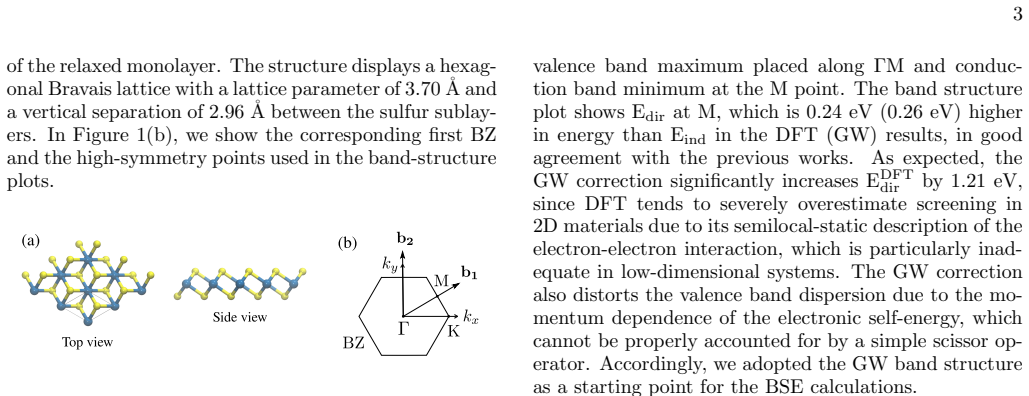
Monolayer SnS2 has emerged as a promising visible-light photocatalyst for photoelectrochemical applications, owing to its strong optical absorption in the visible range and excellent chemical stability. Despite its reduced dimensionality - where excitonic effects are expected to be pronounced - comprehensive theoretical investigations of bound excitons in this material remain scarce. Notably, unlike most two-dimensional hexagonal crystals, monolayer SnS2 exhibits its lowest single-particle transition at the M point of the Brillouin zone (BZ). Here, the electronic valence bands form a saddle point while conduction states display a minimum with pronounced anisotropy, creating a distinctive band topology whose impact on optical excitations has not yet been systematically explored. In this work, we present a first-principles study of bound excitons in monolayer SnS2 based on state-of-the-art many-body perturbation theory, employing the GW approximation and the Bethe-Salpeter equation (BSE). We analyze how band symmetry and anisotropy shape the excitonic wavefunctions and transition dipole moments. By resolving the exciton dipoles in momentum space for different linear light polarizations, we demonstrate that linearly polarized light lifts the C3 rotational symmetry relating the three inequivalent M points, giving rise to three linearly independent excitonic states. This polarization-selective coupling, previously identified for saddle points in graphene, is achieved in SnS2 for bound excitons and provides a potential route toward state encoding schemes in valleytronics applications.
Editorial analysis
A structured set of objections, weighed in public.
Referee Report
Summary. The manuscript reports a GW+BSE first-principles study of bound excitons in monolayer SnS2, where the lowest single-particle transitions occur at the M-point saddle points with anisotropic conduction bands. The central claim is that linearly polarized light lifts the C3 rotational symmetry among the three inequivalent M points, producing three linearly independent excitonic states whose transition dipoles are selectively coupled to individual valleys.
Significance. If the central claim holds, the work provides a concrete, parameter-free demonstration of polarization-selective valley addressing for bound excitons in a 2D material with saddle-point topology, extending prior graphene results to excitonic states relevant for valleytronics. The ab initio methodology with no fitted parameters in the exciton binding or dipoles is a clear strength.
major comments (1)
- [BSE results / excitonic wavefunctions] Section on BSE kernel and excitonic eigenstates (results subsection discussing momentum-resolved dipoles): the manuscript shows polarization selectivity via transition dipoles but does not report or bound the off-diagonal intervalley matrix elements of the direct and exchange kernels between states localized at inequivalent M points. On a discrete full-BZ k-grid these elements are in principle nonzero; if they hybridize the three M-point excitons, the claimed linear independence under linear polarization would not hold. Explicit values (or an upper bound) for these couplings in the bound-state subspace are required.
minor comments (2)
- [Abstract] The abstract states that the polarization-selective coupling 'provides a potential route toward state encoding schemes' but does not outline a concrete readout or manipulation protocol; a brief sentence on experimental implications would improve clarity.
- [Figures] Figure captions for the exciton wavefunction plots should explicitly label which M-point contribution dominates for each polarization direction to aid the reader.
Simulated Author's Rebuttal
We thank the referee for their careful reading of our manuscript and for the constructive comment, which helps clarify the robustness of our central claim. We address the point below and will revise the manuscript to incorporate the requested information.
read point-by-point responses
-
Referee: Section on BSE kernel and excitonic eigenstates (results subsection discussing momentum-resolved dipoles): the manuscript shows polarization selectivity via transition dipoles but does not report or bound the off-diagonal intervalley matrix elements of the direct and exchange kernels between states localized at inequivalent M points. On a discrete full-BZ k-grid these elements are in principle nonzero; if they hybridize the three M-point excitons, the claimed linear independence under linear polarization would not hold. Explicit values (or an upper bound) for these couplings in the bound-state subspace are required.
Authors: We agree that explicitly addressing the off-diagonal intervalley couplings is necessary to fully substantiate the linear independence of the three excitonic states. Our GW+BSE calculations are performed by diagonalizing the full Hamiltonian on a dense, symmetry-unfolded k-grid that includes all possible direct and exchange kernel matrix elements. In the revised manuscript we will report the magnitudes of the off-diagonal elements connecting the bound excitonic eigenstates localized at the three inequivalent M points. We will also provide a brief analysis showing that these couplings remain small compared with the polarization-induced energy splittings and the exciton binding energy, thereby confirming that hybridization does not invalidate the claimed linear independence under linearly polarized light. The new data will be added to the subsection on excitonic eigenstates and momentum-resolved dipoles. revision: yes
Circularity Check
No circularity: first-principles GW+BSE derivation is self-contained
full rationale
The paper performs a standard ab initio GW+BSE calculation on monolayer SnS2. The central result—that linearly polarized light lifts C3 symmetry among the three M-point excitons, producing three independent states—is obtained directly from the computed single-particle bands, the BSE Hamiltonian on a discrete k-grid, and the resulting eigenstates and dipole matrix elements. No parameters are fitted to the target excitonic quantities, no ansatz is smuggled via self-citation, and no prediction reduces by construction to an input. The symmetry-lifting effect emerges as an output of the momentum-resolved dipole analysis rather than being presupposed. The derivation chain therefore contains no load-bearing self-definitional or fitted-input steps.
Axiom & Free-Parameter Ledger
axioms (2)
- domain assumption GW approximation yields accurate quasiparticle band energies and wavefunctions for monolayer SnS2
- domain assumption Bethe-Salpeter equation with static screening captures the bound excitons at the M points
Lean theorems connected to this paper
-
IndisputableMonolith/Foundation/RealityFromDistinction.leanreality_from_one_distinction unclear?
unclearRelation between the paper passage and the cited Recognition theorem.
We present a first-principles study of bound excitons in monolayer SnS2 based on state-of-the-art many-body perturbation theory, employing the GW approximation and the Bethe-Salpeter equation (BSE).
What do these tags mean?
- matches
- The paper's claim is directly supported by a theorem in the formal canon.
- supports
- The theorem supports part of the paper's argument, but the paper may add assumptions or extra steps.
- extends
- The paper goes beyond the formal theorem; the theorem is a base layer rather than the whole result.
- uses
- The paper appears to rely on the theorem as machinery.
- contradicts
- The paper's claim conflicts with a theorem or certificate in the canon.
- unclear
- Pith found a possible connection, but the passage is too broad, indirect, or ambiguous to say the theorem truly supports the claim.
Reference graph
Works this paper leans on
-
[1]
R. Mas-Balleste, C. Gomez-Navarro, J. Gomez-Herrero, and F. Zamora, 2D materials: to graphene and beyond, Nanoscale3, 20 (2011)
work page 2011
-
[2]
M. Xu, T. Liang, M. Shi, and H. Chen, Graphene- like two-dimensional materials, Chem. Rev.113, 3766 (2013)
work page 2013
- [3]
-
[4]
J. R. Schaibley, H. Yu, G. Clark, P. Rivera, J. S. Ross, K. L. Seyler, W. Yao, and X. Xu, Valleytronics in 2D materials, Nat. Rev. Mat.1, 1 (2016)
work page 2016
-
[5]
S. Manzeli, D. Ovchinnikov, D. Pasquier, O. V. Yazyev, and A. Kis, 2D transition metal dichalcogenides, Nat. Rev. Mat.2, 1 (2017)
work page 2017
-
[6]
D. Liu, B. Qin, and L.-D. Zhao, SnSe/SnS: multifunc- tions beyond thermoelectricity, Materials Lab1, 220006 (2022)
work page 2022
-
[7]
Y. Sun, H. Cheng, S. Gao, Z. Sun, Q. Liu, Q. Liu, F. Lei, T. Yao, J. He, S. Wei, and Y. Xie, Freestanding tin disulfide single-layers realizing efficient visible-light wa- ter splitting, Angew. Chem. Int. Ed.51, 8727 (2012)
work page 2012
-
[8]
A. S. Sarkar, I. Konidakis, E. Gagaoudakis, G. M. Maragkakis, S. Psilodimitrakopoulos, D. Ka- terinopoulou, L. Sygellou, G. Deligeorgis, V. Binas, I. M. Oikonomou, P. Komninou, G. Kiriakidis, G. Kioseoglou, and E. Stratakis, Liquid phase iso- lation of SnS monolayers with enhanced optoelectronic properties, Adv. Sci.10, 2201842 (2023)
work page 2023
-
[9]
P. Sutter and E. Sutter, Growth mechanisms of anisotropic layered group IV chalcogenides on van der Waals substrates for energy conversion applications, ACS Appl. Nano Mater.1, 3026 (2018)
work page 2018
- [10]
-
[11]
X. Hu, G. Song, W. Li, Y. Peng, L. Jiang, Y. Xue, Q. Liu, Z. Chen, and J. Hu, Phase-controlled synthesis and pho- tocatalytic properties of SnS, SnS 2 and SnS/SnS 2 het- erostructure nanocrystals, Mater. Res. Bull.48, 2325 (2013)
work page 2013
-
[12]
M. Cao, K. Yao, C. Wu, J. Huang, W. Yang, L. Zhang, F. Lei, Y. Sun, L. Wang, and Y. Shen, Facile synthesis of SnS and SnS2 nanosheets for FTO/SnS/SnS2/Pt pho- tocathode, ACS Appl. Energy Mater.1, 6497 (2018)
work page 2018
- [13]
-
[14]
P. Sutter, H.-P. Komsa, K. Kisslinger, and E. Sutter, Lat- eral Integration of SnS and GeSe van der Waals Semicon- ductors: Interface formation, electronic structure, and nanoscale optoelectronics, ACS Nano17, 9552 (2023)
work page 2023
-
[15]
Y. Huang, E. Sutter, J. T. Sadowski, M. Cotlet, O. L. A. Monti, D. A. Racke, M. R. Neupane, D. Wickramaratne, R. K. Lake, B. A. Parkinson, and P. Sutter, Tin Disulfide – An Emerging Layered Metal Dichalcogenide Semicon- ductor: Materials Properties and Device Characteristics, ACS Nano8, 10743 (2014)
work page 2014
- [16]
-
[17]
H. Wang and X. Qian, Giant optical second har- monic generation in two-dimensional multiferroics, Nano Lett.17, 5027 (2017)
work page 2017
- [18]
-
[19]
F. Wu, F. Qu, and A. H. MacDonald, Exciton band struc- ture of monolayer MoS2, Phys. Rev. B91, 075310 (2015)
work page 2015
- [20]
-
[21]
H. L. Zhuang and R. G. Hennig, Theoretical perspec- tive of photocatalytic properties of single-layer SnS 2, Phys. Rev. B88, 115314 (2013)
work page 2013
-
[22]
B. Li, T. Xing, M. Zhong, L. Huang, N. Lei, J. Zhang, J. Li, and Z. Wei, A two-dimensional Fe-doped SnS2 mag- netic semiconductor, Nat. Commun.8, 1958 (2017)
work page 1958
-
[23]
C. N. Eads, D. Bandak, M. R. Neupane, D. Nordlund, and O. L. Monti, Anisotropic attosecond charge carrier dynamics and layer decoupling in quasi-2D layered SnS2, Nat. Commun.8, 1369 (2017)
work page 2017
-
[24]
C. Bacaksiz, S. Cahangirov, A. Rubio, R. T. Senger, F. M. Peeters, and H. Sahin, BilayerSnS 2: tunable stacking sequence by charging and loading pressure, Phys. Rev. B93, 125403 (2016)
work page 2016
-
[25]
J. M. Gonzalez and I. I. Oleynik, Layer-dependent prop- erties of SnS 2 and SnSe 2 two-dimensional materials, Phys. Rev. B94, 125443 (2016)
work page 2016
-
[26]
H. Avetissian, S. Israelyan, H. Matevosyan, and G. Mkrtchian, Saddle-point exciton signature on high- order harmonic generation in two-dimensional hexagonal nanostructures, Phys. Rev. A105, 063504 (2022)
work page 2022
- [27]
-
[28]
P. Nualpijit and B. Soodchomshom, Strain-tuned optical properties of a two-dimensional hexagonal lattice: Ex- ploiting saddle degrees of freedom and saddle filtering effects (2025), arXiv:2509.18539 [cond-mat.mes-hall]
work page internal anchor Pith review Pith/arXiv arXiv 2025
-
[29]
K. L. Seyler, G. Soavi, B. Weber, S. Das, A. Agar- wal, I. Paradisanos, M. M. Glazov, O. Dogadov, F. Gucci, G. Cerullo, S. D. Conte, S. Biswas, J. Wil- helm, I. ˇZuti´ c, K. S. Denisov, T. Zhou, H. Zheng, W. Yao, H. Yu, T. Cao, D. Waters, M. Yankowitz, G. Burkard, A. Denisov, T. Ihn, K. Ensslin, L. Gaudreau, J. Boddison-Chouinard, Z. Fedorova, I. Staude, ...
-
[30]
D. Sangalli, A. Ferretti, H. Miranda, C. Attaccalite, I. Marri, E. Cannuccia, P. Melo, M. Marsili, F. Paleari, A. Marrazzo, G. Prandini, P. Bonfa, M. O. Atambo, F. Affinito, M. Palummo, A. Molina-Sanchez, C. Hogan, M. Gruning, D. Varsano, and A. Marini, Many-body perturbation theory calculations using the yambo code, J. Phys. Condens. Matter.31, 325902 (2019)
work page 2019
- [31]
-
[32]
G. Strinati, Application of the green’s functions method to the study of the optical properties of semiconductors, Riv. Nuovo Cimento11, 1 (1988)
work page 1988
-
[33]
R. M. Martin, L. Reining, and D. M. Ceperley,Inter- acting Electrons: Theory and Computational Approaches (Cambridge University Press, 2016)
work page 2016
-
[34]
P. Cudazzo, I. V. Tokatly, and A. Rubio, Dielectric screening in two-dimensional insulators: Implications for excitonic and impurity states in graphane, Phys. Rev. B 84, 085406 (2011)
work page 2011
-
[35]
P. Cudazzo, Separation between the long- and short- range part of the coulomb interaction in low-dimensional systems: Implications for the macroscopic screening length and collective charge excitations, Phys. Rev. B 111, 195122 (2025)
work page 2025
-
[36]
M. Palummo, M. Bernardi, and J. C. Grossman, Exciton radiative lifetimes in two-dimensional transition metal dichalcogenides, Nano Lett.15, 2794 (2015)
work page 2015
-
[37]
H.-Y. Chen, V. A. Jhalani, M. Palummo, and M. Bernardi, Ab initio calculations of exciton radiative lifetimes in bulk crystals, nanostructures, and molecules, Phys. Rev. B100, 075135 (2019)
work page 2019
-
[38]
P. Giannozzi, S. Baroni, N. Bonini, M. Calandra, R. Car, C. Cavazzoni, D. Ceresoli, G. L. Chiarotti, M. Cococ- cioni, I. Dabo, A. Dal Corso, S. de Gironcoli, S. Fabris, G. Fratesi, R. Gebauer, U. Gerstmann, C. Gougoussis, A. Kokalj, M. Lazzeri, L. Martin-Samos, N. Marzari, F. Mauri, R. Mazzarello, S. Paolini, A. Pasquarello, L. Paulatto, C. Sbraccia, S. S...
work page 2009
-
[39]
P. Giannozzi, O. Andreussi, T. Brumme, O. Bunau, M. B. Nardelli, M. Calandra, R. Car, C. Cavazzoni, D. Ceresoli, M. Cococcioni, N. Colonna, I. Carnimeo, A. Dal Corso, S. de Gironcoli, P. Delugas, R. A. DiS- tasio, Jr., A. Ferretti, A. Floris, G. Fratesi, G. Fugallo, R. Gebauer, U. Gerstmann, F. Giustino, T. Gorni, J. Jia, M. Kawamura, H.-Y. Ko, A. Kokalj,...
work page 2017
-
[40]
J. P. Perdew, K. Burke, and M. Ernzerhof, Gen- eralized Gradient Approximation made simple, Phys. Rev. Lett.77, 3865 (1996)
work page 1996
- [41]
-
[42]
D. R. Hamann, Optimized norm-conserving Vanderbilt pseudopotentials, Phys. Rev. B88, 085117 (2013)
work page 2013
-
[43]
M. Schlipf and F. Gygi, Optimization algorithm for the generation of ONCV pseudopotentials, Com- put. Phys. Commun.196, 36 (2015)
work page 2015
-
[44]
A. Guandalini, D. A. Leon, P. D’Amico, C. Cardoso, A. Ferretti, M. Rontani, and D. Varsano, Efficient GW calculations via interpolation of the screened interac- tion in momentum and frequency space: The case of graphene, Phys. Rev. B109, 075120 (2024)
work page 2024
-
[45]
M. Ø. Filsø, E. Eikeland, J. Zhang, S. R. Madsen, and B. B. Iversen, Atomic and electronic structure transfor- mations in SnS 2 at high pressures: a joint single crystal X-ray diffraction and DFT study, Dalton Trans.45, 3798 (2016)
work page 2016
-
[46]
J. Yu, E. van Veen, M. I. Katsnelson, and S. Yuan, Ef- fective lattice Hamiltonian for monolayer tin disulfide: Tailoring electronic structure with electric and magnetic fields, Phys. Rev. B97, 245410 (2018)
work page 2018
-
[47]
M. Nalabothula, D. Sangalli, F. Paleari, S. Re- ichardt, and L. Wirtz, Symmetries of excitons (2025), arXiv:2511.21540 [cond-mat.mes-hall]
work page internal anchor Pith review Pith/arXiv arXiv 2025
-
[48]
F. Paleari, A. Molina-S´ anchez, M. Nalabothula, R. Reho, M. Bonacci, J. M. Castelo, J. Cervantes-Villanueva, M. Pionteck, M. Silvetti, C. Attaccalite, and H. Pereira Coutada Miranda, Yambopy (2025)
work page 2025
-
[49]
Y. Park, Y. Kim, C. W. Myung, R. A. Taylor, C. C. S. Chan, B. P. L. Reid, T. J. Puchtler, R. J. Nicholas, L. T. Singh, G. Lee, C.-C. Hwang, C.-Y. Park, and K. S. Kim, Two-dimensional excitonic photoluminescence in graphene on a Cu surface, ACS Nano11, 3207 (2017)
work page 2017
-
[50]
Y. Park, G. Ying, R. A. Taylor, and C. C. Hwang, Ex- citon dynamics in monolayer graphene grown on a Cu (111) surface, npj 2D Mater. Appl.5, 69 (2021)
work page 2021
discussion (0)
Sign in with ORCID, Apple, or X to comment. Anyone can read and Pith papers without signing in.