Recognition: 2 theorem links
· Lean TheoremEmergent inflation in fractional cosmology
Pith reviewed 2026-05-15 16:16 UTC · model grok-4.3
The pith
A fractional potential in generalized cosmology lets inflation emerge dynamically from a non-singular pre-inflationary phase as a stable attractor without any external scalar field.
A machine-rendered reading of the paper's core claim, the machinery that carries it, and where it could break.
Core claim
Within the emergent fractional cosmological framework rooted in generalized measures, a suitably chosen fractional potential produces non-singular pre-inflationary evolution; inflation then arises dynamically without an external scalar field, functions as a stable attractor with plateau-like behavior, yields an alpha-dependent e-fold count consistent with observations, solves the horizon problem, and permits a graceful exit into radiation domination with standard time dependence but alpha-dependent normalization.
What carries the argument
The fractional potential constructed inside the generalized measure framework, which supplies the dynamical mechanism that turns inflation into a stable attractor.
If this is right
- Inflation ends at a definite time set by the dynamics and hands over to radiation domination with standard time scaling.
- The total number of e-folds is fixed by the value of the fractional parameter alpha.
- The horizon problem is solved because the pre-inflationary phase plus the attractor behavior stretches causal regions sufficiently.
- The radiation era that follows has the usual a proportional to t to the 1/2 scaling but carries an alpha-dependent prefactor.
Where Pith is reading between the lines
- If the fractional parameter alpha can be linked to measurable late-time quantities, the model might predict new relations between early-universe observables and present-day cosmology.
- The same construction could be tested by checking whether the predicted exit from inflation produces the observed amplitude of primordial perturbations for a narrow range of alpha.
- Extending the framework to include spatial curvature or matter fields would show whether the non-singular start remains robust.
Load-bearing premise
A suitable fractional potential can be chosen inside the generalized measure framework so that inflation becomes a stable attractor whose e-fold count follows directly from the dynamics.
What would settle it
A concrete calculation or numerical integration showing that no choice of the fractional potential produces both a stable inflationary attractor and an alpha-dependent e-fold number that matches the observed horizon scale.
Figures
read the original abstract
In this paper, we investigate the evolution of the early universe within an emergent fractional cosmological framework. The underlying formulation is conceptually rooted in generalized measure constructions, closely related to fractal geometries and scale-dependent effective dimensions. By constructing a suitable fractional potential, we show that the cosmological evolution naturally originates from a non-singular pre-inflationary regime. Inflation arises dynamically without introducing an external scalar field and emerges as a stable attractor, exhibiting similarities with plateau-type inflationary scenarios. By analyzing the dynamical transition, we determine the end of inflation and establish a meaningful relation between the number of e-folds and the fractional parameter $\alpha$, ensuring consistency with observations and addressing the horizon problem. Moreover, the model admits a graceful exit from inflation, followed by an exact radiation-dominated solution with the standard time dependence and an $\alpha$-dependent normalization.
Editorial analysis
A structured set of objections, weighed in public.
Referee Report
Summary. The paper explores emergent inflation within a fractional cosmological model based on generalized measure constructions related to fractal geometries. By constructing a suitable fractional potential, it claims that the cosmological evolution originates from a non-singular pre-inflationary regime, with inflation arising dynamically as a stable attractor without an external scalar field and exhibiting similarities to plateau-type scenarios. The work derives a relation between the number of e-folds and the fractional parameter α that addresses the horizon problem consistently with observations, and demonstrates a graceful exit to an exact radiation-dominated solution with standard time dependence but α-dependent normalization.
Significance. If the fractional potential follows from the generalized measure rather than being an ad-hoc choice, and if the attractor behavior and e-fold relation are derived directly from the dynamics, this could represent a meaningful alternative to standard scalar-field inflation by naturally incorporating non-singularity and graceful exit. The link to scale-dependent effective dimensions offers a potentially novel perspective on early-universe dynamics. The significance hinges on demonstrating that these features are not engineered into the potential but emerge from the framework.
major comments (2)
- [Section defining the fractional potential] In the section defining the fractional potential, the potential is introduced as 'constructed' to achieve the non-singular pre-inflationary regime and stable attractor behavior. The manuscript should explicitly show whether this specific form is uniquely fixed by the generalized measure (e.g., via the modified action or measure) or selected as an ansatz to produce the desired dynamics; without this, the claims of 'natural' emergence and 'dynamical' origin of inflation rest on a potentially circular construction.
- [Analysis of dynamical transition and e-folds] In the analysis of the dynamical transition and e-fold count, the relation between the number of e-folds and α is presented as following from the equations and ensuring observational consistency. It must be demonstrated that this relation is derived independently from the fractional dynamics rather than adjusted to fit the horizon-problem resolution; otherwise the central claim that inflation 'addresses the horizon problem' risks being an artifact of the potential choice.
minor comments (2)
- [Introduction] A short recap of the generalized measure framework and its relation to fractional derivatives would improve accessibility for readers outside the immediate subfield.
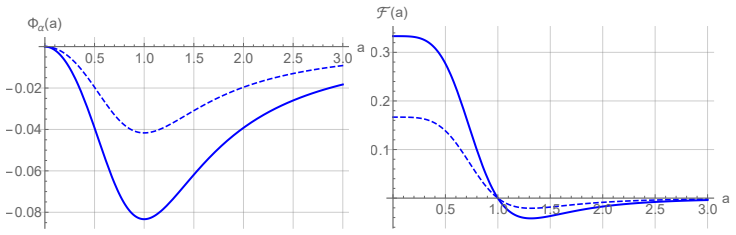
- [Figures and dynamical systems analysis] Phase-space plots and potential figures should explicitly indicate the range of α values shown and label the attractor fixed points for clarity.
Simulated Author's Rebuttal
We thank the referee for the careful review and valuable comments. We have carefully considered the points raised regarding the motivation of the fractional potential and the derivation of the e-fold relation. We provide point-by-point responses below and indicate the revisions we plan to make.
read point-by-point responses
-
Referee: In the section defining the fractional potential, the potential is introduced as 'constructed' to achieve the non-singular pre-inflationary regime and stable attractor behavior. The manuscript should explicitly show whether this specific form is uniquely fixed by the generalized measure (e.g., via the modified action or measure) or selected as an ansatz to produce the desired dynamics; without this, the claims of 'natural' emergence and 'dynamical' origin of inflation rest on a potentially circular construction.
Authors: The fractional potential is selected as an ansatz within the generalized measure framework to realize the desired non-singular pre-inflationary behavior and stable attractor. It is not claimed to be the unique form fixed by the measure, but rather a physically motivated choice consistent with the scale-dependent dimensions in fractional cosmology. In the revised manuscript, we will add a dedicated subsection explaining the rationale for this potential form, referencing how it aligns with the modified action and fractal geometry considerations. This will clarify that the emergence is dynamical once the potential is set, without circularity. revision: partial
-
Referee: In the analysis of the dynamical transition and e-fold count, the relation between the number of e-folds and α is presented as following from the equations and ensuring observational consistency. It must be demonstrated that this relation is derived independently from the fractional dynamics rather than adjusted to fit the horizon-problem resolution; otherwise the central claim that inflation 'addresses the horizon problem' risks being an artifact of the potential choice.
Authors: We agree that it is important to show the independence of the derivation. The relation N(α) is obtained by solving the fractional Friedmann equations and integrating the Hubble parameter over the inflationary epoch, as detailed in our dynamical analysis. The value of α is then chosen to yield sufficient e-folds (N > 60) to solve the horizon problem, which is a standard procedure in inflationary models. In the revision, we will include the explicit integral expression for N in terms of α and the potential parameters to demonstrate that it follows directly from the dynamics. This makes the addressing of the horizon problem a consequence of the model parameters rather than an ad hoc adjustment. revision: yes
Circularity Check
Suitable fractional potential constructed to enforce attractor and e-fold relation
specific steps
-
self definitional
[Abstract]
"By constructing a suitable fractional potential, we show that the cosmological evolution naturally originates from a non-singular pre-inflationary regime. Inflation arises dynamically without introducing an external scalar field and emerges as a stable attractor, exhibiting similarities with plateau-type inflationary scenarios. By analyzing the dynamical transition, we determine the end of inflation and establish a meaningful relation between the number of e-folds and the fractional parameter α, ensuring consistency with observations and addressing the horizon problem."
The potential is introduced as 'suitable' precisely to generate the non-singular regime, attractor behavior, and α–e-fold relation that 'ensures consistency with observations.' The claimed first-principles emergence therefore reduces to the input choice of potential form; the subsequent dynamical analysis and 'meaningful relation' are then computed from that same choice.
full rationale
The derivation begins by positing a generalized measure framework but then explicitly constructs a 'suitable' fractional potential chosen to produce non-singular pre-inflationary evolution, dynamic inflation as a stable attractor without external scalar, and an α-dependent e-fold count that matches observations. This makes the emergence and the e-fold–α relation artifacts of the potential choice rather than independent outputs of the measure equations. The graceful exit to radiation is shown after this choice, but the load-bearing step remains the tailored ansatz. No self-citation chain or external uniqueness theorem is invoked in the provided text, so circularity is partial rather than total.
Axiom & Free-Parameter Ledger
free parameters (1)
- fractional parameter α
axioms (1)
- domain assumption Generalized measure constructions closely related to fractal geometries and scale-dependent effective dimensions form the underlying formulation.
invented entities (1)
-
fractional potential
no independent evidence
Lean theorems connected to this paper
-
IndisputableMonolith/Cost/FunctionalEquation.leanwashburn_uniqueness_aczel contradicts?
contradictsCONTRADICTS: the theorem conflicts with this paper passage, or marks a claim that would need revision before publication.
By constructing a suitable fractional potential, we show that the cosmological evolution naturally originates from a non-singular pre-inflationary regime. Inflation arises dynamically without introducing an external scalar field and emerges as a stable attractor
-
IndisputableMonolith/Foundation/AlphaCoordinateFixation.leanalpha_pin_under_high_calibration contradicts?
contradictsCONTRADICTS: the theorem conflicts with this paper passage, or marks a claim that would need revision before publication.
the fractional parameter α ... |α-1| ≪ 1 ... N ≃ 50-60
What do these tags mean?
- matches
- The paper's claim is directly supported by a theorem in the formal canon.
- supports
- The theorem supports part of the paper's argument, but the paper may add assumptions or extra steps.
- extends
- The paper goes beyond the formal theorem; the theorem is a base layer rather than the whole result.
- uses
- The paper appears to rely on the theorem as machinery.
- contradicts
- The paper's claim conflicts with a theorem or certificate in the canon.
- unclear
- Pith found a possible connection, but the passage is too broad, indirect, or ambiguous to say the theorem truly supports the claim.
Forward citations
Cited by 1 Pith paper
-
Evolution of density perturbations in fractional cosmology
Fractional cosmology modifies density perturbation growth via parameter α, yielding a new upper bound α ≲ 1.07 from σ8 normalization and Sachs-Wolfe constraints.
Reference graph
Works this paper leans on
-
[1]
Alan H Guth. Inflationary universe: A possible solution to the horizon and flatness prob- lems.Physical Review D, 23(2):347, 1981
work page 1981
-
[2]
The inflationary universe.Scientific American, 250(5): 116–129, 1984
Alan H Guth and Paul J Steinhardt. The inflationary universe.Scientific American, 250(5): 116–129, 1984
work page 1984
-
[3]
Alexander Vilenkin. Classical and quantum cosmology of the starobinsky inflationary model.Physical Review D, 32(10):2511, 1985
work page 1985
-
[4]
Hybrid inflation.Physical Review D, 49(2):748, 1994
Andrei Linde. Hybrid inflation.Physical Review D, 49(2):748, 1994
work page 1994
-
[5]
Christian Armendariz-Picon, Thibault Damour, and VF1999PhLB Mukhanov. k-inflation. Physics Letters B, 458(2-3):209–218, 1999
work page 1999
-
[6]
Inflation and eternal inflation.Physics Reports, 333:555–574, 2000
Alan H Guth. Inflation and eternal inflation.Physics Reports, 333:555–574, 2000
work page 2000
-
[7]
Inflationary cosmology.Physica Scripta, 2000(T85):168–176, 2000
Andrei Linde. Inflationary cosmology.Physica Scripta, 2000(T85):168–176, 2000
work page 2000
-
[8]
Katherine Freese and William H Kinney. On natural inflation.Physical Review D—Particles, Fields, Gravitation, and Cosmology, 70(8):083512, 2004
work page 2004
-
[9]
Renata Kallosh and Andrei Linde. New models of chaotic inflation in supergravity.journal of Cosmology and Astroparticle Physics, 2010(11):011–011, 2010
work page 2010
-
[10]
Inflation and fractional quantum cosmology.Fractal and Fractional, 6(11): 655, 2022
Seyed Meraj Mousavi Rasouli, Emanuel W de Oliveira Costa, Paulo Moniz, and Shahram Jalalzadeh. Inflation and fractional quantum cosmology.Fractal and Fractional, 6(11): 655, 2022
work page 2022
-
[11]
Encyclopædia inflationaris: Opi- parous edition.Physics of the Dark Universe, 46:101653, 2024
Jerome Martin, Christophe Ringeval, and Vincent Vennin. Encyclopædia inflationaris: Opi- parous edition.Physics of the Dark Universe, 46:101653, 2024
work page 2024
-
[12]
Andrei D Linde. A new inflationary universe scenario: a possible solution of the horizon, flatness, homogeneity, isotropy and primordial monopole problems.Physics Letters B, 108 (6):389–393, 1982
work page 1982
-
[13]
Andrei Linde. Eternal extended inflation and graceful exit from old inflation without jordan- brans-dicke.Physics Letters B, 249(1):18–26, 1990
work page 1990
-
[14]
SMM Rasouli, Mehrdad Farhoudi, and Nima Khosravi. Horizon problem remediation via deformed phase space.General Relativity and Gravitation, 43(10):2895–2910, 2011
work page 2011
-
[15]
About jordan and einstein frames: a study in inflationary magnetogenesis.Universe, 10(9):350, 2024
Joel Velásquez, Héctor J Hortua, and Leonardo Castañeda. About jordan and einstein frames: a study in inflationary magnetogenesis.Universe, 10(9):350, 2024
work page 2024
-
[16]
Slava Mukhanov. Cosmological perturbations from inflation.Journal of Physics A: Math- ematical and Theoretical, 40(25):6561–6572, 2007
work page 2007
-
[17]
Seoktae Koh and Robert H Brandenberger. Evolution of gravitational perturbations in non- commutative inflation.Journal of Cosmology and Astroparticle Physics, 2007(11):013– 013, 2007. 20
work page 2007
-
[18]
Daniel Baumann. Tasi lectures on inflation.arXiv preprint arXiv:0907.5424, 2009
work page internal anchor Pith review Pith/arXiv arXiv 2009
-
[19]
Inflation and cosmological perturbations
David Langlois. Inflation and cosmological perturbations. InLectures on Cosmology: Accelerated Expansion of the Universe, pages 1–57. Springer, 2010
work page 2010
-
[20]
Robert H. Brandenberger. Principles, progress and problems in inflationary cosmology. AAPPS Bull., 11:20–29, 2001
work page 2001
-
[21]
Inflationary paradigm in trouble after planck2013.Physics Letters B, 723(4-5):261–266, 2013
Anna Ijjas, Paul J Steinhardt, and Abraham Loeb. Inflationary paradigm in trouble after planck2013.Physics Letters B, 723(4-5):261–266, 2013
work page 2013
-
[22]
Gravity-Driven Acceleration and Kinetic Inflation in Noncommutative Brans-Dicke Setting
SMM Rasouli and Paulo Vargas Moniz. Gravity-driven acceleration and kinetic inflation in noncommutative brans-dicke setting.arXiv preprint arXiv:1611.00085, 2016
work page internal anchor Pith review Pith/arXiv arXiv 2016
-
[23]
SMM Rasouli and João Marto. Phase space noncommutativity, power-law inflation and quantum cosmology.Chaos, Solitons&Fractals, 187:115349, 2024
work page 2024
-
[24]
Seyed Meraj Mousavi Rasouli, João Marto, and P Vargas Moniz. Kinetic inflation in de- formed phase space brans–dicke cosmology.Physics of the Dark Universe, 24:100269, 2019
work page 2019
-
[25]
Saeed Noori Gashti, Mohammad Reza Alipour, Mohammad Ali S Afshar, and Jafar Sadeghi. Noncommutativity and its role in constant-roll inflation models with non-minimal coupling constrained by swampland conjectures.Chinese Physics C, 49(2):025108, 2025
work page 2025
-
[26]
Chaotic inflation.Physics Letters B, 129(3-4):177–181, 1983
Andrei D Linde. Chaotic inflation.Physics Letters B, 129(3-4):177–181, 1983
work page 1983
-
[27]
Cosmology of the very early universe
Robert H Brandenberger. Cosmology of the very early universe. InAIP conference pro- ceedings, volume 1268, pages 3–70. American Institute of Physics, 2010
work page 2010
-
[28]
Arvind Borde, Alan H Guth, and Alexander Vilenkin. Inflationary spacetimes are incom- plete in past directions.Physical review letters, 90(15):151301, 2003
work page 2003
-
[29]
PD Meerburg, Planck Collaboration, et al. Planck 2018 results. x. constraints on inflation. Astronomy&Astrophysics, 641:A10, 2020
work page 2018
-
[30]
A new type of isotropic cosmological models without singularity
Alexei A Starobinsky. A new type of isotropic cosmological models without singularity. Physics Letters B, 91(1):99–102, 1980
work page 1980
-
[31]
Nonlocal cosmology.Physical Review Letters, 99 (11):111301, 2007
Stanley Deser and Richard P Woodard. Nonlocal cosmology.Physical Review Letters, 99 (11):111301, 2007
work page 2007
-
[32]
The effective field theory of inflation.Journal of High Energy Physics, 2008(03): 014–014, 2008
Clifford Cheung, A Liam Fitzpatrick, Jared Kaplan, Leonardo Senatore, and Paolo Crem- inelli. The effective field theory of inflation.Journal of High Energy Physics, 2008(03): 014–014, 2008
work page 2008
-
[33]
Introduction to multifractional spacetimes
Gianluca Calcagni. Introduction to multifractional spacetimes. InAIP Conference Pro- ceedings, volume 1483, pages 31–53. American Institute of Physics, 2012
work page 2012
-
[34]
Gianluca Calcagni. Classical and quantum gravity with fractional operators.Classical and Quantum Gravity, 38(16):165005, 2021. 21
work page 2021
-
[35]
Constant-roll inflation in f (r) gravity.Classical and Quantum Gravity, 34(24):245012, 2017
S Nojiri, SD Odintsov, and VK Oikonomou. Constant-roll inflation in f (r) gravity.Classical and Quantum Gravity, 34(24):245012, 2017
work page 2017
-
[36]
Fractional einstein–hilbert action cosmology.Modern Physics Letters A, 28(14):1350056, 2013
VK Shchigolev. Fractional einstein–hilbert action cosmology.Modern Physics Letters A, 28(14):1350056, 2013
work page 2013
-
[37]
SMM Rasouli, S Jalalzadeh, and PV Moniz. Broadening quantum cosmology with a frac- tional whirl.Modern Physics Letters A, 36(14):2140005, 2021
work page 2021
-
[38]
Esteban González, Genly Leon, and Guillermo Fernandez-Anaya. Exact solutions and cosmological constraints in fractional cosmology.Fractal and Fractional, 7(5):368, 2023
work page 2023
-
[39]
Quantum fractionary cosmology: K-essence theory.Uni- verse, 9(4):185, 2023
J Socorro and J Juan Rosales. Quantum fractionary cosmology: K-essence theory.Uni- verse, 9(4):185, 2023
work page 2023
-
[40]
Modified friedmann equations from frac- tional entropy.Europhysics Letters, 143(5):59001, 2023
Zeynep Çoker, Özgür Ökcü, and Ekrem Aydiner. Modified friedmann equations from frac- tional entropy.Europhysics Letters, 143(5):59001, 2023
work page 2023
-
[41]
Quantum tunneling from family of cantor potentials in fractional quantum mechanics
Vibhav Narayan Singh, Mohammad Umar, Mohammad Hasan, and Bhabani Prasad Man- dal. Quantum tunneling from family of cantor potentials in fractional quantum mechanics. Annals of Physics, 450:169236, 2023
work page 2023
-
[42]
Rami Ahmad El-Nabulsi and Waranont Anukool. Constraining the fractal chern–simons modified gravity with astronomical observations and estimation of the fractal dimension of the universe.The European Physical Journal Plus, 139(4):342, 2024
work page 2024
-
[43]
Friedmann equations of the fractal apparent horizon.Physics of the Dark Universe, 44:101498, 2024
R Jalalzadeh, S Jalalzadeh, A Sayahian Jahromi, and H Moradpour. Friedmann equations of the fractal apparent horizon.Physics of the Dark Universe, 44:101498, 2024
work page 2024
-
[44]
DL Canedo, P Moniz, and G Oliveira-Neto. Quantum creation of a frw universe: applying the riesz fractional derivative.arXiv preprint arXiv:2503.15348, 2025
-
[45]
Miguel A García-Aspeitia, Guillermo Fernandez-Anaya, A Hernández-Almada, Genly Leon, and Juan Magaña. Cosmology under the fractional calculus approach.Monthly Notices of the Royal Astronomical Society, 517(4):4813–4826, 2022
work page 2022
-
[46]
Revisiting fractional cosmology.Fractal and Fractional, 7(2):149, 2023
Bayron Micolta-Riascos, Alfredo D Millano, Genly Leon, Cristián Erices, and Andronikos Paliathanasis. Revisiting fractional cosmology.Fractal and Fractional, 7(2):149, 2023
work page 2023
-
[47]
Dark matter in fractional gravity
Francesco Benetti, Andrea Lapi, Giovanni Gandolfi, Paolo Salucci, and Luigi Danese. Dark matter in fractional gravity. i. astrophysical tests on galactic scales.The Astrophysical Journal, 949(2):65, 2023
work page 2023
-
[48]
Fractional einstein field equa- tions in 2+1 dimensional spacetime: E
Ernesto Contreras, Antonio Di Teodoro, and Miguel Mena. Fractional einstein field equa- tions in 2+1 dimensional spacetime: E. contreras et al.General Relativity and Gravitation, 57(5):85, 2025
work page 2025
-
[49]
Estimated age of the universe in fractional cosmology.Fractal and Fractional, 7(12):854, 2023
Emanuel Wallison de Oliveira Costa, Raheleh Jalalzadeh, Pedro Felix da Silva Júnior, Seyed Meraj Mousavi Rasouli, and Shahram Jalalzadeh. Estimated age of the universe in fractional cosmology.Fractal and Fractional, 7(12):854, 2023. 22
work page 2023
-
[50]
SMM Rasouli, J Marto, D Oliveira, and P Moniz. Gravitational foundations and exact solutions inn–dimensional fractional cosmology.arXiv preprint arXiv:2512.11583, 2025
-
[51]
Bayron Micolta-Riascos, Byron Droguett, Gisel Mattar Marriaga, Genly Leon, Andronikos Paliathanasis, Luis del Campo, and Yoelsy Leyva. Fractional time-delayed differential equations: Applications in cosmological studies.Fractal and Fractional, 9(5):318, 2025
work page 2025
-
[52]
VK Shchigolev. Fractional-order derivatives in cosmological models of accelerated expan- sion.Modern Physics Letters A, 36(14):2130014, 2021
work page 2021
-
[53]
Fractional scalar field cosmology.Fractal and Fractional, 8(5):281, 2024
Seyed Meraj Mousavi Rasouli, Samira Cheraghchi, and Paulo Moniz. Fractional scalar field cosmology.Fractal and Fractional, 8(5):281, 2024
work page 2024
-
[54]
Emergent $\Lambda$CDM cosmology from a measure-induced deformation of the Newtonian action
SMM Rasouli. Emergentλcdm cosmology from a fractional extension of newtonian grav- ity.arXiv preprint arXiv:2603.03113, 2026
work page internal anchor Pith review Pith/arXiv arXiv 2026
-
[55]
Fractal universe and quantum gravity.Physical review letters, 104(25): 251301, 2010
Gianluca Calcagni. Fractal universe and quantum gravity.Physical review letters, 104(25): 251301, 2010
work page 2010
-
[56]
Quantum field theory, gravity and cosmology in a fractal universe
Gianluca Calcagni. Quantum field theory, gravity and cosmology in a fractal universe. Journal of High Energy Physics, 2010(3):120, 2010
work page 2010
-
[57]
Renata Kallosh and Andrei Linde. Universality class in conformal inflation.Journal of Cosmology and Astroparticle Physics, 2013(07):002–002, 2013
work page 2013
-
[58]
Evolution of density perturbations in fractional cosmology
SMM Rasouli. Evolution of density perturbations in fractional newtonian cosmology.arXiv preprint arXiv:2603.07781, 2026
work page internal anchor Pith review Pith/arXiv arXiv 2026
-
[59]
A newtonian expanding universe.The Quarterly Journal of Mathematics, (1):64–72, 1934
Edward A Milne. A newtonian expanding universe.The Quarterly Journal of Mathematics, (1):64–72, 1934
work page 1934
-
[60]
William Hunter McCrea and Edward Arthur Milne. Newtonian universes and the curvature of space.The quarterly journal of mathematics, 1(1):73–80, 1934
work page 1934
-
[61]
Newtonian cosmology.Nature, 175(4454):466–466, 1955
WH McCrea. Newtonian cosmology.Nature, 175(4454):466–466, 1955
work page 1955
-
[62]
On the significance of newtonian cosmology.Astronomical Jour- nal, Vol
William Hunter McCrea. On the significance of newtonian cosmology.Astronomical Jour- nal, Vol. 60, p. 271, 60:271, 1955
work page 1955
-
[63]
Cosmology and newtonian mechanics.American Journal of Physics, 33(2):105–108, 1965
C Callan, RH Dicke, and PJE Peebles. Cosmology and newtonian mechanics.American Journal of Physics, 33(2):105–108, 1965
work page 1965
-
[64]
Thomas F Jordan. Cosmology calculations almost without general relativity.American journal of physics, 73(7):653–662, 2005
work page 2005
-
[65]
Discrete newtonian cosmology.Classical and Quantum Gravity, 31(2):025003, 2013
George FR Ellis and Gary W Gibbons. Discrete newtonian cosmology.Classical and Quantum Gravity, 31(2):025003, 2013
work page 2013
-
[66]
Frank J Tipler. Newtonian cosmology revisited.Monthly Notices of the Royal Astronomical Society, 282(1):206–210, 1996. 23
work page 1996
-
[67]
Turning a Newtonian analogy for FLRW cosmology into a relativistic problem.Phys
Valerio Faraoni and Farah Atieh. Turning a Newtonian analogy for FLRW cosmology into a relativistic problem.Phys. Rev. D, 102(4):044020, 2020. doi: 10.1103/PhysRevD.102. 044020
-
[68]
N. Aghanim et al. Planck 2018 results. VI. Cosmological parameters.Astron. Astrophys., 641:A6, 2020. doi: 10.1051/0004-6361/201833910. [Erratum: Astron.Astrophys. 652, C4 (2021)]
-
[69]
Unity of cosmological inflation attractors.Physical review letters, 114(14):141302, 2015
Mario Galante, Renata Kallosh, Andrei Linde, and Diederik Roest. Unity of cosmological inflation attractors.Physical review letters, 114(14):141302, 2015
work page 2015
-
[70]
S. M. M. Rasouli and Paulo Vargas Moniz. Noncommutative minisuperspace, gravity- driven acceleration, and kinetic inflation.Phys. Rev. D, 90(8):083533, 2014. doi: 10.1103/ PhysRevD.90.083533
work page 2014
-
[71]
S. M. M. Rasouli and Paulo Vargas Moniz. Gravity-driven Acceleration and Kinetic Infla- tion in Noncommutative Brans-dicke Setting.Odessa Astron. Pub., 29:19–24, 2016. doi: 10.18524/1810-4215.2016.29.84956
-
[72]
George FR Ellis and Roy Maartens. The emergent universe: Inflationary cosmology with no singularity.Classical and Quantum Gravity, 21(1):223–232, 2004
work page 2004
-
[73]
Paolo Creminelli, Alberto Nicolis, and Enrico Trincherini. Galilean genesis: an alternative to inflation.Journal of Cosmology and Astroparticle Physics, 2010(11):021–021, 2010
work page 2010
-
[74]
Perturbations in a non- singular bouncing universe.Physics Letters B, 569(1-2):113–122, 2003
Massimo Gasperini, Massimo Giovannini, and Gabriele Veneziano. Perturbations in a non- singular bouncing universe.Physics Letters B, 569(1-2):113–122, 2003
work page 2003
-
[75]
Bouncing cosmologies: progress and problems
Robert Brandenberger and Patrick Peter. Bouncing cosmologies: progress and problems. Foundations of Physics, 47(6):797–850, 2017
work page 2017
-
[76]
Density perturbations in the ekpyrotic scenario.Physical Review D, 66(4):046005, 2002
Justin Khoury, Burt A Ovrut, Paul J Steinhardt, and Neil Turok. Density perturbations in the ekpyrotic scenario.Physical Review D, 66(4):046005, 2002
work page 2002
-
[77]
Maurizio Gasperini and Jnan Maharana.String theory and fundamental interactions: Gabriele Veneziano and theoretical physics: historical and contemporary perspectives. Springer, 2007
work page 2007
-
[78]
A minimal fractional deformation of newtonian gravity.arXiv preprint arXiv:2603.16009, 2026
SMM Rasouli. A minimal fractional deformation of newtonian gravity.arXiv preprint arXiv:2603.16009, 2026
-
[79]
Inflationary universe in deformed phase space scenario.Annals of Physics, 393:288– 307, 2018
Seyed Meraj Mousavi Rasouli, Nasim Saba, Mehrdad Farhoudi, João Marto, and PV Mo- niz. Inflationary universe in deformed phase space scenario.Annals of Physics, 393:288– 307, 2018
work page 2018
-
[80]
Noncommutativity, sáez–ballester theory and kinetic inflation.Universe, 8 (3):165, 2022
SMM Rasouli. Noncommutativity, sáez–ballester theory and kinetic inflation.Universe, 8 (3):165, 2022
work page 2022
discussion (0)
Sign in with ORCID, Apple, or X to comment. Anyone can read and Pith papers without signing in.