Recognition: no theorem link
Scattering amplitudes in dimensionless quadratic gravity coupled to QED
Pith reviewed 2026-05-15 14:49 UTC · model grok-4.3
The pith
In quadratic gravity coupled to QED, all analyzed ultra-Planckian scattering channels exhibit differential cross sections scaling as 1/s.
A machine-rendered reading of the paper's core claim, the machinery that carries it, and where it could break.
Core claim
In agravity, the dimensionless quadratic gravity theory, coupled to QED, the unpolarized squared matrix elements for 2→2 scatterings of photons, fermions, and scalars are computed at tree level. The amplitudes feature the characteristic 1/p^4 graviton propagator leading to forward enhancements, and after integration, the differential cross sections exhibit the universal ultra-Planckian scaling dσ/dΩ ∝ 1/s independent of the specific channel and gravitational gauge choice.
What carries the argument
The higher-derivative graviton propagator proportional to 1/p^4 arising from the quadratic curvature terms in the agravity action, which ensures dimensionless couplings and dictates the high-energy scaling when interfering with photon exchange.
If this is right
- Analytic expressions are provided for photon-photon, fermion-fermion, fermion-photon, scalar-fermion, scalar-photon, scalar-scalar, and annihilation channels.
- Results are independent of the gravitational gauge-fixing parameter.
- The scaling holds with the inclusion of photon-graviton interference contributions.
- Forward and backward peaks are amplified by the graviton propagator.
Where Pith is reading between the lines
- This universal scaling could provide a basis for defining infrared behaviors in agravity without additional assumptions.
- It suggests that similar high-energy behaviors might appear in other renormalizable gravity-matter models.
- Extensions to include loop corrections could test if the tree-level scaling persists.
Load-bearing premise
The assumption that tree-level calculations with the higher-derivative graviton propagator suffice to describe the dynamics at ultra-Planckian energies without higher-order or non-perturbative effects.
What would settle it
A calculation of one-loop corrections that changes the 1/s scaling or an experimental observation of high-energy scattering cross sections deviating from this behavior would falsify the claim.
Figures





read the original abstract
We study ultra-Planckian $2\to2$ scattering in an Abelian gauge theory coupled to agravity, the scale-free and renormalizable realization of quadratic quantum gravity. Focusing on charged fermions and scalars interacting with the photon and the higher-derivative graviton, we present compact analytic expressions for the unpolarized squared matrix elements for a broad set of tree-level processes, including photon--photon, fermion--fermion, fermion--photon, scalar--fermion, scalar--photon, scalar--scalar, and annihilation channels. In contrast to purely graviton-mediated analyses, we retain systematically the photon--graviton interference contributions and verify explicitly the independence of the results on the gravitational gauge-fixing parameter. The amplitudes display characteristic forward/backward enhancements associated with small momentum transfer, amplified by the $1/p^{4}$ graviton propagator, while their high-energy scaling reflects the underlying dimensionless gravitational couplings. Moreover, for all channels analyzed the corresponding differential cross sections exhibit the universal ultra-Planckian scaling $d\sigma/d\Omega \propto 1/s$, where $s$ is the Mandelstam invariant (the squared center-of-momentum energy). Our results furnish a unified amplitude-level description of how higher-derivative gravity reshapes familiar QED scattering at ultra-Planckian energies and provide analytic building blocks for further studies of IR definitions and UV consistency in agravity with matter.
Editorial analysis
A structured set of objections, weighed in public.
Referee Report
Summary. The manuscript computes tree-level 2→2 scattering amplitudes in dimensionless quadratic gravity (agravity) coupled to QED for channels involving charged fermions, scalars, and photons. It derives compact analytic expressions for the unpolarized |M|^2, retains photon-graviton interference, verifies gravitational gauge-parameter independence, and reports that all differential cross sections exhibit the universal ultra-Planckian scaling dσ/dΩ ∝ 1/s.
Significance. If the analytic results hold, the work supplies explicit, reusable building blocks for high-energy scattering in a renormalizable gravity-matter model. The universal 1/s scaling follows directly from the dimensionless couplings and 1/p^4 graviton propagator, distinguishing the model from Einstein gravity and offering concrete input for studies of IR definitions and UV consistency.
minor comments (2)
- The abstract states that compact analytic expressions are presented, but the manuscript would benefit from a summary table listing each process, its |M|^2 form, and the leading high-s term to improve readability and allow quick cross-checks.
- A short paragraph clarifying the kinematic regime (e.g., fixed-angle ultra-Planckian limit) and the neglect of higher-loop or non-perturbative effects would strengthen the discussion of the tree-level results without altering the central scaling claim.
Simulated Author's Rebuttal
We thank the referee for the positive summary of our manuscript and the recommendation for minor revision. The assessment correctly identifies the key results: compact analytic expressions for tree-level amplitudes in agravity-coupled QED, retention of photon-graviton interference, gauge-parameter independence, and the universal ultra-Planckian scaling dσ/dΩ ∝ 1/s. No specific major comments were raised in the report.
Circularity Check
Direct Feynman-rule computation from Lagrangian; no circularity
full rationale
The paper derives analytic |M|^2 expressions for tree-level 2→2 processes directly from the agravity+QED Lagrangian using standard Feynman rules. The claimed universal dσ/dΩ ∝ 1/s scaling at high s follows immediately from the dimensionless gravitational couplings (propagator ~1/p^4, vertices ~s) making |M| s-independent and the flux factor supplying the extra 1/s; this is ordinary dimensional analysis, not a fit or self-definition. No self-citations are load-bearing for the central result, no parameters are fitted to data and renamed as predictions, and the gauge-independence check is an internal consistency verification rather than a reduction to prior work. The derivation chain is self-contained against the model Lagrangian.
Axiom & Free-Parameter Ledger
axioms (2)
- standard math Standard quantum field theory Feynman rules and tree-level perturbation theory apply to the coupled agravity-QED Lagrangian
- domain assumption The agravity model is a consistent, renormalizable realization of quadratic quantum gravity at ultra-Planckian energies
Reference graph
Works this paper leans on
-
[1]
G. ’t Hooft and M. J. G. Veltman, Ann. Inst. H. Poincare Phys. Theor. A20, 69-94 (1974)
work page 1974
- [2]
- [3]
-
[4]
J. F. Donoghue, Phys. Rev. D50, 3874-3888 (1994) [arXiv:gr-qc/9405057 [gr-qc]]
work page internal anchor Pith review Pith/arXiv arXiv 1994
-
[5]
C. P. Burgess, Living Rev. Rel.7, 5-56 (2004) [arXiv:gr-qc/0311082 [gr-qc]]
work page internal anchor Pith review Pith/arXiv arXiv 2004
-
[6]
J. F. Donoghue, M. M. Ivanov and A. Shkerin, [arXiv:1702.00319 [hep-th]]
work page internal anchor Pith review Pith/arXiv arXiv
-
[7]
K. S. Stelle, Phys. Rev. D16, 953-969 (1977)
work page 1977
- [8]
-
[9]
S. D. Odintsov and I. L. Shapiro, Class. Quant. Grav.9, 873-882 (1992). 17
work page 1992
-
[10]
A. Salvio and A. Strumia, JHEP06, 080 (2014) [arXiv:1403.4226 [hep-ph]]
work page internal anchor Pith review Pith/arXiv arXiv 2014
-
[11]
Agravity up to infinite energy
A. Salvio and A. Strumia, Eur. Phys. J. C78(2018) no.2, 124 [arXiv:1705.03896 [hep-th]]
work page internal anchor Pith review Pith/arXiv arXiv 2018
-
[12]
M. B. Einhorn and D. R. T. Jones, JHEP03, 047 (2015) [arXiv:1410.8513 [hep-th]]
work page internal anchor Pith review Pith/arXiv arXiv 2015
-
[13]
Effective Action in Quantum Gravity,
I. L. Buchbinder, S. D. Odintsov and I. L. Shapiro, “Effective Action in Quantum Gravity,” IOP Publishing, 2017. Buchbinder, I.L. (1992). Effective Action in Quantum Gravity (1st ed.). Routledge. https://doi.org/10.1201/9780203758922
-
[14]
A. Salvio, Front. in Phys.6, 77 (2018) [arXiv:1804.09944 [hep-th]]
work page internal anchor Pith review Pith/arXiv arXiv 2018
- [15]
- [16]
- [17]
-
[18]
C. ´Alvarez-Luna, S. de la Calle-Leal, J. A. R. Cembranos and J. J. Sanz-Cillero, JHEP02, 232 (2023) [arXiv:2212.01785 [hep-ph]]
-
[19]
Buoninfante, JHEP12, 111 (2023) [arXiv:2308.11324 [hep-th]]
L. Buoninfante, JHEP12, 111 (2023) [arXiv:2308.11324 [hep-th]]
- [20]
-
[21]
A. Salvio, Int. J. Mod. Phys. A36, no.08n09, 2130006 (2021) [arXiv:2012.11608 [hep-th]]
-
[22]
On the quantum field theory of the gravitational interactions
D. Anselmi, JHEP06, 086 (2017). [arXiv:1704.07728 [hep-th]]
work page internal anchor Pith review Pith/arXiv arXiv 2017
- [23]
-
[24]
A. Salvio, Eur. Phys. J. C79, no.9, 750 (2019) [arXiv:1907.00983 [hep-ph]]
-
[25]
Salvio, JCAP07, 092 (2024) [arXiv:2404.08034 [hep-th]]
A. Salvio, JCAP07, 092 (2024) [arXiv:2404.08034 [hep-th]]
-
[26]
New infra-red enhancements in 4-derivative gravity
A. Salvio, A. Strumia and H. Veerm¨ ae, Eur. Phys. J. C78, no.10, 842 (2018). [arXiv:1808.07883 [hep-th]]
work page internal anchor Pith review Pith/arXiv arXiv 2018
- [27]
-
[28]
Holdom, JHEP04, 133 (2022) [arXiv:2110.02246 [hep-ph]]
B. Holdom, JHEP04, 133 (2022) [arXiv:2110.02246 [hep-ph]]
-
[29]
B. Holdom, Phys. Rev. D105, no.4, 046008 (2022) [arXiv:2107.01727 [hep-th]]
- [30]
- [31]
- [32]
- [33]
- [34]
-
[35]
T. Hahn and M. Perez-Victoria, Comput. Phys. Commun.118, 153-165 (1999) [arXiv:hep- ph/9807565 [hep-ph]]
-
[36]
Generating Feynman Diagrams and Amplitudes with FeynArts 3
T. Hahn, Comput. Phys. Commun.140, 418-431 (2001) [arXiv:hep-ph/0012260 [hep-ph]]
work page internal anchor Pith review Pith/arXiv arXiv 2001
-
[37]
N. D. Christensen and C. Duhr, Comput. Phys. Commun.180, 1614-1641 (2009) [arXiv:0806.4194 [hep-ph]]
work page internal anchor Pith review Pith/arXiv arXiv 2009
-
[38]
FeynRules 2.0 - A complete toolbox for tree-level phenomenology
A. Alloul, N. D. Christensen, C. Degrande, C. Duhr and B. Fuks, Comput. Phys. Commun. 185, 2250-2300 (2014) [arXiv:1310.1921 [hep-ph]]
work page internal anchor Pith review Pith/arXiv arXiv 2014
-
[39]
New Developments in FeynCalc 9.0
V. Shtabovenko, R. Mertig and F. Orellana, Comput. Phys. Commun.207, 432-444 (2016) [arXiv:1601.01167 [hep-ph]]
work page internal anchor Pith review Pith/arXiv arXiv 2016
-
[40]
FeynHelpers: Connecting FeynCalc to FIRE and Package-X
V. Shtabovenko, Comput. Phys. Commun.218, 48-65 (2017) [arXiv:1611.06793 [physics.comp- ph]]
work page internal anchor Pith review Pith/arXiv arXiv 2017
-
[41]
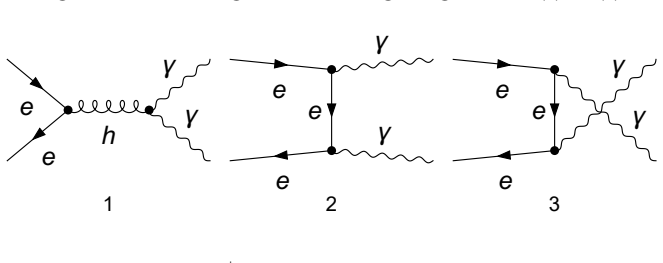
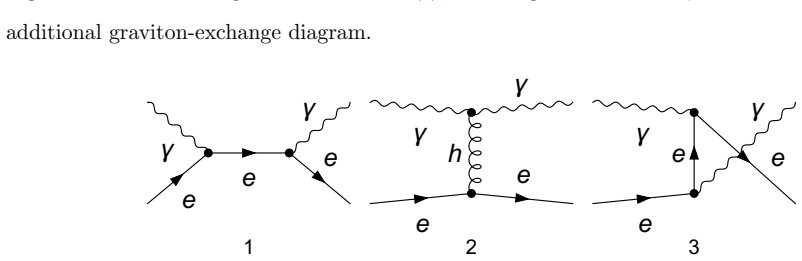
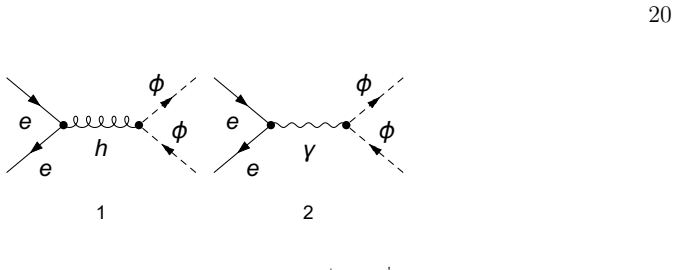
V. Shtabovenko, R. Mertig and F. Orellana, Comput. Phys. Commun.256, 107478 (2020) [arXiv:2001.04407 [hep-ph]]. e e e e h 1 e e e e γ 2 e e e eh 3 e e e eγ 4 Scattering Figure 1: Tree-level diagrams contributing toe −e− →e −e−. Straight, wavy, and curly lines denote, respectively, the electron, photon, and graviton propagators. 19 γ γ γ γh 1 γ γ γ γ h 2 γ...
discussion (0)
Sign in with ORCID, Apple, or X to comment. Anyone can read and Pith papers without signing in.