REVIEW 3 major objections 5 minor 12 references
First-Order Softmax Weighted Switching Gradient Method for Distributed Stochastic Minimax Optimization with Stochastic Constraints
T0 review · 3 major / 5 minor · reviewed 2026-07-15 · grok-4.5
Pith's one-line read A single-loop primal-only switching method with softmax weights solves federated worst-case minimax problems under stochastic constraints at the standard Õ(ε⁻⁴) rate.
desk verdict Solid dual-free constrained federated minimax with clean high-prob rates; theory is convex, main DNN experiment is not. read the letter →
The pith
A machine-rendered reading of the paper's core claim, the machinery that carries it, and where it could break.
The reading
What carries the argument
Softmax-weighted switching: at each round the server forms temperature-α softmax weights over participating clients for both objective and constraint values; if the softmax-mean constraint is below a tightened tolerance it steps on the weighted objective gradients, otherwise on the weighted constraint gradients, then averages only the feasible iterates.
What would settle it
On a convex federated Neyman-Pearson or fair-classification instance with known optimum, run the algorithm with the prescribed step-sizes and batch sizes and check whether the averaged feasible iterate simultaneously meets both ε-optimality and ε-feasibility at the predicted sample complexity; failure under verified convexity and sub-Gaussian noise would refute the claim.
Extended reading notes
Core claim
A single-loop Softmax-Weighted Switching Gradient algorithm, which alternates between a softmax-smoothed worst-case objective gradient and a softmax-smoothed constraint gradient according to a feasibility trigger, returns an averaged iterate that simultaneously satisfies optimality gap ≤ ε and feasibility violation ≤ ε (up to a vanishing sampling term under partial participation) with probability 1-δ at the standard Õ(ε⁻⁴) stochastic oracle complexity.
Load-bearing premise
Every local objective and constraint function must be convex; without that the optimality and feasibility guarantees do not hold.
Editorial extensions
If this is right
- Primal-only switching can replace dual-variable methods in federated settings that require both worst-case performance and client-wise safety or fairness constraints.
- The high-probability rate improves from O(log^{2} 1/δ) to O(log 1/δ), giving tighter sample sizes for the same failure probability.
- Dropping the usual bounded-loss assumption yields a strictly smaller admissible range for the softmax temperature α.
- Under the stochastic-superiority condition the same rates extend to partial participation, recovering the full-participation bound as the participation ratio tends to one.
Reading between the lines
- The same switching-plus-softmax idea may extend, with weaker rates, to the weakly convex regime already studied for unconstrained switching methods, matching the non-convex fair-classification experiments.
- If the stochastic-superiority gap σ can be estimated on-line from client statistics, one could adaptively choose the participation ratio to keep sampling error below a target.
- The unified error decomposition (optimization + estimation + sampling) supplies a practical checklist for allocating communication rounds, local batch sizes and client sampling rates.
Signed reviews
Editorial analysis
A structured set of objections, weighed in public.
Referee Report
Summary. The paper proposes a Softmax-Weighted Switching Gradient method for distributed stochastic minimax optimization with stochastic constraints in federated learning. It replaces the hard client-wise max with a temperature-controlled softmax, then switches between objective and constraint gradients according to a feasibility check, without dual variables. Under convexity, Lipschitz continuity, diameter, and sub-Gaussian assumptions, Main Theorems 4.6 and 4.7 give high-probability O(ε) optimality-gap and feasibility guarantees for full participation at the standard Õ(ε^{-4}) oracle complexity, with an improved O(log 1/δ) dependence. Under an additional stochastic-superiority assumption (4.9), Theorem 4.10 extends the analysis to partial participation. The softmax temperature lower bound is tightened by dropping a global loss bound. Experiments cover Neyman-Pearson classification (convex) and fair classification with a DNN (non-convex).
Significance. If the analysis holds, the work supplies a clean primal-only single-loop alternative to primal-dual and penalty methods for constrained worst-case federated learning, with an explicit three-way error decomposition (optimization / estimation / sampling) and a sharper high-probability rate. The relaxation of the bounded-loss assumption for the softmax parameter and the partial-participation extension under a stochastic-dominance condition are genuine technical contributions relative to prior softmax-minimax and switching-subgradient literature. The appendices contain a full high-probability derivation under the stated assumptions, which is a clear strength.
major comments (3)
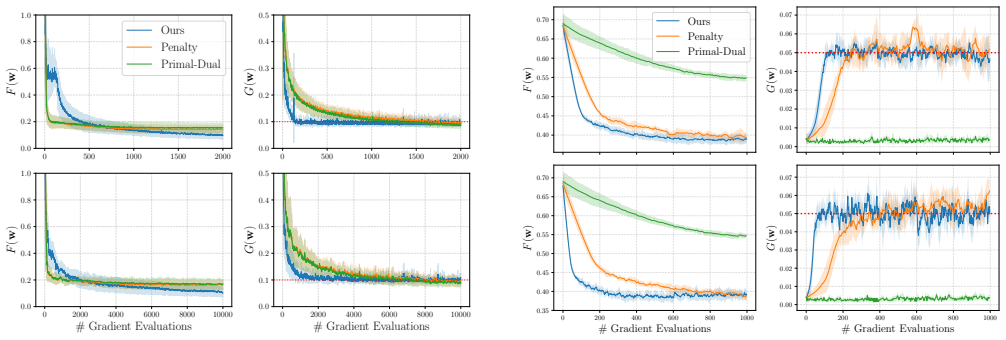
- Assumption 4.1 (convexity of every local f_i and g_i) is load-bearing for Main Theorems 4.6, 4.7 and 4.10: non-negative Bregman divergences, the three-point identity (Lemma B.1), and Jensen passage from averaged feasible iterates to the claimed gap/feasibility bounds all require it. Section 5’s fair-classification experiment, however, uses a deep network whose landscape is described as “highly non-convex and non-smooth.” The optimality-gap and feasibility guarantees therefore do not apply to the setting used to claim competitive performance against primal-dual/penalty baselines. Either a non-convex analysis (or stationarity guarantee) or an explicit disclaimer that the DNN results are purely empirical is needed; without it the experimental section cannot be read as corroboration of the central complexity claims.
- For partial participation, Assumption 4.9 (relative gaps F−f_i and G−g_i stochastically dominated by Unif[0,σ]) is the structural premise that makes client-sampling error O(σ / |ln(1−r)| n) controllable (Theorem 4.10 and the error-decomposition box). The assumption is non-standard, hard to verify on real federated data, and not checked or even estimated in the experiments (m/n = 0.5). The paper should either provide diagnostic evidence that the ordered-gap condition holds approximately on the Adult/Breast-Cancer partitions, or clearly mark the partial-participation rate as conditional on this premise and discuss failure modes when it is violated.
- Abstract and introduction list “federated safe reinforcement learning” among the experimental tasks, yet Section 5 and Appendix F only report NP classification and fair classification. Either the RL experiment must be restored with the same rigor as the other two, or the claim must be removed from the abstract and contribution list so that the empirical scope matches the manuscript body.
minor comments (5)
- Abstract vs. body inconsistency on experimental tasks (safe RL mentioned only in abstract) should be resolved for consistency.
- Figure 2 caption and surrounding text discuss α-sensitivity; the practical switch threshold is relaxed from ε/2 to ε/1.1 in Appendix F without a corresponding statement in the main algorithm description—clarify that the theory uses ε/2 while practice uses a milder constant.
- Notation for masked softmax (Eq. 10) and the localized maxima F(w; I_k), G(w; I_k) (Eq. 11) is introduced late; a short pointer in Section 2 would help.
- Typos: “ganrantees” (p. 5), “fo the worst-case” (p. 5), “condtional” / “defintion” in the appendices; also “V on Neumann” in Related Work.
- Related Work (Appendix G) is thorough but could more sharply position the O(log 1/δ) improvement against Lan & Zhou (2020b) and the α bound against Wang et al. (2023) in a short comparison table or paragraph in the main text.
Circularity Check
No significant circularity: convergence rates follow from standard Bregman/polarization identities, sub-Gaussian concentration and supermartingale arguments under explicit assumptions; softmax lower bound and error decomposition are derived, not fitted or self-defined.
full rationale
The main theorems (4.6, 4.7, 4.10) state high-probability bounds on the averaged feasible iterate under Assumptions 4.1–4.5 (and 4.9 for partial participation). The appendices derive these via the three-point Bregman identity (Lemma B.1), polarization (Lemma B.2), softmax-mean deviation bounds (Lemmas B.4–B.6), sub-Gaussian maximal inequalities and supermartingales (Lemmas B.7–B.14), and a standard error decomposition into optimization, estimation and sampling terms. The softmax temperature lower bound α ≳ ln m / ε′ (or ln n / ε′) is obtained directly from the entropy argument in Lemma B.4 after dropping the boundedness assumption of Wang et al. (2023); it is a free hyper-parameter, not a quantity fitted to data. No step equates a claimed prediction to a fitted input by construction, imports a uniqueness theorem from overlapping authors as an external fact that forces the result, or renames a known pattern. Self-citations (e.g., prior switching-gradient or EM papers by the same group) appear only as background or related-work pointers and are not load-bearing for the complexity claims. The non-convex DNN experiment lies outside the convexity assumption and is therefore a correctness/scope issue, not circularity of the derivation chain. The paper is self-contained against its stated assumptions.
Assumptions & free parameters
free parameters (5)
- softmax temperature α
- global/local stepsizes (η, γ) and local steps E
- feasibility tolerance ε and practical switch threshold
- participation ratio r=m/n and constraint-satisfied ratio κ=|S|/K
- client-gap scale σ in Assumption 4.9
assumptions (6)
- domain assumption Assumption 4.1: each local f_i and g_i is convex on Θ
- domain assumption Assumption 4.2–4.3: L-Lipschitz components and diameter D of Θ
- domain assumption Assumptions 4.4–4.5: sub-Gaussian function-value and gradient noise
- ad hoc to paper Assumption 4.9: relative gaps F−f_i and G−g_i are stochastically dominated by Unif[0,σ]
- domain assumption Existence of a feasible optimum w* with G(w*)≤0 (and optionally Slater for κ bounds)
- standard math Standard concentration / supermartingale tools (Boucheron et al., Durrett)
invented entities (2)
-
Softmax-Weighted Switching Gradient (masked softmax + primal switch for constrained federated minimax)
-
Stochastic superiority / uniformly bounded relative gap (Assumption 4.9)
Cite this review
Pith. "Pith review of First-Order Softmax Weighted Switching Gradient Method for Distributed Stochastic Minimax Optimization with Stochastic Constraints." pith.science (2026). https://pith.science/paper/EZPKGLRL
@misc{pith2026260305774,
  author       = {Pith},
  title        = {Pith review of: First-Order Softmax Weighted Switching Gradient Method for Distributed Stochastic Minimax Optimization with Stochastic Constraints},
  year         = {2026},
  howpublished = {\url{https://pith.science/paper/EZPKGLRL}},
  note         = {Machine review of arXiv:2603.05774}
}
abstract
This paper addresses the distributed stochastic minimax optimization problem subject to stochastic constraints. We propose a novel first-order Softmax-Weighted Switching Gradient method tailored for federated learning. Under full client participation, our algorithm achieves the standard $\tilde{\mathcal{O}}(\epsilon^{-4})$ oracle complexity to satisfy a unified bound $\epsilon$ for both the optimality gap and feasibility tolerance. We extend our theoretical analysis to the practical partial participation regime by quantifying client sampling noise through a stochastic superiority assumption. Furthermore, by relaxing standard boundedness assumptions on the objective functions, we establish a strictly tighter lower bound for the softmax hyperparameter. We provide a unified error decomposition and establish a sharp $\mathcal{O}(\log\frac{1}{\delta})$ high-probability convergence guarantee. Ultimately, our framework demonstrates that a single-loop primal-only switching mechanism provides a stable alternative for optimizing worst-case client performance, effectively bypassing the hyperparameter sensitivity and convergence oscillations often encountered in traditional primal-dual or penalty-based approaches. We verify the efficacy of our algorithm via experiment on the Neyman-Pearson (NP) classification, fair classification, and federated safe reinforcement learning tasks.
Figures


Reference graph
Works this paper leans on
-
[1]
Wenke Huang, Mang Ye, Zekun Shi, Guancheng Wan, He Li, Bo Du, and Qiang Yang
URLhttps://openreview.net/forum? id=a6Cagkpmgz. Wenke Huang, Mang Ye, Zekun Shi, Guancheng Wan, He Li, Bo Du, and Qiang Yang. Federated learning for gener- alization, robustness, fairness: A survey and benchmark. IEEE Transactions on Pattern Analysis and Machine Intel- ligence, 46(12):9387–9406, 2024. Yankun Huang and Qihang Lin. Oracle complexity of sing...
arXiv 2024
-
[2]
Brendan McMahan, Eider Moore, Daniel Ramage, Seth Hampson, and Blaise Aguera y Arcas
PMLR, 2020. Brendan McMahan, Eider Moore, Daniel Ramage, Seth Hampson, and Blaise Aguera y Arcas. Communication- efficient learning of deep networks from decentralized data. InArtificial intelligence and statistics, pages 1273–
2020
-
[3]
Mehryar Mohri, Gary Sivek, and Ananda Theertha Suresh
Pmlr, 2017. Mehryar Mohri, Gary Sivek, and Ananda Theertha Suresh. Agnostic federated learning. InInternational confer- ence on machine learning, pages 4615–4625. PMLR,
2017
-
[4]
Mahdi Morafah, Vyacheslav Kungurtsev, Hojin Chang, Chen Chen, and Bill Lin
URLhttps://proceedings.mlr.press/ v97/mohri19a.html. Mahdi Morafah, Vyacheslav Kungurtsev, Hojin Chang, Chen Chen, and Bill Lin. Towards diverse device heterogeneous federated learning via task arithmetic knowledge integra- tion.Advances in Neural Information Processing Systems, 37:127834–127877, 2024. Arkadi Nemirovski. Prox-method with rate of convergen...
2024
-
[5]
Seonguk Seo, Jinkyu Kim, Geeho Kim, and Bohyung Han
URLhttps://openreview.net/forum? id=ryxGuJrFvS. Seonguk Seo, Jinkyu Kim, Geeho Kim, and Bohyung Han. Relaxed contrastive learning for federated learning. InPro- ceedings of the IEEE/CVF Conference on Computer Vision and Pattern Recognition, pages 12279–12288, 2024. Moshe Shaked and J George Shanthikumar.Stochas- tic orders. Springer, 2007. URLhttps: //lin...
arXiv 2024
-
[6]
Springer, 2018. Antesh Upadhyay, Sang Bin Moon, and Abolfazl Hashemi. Optimization via first-order switching methods: Skew- symmetric dynamics and optimistic discretization.arXiv preprint arXiv:2505.09146, 2025. URLhttps:// arxiv.org/abs/2505.09146. Antesh Upadhyay, Sang Bin Moon, and Abolfazl Hashemi. Fedsgm: A unified framework for constraint aware, bid...
-
[8]
the softmax weightsr k such thatP i∈I[rk]i = 1and[r k]i ≥0and isF t-measurable; (from the defintion ofr k) rk ≡p k1k +q k[1−1 k] = softmax(αf(w k,ξ k))1k + softmax(αg(wk,ξ k))[1−1 k]
-
[10]
effective
the condtional 1-subgaussian random variablez (i) k,τ such thatE[z (i) k,τ | F t] = 0andE[exp(∥z (i) k,τ ∥2)| F t]≤2and therefore lnE[exp(λ⟨e,z (i) k,τ ⟩)| F t]≤lnE[exp(λ∥z (i) k,τ ∥)| F t]≤ λ2 2 ,∀e∈S d−1,∀λ∈R, and isF t+1-measurable. (from the definition ofz (i) k,τ , independence of allζ (i) k,τ andξ k ≡(ξ (i) k )i∈I and the assumption of sub-Gaussiani...
2013
Show all 12 references
-
[11]
the indicator1 k ≡1 Gk(wk)≤ ϵ 2 isF t-measurable; (from the definition ofG k(wk,ξ k) =m(g(w k,ξ k), α))
-
[12]
the softmax weightsr k such thatP i∈Ik [rk]i = 1and[r k]i ≥0and isF t-measurable; (from the defintion ofr k) rk ≡p k1k +q k[1−1 k] = softmax(αf(w k,ξ k))1k + softmax(αg(wk,ξ k))[1−1 k]
-
[13]
the direction vectorsd k ande (i) k such that∥d k∥ ≤1(from the definition ofd k and the assumption of finite diameter of the parameter spaceΘassumption 4.3) and∥e (i) k ∥ ≤1(from the definition ofe (i) k and the assumption of Lipschitz continuity as- sumption 4.2) and areF t-m...
-
[14]
effective
the conditional 1-subgaussian random variablez (i) k,τ such thatE[z (i) k,τ | F t] = 0andE[exp(∥z (i) k,τ ∥2)| F t]≤2and thereforelnE[exp(λ⟨e,z (i) k,τ ⟩)| F t]≤lnE[exp(λ∥z (i) k,τ ∥)| F t]≤ λ2 2 ,∀e∈S d−1,∀λ∈R, and isF t+1-measurable. (from the definition ofz (i) k,τ , indepe...
2013
Reviewed July 15, 2026 · model on record in the stance chip above.
Discussion (0). Continue with ORCID to comment.