REVIEW 2 major objections 12 references
Machine Learning Based Mesh Movement for Non-Hydrostatic Tsunami Simulation
T0 review · 2 major / 0 minor · reviewed 2026-07-15 · grok-4.5
Pith's one-line read A machine-learning mesh mover tracks tsunami waves more accurately and robustly than classical Monge–Ampère adaptation, cutting nearshore peak error by ~91% on a laboratory inundation benchmark while speeding the movement step.
desk verdict Solid first coupling of UM2N into Thetis non-hydrostatic tsunami runs; useful robustness and speed story, but the headline 91%/74% Monai peak-error claim is not backed by a transparent metric or table. read the letter →
The pith
A machine-rendered reading of the paper's core claim, the machinery that carries it, and where it could break.
The reading
What carries the argument
Universal Mesh Movement Network (UM2N): a graph-transformer encoder plus graph-attention decoder that maps mesh coordinates and a Hessian-based monitor (optionally augmented by a wet–dry interface tracker) into new node positions, trained by element-volume and Chamfer losses against Monge–Ampère reference meshes.
What would settle it
On the Monai Valley or conical-island benchmarks, re-run the identical non-hydrostatic solver with a freshly trained or fine-tuned UM2N and show that the nearshore wave-peak error reduction falls below the classical Monge–Ampère result, or that the mesh still tangles within the first hundred time steps.
Extended reading notes
Core claim
A Universal Mesh Movement Network trained only on synthetic random fields can be coupled, without retraining, to a discontinuous-Galerkin non-hydrostatic shallow-water solver and produce adapted meshes that resolve refraction, run-up and inundation at least as well as classical Monge–Ampère movement, cut wave-peak error by ~91% versus a coarse fixed mesh on the Monai Valley gauge, and remain robust where the Monge–Ampère solver diverges, while accelerating the mesh-movement step.
Load-bearing premise
A network trained solely on synthetic Gaussian-sum fields and generic Hessian monitors will transfer, without fine-tuning, to real non-hydrostatic free-surface flows that include wetting–drying and strong refraction.
Editorial analysis
A structured set of objections, weighed in public.
Referee Report
Summary. The manuscript couples the Universal Mesh Movement Network (UM2N) of Zhang et al. (2024) to the depth-integrated non-hydrostatic shallow-water solver in Thetis/Firedrake, and evaluates the resulting adaptive scheme on four benchmarks: an analytical N-wave strip source, solitary-wave refraction over a truncated conical shoal, solitary-wave run-up on a conical island with wetting–drying, and the Monai Valley laboratory inundation experiment. A Hessian-based monitor (with an additional wet–dry interface term, Eq. 32) drives mesh movement; UM2N is used as a PDE-independent surrogate for the conventional Monge–Ampère (MA) solver. The authors report that UM2N-adapted solutions remain close to fine-mesh and laboratory references, that MA frequently diverges under strong refraction or wetting–drying while UM2N remains robust, and that, on Monai Valley, UM2N yields a ~91 % reduction in nearshore wave-peak error versus ~74 % for MA (both relative to the coarse fixed mesh), together with a ~32 % total-runtime reduction and roughly 2 imes speed-up of the mesh-movement step on GPU.
Significance. If the quantitative claims hold, the work supplies a practical route to r-adaptive non-hydrostatic coastal modelling that is both more robust and substantially cheaper than classical MA mesh movement, while remaining compatible with an existing high-order DG code base. That combination is directly relevant to probabilistic tsunami hazard assessment, where many realisations must be run at coastal resolution. Strengths that are already visible include the transparent coupling pipeline (Figs. 1–2), the use of external laboratory gauges and an analytical N-wave solution, and the explicit demonstration that a network trained only on synthetic Gaussian-sum monitors can be deployed without retraining on free-surface flows. These are genuine engineering contributions even if the headline error percentages require clearer documentation.
major comments (2)
- Abstract and §5.4 assert that UM2N achieves a ~91 % reduction in wave-peak error at the nearshore gauge versus ~74 % for MA (both relative to the coarse fixed mesh). Table 1 reports only average inference times; no equation, table or caption defines the peak-error metric (absolute difference at a single time? L2 over a window? which gauge and which peak?), nor are the raw peak elevations for FIX-COARSE / FIX-FINE / MA / UM2N / experiment supplied. Fig. 15 shows qualitatively similar time series from which the stated percentages cannot be recovered. Because this comparison is the central quantitative claim that distinguishes UM2N from MA on a laboratory benchmark, the definition and intermediate numbers must be added (or the percentages removed) before the claim can be verified.
- Abstract states a ~32 % reduction in total runtime and ~2 imes speed-up of the mesh-movement step over the MA solver on GPU. Table 1, however, lists only average inference times for the movement step itself (MA-CPU 12 563 s, UM2N-CPU 2 229 s, UM2N-GPU 43 s) and does not report wall-clock times for the full PDE solve, the number of adaptation calls, or a GPU-based MA baseline. The ~32 % total-runtime figure and the ~2 imes GPU comparison therefore cannot be reconstructed from the published material and should be supported by an explicit timing breakdown (or the abstract wording adjusted to match Table 1).
Circularity Check
No significant circularity: empirical performance claims rest on external analytical/lab/fine-mesh benchmarks and a PDE-independent synthetic training set, not on self-referential definitions or fitted targets.
full rationale
The paper applies a pre-trained UM2N surrogate (Zhang et al. 2024) as a drop-in mesh-movement operator inside an existing DG non-hydrostatic solver (Thetis/Pan). Training uses only synthetic random Gaussian-sum fields and Hessian monitors that are deliberately PDE-independent (§4.3–4.4); the network never sees the tsunami equations or the laboratory gauges. Evaluation metrics (RMS free-surface error on the N-wave analytic solution, time-series peaks at conical-island and Monai Valley gauges, wall-clock timings) are computed against external references (analytic solution of Kanoğlu et al., laboratory data of Briggs et al./CRIEPI, and independent fine-mesh runs). Self-citations supply the underlying solver, the MA baseline, and the UM2N architecture, but none of those citations is used to justify the numerical superiority percentages or the robustness claims; those percentages are measured outputs of new simulations. No parameter is fitted to a target quantity and then re-presented as a prediction, no uniqueness theorem is imported to force the method, and no ansatz is smuggled in as a derivation. The derivation chain is therefore self-contained and non-circular.
Assumptions & free parameters
free parameters (5)
- Hessian monitor intensity α =
5
- Monitor diffusion coefficient ẽα =
0.3–0.5
- Wet–dry monitor parameters μ, α, λ, p_cap, b_λ
- Bottom friction / viscosity (case-dependent) =
Cd=0.01; μ=0.019; ν=0.015
- UM2N loss weights λ_vol, λ_cd
assumptions (5)
- domain assumption Depth-integrated single-layer non-hydrostatic free-surface equations with Keller-box vertical structure and pressure split p = p_h + q are an adequate model for the chosen coastal benchmarks.
- domain assumption Kärnä-style smooth wet–dry depth H̃ = H + f(H) with f(H)=(√(H²+α²)−H)/2 yields a well-posed positive-depth formulation.
- standard math Optimal-transport Monge–Ampère equidistribution m(x) det(I+H(Φ))=θ produces a unique injective mesh map for a given monitor.
- ad hoc to paper A Graph-Transformer + GAT UM2N trained on synthetic Gaussian-sum fields is a valid PDE-independent surrogate for MA mesh movement when fed only monitor values.
- domain assumption Hessian (Frobenius) of free-surface elevation, optionally plus wet–dry tracker, is a sufficient monitor for tsunami-relevant features.
invented entities (1)
-
Wet–dry-aware monitor m_α (Eq. 32)
Cite this review
Pith. "Pith review of Machine Learning Based Mesh Movement for Non-Hydrostatic Tsunami Simulation." pith.science (2026). https://pith.science/paper/PJWXNNP3
@misc{pith2026260306152,
  author       = {Pith},
  title        = {Pith review of: Machine Learning Based Mesh Movement for Non-Hydrostatic Tsunami Simulation},
  year         = {2026},
  howpublished = {\url{https://pith.science/paper/PJWXNNP3}},
  note         = {Machine review of arXiv:2603.06152}
}
read the original abstract
This study investigates the use of machine learning based mesh movement method, specifically the Universal Mesh Movement Network (UM2N), with depth integrated non-hydrostatic shallow water models. Motivation for this comes from the need for models which balance efficiency and accuracy for use in probabilistic coastal hazard assessment. Implementations are built on the discontinuous Galerkin finite-element (DG-FE) based software, Thetis, which leverages the partial differential equation (PDE) framework Firedrake for automated code generation. Verification on benchmark test cases and validation against laboratory measurements of coastal hazards, focusing on tsunami propagation, run-up, and inundation is performed. In these tests, the UM2N-driven meshes help resolve key non-hydrostatic dynamics including wave refraction over a conical shoal, run-up with wetting-drying on a conical island, and tsunami inundation in the Monai Valley laboratory benchmark, and yield numerical solutions in close agreement with reference fine-mesh computations and measured data. Notably, in the Monai Valley case, UM2N achieves a ~91% reduction in wave-peak error at the nearshore gauge compared with ~74% for the conventional Monge--Amp\`ere (MA) mesh movement, both relative to the coarse fixed mesh. The UM2N surrogate based approach accelerates the conventional mesh movement step, achieving a ~32% reduction in total runtime and ~2 times speed-up in mesh movement step time over the MA solver on GPU, while offering a significant improvement in robustness over long integration periods and under strongly nonlinear wave conditions.
Figures


Figures from the paper (12 more)



Reference graph
Works this paper leans on
-
[1]
Introduction 1 Accurate modeling of coastal tsunami has been a challenging research2 topic for many decades, with a goal of effective hazard assessments in the3 arXiv:2603.06152v1 [physics.ao-ph] 6 Mar 2026 faceofcomplexcoastaltopography, changeablemulti-scaleflowdynamicsand4 the impacts of flooding and drying processes. Unlike hydrostatic models that5 ar...
arXiv 2026
-
[2]
Governing equations of non-hydrostatic model117 In this study, a single-layer non-hydrostatic free surface model is adopted118 for our simulations
Mathematical formulation 116 2.1. Governing equations of non-hydrostatic model117 In this study, a single-layer non-hydrostatic free surface model is adopted118 for our simulations. The total water depth, denoted byH[m], satisfies:119 H=η+b,(1) whereη[m] is the free surface elevation andb=b(x)[m] is the bathymetry.120 Although the flow is assumed to be hy...
2019
-
[3]
Following the pioneering work and relevant extensions of layer-206 averaged non-hydrostatic approach (Stelling and Zijlema, 2003; Wei and Jia,207
Discretization methods and implementation in Thetis and Fire-201 drake 202 The non-hydrostatic model is solved using the unstructured-mesh finite203 element coastal ocean modelling system, Thetis (Kärnä et al., 2018), which204 is built upon the automated code generation framework, Firedrake (Ham205 et al., 2023). Following the pioneering work and relevant...
2018
-
[4]
(2019) integrated the layer-209 averaged non-hydrostatic approach into DG finite element implementation in210 Thetis
and non-hydrostatic pressure correction (Marshall et al., 1997; Stansby208 and Zhou, 1998; Lai et al., 2010), Pan et al. (2019) integrated the layer-209 averaged non-hydrostatic approach into DG finite element implementation in210 Thetis. In this formulation the 3D incompressible Navier–Stokes (NS) equa-211 tions are vertically integrated to obtain a dept...
1997
-
[5]
Monge–Ampère mesh movement 249 Following the work of McRae et al
Universal Mesh Movement Network (UM2N)248 4.1. Monge–Ampère mesh movement 249 Following the work of McRae et al. (2018), Wallwork (2021) and Zhang250 et al. (2024), the mesh movement process can be defined as the optimization251 process to find the transformation between a computational domain,ΩC, and252 a physical domain,ΩP. The aim of mesh movement is t...
2018
-
[6]
N-wave strip source 413 This problem was introduced in Kanoğlu et al
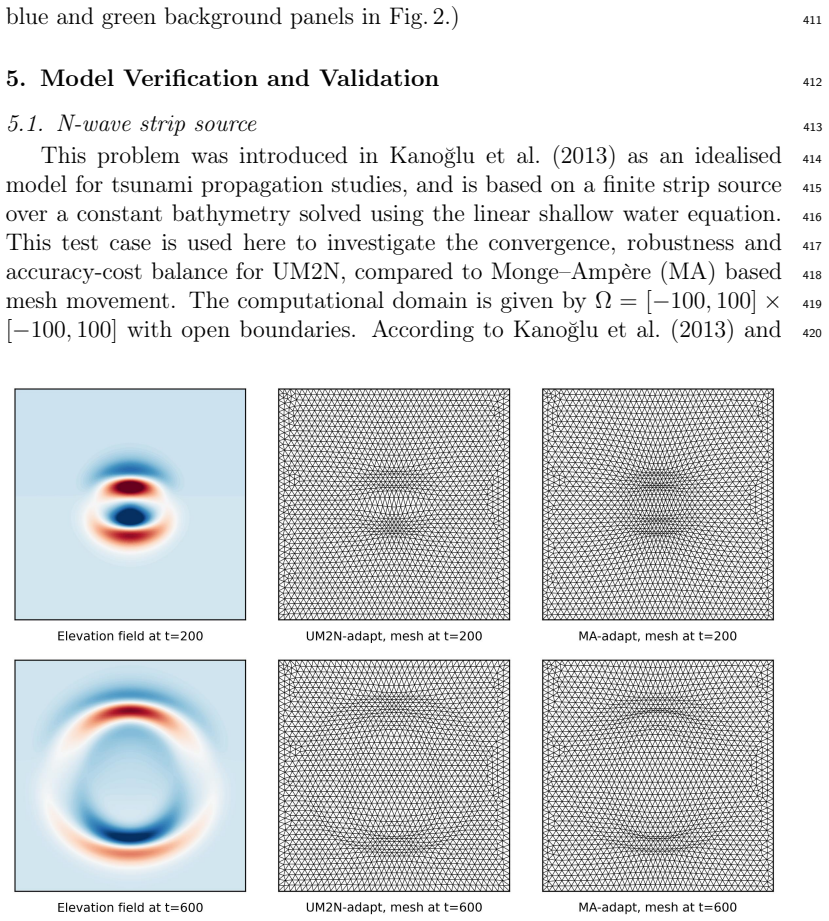
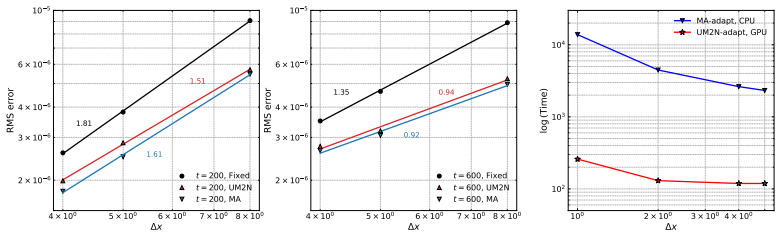
Model Verification and Validation412 5.1. N-wave strip source 413 This problem was introduced in Kanoğlu et al. (2013) as an idealised414 model for tsunami propagation studies, and is based on a finite strip source415 over a constant bathymetry solved using the linear shallow water equation.416 This test case is used here to investigate the convergence, r...
arXiv 2013
-
[7]
Conclusion 620 In this paper, the use of machine learning based mesh movement for non-621 hydrostatic shallow water modelling has been investigated for the simulation622 of complex wave interactions and tsunami run-up on irregular bathymetries623 and changeable boundary conditions. 624 Results indicate that mesh movement via the UM2N network not only625 o...
2005
-
[8]
provide alternative movement strategies that could also be applied to645 non-hydrostatic models. Considering mesh regularity and uniformity during646 movement, the mesh adaptation algorithms can be further improved (e.g.,647 allowing boundary node movement), thus helping to generate meshes with648 31 superior quality. 649 Acknowledgements 650 YL would lik...
Show all 12 references
-
[9]
Technical Report ANL-21/39 - Revision666 3.24
PETSc/TAO Users Manual. Technical Report ANL-21/39 - Revision666 3.24. Argonne National Laboratory. doi:10.2172/2998643.667 Brenier, Y., 1991. Polar factorization and monotone rearrangement of vector-668 valued functions. Communications on Pure and Applied Mathematics 44,669 3...
1991 doi
-
[10]
Improved efficiency of a non-681 hydrostatic, unstructured grid, finite volume model
doi:10.1007/s13137-021-00191-1.680 32 Cui, H., Pietrzak, J.D., Stelling, G.S., 2012. Improved efficiency of a non-681 hydrostatic, unstructured grid, finite volume model. Ocean Modelling 54–682 55, 55–67. doi:10.1016/j.ocemod.2012.07.001.683 Cui, H., Pietrzak, J.D., Stelling, ...
2012 doi
-
[11]
Ocean Modelling 10, 95–113
h, r, and hr adaptivity with applications in numerical ocean mod-763 elling. Ocean Modelling 10, 95–113. doi:10.1016/j.ocemod.2004.07.007.764 Ricchiuto, M., 2015. An explicit residual based approach for shallow water765 flows. Journal of Computational Physics 280, 306–344. doi...
-
[12]
Newark,775 Delaware
Center for Applied Coastal Research, University of Delaware. Newark,775 Delaware. 776 35 Song, W., Zhang, M., Wallwork, J.G., Gao, J., Tian, Z., Sun, F., Piggott,777 M.D., Chen, J., Shi, Z., Chen, X., Wang, J., 2024. M2N: mesh move-778 ment networks for pde solvers, in: Procee...
2024 doi
Reviewed July 15, 2026 · model on record in the stance chip above.
Discussion (0). Continue with ORCID to comment.